The Youth’s Instructor, Vol. 47, No. 20.

WAR-TIME EXPERIENCES

The Youth’s Instructor

May 18, 1899

Review and Herald Publishing Company · Battle Creek, Mich. · May 18, 1899

WAR-TIME EXPERIENCES.
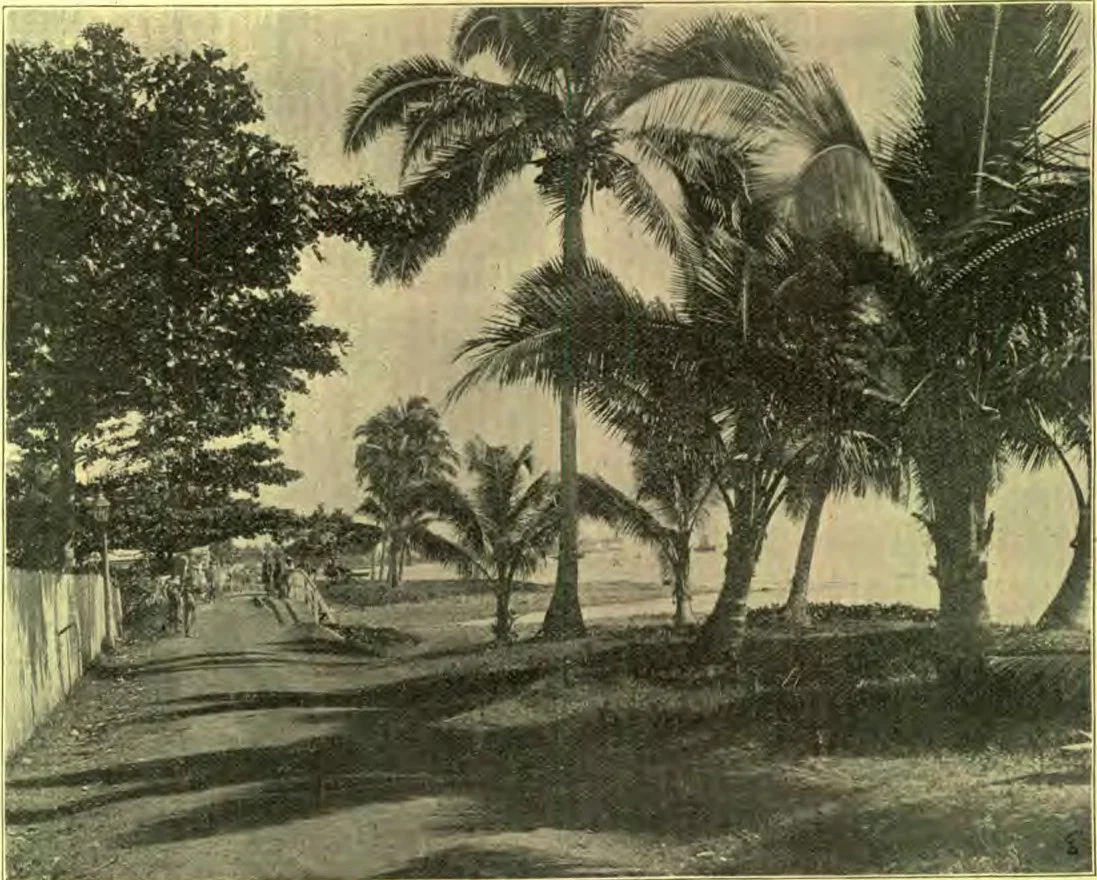
The following article is made up of extracts from a letter written by Mrs. F. E. Braucht, of Samoa, to her sister at Battle Creek College, who kindly allows the INSTRUCTOR thus to give its readers a vivid picture of life on these islands during the political troubles through which they are now passing.
A VIEW OF APIA HARBOR, FROM THE CATHOLIC CHURCH.
In the letter, Mrs. Braucht speaks of the Doctor, her husband; Marjorie and Alden, their children, aged three years and one year, respectively; “Grandpa,” her father, Mr. Owen; Mattie, a little German girl who lives with them; Professor Lake and his wife, formerly of Battle Creek; Sybil, Emily, and Willie, nurses and helpers; and Mr. and Mrs. Osborn, the American consul and his wife.
“APIA, SAMOA, March 6, 1899.
“MY DEAR SISTER:
The American man-of-war came in this morning, and I tell you, it was heralded with joy by the Americans here. The British have two war-ships in the harbor; and we have been looking for one ever since news of the Samoan troubles reached home, but lately we had almost given up hope. This morning, however, while at worship, we heard the booming of the cannon. At first we thought the war-ships were only saluting, as they sometimes do; but from the way the booming continued, Doctor said he thought they must be saluting an American war-vessel. Professor Lake climbed up the vii-tree (by the way, we now have a ladder running clear to the top of the vii-tree at the corner of the house, with a platform at the top. It is fine, they say; I have not ventured up there yet), and pretty soon he came rushing down, with his face all aglow, shouting, ‘It’s come! it’s come! the “Philadelphia” has come!’ Then Doctor and Grandpa went up, and, sure enough, the ‘Philadelphia’ was coming into the harbor. Then what a scampering there was to get ready to go down to the harbor to see her come in! Sybil hitched up the horse, so she and Marjorie and I could ride. We found Doctor, Grandpa, Professor and Mrs. Lake, and Emily there, with a field-glass; so we all took a look at the old ship. She is painted a dead-gray, the war color. She did not have time to repaint before coming.
“These are exciting times for Samoa. The natives are preparing for war again, and some say they will surely attack the white residents next time, but I don’t know. The coming of the American war-ship may make a change in their plans. One party say they will kill the Germans, and the other say they will put the English and Americans out of the way. Sometimes I feel as if I would like to flee from it all; but if the Lord wants us to remain, we do not wish to go. I am sure he will protect us. We learned lessons of faith and trust during the week of anxiety through which we passed a short time ago. Perhaps we have still further lessons to learn. If it becomes necessary to shell the place, or if there are any signs of danger to the whites from the natives, we shall all go on board the ship. Of course we can not tell what togafiti [treatment] the Samoans may use, but I am sure we shall be cared for, and that the Lord is overruling.
MULINU’U POINT, APIA, SAMOA, March 20, 1899.
“Since I wrote the first part of this letter, we have had a varied experience. We have had to flee for our lives, here and there, and are now staying in a native house at Mulinu’u Point.
“One week ago yesterday a proclamation was issued, ordering all the Mataafa natives—rebels, you know—to go quietly to their homes; if they did not obey, they were to be fired upon. Well, instead of going home, they left Mulinu’u Point, and gathered all around Apia. We were completely surrounded by thousands of hostile Samoans. When they left the Point, the loyal party, or Malietoas, went there, and are now guarded on all sides by English and American soldiers. Monday the troops were landed, and stationed around Apia. Tuesday they were still there. Nobody knew what would happen next. Wednesday morning Doctor went down town, and soon came back, saying that in two hours the ships would begin to shell the town, or rather, the surrounding country, and that we must all go down to the beach as quickly as possible. Emily was getting dinner, and I was just beginning some baking. We left the dinner on the stove and in the oven. I hurriedly put a few things into a bundle for the children, and jumped into the buggy. Doctor had gone down the road to see about a patient. Emily drove me down; on the way we met Doctor, and he said we had better go to the American consul’s; so away we went, as fast as the horse could carry us.
“The soldiers were already at the consulate, barricading the place as quickly as they could. Lieutenant Brown told me to get in behind the large iron safe, and keep still; so I curled down there with the children until Mrs. Osborn came in. She said she thought we would all be safe, for a while at least, at the consulate; but Mr. Osborn thought we had better all go on board the ‘Philadelphia.’
“The shelling soon began. The booming of the guns and the noise and bursting of the shells were awful. We went out to the ship. The tide was low, and they carried us out to the small boats. Amid the noise and excitement we got on board the American war-ship; and when we were on board, I found none of the rest of the family there. Emily had driven back from the consulate with the horse. You can imagine my anxiety. The great ship shook terribly, and the noise was deafening. We put cotton in our ears, and stayed down below. In the evening all the other members of the family, except Doctor, who remained at the consulate to look after the wounded, came on board, safe and sound. The bombarding continued all night. We were supposed to sleep on the floor in the admiral’s cabin; but most of the time we were looking out the port-hole, watching the search-lights and the bursting of the shells. One can never realize what an awful thing war is until he has been in the midst of it. Morning came at last, and with it quiet. Doctor sent a note on board to say that he was safe, and that I must not worry. The shelling continued nearly all day Thursday. That evening I sent a note to Doctor, asking him to come on board, and the next morning he came.
“We had a talk with the admiral, and he assured us that they would not shell our place, and said he thought we would be safe at home, if we raised the hospital flag, as all nations respect that. So we all went on shore, but the officers there would not allow us to go home, except the men,—Doctor, Willie, and Brother Lake,—just to see how things were getting on, and then only under promise to return immediately. They found everything all right. Even the natives had not molested anything. The officers said we must go back to the ship, and told us to get into the ‘Royalist’ boat, which was just pushing off, and they would take us to the ‘Philadelphia.’ Grandpa, Sybil, the children, and I got in, therefore, and started off.
“The ‘Philadelphia’ was rocking badly; and as our little boat came up, the ship rolled over on one end of it. It was instantly filled with water, and went out from under us,—and there we were, babies and all, in the briny sea, in great danger of being sucked right under the war-ship, in addition to all the other dangers. But the angels were there to take care of us. I held Alden up above water with my right hand, and swam with my left. Sybil had Marjorie. Sister Lake’s little girl was with us; one of the men had her. We were under the ladder, and there were some ropes near by, which we caught as soon as we could. Officers and sailors immediately jumped overboard to our rescue. They caught hold of the children’s clothes, and drew them up first; then they dragged us up some way, I hardly know how; anyway, we were all saved, and are indeed thankful that our lives are spared.
“Sabbath the admiral assured us we would be perfectly safe on shore, as they would not shell our place, and he did not think the natives would harm us; so we went ashore again, and again all the other officers were opposed to our going home, and said if we did, it would be at our own risk. The place where our house stands is regarded as the most dangerous point, because there are so many trees around for the natives to hide behind. The officers said that if we went home and raised the hospital flag, they feared the Samoans would take advantage of it, and would flock there for refuge from the shells. After praying over the matter, we decided to come to Mulinu’u Point, which is well protected; the officers are willing we should stay here. We are living, for Samoa, in a native house. Doctor has a pass, and can go anywhere. He goes up home every day, and brings down what we need.
“The court-house has been turned into a receiving hospital, and Emily stays there to help care for the wounded. You would hardly think you were in Samoa, if you could step on shore now. You could not even cross the street without a pass. The streets are full of soldiers; for Apia is under martial law. How much longer this state of things will last, none of us can tell. It is feared that a much larger force will have to be called here before the natives can be subdued. The Germans are all the time urging them on and helping them.
“APIA, SAMOA, March 25, 1899.
“We are at home now, though ours is the only family that stays at home at night, except those that live right on the beach. We feel safe, as the admiral has assured us that they will not shell our place, and we do not fear the natives. Our place has not been touched; while nearly all the other white people living back from the beach have had their houses looted, and everything destroyed that was not carried away. The Lord has cared for us and his property here in a remarkable manner.
“Young Malietoa was made king this afternoon, and established at Mulinu’u Point. We attended the coronation. We don’t know where Mataafa and his people are, or what they intend to do. Some think they will yet try to make a rush on Apia, but we hardly think so. They would never try it again if they did. The streets are still full of soldiers, and the question is yet unsettled. They are waiting now to see what Mataafa is going to do. If he is caught, he will probably be shot, or banished for life.
“With all the shelling the men-of-war have done here in Samoa, we do not know that many natives have actually been killed. One American and three or four British soldiers have been killed, and several wounded. From all the banging and booming and shelling that have been going on, you would think thousands had been killed.”

THE RESURRECTION OF LAZARUS.

VIII.

CHRIST had encouraged all, however sinful, to go directly to God as their merciful Father. Neither by precept nor example had he directed the people to the priesthood. But the idea of repenting and receiving forgiveness for their sins was not for a moment to be entertained by the priests. They would not admit that through unbelief they had placed themselves where the blessing of God could not come to them. When Christ had opened the eyes of the man born blind, they had striven with all sophistry to change the truth into a lie, declaring that the man was not born blind, that sight could not be given to eyes that had never seen. The man told them the simple truth; but they could not see, they could not believe, because they would not. So it was that the raising of Lazarus hardened their hearts; for they turned from evidence to cavil and disbelief.
In the meeting called in haste, Pharisees and Sadducees were more nearly united than ever before. Divided hitherto, they became one in their opposition to the Spirit of God, and in their determination to adhere to the cause of the Prince of darkness, who brought sin into the world, and death through sin. What a council this was! The men who had been placed in positions of responsibility did not make investigation to see if these wonderful works bore the divine impress. They did not stop to question whether they were fighting against God. In their bigotry and prejudice they did not bow before God in humble prayer, with the Scriptures in their hands, asking God to show them if, in their opposition to Jesus, they were warring against heaven. So far had they separated from God, that they did not cast one glance heavenward.
But the members of the council were not all agreed. The Sanhedrin was no longer a legal assembly, but existed only by tolerance. Some of its number questioned the wisdom of putting Christ to death. They feared that this would cause an insurrection among the people, causing the Romans to withhold further favors from the priesthood, and to take from them the power they now held by sufferance. The Sadducees were united in their hatred of Christ, yet they were inclined to be cautious in their movements, fearing that the Romans would deprive them of their high standing.
In this Sanhedrin, assembled to plan the death of Christ, the Witness was present who heard the boastful words of Nebuchadnezzar, who witnessed the idolatrous feast of Belshazzar, who was present when Christ in Nazareth announced himself to be the Anointed One. This Witness was now impressing the rulers with the sinfulness of the work they were doing. Events in the life of Jesus rose up before them with a distinctness that alarmed them. They remembered the scene in the temple, when Jesus, a child of twelve, stood before the grave, learned doctors of the law, asking them questions at which they wondered. The miracle just performed appealed to their hearts, impressing them that Jesus was none other than the Son of God. Perplexed and troubled, the rulers asked, “What do we?” There was a division in the council. Under the impression of the Holy Spirit, the Pharisees could not banish from their minds the conviction that they were fighting against God. In their true significance, the Old Testament Scriptures regarding Christ flashed before their minds.
While the council was at the height of its perplexity, Caiaphas arose. He was high priest that year, and among his family connections were Sadducees, proud, bold, reckless, full of ambition and cruelty, which characteristics they hid under a cloak of pretended righteousness. With an assumption of knowledge, the high priest said, “Ye know nothing at all, nor consider that it is expedient for us, that one man should die for the people, and that the whole nation perish not.” Can you not see that if you wish to retain your position in the nation, Jesus must die?
Caiaphas showed them that after this miracle the followers of Jesus would likely rise in revolt. The Romans will then come, he said, and will close our temple and abolish our laws, destroying us as a nation. What is the life of this Galilean worth, in comparison with the life of the nation? Whether innocent or guilty, if he stands in the way of the nation’s well-being, is it not doing God a service to remove him? Better that one man perish than that the whole nation be destroyed.
This false idea had been taken from heathenism. Among the heathen, the dim consciousness that one was to die for the human race had led to the offering of human sacrifices. So Caiaphas thought to save the guilty nation, not from transgression, but in transgression, that they might continue in sin. Thus he thought to silence the remonstrances of those who dared say that as yet nothing worthy of death had been found in Jesus.
MRS. E. G. WHITE.

SYMPATHY

Ask God to give thee skill In comfort's art, That thou mayest consecrated be, And set apart Unto a life of sympathy; For heavy is the weight of ill In every heart, And comforters are needed much, Of Christlike touch.
— A. E. Hamilton.

Meeting Life's Troubles with a Brave Heart

“A BRAVE heart solves most of life’s troubles. To meet every day and event with smiling courage is to drive from them the greater part of their difficulties and annoyances.”

W. S. CHAPMAN

FROM MANILA TO WASHINGTON.
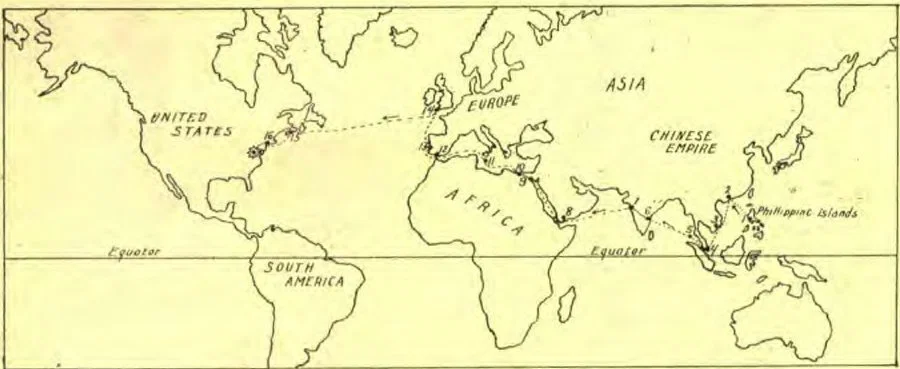
A CABLE despatch from Admiral Dewey or General Otis passes over fourteen cables and telegraph-lines before it reaches Washington. Leaving the Island of Luzon, on which the city of Manila is situated (see Fig. 1), it passes over the cable to Hong-Kong, in China (Fig. 2), a distance of 529.11 miles, under the China Sea. From there it is sent over another cable to Saigon, in Cochin-China (Fig. 3), 460 miles. Another cable carries the message 630 miles to Singapur (Fig. 4). At that point the message is “relayed” around the Malay Peninsula to the Island of Penang, off Siam (Fig. 5), a distance of 288 miles, and thence across the Bay of Bengal by another cable to Madras (Fig. 6), 1,498 miles. In India the message goes over the first land wire to Bombay (Fig. 7), 800 miles; thence under the Arabian Sea to Aden, on the Gulf of Aden (Fig. 8), 1,851 miles; and then under the Red Sea to Suez (Fig. 9), 1,403 miles. Then it goes overland to Alexandria (Fig. 10), 200 miles; by cable to Malta (Fig. 11), 913 miles; and over another cable to Gibraltar (Fig. 12), 1,126 miles. From Gibraltar it travels by cable to Carcavelos, near Lisbon, Portugal (Fig. 13), 337 miles; then by an ocean cable to the cable station at Land’s End, England (Fig. 14), 856 miles. From this point it is sent direct to Dover Bay, Nova Scotia (Fig. 15), 2,531 miles; and then repeated to New York City (Fig. 16), 888 miles over the coast cable; and finally overland to Washington.

W. S. CHAPMAN

MAKING HOME PEACEFUL.

XXIV.

“Why, Regie!” began his mother, with an anxious look at the clock, “how is it you are home so early? You’re not sick, I hope,” she added, though something in the young man’s appearance told her that it was an affair of a far more serious nature than a trifling indisposition. Ellen Beardsley almost held her breath, awaiting his answer.
“Yes, I’m sick; fact is, I’ve been sick a long time—sick of school. Professor Hill is nothing but a crank, anyway. I’ve learned all he knows how to teach me, and now I propose either to stay at home or else go out to Uncle Earl’s to school. I’d like to graduate, and I don’t see why I can’t go.”
Reginald knew well what wires to pull when he wanted his own way. He had long tried to gain his parents’ consent to going out to his Uncle Earl’s, his mother’s brother, who had no children except one daughter. The boy could not endure even the little restraint put upon him at his home, and he longed to be free. Uncle Earl was rich; and Reginald fancied that if he could only live with him, he could do as he liked.
“What’s happened, dear? You haven’t been dismissed from school? Has Professor Hill—after all we’ve done for him—how I do despise an ingrate!” exclaimed Mrs. Beardsley.
Professor Hill was a poor man; and when he first came to Harrisburg, Mr. Beardsley had been the means of getting him a position as principal in one of the public schools, and had aided him financially. This Mrs. Beardsley never forgot; and though the perplexed teacher had done the best he could for Reginald, she always accused him of ingratitude when any trouble occurred with her son.
“Yes, he has; I’ve been expelled. That’s the long and short of it. Maybe I’ll get even with him yet, sometime!” exclaimed the misguided youth, whose chief desire had always been to “get even” with any one who, as he fancied, had done him a wrong. It was this evil spirit of revenge that had prompted him to cause the dismissal of Tom Willis. Alas and alas that his unwise mother never had rebuked this indication of a cruel, revengeful disposition in her son, even as she did not now do! She only shrugged her shoulders uneasily, and said: “I don’t care to have it get out, Reginald. I don’t know what the Greens or the Willoughbys would say or think. Likely they wouldn’t understand, and would think it a great disgrace.”
Ellen Beardsley did not even take the trouble to inquire into the nature of her son’s difficulty at school. It did not occur to her that he could be in the wrong; but she was greatly distressed at the thought of his leaving home, and hoped to be able in some way to bring about a reconciliation with the teacher, so Reginald need not bear the disgrace of expulsion.
But Professor Hill had called to see Mr. Beardsley at his store, after school, so when the latter came home to supper, and his wife proposed that he see the teacher and arrange some compromise, as he had often done before, she was met with the reply that it was useless. “I feel the disgrace of this miserable affair keenly,” Mr. Beardsley explained, “but it is of no use. I said all I could to Professor Hill. He declares the boy to be completely beyond his control, and says he can no longer put up with the effect of his demoralizing conduct on the other boys.”
“‘Demoralizing conduct,’ indeed!” sneered Mrs. Beardsley. She was irritated at once by detecting an inclination on her husband’s part to sympathize with Professor Hill against Reginald. “I suppose Regie is no worse in school, and causes no more trouble, if the truth was known, than Will Green, or Frank Willoughby, or any of the other boys; but the Greens and the Willoughbys are rich. Oh, it’s the money, James,—it’s the money,—I know; and,” she continued, bitterly, “to think of how much you’ve done for that man!”
“Well,” chimed in Grandmother Sharpe, the usual injured look very prominent in her face, “I told James not to help that schoolmaster, nor lend him no money. I could see, well enough, how ’t would all turn out. He don’t think no more of you, nor favor you no more, ’n if you’d never helped him. He’s dretful ungrateful,—a turnin’ your only boy out of school! It’s queer; nobody pays no heed to what I say.”
“Professor Hill has done the best he could with Reginald, grandmother,” explained Mr. Beardsley, mildly. Grandmother had always seemed unwilling to lend a helping hand to those in trouble, for fear they would not appreciate what she had done. There are many like her, who let pass countless opportunities for doing good, from a selfish fear that their own vanity will not be pampered, and their virtues magnified, by the recipient of their favors. Have we not all met persons whose chief concern appeared to be, not to do good for the sake of helping and uplifting fallen humanity, but apparently that some one might owe them so overwhelming a debt of gratitude that every one would agree that it could never be paid? Then they pat themselves upon the back, assume a wounded air, and declare that they are unappreciated, and that the world is very selfish and ungrateful.
“Well, James,” continued Mrs. Beardsley, ignoring her mother’s remark, “I don’t know how you may look at it, but I am of the opinion that Regie had better finish his education and graduate, in spite of Professor Hill or anybody else. I don’t propose to have the poor boy crushed and kept under, just because he happens to have a little more spirit and pluck than the other boys. Nobody knows,—not even you, James,”—whimpered the excited woman, “how hard it would be for me to give my boy up, even for a few months; but I can do it for his good,—I can do it.”
“I presume you think it would help matters to send him out to his Uncle Earl’s. But you know, Ellen—”
“Yes, I know,—you’re going to object. You always do if I set my heart on anything. I tell you, I want my son to graduate, and make his mark in the world.”
“I am as anxious as you are on that point, Ellen; but you know, well enough, that Earl is not a Christian; and I would like our son to be under Christian influence. Of course Earl is eminently respectable and all that, as far as the world goes; but I fear for the influence on the boy. If he were only a Christian—”
“Oh, dear! you’re so straight-laced, James. I’ve no patience with you!” and Mrs. Beardsley turned away, fretfully.
MRS. L. D. AVERY-STUTTLE.
(To be continued.)

THE WHITE PASS AND YUKON RAILWAY.

Soon after the discovery of gold in the Klondike region was announced to the world, and the grand rush of miners to that frozen northern land began, English and American capitalists planned a railroad to the Yukon Valley, made a survey of the most favorable route, and in the spring of 1898 began work with a force of fifteen hundred men. The road begins at Skaguay, and will end at Fort Selkirk, on the Yukon, over three hundred miles distant. “The twenty miles between tide-water and the top of the pass presented a problem of great difficulty. In this there is a rise of two thousand eight hundred and fifty feet, nearly all of which must be overcome in one part. The distinguishing feature in accomplishing this is the employment of many sharp curves, built with great skill on shelves in the face of the rock.” In this way the engineers have obtained a maximum grade of a little over two hundred feet to the mile. The first train arrived at the top of White Pass, February 20, last; and it is hoped that the new line will be completed early in 1900.
The cost of building the road so far has been enormous,—about sixty thousand dollars to the mile,—and it follows that those who travel over it will pay a high price for its meager accommodations. No doubt many a poor man will pay more for the privilege of riding to the gold-fields than he will ever bring away from them. However, the loss of life will be greatly lessened by this means of travel.

THE VIOLET.

Here she is again, the dear, Sweetest vestal of the year, In her little purple hood, Brightening the lonesome wood. We, who, something worn with care, Take the road, find, unaware, Joy that heartens, hope that thrills, Love our cup of life that fills, Since in spring's remembered nooks, Lifting fain familiar looks, Once again, with curtsying grace, In the same dear, lowly place, God his manual sign hath set In the tender violet.
— Margaret E. Sangster.

FACTS ABOUT THE BODY.

THE feeble, incompetent condition of women physically is largely due to ignorance, wilful sometimes, concerning dress and its effects on the body. They do not know that a woman’s waist is naturally larger proportionately than a man’s, because her liver, the largest gland in the body, is larger than man’s. Certain diseases of digestion common to men are comparatively unknown among women, because of the larger organ, capable of throwing off more poison, and acting as a more powerful blood-purifier.
The lymphatic and portal circulation, the importance of which we must study to understand, is seriously disturbed by waist constriction, and consequent superficial breathing; in fact, the entire circulatory system is seriously weakened by this unnatural mode of dress. This accounts largely for cold feet and hands. Tight dress allows a waist expansion of only one fourth of an inch, when the expansion should be from two to six inches.
The Lord has especially spoken on this subject, so we are not left in ignorance as to the danger of this hurtful practise. We are told that corsets compress the internal organs, and induce curvature of the spine and an almost countless train of diseases. “Our Creator made no mistake in fashioning the human body. He gave appropriate space for the free action of every organ, and formed us in such a way that every muscle could come into play without trespassing upon the function of any other muscle.” “Now hath God set the members every one of them in the body as it hath pleased him.” 1 Cor. 12:18.
Then why should Satan try to control the human race, and have the members of the body placed where he desires them?—Because he knows that disease and death will result. When the organs are in the right place, the stomach will lie well up under the ribs, above the transverse colon, which will cross about at the waist-line. Fashion has decreed that no matter what becomes of the stomach or any other organ, the ribs must be lashed together, to overlap each other if possible, so as to enable its victim to be grasped in an eighteen-inch corset. The pressure is so severe that in time the stomach is forced down; then the intestines fall on the pelvic organs and bladder, and the general derangement is complete. “Many have become lifelong invalids through their compliance with the demands of fashion. Displacements and deformities, cancers, and other terrible diseases are among the evils resulting from fashionable dress.” “Satan invented the fashions to keep the minds of women so engrossed with the subject of dress that they could think of but little else.”
The facts that we have noted apply chiefly to the physical condition of women. But what of their moral and spiritual condition? This is a question with two phases, both very serious, as upon them hangs the destiny of every woman. This is a solemn statement; but as the moral phase of physical training is discussed, the subject will be fully explained. May God help every young woman to regard her body as God’s creation, and forbid Satan to deform and destroy her, body and soul. Mrs. M. D. Mc KEE.

SOME VENEERING WOODS, AND HOW TO LAY THEM.
BEFORE instructing you in the art of laying veneers, I will mention some of the choicest woods used for this purpose. Let us notice, first, some of our native forest woods. A fine veneer is made from white maple, also from bird’s-eye maple. The last-named is difficult to work because the eyes in the wood are liable to work out in dressing, but some of it is very beautiful. Birch, both red and white, is now being much used in veneering furniture. White oak, also red oak, when cut quarter-sawed, make a rich veneer. Black walnut, both the crotch of the log and the burl, makes a fine finish. There is a veneer cut from ash, called Hungarian ash, but without doubt the wood from which it is made grows in this country. Then there is what is called “corrugated veneer.” The wood is cut with a crooked knife, across the grain; when pressed down, the work looks wavy, although cut from straight-grained wood.
The tropical regions produce a variety of woods used in veneering. Of these, mahogany, a rich timber, dark-red and clouded, takes a high polish. Different soils give this wood different shades. A beautiful dark veneer is made from rosewood, used largely in overlaying pianos. This wood is so oily that varnish will not dry on it unless it is either baked or shellaced before the veneers are laid. Baking gives it a darker color. Brazilwood is dark, and looks something like rosewood, but has large light streaks in it. It makes a coarser veneer. Olivewood is also made into veneers. The root is very beautiful, being mottled. Ebony comes from Madagascar and Ceylon. The usual color is black, but it sometimes comes in both red and green. Many different materials are cut into veneers.
The object of veneering is to make a nice piece of work at much less expense than would be involved in using the solid wood. The softest woods should be chosen for the foundation upon which to lay the veneers; perhaps the best for the purpose are those having a straight grain, free from knots, as a veneer will soon loosen from a knot.
A person who intends to do much veneering should have a plane about the size of a common smooth-plane, with the iron standing nearly perpendicular, and the edge of the iron full of fine notches. Such a tool is called a tooth-plane. With this plane scratch over the surface upon which you lay the veneer, also the veneer itself, if it is a sawed one. Should a veneer get broken, glue a piece of stiff paper on the outside, which may be scraped off in finishing.
Always cut veneers a little larger than the work to be covered. They can be trimmed to the proper size after the glue has hardened. You will need a board a little larger than the piece of work to be veneered. Dress both sides smooth, after which rub the surface thoroughly with soap or beeswax, and heat it in, to prevent its sticking to the work, should a little glue work through the veneer. (Be careful that no soap gets into the glue, as it would prevent its sticking.) This board is called a caul.
When you are ready to put on the veneers, have your glue thin and hot; and while you are gluing, have your caul heating by the fire, so that when the veneer is laid on, the caul, being hot, will keep the glue liquid until you can get your work clamped up.
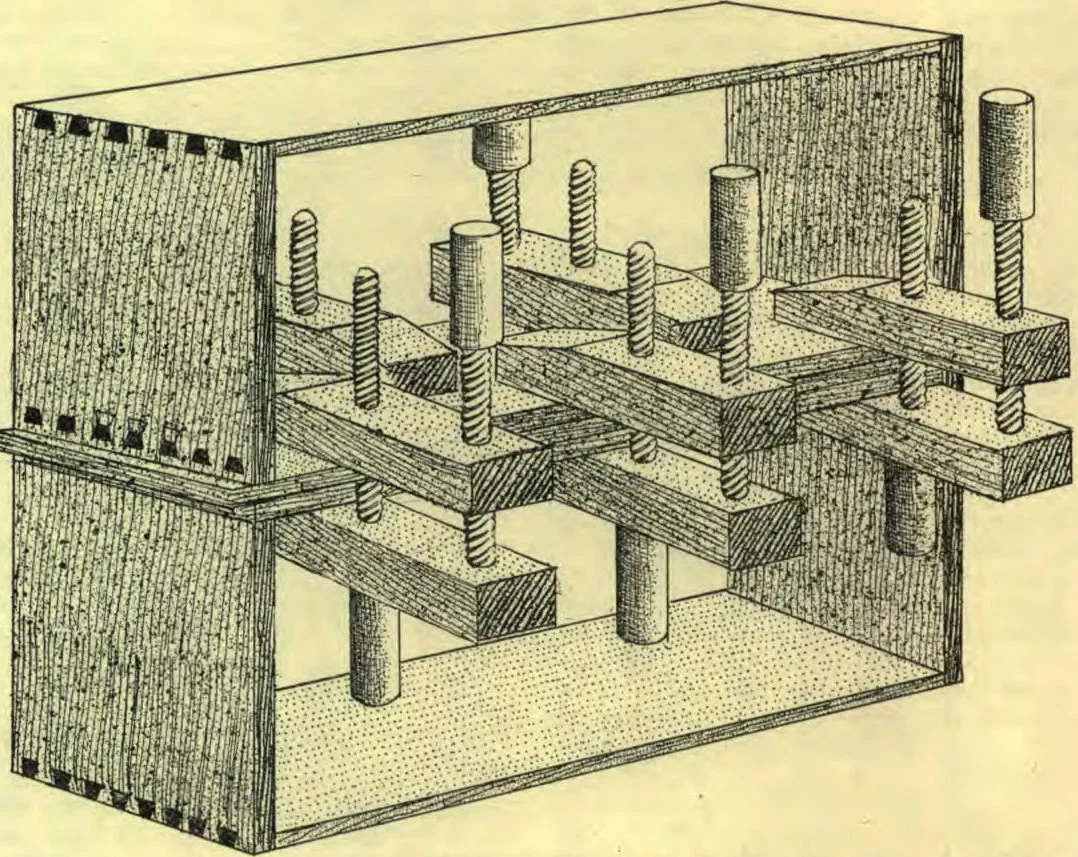
The illustration represents two drawers, without the bottoms, showing the front sides of the two turned together after the veneers are glued on. The caul-board, a, is placed between the drawers, b, b, after which the hand-screws, c, c, are put on. In putting on the hand-screws, keep the jaws, c, c, as nearly parallel as you can, to press the work together as tightly as possible. Turn the screw next to the work up tight; then turn up the outer screw. In this way you get a greater pressure.
Other kinds of cauls are used for different kinds of work. Should the work be crooked or irregular in shape, it often requires a caul fitted to it. Sometimes, in veneering round work, a bag of coarse burlaps is filled with hot sand, and placed on the veneer, as it can then be pressed down to any shape required to fit the wood. Should your veneer be bulged out or crooked, dip a sponge in hot water, and rub over the veneer before using, and it will press down straight when the caul is laid on.
W. K. LOUGHBOROUGH.

HOW COAL IS MADE.

DID you know that coal is made from plants? Not one child in a hundred knows that. The very heat it gives out is what the plant first took in.
What is there more valuable than coal, that warms our houses so nicely, and gives us such beautiful gas-light to sit by on cold winter nights? All kinds of machinery are worked by it, from the factory to the engine. Even the oil that we use in our lamps comes from coal and the remains of plants. If you were to take a piece in your hands, you could see the impression of leaves, like those you gather in the country lanes.
Peat is the beginning of a bed of coal before it grows hard. It makes a nice fire. Coke, which you have often seen burning so brightly in the grate, is made by driving out all the oil and gases from the coal.
Tar often oozes out of the lumps of coal on a fire, making little black bubbles, which burst and burn. Paraffin oil is made from this very tar, and benzolin, too. Anilin comes from benzolin, which makes some of our most beautiful dyes. Some essences that are put in candles come from tar. So you see that from coal we get heat and light, colors, and many pleasant flavors.—Illustrated Home Journal.
Continue reading: PARABLES IN NATURAL SCIENCE