The Youth’s Instructor, Vol. 37, No. 45.

MY LITTLE PLAT

The Youth’s Instructor

Nov 6, 1889

S. D. A. Publishing Association · Battle Creek, Mich. · Nov 6, 1889

MY LITTLE PLAT.

I HAD a little plat of ground, And it was mine by right; I meant to plant it full of flowers Of love and heart's delight. I dreamed and planned of wondrous things That I would do in future springs.
My little plat was broken; It had a rich, good soil. “Now plant your pretty flowers,” one said, “Or soon the thorns will spoil; For 'tis a thing I've often found, That thistles claim all vacant ground.”
Alas! alas! I left it; And when I came at last, The furrowed clods bore thistles, That clung, and held them fast: And many a wound they gave my hand, Before they left my vacant land.
And then I sowed my flowers; But when they broke their seeds, Among my ranks of roses Were great, unsightly weeds; For, O, when weeds a place have found, 'Tis hard to make them leave the ground.
I toiled and toiled all summer, To rid my land of weeds. They need not there have flourished If I had sown my seeds; But if a plat lies empty, straight Evil stalks up, and will not wait.
Now, if you have a plat of ground, In heart, or hand, or field, Be sure to sow it full of good, Before its doom is sealed; For thistles wait on every hand To lay their claim upon the land.
O, sow your seeds of duty, That you may do all deeds For the bringing forth of beauty Instead of pulling weeds! Sow day by day with lavish hand; Let good preoccupy the land.
FRANCES E. BOLTON.

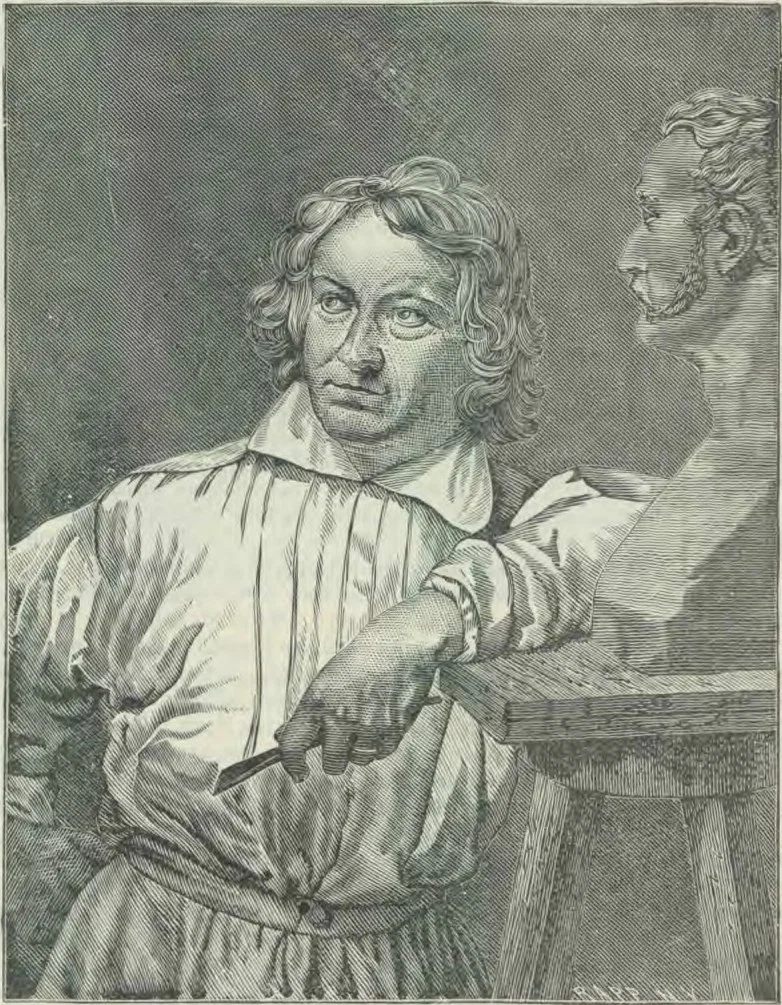
BERTEL THORWALDSEN

A few months ago we visited a plain old house in Copenhagen, the boyhood home of the great Danish sculptor. Here he worked with his father, a poor wood-carver, who, thinking his boy would be a more skillful workman if he learned to draw, sent him to the Free Royal Academy of Fine Arts when he was twelve years old. At the end of four years he took a prize, and the fact was mentioned in the newspapers. The next day, one of the teachers asked, “Thorwaldsen, is it your brother who has carried off the prize?”
Bertel’s cheeks colored with pride as he said, “No, sir; it is I.” The teacher changed his tone, and replied, “Mr. Thorwaldsen, you will go up immediately to the first rank.”
Years afterward, when he had become famous, he said that no praise was ever so sweet as being called “Mr.” when he was poor and unknown.
Two years later, he won another prize; but he was now obliged to stay at home half the time to help support the large family. Obtaining a small gold medal from the Academy, although so modest that, after the examination, he escaped from the midst of the candidates by a private staircase, he determined to try for the large gold medal. If he could obtain this, he would receive a hundred and twenty dollars a year for three years, and study art in Italy. He at once began to give drawing-lessons, taught modelling to wealthy boys, and helped illustrate books, working from early morning till late at night. He was rarely seen to smile, so hard was the struggle for daily bread. But he tried for the medal, and won.
What visions of fame must have come before him now, as he said good-by to his poor parents,—whom, alas, he was never to see again,—and, taking his little dog Hector, started for far-away Italy! When he arrived, he was so ill and homesick that several times he decided to give up art, and go back. He copied diligently the works of the old masters, and tried in vain to earn a little money. He sent some small works of his own to Copenhagen; but nobody bought them. He made “Jason with the Golden Fleece,” and, when no one ordered it, the discouraged artist broke it in pieces. The next year he modeled another Jason, a lady furnishing the means; and while everybody praised it, and Canova said, “This young Dane has produced a work in a new and grand style,” it did not occur to any one to buy the statue in marble.
An artist could not live on praise alone. Anxious days came and went, and he was destitute and wretched. He must leave Rome, and go back to the wood-carving in Copenhagen; for no one wanted beautiful things, unless the maker was famous. He deferred going, from week to week, till at last his humble furniture had been sold, and his trunks waited at the door. As he was leaving the house, his traveling companion said to him, “We must wait till tomorrow, from a mistake in our passports.” A few hours later, Mr. Thomas Hope, an English banker, entered his studio, and, struck with the grandeur of his model of Jason, asked the cost in marble. “Six hundred sequins” (over twelve hundred dollars), he answered, not daring to hope for such good fortune. “That is not enough; you should ask eight,” said the generous man, who at once ordered it.
And this was the turning-point in Bertel’s life. How often a rich man might help a struggling artist, and save a genius to the world, as did this banker! Young Thorwaldsen now made the acquaintance of the Danish ambassador to Naples, who introduced him to the family of Baron Wilhelm von Humboldt, where the most famous people in Rome gathered. Soon a leading countess commissioned him to cut four marble statues,—Bacchus, Ganymede, Apollo, and Venus. Two years later he was made professor in the Royal Academy of Florence.
The Academy of Copenhagen now sent him five hundred dollars as an expression of their pride in him. How much more he needed it when he was near starving all those nine years in Rome! The bashful student had become the genial companion and interesting talker. Louis of Bavaria, who made Munich one of the art centers of the world, was his admirer and friend. The Danish king urged him to return to Copenhagen; but as the Quirinal was to be decorated with great magnificence, Rome could not spare him. For this, he made, in three months, his famous “Entry of Alexander into Babylon,” and soon after, his exquisite bas-reliefs, “Night” and “Morning,”—the former a goddess carrying in her arms two children, Sleep and Death; the latter a goddess flying through the air, scattering flowers with both hands.
In 1816, when he was forty-six, he finished his Venus, after having made thirty models of the figure. He threw away the first attempt, and devoted three years to the completion of the second. Three statues were made, one of which is at Chatsworth, the elegant home of the Duke of Devonshire, and one was lost at sea. A year later, he carved his exquisite Byron, now at Trinity College, Cambridge.
He was now made a member of three other famous academies. Having been absent from Denmark twenty-three years, the king urged his return for a visit, at least. The Royal palace of Charlottenburg was prepared for his reception. The students of the Academy escorted him with bands of music, cannons were fired, poems read, cantatas sung; and the king created him Councilor of State.
Was the wood-carver’s son proud of all these honors? No! The first person he met at the palace was the old man who had served as a model for the boys when Thorwaldsen was at school. So overcome was he as he recalled those days of toil and poverty, that he fell upon the old man’s neck, and embraced him heartily.
After some of the grandest work of his life, in the Frue Kirke,—“Christ and the Twelve Apostles,” and others,—he returned to Rome, visiting, on the way, Alexander of Russia, who, after Thorwaldsen had made his bust, presented the artist with a diamond ring.
Although a Protestant, accounted now the greatest living sculptor, he was made president of the Academy of St. Luke, a position held by Canova when he was alive, and was commissioned to build the monument of Pius VII. in St. Peters. Mendelssohn, the great composer, had become his warm friend, and used to play for him as he worked in his studio. Sir Walter Scott came to visit the artist, and as the latter could speak scarcely a word of English, the two shook hands heartily, and clapped each other on the shoulder, as they parted.
When Thorwaldsen was sixty-eight years old, he left Rome to end his days among his own people. The enthusiasm on his arrival was unbounded. The whole city waited nearly three days for his coming. Boats decked with flowers, went out to meet him, and so many crowded on board his vessel that it was feared she would sink. The members of the Academy came in a body; and the crowd took the horses from the carriage, and drew it themselves through the streets to the Palace of Charlottenburg. In the evening there was a grand torch-light procession, followed by a constant round of parties.
So beset was he with invitations to dinner, that, to save a little time for himself, he told his servant Wilkins that he would dine with him and his wife. Wilkins, greatly confused, replied, “What would the world think, if it found out that the chancellor dined with his servant?”
“The world—the world! Have I not told you a thousand times that I don’t care in the least what the world thinks about these things?” Sometimes he refused even to dine with the king. Finding at last that society would give him no rest, he went to live with some friends at Nyso, seven hours by boat from Copenhagen.
Once more he visited Rome, for a year, receiving royal attentions all through Germany. Two years after, as he was sitting in the theater, he rose to let a lady pass. She saw him bending toward the floor, and asked, “Have you dropped something?”
The great man made no answer; he was dead. The funeral was a grand expression of love and honor. His body lay in state in the Royal Palace, laurel about his brow, the coffin ornamented with floral crowns—one made by the Queen of Denmark; his chisel laid in the midst of laurel and palm, and his great works of art placed about him. Houses were draped in black, bells tolled in all the churches, women threw flowers from their windows before the forty artists who carried the coffin, and the king and prince royal received it in person at the Frue Kirke.
Then it was borne to the large museum which Copenhagen had built to receive his work, and buried in the center of the inner court, which had been prepared under his own hand. A low granite coping, covered with ivy, surrounds the grave, and on the side is his boyish name, Bertel Thorwaldsen.—Sarah K. Bolton, in Boys Who Became Famous.

MEANS OF GRACE IN A CLOSET DOOR.

Of course, you are wondering how this can be, and perhaps you are even thinking that it is a ridiculous idea. I presume I would have thought so myself once, but now I know better, and I’m going to tell you how it came about. Quite a good many years ago, I had an invitation to visit a dear old aunt of mine. I was very fond of her, not only because she was sweet and good, but because she was so bright and original, and had such clever, entertaining ways of looking at things. So, of course, I accepted with pleasure, and before many days I was safely ensconced in her cozy home. She was something of an invalid, so we used to sit up in her room a good deal, in front of a cheerful little wood-fire, while we talked about many things that happened long ago, before I was born, when she and my father were children together, or of my own mother, who had died when I was quite a child. In all of these things I was immensely interested, but I doubt if anything she ever told me did me more good than this funny little incident about her closet door. One morning, after we had been busy together, as she rose to put away her work, she said: “My dear, come hold my closet door open for me, please.” I complied at once, somewhat wondering, and then said, “Why?”—for, I must confess, that habit of my childhood still clings to me.
Many times have I been thankful for the bit of helpful wisdom that came to me in answer to that “Why?” She answered: “My dear, years ago, when I took up my abode in this room, I found, to my great annoyance, that the closet door had a way of shutting by itself, without in the least consulting anybody else’s convenience. I might be only half-way in, or half-way out, or poking about in its darkest corner with my dim old eyes—slowly but surely, and most exasperatingly, would that closet door shut upon me. I’m afraid I lost my temper a good many times over it. In despair I finally sent for a carpenter who came with his box of tools and fussed a whole morning. As he went away, he said: ‘I can’t say surely, ma’am, as I’ve helped you any. This here is an old house, and it’s settled, ma’am, and I’m afraid that door’ll swing to the end of time.’ So I sat and thought about it. ‘Swing to the end of time!’ I said. ‘And am I going to keep losing my temper three and four times a day to the end of time? Wretched prospect! I won’t do it! I’ll make use of that door. It shall be a means of grace to me. I’ll take pleasure in its very infirmity; for I’ll make it teach me patience.’ And it has, my dear. It sounds strange, perhaps, to say it; but I really believe that closet door has helped my Christian life.”
I thought over her story a long time, and a new idea of life came to me. The little things that seem so insignificant—can we use them? Are they among the “all things”? Surely it was true! I could think of several things that had been daily small trials to me at home. I made a resolve that they should be “means of grace” instead, and I think they have been.—The Sunday-School Times.

SALMON CANNING.

ALONG the south line of Washington Territory runs the great Columbia River. One of the industries of this region of country is the catching and canning of those huge fish called salmon, that frequent this river at certain seasons of the year. As few of the INSTRUCTOR readers have ever seen the process of canning performed, and as it is interesting to read about, though not so interesting to see done, a description will be attempted. At various points along the river are establishments devoted entirely to the business of canning salmon. The fishermen who bring the monster fish to the wharves are white men, but all the handling and the work is done afterwards by Chinese. The fish weigh from five to forty pounds, and are piled on the dock by the fishermen in regular piles. Then come the Chinamen and re-assort them according to the calls from the factory, or as strikes their fancy. The hands are not used in doing this part of the work, but a stick, with a sharp spike in the end, is employed. By a quick thrust of the spike into the head of a fish, and a peculiar turn of the wrist, a fish is thrown from one pile on to another with ease and exactness.
The first glance into an establishment of this kind is an uninviting one, and one that leads the gazer, if not blessed with a very strong stomach, to mentally resolve never again to taste of the canned article. By the side of several long benches stand Chinamen, with long knives in their hands, which they often sharpen on the steels fastened by a chain around the waist.
At the first table, as you enter, stands a Chinaman laying the fish side by side, as they are brought in, and with their heads all one way. When his table is filled, an operator steps forward, and with more or less skill, according to his experience, cuts off the heads and front fins. Some of the men exhibit marvelous dexterity in this portion of the work. The fish, freed from their heads and front fins, are taken charge of by another man, who, with two quick movements, removes the tail and back fins; one single long cut, and the fish is laid open its entire length; a fourth movement, and the entrails are all removed and laid to one side.
The fish, minus their heads, tails, fins, and entrails, are then thrown into vats of clear water, and are well rinsed and scraped. As salmon have no scales, this part of fish-cleaning is saved. The workmen are very particular at this stage of the process, to their credit be it said, and remove everything offensive; yet by the time the visitor has penetrated thus far into the establishment, he finds the dirt and stench almost unendurable.
From the vats the fish are sent to the “chopper,” a long table having slots throughout its entire length and about two inches apart, into which curved knives play, worked by a lever. The fish are laid evenly upon this table, and the knives cut them into sections just two inches wide. These sections are then subdivided by hand into pieces small enough to pass into the cans, into which the fish are now ready to be placed.
These cans are made in a separate room by other Chinamen. Two dozen are arranged on the “salting-table” at one time. Over them is placed a salting-board,—a board with two dozen auger holes bored into it. Under these holes a thin board is placed, and then the holes are filled by throwing salt upon the upper board and scraping off the surplus after the holes are filled. A can is directly under each hole, and when the under board is withdrawn, each one receives a measured quantity of salt, generally about a teaspoonful.
The cans are next carried to a table piled up with chopped fish, and the fish packed into them as solidly as it is possible to do. There is no danger of being cheated in quantity; for every effort is made to have the can packed full in the beginning, so that, after cooking, it may be reasonably full. All inequalities at the top are then neatly pared off with a knife, the tops are put on, and the cans run through a soldering machine. From this machine they go to another table, where the little holes in the covers are closed by hand. From this time on, the cans are continually tested for flaws, to prevent the possibility of sending out any imperfect ones.
Now comes the cooking. A large, square iron tray is lowered to the table by means of a rope which passes over a pulley, and about one hundred cans placed upon it. The tray is then lowered into a vat of boiling water, and allowed to remain two hours. It is then raised and placed again on the table, and a man strikes each can with a wooden mallet, to ascertain if all are sound. He throws the faulty ones to one side to be fixed up. This man is an expert at his work. He strikes the blows so rapidly that the eye cannot follow the motion, yet his ear is so exquisitely trained, by long practice, that he never errs, but will detect a fault instantly. Behind him follows a man with a mallet that contains a small awl. He strikes each can with this mallet, and the awl makes a small hole through which the gas escapes. Often when this is done, the gas and fluid will spurt up two or three feet in hight. It is not, therefore, very safe to be too close to the man as he does this part of the work.
The little hole is then soldered up, and the cans are carried to the “retort,” where the heat is kept steadily at twenty-eight degrees above the boiling point. They remain in this retort for another two hours, and that finishes the cooking. On being removed, they are again tested, and then passed to the “cooling-room.” When perfectly cool, they receive another test, and are then lacquered or varnished. This is done by dipping a brush into brown varnish and rubbing the cans one by one with it. They are then placed on slats, and allowed to drain the surplus into trays. When dry, they are tested once more, labeled, and packed into boxes containing four dozen cans, and so shipped.
W. S. C.

FAITHFUL CHILDREN.

How much care and anxiety as well as labor can be saved by faithful children. If they will faithfully do what they are told, forgetting nothing and neglecting nothing, they then become helpers indeed. Such children are to be depended upon and trusted, and when an emergency arises, and some one is needed who is faithful and responsible, then is the time their worth is known. But people who are always forgetting, always neglecting, always saying, “I meant to,” or, “I didn’t mean to,” blunder through the world, and are very little comfort to themselves or help to any one else. It is a great thing to have a faithful, responsible child in the house; it is a sad thing to have a rattle-brained, headstrong child, who does mischief, commits blunders, makes mistakes, and causes trouble in every direction.
“I didn’t think,” is a poor answer. Persons ought to think. “I forgot,” is a poor excuse. No person should forget the things that it is his duty to attend to. A boy does not forget a thing which interests him. Who ever knew a boy to go fishing and forget his bait? Who ever knew a girl to forget her ribbons and ornaments? The reason people forget things is that they do not care about them. The way to remember is to care, and if we have a care for our ways and our work, then we shall not forget to attend to our duties.—Selected.

THE SEA-SAW IN KOREA.

A warped board is placed, with the hollow upward, upon a bunch of straw, or on bags filled with sand or something similar, so as to raise it from the ground not more than a foot or so. Alongside of this, and at the proper height for the children to reach, is stretched a rope, which the jumpers grasp and retain while they play. On the board the two children stand, the heavier jumping from the board, and alighting upon it again, thus by the jar sending the other child into the air. The child thus propelled alights with all the impetus possible upon its end of the board; and in two or three jumps, the two will be rising into the air as high as six feet. The exercise is much more violent than in the American game, and frequent rests are necessitated. It requires more skill, greater nerve, keener sight, and nicer powers of balancing. The result to the muscles and nerves must be, when played in moderation, exceedingly beneficial.—Ex.

A LITTLE ABOUT YUCATAN.

THE little fellow in our picture is a grass-seller. He lives in a country called Yucatan. Yucatan is south of the United States. It is a peninsula, and extends north into the Gulf of Mexico. It is not quite as large as the State of Michigan. For seven hundred miles its shores are lapped by salt water.
Yucatan is a very hot country. But most of the time sea-breezes sweep over it, so that people who are used to it, do not find it an uncomfortable country to live in. No rain falls from October to May; that is summer-time in Yucatan. During the winter, rain falls.
In this country, water does not form into brooks, and the little brooks into big rivers, rolling down to the ocean, and making everything green along their way. The dry, thirsty soil soaks up water like a sponge. But the water is in the earth, and the people can get at it by digging wells. Nothing grows well where the land is not watered. Where the people can afford the expense, and will take the trouble to do it, they can make their country beautiful.
The people who lived in Yucatan a long while ago, were once thought to be the wisest in America. Those in the northern part especially, spared no pains to make their country as good as they could. They dug many wells, and kept their land well watered. They planted gardens. They had large cities. They built grand temples.
This was a long time ago, before Columbus discovered America. After the Spaniards found out about this country, they came to Yucatan. They wanted to convert the people to their religion; for the people in Yucatan worshiped false gods. They also wanted to capture the country, and take all its wealth for themselves. They did not care much for these heathen. When the heathen were not easily converted to the Catholic faith, the Spaniards thought it just as well to kill them.
A great deal of trouble followed on account of this treatment, and there were many long, hard-fought wars. The Spaniards at last got the country. They destroyed temples, pulled down monuments, and ruined towns.
None of the works of these early people remain; but there are acres of land covered with ruins of churches, fine houses, wells, and water-works. We know by these ruins that the people who built these things must have been wise.
Their descendants still live in Yucatan. They are not handsome, but they are strong and well-built, and have frank, intelligent faces. They have very good manners. In a great many ways they show that they once belonged to a wise people. No doubt the little grass-seller in the picture belonged to one of these old families.
Grain does not grow well in Yucatan. Corn is used mostly for food. So grass and hay for the cities must be brought long distances. The people start from home a long time before sunrise; for the sun is so hot that they cannot travel in the daytime. They carry their burdens on their heads and on their backs, They bring the grass to town in this manner. A short distance away they look like walking haystacks.
The little boys and girls early learn to carry burdens on the head. It teaches them to walk erect, and makes their shoulders broad and strong.
W. E. L.

KITTY AND THE BIRD SONG.

“Where are you going, Sue?” asked Kitty.
“Never you mind,” said Sue. “You can’t go.”
“Where are you going, Jenny?”
“I sha'n't tell you.”
Jenny and Sue were putting their dolls’ best clothes on. Kitty knew they were going away somewhere, and she wanted very much to go too.
“Do let me go,” she coaxed.
“No, you can’t,” said Sue. “We don’t want any young one along.”
“But I want to go,” she said, half crying.
Sue and Jenny whispered together a minute and then said,—
“Well, get your doll. Put her best things on.”
Kitty dressed her doll as fast as she could and hurried down-stairs. Her sisters were not where she had left them, and she could not find them anywhere.
“Where are Sue and Jenny gone?” she asked of Jane, the girl.
“I saw them running down the road with their dolls a quarter of an hour ago,” said Jane. “I guess they’ve gone over to the village to see somebody.”
Kitty burst out crying, and ran into the garden.
“I hate them! I hate them both!” she cried. “They’re just as mean as they can be. I wanted to go-o-o-o-o—”
The poor little girl threw herself upon the soft grass, and sobbed in anger and disappointment. Close beside her was a bed of beautiful pansies which belonged to Sue and Jenny.
“I’ll step on their pansies,” she cried. “I’ll spoil ’em, every one. I’ll—”
“Kitty, Kitty, Kitty!”
Kitty stopped the motion of her angry little foot, and looked quickly around.
“Who called me?” she asked.
“Kitty, Kitty, Kitty!”
She looked into the tree above her head, and then laughed a little in spite of her anger. Up in the thick green branches a little bird was hopping about, and as she looked it again twittered:
“Kitty, Kitty, Kitty!”
She moved away from the pansies and sat down on the grass. She could not destroy the lovely flowers while that little bird was looking down at her. She thought she would wait until it flew away.
But the longer she waited the harder it seemed to do what she thought of doing. The blossoms seemed to look into her face as if asking if she really could be cruel to them. The sun shone down upon her, and the wind fanned her poor little angry face until it seemed as if everything was sweet and lovely but just herself.
She sat there feeling very sad and sorrowful. She would have enjoyed so much going visiting with her doll with the others! She thought she never could forgive them for playing such an unkind trick upon her.
“Kitty, Kitty, Kitty!”
The bird had hopped down to the lowest limb of the tree, and was so near her that she held her breath as she smiled up at him, for fear of driving him away.
“Sweet, sweet, sweet!”
“Dear me,” said Kitty. “I wonder if he means that I’m sweet.”
“Sweet, sweet, sweet! Kitty, Kitty, Kitty!” said the bird. Kitty shook her head.
“I guess you wouldn’t say so, little bird, if you knew all about it,” she said sorrowfully. She wondered if he had heard her angry sobs, and hoped in her very heart that he had not understood her bitter words. She was beginning to feel ashamed of them, and wished she had not been so angry.
“I haven’t been sweet a bit,” she said, looking up at the bird, who had gone back into the far-up branches.
“Sweet, sweet, sweet, sweet! Kitty, Kitty, Kitty, Kitty, Kitty, Kitty, Kitty, Kitty! Sweet, sweet, swe-e-e-e-t!”
Away flew the bird up into the sunshine, with a stream of chirps and trills and twitters. And in less time than it takes to tell it, a dozen or twenty other birds had joined him, and were singing as loud and as fast as their little throats would let them, all about Kitty.
Kitty went into the house and told grandma about it, adding,—
“I couldn’t do such a spiteful thing, nor keep on feeling angry when that little bird was looking at me.”
“But I hope, little dearie,” said grandma, “that you will learn not to think or do naughty things while God is looking at you.”
“Oh, but he’s always looking at me,” said Kitty.
“Yes, dear.”
“Then I couldn’t ever get angry or do spiteful things.”
“Not if you remembered, and tried with the help he would give you.”
“I s’pose ’t would be a good way,” said Kitty, with a very thoughtful face.
“I wonder how Kitty feels by this time,” said Sue, as she and Jenny were walking home.
“Oh, I s’pose she’s as cross as she can be,” said Jenny.
“But we don’t care for that,” said Sue.
Kitty came to meet them at the gate, but her face was as bright and sweet a one as any bird could have wished to see.
“Oh, I am so hot!” said Jenny.
“I’ll get you a drink of ice water,” said Kitty.
She brought it, and Jenny kissed her as she waited to take the empty glass, saying,—
“You dear little thing, I’m sorry we were so unkind to you. You’re just as sweet as you can be.”
“Perhaps the bird was right,” whispered Kitty to herself, smiling as she went to get a drink for Sue.—Sydney Dayre.

SOW, SEW, AND SO.

Sow, sow, sow. So the farmers sow! Busy, busy, all the day, While the children are at play, Stowing, stowing close away Baby wheat and rye in bed, So the children may be fed. So, so, so.
Sew, sew, sew. So the busy mothers sew! Busy, busy all the day, While the children are at play; Sewing, sewing fast away, So the children may have frocks, Trowsers, coats, and pretty socks, So, so, so.
Sow, sew, so, So they sow and sew; S, and O, and W, This is what the farmers do; Put an E in place of O, This is how the mothers sew,— So they sow and sew for you, So without the W, So, so, so.
—Selected.

BETTER THAN GOLD.

A good name is worth more to a boy or a girl than a bag full of money; and a good boy is very likely to have a good name. A person may for a while keep a good name while doing bad deeds, but in time the tricks will be discovered, and the boy who has tried to gain credit by his wits instead of his honesty, will find he has made a bad mistake.
Nothing wins in the end like downright honesty and integrity. Some one persuading a boy to do wrong said, “No one will know it.” “I shall know it myself,” was the boy’s answer, and he would not do the wrong thing.
It is much easier to do right than it is to do wrong and make people think you are doing right. There are hundreds of men in prison to-day who might have been free, and rich, and prosperous, if they had worked half as hard to be honest as they did to be dishonest and not to be caught. There are some of the finest mechanics in the country locked up in prisons, who if they had been honest and true, might have commanded almost any wages they chose, and have been honored and wealthy, instead of being prisoners and outcasts.
The way of the transgressor is hard.—Little Christian.

The Value of a Cheerful Temper

PERSONS who are always cheerful and good-humored are very useful in this world; they maintain peace and happiness, and spread a thankful temper among all who live around them.

ORIGIN OF SOME FAMILIAR THINGS.

The pin was not known in England till near the end of the reign of Henry VIII., the ladies until then using ribbands, and skewers made of wood, brass, silver, or gold. At first the pin was so wretchedly made that its head must have had a habit of coming off; for in the thirty-fourth year of the king, Parliament enacted that none should be sold unless they were “double-headed, and have the heddes soudered faste to the shanke of the pynne.” Since that time, manufacturers have learned to make them with one head that will stay on, and dictionaries have become wise enough to spell the name pin.
The saw was first made by a nephew of Dædalus, who, as they say, having accidentally found the jaw of a serpent, when looking for something with which to divide a small piece of wood, used it successfully, and in this way obtained the idea of making a metallic instrument in imitation of it. It is also said that the idea of the file came from that of the saw.
The first piano was made about the year that our national independence was declared,—1776. The maker is believed to be a German named Bachers, as there is still in existence the nameboard of a piano inscribed Americanus Bachers, Factor et Inventor, Jermyn St., London, 1776.
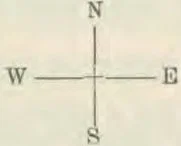
The word news is generally supposed to be taken from the adjective new. But it is asserted by some that its origin can be traced to the custom in former times of placing on the newspapers of the day the initial letters of the cardinal points of the compass, thus:—
These letters were intended to indicate that the paper contained intelligence from the four quarters of the globe; but they finally came to assume the form of the word news, from which the term newspaper is derived. The first newspaper was published in England by Nathaniel Butler in 1662. The first in France in 1682. The first Russian in 1703 under the personal supervision of Peter the Great. The first Dutch in 1656. The first in North America was the Boston News-Letter, commenced April 24, 1704. It was but half a sheet of paper, twelve inches by eight, two columns on a page. B. Green was the printer. This paper lived till 1776, seventy-two years. It favored the British Government at the commencement of the Revolution, and this may account for its death.
From a copy of this paper printed in 1769 is obtained the following announcement:—
“The bell-cart will go through Boston before the end of next month, to collect rags for the paper-mill at Milton, when all people that will encourage the paper manufactory may dispose of their rags.
“Rags are as beauties which concealed lie, But when in paper, how it charms the eye! Pray save your rags, new beauties it discover; For paper, truly, every one’s a lover: By pen and press such knowledge is displayed As wouldn’t exist if paper was not made. Wisdom of things mysterious, divine, Illustriously doth on paper shine.” —Christian Advocate.
Continue reading: LETTER TO THE HEBREWS