John Wesley once said, “The world is my parish.” So filled was his heart with the love of Christ, that his soul went out in earnest longing for the great brotherhood of humanity everywhere. Like that other faithful servant of God, the apostle Paul, he could say: “The love of Christ constraineth me.” And that is just the spirit—the spirit of service—that should and must possess every lover of God under the last solemn message to the world.
The holy prophets of the Old Testament were men and women of service. Jesus came to serve others, not to be ministered unto. All the noble New Testament characters were men and women of service. And now, when the world is to be warned of the soon coming of our Lord and the dire judgment that will quickly fall upon the earth, God wants all his people, everywhere, to be men and women of service,—men and women upon whom he can place his Holy Spirit, and thus thoroughly equip them for earnest, faithful, efficient service in every part of John Wesley’s parish, and their parish as well,—the world.
We praise God and rejoice for what has been done, and what is now going forward throughout the earth. Still there are many corners yet to be entered with the warning message against the worship of the beast and his image.
The Work of Cleansing
But God can never place upon sinful men and women this heavenly endowment, his Holy Spirit. The Holy Spirit can not dwell in the heart or the body defiled with sin. This truth is clearly taught in the fifty-first psalm. In verse five David speaks of his sinful nature, and his condition before conversion: “Behold, I was shapen in iniquity; and in sin did my mother conceive me.” What was true of King David is true of every man and woman.
Another fact in David’s experience is also true of all mankind; namely, “Behold, thou desirest truth in the inward parts: and in the hidden part thou shalt make me to know wisdom.” Verse 6. This is and must be the experience and the condition of every one who meets the mind of God. In order that this necessary and happy result may be secured, David prays: “Purge me with hyssop, and I shall be clean; wash me, and I shall be whiter than snow.” This must be the very first work accomplished for and in him. He must first be made free from all carnality and sinful defilement, because the Lord will never accept as his child, and employ in his service, one who cherishes and practises sin. Jesus is the “same yesterday, and to-day, and forever;” therefore this truth is just as patent to-day as it was ten hundred years before Christ.
Let us study these important lessons further. Having been made clean and freed from sin, David continues: “Make me to hear joy and gladness; that the bones which thou hast broken may rejoice.” Certainly he would be in a condition of happiness and rejoicing when thus restored to the favor of God. “Hide thy face from my sins, and blot out all mine iniquities,” he continues; and then, reaching the climax of his hope and prayer, he cries out: “Create in me a clean heart, O God; and renew a right spirit within me. Cast me not away from thy presence; and take not thy Holy Spirit from me. Restore unto me the joy of thy salvation; and uphold me with thy free Spirit.”
Prepared to Teach Others
Notice the conditions that God imposes,—a thorough transformation of character and life, a baptism of the Holy Spirit, the heart filled with loyalty, love, and praise. “Then,” continues the psalmist, after all this has been accomplished in me by the power of divine grace, “then will I teach transgressors thy ways; and sinners shall be converted unto thee.”
Those, and only those, are the conditions of acceptance with God; that baptism, and only that baptism of the Holy Spirit, is the divine equipment for the Master’s service. Have you complied with the conditions? have you received the divine equipment necessary to do efficient work for God?
Another forcible example of this lesson is found in Acts 2, as follows: “Now when they heard this [the stirring words of Peter], they were pricked in their heart, and said unto Peter and to the rest of the apostles, Men and brethren, what shall we do? Then Peter said unto them, Repent, and be baptized every one of you in the name of Jesus Christ for the remission of sins, and ye shall receive the gift of the Holy Ghost. For the promise is unto you, and to your children, and to all that are afar off, even as many as the Lord our God shall call.” Verses 37-39.
To Every Man His Work
Dear brethren and sisters who are longing to see the work advance, whether you may be in the home land or in some far-off field, the same conditions and the same promises obtain now as ever. Humble your heart before the Lord, confess and forsake your sin, and consecrate yourself without reserve to him and his cause; and you may rest assured that you will receive just the fitting up you need in order to do the work he would have you do. This does not mean that God will make an eloquent preacher of every man or a successful Bible worker of every woman. He does not need all men for preachers. He desires some to be farmers, others to be mechanics, and others to engage in various other vocations. He wants mothers and fathers to train their sons and daughters for positions of usefulness in the many walks of life. And for all these fields of service, however lowly or humble they may be, each and all need divine equipment, “being filled with the Spirit,” to enable them to accomplish the best possible results for God and humanity.
Hewitt, Minn.
Knowing That We Have Eternal Life
By Albert Weeks
ALBERT WEEKS
“These things have I written unto you that believe on the name of the Son of God; that ye may know that ye have eternal life, and that ye may believe on the name of the Son of God.” 1 John 5:13.
What are the things that John has written that will enable us to know of a certainty that we have that precious boon, eternal life?—First and all-important is the belief on the name of the Son of God, as it has been manifested. “For the life was manifested, and we have seen it, and bear witness, and show unto you that eternal life which was with the Father, and was manifested unto us.” 1 John 1:2.
But it is not belief in the abstract that the apostle means. The belief must control the life. We must walk in the light, as He is in the light, having fellowship one with another, and allowing the precious blood of Christ to cleanse us from all sin. Verse 7. “If we confess our sins, he is faithful and just to forgive us our sins, and to cleanse us from all unrighteousness.” Verse 9.
Having received forgiveness of sins through our advocate and propitiation, we receive power to keep God’s commandments, and this is an evidence that we know him. But this is not all. The commandments are an expression of love, both of the love of God toward us and of our love for God. “For this is the love of God, that we keep his commandments.” 1 John 5:3.
This love is broad. It covers all God’s creation. “If a man say, I love God, and hateth his brother, he is a liar: for he that loveth not his brother whom he hath seen, how can he love God whom he hath not seen?” 1 John 4:20. The test of our love for our brethren is the test of our hope of eternal life. So we read again: “We know that we have passed from death unto life, because we love the brethren. He that loveth not his brother abideth in death.”
How are we to manifest our love for our brethren?—“My little children, let us not love in word, neither in tongue, but in deed and in truth.” Verse 18. “But whoso hath the world’s goods, and beholdeth his brother in need, and shutteth up his compassion from him, how doth the love of God abide in him?” Verse 17, A. R. V. Doing good to all mankind, and especially to the household of faith, is a test of our surety of eternal life. “Beloved, let us love one another; for love is of God; and every one that loveth is born of God, and knoweth God.” 1 John 4:7.
Smith’s Creek, Mich.
The Children In — But Father!
By Agnes W. Prather
(Response to "Are All the Children In?" by Mrs. Elizabeth Rosser.)
MRS. AGNES W. PRATHER
Yea, all are in, the babes; but not the father!
For he is far from home, and breasts the storm
All wildly raging round the cot, where gather
The awed and terror-stricken of home.
O, place the lamp, dear hearts, to light the father
To that safe port he willing steereth from!
Yea, place the lamp, dear hearts; for O, the rather
That none should perish in the earth's last storm!
Here are the children, the babe whose footsteps falter,
All humbly walking in the narrow way,
With hearts and hopes all laid upon the altar;
O, will you not come in, dear father, pray?
Come into port, where shelter waits from danger;
Come into port; for, lisping many a prayer
For him remaining long to peace a stranger,
Their voices rise who form this cluster rare.
For O, we love you, we who are your family!
And notwithstanding, in your manhood's pride
Aloof you hold, and shun the meek, the godly,
The waiting Saviour shows his bleeding side.
So come, dear father, come; for he, our Father,
Is calling to each wanderer from the fold.
Make heaven thy goal,—the wife, the child, the father,
In Christ renewed, to nevermore grow old.
A wild, wild gust sweeps o'er the fast-closed shutters,
A howling gale the home's foundations shake;
While o'er the storm fiend's rage, that loudly mutters,
We cry, Come home! thy storm-lashed bark forsake
Ere breaks the final storm! each sand-base sliding,
Will leave its builder shelterless, out-cast,
While those built on the Rock, within him hiding,
Will safe within the veil abide at last.
For he of old, who stilled the tempest raging,
And calmed their fears on bluest Galilee,
Will write within thy soul his peace, engaging
Thy powers entire, and set thy spirit free
To taste, with them,—the children of our union
(The Shepherd kind hath sought and gathered in),—
Life's golden fruits; and hold with Christ communion
Eternity throughout, redeemed from sin.
No more farewells; no tears; for, off all faces
The Lord will wipe their tears who suffered long.
Nor death nor storm shall e'er destroy their graces,
Who've learned of Moses and the Lamb the song.
So place the lamp, dear hearts, to light the father
To that safe port to which Christ's own shall come.
Yea, place the Lamp, dear hearts; for O, together
We'd stand "complete in him," without the loss of one.
Fort Steilacoom, Wash.
Exercises to Improve the Circulation
By MRS. H. R. SALISBURY
MRS. H. R. SALISBURY
For Cold Hands
1. If your hands are cold, give them a hard shaking. Imagine that you have dipped them in water, and that you wish to shake off every drop. Shake them briskly till the fingers begin to feel big and swollen. Keep on shaking them till each feels as “big as a barrel,” and shortly they will be tingling and glowing with warmth.
2. If you wish an exercise a little more general in effect, and also more vigorous, try what is known as the “milkman’s slap.” Extend the arms at the sides, level with the shoulders, with the palms facing front. With an energetic swing fling them across the chest, crossing each other, the right hand giving a decided “slap” to the left shoulder, while the left hand does the same to the right shoulder. Take this twenty times, first with the right arm crossing above the left, then vice versa.
3. If the hands are not yet warm, this exercise will undoubtedly produce the desired effect. Start in the same position as for No. 2. Strike the palms of the hands together sharply in front, shoulder high; then strike them low down, behind the back; then, reaching as high as possible, overhead; then behind the back again; making four strikes for each exercise. Keep the chest well lifted, and the head erect. Take ten to twenty times.
4. A very good general warming-up exercise is as follows: Raise the arms shoulder high at the sides, with the hands strongly clenched. As you raise the arm, rise on the toes, and begin to inhale slowly. Stretch the arms to the greatest extent possible, and without allowing the elbows or wrists to bend, rapidly describe very small circles back and down with the clenched fists, making the circles at the rate of three a second. After you have made from thirty to forty circles, let the arms and heels slowly lower as you breathe out. Repeat four to eight times, or until you are warm. This exercise, besides stimulating the circulation, broadens the chest and strengthens the muscles of the upper part of the chest. In practising it, lean a little forward rather than back.
5. Another exercise, which may be taken without attracting attention when walking or sitting, is to clench the hands very tightly, then force the fingers open, making strong resistance at the same time. Take first with one hand, and then with the other.
For Cold Feet
1. Nothing will warm the feet more quickly or effectually than a good run out-of-doors. Run on the balls of the feet, leaning a little forward, and holding the arms in an easy position at the sides. Keep the mouth closed, breathing through the nose, and breathe slowly and deeply. If you are careful to take the breath slowly and evenly, you can run much farther without getting out of breath.
2. Rise quickly on the balls of the feet; hold the position for an instant, then slowly let the heels sink. Inhale as you rise, and exhale as the heels come down. Take from twenty to thirty times.
3. The muscles of the calves of the leg will be rather tired after taking the heel-raising, and it will both rest them and help bring blood to the feet if you practise the following: Place the hands on the hips, and touch the right toe straight back as far as you can without bending the body or stooping. Then swing the leg with a pendulum movement forward and backward, counting one for the forward movement, and two for the backward swing till you have counted ten. This will leave the foot in the starting position. Change your weight to the right foot, and take the same exercise with the left foot. In swinging let the leg be relaxed at the knee. Take from six to ten times with each foot.
4. An exercise which may be taken either sitting or standing, is to raise one foot slightly from the floor, extending it in front. First flex the foot forcibly, then extend it till all the muscles in the upper part of the foot are at full stretch. Take from ten to twenty times with each foot.
5. If you are a stenographer or a clerk, and can not stop for a run or a walk, or9even three minutes’ heel-raising, try an exercise for the feet similar to one already given for the hands. Contract the toes as strongly as you can. Hold the position for a moment without relaxing the muscles in the least. Then let go, and take the exercise with the other foot. Exercise the feet alternately till they are warm.
*Foreign Mission Seminary, Washington, D. C.
Every-Day Table Manners
By Christine Terhune Herrick
Table manners in their simplest form are so taken for granted by well-bred people that at the first impulse it seems almost unnecessary to give instructions concerning details of behavior. But the offenses against convention we all see at times prove that every one does not know exactly what constitutes good conduct at meals.
Is it needful at this stage of civilization to say that one should not eat with his knife? It ought not to be, but I am afraid it is. In no circumstances is eating with the knife anything but an offense against good manners. The knife is to cut with, the fork to be used in eating.
Quiet eating might, it would seem, be taken for granted. Yet I know a family of charming girls who all eat noisily, apparently never thinking, or never having been taught, that one of the first essentials of table manners is to keep the lips closed while chewing.
Good table manners never come from occasional experience. You can almost always tell, from the manners of a man or a woman, whether the conduct displayed is the result of habit, or of a desire to appear well in the presence of strangers. The behavior which is taught at home, and, if necessary, enforced there, is the only kind that will stand.
Hurried Eating Destroys Table Decorum
Among other good table manners I would like to lay stress upon the desirability of deliberation. The demon of haste does more to destroy table decorum than any other one cause. The curse of the quick-lunch counter has made its way into the home, and in many cases taken up its abode there. From the head of the house, who swallows his breakfast with one eye on the morning paper and the other on the clock, down to the smallest schoolchild in the family, who allows himself just time to swallow his food before he must leave the house, the one idea seems to be to eat in the quickest time and get it over.
Do not encourage nor permit your family to eat hurriedly. Demand that one shall not begin to eat until the others are served. This applies in a family meal more than it does at a large dinner, where there may be a number of servants, so that the second course is ready to be passed by the time the first is eaten. Even then I confess I am sufficiently old-fashioned to dislike to see any one begin to eat his food as soon as helped. To my mind it is better form to wait a little, and give some one else a chance to be served. At the home table it smacks of absolute greediness to attack your food the moment it is placed before you.
The knife is best left untouched whenever this is possible. When food must be cut up, the knife is, of course, to be used; but when it does not actually require the services of a knife, it is better to leave it lying beside the plate than to use it at all. Never should it be employed as a means of loading the fork. You can take enough on your fork to make a mouthful. Don't shovel food on the knife-blade and scrape it off with the fork. I know that many people do this, but it is not good manners.
The Fork and the Spoon
A word concerning the fork will not be amiss. It hardly seems possible to misuse so simple an implement, and yet this is done every day. For one thing, the fork is often held wrong. It is not to be grasped in the fist; it is not to be held as one might hold a dagger, in a back-handed clutch; it is not to be manipulated by a grip close down to the tines. Rather, it is to be held lightly between the fingers, and to serve to convey food in small portions to the mouth. Never should it be loaded to its full capacity, as if the chief thing in eating was to pack nourishment in by allopathic doses. Use your fork in cutting, rather than your knife, when the food is tender enough to be divided by the fork.
The spoon has lost prestige of late years, the fork having superseded it in eating desserts, from ice-cream down. Strawberries are eaten with a fork by those who do not care for cream with them, although the spoon still has its place when raspberries and the like are served.
Strawberries served unhulled without cream are among the foods which may be eaten with the finger. There are a number of these,—nuts, olives, celery, French artichokes, etc. Asparagus is still eaten with the fingers only when one is in the privacy of one's own home. Salad, too, must be eaten with the fork—a knife should never touch it. Cake, also, should be eaten with a fork, except in the case of such small sweets as fancy cakes, macaroons, and the like.
Anything which looks like a display of greediness should be shunned. To heap the plate, to gobble the food, to drain your glass or your cup, to tip your soup-plate, that none of the precious drops may escape you, to swab the gravy from the plate with a bit of bread, to demand a second helping before others at the table have fairly begun on their first supply,—all these are such flagrant manifestations of a lack of breeding that it would seem almost superfluous to utter a caution against them were they not so frequently seen.
The Napkin
The man of good breeding leaves his napkin half folded, and lays it across his knees. The woman spreads hers over her lap. Neither folds the napkin when leaving the table if a guest in the house, but lays it loosely at the side of the plate.
A few general precepts about table manners are not out of place. First of all I would urge every one to take as a motto the principle not to do anything which may give discomfort to any one else at the table. As is easily seen, this would at once lay an embargo upon greediness, noisy eating, careless handling of knife and fork, and all other common disregard of conventions. It would also preclude that unpleasant trick sometimes practised of heaping the plate with food not eaten,—an action which very greatly annoys the economical housekeeper, who is delighted to see food eaten, but is distressed to see it wasted.
At the ceremonious meal, as at home, the smaller niceties of manners are practised. The mother's rules, “Keep your elbows off the table. Don't play with the table furniture. Keep your hands under the table when you are not eating. Eat quietly. Don't talk with your mouth full,” are as helpful here as at home.
Be sure of this, that no amount of knowledge and wealth and good clothes can compensate to you or to any one else for the lack of the simple table manners which you should have learned in your childhood, and should, if you have children of your own, teach to the youngsters while they are too small to have learned anything else.—Christine Terhune Herrick, in Woman's Home Companion.
Fidelity
By Punshon
To engage in the performance of home duties faultlessly, without petulance, without haste, without fretting; to repress the sarcastic and unkind word; to be calm in the hot moment of anger; to do without weariness, and to suffer without murmuring; to be charitable in judgment, and trample out of the heart the Pharisee spirit, deeming life at once too short and too costly for quarrels and pride; to maintain a chivalrous honor in all business relations; to hold back from the temptations of doubtful or hasty gain; to wear “the white flower,” not “of a blameless life” only, but of a life cleansed from its earthliness, and made pure by the Holy Spirit; to walk about the world and before men with a calm heart filled with love; to shed abroad the “sweet savor of Christ,” and allure men to the heaven to which they know you to be traveling,—these are but many-sided exhibitions of the holy character, many facets of the one jewel of fidelity, by which you are to be approved of your Father which is in heaven.—Punshon.
Bearing Disappointments Patiently
A DISAPPOINTMENT, a contradiction, a harsh word, an annoyance, a wrong received and endured as in His presence, is worth more than a long prayer; and we do not lose time if we bear its loss with gentleness and patience, provided the loss was inevitable, and was not caused by our own fault.—Fenelon.
G. W. CAVINESS
By G. W. CAVINESS
Mexico
G. W. CAVINESS
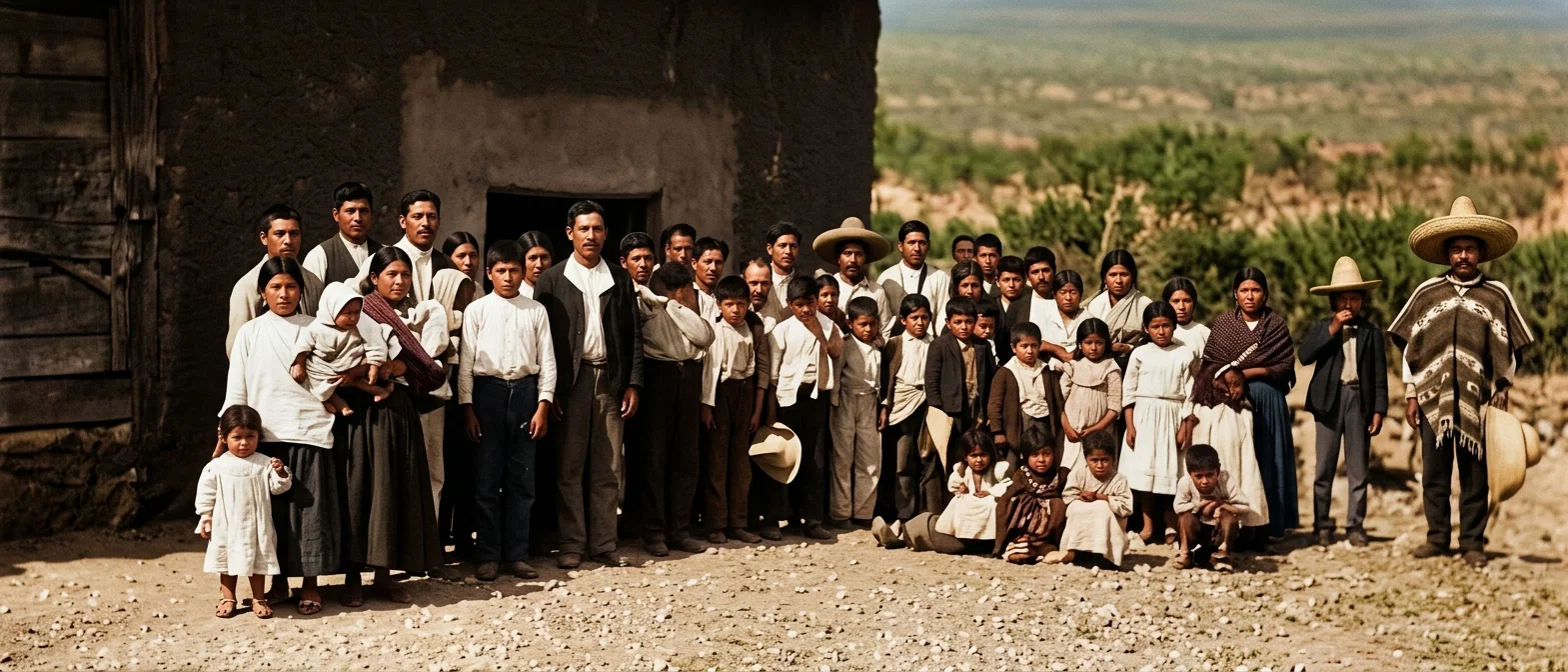
THE BELIEVERS IN VISNAGA, MEXICO
During the months of October and November it was my privilege to visit the companies and workers in the northern part of this republic. In San Luis Potosi I found the brethren of good courage. We now have here a good place for meetings. A school was opened last September, and is now paying its way. A teacher was obtained from College View, Miss Bertha M. Lewis, and she, with her sister, is engaged in the work here. The school consists of fifteen students, whose tuition pays the teacher's salary and the rent for the room. This school is for the benefit of the English-speaking children. It will be a help in giving us an influence and acquaintance with a number of the people. The teacher is studying Spanish, so that later she will be able to be of use in the Spanish work.
About fifteen miles in the country from San Luis Potosi, is a company of believers. I visited them, and held a few meetings. They all seemed to be of good courage, and there is an interest on the part of others to hear the truth. Some one ought to spend a few weeks with this company. They very much need a place in which to hold services, and we expect to erect a little chapel there soon.
In Moctezuma, less than two hours' ride on the train from San Luis Potosi, live a brother and his wife who, for a number of years, have been doing what they could to give the truth to their neighbors. During the five days I spent with them, we had good meetings, a number of their neighbors attending. I had the privilege of baptizing four at this place, so that we now have here a little congregation.
In Visnaga I had the privilege of dedicating a little chapel. We bought a small lot with a building on it. This we repaired, and it is now used for a place of worship as well as a school. There is no school here except ours. About fifteen boys and girls attend it. It did me good to spend a few hours in this school, and hear the bright little fellows read, and see their ability in writing and in number work. The teacher gets only seven dollars and a half a month, but I am sure the good that is being done is worth many times the amount of money spent in this enterprise. The building, with something like two acres of land, cost us two hundred fifty dollars. The brethren in Mexico, although very poor, paid fifty dollars; a brother gave twenty-five dollars; this, with a few other donations, reduced the expense for the mission considerably.
There is but little work for the brethren here to do except farming. The usual wage is only thirty-seven cents (Mexican) a day, and much of the time there is no work even at that. This year the corn crop was almost an entire failure. One brother supports himself, his wife and child, and his mother and a widowed sister, on only fifty cents (Mexican) a day. One can scarcely realize the poverty here. The brethren tried to make me as comfortable as possible, giving me the best they had, which was a few boards laid across some benches, and a very thin, short mattress. The bed was so short I had to make an extension with a box, then roll up in my blanket, and go to sleep.
At another place it was impossible to find a bed of any kind, so I was compelled to sleep on some sacks laid on the ground. I have learned to do as the Mexicans do, and so now carry a blanket with me, and by rolling up in this I am able to sleep almost anywhere. When one considers the poverty of these people, to give fifty dollars was certainly very liberal of them. They also paid for the bell, which cost twelve or fifteen dollars. Some of them gave the last penny they had in order to secure that.
There are some in this place who desire baptism, but have been waiting until the opposition of their relatives should calm down somewhat. We shall soon be able to baptize more. The work in Visnaga is mostly the result of the faithful labors of Brother A. Marchisio, who is now trying to look after the interests in San Luis Potosi, Moctezuma, Mexquitic, and Visnaga. The work is really more than he can do, and he must have help.
In Torreon I found the company still earnest and full of courage. While there, I baptized five persons; we also celebrated the Lord's supper. Brother Robles has been stationed at this place, and there is now a good interest to hear the truth.
In Gomez Palacio, about three miles distant from Torreon, and connected with it by a street-car line, is another company. A doctor, a Protestant, raised up quite a company here on his own responsibility. Our brethren found him, and began to teach him the truth. At first he did not care to hear, but later he became convinced and accepted all. He then asked us to preach the truth to his congregation. This we did. Brother J. F. Blunt began meetings; after that I visited them. When Brother Blunt returned to the United States, Brother Robles was sent to look after them. On a former visit I baptized two, and this time fourteen. We now have here a good congregation, with prospects that it will grow. The doctor desires to join us, and give his life to the work.
Central America
By D. C. Ross
D. C. ROSS, M. D.
(Concluded)
THE poorer classes in the city of Guatemala live in very close quarters, and often the very poor have no homes at all, but lie down where night overtakes them. They eat when they can, and though the food is not always the cleanest or best, they manage to exist.
Nearly every one has one or more servants. They do all the work. The very best get three or four dollars (gold) a month, and will work hard for that. Many do not know how to work, but are anxious to learn. They will easily save more than their wages if allowed to buy the food, as they can get better prices than those newly come to the country.
Living expenses are possibly a little lower than in the States. All foods shipped into the country are high; but there is enough of nearly everything raised in the locality to satisfy almost any one. Both fruit and vegetables are quite plentiful the year round, and very reasonable in price.
The school is prospering financially, and I believe it is doing a good work. The teachers are learning the language and the customs of the country, and they are certainly working faithfully. I found their lessons to be one of the main topics of conversation. If it is necessary to make any changes later on, these teachers will be able to take right hold where11they are needed, as they will have a good command of the language. The school is also having an excellent influence, and is making friends among its patrons, most of whom are of the better class. The influence of these Christian teachers is being felt by the children, and I have no doubt that we shall yet see a number of them in our ranks proclaiming this truth to their neighbors.
Guatemala is certainly a needy field. Workers who are fully determined to remain in the field until God calls them to leave are badly needed. Those coming to Central America can not begin work at once. Conditions are such that it takes time and study to get started right. It is a blessing that we can not speak the language at first. While studying that, we are unconsciously learning the ways of the people; and when we are ready to speak, we can go to work without making so many mistakes.
Central America is not an easy field; and if one is looking for something of that sort, it would be better to remain at home. But if one has a sincere desire to save souls, and really wants to work, there is plenty of opportunity to develop one's talents. If any who read this feel a burden to help this needy field, either with their means or by giving themselves, the secretary of the Mission Board would be glad to correspond with them. What I have seen has made me long for a closer walk with God than I have ever had before. My earnest desire is that I may be so filled with the Holy Spirit, and so purified from sin and selfishness, that God will continue to let me have some part in giving the gospel to the world in this generation.
Guatemala City.
Australasian Union Conference
By G. D. THOMPSON
(Concluded)
G. D. THOMPSON
WHILE the Wahroonga Sanitarium as a whole showed some financial loss, the medical department made an excellent showing. The sale of health foods has increased so that further facilities for manufacture must be provided. The work of the various other institutions and health food cafés is encouraging; all showed a balance on the right side of the ledger, and they are exerting a strong influence for the truth.
The treasurer presented a very clear and comprehensive report, showing the expenditures made in the home field and in each mission established among the islands. Missions are being sustained in the Cook Islands, Fiji Islands, Friendly Islands, Java, New Guinea, Norfolk, Pitcairn, Samoa, Society Islands, and Sumatra. There are, of course, several missions in some of these groups. The union conference raised for its work from all sources the past two years, about $93,500. Of this amount the Sabbath-schools alone gave about $17,700. The increase in the Sabbath-school donations in 1910 over those for the previous year was $5,500. When it is remembered that this is in a field where the total church-membership is only a little over four thousand, the increase is very gratifying indeed. Nowhere have I seen the Sabbath-school work carried forward so aggressively, and made so nearly what it should be, as here. The island fields have been kept before the schools continually, and much interest is taken by the schools in producing illustrations for the lessons, and brightening things up, and making the school interesting. At the same time the spiritual interest is not neglected.
One difficulty here, as elsewhere, is to find qualified laborers to answer the calls coming from the various parts of the field. There is a fine class of young people in the union. These are being trained for service, and are carrying heavy responsibilities; but the demand for workers is greater than the supply. A number, however, were chosen for various places in the islands. It was planned, if possible, to open work in Borneo, the Celebes, and the New Hebrides, where John Paton spent his life. These are important fields. Borneo is, I believe, the second largest island in the world, and has a large population. The others are also important fields, and the opening of our work in these places will mark an important step in the progress of the message. It is hoped that these fields may be entered at once.
The Missionary Volunteer Department is well organized. The work done is very encouraging. There were eighty-three societies at the close of the year; and during the biennial period just closed, they contributed to the foreign work nearly seven thousand dollars, a gain of about three thousand dollars over the previous biennial period. To say nothing of the inestimable spiritual blessings which have come to our churches and youth through the work of this department, the above figures are sufficient to show that the organization of the Missionary Volunteer Department was a wise step.
For some time the need of a paper in the Samoan tongue has been felt, and it was voted at the conference that such a paper be started as soon as possible. Some funds for this enterprise are already in hand, and no doubt the paper will soon make its appearance. It will be printed at the Avondale Press.
Pastor J. E. Fulton was unanimously chosen president for the coming term. Pastor E. H. Gates, who has been some twoscore years among the islands, was elected as one vice-president, and he will devote much of his time to caring for the work in the islands. The other vice-president can not at this time be definitely announced. Pastor A. H. Piper was elected secretary; Miss E. M. Graham, treasurer; and Brother C. H. Pretyman, auditor.
The call to work the cities met a hearty response in the conference. All saw in it a great evangelistic revival, a return to old-time methods of bringing souls to the truth. In this conference are found some of the largest cities south of the equator. Much has been done in these centers; but much still remains to be done, and plans are already being made greatly to advance this work.
The work of the conference was characterized by deep earnestness. A spiritual atmosphere was very marked throughout. Daily Bible studies were conducted, and during this period no committee meetings were held, but all the delegates came together to study the Word of God and seek for divine guidance. A number of studies were given concerning the work of the Holy Spirit, and our need of a great spiritual refreshing, that we might put forth stronger evangelical efforts than ever before to finish the work. God's Spirit came near to our hearts. There were perplexities, and some serious problems to solve; but the Lord helped us, and we had clear evidence of the leading of God in many things. A number expressed their great thankfulness for the way the Lord guided in the deliberations of the meetings.
This was one of the best union conferences I ever had the privilege of attending. I got a new view of the great scope of God's work in this part of the world. The brethren here are struggling with stupendous problems. This field is one of the most difficult in the world to manage, owing to the great scope of territory which it embraces. But the Lord has wrought great things for his truth here during the quarter of a century the message has been established. At great sacrifice, schools and sanitariums have been built, in which our young people can be trained to carry forward the work. Over four thousand believers have been gathered into the churches. There are no more faithful and efficient workers in any field than here, nor a more kind-hearted and loyal body of believers. Their hearts are in this work, and they love it more than their own lives, and are making great sacrifices to advance the message.
I have never seen delegates leave for their homes with more courage for the future, and the outlook for the advancement of the work is good. Let God's people everywhere remember the great Australasian Union Conference in their prayers. The work in this field, especially in the islands, can be carried forward only by sacrifice. Some fields are unhealthful and the climate is trying. Homes must be built for the workers. A number of homes have been provided, yet not enough. Some of the workers have already suffered loss of health for lack of a comfortable place in which to live. I think this conference has done more in that direction than any union I know of.
I appreciated very much the privilege of attending this conference, uniting with the delegates in council, and forming the acquaintance of so many of the believers.
Following the conference, I plan to attend the camp-meetings in Adelaide and Tasmania, and after spending some time with the conference president among the churches in New Zealand, I expect to return home.