The Youth’s Instructor, Vol. 38, No. 52.

CHICKADEE

The Youth’s Instructor

Dec 24, 1890

S. D. A. Publishing Association · Battle Creek, Mich. · Dec 24, 1890

CHICKADEE
WHEN grim old Winter shakes his beard, And all the world besprinkles With powdery flakes to hide dead leaves And dear Dame Nature's wrinkles, Still merrily pipes chickadee, "Old Winter's warm at heart," sings he.
The wind screams through the garden drear, The naked bushes shiver; Chained in the marshes still and bleak Is the light-footed river: "Cold days must be, chickadeedee, Old Winter's warm at heart," sings he.
The rude gales beat his pretty wings, He has no cozy shelter, The pitying children's gift of crumbs The winds blow helter-skelter. But, "Chickadee, chickadeedee, Old Winter's warm at heart," sings he.
He seems as glad of one sun-ray, As spring bird of new blossom, He rests upon an icicle His brave and bonny bosom: Still full of glee, "Chickadeedee, Old Winter's warm at heart," sings he.
Till listening through the windowpane These mornings chill and dreary, Folks 'gin to think less ill of him Who has a friend so cheery. "Cold days must be, chickadeedee, Old Winter's warm at heart," sings he.
These frosty months bring Christmas fair, We muse with memories loving, And home to the fire-lighted hearth, Lead back the feet long roving, And tenderly with chickadee, "Old Winter's warm at heart," sings he.
—Harper's Young People.
THE JIN-RIKA-SHA.
THE JIN-RIKA-SHA.

ROUND THE WORLD.—41.

IN THE HEART OF JAPAN.

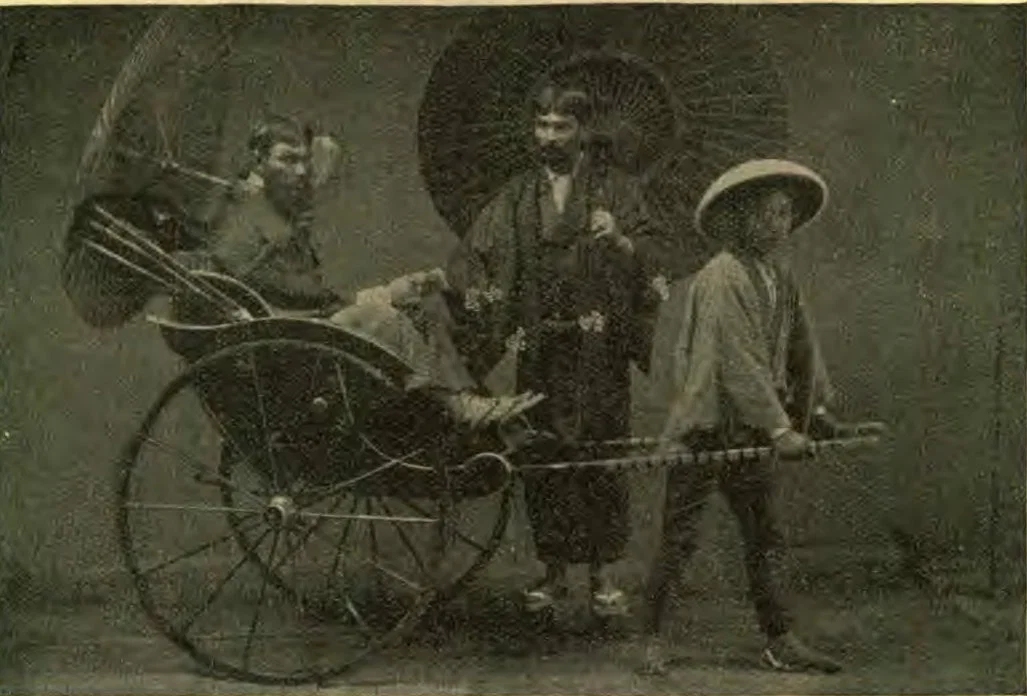
There is yet one more of the “Things Japanese” which we must mention, before we proceed on our journey into the heart of Japan. It is the pride of Japan, the jin-rika-sha. It is the conveyance of the country, and is pulled by a sturdy little Jap. The engraving shows what it is like, so there is no need to describe it further. Most of them are built to hold only one, but some are large enough to carry two. A good jin-rika-sha man will travel as fast as an ordinary pony, and keep it up for several hours. It is reported that one can go over forty miles in a day. But this we doubt, as we had a good chance to try them up-country, and did not find that their staying powers were nearly so good as that. They will run well on a stretch for two or three hours, but after that their speed is very light. They have adopted a European form of dress instead of the long, flowing kimono, which would not make a very good racing costume. No whip or reins are needed, but a walking stick is a very helpful thing to steer them with, when you cannot talk a word of the language. A touch on one side or the other indicates the way to turn, while a poke means to stop. Sometimes they run tandem, and often there is one to push behind. At night they carry paper lanterns with their numbers printed thereon. Often a name is also affixed, such as “Tame,” “Frisky,” and many other such epithets.
Yokohama, the metropolis of foreigners in the Island Empire, has been getting very hot, and the inhabitants are growing very lazy. Sights and sounds at first novel are becoming monotonous, and so for variety’s sake, and to learn a little more about the people and their country, a trip has been planned to the mountains.
At ten A. M., one fine morning in the month of June, we start off on the cars for a place bearing the unpronounceable name of Utsomomiya. For awhile we skirt the edge of Yeddo Bay at the rate of eighteen miles to the hour. It is not very fast, but considering that rika-sha exercise is the fastest kind of locomotion we have been used to for some time in the past, we will not complain. Then we turn inland, leaving behind all men of our color and blood, and coming among those who are Japs pure and simple.
It is not a very pleasant thing to realize that you are the only white man for miles and miles around, that you cannot speak a word of the current language, and that those whom you meet are ignorant of your tongue. Such was my lot.
The country is level for most of the way. There is nothing much to be seen. Rice-fields and tea-gardens seem to occupy most of the space, but a description of them must be left for some other time. At last the end of the main line is reached, and we change onto a new branch, which will take us part way up the mountains. At thirty minutes past four, we are deposited in a pouring rain at Imaichi. This little village is five miles from Nikko, our destination. There is nothing for it but jin-rika-sha, so with two coolies we start. After awhile it clears off a little, and we let the top down so as to the better take in the scene; for a Japanese proverb has it, “Use not the word ‘beautiful’ till Nikko thou hast seen.” The rain is still falling, but it does not seem to wet us; perhaps, like the Irishman, we are going between the drops.
Soon we enter the Empress Avenue. It is some twenty-one miles long, and we have seen it stated by some authors much longer than this. At Nikko is the shrine of the great Iyeyasu, and once, long ago, the daimios (princes) were bringing their gifts. One was poor, and had no rich lacquer to offer, like his fellows, so he planted the beautiful avenue instead. His gift has lived, and theirs have long since moldered in the dust.
Entering this avenue, we see above us the heights of Nikko, “like sleeping kings,” and at their feet rest the great shoguns Iyeyasu and Iyemitsu. The flat-crested giant which overtops the rest is Nantai-zan, 8,196 feet above the level of the sea.
In the wide world there can hardly be a region of more solemn grandeur than Nikko. Nature here seems ever to sing a Gregorian chant, to which the many waters around and above contribute their various parts, from the thundering cataract to the silvery rill; and the great, somber forests send forth their incense of pine; while the great mountain gods above sit from age to age unchanged, their rugged heads clear against the blue vault of heaven, or hidden beneath the folds of enswathing clouds.
Each side of the spacious highway is lined with majestic cryptomerias, varying from 100 to 150 feet in height. The rows of massive perpendicular trunks, with their branches converging above, produce at many points the effect of a vast cathedral aisle. Through these glorious vistas, between the over-arching boughs and the shadow-dappled road, we get glimpses of the shingled roofs of villages, and as we near the sacred region, of the blue, wrinkled summit of Nantai-zan, or of the more gently-sloping foot-hills. And this superb avenue is in honor of the great chief whose remains were interred fully two and a half centuries ago. At the village of Nikko we alight, and commence to tramp, as the road is heavy after the rain, and the coolies are tired. Above us are the mountains, where nature seems to have glorified herself with these mighty ranges, of which glorious Nantai-zan is king, his feet laved by the blue splendors of Lake Chiuzenji, in which his mighty form is mirrored. Nikko means “Sunny Splendor;” and through Japanese poetry and impassioned rhetoric ever sparkle the glories of the morning’s mirror in Chiuzenji, and the golden floods of light which bathe Nantai-zan.
Having passed up the long street of the village, we come upon a little ravine, through which rushes an impetuous river. It bears the name of Daiya-gawa. On the opposite side is an immense grove of aged cryptomerias; and it is in the eternal twilight of this that the shrines are situated. Two bridges cross the stream, one coterminous with the road, and the other a few yards further up. The second is like the other, of wood, but it is a more artistic structure, and is colored a deep red; both ends are closed, for none save the emperor himself may cross it. The legend has it that many years ago a noted worthy came to the river. It was greatly swollen, and there was no bridge for him to cross on. He prayed to the gods, and in response there appeared this red lacquer bridge, which is now looked upon as very sacred.
We enter the sacred grove. After ascending a broad avenue with occasional steps, and bordered by stone embankments, we pass under a granite torii twenty-seven feet six inches high, with columns three feet six inches in diameter, beyond which are one hundred and eighteen magnificent bronze lanterns on stone pedestals, and with a richly carved and painted pagoda of five stories, rising one hundred and four feet on the left.
Here we find ourselves at the foot of the steps leading up to the entrance of the great temple of Toshogu, dedicated to Iyeyasu, and unequaled in Japan for gorgeousness.
It would be vain to enter into anything like a detailed description of this masterpiece of Japanese architecture. At the first visit the mind is simply dazzled with the splendor, and retains little beyond a general impression of black, fluted, curving roofs, heavily bordered with gold, and overshadowing gables, carved with hundreds of quaint designs, in high relief, and of every shade and color; elephants, pheasants, doves, dragons, trees, and flowers innumerable; of gateways one mass of decoration, leading to neatly paved courts, with massive stone steps and pavements; of gates of solid, cunningly wrought bronzes; of palisades, almost outvying in their carvings the gilding which they surround; of interiors with lacquered floors, and beautifully lacquered ceiling, and marvellously gilt and colored screens,—an utter lavishness of color, and yet nothing but perfect harmony in the blending of it; and of all this within the folds of a grove whose solemn trees add the finishing touch to the triumphs of art which they imbed.
Such is a meager sketch of the temple reared to Iyeyasu. But it is not within this shrine that the bones of the hero are laid. A staircase of solid stone ascends, with two hundred and forty steps, behind the Toshogu temple. An impressive stairway it is, moss-covered, and flecked with the shadows of the stately cryptomerias amid which it winds. Its goal is a bronze urn, surmounting a plain but massive tomb of stone and bronze, and it is here that the dust of Iyeyasu lies.
It would take too long to tell how we ascended the gorge of the Daiya-gawa, beneath the frowning precipices of basaltic rock, and climbed the winding road to the pass of Chiuzenji, getting wonderful views of rocks and peaks and forests and waterfalls. At the top of the pass lies the lake Chiuzenji, with the steep, forest-clad slopes of Nantai-zan immediately above it. There it lies, so calm, so peaceful, and so pure. Surrounded on all sides by mountains, it looks like a mirror of silver in which their sentinel forms are reflected. It reminds one of a loch in the Scottish highlands; but few of them, however, can compare with it for beauty.
But time is waning fast, and although we would fain spend many days more in this lovely spot, we become painfully convinced that it is best for us to go. Soon we bid it farewell, bound once more for the seaport and the leviathans of the deep, to return to China.
At present the weird, mystic bells of Buddhism are heard on in the mountains and plains of Japan, but God speed the day when the Christian bells of “Glory to God in the highest, and on earth peace, good will toward men” will take their place. P. T. M.

Pattie's Christmas Flowers.

“Faith, and that's the quarest little crathur upstairs that ever I saw,” said Mrs. Sullivan to her neighbor. “Sure, and the poor crippled thing wor down in the cellar, when I went in, diggin' up a bit of a green sprig of a thing, as though she'd found a mine of gold. And her a-bobbin' around on her crutches, an' singin' a bit of a song about it.”
Mrs. Sullivan was an Irish washer-woman who lived in a room in a tenement house in Chicago, and above her lived Mrs. Matthews, a widow lady, and her crippled daughter, Pattie. Mrs. Matthews eked out a bare living as a clerk in a store. They had seen better days before Mr. Matthews' death and Pattie's fall. Once they had a fine home, full of beautiful things, and a conservatory filled with flowers, that were Pattie's delight. But now Pattie had to stay alone all day long, and hobble around on her crutches as she could, and sing to herself. She had a happy faculty of looking on the bright side; she made a piano of the window-sill, and played and sang by the hour. She made brown paper bonnets for her dolls, and trimmed them with bits of cotton and moss from the firewood, and when she grew tired, she looked up at the patch of blue sky, and thought about God and and the sweet, sweet heaven that mamma had told her about. She watched the children playing in the streets, and laughed with them in their glee, with never a thought of repining that she had no part in their pleasure, but was only a poor cripple, who had few to love her.
But now she had found a new treasure, a beautiful sprig of green that she had found growing in the cellar, stretching up toward the light, “so brave,” said Pattie. “And now darling,” she whispered, “you are going to live with me, and teach me how to be brave too.”
Pattie found a tiny jar in the cupboard, and set her plant in it. And oh, how it grew from day to day, putting out beautiful little feathers of green! The days grew dark and cloudy, and it was Pattie's sky and sunshine to see her darling plant grow.
Her mother had smiled as she saw her plant, and then sighed, and wiped the tears from her cheeks, as she thought of the rows on rows of beautiful flowers she had passed in the windows on her way to work, and had wished so much she could buy for Pattie.
“O Mrs. Sullivan!” cried Pattie, one morning, “won't you come up and see my little beauty? The plant I got down in the cellar has grown into a flourishing flower.”
Mrs. Sullivan wiped the suds from her hands, and came up. “Faith, it is a love of a thing,” she said; but on examining it closer, she burst out into a hearty laugh.
“Why, Pattie,” she exclaimed; “sure, and it's nothing but a bit of a turnip. And is it a farmer you're going to be, that you're into cultivatin' vegetables? You better be after plantin' potatoes and cabbages next. Why, law, deary, is it crying ye are? Faith, Pattie, and I wouldn't hurt ye for the world.”
“It's only a turnip, only a turnip,” sobbed Pattie, “and here I've dreamed everything about it, what flowers it would have in the spring,—but I shan't care for it any more.”
“Never mind, darling,” said Mrs. Sullivan. “Sure, and it's a lesson we have to be learnin' all through our lives, that things are different from what we think they be. For instance, there's that fine lady, Mrs. Atkins, who gave me a pile of white skirts to be doin' up for her, and when I carried them home, she jewed me down, instead of payin' handsome for them, as I thought she would. But never mind, Pattie. Just wait a bit. Mum's the word, darlin', till I see what I'll do for ye.”
It was a week before Christmas, and everywhere Mrs. Sullivan went, she told of the poor cripple, and laughed over her turnip. She had no thought of the seed she was sowing. It was only out of her good-natured soul that she poured out in sympathetic utterances the story of Pattie and her widowed mother; but in every place where she told this story, at the homes of the rich, some one was stirred to sympathy, some one took Pattie's name and address.
After Pattie's awakening to the real character of her flower, for awhile she would not look at it without a pang of sorrow. It seemed too cruel, that after all her dreaming, it should only be a bit of a vegetable, but gradually she grew to love her flower afresh.
“I don't care,” she said, “if it is only a turnip, it has done its best to make me happy. It's been a friend in need, and that's a friend indeed, isn't it, mamma?”
“Yes,” said mamma; “it has sent up all its feathers of green, and given you all its little life, and really it is just as pretty as though it had a more beautiful name. If we only try to please God as well, he will give us a place in his rich garden by and by.”
And so Pattie grew to love her flower with a new thought of affection. “Why, forgive me, dear,” she said, “for feeling so mad at you. I'm nothing but a poor little turnip myself. You see I am not at all like the pretty children outside who can skip around. I am just a little thing growing in the dark, but I am going to grow just as beautiful as I can, so as to make others as happy as possible. We'll just grow together, and try to help each other, and by and by, perhaps God will make us over into lilies or roses.”
When Christmas morning came, Mrs. Sullivan knocked at the door, holding in her arms a large geranium, full of scarlet flowers. “There ye are, Aéushla,” said Mrs. Sullivan; “Faith, and if ye throw away that ugly bit of a turnip, I'll give ye this queen of a flower.”
Pattie looked at it with longing eyes, and fingered its beautiful leaves. The big tears came to her eyes, but she shook her head. “No, dear Mrs. Sullivan. Thank you, I love my turnip best.”
“What a quare little budget ye are,” said Mrs. Sullivan. “Bad luck to ye! And won't ye throw away that bit of a vegetable for a handsome thing like this? And me goin' and spendin' my hard-earned wages to make a present to ye!”
“Oh, how I should love to have it,” said Pattie; “but I never, never can throw away my turnip. How would the poor thing feel? And suppose God should do the same way with me? I love my turnip, and I must give up the geranium, if I must choose between the two.”
Mrs. Sullivan went away angry, with a face as red as her flower, and Pattie choked back her tears of disappointment.
Pretty soon some one knocked at Pattie's door. When Mrs. Matthews opened it, she found a great monthly rose in blossom, and a card on it, on which was written, “Merry Christmas to Pattie.” Then one after another came, children, and ladies stepping out of grand carriages, and colored boys, with blue suits and brass buttons, all bringing flowers in pots and bouquets, till Pattie's room was gay with plants. Mrs. Sullivan's story of Pattie had circulated from one to another, and somehow everybody who heard of it wanted to help the little cripple who could take comfort even in a turnip. Pattie laughed for joy, and sang, and hovered over her flowers like a little humming-bird.
Late Christmas night, Mrs. Sullivan came up again with the geranium. “The saints preserve us!” she exclaimed, looking at Pattie's plants. “And shure, did hivven take a vengeance on me, raining ye down all these flowers, when I refused ye the geranium? Shure, I was that mad, because ye wouldn't throw away yer turnip for the geranium, that it took me the live-long day to get over it. But, faith, when I came to think of it, I saw that it was a good thrait of character in ye, and I just reasoned with myself that ye'd be one of the kind that would kape thrue to a homely friend, no matter if finer ones come to claim yer attention. And I said, ‘Shure, and I'll just add my geranium to Pattie's farm and garden.’”
Several ladies called on Pattie the next week, and Mrs. Matthews found a better place through their kindness. Pattie was taken to a skillful physician, and her lameness was cured, and then she devoted her time to her flowers and to music, for which she had a rare gift.
“It seems as if it was next to living with the angels, to be among my flowers,” said Pattie. “They teach me so many beautiful lessons of God's love and patience and sweetness.” Pattie sent her flowers here and there, with delicate messages that breathed a sweet fragrance. She sang by the beds of the sick, in the homes of the lowly, and sought to be a good steward of the precious gifts that God had given her. She was always working for poor children, and kept a little sprig of turnip among the flowers in her conservatory.
“'Tis because I was true to my little trust,” said Pattie, in answer to a question about her odd plant, “that God gave me a rain of flowers one time; and so it is always,” she said, with a smile, “I have proved it over and over. ‘To him that hath shall be given.’ I keep a little sprig of turnip, just to remind me that ‘He that is faithful in that which is least,’ will have a chance to be faithful in that which is greater.” FANNIE BOLTON.

The Ease of Fault-Finding Versus Doing Good

NOTHING is easier than fault-finding. No talent, no self-denial, no brains, no character, are required to set up in the grumbling business. But those who are moved by a genuine desire to do good have little time for murmuring a complaint.—West.

To Thine Own Self Be True

“To thy own self be true; it doth follow then thou wilt be true to every man.”

SELF-RELIANCE

HENRY WARD BEECHER used to tell this story of the way in which his teacher of mathematics taught him to depend upon himself:—
“I was sent to the blackboard, and went, uncertain, full of whimpering.
“‘That lesson must be learned,’ said my teacher, in a very quiet tone, but with a terrible intensity. All explanations and excuses he trod under foot with utter scornfulness. ‘I want that problem; I don’t want any reasons why you haven’t it,’ he would say.
“‘I did study it two hours.’
“‘That’s nothing to me; I want the lesson. You need not study it at all, or you may study it ten hours, just to suit yourself. I want the lesson.’
“It was tough for a green boy; but it seasoned me. In less than a month I had the most intense sense of intellectual independence and courage to defend my recitations.
“One day his cold, calm voice fell upon me in the midst of a demonstration, ‘No!’
“I hesitated, and then went back to the beginning, and on reaching the same point again, ‘No!’ uttered with the tone of conviction, barred my progress.
“‘The next!’ and I sat down in red confusion.
“‘He, too, was stopped with ‘No!’ but went right on, finished, and as he sat down, was rewarded with, ‘Very well.’
“‘Why,’ whimpered I, ‘I recited it just as he did, and you said “No.”’
“‘Why didn’t you say yes, and stick to it? It is not enough to know your lesson; you must know that you know it. You have learned nothing till you are sure. If all the world says no, your business is to say yes, and prove it.’”

CHRISTMAS DIALOGUE.

Belle. Pray do you remember, sweet sister, That Christmas is almost here? And you know it is quite an event, love, For it comes only once in the year. I wonder if you, too, are anxious And eager as I am, my dear?
Minnie. Why “anxious” of course, little sister, For I’m almost as sure as I live That mamma has lots of nice presents That she is just waiting to give, And I know she’s as willing to give them As you and I are to receive.
Belle. I hope there’s a big waxen dolly For each of us, Minnie, you know, All done up in lovely white dresses, With a sash and a ribbon and bow, And a nice dainty muff and toboggan To wear in the cold and the snow.
Minnie. Oh, yes, little sister, but truly I’m afraid we are selfish, my dear; For you know there are many poor children Whose homes are so lonely and drear. Don’t you think we might sacrifice something To add to their comfort and cheer?
Belle. Why, yes, I am glad you have spoken; I am always so thoughtless, you know; There is poor little Annie, the cripple, And Billy, and Susie, and Joe. They say that their father’s a drunkard, And that is so dreadful, you know.
Minnie. Let us have mamma give them our presents, We really don’t need them, you see; And I know it would make them so happy, They would shout in their gladness and glee; And Christ says, “Inasmuch as ye’ve done it To the least, ye have done it to me.”
Both. It is best we should give unto others, For Christ gave his life for mankind; He went about healing the cripples, And giving sweet sight to the blind. Ah! the Beautiful Babe in the manger Was God’s precious gift to mankind.
MRS. L. D. A. STUTTLE.

JULIETTE

Did you ever own a nice horse, who was full of fun and mischief, and whose eye seemed to have a laugh in it? Let me tell you about such a one. She was as black as jet; she had a white star in her face, and a white stocking on her left hind foot. She was round and plump, and very quick in her motions. She could trot, rack, pace, and run, and under the saddle was a charmer. Her name was Juliette. As a colt she took the lead in mischief.
She could untie a bow-knot even when the end of the strap was put through the bow, and drawn up tightly. But she was not so foolish as to do this when there was no occasion. But omit feeding her when the other horses were fed, and then step out of the barn for a few moments; suddenly return, and she would be found untied, and in a stall with another horse, helping herself to his grain. She had three associates whom she led into mischief in the night. She would open the barn door, which was fastened with a hook and staple; open the barnyard gate by drawing out the pin that held it. She would let down the bars with her teeth, and lead her three trusting companions into the grain-field. There they would be found in the morning, while she had returned to the barn before the boys were up. She had such an innocent look when she had been on these excursions that it would call forth one’s admiration. When I rode her to bring back the colts, she seemed to know what we were after. She would go quite direct to where those wicked colts could be found, and we would chase them home in a hurry.
One night a mysterious noise was heard at the barn. Horse-thieves were not unknown, and, as we had the best horses in the neighborhood, great anxiety was felt. Father drew himself softly out of his warm bed. Revolver in hand, he went carefully and quietly out of the house, followed by a courageous bull-dog.
You can imagine his astonishment when, instead of finding horse-thieves, he found Juliette, standing with the raised pump-handle in her mouth, trying to pump water; while the three colts, with unbounded confidence in her ability, stood at the trough watching her with expectant eyes.—Chilion B. Allen.

JEANIE'S FAITH.

LITTLE Jeanie was a Scotch lassie. She lived on the edge of a wide moor which stretched away in the distance like an unbroken sea of tall grass and purple heather.
A splendid playground it made for the little girl, although a lonely one. She had no brothers or sisters, and no neighbors lived very near, so she had no companions to share her sports.
She never thought of being lonely in summer, when she made friends with the little birds, and listened to their sweet songs, but sometimes in winter she was tempted to wish she did not live so far away from all neighbors.
One day late in November, when the air began to grow cold with the breath of approaching winter, Jeanie's father fell ill. At first his wife did all she could to relieve him; but, as his fever increased, and his cough became more incessant, she lost faith in the simple remedies she had been applying, and wished that she might consult the doctor.
How to send word to him was the question that perplexed her. She could not leave her husband, for he needed her too much, and she was afraid to let little Jeanie start out on such a long walk alone.
“I am not afraid, mother,” insisted the child. “Do let me go, and perhaps I can bring back some medicine that will make him better.”
The mother hesitated. It was a long walk, but the sturdy little maiden had often walked four miles before without being overwearied, and she could come back with the doctor.
The noonday sun swung high in the heavens, so she was sure that Jeanie would have time to go and return before nightfall, and she gave her consent.
Proud of her responsibility, Jeanie bade her father and mother “Good-by,” and hastened away, looking back to throw a kiss before her mother closed the door.
The air was clear and cold, but Jeanie was so warmly wrapped in her plaid that she did not heed it. The sky was becoming darker as she went on, but she did not mind it until a snow-flake whirled before her eyes.
“Oh, the first snow has come!” she cried in delight; and soon the air was full of feathery, whirling snow-flakes.
“I am glad I am so near the doctor's house,” she thought, as they fell thicker and faster. “It would not be pleasant to walk all the way back in a storm.”
She was very tired, though she would not admit it to herself, when at last she reached the doctor's house, and rapped for admission. A woman opened it almost before the sound of the old-fashioned brass knocker had died away.
“The doctor is out,” she said, in answer to Jeanie's query; “he may not be back till evening. Who do you say is sick?”
Jeanie told her, and then, as the door closed, she turned away with a swelling heart. She was so tired that her feet fairly ached, and the long homeward walk was yet before her.
It never occurred to her to ask if she might rest till the doctor came, and so she set off at once on her return journey, while the snow-flakes whirled about her as if they were trying to have a game with her.
Very slowly and wearily the little feet dragged themselves along, and poor Jeanie wondered whether they would ever be able to carry her home.
She toiled on until she had accomplished about half her journey; then the short winter twilight closed around her, and she sank down on the snow-covered ground to rest for a little while. She was so cold that her feet and hands pained her, and the stinging sensation brought tears to her eyes.
With a little sob she gathered her plaid closer around her. She would never go home again; she would have to perish here alone in the dark and the cold; there was no one to help her. Oh, but there was a Friend at hand! Suddenly she remembered who it was that is a refuge in time of trouble, and, kneeling, she clasped her hands, and prayed, “O God, please send some one to take me home, for Jesus' sake. Amen.”
Then she waited and listened, with a child's trusting faith that her prayer would be speedily answered. Nor was her faith unrewarded, for in the distance she heard the sound of a horse's hoofs rapidly approaching, and as they drew near her, she called loudly lest they should pass her.
A cheery voice answered, and in a few moments more the doctor's strong arms had gathered up the little snow-covered figure, and wrapped it in a warm robe.
“God sent you, didn't he?” said Jeanie, when she had told him how tired and cold she had grown, and how she had despaired of reaching home.
The doctor told her that when he had returned home at an earlier hour than he had expected, his servant had told him of Jeanie's call.
“I was afraid you would get lost in the snow, so I hastened to overtake you; and I was not any too prompt, for you would soon have frozen to death lying there in the snow. Yes, little one, God sent me to you, and you did well to trust him to care for you.”—Minnie E. Kenney.

GOD KNOWS THE WAY.

Two little children were returning with their father from spending an evening with some friends at a distance. They stayed longer at their friend's house than they had at first intended. The shades of the evening had fallen, and night was coming on, and before they had proceeded far, a heavy curtain of murky clouds seemed drawn about them. They had to cross a moor, pleasant enough in daylight, but not so pleasant with darkness around. A silence fell on all; the father, busy with his own thoughts, took a little hand in each of his, and pressed forward.
“Johnny,” whispered Amy’s timid voice, in her brother’s ear, “are you frightened?”
“No,” replied the little man, “not at all.”
“Why, Johnny, it is awful dark,” again murmured the timid voice, this time almost with a sob.
“But, you see,” returned the boy, confidently, “father knows the way.”
The father had heard the low conversation, and stooping down, he lifted Amy into his strong arms, while he clasped his boy’s hand more tightly.
“Thank you, my children,” he said, “you have taught me a lesson. I, too, am going home to my father’s house above. It is but a little way, yet often dark and dreary, so that my heart gets afraid. Still, it is the best path, and when I get home, I shall be constrained to declare: ‘He led me by the right way!’”
As Amy’s mother laid her down to rest that night, the little girl murmured, very contentedly: “Mamma, I was not one bit frightened when I remembered that father knew the way.”—Selected.
Continue reading: THE EPISTLE OF JAMES