The Youth’s Instructor, Vol. 31, No. 36.

CORINTH

The Youth’s Instructor

Sep 5, 1883

S. D. A. Publishing Association · Battle Creek, Mich. · Sep 5, 1883

CORINTH

Written for the INSTRUCTOR.

CORINTH

LET every one who intends to read this article get his atlas and find the map of Greece. You will notice that about midway north and south, the country is cut nearly in two by the waters of the Ægean and Ionian seas. The lower part is thus made a peninsula, which is joined to the mainland by a narrow isthmus, ten miles long, and from four to seven in width. On this neck of land was situated the celebrated city of Corinth, with its two seaports,—Cenchrea, some eight miles distant on the eastern coast, and Lechæum, on the western coast, about a mile and a half away.
The situation of Corinth was one of the finest in all Greece. From its location we readily see that all the land traffic to and from the lower peninsula must necessarily have passed through Corinth. This, with the advantages of its two seaports, made it a very important commercial city. The town was built on a high tableland just at the foot of Acrocorinthus, a mountain which towered on the south, and overlooked the city spread along its northern base. This mountain rises 2,000 feet above the sea, and the ascent is so circuitous as to make the distance four miles. On the top was situated the citadel of the town, which is said to have been the strongest fortress in Greece. The sides of the mountain are so steep and precipitous that a few soldiers could hold the castle against a whole army. The prospect from this height is said to be one of the finest in the world.
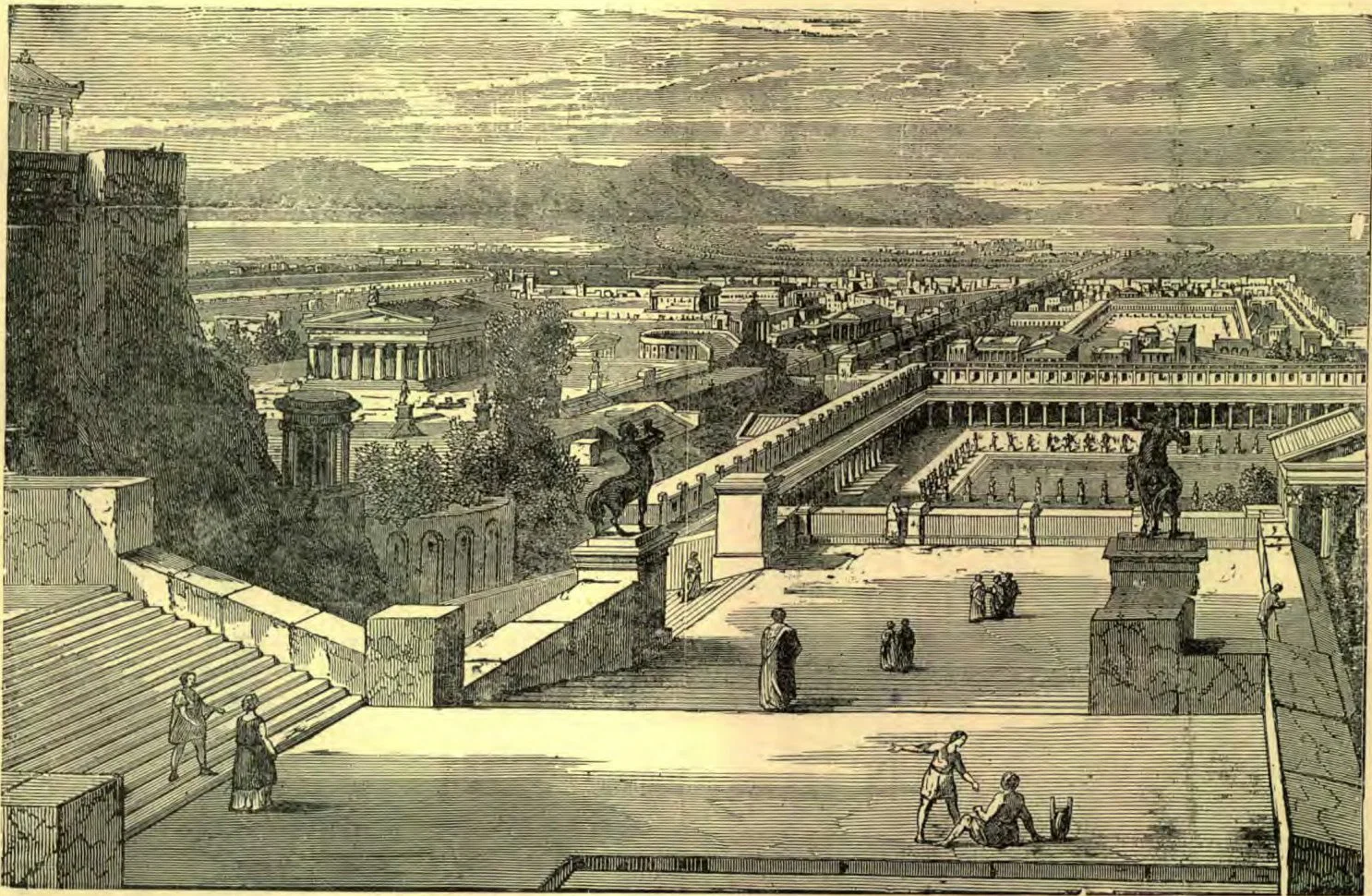
Corinth was five miles in circumference, and where not sufficiently defended by nature, was fortified by a wall. In the year 268 B. C., this city, then in the pride of its glory, was taken by the Goths, and the town and the citadel on Acrocorinthus were burned. The numerous statues with which the sides of the mountain were studded, were melted by the fierce heat, and afterward formed the celebrated Corinthian brass. The town lay thus in ruins for one hundred years, when Julius Caesar had it built afresh, and peopled it with a Roman colony. It soon became as rich and populous as ever; and as is almost always the case with people and empires, with plenty came pride, luxury, and corruption, until Corinth had the reputation of being the most dissolute city in Greece. It had temples to Venus and Neptune, and other heathen deities. Some of these buildings were very magnificent. In the picture on this page is shown the splendid temple of Venus, adorned with armed statues of the goddess. It is surrounded by a row of massive pillars, and looks considerably like the Parthenon, or temple of Minerva, on the Acropolis at Athens. The magnificent open courts shown in the forefront of the picture are probably theaters for some of the numerous feats, wrestling matches, and contests, of which the Grecians were so fond. The view here given is said to be a good representation of ancient Corinth as seen from Mount Acrocorinthus.
To the left of the temple may be seen the stadium, a place prepared for the national games and races, for which Greece was so famous. These stadiums were common in nearly all Grecian cities, but that at Corinth was quite a famous one. An open space was laid out, generally from 600 to 700 feet long and one-third as wide, and rounded at one end. Around this was built a wall, but no roof covered it. On each side of the inclosure ran an ascent, or kind of terrace, covered with seats and benches, upon which were seated those who came to witness the games and races that were carried on in the center. At one end was the starting point; at the other, the goal. Opposite the goal, on one side, were the seats of the judges; and on the other, an altar for priestesses, the only women allowed to be present. The stadium was named from stadium, a Roman measure of 607 feet, which was originally the prescribed distance round every race-course. Crowds attended these contests, among whom were the most distinguished men of the nation.
The city was still in the days of its prosperity, in A. D. 52, when the apostle Paul made the visit to Corinth recorded in Acts 18. Here he tarried for a year and a half, preaching to both Jews and Greeks the gospel of Jesus Christ, laboring with his hands, meanwhile, to support himself. He here found friends in Aquila and Priscilla, at whose house he made his home, and with whom he worked at the humble occupation of tent-making. His preaching must have been somewhat successful; for we read that “many of the Corinthians, hearing, believed and were baptized.” And at one time, when Paul was almost discouraged because of the treatment he had received from the Jews there, the Lord appeared to him in a night vision, and told him not to be afraid, but to speak boldly, and hold not his peace; “for,” said the Lord, “I have much people in this city.”
While at Corinth, Paul wrote the epistles to the Thessalonians, and during another visit there, the epistles to the Galatians and Romans. He seems to have felt a very tender and fatherly regard for these Corinthians. In the years 59 and 60 A. D., he wrote two letters, or epistles, to the church at Corinth, in which he once and again refers to his stay with them. It is interesting to notice how many figures of speech the apostle obtains from the habits and customs of these people with whom he was so long associated, and especially from the public games and contests which formed so important a feature in the social life of Corinth and other Grecian cities.
So in Heb. 12: 1 the Christian warrior is compared to one who takes part in the public foot races. The throng of spectators is the “so great a cloud of witnesses.” As the athlete lays aside his clothes, and everything that would impede his swiftness, so must the Christian “lay aside every weight,” and “run with patience the race that is set before” him. And in Phil. 3: 13, Paul “presses toward the mark [the goal] for the prize [the victor’s wreath] of the high calling of God in Christ Jesus.” These are but a few of the beautiful figures which will appear in Paul’s writing, to those who care to trace them out.
The former glory of Corinth has passed away. There remains among the ancient ruins a poor little village called Gortho; but few signs of thrift or enterprise are to be seen. Only the Mount Acrocorinthus rises just as grandly as when it looked on the proud city at its feet, and still abundant on the shore are the small green pine-trees which gave the fading wreath to the victors in the games. Those perishing crowns have passed away with the men who wore them; but the “incorruptible crown” of which Paul wrote unto the Corinthians (1 Cor. 9: 25),—that “crown of righteousness, which the Lord, the righteous Judge” will give at the great day, is still laid up for all those who shall come off conquerors in “the race that is set before us.” E. B. G.

HARVEST TIME.

When on the breath of autumn breeze, From pastures dry and brown, Goes floating like an idle thought The fair whistle-down, Oh, then what joy to walk at will Upon the golden harvest hill!
What joy in dreamy ease to lie Amid a field new shorn, And see all round on sun-lit slopes The piled-up stacks of corn; And send the fancy wandering o’er All pleasant harvest-fields of yore.
I feel the day—I see the field, The quivering of the leaves, And good old Jacob and his house Binding the yellow sheaves; And at this very hour I seem To be with Joseph in his dream.
I see the fields of Bethlehem, And reapers many a one, Bending unto their sickle’s stroke— And Boaz looking on; And Ruth, the Moabite so fair, Among the gleaners stooping there.
Again, I see a little child, His mother’s sole delight,— God’s living gift of love unto The kind, good Shunamite;— To mortal pangs I see him yield, And the lad bear him from the field.
The sun-bathed quiet of the hills, The fields of Galilee, That eighteen hundred years ago Were full of corn, I see; And the dear Saviour takes his way ’Mid ripe ears on the Sabbath-day.
Oh, golden fields of bending corn, How beautiful they seem! The reaper-folk, the piled-up sheaves, To me are like a dream. The sunshine and the very air Seem of old time, and take me there.
—Mary Howitt.

Satan’s Chain.

While coming from our Sabbath-school room, I heard two boys before me, talking.
“Wasn’t it strange what our teacher told us this morning about Satan’s chain?” said Charlie.
“Yes,” replied Jimmie, “but I know it is all true; and I tell you I don’t want him to get too strong or too long a chain around me.”
“Nor do I,” said Charlie, “but I never thought Satan could slip such little things into his chain for links. How can a boy help getting mad when others tease him, as some of those chaps at school do me?”
“Miss Seymour said, ‘getting mad’ is one of Satan’s best links, and that he is glad to have us use it; for then he is sure we will soon want others.”
“That is true; for when I am mad, the bad words slip from my tongue before I know it, and I often feel just like hitting somebody, too. The other day I hurt little John Miller just because I lost my temper, but he was so provoking! There were three links slipped into the chain for me that day.”
“I believe we boys have more links added to our chains on account of our tempers than from any other cause. I know my temper has led me into many troubles.”
Idleness, deceitfulness, forgetfulness of God, neglect of prayer, and running with the wicked, are other links in Satan’s chains. Of all of these, beware!—Little Star.

THE STORY OF ST. PATRICK.

“Mamma, the Irish boys in the court yonder are making great preparations for St. Patrick’s day; and one of them said to me that St. Patrick was a great deal better man than George Washington, or any other American that had ever lived. I told him I didn’t believe it. Now, mamma, do you know anything about St. Patrick, or what he did to make him so famous?”
“Yes, Frank. I was reading an account of his life not long since, and I learned he was a Christian missionary, and a really great and good man.”
“Why, mamma, I thought he was a Roman Catholic saint.”
“So he is, or rather he was claimed by the Catholics, and canonized as a saint by them. His religion, however, was the simple faith now taught by those who call themselves Protestants.”
“Was he an Irishman, mamma?”
“No; he is supposed to have been born in Scotland, and was the son of Christian parents, who early taught him the truths of religion. During his boyhood he had the misfortune to be taken by pirates, and carried to Ireland, where he was sold to one of the chiefs as a slave.”
“The Irish at that time were said to be more barbarous than the other people of Europe. Perhaps this was because they were more out of the way, dwelling on the most westerly island of Great Britain, and one which had never been visited by other nations.”
“How long did he live, mamma?”
“He was born somewhere between the years 377 and 387, and lived to be about eighty-three years of age. He was kept as a slave in Ireland for several years, and then was allowed to go home. His duties while there were to tend the cattle in the fields; and he used often to pray in the lonely hours of watching; and he says, in a confession that he once made, that his heart ‘was turned to God during his captivity.’”
“After his return home, he had a great desire to go again to Ireland, and teach the heathen people there about the true God. But his parents were greatly distressed at the idea of his going back among those rude people, and besought him with tears not to go, and even offered him gifts if he would stay with them.”
“Don’t you think, mamma, he ought to have obeyed them?”
“Not in this instance; for God had evidently put it into his heart to go on his mission. It is one of those cases where we ought to obey God rather than man.”
“As Patrick knew the language of the Irish, he had great success in teaching them. The country was peopled by numerous clans, or tribes, at that time, and they were each governed by a chief. The good missionary always tried to convert the chief first; for the clan were almost sure to follow him, and become Christians too.”
“He used to call them to his meetings by beating a kettle-drum; and when he had gathered a large company about him, he would tell them the story of Christ’s life, and how he died to save them.”
“I was greatly interested in the life of this good man, who voluntarily left friends, and spent his life among the Irish, in order to lead them to Christ.”
“It isn’t any wonder, then, that the Irish people think a great deal of him, is it mamma?”
“No; they would be very ungrateful not to remember him kindly. He was long ago made their patron saint; and his name is always held in great honor, as it deserves to be. He wasn’t the kind of saint, however, that they think him.”—Little Star.

AT GRANDMOTHER'S.

Under the shade of the poplars still, Lilacs and locusts in clumps between, Roses over the window sill, Is the dear old house with its door of green.
Never were seen such spotless floors, Never such shining rows of tin, While the rose-leaf odors that came through the doors Told of the peaceful life within.
Here is the room where the children slept, Grandmother's children, tired with play, And the famous drawer where the cakes were kept, Shrewsbury cookies and caraway;
The garden walks where the children ran, To smell the flowers and learn their names, The children thought, since the world began, Were never such garden-walks for games.
There were tulips and asters in regular lines, Sweet williams and marigolds on their stalks, Bachelor's buttons and sweet-pea vines, And box that bordered the narrow walks.
Pure white lilies stood corner-wise, From sunflowers yellow and poppies red, And the summer pinks looked up in surprise, At the kingly hollyhocks overhead.
Morning-glories and larkspur stood Close to the neighborly daffodil; Cabbage roses and southernwood Roamed through the beds at their own sweet will.
Many a year has passed since then, Grandmother's house is empty and still, Grandmother's babies have grown to men, And the roses grow wild o'er the window-sill.
Never again shall the children meet Under the poplars gray and tall, Never again shall the careless feet Dance through the rose-leaf-scented hall.
Grandmother's welcome is heard no more, And the children are scattered far and wide, And the world is a larger place than of yore, But hallowed memories still abide.
And the children are better men to-day For the cakes and rose-leaves and garden walks, And grandmother's welcome so far away, And the old sweet-williams on their stalks.
—Arthur Wentworth Eaton.

NEW-TESTAMENT HISTORY.

LESSON 151.—PAUL'S LABORS AT CORINTH.

The Athenian philosophers, and the strangers who met with them at the Areopagus, had a great love for the strange and marvelous, insomuch that they were said to spend all their leisure in telling or hearing some new thing. It was this curiosity that led them to invite Paul to speak to them. The courageous apostle gladly embraced this opportunity, and said, “Ye men of Athens, I perceive that in all things ye are too superstitious. For as I passed by, and beheld your devotions, I found an altar with this inscription, TO THE UNKNOWN GOD. Whom therefore ye ignorantly worship, him declare I unto you. God that made the world and all things therein, seeing that he is Lord of heaven and earth, dwelleth not in temples made with hands; neither is worshiped with men’s hands, as though he needed anything, seeing he giveth to all life, and breath, and all things; and hath made of one blood all nations of men for to dwell on all the face of the earth, and hath determined the times before appointed, and the bounds of their habitation; that they should seek the Lord, if haply they might feel after him, and find him, though he be not far from every one of us: for in him we live, and move, and have our being; as certain also of your own poets have said, For we are also his offspring. Forasmuch then as we are the offspring of God, we ought not to think that the Godhead is like unto gold, or silver, or stone, graven by art and man’s device. And the times of this ignorance God winked at; but now commandeth all men everywhere to repent: because he hath appointed a day, in the which he will judge the world in righteousness by that man whom he hath ordained; whereof he hath given assurance unto all men, in that he hath raised him from the dead.”
When Paul spoke of the resurrection of the dead, some mocked, but others said, “We will hear thee again of this matter.” Then Paul went out from among them. His discourse, however, was not wholly fruitless; for some listened with candor, and believed his preaching. Among this number was Dionysius, the Areopagite, and a certain woman named Damaris.
On leaving Athens, Paul went to Corinth, where he found a certain Jew named Aquila, a man of Pontus by race, who, with his wife Priscilla, had lately come from Italy. These people had been driven thither by the command of the emperor Claudius, who had ordered all Jews to depart from Rome. These people were tent-makers; and because Paul was of the same trade, he remained with them, and joined in their occupation. Every Sabbath-day he reasoned in the synagogue, trying to persuade both Jews and Greeks to turn fully to the Lord.
When Silas and Timotheus had come from Macedonia, and joined Paul, he was so deeply moved in spirit that he testified to the Jews boldly that Jesus was the Christ. But they, unwilling to receive his doctrine, opposed themselves and blasphemed. Then Paul shook his raiment, and said unto them, “Your blood be upon your own heads; I am clean; from henceforth I will go to the Gentiles.”
Paul now became the guest of one Justus, a good man whose house was near the synagogue. Crispus, the chief ruler of the synagogue, also believed on the Lord, with all his house. Many more of the Corinthians who heard him believed, and were baptized. At this time, Paul was encouraged by a vision, in which the Lord said to him, “Be not afraid, but speak, and hold not thy peace; for I am with thee, and no man shall set on thee to hurt thee, for I have much people in this city.” So Paul continued in that place six months, teaching the word of God among them. At one time when Gallio was proconsul of Achia, the Jews rose up against Paul, and brought him before the judgment seat, saying, “This man persuadeth men to worship God contrary to the law.” But as Paul was about to speak, Gallio refused to hear the case, saying that if it were a matter of wrong or wicked lewdness, it would be reasonable for him to bear with them; but since it was a question of mere words and names and of their law, he would have nothing to do with it. So he drove them away; but some of the Greeks were so filled with contempt for the conduct of the Jews, that they took Sosthenes, the chief ruler of the synagogue, and beat him before the judgment seat; while Gallio, being indifferent to the matter, allowed them to proceed.

QUESTIONS.

  1. What peculiarity had the Athenian philosophers and the strangers that met with them?
  2. What did this lead them to do?
  3. How did Paul open his speech? Acts 17:22.
  4. What had he noticed in passing by?
  5. What did he say of this unknown God?
  6. How did he show that their temples and modes of worship were wholly inappropriate for such a being?
  7. What did he say that this God had done? Verse 26.
  8. How did he show the inconsistency of representing the Godhead by graven images?
  9. How did he say that God had regarded their ignorant worship? Verse 30.
  10. How were they now to be made responsible for a different life?
  11. How did he try to deepen their sense of responsibility?
  12. By whom did he say the world is to be judged?
  13. How had he given assurance that Jesus Christ was the one ordained to execute judgment upon the world?
  14. How did the Athenians receive the doctrine of the resurrection of the dead?
  15. What were some of the fruits of this discourse?
  16. Where did Paul go on leaving Athens?
  17. Where did he find a home there?
  18. How did he employ his time?
  19. What bold declaration did he make to the Jews after Silas and Timothy had joined him?
  20. How did the Jews receive this doctrine?
  21. How did Paul rebuke their blasphemy?
  22. Whose guest did Paul become about this time?
  23. What success attended Paul’s labors?
  24. What did the Lord say to him in this vision?
  25. How long did Paul continue to preach in Corinth?
  26. What opposition was raised against him at one time?
  27. Before whom was he brought?
  28. Of what crime was he charged by his accusers?
  29. On what grounds did the proconsul refuse to hear the case?
  30. How did the Greeks show their contempt for such conduct on the part of the Jews?

NOTES.

Acts 17:28. For in him we live. The expression “in him” evidently means by him; by his originally forming us, and continually sustaining us. No words can better express our constant dependence on him. He is the original fountain of life; and he upholds us each moment.—Barnes. As certain also of your own poets have said.—It is interesting to know that we have the very connection of this quotation of Paul. Aratus was an eminent Greek poet, born in Cilicia, of which Paul’s native city was the capital. He wrote about 300 years before Paul’s visit to Athens. The quotation is verbatim from an astronomical poem of 732 verses, the Phænomena, which runs:—
“From Jove begin we—who can touch the string And not harp raise to heaven’s eternal King? He animates the mart and crowded way, The restless ocean and the sheltered bay. Doth care perplex? Is lowering danger nigh? We are his offspring, and to Jove we fly.”
How little did the Athenian audience imagine that their poet’s immortality would really be owing to the quotation made by the despised “babbler” who addressed them!
Ver. 30. God winked at. Overlooked; did not come forth to punish. In chap. 14:16, it is expressed thus: “Who in times past suffered all nations to walk in their own ways.”—Barnes.
Ver. 34. The Areopagite. Connected with the court of Areopagus, but in what way is not known. It is probable that he was one of the judges.—Barnes. He must have been a man of distinction. Eusebius and other writers relate that this Dionysius subsequently became bishop of Athens, and according to one tradition, suffered martyrdom.—Rev. Com.
Chap. 18:1. To Corinth. The distance from Athens to Corinth by land is about forty-five miles. The summit of the Acropolis of the one city can be distinctly seen from that of the other.—Hackett.

THE WEEKLY REPORT

Written for the Instructor.

THE WEEKLY REPORT.

THERE are few duties connected with the Sabbath-school work requiring more skill and ingenuity than making an interesting and instructive weekly report. Every secretary who has had any experience no doubt appreciates this. Coming every week, as the report does, there is of necessity a sameness to it in some respects, and how to avoid this unpleasant feature is a question of no little perplexity.
In general, there may be said to be three different methods, adopted by as many different classes of secretaries, in furnishing the weekly reports. Each of these representative secretaries sees the difficulty in getting a good, readable report. The first class, which is, we are glad to know, constantly growing less, is fully conscious of the difficulty, but sees no way to avoid it, and consequently submits to the plan of having a report from week to week, of which it might be said, “The same yesterday, to-day, and forever,” excepting it be in the matter of dates, number present, and amount of donations. In other respects it is precisely the same, and everything comes in about the same order. With the exception of an item or two, such a report contains nothing of interest to the school. Its effect upon the scholars is decidedly detrimental, creating a spirit of listless indifference to its reading; and this careless habit once formed in the student very soon shows its effect in the class recitation.
“But,” says secretary number two, “we must avoid this sameness in our reports.” To do this he uses all his inventive powers in seeing in how many forms and shapes he can present the same report substantially that secretary number one gives from week to week. One Sabbath it is read one way, the next week it is just about the same thing, only it has been changed around so as to read differently. This plan is regarded by some as an improvement over the first. That matter, however, we will not stop to discuss here, but will examine the third plan, which, we are glad to say, many of our secretaries are adopting.
This plan, while it has in view the object of interesting the school, at the same time endeavors to present such a report as will be really instructive to those who listen to its reading. These two objects this plan secures as follows. The report, in addition to the formal minutes of the previous Sabbath, gives a general outline of the lessons then recited, noting the main points they contained, thus refreshing the minds of the scholars with the facts of the last lesson, and connecting it with the one they are about to recite. Any other items in regard to the workings of the different divisions of the school calculated to interest and encourage those engaged in it may also be given with profit. In this way, those studying one set of lessons will be kept informed in regard to the interest and progress of the other divisions; and so the school be brought into more perfect union of feeling and sympathy. One part, too, may thus be stimulated to greater efforts by the good example of another part.
The report which this method furnishes obviates the sameness that must otherwise occur, secures the attention of the school, interests and instructs those who are in attendance, and is too valuable to be dispensed with. While this plan is valuable to the school as a whole, it is also a great advantage to the secretary. It gives him an excellent opportunity for thought, and for educating the mind to group ideas and properly connect them. We have simply hinted at this matter, hoping it may aid some in their work.
D. A. ROBINSON.

ALL HAVE A WORK TO DO.

Stop, little stream, and tell me why Thou’rt running on so fast, Forever gliding swiftly by, And yet thou’rt never past.
“I love to look into thy face, Although I’m but a child, And watch thy dimpling eddies play, And hear thy music wild.
“Thou must be very happy here, With nothing else to do But running by these mossy banks, Beneath the greenwood, too.
“The pretty robin sings to thee His cheerful matin song, While ’mid the leaves the squirrel peeps, And frolics all day long.”
The little streamlet heeded not The prattling child’s request, But, while it still ran swiftly on, The laughing boy addressed:—
“’Tis true I’ve squirrels, birds and flowers, To cheer me on my way, And very pleasant is my lot; But still I must not stay.
“Like Truth, I have my work to do, My errand to fulfill; I cool the weary traveler’s lips, And help the sea to fill.
“If I should stop and idly lie Upon my pebbly bed, Soon all my freshness would be gone, My verdant banks be dead.
“Our heavenly Father gives to all His blessings most profuse, And, not the least, in wisdom gives The kindly law of use.
“So, little child, your duty do In cheerfulness all day; And you, like me, shall then be blessed With flowers upon your way.”
—Book of Songs.

JOSIE’S BRITISH SOLDIERS.

Josie is a bright boy, living on a rocky farm in one of the towns of eastern Connecticut. He goes to the district school, that is kept three months in summer and three in winter, in the little, brown wood school-house standing at the fork of the roads just beyond his father’s garden.
When Josie was a little fellow, before he could tell O from Q, indeed, or B from D, he greatly enjoyed hearing the class in United States History recite, and spent many happy hours over the pictures in the thick text-book used in the school.
He knew about the battle of Bunker Hill and the battle of Groton Heights. He went to Groton one summer day, and his cousins took him to see the monument, and showed him forts Trumbull and Griswold across the Thames River, at the mouth of the New London harbor.
He got the fact very firmly fixed in his childish mind that the British soldiers were sent here by the king to make trouble, and that our great-grandfathers and uncles went out with guns and swords to fight with them and drive them away; and he was never tired of hearing about those troublesome times.
One day Josie got into mischief, and when his mamma found him, she said,— “I am very much surprised, Joseph. You would better go out in the garden, and think how naughty you have been. You can stay out until you are sorry, and ready to say so, and ask forgiveness.”
Josie was vexed at being called Joseph, and thought he had been very much wronged. As he dug his bare toes into the soft black earth in the path between the two rows of currant bushes, he thought to himself,— “I shall never be sorry, because I don’t want to be sorry. I don’t see as I have done anything so very, very bad. I know what I will do. I’ll just run away up to the village, and make my Aunt Jeanette a visit; and when my mamma looks for me, she wont find me, that’s what she will find. I will run away from her; and then, perhaps, she will wish she had let me eat all the cake and currant jelly out of the pantry cupboard that I wanted to.”
So Josie called the dog, Brace, and trotted away across the orchard, over the wall, through the clover meadow, where the trout-brook sang, up the green pasture hill, where the white cow and the cosset lambs were feeding, and into the leafy, ferny woods.
He knew the way well enough. He had followed the narrow, zig-zag footpath many a time with his mother and his sister Annie, but it seemed strange to be up here alone, especially when he had been doing wrong; for it was wrong, he knew, to go into the pantry when mamma was gone, and help himself to the cake and jelly in the corner cupboard.
Brace, the big, fat dog, had nothing to trouble him, and enjoyed the walk very much. He trotted on after his little master, sniffing for rabbits and having an eye out for squirrels. Thinking all at once that he caught the flash of a bushy tail in the sunlight, he pricked up his short ears and dashed down the bank into a thicket.
Josie, still planning how he should make Aunt Jeanette understand why he had come all alone, had forgotten all about Brace, and hearing a crackling of dead branches, he began to scream and cry out,— “Oh! it is the British soldiers! the British soldiers! They are after me!” and turning about, he ran for home as fast as his small, bare feet would fly. The big, fat dog, who could not think what it all meant, ran close behind him, but guilty little Josie, hearing his steps, thought they were the footfalls of a squad of “red coats.”
Reaching the house, the child threw himself, white and almost breathless, into his mother’s arms. “Oh! the British soldiers! the British soldiers!” he sobbed. “I have been through the woods so many times, and they never came after me before. How did they know I was running away so as to make you sorry that you punished me? Did a little bird tell them?”
“It was not the British soldiers, my child,” said his mother, as she bathed the heated, tear-wet little face. “They all left this country as soon as the war you are so fond of hearing about was over. It was my own little boy’s heart that was so full of bad thoughts that every sound meant something bad to him.”
Josie sat down on the steps just outside of his mother’s door, and thought the morning all over. At last he said,— “If I had gone to town, I shouldn’t have been lost in the woods, but mamma would have thought I was, and that would have made it just as bad for her. And I didn’t hear British soldiers, but I thought I did, so that made it just as bad for me. So I got punished and fooled for wanting to fool and punish mamma.”
Josie is a big boy now, well up in his “United States History,” but when he is tempted to do anything wrong, he says to himself, “I’d better not, or the British soldiers will be after me.”—Annie A. Preston.

Letter Budget.

IVA L. BREWER, of Dupont, Wisconsin, says: “I am seven years old. I go to school, and my brother Giles, who is five years old, goes with me. I have a baby brother almost a year old. We keep the Sabbath. I go to Sabbath-school almost every Sabbath, and get a lesson in Bible Lessons for Little Ones. I like to read the INSTRUCTOR.”
ALICE M. BARTLETT writes from Bolton, Mass. She says: “I am six years old. My mother died when I was a baby, and ever since then I have lived with my grandma. My father lives in Lynn. I take the INSTRUCTOR, and think it is the best little paper ever printed. I am trying to do right.”
MAGGIE MILLER writes from Deerton, Kansas. She says: “I am ten years old. We take the INSTRUCTOR, and I love to read it. I go to Sabbath-school. I want to be a good girl, so that I can meet the INSTRUCTOR family in heaven.”
WARREN L. MONROE sends us a letter from San Bernardino, Cal. He says: “Not seeing many letters from California, I thought I would write a short one. We are the only Sabbath-keepers here. My brother Gussy and I learn our Bible lessons at home every Sabbath. We have been through Book No. 1, and half way through No. 2. We are always glad to get the INSTRUCTOR. My grandpa and grandma live a little way from us; they don’t keep the Sabbath now, but we hope they will some time.”

You have reached the end of this edition.

The Youth’s Instructor · Sep 5, 1883