The Youth’s Instructor, Vol. 31, No. 50.

THE BATTLE-FIELD

The Youth’s Instructor

Dec 12, 1883

S. D. A. Publishing Association · Battle Creek, Mich. · Dec 12, 1883

THE BATTLE-FIELD.

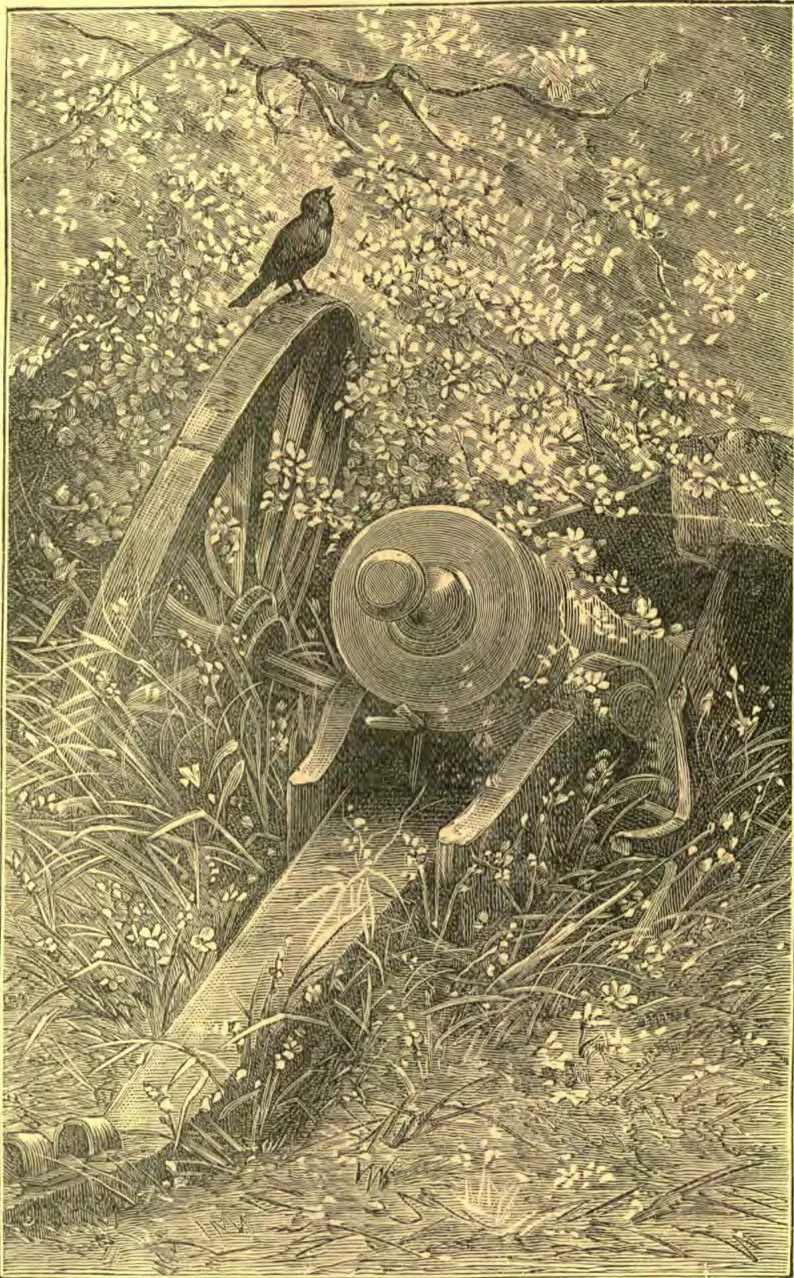
Once this soft turf, this rivulet’s sands, Were trampled by a hurrying crowd, And fiery hearts and armed hands Encountered in the battle-cloud.
Ah! never shall this land forget How gushed the life-blood of her brave,— Gushed, warm with hope and courage yet, Upon the soil they fought to save.
Now all is calm and fresh and still; Alone the chirp of flitting bird, And talk of children on the hill, And bell of wandering kine, are heard.
No solemn host goes trailing by, The black-mouthed gun, and staggering wain; Men start not at the battle-cry,— Oh, be it never heard again! —Bryant.

JEREMIAH AND THE REMNANT IN JUDEA.

A MONTH had passed since the capture of Jerusalem. Nebuchadnezzar was waiting at Riblah for news of the success of other military enterprises which he was conducting at the same time. But on the 10th of August the suspense at Jerusalem was broken by the appearance of Nebuzar-adan, the captain of Nebuchadnezzar’s bodyguard. He was accompanied by a detachment of the Chaldean army, and brought orders to put the finishing stroke to the work of destruction. The temple was committed to the flames; the palace and the houses of the nobility shared its fate; the walls of the city were thrown to the ground. The envious heathen from Moab and from Ammon gloated over the spectacle of Zion’s humiliation, and clapped their hands in glee. Edom, especially, the old enemy of Jacob’s race, stood by and exultingly cheered on the work, crying out, “Rase it, rase it, even to the foundations!” The golden, the silver, and the brazen vessels of the temple were carried away to grace the idolatrous festivals of the Chaldean conqueror. The great brazen sea, or laver, and the lofty and richly-ornamented pillars of brass standing in the temple porch, named Jachin and Boaz, relics of the times of Solomon, which had passed unharmed through all the earlier spoliations of the temple, were now seized, broken to pieces, and carried away to Babylon.
Along with this treasure, the Chaldeans carried off great numbers of the people, especially those of the better class, until the city was almost depopulated. Only the poor of the land were left to look after the vines and other crops. Seventy-one prominent exiles, including the chief and the second priests, three of the guardians of the temple, the chief military officer of Jerusalem, five members of the royal council, the keeper of the army register, were carried to the king of Babylon at Riblah, and slain before his eyes. The first of this devoted list, Seraiah, the chief priest, was the father of Ezra the scribe.
Over this scene of devastation and woe, Jeremiah uttered those pathetic lamentations which cannot even now be read without profound emotion. They are not unmeaning outbursts of passion; their great, deep tide of feeling rolls along the channels of genuine poetry. They appeal alike to the tastes and to the sympathies of the reader.
The weeping prophet, who had long foreseen and given warning of the coming ruin, and who had offended the Jewish king and court by the directness and urgency of his speech, had been thrown into prison, and lay in chains when the city was taken. But by some means Nebuchadnezzar became acquainted with the character of Jeremiah, and felt a reverence for his prophetic office, mingled, possibly, with superstition. At all events, when the captain of the guard was sent to complete the destruction of the city, he received a special commission to look well to Jeremiah, and not only to do him no harm, but to follow his wishes to the letter.
So, one of the first acts of the Chaldeans was to penetrate to the court of the prison where Jeremiah was confined, to take off his chains and set him free. Gathering together the exiles, they took Jeremiah with the crowd on the northern road toward the fatal city of Riblah. However, when they reached Ramah, six miles from Jerusalem, Nebuzar-adan, captain of the guard, drew the prophet aside, and informed him that he was free to go where he wished. Should he choose to come to Babylon, the captain promised to look well to his interest, but if he preferred to remain, the whole land was before him to go whithersoever he pleased.
Thus a brilliant prospect seemed open to the long-persecuted and afflicted Jeremiah. The liberated prisoner might hope to perform a splendid part in exile, like that of Daniel. Wealth and honor were almost within his grasp; but with a truly loyal heart he sacrificed all these prospects and remained, with hope of doing something for his prostrate country. “He refused,” says Josephus, “to go to any other spot in the world, and he gladly clung to the ruins of his country, and to the hope of living out the rest of his life with its surviving relics.”
Evidently the first thing demanded by patriotic feeling was to rally once more the broken-hearted remnants of the people around some common center, and to keep alive by all possible means the peculiar spirit of the Jewish religion and the hope of the coming Messiah. The people must not be suffered to lose faith in themselves as the chosen people of God, through whom all the nations of the earth should be blessed. Of all persons remaining in the Holy Land, Jeremiah, the inspired prophet, was best fitted to lead in this work.
Nebuchadnezzar appointed Gedaliah civil governor over the desolated country. His father, Ahikam, had been a firm friend of Jeremiah, and he inherited his father’s regard for the prophet. His grandfather, Shaphan, had been the royal secretary under King Josiah. Jeremiah, upon being released, attached himself to Gedaliah, who had established the new capital at Mizpah, an eminence within sight of Jerusalem, four and a half miles to the north. Here were gathered such persons of eminence as had escaped death or deportation, among them the daughters of the exiled king, Zedekiah.
Thus a degree of importance was not wanting to the nucleus now gathered around Mizpah. The place itself was distinguished as an outpost of the defenses of Jerusalem toward the north which had been originally fortified by King Asa. A high inclosed courtyard containing a deep well furnished secure quarters for the garrison. Here Gedaliah took up his residence. Hither, from their various hiding-places in the open country, the scattered soldiers and officers soon began to gather, with Johanan, son of Kareah, at their head. Hither flocked the fugitive Jews from beyond Jordan—from Moab, from Ammon, and even from hostile Edom. Gedaliah received them with a generous cordiality, gave them his oath that if they would submit to the king of Babylon they would be unmolested, and encouraged them to gather in the waiting harvests of summer fruits, of wine and of oil. He also advised them to return and to occupy their towns and cities as of old.—From Exile to Overthrow.

By the Flow of the Inland River

By the flow of the inland river; Whence the fleets of iron have fled, Where the blades of the grave-grass quiver, Asleep are the ranks of the dead,— Under the sod and the dew, Waiting the Judgment day— Love and tears for the Blue, Tears and love for the Gray.
—Finch.

OUR INFLUENCE.

As we associate with those around us from day to day, how seldom we think of the influence we exert upon them!
“Our many deeds, the thoughts that we have thought, They go out from us, thronging every hour, And in them all is folded up a power That on the earth doth move them to and fro, And mighty are the marvels they have wrought In hearts we know not, and may never know.”
Could we but realize that all we say and do is helping to mold the lives of others as well as our own, we would be more careful to have each word and action right. We little know the trials and difficulties of those around us. As the poet has beautifully expressed it:—
“The smile that rests the fairest, and the head that wears the crown. May be near the heart that’s breaking a little farther down.”
And we know not what word of ours may either encourage that heart, and aid it forward in the way to life, or by discouraging, help to send it on the downward course.
We may think our influence so small that it cannot amount to much; yet when it is exerted on the wrong side, the enemy of all good is ever ready to make the most of it. Is it not our privilege as well as our duty to have an influence which will be felt, and that strongly, in favor of right and truth? Even our silence may tell on the wrong side; for if we hear people slandering others, and do not show our disapproval, we may be taken to agree with all they say.
As a stone falling into the clear surface of a lake, sends forth ripples in ever-widening circles, so our influence widens as it goes forth from us, until it breaks at last upon the shores of eternity.
How careful, then, ought we to be to have our every thought and act controlled by the Spirit of God, for without his help it is utterly impossible always to exert a good influence.
LAURA BEE.

A STORY OF TITHES.

MANY years ago a lad of sixteen years left home to seek his fortune. All his worldly possessions were tied up in a bundle, which he carried in his hand. As he trudged along, he met an old neighbor, the captain of a canal boat, and the following conversation took place, which changed the whole current of the boy’s life:—
“Well, William, where are you going?”
“I don’t know,” he answered. “Father is too poor to keep me at home any longer, and says I must now make a living for myself.”
“There’s no trouble about that,” said the captain. “Be sure you start right, and you’ll get along finely.”
William told his friend that the only trade he knew anything about was soap and candle making, at which he had helped his father while at home.
“Well,” said the old man, “let me pray with you once more, and give you a little advice, and then I will let you go.”
They both kneeled upon the tow-path (the path where the horses which drew the canal boat walked); the old man prayed earnestly for William, and then this advice was given: “Some one will soon be the leading soap-maker in New York. It can be you as well as any one. I hope it may. Be a good man; give your heart to Christ; give the Lord all that belongs to him of every dollar you earn; make an honest soap; give a full pound; and I am certain you will yet be a great, good, and rich man.”
When the boy arrived in the city, he found it hard to get work. Lonesome and far from home, he remembered his mother’s words and the last words of the canal-boat captain. He was then and there led to “seek first the kingdom of God and his righteousness.” He united with the church. He remembered his promise to the old captain.
The first dollar he earned brought up the question of the Lord’s part. He looked into the Bible, and found the Jews were commanded to give one-tenth, so he said, “If the Lord will take one-tenth, I will give that,” and so he did. Ten cents of every dollar was sacred to the Lord.
After a few years both partners died, and William came to be the sole owner of the business.
He now resolved to keep his promise to the old captain; he made an honest soap, gave a full pound, and instructed his book-keeper to open an account with the Lord, and carry one-tenth of all his income to that account. He was prosperous; his business grew; his family was blessed; his soap sold, and he grew rich faster than he had ever hoped. He then decided to give the Lord two-tenths; he prospered more than ever; then three-tenths, then four-tenths, then five-tenths. He then educated his family, settled all his plans for life, and told the Lord he would give him all his income. He prospered more than ever.
This is the true story of Mr. Colgate, who has given millions of dollars to the Lord’s cause, and left a name that will never die.
Are there not boys and girls who will now begin to give the Lord one-tenth of all the money they receive, and continue to do so throughout life?—Selected.

THE CUT IN THE APPLE-TREE.

There was once in a young apple-orchard a fine tree that some boys had carelessly cut with a hatchet. They had not cut the tree down, nor yet so bad that it died, but the hatchet had left deep marks on its trunk. These, however, in time seemed to heal up and the bark closed over them, so that they could not be seen. The tree grew almost as well as the others, and bore fruit. Its apples were fine, large, red-streaked ones, that every one liked. When ripe and soft, they were very good, and few of them were allowed to go to waste. If boys could get some of the “red-streaked” apples, they cared for none of the others.
For a number of years the tree continued to grow and bear fruit. One summer evening, when it was loaded with ripening apples, there came a very severe storm of wind and rain. The storm was so great, and the night so dark, that no one dared go out of the house to see what damage was done, and how many trees had been blown over.
When morning came, the storm had gone, the sun shone brightly, and there was no wind. Two of the little boys in the house near the orchard went out early to see if any trees were blown over. The orchard stood in a valley, protected on three sides by the hills, and those hills had been a protection to the trees now as before; but one tree was down. In a moment the boys saw that it was the “red-streaked” apple-tree. Though apples had fallen, and a few limbs had been broken off from the others, all except the “red-streaked” stood firmly upright.
The boys hurried to the fallen tree, and saw that it had broken off near the ground; nothing could be done to save it. They were ready to cry when they found their favorite apple-tree so hopelessly broken. Sitting down on the fallen trunk, they looked carefully at the break, and saw marks near the heart of the tree of the cuts of an axe or hatchet.
“Look here!” said Johnnie, the older, to his brother. “Somebody has cut this many years ago.”
There were the cuts of the hatchet plainly seen, and just there the tree had broken off. Had it not been for those cuts made many years before, that tree would probably have stood the storm. The injury then done had remained, and had only been covered, proving a weakness when the tree most needed strength.
Some time ago many people were surprised and pained to learn that a man whom all thought good and honest, had stolen a great amount of money and wasted it. People wondered how such a good man could be guilty of so great a sin. Though he had been in business many years, they had never heard of his being dishonest in any of his affairs; nor had he. But he had stolen when a boy, and had stolen more than once. As he grew to manhood, he became honest, and people forgot all about his boyhood dishonesty. Those who did business with him never heard of it. Like the cuts in the apple-tree, those acts of his thieving in his boyhood had left a weak place in that man’s character. When a strong temptation came, his character broke at that place; it was the one weak spot. It ruined him.
Boys, girls, the sins of youth, the evil habits of childhood, do for your characters what the hatchet-cuts did for that young apple-tree. You may overcome them, repent of the sins, but those habits, those sins, leave weak places in your characters. When you grow to be men and women, the world may forget—and so may you—those early habits of evil. You may entirely overcome them, but if a strong temptation comes, you may fall before it, and be guilty of that very sin you committed so many years before. Beware of evil habits; they are cuts in the strength of your character; they may grow over and be hidden, but they stay there; they weaken you. Give them up at once.—Sydney Clare.

Flowers of the Year.

The daisies have all passed away, you know, With their pearl-crowned heads and their hearts of gold, And fragrant Mayflowers, and violets blue, That sprung from the winter’s snows so cold; In those sheltered nooks with the mosses sweet, They bloom no more ’neath our wandering feet.
The buttercup gold that the fairies use To star the meads where the grasses wave, Is fallen and spent, for it rather chose To find in autumn an early grave. The feathery golden-rod later grown Has drooped and left but a stalk of brown.
The pink sweet blooms of the apple-tree boughs Were fallen pearls in an emerald sea, While the roses that graced the dark hedge-rows, Went far, far too soon, it seems to me. And the birds have fled from the woodland bowers, Bidding good-by to the faded flowers.
There’s a scarlet banner with fringe of gold Flung over the trees on the hillsides gray, And the forests still brighter glories hold, Where flaming woodbine and berries gay Are blushing and bridling in nooks unseen, Scorning and losing their coats of green.
Soon over them all shall the pure white snow Shower many a pearl, and crystal gem; And the trees be covered with gleam and glow Of icy fretwork, on branch and stem. But the frailest flowers of the Year’s bright train Shall bloom and melt on my window pane.
—E. U. French.

NEW-TESTAMENT HISTORY.

LESSON 165.—AN EXHORTATION TO PATIENCE, SELF-DENIAL, AND FORTITUDE.

In view of the facts noticed in the preceding lesson, and especially since the apostles are the ambassadors of Christ, Paul says, “We, then, as workers together with him, beseech you also that ye receive not the grace of God in vain.” Furthermore, he tells them that now is the accepted time, and the day of salvation; admonishes them to be careful of giving any occasion of stumbling; and urges them to pursue a course of conduct that could bring no discredit upon the ministry of those who had preached the gospel to them.
By way of setting home the admonition just given, Paul speaks of the example which he and the other apostles had set. They had themselves been very careful of giving offense; they had been patient in afflictions, in necessities, in distresses, in stripes, in imprisonments, in tumults, in labors, in watchings, in fastings. All these they had, without a murmur, endured for Christ’s sake. They had not attempted to retaliate; they had scarcely resented the injuries done them, though they had boldly defended the truth on all occasions. They had deserved the approval of all, by their purity of life, by their knowledge of divine things, by their long-suffering and kindness toward those who persecuted them, by the fruit of the Spirit, and by the sincerity of their affection. They gave proof of their apostleship, by the word of truth which they preached; by the power of God manifested in the miracles they performed, as well as in setting home the truth to the hearts of men; and by keeping on the whole armor of righteousness. Sometimes they were honored, but oftener dishonored; sometimes they were praised, but oftener spoken of as evil; although true, they were regarded by many as deceivers; although by their deeds they ought to have been known as good men, they were thought to be of doubtful character, and of unworthy connections; although apparently given over to death, they still lived; although they seemed to be chastened of God, they were not allowed to perish; although they had abundant cause for sorrow, they were always found rejoicing; although poor, they made many rich, by giving them the key to eternal life; although they had small possessions in this life, they looked forward by faith to the time when all things should be theirs to enjoy.
Thus it was that the apostle again called the Corinthians to a high standard of Christian conduct and character, by presenting before them a vivid picture of the life led by their religious teachers. No circumstances could be more trying than those under which the apostles labored; and yet, amid all, they had been faithful, and of good courage.
The Corinthian brethren might have thought that, since Paul had seen so many faults in them, he could not hold them in very high esteem; yet the generous-hearted apostle assures them that there is no lack of affection on his part; his heart is enlarged toward them; he can take in all their interests; he can forgive their faults, and love them still. They are the ones that have become narrow and selfish in their feelings, and the apostle exhorts them to become enlarged.
Paul found it necessary to warn the disciples at Corinth against being too closely connected with unbelievers. He probably had reference to business relations, as well as to marriage. He says: “Be ye not unequally yoked together with unbelievers; for what fellowship hath righteousness with unrighteousness? and what communion hath light with darkness? and what concord hath Christ with Belial? or what part hath he that believeth, with an infidel? And what agreement hath the temple of God, with idols? for ye are the temple of the living God; as God hath said, I will dwell in them, and walk in them; and I will be their God, and they shall be my people. Wherefore, Come ye out from among them, and be ye separate, saith the Lord, And touch no unclean thing; And I will receive you, And will be to you a Father, And ye shall be to me sons and daughters, saith the Lord Almighty.”

QUESTIONS.

  1. What was the leading theme of the last lesson?
  2. What were its most prominent features?
  3. In view of these, what does Paul say? 2 Cor. 6:1.
  4. What does he tell them about the time then present?
  5. What admonition does he give them?
  6. In what way does Paul set home this admonition?
  7. Under what circumstances had the apostles been an example of patience?
  8. Why had they borne all these without a murmur?
  9. What spirit had they manifested under all these trials?
  10. In what had they always been bold?
  11. How had they deserved the approval of all?
  12. How had they given proof of their apostleship?
  13. What varied experiences did they have to meet?
Verse 8.
  1. To what did their deeds entitle them?
  2. How were they suspiciously held?
  3. What contradictory conditions were manifested in the lives of these men of God?
  4. Although poor, how did they make many rich?
  5. Although so destitute of worldly comforts, how did they possess all things?
  6. How did the apostle thus call the Corinthians to a high standard of Christian conduct and character?
  7. How had he done this before?
  8. What may be said of the labors and faithfulness of the apostles?
  9. What might it have been natural for the Corinthians to suppose?
  10. What assurance does Paul give them?
  11. Who is it that has become narrow and selfish?
  12. How does Paul exhort them?
  13. Against what did he find it necessary to warn them?
  14. In what words does he give the admonition?
Verse 14.
  1. By what questions does he show the consistency of this instruction?
  2. What does he say about their being the temple of God, and of his promise concerning them? Verse 16.
  3. What commandment and promise does Paul then quote?

PAUL AT EPHESUS.

When Paul arrived at Ephesus, he found that the brethren there had been visited during his absence by one Apollos, a learned Jew from Alexandria, who having in some way learned of the new religion, was very zealous in presenting it to others. Coming to Ephesus, he went boldly into the synagogue of the Jews, and with all earnestness bore witness to “that Light which lighteth every man that cometh into the world.” Aquila and Priscilla, seeing that the teaching of Apollos, though eloquent, learned, and zealous, was defective in some important points, undertook to teach him the “way of the Lord more perfectly.” The man showed himself to be really a sincere follower of Christ by accepting correction from these humble tent-makers. Before Paul’s arrival at Ephesus, however, Apollos had gone to visit the brethren at Corinth.
Paul was no doubt glad to learn of this new laborer in the great vineyard; yet he found that the brethren at Ephesus had not been properly instructed on some important points of truth. Apollos had baptized them unto the baptism of John, but Paul again baptized them in the name of the Lord Jesus. After this he preached boldly in the synagogue of the Jews for some three months, until his work was no longer acceptable. He now found freedom to continue his public instruction in the “school of one Tyrannus,” who was probably a teacher of philosophy or rhetoric converted by the apostle to Christianity. These labors, continued thus earnestly for two years, could not fail to produce great results in the busy town, thronged with travelers from all countries. A large church was formed at Ephesus, and the name of Christ became generally known throughout the province of Asia.
During his labors at this place the Lord wrought many miracles by the hand of the apostle. In Ephesus were great numbers of those who practised curious arts, and among them were then in the city, in the course of their wanderings, several Jewish exorcists. These magicians soon saw that the miracles of Paul were performed by a higher power than their charms and enchantments. So they began to call the name of Jesus over those possessed with devils, as they had seen Paul do. The fate which befell them in consequence of this impious act, had a powerful effect upon the dwellers in Ephesus. Many of the sorcerers themselves openly renounced their wicked practices and brought together their books containing the mystic formulas, and burnt them in the sight of all the people, thus showing how utterly worthless they were. Such books, from their very nature, would be costly, and all books in that age bore a value which would seem exorbitant to us in these days of books. So we need not be surprised that the whole cost sacrificed in the flames amounted to as much as 2000 pounds, or 10,000 dollars, of English money. The scene of this burning must have been one long remembered in Ephesus.
Sometime during Paul’s stay at Ephesus, he made a short visit to the church at Corinth. Paul himself refers to this visit in his epistles, and describes it as a painful one. He found that many of his beloved converts had departed from his teachings, and were indulging in “sin and uncleanness.” This was a source of great grief to the apostle. Yet while he dealt with the offenders kindly and tenderly, he spared not their sins. This visit was probably not a long one; and Luke does not mention it in the Acts at all. In the letters which Paul wrote to the Corinthian church after his return to Ephesus, he still rebukes them for their sins and earnestly exhorts them to better lives.
After the burning of the books of sorcery, Paul stayed “for a season” in Ephesus. He had it in mind very soon to go into Macedonia, his first field of labor in Europe, and from thence to Achaia, or Greece. This would give him a chance to visit the churches which he had raised up at Philippi, Thessalonica, Berea, and Corinth. From there he intended to go to Jerusalem. So he sent before him into Macedonia two of his helpers in the work, Timothy and Erastus. But while the apostle himself still tarried at Ephesus, “until Pentecost” (1 Cor. 16:8.), occurred the great uproar raised by Demetrius about the worship of Diana, which will soon be noticed in the lessons.
E. B. G.

SIGHTS FROM AN ELEPHANT'S BACK.

GEORGE BURNETTE was a bright little boy who lived in England. His father was an officer, and had for a long time been trusted to do important work for the government. Now they wanted to send a man to India, and thought no one else could do so well as Mr. Burnette; so they asked him to go. Georgie's mother had died a short time before his father was to start, and so Mr. Burnette thought it best to take Georgie with him. I cannot tell you of all the strange things he saw on his way to his new home, nor how sick he was when at sea, nor of the wonderful stories the sailors told him when he was able to be on deck; for it would fill a book.
At last, after weeks of sailing, they came to Singapore. If you look on the map of Asia, you will find that south of Burmah the land runs out in a long point into the Indian Ocean; and just at the end of this point of land is the island of Singapore. It looks very small on the map, though it is twenty-seven miles long, and fifteen miles broad.
They landed near the European Hotel, where the captain had told them they could get good lodgings. When George was walking around in the halls of the hotel the next morning after he landed, he found two little English boys, one a year older and the other a year younger than himself.
They looked up and smiled good-naturedly when they saw George. At breakfast they all sat at the same table, and after looking at each other awhile, the boys asked, “Did you just come to Singapore?”
“Yes,” said George; “my father has come to work for the British government, and he brought me along, too. We are going to stay here three years.”
“That's jolly,” said the boys; “we have been here two years, and know the way all over the city. If your father will let you, we will go out after breakfast, and show you lots of funny things.”
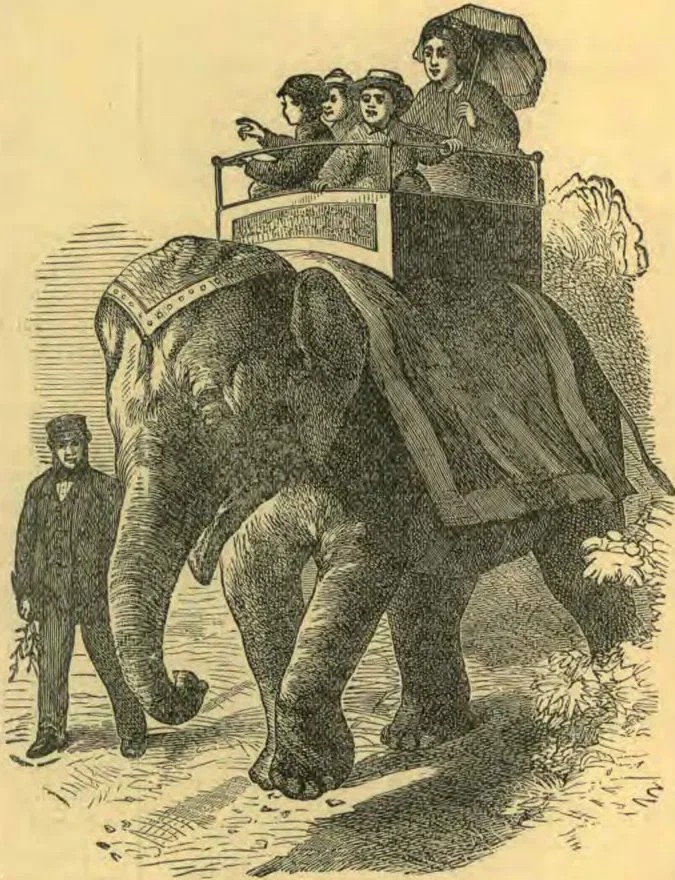
Mr. Burnette said he was willing, if some older person would go along with them. So Mrs. Preston, the boys' mother, said that she would take them with her. By and by they set out, not in a buggy, but on the back of a huge elephant. George thought an elephant would be a fine animal to ride; but he found that it wasn't the easiest way
First they rode out in the country a little way, where a good many people from Europe live in their country houses, or bungalows, as they are called. This was a very pretty road, with bamboo hedges and trees on either side, so tall that their branches bent over and came together across the road. Then they drove down through the market, where all manner of vegetables and fruits were kept for sale. They passed a temple with two great stone tigers by the door and dragons carved in the wood on the front; the roof was held up by carved images of their gods, all gilded and glittering in the sun. As they were riding along, Mrs. Preston told them some things about this strange religion.
They saw the curious houses of the natives, built of bamboo with roofs of thatch; and the natives at work, with no clothes on except a cloth around the hips and a gay-colored turban made of a long strip of cloth around their heads.
Then they stopped by a lumber-yard, and saw the strangest kind of lumbermen. In one corner was a high pile of logs, and by it stood a large elephant, that would roll the great logs up on his tusks, and balancing them there by his trunk, carry them to another part of the yard and pile them up as nicely as a man could do. There were three or four more elephants in the yard, doing the same kind of work.
“Why,” said George, “I shouldn't think they knew enough to do just what the man told them to.”
“Yes, they do,” said Frank; “my papa saw an elephant building a stone wall once. He laid a row of stones up, and then made a noise for his keeper to come and see if he had done his work well. If the man said it was all right, he went on and laid another row.
“The king of Ava keeps some white elephants in his palace yard,” continued Frank. “Papa saw them when he went up to Ava, and he saw the king, too. They're not real white, you know, only a good deal lighter colored than this one we're on. The elephants are kept in a nice shed, and have gold and white umbrellas over them, just as the king does.”
“What do they do that for?” asked George.
“Why,” said Frank, “because they worship them. When an elephant goes to the river to bathe, the king's nobles go along beside him with music and banners, and all the people crowd around to see him. They think white elephants' hairs are very precious, and when the king wants to give anybody a costly present, he sends him elephants' hairs in a gold box.”
“I think they are silly to make so much fuss just over an elephant,” said George, as they climbed down off their elephant's back at the hotel door.
“So do I,” said Frank, starting for his room; “but be sure to ask your father to-night if he will let you go with us to-morrow to see them make ropes out of cocoanut husks; and we will go and see them make sago out of the sago palm, too.”
W. E. L.

“OUR LIVES ARE WHAT WE MAKE THEM.”

Do you know, little ones, That our lives at the end Will be what we’ve made them As onward we tend?
Then let us be careful, Each day that we live, What steps we are taking, What answers we give.
Let the words of the Saviour Be written within, That we may be kept From all danger and sin.
Let us follow him closely Let him be our guide, And in the bright kingdom We shall dwell at his side. —S. R. Wince.

Letter Budget.

W. N. GLENN sends a letter from Oakland, Cal. He says: “I am a child of about seven years, and six feet tall. Perhaps the editors will not let me into the little family because I am so large; but I am so young that I will ask to be let in on that score. You will say, How can he be so large and yet so young? I will tell you. I was nearly forty years wandering in the ‘wilderness of sin,’ and I have learned that all that time does not count in this family. I lost all that time, and I want to tell you little folks that if you will heed all the good lessons in the INSTRUCTOR, you need not lose your years as they pass by, one by one; but you may be men and women when you are grown up, and your happiness will not be marred with regrets for the past. ‘This is my first letter to the INSTRUCTOR.’”
MAY SANTEE sends a letter from Parsons, Kansas. She says: “I am thirteen years old. I keep the Sabbath. I and my sister, eleven years old, were baptized two years ago at camp-meeting. We have no Sabbath-school here. Papa is away preaching most all the time. We have taken the INSTRUCTOR for several years, and like it very much. I always look at the Letter Budget first, to see if there is a letter from any one I know. I am trying to be a good girl, so that I can meet the INSTRUCTOR family in heaven.”
INA JONES sends a letter from Arapahoe, Furnas county, Nebraska. She says: “I am thirteen years old. I have been thinking for a long time of writing for the Budget; if this letter is printed, I will write again. We all keep the Sabbath. We do not have any meeting or Sabbath-school to go to. I was baptized at the district camp-meeting this fall. I have one brother and sister that are dead. I want to live so as to meet them when Jesus comes.”

You have reached the end of this edition.

The Youth’s Instructor · Dec 12, 1883