The Youth’s Instructor, Vol. 32, No. 35.

BOY WANTED

The Youth’s Instructor

Aug 27, 1884

S. D. A. Publishing Association · Battle Creek, Mich. · Aug 27, 1884

“BOY WANTED.”

People laughed when they saw the sign again. It seemed to be always in Mr. Peters’s window. Not that there was lack of boys— as many as a dozen used sometimes to appear in the course of a morning, trying for the situation. Mr. Peters was said to be rich and queer; and for one or both of these reasons, boys were very anxious to suit him. “All he wants is a fellow to run of errands; it must be easy work and sure pay.” This was the way they talked to each other.
But Mr. Peters wanted more than a boy to run of errands. John Simmons found that out, and this is the way he did it. He had been engaged that very morning, and had been kept busy all the forenoon at pleasant enough work; and, although he was a lazy fellow, he rather enjoyed the place. Toward the middle of the afternoon, he was sent up to the attic, a dark, dingy place, inhabited by mice and cobwebs.
“You will find a long, deep box there,” said Mr. Peters, “that I want to have put in order. It stands right in the middle of the room; you can’t miss it.”
John looked doleful. “A long, deep box, I should think it was!” he said to himself, as the attic door closed after him. “It would weigh ’most a ton, I guess; and what is there in it?—Nothing in the world but old nails, and screws, and pieces of iron, and broken keys and things—rubbish, the whole of it. Nothing worth touching; and it is as dark as a pocket up here, and cold besides. How the wind blows in through those knot-holes! There’s a mouse! If there is anything I hate, it’s mice! I’ll tell you what it is, if old Peters thinks I’m going to stay up here and tumble over his rusty nails, he’s much mistaken. I wasn’t hired for that kind of work.”
Whereupon John bounced down the attic stairs, three at a time, and was found lounging in the show-window half an hour afterward, when Mr. Peters appeared. “Have you put the box in order already?” was the gentleman’s question.
“I didn’t find anything to put in order; there was nothing in it but nails and things.”
“Exactly. It was the ‘nails and things’ that I wanted put in order. Did you do it?”
“No, sir. It was dark up there, and cold; and I didn’t see anything worth doing. Besides, I thought I was hired to run of errands.”
“Oh,” said Mr. Peters, “I thought you were hired to do as you were told.” But he smiled pleasantly enough, and at once gave John an errand to do down town; and the boy went off chuckling, declaring to himself that he knew how to manage the old fellow—all it needed was just a little standing up for your rights.
Precisely at six o’clock, John was called and paid the sum promised for a day’s work, and then, to his dismay, he was told that his services would not be needed any more. He asked no questions. Indeed, he had time for none, as Mr. Peters immediately closed the door.
The next morning the old sign, “Boy wanted,” appeared in its usual place. Before noon it was taken down, and Charlie Jones was the fortunate boy. Errands!—plenty of them. He was kept busy until within an hour of closing; then, he was sent up to the attic to put the long box in order. He was not afraid of a mouse nor of the cold, but he grumbled much over the box. Nothing in it was worth his attention. However, he tumbled over the things, growling all the time, picked out a few straight nails, a key or two, and finally appeared with this message: “Here’s all that is worth keeping in that box. The rest of the nails are rusty, and the hooks are bent or something.” “Very well,” said Mr. Peters, and he sent him to the postoffice. By the close of the next day, Charlie had been paid and discharged, and the old sign hung in the window.
“I’ve no kind of a notion why I was discharged,” grumbled Charlie to his mother. “He said he had no fault to find, only he saw that I wouldn’t suit. It’s my opinion that he doesn’t want a boy at all, and that he takes that way to cheat. Mean old fellow!”
It was Crawford Mills who was hired next. He knew neither of the other boys, and so did his errands in blissful ignorance of the “long box,” until the second morning of his stay, when, in a leisure hour, he was sent to put it in order.
The morning passed, dinner-time came, and still Crawford had not appeared from the attic. At last Mr. Peters called him: “Got through?”
“No, sir; there is ever so much more to do.”
“All right. It is dinner-time now; you may go back to it after dinner.”
After dinner, back he went. All the short afternoon he was not heard from; but just as Mr. Peters was deciding to call him again, he appeared. “I’ve done my best, sir,” he said, “and down at the very bottom of the box I found this.” “This” was a five-dollar gold piece.
“That’s a queer place for gold,” said Mr. Peters. “It’s good you found it. Well, sir, I suppose you will be on hand to-morrow morning?” This he said as he was putting the gold piece into his pocket-book.
After Crawford had said good-night, and gone, Mr. Peters took the lantern, and went slowly up the attic stairs. There was the long, deep box, in which the rubbish of twenty-five years had gathered. Crawford had evidently been to the bottom of it. He had fitted in pieces of shingle to make compartments, and in these different rooms he had placed the articles, with bits of shingles laid on top, and labeled thus: “Good screws,” “Picture nails,” “Small keys, somewhat bent,” “Picture hooks,” “Pieces of iron, whose use I do not know.” So on through the long box. In perfect order it was at last, and very little that could be called useful could be found within it. But Mr. Peters, as he bent over and read the labels, laughed gleefully, and murmured to the mice: “If we are not both mistaken, I have found a boy, and he has found a fortune.”
Sure enough. The sign disappeared from the window, and was seen no more. Crawford became the well-known errand boy of the firm of Peters & Co. He had a little room neatly fitted up, next to the attic, where he spent his evenings, and at the foot of the bed hung a motto, which Mr. Peters gave him. “It tells your fortune for you. Don’t forget it,” he said when he handed it to Crawford. And the boy laughed, and read it curiously: “He that is faithful in that which is least is faithful in much.” “I’ll try to be, sir,” he said; and never once thought of the long box over which he had been faithful.
All this happened years ago. Crawford Mills is errand boy no more, but the firm is Peters, Mills & Co. A young man and a rich man! “He found his fortune in a long box of rubbish,” Mr. Peters said once, laughing. “Never was a five-dollar gold piece so successful in business as that one of his has been; it is good he found it.” Then, after a moment of silence, he said, gravely: “No, he didn’t; he found it in his mother’s Bible—‘He that is faithful in that which is least is faithful also in much.’ It is true; Mills the boy was faithful, and Mills the man we trust.”—The Pansy.

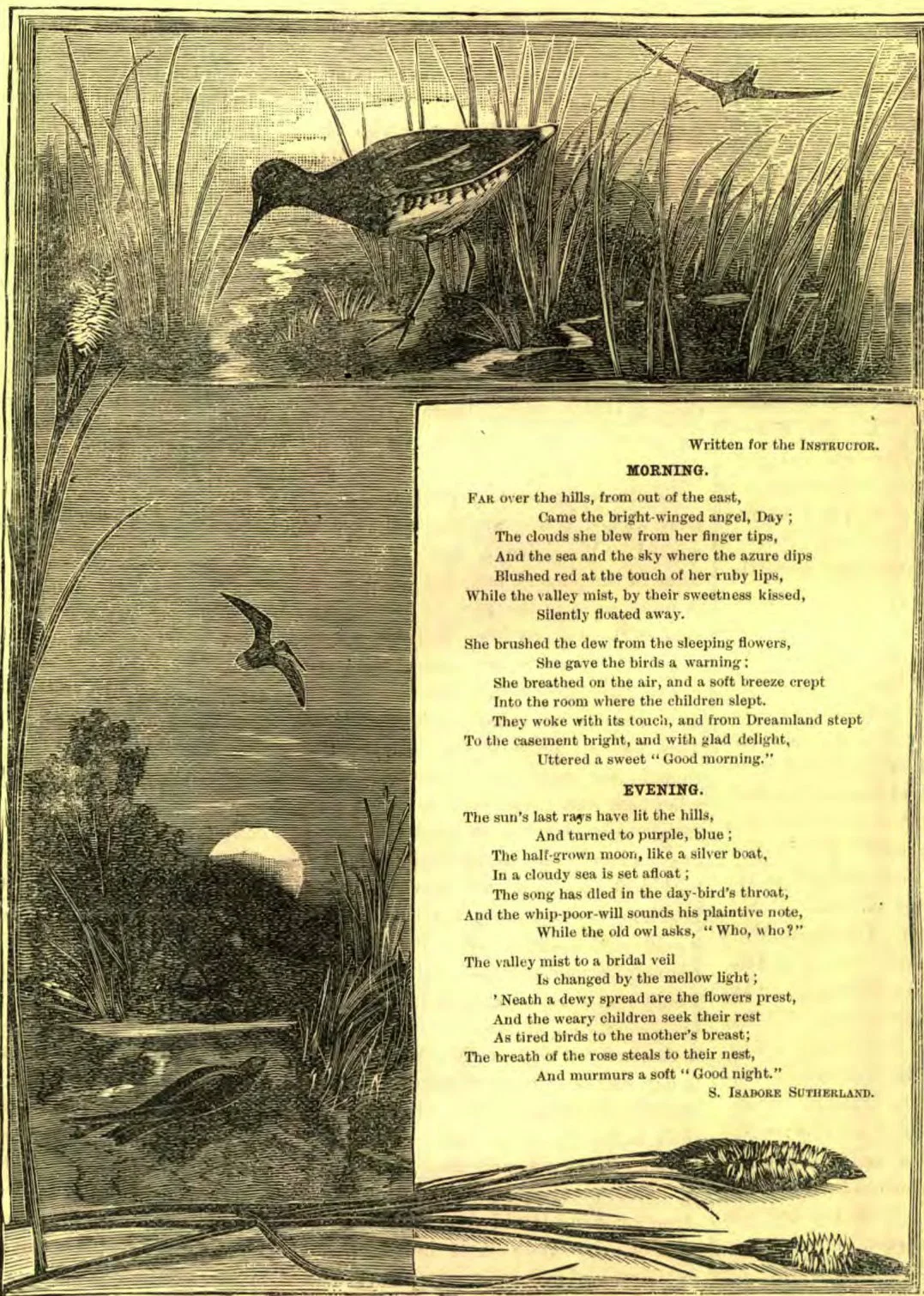
MORNING

Far over the hills, from out of the east, Came the bright-winged angel, Day; The clouds she blew from her finger tips, And the sea and the sky where the azure dips Blushed red at the touch of her ruby lips, While the valley mist, by their sweetness kissed, Silently floated away.
She brushed the dew from the sleeping flowers, She gave the birds a warning; She breathed on the air, and a soft breeze crept Into the room where the children slept. They woke with its touch, and from Dreamland stept To the casement bright, and with glad delight, Uttered a sweet “Good morning.”

EVENING.

The sun’s last rays have lit the hills, And turned to purple, blue; The half-grown moon, like a silver boat, In a cloudy sea is set afloat; The song has died in the day-bird’s throat, And the whip-poor-will sounds his plaintive note, While the old owl asks, “Who, who?”
The valley mist to a bridal veil Is changed by the mellow light; ’Neath a dewy spread are the flowers prest, And the weary children seek their rest As tired birds to the mother’s breast; The breath of the rose steals to their nest, And murmurs a soft “Good night.”
S. Isadore Sutherland.

THE PASSOVER, AND THE STRASSBURG CLOCK

FOREIGN TRAVEL.—NO. 15.

THE PASSOVER, AND THE STRASSBURG CLOCK.

At this Passover celebration we were at Pitisti, a city of some 15,000 people. The feast lasted for three days. Religious services were held in the morning, and for the rest of the day the people enjoyed themselves the best they knew how. On a hill at the edge of the city there was a large gathering, the most grotesque I ever saw. There had been erected some eight or ten swings of a very peculiar kind. They were made after this fashion: In the ground, some twelve feet apart, were set two crotched posts, twelve feet in height. A large stick, rounded so that it would turn easily, was placed in these crotches. Four mortises were made in it at each end, and arms, perhaps eight feet long, were put through. At the end of these arms a cross-piece was fastened, and hanging down below these cross-pieces were two rude chairs, eight in all, for persons to sit in. By means of large handles placed at the end of the large central axle which lay in the crotches, men turned the whole thing over like a huge wheel. The chairs were swung so that they would hang down perpendicularly all the while. Men were rolling these huge wheels over, while their living freight of eight persons were sometimes sixteen feet high in the air, and then down almost to the ground.
The sight of ten of these huge wheels all turning over at once, with their curiously dressed occupants, was indescribably ludicrous to me.
They had some tents pitched, and persons in hideous masks made sport for the crowd. They had rude bagpipes and drums for music. Eatables and drinkables, candy, cakes, etc., were plentiful. Remember that these were special religious holidays, lasting for three days. This will perhaps give you a good idea of the religious habits of the people. Formalism and pleasure-seeking together make up the religion of large portions of Europe. On these feast days and holidays, the business houses are usually closed, and the people cease their labor, and have what they call a good time.
One strange costume I had almost forgotten to mention. It consisted of a sheepskin cap with the wool on the outside, and a sheepskin coat with the wool on the inside. It was rather a greasy-looking dress.
Many countenances that we saw were anything but beautiful and refined. But lest my readers should get a wrong impression, I must not forget to say that there were many intelligent and interesting people in Roumania, who would not do discredit to any country. Many of them can speak French, and they compose the better class.
The valley of the Danube is a fine country, containing excellent soil. The birds are protected, so that they have become very tame. The people build their chimneys with a flat space on top for the storks to build their nests on. The storks return year after year, and rear their young in the same place. This is as it should be. Man, the strongest and wisest of God’s creatures, should care for and protect the defenseless, instead of shooting for sport any of God’s created things. While we were up in a dizzy tower, we could see the storks and their nests in all directions. Some storks were flying about, and they looked as if they would surely fall, and be dashed in pieces. But they sailed around us as unconcernedly as though they were walking on the ground.
But we must not forget to say a little concerning the famous Strassburg clock, though it has been described so many times that it hardly seems worth while to speak of it. The clock stands in the lower story of the Strassburg cathedral. We had the privilege of being present at noon, the most interesting time for observing the workings of the clock. We found perhaps two hundred persons there, waiting, like ourselves, to hear the clock strike. A fine-looking gentleman, dressed up in official style, sought us out, and asking if we were strangers, took us to a favorable place, and explained to us the wonders of the clock. We were, of course, much pleased with his civility and condescension; but we lost a little of our appreciation of his courtesy when we found out soon after that a franc was expected of every such one.
The clock gives the seconds, minutes, hours, changes of the moon, all the principal feast days of the calendar, the changes of the seasons, and the positions of the planets for an almost unlimited number of years. It is so constructed as to regulate itself for a long period.
In the face of the clock are three little galleries, one above another. Below the lowest one, the symbolic deity of each day steps out of a niche,—Apollo on Sunday, Diana on Monday, etc. In the first gallery, an angel strikes the quarters on a bell, while a genius at his side reverses his sand-glass every hour. Higher up, grouped around a skeleton which strikes the hours, are four figures,—childhood, youth, manhood, and old age. These successively strike the quarters on a little bell. In the highest gallery there is a figure of the Saviour. And at noon, each day, after the other figures have performed their work, miniature figures of the twelve apostles come around in front of the Saviour, and, one by one, make a bow to him; while he bestows upon them his benediction. By the side of the clock, perched high up, is a brazen cock. As the apostles commence their work, he flaps his wings three times, and gives a shrill crow. When they are nearly through, he crows again; and just before the last one passes, he flaps his wings three times, and crows again, making the echoes ring through the old cathedral. He does his crowing quite naturally, and it was remarkable and amusing to see him do it.
There was a famous clock here as early as the thirteenth century. In 1571 Dasypodius made a clock similar to this one, which run till 1789. The present one was made from 1838-42, by Schevilgué, a Strassburg clock-maker.
This city of Strassburg has a library of 500,000 volumes. Guttenburg here first began his experiments in printing, which resulted in such great benefit to the world. There is a monument of him in the city. Kleber, one of Napoleon’s greatest generals, who was assassinated in Egypt, also has a monument in the city. He was a native of this place.
Leaving Strassburg, we traveled northward along the beautiful valley of the Rhine. The steep hillsides are terraced in a wonderful way, and vineyards everywhere greet the eye. Probably there is no river in the world which abounds in more beautiful scenery. Hoary ruins of old castles, as well as castles better preserved, appear from time to time. The train will not let us stop, but hurries us on till we reach Cologne—“Koln” the Germans spell it and pronounce it.
This is a fine city of nearly 150,000 people. It is the largest in Rhenish Prussia, and one of the most important in Germany. It dates from about the time of the Christian era. A Roman colony was planted here by the mother of Nero, though there was already a small city here. In A. D. 308, Constantine the Great built a stone bridge over the Rhine at this place. After many quarrels between the archbishops and the citizens, municipal independence was gained in 1288.
We could see but little of the city between the time of the trains; so we gave a hurried visit to the cathedral, the principal point of interest. Externally, it is one of the finest cathedrals we have seen in Europe; internally it is not so remarkable. The foundation of the present building was laid in August, 1284, but the structure was not completed till August, 1880. The sum spent upon it between 1842 and 1880 was $4,500,000. At its dedication, it was honored with the presence of the Emperor William, and nearly all the sovereign princes of the German Empire. It has a very prominent situation, and can be seen a long distance from the city.
It is built in the form of a cross, the nave being flanked with double, and the transept with single, aisles. The total length is 444 feet; the breadth, 201 feet; the height of the walls, 150 feet; the height of the roof, 201 feet. The height of the central tower above the transept is 357 feet. The height of the larger towers to the end are 512 feet. They stand side by side, the highest of any in Europe. This great mass of stone is covered over with a great variety of turrets, statuary, and all sorts of figures, and the whole presents a most imposing appearance. Internally, there are many cathedrals which excel it. The largest bell in it is called the Köiserloche. It was cast from the metal of a cannon captured from the French in the last war, and it weighs twenty-five tons.
A very fine iron bridge crosses the Rhine at Cologne, on which cars, teams, and foot-travelers cross. UNCLE IDE.

Christ's Example of Filial Duty to Parents

“Let all children remember,” says Dr. Dwight, “if ever they are weary of laboring for their parents, that Christ labored for his; if impatient of their commands, that Christ cheerfully obeyed; if reluctant to provide for their parents, that Christ forgot himself, and provided for his mother amid the agonies of the crucifixion. The affectionate language of this divine example to every child is, ‘Go thou and do likewise.’”

EDITOR'S CORNER.

We were once traveling by railroad from Indiana to New York, when a gentleman entered the car with his little three-year-old daughter, whom he was taking to live with her grandmother because her own mother had died. Every other car was crowded with passengers, and the only vacant seat in this one was by the side of a colored man, just in front of the one we occupied. The new-comer placed his daughter in the empty seat, and remained standing in the aisle himself. Presently the child discovered that she was sitting by a black man, a stranger, when she cried out, “O papa! take me away quick: people will think I am his little girl.”
The father took his daughter into his arms, and then occupied the vacant seat himself, at the same time engaging in conversation with the colored man, who proved to be an intelligent Christian gentleman. After this, the child did not mind being left in the seat with him occasionally.
This fear on the part of the child seemed a good illustration of the feelings which should take possession of persons who are unavoidably thrown into the seat or society of those who make a mock of sin, who scoff at religion, and take pleasure in ridiculing any who delight in the service of God. “Blessed is the man that sitteth not in the seat of the scornful.” If we chance to be associated with such, our duty is plain;—we should cry for deliverance “quick;” for the scorner brings others into a snare by his wicked counsels, thus exposing them to God’s wrath. There is but little hope of the scorner; for he hateth reproof, and the reprover.
But there are some persons who are not so bitterly wicked as they are carelessly and ignorantly wicked. We have a duty to faithfully warn these of the sinner’s fate, and to do all we can to interest them in the plan of salvation. And so long as there is any hope of them, we should not cease our efforts to help them. However, we are not to “company with” sinners. The little girl’s great anxiety was what people would think of her. This was all proper; for in her innocence, she thought she should be disgraced if she remained where she was. The Bible says, “A good name is rather to be chosen than great riches.” If a child of good repute should gradually begin to company with bad boys and girls, how long do you think his name would remain untarnished? Those who would pass sentence upon him know that “evil communications corrupt good manners,” and they would very soon offset him in the balances with his wicked companions.
A great per cent of the children and youth of to-day are too corrupt to associate as companions with those who fear God. How shall you escape their influence, do you ask? First, see that you have a good name, and then “set bounds about” it. Shun every appearance of evil. Heed the instruction King David gave to Solomon, his son: “Enter not in the path of the wicked, and go not in the way of evil men; avoid it, pass not by it, turn from it, and pass away; for they sleep not except they have done mischief; and their sleep is taken away unless they cause some to fall.”
It is right to try to gain the good opinion of the people by a well-ordered life and a godly conversation; but a desire to have a perfect record in the “ledger of heaven,” and to be of good esteem in the eyes of the Creator and Judge, should eclipse every other desire. M. J. C.

TWO CURIOUS NEEDLES.

GIRLS, we are afraid, don't like sewing quite as well as they ought to. It is so much easier to ask mother to do what is needed than to do it themselves. But the girls may be interested in reading about some curious needles, if they are not obliged to use them.
The king of Russia recently visited a needle manufactory in his kingdom, in order to see what machinery, with the human hand, could produce. He was shown a number of superfine needles, thousands of which, together, did not weigh half an ounce, and marveled how such minute objects could be pierced with an eye. But he was to see that in this respect something still finer and more perfect could be created. The borer, that is, the workman whose business it is to bore the eyes of these needles, asked for a hair from the monarch's head. It was readily given, with a smile. He placed it at once under the boring machine, made a hole in it with the greatest care, furnished it with a thread, and then handed the singular needle to the astonished king.
The second curious needle is in the possession of Queen Victoria. It was made at the celebrated needle manufactory at Redditch, and represents the column of Trajan in miniature. This well-known Roman column is adorned with numerous scenes in sculpture, which immortalize Trajan's heroic actions in war. On this diminutive needle, scenes in the life of Queen Victoria are represented in relief, but so finely cut, and so small, that it requires a magnifying glass to see them. The Victoria needle can, moreover, be opened; it contains a number of needles of a smaller size, which are equally adorned with scenes in relief.—Good Cheer.

Habit: The Silken Thread That Becomes a Chain

HABIT at first is but a silken thread, Fine as the light-winged gossamers that sway In the warm sunbeams of a summer’s day; A shallow streamlet, rippling o’er its bed; A tiny sapling, ere its roots are spread; A yet unhardened thorn upon the spray; A lion’s whelp that hath not scented prey; A little, smiling child obedient led. Beware! that thread may bind thee as a chain; That streamlet gather to a fatal sea; That sapling spread into a gnarled tree; That thorn, grown hard, may wound and give thee pain; That playful whelp his murderous fangs reveal; That child, a giant, crush thee ’neath his heel. —Selected.

IMPORTANT BIBLE SUBJECTS.

LESSON 9.—RESURRECTION.

[NOTE TO THE STUDENT.—Do not consider the lesson learned until you can give at least the substance of every text, with the correct reference for each. The references in black letters indicate those texts that should be committed to memory. A little diligent application each day will enable you to do this.]
“Thus saith the Lord; A voice was heard in Ramah, lamentation, and bitter weeping; Rachel weeping for her children refused to be comforted for her children, because they were not. Thus saith the Lord; Refrain thy voice from weeping, and thine eyes from tears: for thy work shall be rewarded, saith the Lord; and they shall come again from the land of the enemy.” Jer. 31: 15, 16.
“Forasmuch then as the children are partakers of flesh and blood, he also himself likewise took part of the same; that through death he might destroy him that had the power of death, that is, the devil.” Heb. 2: 14.
“He will swallow up death in victory; and the Lord God will wipe away tears from off all faces; and the rebuke of his people shall he take away from off all the earth: for the Lord hath spoken it.” Isa. 25: 8.
“Behold, I show you a mystery; We shall not all sleep, but we shall all be changed, in a moment, in the twinkling of an eye, at the last trump: for the trumpet shall sound, and the dead shall be raised incorruptible, and we shall be changed. For this corruptible must put on incorruption, and this mortal must put on immortality.” 1 Cor. 15: 51–53.

QUESTIONS.

1. Shortly after the birth of Christ, what cruel act did Herod perform? Matt. 2: 16.
2. What prophet had foretold this event and its attendant sorrow? Verses 17, 18.
3. Where is this prophecy found? Jer. 31: 15.
4. What did the Lord, through his prophet, say to these sorrowing mothers? Verse 16.
5. From what place is it said that the murdered children shall come? Ib.
6. What is found in heaven, in the presence of God? Ps. 16: 11.
7. Since the murdered infants are now in the land of the enemy, can it be that they went to heaven at death?
8. Who is the enemy of the human race? 1 Pet. 5: 8.
9. Do all who die, pass under Satan’s power? Heb. 2: 14.
10. Who has the keys of Satan’s prison-house? Rev. 1: 18.
11. By whom is the resurrection from the dead made possible? Acts 4: 2; 1 Cor. 15: 22.
12. What has the Lord promised to do with death? Isa. 25: 8.
13. When will this saying be brought to pass? 1 Cor. 15: 54.
14. What is the change that takes place when this saying is brought to pass?
15. When does this change from corruption to incorruption take place? 1 Cor. 15: 51–53.
16. And when is it that the trumpet sounds? 1 Thess. 4: 16.
17. Then when is it that God’s people gain the victory over death?
18. When will they come from the land of the enemy?
19. Quote two scriptures to show that both living and dead are made immortal at the same time.

Strength for the Burden: Grace Proportioned to Need

“Either lighten my burden or strengthen my back!” cried out an old divine, in prayer to God, under the weight of his trials. The Lord can help us in either one of these ways. In the one case, we shall have less burden and less strength. In the other case, we shall have more burden and more strength. The grace is proportioned to the need of grace; the added blessing, to the added burden. When Paul asked for the lighter burden, God gave him the stronger back; and Paul learned to say: “I rather glory in my weakness, that the strength of Christ may rest upon me.”

CLEOPATRA

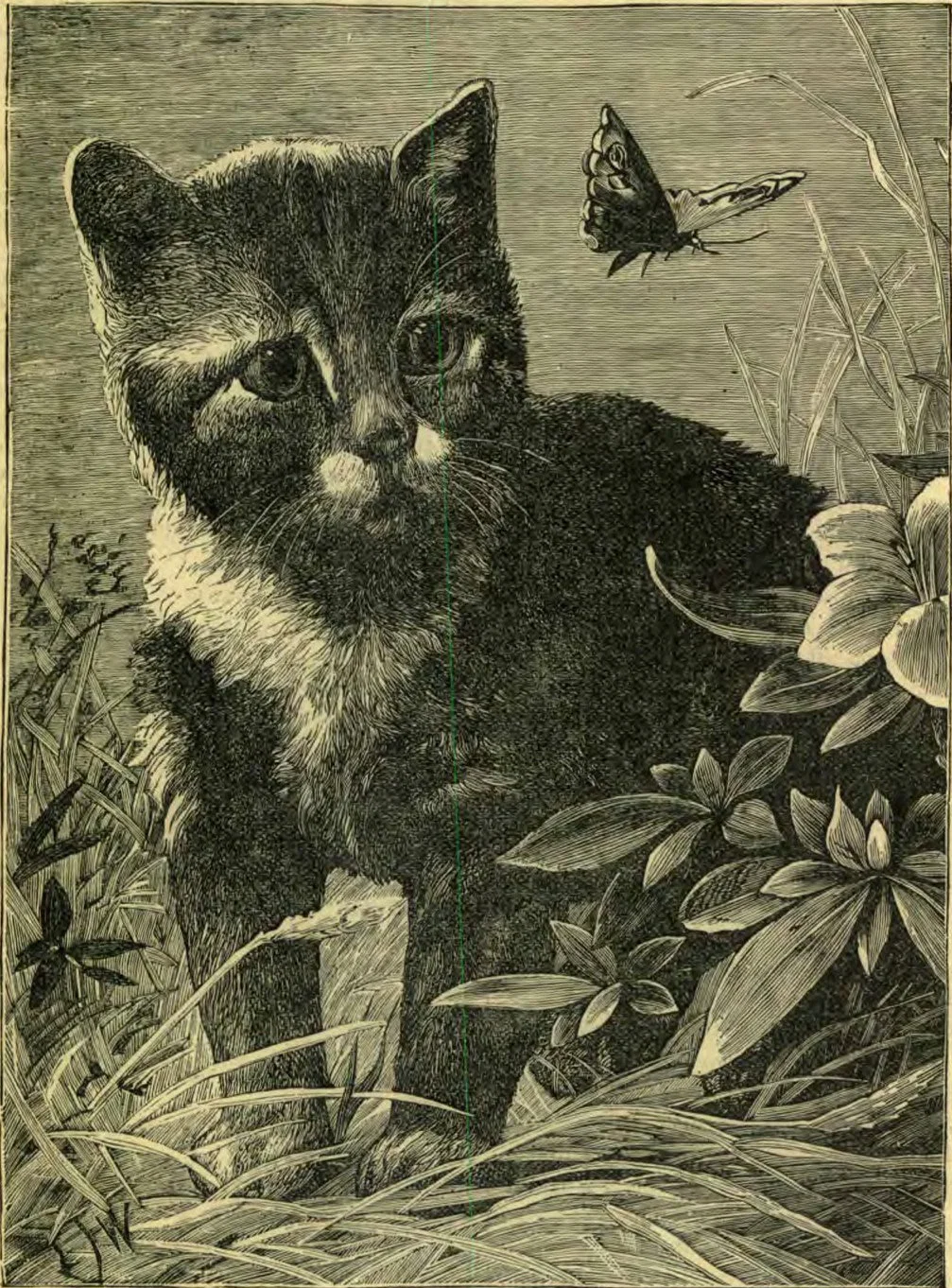
WE'VE called our young puss Cleopatra; 'Twas grandpa who named her like that. He says it means “fond of good living;” A queer enough name for a cat!
She leads the most lovely existence, And one which appears to enchant: Asleep in the sun like a snowflake That tries to get melted and can't;
Or now and then languidly strolling Through plots of the garden, to steal On innocent grasshoppers, crunching Her cruel and murderous meal;
Or lapping from out of her saucer— The dainty and delicate elf!— With appetite spoiled in the garden, New milk that's as white as herself.
Dear! dear! could we only change places, This do-nothing pussy and I, You'd think it hard work, Cleopatra, To live as the moments went by.
Ah! how would you relish, I wonder, To sit in a school-room for hours! You'd find it less pleasant, I fancy, Than murdering bugs in the flowers. —Edgar Fawcett.

WHERE TOM FOUND HIS MANNERS.

Tom's father was a rich man, and Tom lived in a large house in the country. He had a pony and many other pets, and wore fine clothes. Tom was very proud of all the fine things his father's money bought. He began to think that being rich was better than being good. He grew very rude, and was cross to the servants. Once he kicked Towser; but the dog growled, and Tom was afraid to kick again.
One day when Tom was playing in the yard, he saw a boy standing by the gate. He was ragged and dirty, his hat was torn, and his feet were bare. But he had a pleasant face. In one hand he carried a pail half full of blackberries.
“Go away from here!” said Tom, running to the gate. “We are rich, and we don't want ragged boys around.”
“Please give me a drink,” said the boy. “If you are so rich, you can spare a dipper of water.”
“We can't spare you anything,” said Tom. “If you don't go away, I will set the dog on you.”
The boy laughed and walked away, swinging the tin pail in his hand.
“I think I will get some blackberries, too,” said Tom to himself. He went out of a gate into a lane leading to a meadow where there were plenty of berries.
Tom saw some fine large ones growing just over a ditch. He thought he could leap over it very easily. He gave a run and a very big jump. The ditch was wider than he thought, and instead of going over it, he came down in the middle of it.
The mud was very thick and soft, and Tom sank down to his waist. He was frightened, and screamed for help until he was tired. He began to think he would have to spend the night in the ditch, when he heard steps on the grass, and looking up, he saw the ragged boy he had driven from the gate.
“Please help me out,” said Tom, crying, “and I will give you a dollar.”
“I don't want the dollar,” said the boy, laying down flat on the grass. He held out both hands to Tom, and drew him out of the ditch.
Tom was covered with mud, his hat was gone, and one shoe was lost in the ditch. He looked very miserable.
“Who is dirty, now?” asked the boy.
“I am,” said poor Tom; “but I thank you very much for helping me out of the mire. And I am sorry I sent you away from the gate.”
“The next time I come, perhaps you will treat me better,” said the boy. “I am not rich, but I am stronger than you are, and I think I have better manners.”
“I think so too,” said Tom.
The next day, when Tom saw the boy going by the gate, he called him in, showed him his rabbits, doves, and little ducks, and gave him a ride on his pony.
“You have good manners now,” said the boy.
“Yes,” said Tom, “I found them in the ditch.”
—Our Little Ones.

LETTER BUDGET.

Ella Bean, of Aroostook Co., Me., writes: “I am ten years old. I have a little brother five years old, and a sister seven years old. There is a small company of Sabbath-keepers here. I go to Sabbath-school and try to have my lessons. I study in Book No. 1. I love my teacher very much. My brother and sister go to Sabbath-school with me. I am trying to be a good girl.”
Charlie Warden, of Caldwell Co., Mo., says: “This is my first letter to the INSTRUCTOR. I cannot write, so I printed this on my slate, and mamma copied it for me. I am eight years old. I study in Lesson Book No. 3, and when I go to day school, I read in the Fourth Reader. I have begun to read the Bible through this year. I want to meet the INSTRUCTOR family in the earth made new.”
Lulu Starr, of Kingsbury Co., Dak. Ter., says: “I have four brothers and three sisters, and we all keep the Sabbath. I am six years old. I like to go to Sabbath-school. I get my lessons in Book No. 2. My sister is my teacher. I had the scarlet fever last spring. My sister writes this for me. I am going to school this summer, and am learning to write, so I can write a letter for the Budget myself.”
Claude H. Wilcox, of St. Lawrence Co., N. Y., writes: “I am a little boy six years old. I like so much to have my mamma read the pieces in the INSTRUCTOR to me. I go to Sabbath-school, and learn my lessons in Book No. 1. I am studying it through the second time. I have a little sister named Katie, and a little brother named Milton, after my uncle who has gone to England. Papa attended the canvassing school last May. I want to be a good boy. I cannot write, so ma writes this for me.”
Leslie D. Iler writes from Miami Co., Kan. He says: “May I come into the letter corner? Some kind friend sends me the INSTRUCTOR, and I should like to know who it is. It is such a good paper. My ma thinks it is a real treasure in the family. If this letter meets the eye of the one who is so kind as to send it, I send thanks, and hope the person will write me a letter through the INSTRUCTOR. I have older brothers who may profit by its good reading.”

You have reached the end of this edition.

The Youth’s Instructor · Aug 27, 1884