The Youth’s Instructor, Vol. 32, No. 45.

WEAVING

The Youth’s Instructor

Nov 5, 1884

S. D. A. Publishing Association · Battle Creek, Mich. · Nov 5, 1884

WEAVING
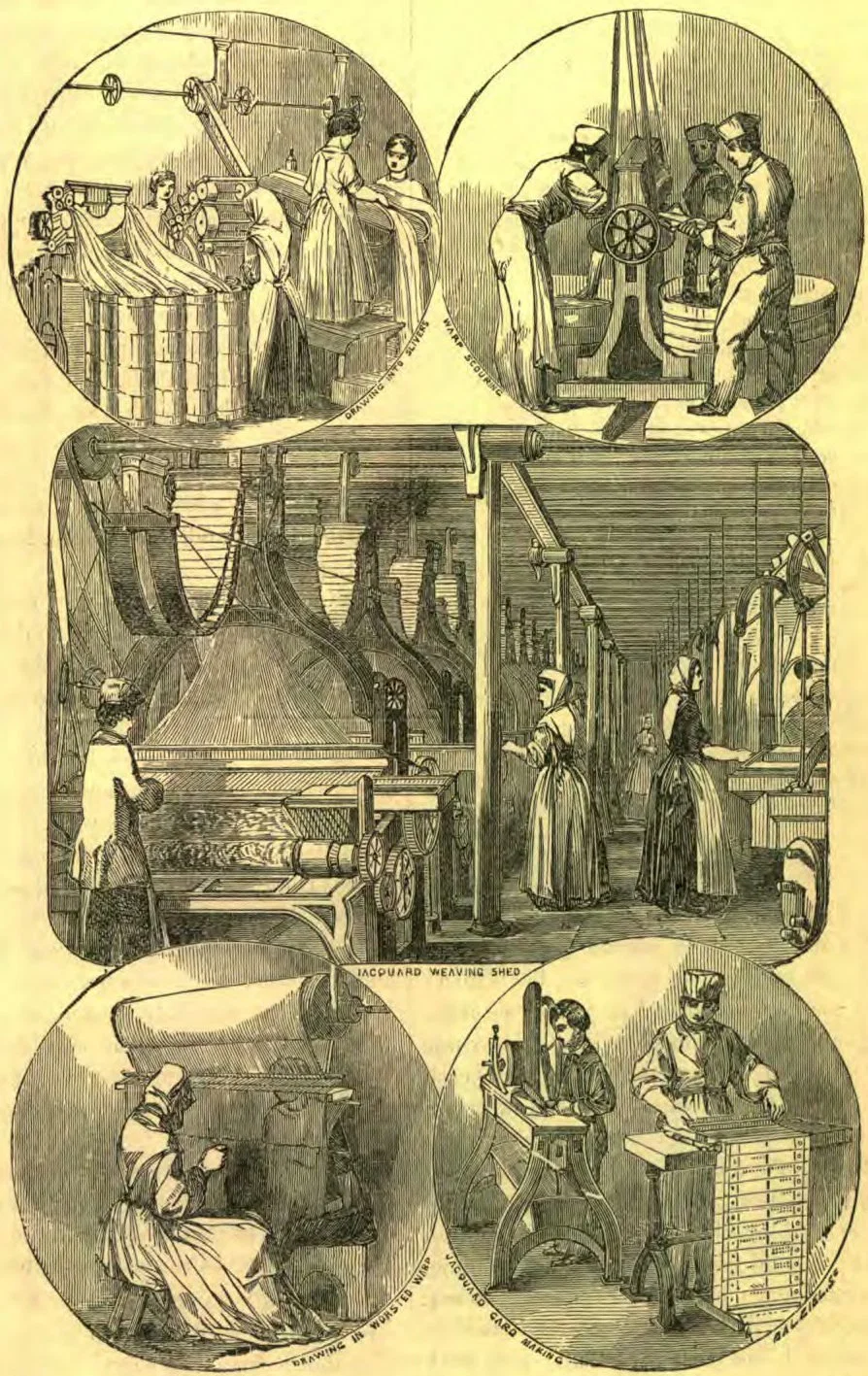
The origin of the art of weaving is not now definitely known. The weaving of reeds, of thongs of hides, and of rude fibers, was without doubt practiced before the preparation of fibers for the loom by spinning had been thought of. The Egyptians possessed a knowledge of the art; and although their looms were very simple, the fabrics produced in them were often elegant and costly. Specimens of these fabrics are seen in the mummy cloths found in the ancient tombs.
Weaving was also known and practiced in very early times in Greece, both as a domestic employment and as a distinct trade. In the writings of Homer we find a description of certain products of Creüsa’s shuttle,—a figure-woven pattern, in which appeared a gorgon and dragons.
JACQUARD WEAVING SHED
In more modern times, the people of Italy and of the Netherlands appear first to have become famed for their textile manufactures, and from these countries the trade passed to England and France, though just at what period is uncertain.
Until within about two centuries, the looms were operated by hand and foot; but about that time the first power loom was invented by M. de Gennes, a French naval officer of some distinction. He communicated his plan to the French academy of sciences in 1678; but although possessing superior advantages, his loom was not brought into use. During the century which followed, several English inventors brought out power looms, none of which were generally adopted. The first successful power loom was the invention of the Rev. Edmund Cartwright, in 1785-7.
Improvements in the various machines for weaving have constantly been going on, until, as one watches their marvelous movements, they seem almost possessed of life and intelligence, and their productions truly wonderful. Among the more recent of these improvements is the “electric loom,” in which various parts of the machine are operated by electricity. This loom was constructed by M. Bonelli, a gentleman well known in connection with recent electrical investigations.
We have not space to give anything of a description of the many methods of weaving various fabrics. Our engraving gives a faint idea of the machinery for weaving, as invented by Joseph Marie Jacquard, a French mechanician, born in Lyons, July 7, 1752. His father was a weaver, and the proprietor of a loom. At the age of twelve, Joseph succeeded, upon the death of his father, to his shop and two looms, and commenced business as a weaver. He made various improvements in the machinery for weaving. For this he was assailed with open abuse and violence by those whom the introduction of his apparatus had temporarily thrown out of employment; and he was denounced as the man who was reducing families to ruin and starvation. His house was entered by a mob, and one of his looms was broken to pieces. On several occasions he barely escaped with his life. But these scenes soon ended, when his invention was purchased by the government, in accordance with an imperial decree, and made public property. He received the cross of the legion of honor, and in 1840 a statue of him was erected in Lyons. J. W. B.

TIME TO GO.

THEY know the time to go! The fairy clocks strike their inaudible hour In field and woodland, and each punctual flower Bows at the signal an obedient head, And hastes to bed.
The pale anemone Glides on her way with scarcely a good night; The violets tie their purple nightcaps tight; Hand clasped in hand, the dancing columbines, In blithesome lines,
Drop their last courtesies, Flit from the scene, and couch them for their rest; The meadow lily folds her scarlet vest Fair and serene, And hides it 'neath the grasses lengthening green.
Her sister lily floats On the blue pond, and raises golden eyes To court the golden splendor of the skies; The sudden signal comes, and down she goes To find repose In the cool depths below.
A little later and the asters blue Depart in crowds, a brave and cheery crew; While golden-rod, still wide awake and gay, Turns him away,
Furls his bright parasol, And, like a little hero, meets his fate. The gentians, very proud to sit up late, Next follow. Every fern is tucked and set 'Neath coverlet,
Downy and soft and warm. No little seedling voice is heard to grieve, Or make complaints the folding woods beneath; No lingerer dares to stay, for well they know The time to go.
Teach us your patience, brave, Dear flowers, till we shall dare to part, like you, Willing God's will, sure that his clock strikes true, That his sweet day augurs a sweeter morrow With smiles, not sorrow.
—Susan Coolidge.

“HE CARETH.”

“Mamma said we should keep together and take care of grandma, but I don’t see how we can. I just know we can’t, and there’s no use trying,” and Annie Benson stopped her sewing to brush off a few hot tears that would fall upon her cheeks.
“Hey? What’s that ’bout takin’ care of grannie?” asked the deaf old grandmother, who could not hear everything, but heard just enough to trouble her. “You needn’t take care of grannie, child—only to give me a bite of somethin’ to eat, and mebbe, if you’re tired, you needn’t even do that. I guess I can wait till Lizzie gets back from the shop. Only I s’pose poor Lizzie’ll be tired a-standing on her feet all day, but she’ll comb my hair all the same, poor Lizzie!”
“Grandma, dear,” Annie said, “you don’t understand. I didn’t think you could hear me, but I wasn’t complaining about taking care of you; I am worried and anxious—that’s all. Do you understand that?”
Grandma passed her hand across her wrinkled forehead wearily; then, raising her aged face, she said, “P’r’aps I understand, I hardly know myself, child; but whether I do or not, ‘Cast your care upon Him, for He careth for you.’ Don’t you know, child, that He is ‘a refuge in times of trouble’?”
The Lord did not seem to be a refuge just now to Annie. She went out into the wood-shed and cried bitterly. “It’s well enough for grandma to talk about God’s being a refuge. She don’t know how hard it is for us to get along; how Lizzie is working her very life out, and Frank going into evil ways clerking for a liquor-dealer.”
“I wish I could get another place somewhere—a place where I could sit down once in a while,” said Lizzie that night, just as she crept into bed.
“I wish you could,” Annie kindly replied, but biting her lips hard to keep from letting her weary sister know how sick of life she herself was.
Lizzie dropped to sleep in a moment, her dreams all night long being troubled ones. She dreamed over and over of falling to pieces, or of dropping on the floor in a limp, white heap, and of hearing people say indifferently, “Well, she was only a shop-girl in a variety store; it is better so.”
Annie lay awake, her mind too troubled to rest. Pretty soon she heard grandma talking in her sleep; the words she caught were these: “He careth for you.” Annie did not believe it. No; she felt sure God did not care for her, else he would comfort her. She felt hard and bitter that first hour. The second hour she wept softly, with a strange yearning in her heart; for again grandma had murmured, “He careth for you.”
After a while, Annie’s heart grew loving; she again remembered the Saviour, whom she had been neglecting. She wished she could find him, and rest her tired head upon his breast. She believed, after all, that he did care for her. To resolve was to do. Very soon Annie was on her knees praying with faith to her heavenly Father. Then, having finished, she lay down beside her sister, and fell asleep to dream that a strong arm was about her, and that a firm, loving hand was leading her.
The next morning was a cold one. Soon after Lizzie had gone to the store, Annie sat down by the window to her sewing; she was stitching underclothing for Lizzie’s employer. Her breakfast had been meagre; her clothing was scant; and yet there was a song upon her lips: “He careth, he careth.” Fully she now believed that her prayer would be answered.
At ten o’clock a lady rapped at the door. “Does Dora Steele live in this house?” she asked.
“She did live on the second floor, but she has moved to another State; she went with a lady as family seamstress,” answered Annie; and then, noticing that the lady looked troubled, she politely invited her in. The lady declined, saying, “No, I thank you; I must hunt up a sewing-woman without delay. Do you know of a good one along this street?”
“I can sew pretty well, madam. Will you step in, and look at some of my work?”
The result of that looking, Annie told to Lizzie when she called at the store at twelve o’clock.
“O Lizzie,” she whispered joyfully, “He does care for us; we’re both to sew for such a good Christian woman. We’re to make piles of clothes, and sheets, and pillow-cases, and quilts, and everything for a bride; and O Lizzie, the lady was so kind and tender, somehow, that I told her about Frank; and her husband will look after him, and will try to get him a safe place.”
Lizzie’s face glowed at the good news, but she asked, “Who will stay with grandma?”
“Mary must stay home from school for awhile, and then I’ll trust God for what will come afterward.”
Thanksgiving-day came. The Benson family were all at home—grandma, Frank, Lizzie, Annie, and little Mary. Such a good dinner as they sat down to had never been seen before in that house.
“I’ve got a grand place, now, I tell you; no ‘letting down of bars.’ I feel as if I’d got a little nearer God,” said Frank.
“Thank God!” said grandma, earnestly.
“That’s just the way I feel,” Lizzie said, a bright light flooding her eyes. “I know I am nearer my God since I’ve worked for this Christian woman. She does not drive us as others did. I’ve found some flesh and color again. Do you see it, grandma?”
“Yes, child, and I thank God.”
“And then, when she’s through with us, she is to send us to her friends. We’re promised steady work, and oh, such generous pay! How glad I am that I found the ‘cleft in the Rock’!”
“And crept in there. Annie, child, it’s good you did that. God is a sure refuge. He careth, he careth,” grandma said.—S. S. Visitor.

SOME PORTIONS OF SWEDEN

FOREIGN TRAVEL.—NO. 20.

SOME PORTIONS OF SWEDEN.

FROM Christiania we went by rail through the eastern part of Norway, spending a day at a small inland village, then going on to Stockholm, the capital of Sweden. It was a rough, hilly country, covered largely with evergreen timber. The soil was very stony where the rocks did not wholly prevail. The portion of Sweden through which we passed was mostly covered with timber. The soil looked cold and sterile, and the country was but little settled, though several villages were passed. We never saw so many lakes in any country as we saw here. For hundreds of miles it seemed as though we were hardly out of sight of them, there being sometimes four or five in sight at once. Nearly all of these were small. The water was clear, and many of them were very attractive.
Sweden contains many iron mines of the very best quality to be found in the world. The people have to labor very hard to obtain a living.
Stockholm is a fine city of some 220,000 people. It is built upon islands, in a beautiful bay, some of them being well fortified. It contains many fine buildings, among which are the king’s palaces and various public buildings, and some very beautiful public squares and ornamental gardens. It has many public baths, which are most generally managed by women.
We saw more drunkenness here than in any other country we visited in Europe. One reason of this is because in these northern countries stronger kinds of liquor are used than wine and beer, which are most generally drunk in Germany, France, Italy, etc. One feature which is seen in many European cities, is the prevalence of beer gardens and drinking places. In many of the most beautiful parts of the city, a great number of small tables were placed under the shade of trees, around which were seated many of the youth of both sexes, also of people in middle age and those advanced in years, whose demand for strong drink was being supplied by the numerous waiters running to and fro. In the meantime, bands of music were playing to make the scene still more enticing. On Sunday nights these were more largely attended than at any other time. It was enough to make any one who had any love for temperance heart-sick to see the youth of both sexes drinking freely of that which “biteth like a serpent, and stingeth like an adder.” Every attraction that could be provided was used to draw the people to these places. Many thousands of people could be seen at these various resorts in one hour’s walk.
From Stockholm we traveled by rail down the the long peninsula of Sweden till opposite Copenhagen, where we crossed in a steamer an arm of the Baltic Sea, to the city. Norway, Sweden, and Denmark are called the Scandinavian countries. Their people were anciently of the same origin. Over a thousand years ago, this people were a terror to all Northern and Western Europe. They conquered England, and held it under their rule for a long period. They swarmed down from their bays and inlets in large bodies, and ravaged the coast of many countries. After their conversion to Christianity, they became more mild.
There were some very famous men in history who were of this race. Gustavius Adolphus, of Sweden, upheld the Protestant cause after the Reformation; and had it not been for him and the victories he gained for it, the prospect of the Reformation would have been very dark. Charles XII. of Sweden was a great warrior, and for a time disputed with Peter the Great of Russia for the sovereignty of all these northern countries. At that time, Sweden was a much stronger power than Russia, holding a very prominent place in the affairs of the world. Now these Scandinavian countries are much reduced in military power, and in population. Denmark contains less than 2,000,000 people, Norway about 1,500,000, Sweden about 4,000,000. These countries, Norway and Sweden, lie very far to the north, their southern coast being about the same latitude as that of Greenland. Were it not for the warming influence of the Gulf Stream, they would be about uninhabitable. As it is, they afford a very pleasant residence in the summer season, when the nights are short, and the days are long. When we were there, in May, we could read ordinary print at ten or eleven o’clock at night, and at about three in the morning. On the northern coast of Norway the sun is visible night and day for three months in the year. There is a beautiful twilight extending the whole night through in both of these countries in the summer season, so the night is not very dark. In the winter, however, the days become very short, so that lights must be used in the afternoon as early as three o’clock.
There are few travelers who visit these countries; but there are many objects of interest connected with them. The inhabitants, we believe, are far more virtuous on the average than in many of the warmer countries in the old world. They are a patient, industrious, enterprising people.
UNCLE IDE.

SOME OTHER DAY.

If all the words that grown folks say, The saddest are these, “Some other day.” So easily, carelessly, often said, But to childish ears they are words of dread, To hope a knell, and to wish a doom, A frost on expectancy’s tender bloom; For even a baby who scarce can crawl, Knows a promise like that is no promise at all, And that out of sight and of mind alway Is that mocking mirage, “Some other day.”
The years flit by, and wishes fade, And youth in the grave of age is laid, And the child who bent his youthful will Is a child no more, but is waiting still. For the pleasure deferred, the left-out game, Though it come at last, is never the same; The bubble has died on the mantling cup, The draught is dull as we drink it up; And old hopes laugh at us as we say, “At last it has come, that ‘other day.’”
Ah! little hearts which beat and fret Against the bounds by patience set, Yours is but universal fate, And the old as the young all have to wait. You will learn like us to be stout in pain, And not to cry when your wishes prove vain, And the strength that grows from a thwarted will, And that service is done by standing still, And to bravely look up into heaven, and say, “I shall find it all there, ‘some other day.’”
—Susan Coolidge.

IMPORTANT BIBLE SUBJECTS.

LESSON 19.—IMMORTALITY.

[NOTE TO THE STUDENT.—Do not consider the lesson learned until you can give at least the substance of every text, with the correct reference for each. The references in black letters indicate those texts that should be committed to memory. A little diligent application each day will enable you to do this.]

QUESTIONS.

1. What do the afflictions of this life work for us? 2 Cor. 4: 17.
2. Under what conditions do they accomplish this result? Verse 18.
3. By what means do we behold unseen things? Heb. 11: 1.
4. While looking at unseen things, of what are we assured? 2 Cor. 5: 1.
5. What is meant by “our earthly house of this tabernacle” being “dissolved”? Compare 2 Pet. 1: 13, 14 with John 21: 18, 19.
6. What does Paul say that we earnestly desire while in this earthly tabernacle? 2 Cor. 5: 2.
7. Why do we desire to be “clothed upon”? Verse 4.
8. Then to what is being “clothed upon with our house which is from heaven” equivalent?
9. What do these two “houses” represent? 1 Cor. 15: 44.
10. Which of these comes first? Verse 46.
11. When is the spiritual body bestowed? Verses 42–44.
12. Whence does this spiritual body come? Verse 49.
13. When is it that corruption puts on incorruption, and mortality puts on immortality? Verses 42, 51–53.
14. Then when is it that mortality shall be “swallowed up of life”?
15. To what is this equivalent? 2 Cor. 5: 4.
16. Who hath wrought us for this thing? Verse 5.
17. What is it for which God hath wrought us? Verses 4, 5.
18. As a pledge of future immortality, what does God now give us? Verse 5.
19. If mortality is swallowed up of life when this earthly house is dissolved, and we are “clothed upon” with our house from heaven, what opposite conditions do the two houses represent?
20. Then in what state are we while in this earthly body?
21. While “at home in the body,” from whom are we absent? 2 Cor. 5: 6.
22. When shall we be with the Lord? 1 Thess. 4: 16, 17.
23. What do we “put on” at that time? 1 Cor. 15: 51–54; 2 Cor. 5: 2–4.
24. Since death is the dissolving of this body, and we are not “clothed upon” with our spiritual body until the resurrection, in what condition are we between death and the resurrection? 2 Cor. 5: 4.
25. Is being “unclothed” a desirable state?
26. What do we desire rather than this? 2 Cor. 5: 8.
27. Quote three texts to prove that we can be with Christ only at his coming.

NOTES.

From a careful examination of 2 Cor. 5: 1–8, it is evident that the apostle is describing two different conditions,—the mortal and the immortal state. Verse 4 shows that mortality being swallowed up of life is the equivalent of being “clothed upon” with our house which is from heaven. And this, as we learn from 1 Cor. 15: 42–49, is the receiving of the spiritual body at the resurrection. When this mortal body is dissolved, at death, we are said to be unclothed, because immortality—our “house not made with hands, eternal in the heavens”—is not bestowed until the resurrection. Death is not a thing to be desired; but the follower of Christ earnestly longs for his coming, when death shall be “swallowed up in victory.” We may desire to be “absent” from this mortal state, and to be “present with the Lord;” but this can take place only “when Christ, who is our life, shall appear.” Then we can see him as he is, for we shall then be like him—immortal. The object of the scripture under consideration is to teach us to bear up under affliction, by the sure hope that immortality, bringing a “far more exceeding and eternal weight of glory,” will be ours when Jesus comes.
The passage of Scripture forming the basis of this lesson, needs careful, patient study, but the student will be amply repaid for all the time spent on it.

THROUGH GOD WE SHALL DO VALIANTLY.

[Read at a Sabbath-school convention held in connection with the camp-meeting at Marshalltown, Iowa.]
In considering my subject, almost the first thought that comes to mind is the fact that we are engaged in a most important work. It is within the province of the Sabbath-school to play no small part in the religious training of children; for who besides a parent can have more influence over a child than a loving, Christian teacher? As I write, a vast multitude of childish forms gather before me from all parts of the land. Their souls are comparatively pure; their minds, a most fertile soil, stand ready for the hands of the sower, and while he lingers, little incidents and circumstances may plant seeds that will grow to the rankest, vilest weeds. The lambs of the flock! Very precious are they in the sight of their Redeemer. Even the youngest has a soul to be saved. And besides this, many of them, if trained for God, may yet work valiantly for him.
But this is not all. Besides the molding of these younger ones, we have the care of the youth,—those just putting on the crown of manhood and womanhood; and here lies our greatest work,—to keep their eyes from becoming blinded by the glamour of the world. To them this life is one of pleasure. They cannot see its emptiness—the heart-aches just ahead. The mirage looks very beautiful to them, and they cannot think it an illusion. Often it is only when it has vanished, leaving them but the desert sands of wasted years, that they see its deception and their need of God. They may then turn to him, but it will be with lives darkened by sin, and with habits which will mar their usefulness through the rest of life. Let ours be the task to lead them into the path of right, and to do our best to keep them in it. They are precious jewels intrusted to our keeping, and by and by the Master will ask for his own. What a field for good, faithful Sabbath-school workers! What account shall we render to our Maker if we neglect its tillage?
The burden looks heavy; the work is vast, but we have the soothing assurance that we need not work alone. We are wielding the sword of the Spirit, and we may be sure of the Spirit’s aid if we ask for it in sincerity. If one of us should employ a man to do a piece of work, would we not be willing to aid him? How much more, then, must God, with his great heart of love, be willing to aid his servants when trying to save for him a perishing world.
Holy Writ is filled with examples of great deeds done through mankind by him. Moses was a man “mighty in words and in deeds,” “learned in all the wisdom of the Egyptians;” but did he accomplish anything in the work he believed himself pre-ordained to do until God said, “Go and deliver my people,” assuring him that he would certainly be with him? Then he went; and by being a humble, willing instrument in God’s hands, what a work he wrought!
The twelve apostles and Paul! Our hearts thrill with admiration when we think of the many thousands who became Christians through their instrumentality; but Paul tells the secret, when he says, “I have planted, Apollos watered; but God gave the increase.”
Luther, the great reformer, though a man of giant mind, knew that without God he could do nothing, but that with him he could do much; for at one time he said, “I have so much to do to-day that I must pray two hours.” He believed that God would help, and he “through God did valiantly.”
Many examples might be brought to show that the Lord of Hosts arms the right, and gives victory; for no great, good work has ever been accomplished but it was seen that his guidance had been over it all.
What we most need is the will to do. God’s help is sure. An anecdote which I read some time ago fully illustrates my meaning: A little boy was riding down a rather steep hill on a load of hay. As they neared the foot, the horses broke into a trot, which, of course, jolted the load some. The little boy’s mother looked out of a window, with some anxiety; and shortly afterward, when he came in, she asked, “Willie, weren’t you frightened when the horses began to run?” “Yes, mamma, I was,” replied he; “but I asked the Lord to take care of me, and then hung on like a beaver.” Surely this little fellow had the right idea of asking God’s help. It is because we lack the will to do that we are not accomplishing more in our Sabbath-school work. We ask God to help us, and in a great measure have faith that he will; and I believe he does, but just in proportion to our work. He is not going to do it all. In mercy to us, he will not; for it is by working for him that we are to save our own souls. Faith and works, like the two oars of a row-boat, must be pulled with equal force, or we will not make very great advancement. If we could only throw our whole soul into the work, knowing that God is much more than willing to help us, what might we not accomplish? Through God we could do valiantly, and when Christ comes, could go home rejoicing, carrying in our sheaves. E. R.

Example Teaches Better Than Precept

SAID a crab, according to an oriental proverb, “Daughter, why do you walk crooked?” “Mother,” said the young crab, “show me how to go straight.” There is no better mode of practical teaching than by example.

A SYRIAN STREET-SCENE.

How much we would enjoy going up and down the streets of the towns across the sea, especially in those places where the Saviour once lived! We would find things now very much as they were thousands of years ago. The fashions do not change there, as they do in our country; people dress much as they used to, and build their houses in the same way. Very few of us, however, can hope to make such a journey, so we will have to content ourselves with reading what other people have written. We can thus imagine how it would look.
The picture on this page shows a street scene in Syria. What odd-looking clothes these men wear! Over their full trousers and undergown they wear a long, flowing robe, with great, wide sleeves. On their feet are colored slippers, pointed and turned up at the toes. A large turban of white cloth covers the head. Sometimes they wear an embroidered jacket in the place of the robe. This man in the fore front of the picture has one on. You see, under his right arm, a curious bag. This is a bottle made of the skin of some animal. In some parts of the country, water is very scarce, so these water-carriers make it their business to sell water to any who are thirsty.
At his heels is a dog,—not such a fine, noble-looking animal as are some of the dogs of our country; but a snapping, snarling, wretched-looking cur, more like a wolf than anything else. He would not know what it meant if any one should pat him on the head, for he is wholly unused to kindness. Nobody owns the dogs, or takes any kind of care of them. They never receive any petting; they are treated only to kicks and curses.
There goes a man walking down the street, smoking his long pipe. Behind him, a little way off, follows a woman, closely veiled. You can see nothing of her face except her piercing black eyes. She is the man's wife. He never walks beside her, for a Syrian thinks it a great disgrace to be seen in company with a woman, even though it should be his wife. He never speaks of her, and considers her little better than his dog or his donkey. You may be sure the little Syrian girls have a hard time of it. They are not thought of much account, and are treated with contempt, and sometimes with cruelty. When a girl is born, the people think it a great misfortune, and mourn bitterly about it. But there is great rejoicing at the birth of a son. Then the parents make a feast, and sometimes send presents to the relatives.
Have you noticed what strange houses the people live in? They are low, dark, flat-roofed huts. Sometimes they have no window, and only a low door. What a din the people are making in that little, dark room! Let us go nearer, and peep in. Ah! it is an Arab school. Here you see a roomful of boys, sitting cross-legged on the floor, swaying their bodies to and fro, and studying out loud from the Koran. This book is the holy book of the Mohammedans; it is their bible, but it does not teach them the same pure truths that our Bible teaches us. Don't you wonder how the teacher can hear the children recite in such a noise! When they go up to say their lessons, they shout a great deal louder than the rest. The teacher thinks himself very strict. Sometimes he punishes the boys all around, and sometimes he lets them go. When the teacher thinks it best to punish a boy, he makes him lie down on the floor. Then he takes a stick like a bow with a cord to it, and winds the cord around the boy's ankles, as tight as he can. Taking a rod, he beats him on the soles of his feet, until he is almost black in the face with rage and pain.
What a pile of shoes there are outside the school-room door!—black shoes, yellow shoes, red shoes; new shoes and tattered shoes, and kob kobs. These kob kobs are wooden soles, raised three or four inches high, so as to keep the feet out of the water. They are held on to the foot by a strap over the toe. They are awkward things to wear; and when the children try to run with them on, they very often trip, and fall on their noses, and the kob kobs fly off, and go rattling over the stones. It would be very impolite for them to enter a room with their shoes on their feet, so they have to leave them outside. But they may go in with their red felt caps on their heads. They have great times trying to find their own shoes when school is out; and they often get into fights, and swear dreadfully at each other about it.
Do you ask what those men are saying from that mosque, or temple, over yonder? That is the call to prayer. Five times a day that call is given,—at morning, noon, and night, and at two other times. The men are saying, “There is no other god but God;” that is true, but then they add, “and Mohammed is the prophet of God,” and that is very untrue. Every devout Moslem, when he hears the call, stops whatever he is doing, no matter if he is in the midst of a bargain, and raising his hands to his head, offers his prayers; then he falls on his face with his head between his out-stretched palms, and prays again. If he is very pious, he says the same prayers five or six times.
You would think at first that the people knew more about the true God than the Christians. But this is not the case. They do not know about Jesus, and what he has done for us. They are not, as a general thing, kind and loving to one another. Many take no care to tell the truth, and they would as soon steal your things as not.
But interesting as it would be to visit in these strange countries, you would no doubt soon tire of living there, and would think our own country the best.
W. E. L.

OUR GARDENS.

Who has a garden to plant? I know,— Each little boy and girl; and so Each little boy and girl must get Good seeds to sow, good grafts to set; And when they have set and sowed, take care To trim them and weed them, till they shall bear Such good and beautiful fruit that they Will be glad for all they have done, some day. Each little garden is each little heart, Where the good seeds with the bad will start; And we all must strive to destroy the bad And protect the good. And the lass and lad Who work the hardest to plant and sow In their little hearts good seeds, may know That their future lives will prove what care They took, and what seeds they planted there.
Continue reading: Letter Budget