Why have so many church schools failed of the expectations of those who sent pupils to them? This question has been asked many times. There is one reason that it is well for every parent to think of candidly and seriously. It is the position that far too many have occupied.
When we were connected with the public schools, the civil power was behind them. It was necessary that it should be so. God ordained the civil power as the best thing to control those who would not yield to the power of his Spirit. Romans 13. It was the best thing that the Lord in infinite wisdom could give to meet man’s needs where it found him. But when we left the public schools, it was to place ourselves under the power of God’s guiding Spirit, that would accomplish all that the civil power could ever do, even when well administered, and far more, as the civil power can compel only as far as it can keep a man in sight, while the higher power under which the Christian places himself will cause him to conform to every good thing that the civil law requires, not only when under the eye of his fellow man, but being the well-spring of his being, he will as gladly do all when no human eye can trace his footsteps.
But now to trace the path of the many who have turned toward the higher way. We have left the civil power behind, in the school, and claimed to place ourselves under the mightier controlling power of God. But failing to place ourselves unreservedly there as parents, we have occupied a middle ground where the civil power was left behind, yet the other power has not controlled in the home. There is no law, divine or human, that can successfully cover the middle ground. The result has been a dangerous nearness to a lawless condition. But a lawless condition is anarchy.
This has brought an almost hopeless task to many teachers, as they have undertaken to maintain system and order. As parents have seen this, some have decided to send their children again to the public school, feeling that this was better than the change. This was not wise. The civil power was instituted and is maintained for the lawless and wicked. It was not instituted for the true Christian. It could not be. He will do the good things demanded by just laws, because, having kept the moral law, which embraces all just laws, he will never need them. Then the one who decides to go back to this for controlling power, confesses that he has not attained to the higher and overshadowing power of the Spirit of God to control and guide. His faith has not grasped it, and he, virtually, has given up the struggle. Should he have done this? Better12to turn, and, with a persevering spirit, place himself entirely under the stronger and more far-reaching power of God. This will first conquer his own spirit. Then it will control in the family. (This is said of the family where the parents are united. Where they are not, there is need of especial grace. God will not desert the faithful soul, even here.) When the peace of God has quelled the excitable spirits of the parents, they will be instruments in God’s hand to quell the unsubdued spirits of the children, and the same power that can do for the parent what the civil power can not do, in that it keeps him right all the time, will be manifest in the child, both when in the presence of the parents and when away from them. Then the question of order in the church school will be solved. It centers in the Christian experience of the home. If the experience of the home is worldly, then the civil power will accomplish the most. But instead of invoking this, let us not rest until we know that the quieting power of God has prevailed.
The condition of the church school will be a means in God’s hand of showing the condition of the church as families. In this way there is a double blessing,—pointing out to us our needs, and giving our children true education. In the first opening of church schools, while undertaking to follow the light given, we saw no way to meet the expense, but to charge a certain amount for each student, and in this way raise the necessary funds. This really made them subscription schools. This worked hardship, as some of the families having the largest number of children who ought to be in the church school, were unable to pay the tuition for all. They could send one or two, and the others must wait, or still attend the public school. To remedy this evil, it was proposed to raise a church fund to assist those who could not otherwise have the benefit of the school. It was not long before this was found to have its weakness. Then there was a general forward step taken when it was decided to do away with the tuition, and make them indeed “church schools.” To accomplish this, there were calls made to all the church to raise the amount necessary to pay the expense of the school, month by month, and then all the children would have an equal right to the privileges of the school. While these steps were being taken, the public schools were opening their arms to all, rich and poor alike, saying “Come. All are equal. All are welcome.” And while many have seen the dangers that menaced the public schools, yet all must admit the grand basis that opens the doors of possibility to rich and poor alike.
This last step in church-school work brought us to the same equality, but still there has been a financial uncertainty, as the pledges or cash donations have been continually changing. Some have freely given, others have felt excused after placing in the Sabbath contribution a nickel, a dime, or at times, perhaps, a quarter. Inequality has continued. Some have recently been studying the foundation of the second tithe, as given to Israel, believing that what did not in some way foreshadow the death of Christ, was not taken away at his death. Hence many churches and some conferences have heartily adopted the plan of second tithing, to meet the many calls, especially those for the support of the church schools. This has been found to bring exact equality to all, rich or poor, and no one is unequally burdened.
The plan has been to send two thirds of the second tithe to a central treasury for the paying of the teachers, retaining one third at the home church for local needs. The church-school teacher thus becomes a conference employee. The surplus of the second tithe, either at home or in the central treasury, will be, from time to time, devoted to missionary work.
This would make two systems, equally perfect, side by side,—the first tithe supporting the ministry at home, as well as the ministers chosen to go to foreign fields, and then, from time to time, the surplus, by vote of the conference, sent as a donation to other needy fields; the second tithe paying the teachers at home, supporting the teachers called to other fields (and these calls will come), and then, from time to time, the surplus donated to the places of greatest need. We feel satisfied that this is God’s plan, and hence the most equal and just that can be devised.
Still further, if the plan of charging a certain rate for each child was not the best plan, and has been quite generally laid aside for something more satisfactory, should we charge a tuition for each child, when a little older, in advancing from the church school to the higher grades? Here, too, the public schools offer every inducement for advancement, free of charge, and at the time when Satan will bring to bear every device known to his subtle mind to turn the young man or young woman after the offers of the world. This is the time of all times when we should encourage those for whom we have sacrificed through the period of church-school life, to keep the separation distinct and complete by stepping into the next higher schools prepared by our people. Will not the second tithe open the way for this, by paying the teachers—except the Bible instructor, who we are told should be paid from the first tithe—in the higher conference schools? We suggest this for serious thought. If, for lack of means, the student goes back to the public school after having passed through the church-school grades, his former separation will avail but little. The seal of all the past work comes at this critical time. Shall we, then, allow the world to triumph at the last, because we make the continued advancement more difficult than it has been in the earlier grades? The Lord has patiently borne with us through all the mistakes of the past, and he will guide to the right way all who, with a constant spirit, look to him for light, and do not rashly turn back.
The Marriage Relation
By G. C. Tenney
G. C. TENNEY
MARRIAGE as a divine institution is essentially and altogether another thing from merely human wedlock. In the latter the bond is self-interest, gratification or profit being the motive. In the former the union is approved of God, and is formed by his power. In such a case there is no place for strife or hatred or taking of personal advantage, because the twain have been made one flesh. And no man ever yet hated his own flesh. Many husbands and wives acknowledge that they should be one, but quarrel continually over which shall be the one. But neither is to be the one. It requires both to make one. Neither is to swallow up the other.
And yet, while this is true, every family should have one recognized head. To find this place the Bible as well as nature assigns the man. He is the house-band. His rightful place is over his house as Christ is over the church. This does not imply tyranny or lordly domination. It rather means a protector, provider, teacher, example, comforter, and counselor. In nothing does a true husband and father take so much satisfaction as in the purity and true dignity of his wife and children. They are his special treasure. How quickly would he resent any attempt on the part of another to bring shame or reproach upon them. Should he not be equally careful not to do so himself? There are many ways in which a man can humiliate his wife, and break the spirit of her womanly dignity and self-respect, which is the secret of true ladyhood. If a man desires to have a lady for a wife, it rests with himself to make and preserve her such. He must treat and regard her as a lady if he expects others to do so. It is nothing short of beastly baseness and cowardice to treat a wife in an impure, disrespectful, or inconsiderate manner, and then demand that she become a queen or a model in the presence of others. Let a woman know that she has the honor, love, and high esteem of her husband, and that very assurance, and that fact, with the consciousness of her acceptance with God, forms a sure foundation for true nobility in character and deportment. Deprive a wife of that great boon, and she becomes either a bold rebel against her cruel lot, or a servile slave without spirit or grace.
Then, as the church submits to her loving Saviour, so should the wife obey her husband. Neither the husband nor the wife has the least right to interfere with each other's relations to God. Differences of religious faith and practise should not separate hearts or cause persecution. There is no necessity for this. The duties we owe to God do not conflict with those we owe to our companions. The supreme love we owe to him does not detract a particle from the pure love we should bestow upon those who are our own flesh and bones. There should be no coercion on either side in religious matters, and the one who displays the most of Christ's tender love will stand the best chance of winning the other to his or her side.
Family union should include the purse and the bank account. It is pitiful to see the way some wives suffer in obtaining meager allowances of “change” from the lord of the pocketbook. It is impudent robbery to deny to the wife her share and say in money matters. Some women marry only the pocketbook, and care nothing for the man. Many women find out later that the pocketbook was not in the bargain at all. But all such arrangements are no marriage in his sight, who, in marrying men and women, makes them one flesh.
Plenty of Time
By Margaret E. Sangster
I HEAR you complaining, dearest, You have ever too much to do; Your temper is worn with trying To make old things look like new You sew for the little children, You mend for the rollicking boys, You were never a shirk, and you fret and work Till your life is shorn of joys.
If the day were longer, dearest! If you never need go to bed! But the time goes racing by you Till the hurrying week has sped; And your basket’s overflowing, And your tasks are never done. Poor, weary friend, will they never end, Till the sleep of death is won?
It’s time you are needing, dearest; Ah, yes! but there’s time to spare If you’d let our Father carry One end of your load of care. If you’d tell him all your trouble, And ask from his tender hand The gift of his peace, your pain would cease; His way you would understand.
There is time for loving, dearest, If we take the time there is, And fill that up with sweetness, Whatever beyond we miss. Let the little frocks be plainer, Let the dust alone for a while; Let the good man see how blithe it can be,— His home, in your tender smile.
Get out in the sunshine, dearest, There is time for that be sure— If you’ll only let the flowers And the birds, your steps allure. Go out in the sunshine, dearest, And bring it back with you; Don’t sit in the gloom, when his lilies bloom, And his bending skies are blue.
— Margaret E. Sangster.
A Lesson for Parents
By Ellet Joseph Waggoner
E. J. WAGGONER
The feast was over, and the people were on their way home. Joseph and Mary missed Jesus from their side, but gave themselves no concern over the matter, supposing him to be with some of their acquaintances. But when after a day’s journey they saw nothing of him, they began to be alarmed, and, not finding him with any of their friends in the company, they returned to Jerusalem, where another day was spent in search. To his mother’s reproving words, “Son, why hast thou thus dealt with us? behold, thy father and I have sought thee sorrowing,” he replied, “How is it that ye sought me?” Surely in these words and in this record we have a lesson for parents. It was most certainly recorded for their learning.
The lesson to be learned is that parents should know where their children are. “How is it that ye sought me?” Sure enough; if they had been mindful of their duty in the first instance, they would not have needed to seek him. That he was in no danger, and exposed to no special temptation, was not due to their care. The place for every child is with its parents, and every hour of the day and night the parents should know where it is. Supposing or even knowing that a child is with “kinsfolk and acquaintance,” does not relieve parents of their responsibility. Many a child has been ruined, or has at least acquired habits that required much discipline to overcome, by making what was supposed to be the most innocent visits. Parents can not be too jealous in their watchfulness as to their children’s associates.
Nobody can take the place of the parent, and nobody should be expected to while the parent is alive. Nobody else can be expected to have the same watchful interest in the child that the parent has. No right-minded person will resent such watchfulness on the part of the parents, and no true parent will begrudge the time and trouble. Too much trouble to look so closely after children? Ah! how few parents understand that they themselves are the chief gainers by their care for their children. In bringing up children in a proper manner, the parents get most valuable discipline, and learn far more than the children do. The parent who does not learn more from his child than his child does from him, does not do his duty, or is very dull. Keep watch of the children! You need the discipline as much as they do.
Nothing to Do: A Call to Christian Labor
“ ‘Nothing to do,’ in this world of ours,
Where weeds spring up with the fairest flowers,
Where smiles have only a fitful play,
Where hearts are breaking every day?
‘Nothing to do,’ thou Christian soul,
Wrapping thee round in thy selfish stole?
Off with the garments of sloth and sin;
Christ thy Lord hath a kingdom to win.”
Ripe to the Harvest
By A. G. Bodwell
A. G. BODWELL
The city of Tehuantepec is situated on a beautiful river. It contains about thirty or thirty-five thousand inhabitants, most of whom are Zapotecan Indians. They are above the average natives, and are very intelligent and thrifty. The fine physique which many of them have impressed me. I think that due largely to the kind of bread they eat, and to their habits of cleanliness. Most of them bathe in the river once or twice a day, and some of them oftener than this.
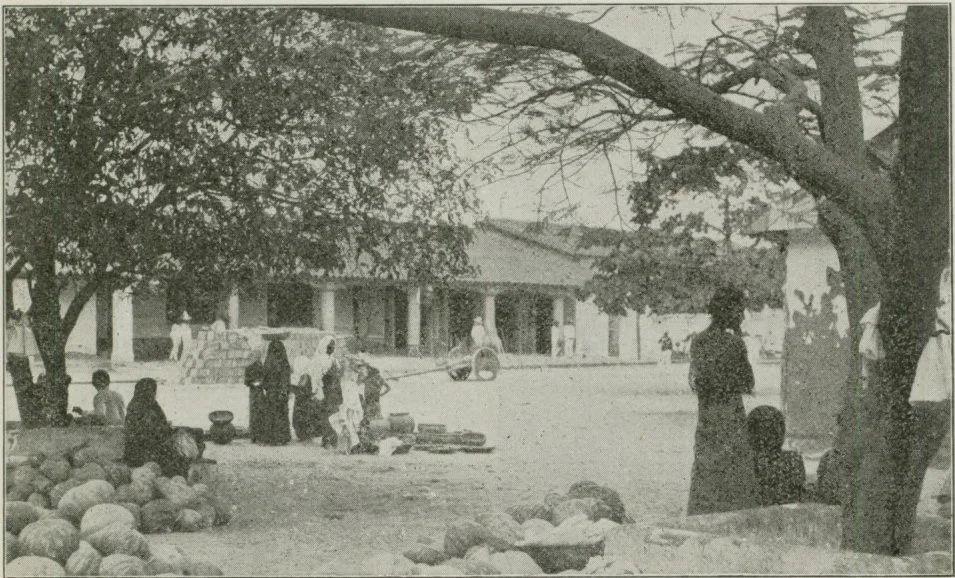
OUTSIDE THE MARKET HOUSE, TEHUANTEPEC
Their bread is toasted tortillas. These are made differently from the tortillas of any other part of the republic. The Indians take shelled corn and boil it until it is soft and tender. It is then placed upon a metate (a kind of granite stone, upon which they grind their corn). A rolling-pin of the same material is used, and the corn is rolled over and over on this stone until it is ground into a very fine dough. The tortillas are then rolled out, resembling pancakes in appearance. For cooking these a large earthen vessel is sunk in the ground, and a fire is built in it. When there is a good live bed of coals, the tortillas are placed upon them, the top of the vessel is closed, and they are left until cooked thoroughly. When taken out, they are well browned all the way through, and are quite crisp. They are very delicious and nutritive.
Many of these people live in the towns and the country between Tehuantepec and Oaxaca on the north, and between Tehuantepec and Tonala on the south. A man who has been a Bible colporteur in Mexico for twelve years, and has traveled all over the republic, told me that this was the ripest field of which he knew anywhere in the republic. About two or three years ago he was in Tehuantepec, and almost literally sowed it with Bibles and Testaments. And they have done a good work; for the power of the priests has been broken, to a large extent. The people seem to be very anxious to know what is truth. Most of those living in Tehuantepec speak the Spanish language, but in some of the smaller towns the women do not speak anything but the Zapotecan.
Persons coming here to labor will find drawbacks, as well as in other places. But if the right ones come, success will attend their labors; for if we are led by the Spirit of God, there is no such thing as failure, because the Lord does not fail.
Sometimes there is yellow fever in Tehuantepec. But I think that no one who lives in harmony with the laws of health need fear the fever. During the sickly season those who prefer to do so could live in one of the small towns near by where there is no fever.
There is a beautiful strip of well-watered country between Tehuantepec and Tonala, and land can be bought for from one dollar an acre up. In one of these little towns the judge offered me the building that corresponds to the county court-house in the States, in which to hold meetings. In this same town I met an Indian woman who had procured a Bible from some one passing through the country about eight years before. I tried to obtain her subscription for our paper, but she said that she had no time to read anything but the Bible, and that she kept it near her so that when she stopped to rest, she could read it. She further said that as far as she knew how, she tried to live according to its teaching. It was wonderful to see the truths that she had learned from the Bible, especially in regard to the second coming of Christ. I told her that she needed the paper to explain the Bible to her; but she said that was not necessary, as one part of the Bible explained the other. I gave her a Bible reading upon the Sabbath question, which she seemed to drink in with delight. I also gave her some tracts, and showed her how to study them in connection with her Bible.
I think that meetings could be held in Tehuantepec with perfect freedom. In the few days that I was there, I obtained forty-four paid subscriptions for our paper, sold one hundred and eighty-eight papers, thirty copies of “Steps to Christ,” eighteen of “Christ Our Saviour,” one of “Patriarchs and Prophets,” twenty-four Bibles, and ten Testaments. The last full day that I worked I received $30.56 from cash sales and subscriptions. The town was barely touched, as far as canvassing goes.
A person could obtain enough English pupils to earn a good living, I think. But it is no place for those who are not willing to do hard work. The thing that each one should know for himself is where the Lord would have him labor. And if the Lord directs to a certain field, he need have no fear in going to that field to labor; for the Lord will never leave those who trust in him.
I met a man here who had a Bible, and sold him “Patriarchs and Prophets,” “Christ’s Object Lessons,” and “Steps to Christ,” and took his subscription for the paper. Before leaving him, he said: “Will you send some one to teach my people the gospel? If you will, I will teach him my language, so that he can teach the gospel to my people.” He tried to get me to promise to send some one, but I told him I could not, but that I would tell my people of his request. These people must have the message, and who will give it to them remains to be seen. That God may impress some one to come to this needy field without delay, is the sincere desire of my heart.
Mexico City.
The First Year of the European General Conference: Statistical Report
By Guy Dail
GUY DAIL
With June 30, 1902, closed the first fiscal year of the European General Conference,—the most important year in the history of our work in this immense and interesting field. Doubtless more progress might have been made had each man more faithfully performed his duty, and still we feel encouraged and hopeful, and are thankful to God that he has so visibly made bare his mighty arm in behalf of his co-laborers, who are seeking to keep aloft the precious torch of truth in these lands.
As our readers are presumably acquainted with the organization of the European General Conference, and its five union fields,—the German Union Conference, the Scandinavian Union Conference, the British Union Conference, the French-Latin Union Mission, and the Oriental Union Mission,—we will not attempt to review the circumstances leading up to, or connected with, the formation of these union fields, but will content ourselves by giving the facts as they existed June 30, 1902.14
The German Union Conference
Of the growth of the work in this, the largest of the union fields in Europe, a detailed account appeared in the REVIEW AND HERALD, Dec. 2, 1902. During the year (the reader will bear in mind that all the facts and figures in this article refer to the twelve months closing June 30, 1902) the tithe received in this conference amounted to $25,401.55, the Sabbath-school donations to $2,315.25, the First-day offerings to $426.87, the annual offerings to $1,309.39, and miscellaneous gifts to $122.03. The 203 canvassers sold $38,662.96 worth of books, in the following languages: German, Hollandish, Esthonian, Lettic, Russian, Livonian, Bohemian, Hungarian, Rumanian, and Bulgarian. Among our 150 churches and companies, 750 persons were baptized, and 161 were received by vote, bringing our total membership up to 4,079. There were twenty-five ministers, fourteen licentiates, and thirty-eight Bible workers in the field. Area, 23,271,006 square kilometers; population, 255,364,842.
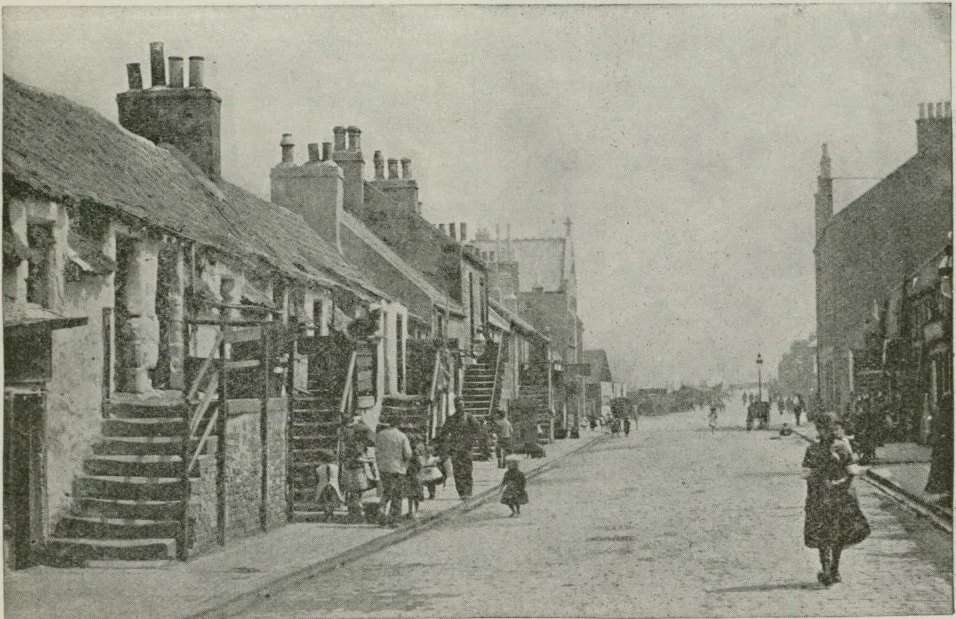
A VILLAGE IN SCOTLAND
The Scandinavian Union Conference
This field includes Sweden, Norway, and Denmark, which are organized conferences, and the mission fields of Finland and Iceland (with Greenland). Eighteen ministers, four licentiates, twelve Bible workers, seventy-one churches and companies with a total membership of 2,215; 116 additions by baptism and 44 by vote; $13,733.70 tithe; $806.89 Sabbath-school donations; $312.32 First-day offerings; $578.93 annual offerings; $376.03 general gifts; $32,920.32 book sales by eighty-one canvassers,—such is the summary for this field. Area, 1,382,272 square kilometers; population, 12,506,503.
The British Union Conference
In reality, at the time concerning which we are writing, there was no such thing as a British Union Conference, as that was organized later in the summer. But we can give the data for that entire field: ministers, eight; licentiates, three; Bible workers, thirteen; canvassers, thirty-four; other workers, three; churches, forty; total membership of field, 926 (there are a number of “unbaptized Sabbath-keepers” not reckoned in this statement); baptisms, 105; tithe, $12,287.75; Sabbath-school donations, $239.93; First-day offerings, $232.15; annual offerings, $432.66; book sales, $41,101.87. In this field are England, Scotland, Ireland, and Wales. Area, 314,667 square kilometers; population, 41,660,000.
French-Latin Union
What is now the French-Latin Union Mission was formerly known as the Central European Conference. This is a great field. It includes the French-Swiss Conference, and the French, the Italian, the Spanish, and the Portuguese missions. The two latter are as yet unentered. Five ministers, six licentiates, nine Bible workers, and eight canvassers make up their working force. The summary is as follows: membership, 531; tithe, $4,753.87; Sabbath-school offerings, $596.55; First-day offerings, $141.12; annual offerings, $640.64; general gifts, $607.82; book sales, $5,443.91; persons baptized, thirty-nine; received by vote, twenty-seven. Area, 2,336,887 square kilometers; population, 104,245,000.
Oriental Mission
Greece and Crete, Turkey, Egypt, Asia Minor, Palestine, and Persia are in this field. They have three ministers, four licentiates, seven Bible workers, twenty-four churches and companies, with a membership of one hundred and eighty-nine; nineteen persons were baptized, and four were received by vote. The tithe amounted to $1,175.85; Sabbath-school gifts to $78.31; First-day offerings to $46.91; annual offerings to $125.83. Area, 7,565,488 square kilometers; population, 56,066,000.
Summary
In the territory of the European General Conference are fifty-nine ministers, thirty-one licentiates, seventy-nine Bible workers, 326 canvassers, 307 churches and companies, 7,940 members,—1,029 were added by baptism, and 236 by vote. The tithe amounted to $57,352.72, Sabbath-school donations to $4,036.93. First-day offerings to $1,159.37, annual offerings to $3,087.45, general gifts to $1,105.88, book sales to $118,129.06.
These figures speak for themselves. They show our need better and more eloquently than anything else could. Consider them, kind reader, and then ask God if you personally owe anything to the millions of Europe and the territory covered by the Oriental Mission, and answer the question as he directs. There is plenty of work for all.
Hamburg.
Our School in Rarotonga
By A. H. Piper
A. H. PIPER
As we have just closed the year's work, it seems proper to look back over the months that have gone, and call to mind the manifest working of God.
Early in February, 1902, Sister Evelyn Gooding, of Australia, came to the island to conduct the school that we contemplated beginning. After a week or two of prayer and counsel, we decided to erect two suitable native houses for dormitories, and in the meantime to begin a day-school at Arorangi. Sister Gooding began with one student, then two, and so on until she had fifteen pupils on the school register. This school was held in the morning, and as most of our brethren lived in Titikaveka, another village, we decided to conduct an afternoon school for the benefit of their children, Sister Gooding driving there four days in the week.
Owing to a good deal of trouble in securing roofing material for the dormitories, it was not until the beginning of July that we were ready to convert the two day-schools into a boarding-school. In doing so, we lost some of the students of the Titikaveka school, but those who did come were greatly benefited by being under our personal supervision. The Arorangi youth still continued to attend as day-students. Our class room was the largest room in the mission house, but it soon proved far too small to accommodate the growing number of students.
Seeing this, we decided to erect a schoolhouse with accommodations for forty or fifty students. The walls of this house are built as natives often build,—the lower part stone and the rest sticks bound side by side to the frame. This insures thorough ventilation, which is so much needed in a schoolroom. The roof is of iron, and the floor is concrete, which is clean and cool, and in every way suitable for this climate. It was a happy day when we were able to move into it after being so cramped in the mission home.
School is held five days in the week; it begins at 7 A. M. and continues until 12:45 P. M., with the exception of an intermission of an hour and a quarter. For three hours during the afternoon, all the students are engaged with manual labor. They raise part of their food, the remainder being supplied by their parents and friends. With the aid of the15caretaker, they have built a good native house. Several of them came to school with sores all over their bodies, but by regular habits of eating and the use of simple remedies, their skins have become clean and clear.
During the last two months, an epidemic of measles and dysentery has caused all other schools on the island to be closed. We have not had one case among the students living here. This is all the more remarkable when we remember that all the families represented in the school have been afflicted with one or the other of the diseases, and in some cases with both of them, and yet have frequently come to the school with food supplies for their children. To the kind watch-care of our Heavenly Father alone can we attribute this immunity. To him be the praise.
When our readers realize that the grandparents of the children of Rarotonga were heathen, they will better understand the material that we have to deal with in our school work. But we have had evidence that God is in the movement, as gradually the students became disciplined to a good degree. And this is not all: several have given their hearts to God, and the two leading students, youths just entering manhood, desired to follow their Lord in baptism. This they had the privilege of doing today. It was a blessed service. As we gathered on the shore of a beautiful lagoon, which divides the land from the ocean beyond, every heart seemed animated with the presence of God's Spirit. At the conclusion of the ordinance, as we arose from seeking God's blessing upon what had been done, there was hardly a dry eye in the assembly. Brethren and strangers alike were moved by the Holy Spirit. The father of one of those baptized, himself a Sabbath-keeper, but who has not gone forward in baptism, went to the edge of the bush which fringes the beach, and there wept like a child. Another, a Maori woman not of our faith, said to me with tears streaming down over her cheeks: “O missionary, my heart is sad because of my sin, yet very happy for what I have seen with my eyes to-day.” Others were affected in a similar manner. As we went from one to the other, we had the privilege of pointing them to “the Lamb of God, which taketh away the sin of the world.” We believe that others in the school and also some outside will ask for baptism before long. May the blessed work go on, and may we have the prayers of the brethren in the home land that it may be so.