Your ShelfYour Projects

The Youth’s Instructor, Vol. 43, No. 13.

WIND AND TIDE

The Youth’s Instructor

Mar 28, 1895

S. D. A. Publishing Association · Battle Creek, Mich. · Mar 28, 1895

WIND AND TIDE.

The ocean is wide; But a timely tide Rolls in from the unknown shores, To carry our bark O’er the waters dark, Where the heart hath treasured stores.
And the winds adrift Well their burdens shift, As they fill the dove white sails; And it’s good to know That the winds will blow For the life which sometimes fails.
For upon the sea, Where our lives must be, God’s wind bloweth sure and strong; And where’er we glide, He sendeth the tide To further our lives along.
— Rev. I. Mench Chambers, in Ram’s Horn.

THE YOSEMITE VALLEY.

LAST PART.—TO GLACIER POINT.
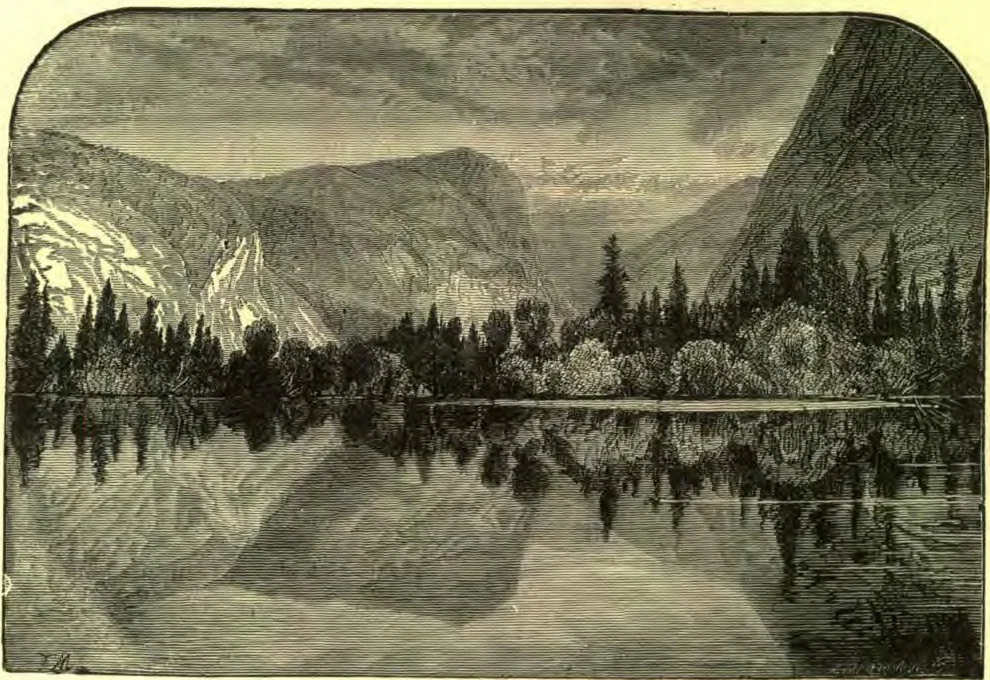
MIRROR LAKE.
MIRROR LAKE.
That part of the trip to and around Yosemite which will remain in my memory longest, is the trip from Vernal and Nevada falls to Glacier Point.
Early in the morning my father, mother, brother, a doctor who was traveling with us, and myself drove to Mirror Lake in time to see the sun rise over the mountains. We then drove about two and one half miles, when we tied our horses to a hitching rack, and started afoot up the mountain toward Vernal and Nevada falls, the doctor and I going on ahead.
When we two got to Vernal Fall, we stopped a little while to admire the beautiful scenery, and then walked up the river to the bridge, crossed over to Snow’s Hotel, and thence to Nevada Fall. At the top of the fall is a bridge so built that one can look over and away down to the bottom of the fall. At the bridge we saw a sign, “To Glacier Point,” and we thought we would go there. When we had walked about two and a half miles, we ate an orange and two crackers apiece (all we had with us for lunch), after which we went down to the Illilouette River, but could not find the bridge.
In looking up and down the stream, I saw a log that had lodged in the river during winter. We crossed over on our hands and knees, although the log was wet and slippery, caused by water splashing on it. We then began to ascend the eastern side of Glacier Point. After climbing a few hundred feet, it became so steep that we literally had to crawl through a thick growth of underbrush on all fours. Among this brush we found chestnut burs, but we could not imagine where they came from, as there were no chestnut trees near us.
When we had crawled through this brush for about a thousand feet, we came to a smooth stratum of rock which was so steep we could not stand erect upon it. The only means by which we could climb was by putting our fingers into small crevices, and drawing ourselves up. About two hours and a half after leaving the river, we reached the summit, having crawled nearly three thousand feet. But we were about one mile south of Glacier Point Hotel. Here we came upon a large snowbank, which was a rare treat to me, being the first I had ever seen, except on distant mountains, as snow is very rare in the valley.
We finally reached the hotel, and ordered a meal, as we were very hungry. We then went to the railing to view the valley. We wanted to get home as soon as possible, as the sun was down, and my parents did not know that we had gone that way; so we started down the mountain, having about six miles to go, three and one half of which were down hill.
Having seen my father tie a large bush on behind the buggy to serve as a brake in going down hill, I tried the same plan by fastening one behind me with a cord around my waist. And then away I went down the mountain, leaving a cloud of dust behind me, and making the descent of three and a half miles in sixty minutes. When I got to the bottom, I did not have to wait long for the doctor. We arrived at our camp about eight o’clock P. M.
The best time to visit the valley is about the middle of June, when the water is at its best height; and at this time of year the extreme altitude, the grand forests, the beautiful flowers, the perfect grade of the roads, and the splendid scenery everywhere, make for the tourist, after crossing the warm valley below, a treat hard to describe. D. GRAY.

ON THE BEACH.

The moon was bright, the day was fair, The crowd was gay and full of song; There was a spirit in the air That seemed to tell of student throng All out for frolic wild.
They were to seek San Pedro beach, Where level sands, in ample reach, Hold countless treasures that will teach A nature-loving child What wondrous things old ocean flings Upon the shores to which it sings.
Three forward cars at once were crammed,— It was the space to them assigned,— And baskets, bags, and pails they jammed In every corner they could find; The teacher cleared the fold Of wolves and goats that in the throng Had wandered in. She walked along, And asked each, "Where do you belong? These cars will only hold The Normal students, who to-day Are out, and have the right of way."
With all on board and doing well, We passed the time in laugh and joke; When suddenly our spirits fell,— The forward car its coupling broke, And left us standing still. On flat cars then a crowd did climb; We thought to have a jolly time, But soon the cinders, smoke, and grime Our smarting eyes did fill. But our brief journey soon was o'er, For we had reached the ocean's shore.
Before we scattered on the beach, We stopped to eat our noon-day meal, To hear an after-dinner speech, And join the merry laughter's peal, Or other frolic find.
The costumes made some sailors stare, But then the students did not care; And if some styles were rather rare, The critics all were kind.
Then did the groups and couples go, And chase the wavelets to and fro. O beauteous sea-anemone! And wondrous, writhing devil-fish! And curious dwellers in the sea! How long and ardently I wish Some one who knew could tell Me how and why and whence you came, And how you live, and what each name, What friends you love, what foes you blame! The ceaseless surges swell In rhythmic language, wild and grand, That I can never understand.
We saw the curious bivalves bore The piles and wharves that man had wrought; We saw great rocks along the shore, Where crabs in countless numbers fought, Or hid away from sight; The little hermit in his cell, The mollusk deep down in his well, The place where sea-stars love to dwell, All filled us with delight; While all along old ocean's bed Were broken shells, with tenants fled.
We saw sea-urchins on the rocks, A porpoise tumbling in the wave; Two girls went rowing round the docks, And dared the sea with spirit brave, And safe returned to shore.
We saw the stately ships go by; Their slender masts were towering high, To catch the breezes in the sky; And one whose voyage was now o'er, "A happier one, whose course was run, From lands of snow, to lands of sun."
And now the sun descending low Has sought his bed in ocean wave; The signal this for us to go; A parting look we fondly gave, Then left the sea behind.
"With sheathed swords and bows unstrung, And spears and shields with garlands hung." This was the song one choir sung, With victory in mind; And while our thoughts did lightly roam, The train rolled on, and brought us home.
The day has gone, my schoolmates dear, And passed into a memory; To-day we stand and are more near The borders of eternity, Upon whose level strand, The shores of time, beneath our feet, Are strewn with treasures that we greet, As wave rolls after wave so fleet, And flings them on the sand; And some are battered by the storms,— Old wrecks that once held living forms.
Still to our souls, in rhythm sweet, The waves will speak a speech unknown. Sometimes they roll in, wild and fleet, Then low subside, in sobbing moan; But voices never cease. They seem to say, "Beyond the roar There is another, brighter shore, Where wreck and death are found no more, But all is life and peace. May joy for aye your portion be, When you shall stand beyond the sea."
F. S. Hafford.

TYPE-SETTING IN JAPANESE.

SPEAKING of the difficulties of journalism in the Japanese tongue, Henry Norman says in Real Japan:—
“They are very keen journalists in the land of the chrysanthemum; but it must be allowed that the business is carried on under difficulties from which even the hardened western newspaper man might shrink appalled. The internal organization of a newspaper office is a sad spectacle of daily struggle with difficulties unknown elsewhere, and really unnecessary here.
“The Japanese written and printed character consists of the Chinese ideographs, those complicated square figures made up of an apparent jumble of zigzags and crosses and ticks and triangles and tails,—‘the footprints of a drunken fly,’—and of the original Japanese syllabary, called kana. Of the former there are twenty thousand in all, of which perhaps fourteen thousand constitute the scholars’ vocabulary, and no fewer than four thousand are in common daily use; while the forty-seven simple letters of the kana are known to everybody. Therefore, the Japanese compositor has to be prepared to place in his stick any one of over four thousand different types—truly an appalling task. From the nature of the problem several consequences naturally follow. First, he must be a good deal of a scholar himself to recognize all these instantly and accurately; secondly, his eyesight suffers fearfully, and he generally wears a huge pair of magnifying goggles; and, thirdly, as it is physically impossible for any one man to reach four thousand types, a totally different method of case arrangement has to be devised.
“The ‘typo,’ therefore, of whom there are only three or four on a paper, sits at a little table at one end of a large room, with the case containing his forty-seven kana syllables before him. From end to end of the room tall cases of type are arranged like the shelves in a crowded library, a passage three feet wide being left between each two. The compositor receives his copy in large pieces, which he cuts into little takes, and hands each of these to one of half a dozen boys who assist him. The boy takes this and proceeds to walk about among the cases till he has collected each of the ideographs, or square Chinese picture words, omitting all the kana syllables which connect them. While these boys are thus running to and fro snatching up the types and jostling each other, they keep up a continual chant, singing the name of the character they are looking for, as they cannot recognize it till they hear its sound, the ordinary lower class Japanese not understanding his daily paper unless he reads it aloud.”
The Japanese, like the Chinese, write and print in columns from the lower to the upper part of the paper, beginning at the right. Their “footnotes” are on top instead of at the bottom of the page.

THE FLORIDA SPONGE INDUSTRY.

IN TWO PARTS.—PART I.

Sponges are, as is now generally conceded by naturalists, an animal, and not, as formerly supposed, a vegetable growth. They consist of a framework, or skeleton, coated with gelatinous matter, and forming a non-irritable mass, which is connected internally with canals of various sizes. The ova are very numerous, and present in appearance the form of irregular-shaped granules, derived from the gelatinous matter which grows into ciliated germs, and, falling at maturity into small canals, are then expelled through the orifices. When alive, the body is covered by a gelatinous film, which, being provided with cilia, causes a current of water to pass in at the smaller pores and out at the larger apertures, the sponge probably assimilating the nutritive principles contained in the water.
Sponges are found abundantly in tropical waters generally. They gradually decrease in numbers toward the colder latitudes, till they become entirely extinct. They vary much in shape. Some are shaped like a vase, others are semi-cylindrical, others flat like an open fan, and some are round. The typical forms—the commercial sponges—are essentially confined to the waters of the Bahaman Archipelago and the southern and western coasts of Florida, in the western hemisphere, and to the Mediterranean and Red seas in the other.
The Florida sponge grounds form three separate and elongated stretches along the southern and western coasts of the state. The first includes nearly all of the Florida reefs; the second extends from Anclote Keys to Cedar Keys; and the third from just north of Cedar Keys to Saint Mark’s. The Florida grounds have a linear extent of about one hundred and twenty miles, beginning at Key Biscayne, in the northwest, and ending in the south at Northwest Channel, just west of Key West. The northwestern half of the grounds is very narrow, having an average width of only about five miles, and being limited to the outer side of the reefs. At about the Matacumbo Reefs the grounds broaden out so as to cover the entire width of the reefs, which are much broader here than at the north. The entire southern half of the grounds has more or less of the same breadth, which is about thirteen or fourteen miles.
The sponge fishery of the Florida coast differs from that of the Mediterranean, in that sponges are not obtained by divers, but by means of a long hook fastened to the end of a long pole, and managed from a small boat. Small vessels of from five to fifty tons measurement are employed to visit the grounds to afford quarters for the men, and to bring home the catch.
The working outfit of a Florida sponging vessel consists of a few small yawl boats, called “dingies,” and a supply of sponge hooks and sponge glasses. The boats used are always made as light as possible. They are from fifteen to twenty feet long, and from four to six feet wide. The idea is to have the boats light enough to enable two men to haul them in and out over the side of the vessel, and yet strong enough to withstand the rough handling which they are sometimes subjected to, and to carry the heavy loads resulting from a day’s catch. While catching sponges, it is necessary to scull the small yawl boats (dingies) from the stern, and, for convenience in doing so, this form of sculling notch is used: A piece of oak plank about six inches wide and one foot long is notched at one end to fit the oar, and inserted at the other between two guiding strips well fastened to the stern sheet. It is made to be easily removable, in order that it may be readily taken out of the way when not needed. The sponge hooks are made of iron, with three curved prongs, measuring about five to six inches in width. The entire length of a hook is about eight inches, the upper end being made into a very strong socket for the insertion of the pole.
The sponge-glass is made from an ordinary wooden bucket, the wooden bottom being replaced by one of ordinary window-glass, securely fastened by cement. In using a sponge-glass it is placed upright on the water’s surface, with the handle of the bucket on the back of the neck of the fisherman with his head thrust down in the bucket. In this way the fisherman can distinctly see very small objects in very deep water, and can easily distinguish good sponges from those of an inferior grade.—Abridged from American Journal of Pharmacy.

Utilizing the Earth's Central Heat Through Deep Shafts

SOME one has suggested the sinking of a shaft twelve or fifteen thousand feet into the earth, for the purpose of utilizing the central heat of the globe. It is said that such a depth is by no means impossible, with the improved machinery and advanced methods of the coming engineer. Water at a temperature of two hundred degrees centigrade, which can, it is said, be obtained from these deep borings, would not only heat houses and public buildings, but would furnish power that could be utilized for many purposes.—New York Ledger.

Militiamen Cooking by Electricity During Brooklyn Strike

DURING the Brooklyn trolley strike militiamen, quartered in one of the car barns, did part of their cooking by electricity.

THE SEVEN WONDERS OF THE WORLD.

NO. 5. — THE HANGING GARDENS OF BABYLON.

Before catching an imaginary glimpse of this wonder of the ancient world, let us seek to penetrate the mists of more than three thousand years, and glance briefly at the great city itself. Its exact origin is veiled in uncertainty, some even attributing it to those who vainly sought to erect a tower whose top should reach unto heaven.
The circumference of the city formed a perfect square, each side of which was fifteen miles long. It was surrounded by a strong wall eighty-seven feet thick, which is said to have reached the gigantic height of three hundred and fifty feet. An immense ditch, or moat, full of water, surrounded the wall on the outside. Both sides of this ditch were lined with brick. Some idea of its size may be gained when we read that the bricks composing the prodigious wall were made from the dirt removed from it. These bricks were cemented together with a bituminous cement, which in time became harder than the bricks themselves.
Every side of the city had twenty-five brazen gates, and from these gates straight streets crossed the city, making fifty streets in all, which crossed each other at right angles. Then on each side of the city next the wall was a half street which had houses on one side and the wall on the other. These half streets were about two hundred feet wide, while all the other streets had a uniform width of about one hundred and fifty feet. The fifty cross streets laid the city out in large squares, each of which was over two miles in circumference. The houses were three or four stories high, and were built on the outer edges of these squares, the sides fronting the streets being beautifully ornamented. The houses had spaces between them, and the centers of the squares served for gardens, yards, etc. Babylon, therefore, was not as large a city as its sixty miles of circumference might indicate; for nearly one half of the land inclosed within its ponderous walls was given to cultivation.
The historic Euphrates crossed the city diagonally, the restless waters of which were spanned by a wonderful piece of art in the form of a bridge a furlong in length and thirty feet wide. At each end of this bridge was a palace, one of which is said to have been three miles and three quarters in circumference; the other, seven and one half miles. Toward this latter palace our attention especially turns; for it was here that the famous hanging gardens were located. It was surrounded with three distinct walls, and these were highly ornamented with sculptures of animals, etc. One remarkable hunting-piece has received special mention. It represented Queen Semiramis on horseback, throwing her javelin at a leopard, while Ninus, her husband, was intent on piercing a lion.
The hanging gardens owed their existence to the wife of Nebuchadnezzar, who had been accustomed to the woods and hills of Media, and desired some such scenery to vary the monotony of the Babylonian plain. It was to gratify her that the immense task was undertaken. “They contained a square of four hundred feet on every side, and were carried up in the manner of several large terraces, one above another, till the height equaled that of the walls of the city. The ascent was from terrace to terrace, by stairs ten feet wide. The whole pile was sustained by vast arches one above another, and strengthened by a wall, surrounding it on every side, of twenty-two feet in thickness. On the top of the arches were first laid large flat stones, sixteen feet long and four broad; over these was a layer of reeds mixed with a great quantity of bitumen, upon which were two rows of brick closely cemented together with plaster. The whole was covered with thick sheets of lead, upon which lay the mold of the garden. And all this floorage was contrived to keep the moisture of the mold from running away through the arches. The earth laid thereon was so deep that the greatest trees might take root in it; and with such the terraces were covered, as well as with all other plants and flowers that were proper to adorn a pleasure garden. In the upper terrace there was an engine, or kind of pump, by which water was drawn up out of the river, and from thence the whole garden was watered.” “In the spaces between the several arches upon which the whole structure rested, were large and magnificent apartments that were very light, and had the advantage of a beautiful prospect.”
But where is Babylon, with all her splendor and magnificence? True to the prophetic word, she has fallen a prey to the ravages of time, and even the exact site of the once flourishing city has become a matter of uncertainty. Thus it is; all these works of man are doomed to destruction; for mutability is stamped upon all things earthly. But happy is he whose treasure is laid up in heaven, and who lives for that which will endure forever,—for that world where all things shall receive the touch of immortality. MRS. M. A. LOPER.

THE EASTERN QUESTION.

  • (Concluded.)*

PART IV.— ITS PRESENT AND FUTURE.

At the close of the Crimean war there was formed a treaty which gave Sebastopol back to Russia, but required the abandoning of claims to a protectorate over any of the sultan’s subjects, Christians or Mohammedmans, and the giving up of the provinces around the Black Sea. Russia was also forbidden to raise any fortresses on the Black Sea, or to keep any armed ships there, save what would be needed for police service. The Christian subjects of the sultan were placed under the guardianship of England, France, and Sardinia, who were to see that the sultan protected them in their religious worship.
You may find Afghanistan on your map, and now we will find out what we can about the Afghan war of 1857. That state then had a ruler who had usurped the power, and who was inclined to an alliance with Russia. As it is England’s policy to maintain Afghan as a barrier between her East Indian possessions and Russia, England therefore dethroned the usurper of Afghanistan, and put in his place the legitimate prince. The Afghans resented this interference in their affairs, rose in revolt, and forced the English to retreat into India, cutting off the whole army in the mountain passes. The English then punished the Afghan leaders of the revolt, burned their chief city, and compelled them to submit.
We will now return to the Turks, whose deadly hatred of the Christians led constantly to disturbance and outrage. In 1860 they murdered a great number of Syrian Christians; and in 1876 occurred the so-called “Bulgarian atrocities,” similar to the recent Armenian outrages,—massacres of Christian men, women, and children, more revolting perhaps than any others of which history tells. In 1876 the sultan could not or would not protect his Christian subjects, and Disraeli, then English prime minister, affected not to believe the reports, and appeared calmly indifferent over the matter; whereupon Russia once more set her armies in motion toward Constantinople.
England then, as formerly, interfered, and another treaty was signed at Berlin. By this the “Sick Man” lost a good part of his estate—Bulgaria, Servia, and Montenegro are now independent. Bosnia and Herzegovina were given to the Austro-Hungarian monarchy. Russia acquired everything lost in the Crimean war, and some places in Armenia. (Please refer to your map.) There were left in Europe under the direct authority of the sultan barely five million subjects, of which number one half are at least nominally Christians. England alone is responsible for the emancipation not having been complete.
The Armenian outrages of August last were perpetrated by the Turks, it is said, by the authority of the sultan, though he professes no knowledge of it. The Armenians in this country are very much worked up over it, and have petitioned the president to aid in investigating the matter. He has appointed a delegate to assist in this.
It is likely Russia, since the accession of the young czar, will confer with England on the subject before trying to take Constantinople again. Indeed, the young czarina is a granddaughter of Queen Victoria; and friendly relations are in process of cultivation between the two nations, so they may at no distant day arrive at a satisfactory division of the “Sick man’s estate.”
But if England and Russia should form the “balance of power” in Europe, the other nations will be alarmed for their kingdoms, and most likely try to form a coalition strong enough to overcome them. It is difficult to predict what will be the settlement of the question; for deaths and marriages of royalty change the aspects completely at times.
But of this we are assured: the “Sick man” will “come to his end,” and “none shall help him.” This is the prophecy of Daniel. Dan. 11:45. He will be driven from Constantinople, and set up his capital at Jerusalem, “in the glorious holy mountain.” Yet none shall help him. “And at that time shall Michael stand up, the Great Prince which standeth for the children of thy people: and there shall be a time of trouble, such as never was since there was a nation even to that same time: and at that time thy people shall be delivered, every one that shall be found written in the book.” Dan. 12:1.
Then will follow that great battle at the “place called in the Hebrew tongue Armageddon” (Rev. 16:16), in which all the nations of the earth take part, around Jerusalem. That is the time for the coming of Jesus in the clouds of heaven, in power and great glory! What can equal that event if we are prepared to meet him in peace, and not be “destroyed by the brightness of his coming”? “Come quickly, Lord Jesus.” LORETTA REISMAN.

Small Kindnesses Give Character Its Greatest Charm

“SMALL kindnesses, small courtesies, and small considerations, habitually practised in social intercourse, give a greater charm to the character than the display of great talents and accomplishments.”

THE EARTH WILL BE RENEWED.

The curse of God now rests upon the earth because of sin. When Adam had sinned in Eden by eating of the fruit of the forbidden tree, the Lord asked him why he had done so. Adam tried to excuse himself, saying, “The woman whom thou gavest to be with me, she gave me of the tree, and I did eat.” Gen. 3: 12. He blamed the woman, and he blamed God who had given him such a woman. But he attached no blame to himself. Since that time all his sons and daughters have done the same, until they learn to repent and confess their sins. Adam soon learned that excuses are no shield against the curse that falls upon the sinner. Excuses bring only death; but confession and repentance are the way of life.
After the Lord had pronounced a curse upon the serpent and the woman, he said unto Adam: “Because thou hast harkened unto the voice of thy wife, and hast eaten of the tree, of which I commanded thee, saying, Thou shalt not eat of it: cursed is the ground for thy sake; in sorrow shalt thou eat of it all the days of thy life; thorns also and thistles shall it bring forth to thee; and thou shalt eat the herb of the field; in the sweat of thy face shalt thou eat bread, till thou return unto the ground; for out of it wast thou taken: for dust thou art, and unto dust shalt thou return.” Gen. 3: 17-19. The curse fell not only upon Adam, but upon all the earth for his sake.
The perfect and happy state of man in paradise passed away by the fall. Adam could no longer remain in the beautiful garden which God himself had planted. Gen. 2: 8. If he had remained there, and had eaten of the tree of life, he would have been an immortal sinner. This was contrary to the plan of God, and out of harmony with his tender mercy. Sin and misery are inseparably connected, and God did not want man to live always in misery. So he drove out the man from the garden of Eden, lest he should put forth his hand, and take also of the tree of life, and eat and live forever. And the Lord sent Adam away from the garden of Eden to till the ground from whence he was taken, while mighty angels guarded the way to the tree of life. Gen. 3: 22-27.
If Adam had remained in the garden, he would have dressed it and kept it. Gen. 2: 15. His time would have been occupied by the worship of God, and by light and pleasant occupation in the garden. But after he fell, he had to work hard, and eat his bread in the sweat of his face. Yet I suppose the work of Adam was light and easy compared to the work of tilling the ground at present. This is evident from the fact that the earth has been cursed twice since that time, and in the last days the curse is resting still more heavily on it, because of the great wickedness of man.
The luxuriousness and abundance with which the earth has produced everything that was useful and pleasant, was diminished. Pernicious plants, such as thorns and thistles, sprang forth out of the ground, and became a burden to man. Hard work was necessary to sustain life. However, the soil was rich and fruitful compared with its present condition.
Man still persists in wickedness. Therefore the curse rests more and more heavily on the earth, until at last it will be destroyed by fire. 2 Peter 3: 7. Because of the sin of Cain as he cruelly murdered his innocent brother, the earth became less fruitful, and yielded her strength more sparingly. Gen. 4: 12. Later on the wickedness of man became so great that every purpose and desire of his heart was only evil continually. Gen. 6: 5.
Then the Lord brought the flood upon the earth. In connection with this, the surface of the ground was greatly changed. Mighty volcanic powers from the inside of the earth broke out at the surface. Not only were the flood-gates of heaven opened so that the rain poured down upon the earth forty days and forty nights, but the fountains of the great deep were also broken up. Gen. 7: 11. The solid foundation of stone and the substrata of clay and sand were lifted to the surface, and formed high mountains with ragged rocks and barren hills, while the fruitful soil in many places was buried far below. The gold and precious stones were also buried, together with great forests which now are dug up in the form of coal, and used for fuel.
The Lord can easily bless or curse the earth, causing it to bring forth abundantly or sparingly. Deut. 28: 3-24. He can still give rain from heaven and fruitful seasons. Acts 14: 17. But he can also direct circumstances so that men carry out much seed on the field and gather in little. He can send drought, mildew, locusts to devour, worms to destroy, storms to break down, and hail to crush, until famine and pestilence fill the land; and because of the wickedness of men the earth is now greatly cursed.
The Lord still sets life and death before men, blessing and curse, and he tells them to choose life that they may live. Deut. 30: 19. “O that they were wise, that they understood this, that they would consider their latter end!” O that you would love the Lord your God with all your heart, and walk in his commandments and statutes! Then would your frugal meal be sweet, and the few things you possess would be a blessing, until the Lord brings you to the heavenly Canaan, which flows with richer treasures than milk and honey.
Sin is the cause of the languishing of the earth. “The earth mourneth and fadeth away, the world languisheth and fadeth away, the haughty people of the earth do languish. The earth also is defiled under the inhabitants thereof; because they have transgressed the laws, changed the ordinance [the Sabbath of the Lord], broken the everlasting covenant. Therefore hath the curse devoured the earth, and they that dwell therein are desolate: therefore the inhabitants of the earth are burned, and few men left.” Isa. 24: 4-6.
But the Lord will redeem the earth; he will change it, and renew its form. “Nevertheless we, according to his promise, look for new heavens and a new earth, wherein dwelleth righteousness.” 2 Peter 3: 13. “For, behold, I create new heavens and a new earth: and the former shall not be remembered, nor come into mind. But be ye glad and rejoice forever in that which I create: for, behold, I create Jerusalem a rejoicing, and her people a joy. And I will rejoice in Jerusalem, and joy in my people: and the voice of weeping shall be no more heard in her, nor the voice of crying.” Isa. 65: 17-19. “And I saw a new heaven and a new earth: for the first heaven and the first earth were passed away; and there was no more sea.” Rev. 21: 1. “Thou sendest forth thy spirit, they are created: and thou renewest the face of the earth.” Ps. 104: 30.
Then the whole creation will cease to groan, and joy and peace will fill the universe. “For the earnest expectation of the creature waiteth for the manifestation of the sons of God. For the creature was made subject to vanity, not willingly, but by reason of him who hath subjected the same in hope, because the creature itself also shall be delivered from the bondage of corruption into the glorious liberty of the children of God.” Rom. 8: 19-21. This cannot be before the resurrection and the final judgment have taken place. Verse 23.
The mercy of God is great, and his wisdom is unsearchable. He will have mercy upon his people, and give them the new earth for an everlasting inheritance. Then “the redeemed of the Lord shall return, and come with singing unto Zion; and everlasting joy shall be upon their head: they shall obtain gladness and joy; and sorrow and mourning shall flee away.” Isa. 51: 11. J. G. MATTESON.

WHAT IS LIFE?

LIFE is not just simply living, It is loving, it is giving; 'Tis bearing hardships, toil, and pain, Another's highest good to gain.
Life is not to live forever; It is more—'tis high endeavor, And noble purposes fulfilled When human passions all are stilled.
Life ne'er can hold one selfish deed; Ne'er can be found in man-made creed,— The end of selfishness is death, And man as such is but a breath.
Life is to be, and bear, and do, As earth's journey we pursue; To walk by faith and not by sight, To shun the wrong and do the right.
“I set before you death and life, Defeat or victory in the strife; Choose life while yet 't is called To-day; In Christ alone you'll find the way.”
For this is life; that you might know Jesus, God's Son, he sent below; And life eternal is to see Him who dwells in eternity.
ELLA CORNISH.

Gratitude to God for His Many Mercies

PLATO was accustomed to express his gratitude for three things: (1) that he was born a man; (2) that he lived in Greece; and (3) that he was a contemporary of Socrates. For how many things do we owe gratitude to God? If we consider the value of our senses, our strength of mind and body, and the benefits we receive from God’s sunlight above us, from food, raiment, etc., etc., and above all, the hope of eternal life through Christ, the Son of God, can we allow a single moment to pass without feeling grateful to the Lord for all his mercies and benefits?

Moses Trampling Pharaoh's Diadem: A Lesson in Resisting Worldly Honor

JOSEPHUS, the great Jewish historian (37–96? A. D.) tells of Moses that when a little boy at the court of Pharaoh, the king on one occasion placed the royal diadem on his young head, but that Moses took it down, put it under his feet, and trampled upon it. So we should do when Satan seeks to bait us with the glittering tinsel of worldly attraction or honor—put them under our feet, rising as conquerors above them, that we may obtain that crown “which fadeth not away.”

The Bread That Cometh Down From Heaven

The Bread that cometh down from heaven is never sour nor stale, but sweet, wholesome, and strengthening.

Blessing Others as a Condition of Divine Blessing

You cannot expect God to bless you, as long as you are not willing to do what you can to bless others.

LESSON 2.—THE SOURCE OF WISDOM.

(April 13, 1895.)
Time: B. C. 603. Place: Nebuchadnezzar's palace. Characters: The king, wise men, Hebrew children, and Arioch.
ANALYSIS.—Verse 1: The king dreams a dream. Verse 2: The wise men called. Verses 3-11: Dialogue between the king and wise men. Verses 12, 13: The king's decree. Verses 14, 15: Daniel's talk with Arioch. Verse 16: Daniel visits the king. Verses 17-23: Daniel's experience with his brethren; their prayer, and the result. Verses 24-30: Daniel's second visit to Arioch and to the king.
IMPORTANT LESSONS.—(a) God is willing to reveal his truth even to heathen kings. (b) There is danger in professing to be wise when we are not. Verse 5 (Compare Hosea 10 : 13; Job 15 : 34.) (c) We should exercise faith in God to ask him to reveal his will to us, and give us wisdom in his word. (d) When he does it, thank him for it, and be ready to go to declare it, whether in the king's palace or in the lion's den.
MEMORY VERSES.—Dan. 8 : 20-22.
1. WHEN and by what was Nebuchadnezzar troubled? Verse 1.
2. What did the king command? Verse 2. (See note .)
3. What did he desire them to do? Verses 2, 3.
4. How did they reply? Verse 4.
5. What was the king's answer? Verses 5, 6.
6. How did they respond to this? Verse 7.
7. How did the king regard their course? Verses 8, 9. (See note .)
8. What did the professed wise men say of the king's requirements? Verses 10, 11.
9. How did this reply affect the king? Verse 12.
10. What decree did he issue? Verse 13. (See note .)
11. Who were counted among these wise men?
12. What was Daniel's plea concerning the king's decree? Verses 14, 15.
13. What course did Daniel pursue? Verses 17, 18. (See note .)
14. How was the secret revealed to Daniel? Verse 19.
15. With what words did he praise the Lord for his mercy? Verses 20-23.
16. When Daniel was brought before the king, what did he say of the wise men and astrologers? Verse 27.
17. Who did he say could reveal the secret? Verse 28.
18. What did the Lord make known to Nebuchadnezzar by his dream? Verse 29.
19. Why was the dream revealed to Daniel? Verse 30.

NOTES.

Continue reading: TRADING WITH THE TALENTS