GOD has never established authority with any man, or any number of men, to declare what is final law for others, in matters of religious faith. Give this power to either the Governor of a State, or to the popular majority of a community, and such authority gradually becomes invested with a force that is sure, sooner or later, to be swayed oppressively. Men who stand with the minority, have a more vivid realization of this, than those on the opposite side. Macaulay stated the truth on this point, in a few words, when he said:—
The doctrine which, from the very first origin of religious dissensions, has been held by all bigots of all sects, when condensed into a few words, and stripped of rhetorical disguise is simply this: I am in the right and you are in the wrong. When you are the stronger, you ought to tolerate me; for it is your duty to tolerate truth. But when I am the stronger I shall persecute you, for it is my duty to persecute error.—Macaulay’s Essay on Sir James Mackintosh, Par. 57.
It was observed in the beginning of this book that crimes and misdemeanors are a breach and violation of the public rights and duties, owing to the whole community, considered as a community in its social aggregate capacity. And in the very entrance of these commentaries it was shown that human laws can have no concern with any but social and relative duties, being intended only to regulate the conduct of man considered under various relations as a member of civil society. All crimes ought therefore, to be estimated merely according to the mischief which they produce in civil society, and of consequence, private vices, or breach of mere absolute duties, which man is bound to perform considered only as an individual, are not, cannot be, the object of any municipal law.—Cooley’s Blackstone, Book 4, P. 40.
Cooley in his work on Constitutional Law, also sets forth the relation of the individual conscience to the civil law, as follows:—
It is the province of the State, to enforce, so far as it may be found practicable, the obligations and duties which the citizen may be under, or may owe to his fellow-citizen, or to society; but those which spring from relations between himself and his Maker are to be enforced by the admonitions of conscience, and not by the penalties of human laws. Indeed, as all real worship must essentially and necessarily consist in the free-will offering of adoration and gratitude by the creature to the Creator, human laws are obviously inadequate to222incite or compel those internal and voluntary emotions which shall induce it; and human penalties, at most, could only enforce the observance of idle ceremonies, which, when unwillingly performed, are alike valueless to all the participants, and devoid of all the elements of true worship.—Constitutional Limitations, X 469, 3.
To state the proposition in another form, Macaulay, in his review of Gladstone, “Church and State,” says:—
Now here are two great objects: one is the protection of persons and estates of citizens from injury; the other is the propagation of religious truths. No two objects more entirely distinct can well be imagined. The former belongs wholly to the visible and tangible world in which we live; the latter belongs to that higher world which is beyond the reach of our senses. The former belongs to this life; the latter, to that which is to come. Men who are perfectly agreed as to the importance of the former object, and as to the way of obtaining it, differ as widely as possible, respecting the latter object.—Par. 13.
There is one prominent doctrine set forth in the foregoing quotations to which there must be a general agreement: that is, that the Christian religion is designed to do a work which civil government is in nowise qualified to do. The former accomplishes its mission, and saves the transgressor of God’s law, by offering mercy to all who confess their guilt. The latter restrains crime only by the rigid application of its laws, which can in no way change men’s hearts. There is no mercy in law, not even in that of Jehovah. True, the word “mercy” occurs in the moral law, but its use there in no way signifies that there is mercy in the execution of that law. Neither could God make men good and save them by the moral law after sin had once entered the world. It was therefore necessary that an atoning sacrifice be offered in behalf of man, and thus the gospel was established, by which all who choose may be eternally saved. The gospel, thus necessitated, was committed to the Church to be proclaimed and administered; but never to the State. In the hands of the Church, it is God’s supernatural interposition for the salvation of individual sinners. The State having no gospel, nothing but law, and that only of human enactment, cannot, from the very nature of the case, be qualified to instruct in matters of faith and conscience.
J. O. CORLISS.
What We May Expect.
By W. H. M.
THE Washington Baseball Club has been prevented from filling an engagement for a Sunday game at Atlantic Park, Washington, by the Commissioners of the District of Columbia.
District Commissioner Douglass thus states the law and the gospel of the case, as reported in the Washington Evening Star:—
“Commissioner Douglass in an interview with a Star reporter upon the subject said: ‘I thought it would shock the country to learn that such a thing as Sunday baseball was permitted at the national capital. If we had been unsuccessful in finding a law I should have done my utmost to manufacture one.’”
“You found a law then?” queried the Star man. “Yes, we did, the old common law of England held that the Christian religion was part of the common law, and when the first settlers came to this country they brought the common law with them. You know that it’s against the Christian religion to play ball on Sunday, for on the face of it, it’s a violation of the fourth commandment. That is the law we operated upon in this case.”
So the time has already come when the Commissioners, having in charge the administration of the local government of the national capital, search the statute books for an authority, however obscure, to uphold them in enforcing a religious requirement; and openly assert their readiness to manufacture a law to suit if none shall be found.
So far as its applicability is concerned, that is just what they have done,—manufactured a law. Blackstone says, in Book IV, page 58 (Cooley’s Blackstone): “These are offenses punishable at common law by fine and imprisonment, or other infamous corporal punishment; for Christianity is part of the laws of England.” Commissioner Douglass is no more endowed with authority to decide what is a “violation of the fourth commandment,” or with power to enforce such a decision, than is the chief executive of this Nation endowed with political perfection, because Blackstone says, in Book I, page 245 (Cooley’s Blackstone), “The law also ascribes to the king, in his political capacity, absolute perfection. The king can do no wrong. . . . The king, moreover, is not only incapable of doing wrong, but even of thinking wrong; he can never mean to do an improper thing: in him is no folly or weakness.” One of these political dogmas is just as sound as the other, and if one may be applied as binding now and here, the other may be also, for the same reason.
The Christian religion is a part of the law of the land; the President (and Commissioner Douglass) “can do no wrong, neither think any wrong, in him is no folly or weakness.” This is the perfection which the Commissioner has arrogated to himself in assuming to decide that to play ball on Sunday is a violation of the fourth commandment, and then, as he says, “to operate upon that law.”
The Commissioner decides that when Jehovah wrote, on Sinai, “the seventh day is the Sabbath of the Lord thy God, in it thou shalt not do any work,” etc., he intended to have written, “the first day of the week, commonly called Sunday, is the rest day of a Christian nation, in it thou shalt not play baseball,” etc.; and having so determined, the Commissioner by virtue of divine right of authority as the representative of the chief executive, who can do no wrong, constitutes himself the vice-gerent of God to enforce his law. This is the common law precedent upon which the Commissioner has seen fit to take summary action as a public official of the capital city of the United States.
It is well to look through that chapter of Blackstone on “Offenses against God and Religion,” from which the Commissioner obtains his “law,” that we may know what to expect in the future. (See Cooley’s Blackstone, Book IV, pp. 41–64.) In this chapter Blackstone enters into the consideration of those offenses “which are more immediately injurious to God and his holy religion.”
I. Of this species (of offenses) the first is that of apostasy, or a total renunciation of Christianity, by embracing either a false religion, or no religion at all. This offense can only take place in such as have once professed the true religion.
II. A second offense is that of heresy, which consists, not in a total denial of Christianity, but of some of its essential doctrines, publicly and obstinately avowed.
III. Another species of offenses against religion are those which affect the established church. And these are either positive or negative: positive, by reviling its ordinances; or negative, by non-conformity to its worship.
IV. The fourth species of offenses, therefore, more immediately against God and religion, is that of blasphemy against the Almighty, by denying his being or providence; or by contumelious reproaches of our Saviour Christ. Whither also may be referred all profane scoffing at the holy Scriptures, or exposing it to contempt and ridicule. These are offenses punishable at common law by fine and imprisonment, or other infamous corporal punishment; for Christianity is part of the laws of England. . . .
VI. A sixth species of offense against God and religion of which our ancient books are full, is a crime of which one knows not well what account to give. I mean the offense of witchcraft, conjuration, enchantment, or sorcery. . . .
VII. A seventh species of offenders in this class are all religious impostors; such as falsely pretend an extraordinary commission from heaven; or terrify and abuse the people with false denunciations of judgments. These, as tending to subvert all religion, by bringing it into ridicule and contempt, are punishable by the temporal courts with fine, imprisonment, and infamous corporal punishment. . . .
IX. Profanation of the Lord’s day, vulgarly (but improperly) called Sabbath-breaking, is a ninth offense against God and religion, punished by the municipal law of England. . . . And therefore the laws of King Athelstan forbade all merchandising on the Lord’s day, under very severe penalties. And by the statute 27 Henry VI., chap. 5, no fair or market shall be held on the principal festivals, Good Friday, or any Sunday (except the four Sundays in harvest), on pain of forfeiting the goods exposed to sale. And since, by the statute 1 Car. I., chap. 1, no person shall assemble out of their own parishes for any sport whatsoever upon this day; nor in their parishes, shall use any bull or bear-baiting, interludes, plays, or other unlawful exercise, or pastimes; on pain that every offender shall pay 3s. 4d. to the poor.
These are some of the provisions of Chapter IV. Book IV., Blackstone’s Commentaries, from which the Commissioners of the District of Columbia obtain their law for the ordering of the civil affairs of the capital of this free and enlightened country, just entering upon the last decade of the nineteenth century, and after more than a hundred years of supposed separation of Church and State.
W. H. M.
Sunday Laws of New York and Blue-Law Satire
SOME of the provisions in the Sunday laws of New York, are worthy of having emanated from the Sunday Union itself, instead of being, as they are, a survival of the blue-law code established by the Church and State union of Colonial days. The Ellicottville (N. Y.) News, makes this jocose suggestion: “Hunting on Sunday, subjects the offender to a fine of twenty-five dollars. One half of the fine goes to the prosecutor. Here is an opportunity for some one to make money without very much hard work.” How long will it be before this will be adopted, together with the grab-bag and the church-lottery, as a legitimate means of assisting the church and Sunday-school treasuries?
Lady Canvassers Wanted for Healthful Corset Alternatives
PEERLESS. HYGIENIC.
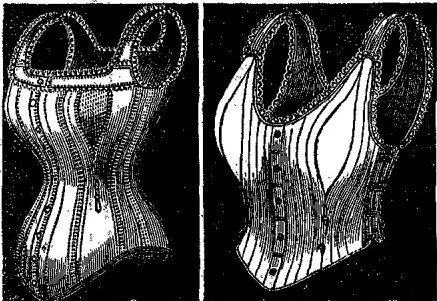
Freedom and grace of motion cannot be obtained by those wearing a stiff corset. Thousands of sensible women have laid aside their corsets and now wear our perfect substitute, “Madame Salisbury’s peerless corset waist,” or the hygiene bodice, perfect fitting, graceful, yet healthful.
LADY CANVASSERS
Make $5, to $8 per day selling our corsets, shoulder braces, skirt supporting bustles, etc., send two cent stamp for illustrated pamphlet “How to Dress Healthfully.”
Health produces wealth and good health can not be made of poor material. The agitation of this health question for some years in the past has created a demand for
HEALTHFUL FOODS,
in the manufacture of which we have for the past ten years engaged. The demand having constantly increased we have found it necessary to greatly increase our facilities by the addition of new and the latest improved machinery etc. We are now well equipped and prepared to fill all orders and to extend our business into new fields.
Our Foods and Crackers are made from the choicest grains and are strictly pure, justly entitling them to the name above given.
SAMPLE PACKAGES
Of assorted Health Food Crackers sent post-paid on receipt of fifty cents. Write for descriptive circular and price list to
Health Food Company,
168 WEST MAIN ST.,
Battle Creek, Mich.
WATERMAN'S IDEAL FOUNTAIN PEN.
HAS THE MOST RELIABLE arrangement for feeding the ink from the reservoir to the pen. It has the same sure principle of operation (capillary attraction) and simple construction (a split) that have been used by the ordinary dip pen for 5,000 years to carry the ink to the paper. Remember it is a combination of the BEST material, workmanship, and principle of operation. Don't waste your time or shorten your life with any other. Address, PACIFIC PRESS PUBLISHING CO., 43 BOND STREET, NEW YORK. Or OAKLAND, CAL.
GOOD HEALTH
Is a popular health magazine, published at Battle Creek, Mich., and conducted by
J. H. KELLOGG, M. D.,
Assisted by an able editorial staff.
It contains, each month, general articles on practical hygiene, and medical papers, besides a rich variety of other matter, pithy and practical, on popular questions, also representing the latest scientific thought, in combination with Dr. Kellogg’s wide professional experience.
Established on Four Continents. No journal devoted to health or kindred topics has ever enjoyed so great a popularity as this journal has earned by its devotion to the interests of the people in the development and popularization of knowledge on all sanitary topics. It has been introduced into nearly every part of the civilized world, and enjoys a large circulation, not only in America, but in England, upon the continent of Europe, in South Africa, and in Australia. Among the
SPECIAL ATTRACTIONS
For 1890, the managers of this journal propose during the year to devote considerable space to the Exposure of Medical Frauds. They have, therefore, established a chemical laboratory, in charge of a competent chemist, for the purpose of carrying on a series of thorough-going investigations, the results of which will be published in the columns of this journal. Price, $1.25 a Year. Single numbers, 15 Cents. Send for specimen copy, and terms to agents.
GOOD HEALTH PUB. CO., Battle Creek, Mich.
TEN LECTURES ON NASAL CATARRH
By John Harvey Kellogg
Its Nature, Causes, Prevention, and Cure, and Diseases of the Throat, Eye, and Ear, due to Nasal Catarrh;
with a chapter of CHOICE PRESCRIPTIONS
BY J. H. KELLOGG, M. D.,
Medical Superintendent of the Largest Medical and Surgical Sanitarium in the World.
The work consists of 120 pages, and is embellished with a colored frontispiece and SIX BEAUTIFULLY COLORED PLATES, besides many illustrative cuts of the throat and nasal cavity in health and disease. This little work costs only 30 cents, and is in great demand.
PACIFIC PRESS PUBLISHING CO., 48 BOND STREET, NEW YORK.
OR OAKLAND, CAL.
NEW EDITIONS
By A. T. Jones
CIVIL GOVERNMENT AND RELIGION
IN ENGLISH AND GERMAN
By A. T. Jones,
One of the Editors of the AMERICAN SENTINEL.
Scriptural, Logical, Plain, and Forcible.
THIS IMPORTANT WORK SHOWS CLEARLY THE RELATION THAT SHOULD EXIST BETWEEN CHURCH AND STATE AT THE PRESENT TIME, AS PROVEN BY THE BIBLE AND HISTORY OF THE PAST TWENTY-FIVE CENTURIES.
CHAP. I outlines vividly the relation that existed between “Christianity and the Roman Empire.”
CHAP. II distinguishes between “What is due to God and what to Cæsar.”
CHAP. III shows for what purpose the “Powers that Be” are ordained.
CHAP. IV ably discusses “The Religious Attack upon the United States Constitution, and Those Who Are Making It.”
CHAP. V unmasks “Religious Legislation,” calling special attention to the Blair Sunday Bill now pending in Congress.
CHAP. VI is devoted to the “Sunday-Law Movement in the Fourth Century, and its Parallel in the Nineteenth.”
Chap. VII shows The Workings of Sunday Laws when they are enforced.
These chapters, with the Declaration of Independence and the Constitution of the United States which are printed in Appendices C and D, make this treatise INDISPENSABLE TO EVERY LOVER OF CIVIL AND RELIGIOUS LIBERTY.
CIVIL GOVERNMENT AND RELIGION
Is a Pamphlet of 182 Large Octavo Pages, in English, Price 25 Cents; and in German, 228 Pages, Price, 35 Cents.
MILLIONS OF COPIES
Should be Placed in the Hands of Thinking People at once. It Clearly Defines what Position American Citizens should Sustain Toward the Effort now on Foot to Secure Religious Legislation. Address.
PACIFIC PRESS PUBLISHING CO.,
43 BOND STREET, NEW YORK,
OR OAKLAND, CAL.
GOOD FOR ALL TIME!
THE NATIONAL SUNDAY LAW
THIS PAMPHLET CONTAINS THE ARGUMENTS IN BEHALF OF THE RIGHTS OF AMERICAN CITIZENS, AND IN OPPOSITION TO THE BLAIR SUNDAY-REST BILL, WHICH MR. JONES PRESENTED BEFORE THE SENATE COMMITTEE ON EDUCATION AND LABOR, DECEMBER 13, 1888.
Mr. Crafts has pronounced the report as published
“MIGHTY INTERESTING READING.”
And Mr. Jones’ comments make it more so. His argument is enlarged to what it would have been without Senator Blair’s interruptions, objections, and counter-arguments, and is accompanied with answers to all of his objections and counter-arguments. As the Sunday question is now a living issue, this treatise will be interesting to all classes, especially Legislators, lawyers, judges, and other public men. The argument is based on Scripture and history, constitution and law, showing the limits of the civil power, the unconstitutionality of the Sunday bill, an analysis of the Sunday laws and other religious legislation of the different States, the
Sunday-Law Movement of the Fourth Century, AND THE Sunday-Law Movement of the Nineteenth Century.
The Methods Used in Securing Indorsements to the Petition for the Blair Bill, and the Workings of Such Sunday Laws as are Proposed for the United States.
The Work Contains 192 Pages and will be Sent Post-paid on Receipt of 25c.
Send for it! Read it! Send it to Your Friends!
Address all Orders to
PACIFIC PRESS PUBLISHING CO.,
43 BOND STREET, NEW YORK.
OR OAKLAND, CAL.
THE BEST DUPLICATING INKS
FOR USE WITH
“CYCLOSTYLE,” “MIMEOGRAPH,” “COPYGRAPH.”
Or any Duplicating Process in which a Stencil is used, are the Celebrated “Redding Inks.”
They Dry Fast, will not Blur nor Clog the stencil, Dry or Harden on Roller or Pallet, and are in every way A SUPERIOR ARTICLE.
Send for Price Lists and Samples of Work Done with these Inks.
REDDING INK CO.,
43 BOND STREET, NEW YORK.
SAFETY PENCIL POCKET
Neat, cheap, serviceable. They perfectly secure pen or pencil in the pocket, so that it cannot fall out when stooping. Can be easily and safely attached to any part of the clothing. A small investment will prevent the loss of a valuable pen or pencil.
PRICES.
No. 1. Russia leather, for 2 pens . . . 10c.
No. 2. Russia leather, for 3 pens . . . 15c.
Sent by mail on receipt of price. We guarantee these pockets superior in every particular to similar styles formerly sold and still offered at much higher prices. Address.
PACIFIC PRESS PUBLISHING CO.,
43 BOND STREET, NEW YORK.
Or OAKLAND, CAL.
Florida Phosphate Facts Freely Furnished
FORTUNE!
Florida Phosphate Facts Freely Furnished.
Knowing that very many people have erroneous ideas about Florida, her climate, resources, etc., and wishing to add 100,000 new names to our subscription list, we offer to send the Florida Home-Seeker till 1891, for only 50 cents, to everyone answering this advertisement. The Home-Seeker tells the truth, and nothing but the truth about Florida. Address:
Apr. 24-3m FLORIDA HOME-SEEKER. GAINESVILLE, FLA.
ARGUMENTS ON THE Breckinridge Sunday Bill.
Verbatim report of the speeches of Eld. J. O. Corliss, of Washington, Alonzo T. Jones, of New York, Editor American Sentinel, and Millard F. Hobbs, District Master Workman of District Assembly 66, Knights of Labor, together with a brief submitted by Prof. W. H. McKee, Secretary of the National Religious Liberty Association,
All Against the Breckinridge Sunday Bill.
An important and telling document against all Sunday legislation, giving the basis of such legislation, together with the object and price of exemption clauses. Issued as No. 29 of the Sentinel Library. Price 10 cents. Address,
PACIFIC PRESS PUBLISHING CO.,
Or 43 Bond St., New York. Oakland, Cal.
CALIFORNIA TOURISTS
Should have a Copy of the Grand Book
“In the Heart of the Sierras.”
It Pictures the World-renowned Yo Semite Valley, the Big Tree Groves of California, the Glaciers, Gold Mines, and Caverns of this Wonderful Region. It is a
Complete Guide to the Yo Semite Valley,
Giving routes of travel, number of miles by rail and stage; describes points of interest en route; gives map of the Valley, and contains 160 Illustrations, 28 of which are Beautiful Full-Page Artotypes, and which portray the wonderful Cataracts, Mountains, and Precipices with all the REALITY OF A PHOTOGRAPH. Bound in five styles. Copy in cloth, embossed in jet and gold, gold edges, sent postpaid where we have no agent for $3.50.
CHEAPER EDITION.
We have just issued a special TOURISTS’ EDITION of this book, containing all the matter of the other edition, printed on thinner paper, without artotypes, bound in flexible cloth covers. Copies sent postpaid anywhere for $1.50.
Address PACIFIC PRESS PUB. CO.,
Or 43 Bond St., New York. Oakland, Cal.
Union Signal Praises Senator Blair's Educational Bill
The Union Signal has grown enthusiastic over Senator Blair, and finds vent in the following piece of sentimental sweetness:—
Senator Blair is one of the wisest statesmen in Congress; the white-ribbon army, the home-folk, the wage-earners, the militant Christians, are proud of his leadership. Though a recreant Senate voted down his Educational Bill by six majority, his plan of national aid against illiteracy is sure to win. More than any other senator of this generation he represents the hopes of the classes that need a champion. He has dared to take up the gauntlet for them; dared to devote himself to their interests, and we humbly trust they may not only dare but have the power to do, that he may yet be President of the United States. Two pillars must be set up between which the processions of the future shall march into America’s temple of prosperity and peace. They are National Education and National Prohibition. When put in place these pillars of our moral Hercules will bear the name of Henry W. Blair.
We know that the United States Senate is not composed of the highest model of statesmanship, but as for Senator Blair, we know that he is not a statesman at all, in any true sense of the word, where American principles are concerned. The legislation which he has originated, and the speeches which he has made in support of that legislation, show that he does not understand the first principles of the United States Government. It is true that he is the champion of the classes who need that kind of a champion, and it is true that to people who need that kind of a champion, he is the very kind of a champion that they would like; but there are two things about it that are too bad. First, it is too bad that there should be anybody to need such a champion. Secondly, even though there be such, it is too bad that they can find anybody in the United States to be their champion.
Lutherans, Public Schools, and the Bennett Law
By Editor
In the article on the Bennett Law in THE SENTINEL of June 5, we said:—
The Lutherans maintain the perfect right of the public school to exist, and willingly pay their proportion of the public-school taxes.
We have received letters from Nebraska and Wisconsin, stating that this is not true in the localities from which these letters come. One of the letters coming from the County Judge of Jefferson County, Nebraska, says that to his knowledge the Lutherans pay the public school taxes unwillingly and only because they must do so. Another comes from a trustworthy citizen of Liberty Bluffs, Wisconsin, in which he says the same thing and gives the following facts:—
When I settled in this part of Wisconsin, the German Lutherans were not in the majority, and we had eight or nine months school in the year, and fairly good teachers; but just as soon as they got a majority of votes in our district, the time was cut down to five months in the year, all in the winter, no summer term; and teachers wages cut down as low as thirteen dollars to sixteen dollars per month. They voted down all propositions to repair school house, purchase maps, dictionary, etc. Finally when this did not break up the school altogether, they voted to have no school at all, and actually had no school for over a year; and if the State Superintendent had not interfered, this state of things might have continued. Many other districts that I know of have this same difficulty, more or less, where the German Lutheran element predominates, especially in rural districts.
We made our statements upon the authority of the statements of the synods of the West. The official statements of the Lutheran body must be taken as the principles of the body; and although these facts no doubt exist in the localities named, it is clearly in violation of the principles announced by the body as such in the United States. We are glad to know these facts. We do not indorse the action in the slightest degree, yet from the official statements of the Lutheran body, in our position we cannot hold that body responsible for the action of the Lutherans in these localities. These facts only show that the Lutherans in those localities have gone contrary to their principles; and whether in that place or any other, such action has ever been taken, we earnestly hope that they may reform, and conform to the principles set forth as the principles of the Lutheran body.
We have no sympathy with any antagonism to the public-school system. But, the practice of the Lutherans in the localities named, even though it were more general, will not justify, to the least extent, the State in invading private rights, and taking charge of the private school, and putting itself in the place of the parent, as the Bennett Law does. Clearly the Lutherans named by these correspondents were, and are, in the wrong; and the State of Wisconsin, in the Bennett Law, is also clearly in the wrong; and the wrong course of the Lutherans does not make right the wrong course of the State.
Catholic Review on Government Support for Religion
THE Catholic Review remarks that “the theory that not a dollar should be spent by Government for the spread of religion is a very good theory, but it does not work, never did, and never will.” It is not strange that Roman Catholics should take such a view of this matter, but it is surprising that so many Protestants should agree with them.
Writ of Mandamus Against Edgerton School Board
JUNE 17, the Sheriff of Rock County served a writ of mandamus on the School Board of the city of Edgerton, Wisconsin, commanding it to compel teachers not to read the Bible in the public schools. This is the district from which the famous Bible case came, which was decided by the Supreme Court against allowing the Bible in the public schools. Teachers have thus far ignored the decision.
Sunday Street Cars and Silent Horse Bells
“I NOTICED a queer thing recently in Philadelphia,” said a New York man the other day. “It was Sunday, and all the street cars ran as usual except that there were no bells on the horses. They told me that was the law there. They have to wear bells week-days, so that people will notice them coming and get out of the way, but Sundays, apparently, it doesn’t make any difference whether folks are run over or not. The proprieties are observed you see, but business isn’t interfered with.”
Priests, Language Rights, and the Loyal American Debate
The Loyal American plaintively asks: “Shall we permit priests to deprive native born Americans of a birthright, the right to know the language of their native land?” Certainly not; neither shall we suffer them to be deprived of the privilege of learning the language of their fathers if they wish to learn it. The fact is, however, that no priests wish to deprive “native born Americans,” or anybody else, of learning the language of their native land; indeed they are anxious for them to learn it, and to learn every thing else that will enable them to become legislators, etc., and so rule the country. The Loyal American need not fear that any considerable number of “native born Americans” will grow up in ignorance of the language and customs of the country.