The Youth’s Instructor, Vol. 30, No. 17.

NEWTON'S CHILDHOOD

The Youth’s Instructor

Apr 26, 1882

S. D. A. Publishing Association · Battle Creek, Mich. · Apr 26, 1882

NEWTON'S CHILDHOOD.

SIR ISAAC NEWTON is the greatest of modern philosophers and mechanics. When he was born, December 25, 1642, three months after his father's death, he was so small and feeble that no one supposed he would live a day; but the weak infant grew to be a healthy, robust man, who lived until he was eighty-four years old. He began to invent, or contrive, machines and to show his taste for mechanics in early childhood. He inherited some property from his father; his mother, who had married a second time, sent him to the best schools, and to the University of Cambridge. At school he soon showed his natural taste; he amused himself with little saws, hatchets, hammers and different tools, and when his companions were at play, he spent his time in making machines and toys. He made a wooden clock when he was twelve years old, and the model of a windmill, and in his mill he put a mouse, which he called his miller, and which turned the wheels by running around its cage. He made a water clock four feet high, and a cart with four wheels, not unlike a velocipede, in which he could drive himself by turning a windlass.
His love of mechanics often interrupted his studies at school, and he was sometimes making clocks and carriages when he ought to have been construing Latin and Greek. But his mind was so active that he easily caught up again with his fellow scholars, and was always fond of every kind of knowledge. He taught the school-boys how to make paper kites; he made paper lanterns by which to go to school in the dark winter mornings; and sometimes at night he would alarm the whole country round by raising his kites in the air with a paper lantern attached to the tail; they would shine like meteors in the distance, and the country people, at that time very ignorant, would fancy them omens of evil, and celestial lights.
He was never idle for a moment. He learned to draw and sketch; he made little tables and sideboards for children to play with; he watched the motions of the sun by means of pegs he had fixed in the wall of the house where he lived, and marked every hour.
At last, when he was about sixteen, his mother placed him in charge of a farm, and every Saturday he went with a servant to Grantham market to sell his corn and vegetables. But the affairs of the farm did not prosper; the young philosopher hid himself away in a room in a garret which he hired, studying mechanics and inventing a water-wheel on a new model, while the sheep wandered away in the field, and the cattle devoured the corn.
Next he went to Cambridge University, and became a famous scholar. At the age of twenty-four he began his study of the spectrum, as philosophers call that brilliant picture of the colors of the rainbow, which is shown by the sun's rays shining through a three-sided piece of glass, called a prism. It is one of the most beautiful objects in science or nature, and Newton's study of its splendid colors led to his greatest discoveries of optics, or the science of the sight. In our own time the use of the prism and its spectrum has shown us of what the sun and moon are composed.
One day as Newton sat musing in his garden at his retired country home, an apple fell from a tree to the ground. A great idea at once arose in his mind, and he conceived the plan of the universe and of the law of gravitation, as it is called. He was the first to discover that famous law. He showed that the heavier body always attracts the lighter; that as the apple falls to the earth, so the earth is drawn toward the sun; that all the planets feel the law of gravitation, and that all the universe seems to obey one will. Newton soon became the most famous of living philosophers. But at the same time he was the most modest of men; he never knew that he had done anything more than others, nor felt that he was any more studious or busy. Yet he never ceased to show, even in late old age, the same love for mechanical pursuits and the study of nature he had shown when a boy. His most famous work, the “Principia,” proving the law of gravitation and the motion of the planets, appeared in 1687. He made beautiful prisms of glass and other substances, and fine reflecting telescopes, the best that were yet known. He wrote valuable histories and works. He was always a devout Christian and scholar. He died in 1727, and was buried in Westminster Abbey.
Thus the puny baby that was scarcely thought worth the care of his nurses, became an active and healthy boy and man, with the clearest mind of his time. He was stout, ruddy, healthy, and never, it is said, lost a tooth. But he preserved his health by avoiding all that was hurtful. He was a philosopher at twelve years old, and the world owes much of its progress to Newton's well-spent childhood.—Harper's Young People.

WELCOME TO SPRING.

“Spring is coming,” cry the swallows in the hedges; “Spring is coming,” call the lambs upon the hills; “Spring is coming,” croak the bullfrogs in the sedges, On the margin of the little sparkling rills.
“Spring is coming,” murmur low the balmy breezes, As the bare boughs to and fro they gently swing; “Lo! the Winter now his icy hold releases, Warmth and sunshine are returning with the Spring.”
“Spring is coming,” say the buds upon the beeches, While the maples in the breeze their tassels fling, And each grass-blade from the mold its pale face reaches, And re-echoes, “Spring is coming, loving Spring!”
“Spring is coming,” cry the sunbeams gaily glancing, “From the sunny Southland, where she tarried long;” “Coming, coming,” call the brooklets, blithely dancing, To the fields that echo back the happy song.
“Spring is coming, coming, coming,” cry the flowers; I can almost hear them growing ’neath the leaves, Withered leaves that strew the naked woodland bowers, And the fields where fell the golden harvest sheaves.
“With the Springtime we are coming, and our faces Soon in all the verdant meadows you will see; In the hedge-rows, and the wild-wood’s pleasant places, We will frolic with the butterfly and bee!”
And the hill repeats the message to the mountain,— The message that the fleet-winged swallows bring,— And from every tinkling crystal rill and fountain Rings the joyous answer, “Welcome to the Spring!”

CHARACTERS EARLY FORMED FOREVER.

[An extract from an address to the students of Phillip's Academy, Andover, on the day of prayer for colleges.]
THERE were two young men at Yale College, many years ago, both deliberating as to what position they should take in regard to the religious interest then prevalent in the college. They took a walk together; they queried with each other whether or not they should call on President Dwight. One of them was in favor of calling, the other was doubtful. They came to the gate of the President's house. “Will you go in?” said one. “I think I will.” “And will you go in?” said the other. “Not to-night.” At the gate they separated. One went in, the other went on. The one who called on the President became a pious man; the one who refused to call was confirmed in his iniquity, lived an irreligious and scandalous life, died, and, in the significant language of the Bible, “was buried.” At that gate they parted morally. They continued to go further and further from each other. The probability is that they are now moving further and further from each other, the one upward to greater and greater glory, the other downward to lower and lower shame. In one minute, a young man lifts the gate, and the floods of error flow through, and never cease their flow. In the language of the dramatist,—
“There is a tide in the affairs of men, Which, taken at the flood, leads on to fortune; Omitted, all the voyage of their life Is bound in shallows and miseries.”
That is the language of Shakespeare. God says: “Choose you this day whom you will serve. If the Lord be God, serve him; if Baal, serve him.” This is the dignity and the greatness of the human soul. The Maker of heaven and earth comes down to every individual soul, and says: “Here is the course prescribed in the Bible: there is the course prescribed by the world. If the course of the Bible be right, follow it: if the course of the world be right, follow it. You have reason, you have conscience: the matter is committed to your own choice. Choose which you will do. Choose to-day, for to-morrow it may be too late.” To-morrow the Master of the house may have risen up and shut the door.
And now the question comes, If this be so, what shall I do? There is the old advice given by the Rabbi Eliezer, “Repent one day before you die.” But I do not know when I am to die. “You may die to-morrow: therefore repent to-day, and that may be one day before you die.” Here is the solemn lesson, my friends. In one minute, I may put forth a choice which will secure my everlasting good. In one minute, I may put forth a choice which will secure my doom forever and ever, as the doom of wretchedness and woe. After that minute, friends may plead, but it shall be all in vain. Seize, then, the present hour, seize the present minute, and unite yourselves at once to the cause of goodness, truth, and God.—Edward A. Park, D.D.

A TALK WITH THE BOYS.

WE all admire the hopeful boy,—one who always whistles his merriest tunes on a cloudy day, or when every one else is out of sorts. When things go wrong, he sets to work to right them; if this effort proves a failure, he whistles till he doesn't mind it much. He is usually a boy with a large heart and generous sympathies.
In the boys' vocabulary, however, no word stands so prominent as bravery. The very thought of a daring general who braves danger and death for the cause he deems right, of the fireman who risks life to rescue others, of the impetuous hero of history or fiction—thrills the boy with admiration. No praise is so desired by him as to be called brave, no epithet so dreaded as that of coward. But did it ever occur to you, boys, that he is a coward who most fears to be called one, and that the genuine coward is the first to suspect another of that weakness? Many a boy has grown to manhood longing for an opportunity to manifest the unusual bravery of which he fancies himself the possessor, while in the little acts of life he shows himself a cringing coward. He longs to face some unknown danger, while he lacks courage to meet the sneer of a classmate. Boys, the real test of bravery is not in moments of excitement, when a wild impulse sweeps all before it, and the world gazes in breathless admiration; but when alone the hero meets a little foe which seems scarcely worth the effort of subduing, or when he chooses the unpopular side in spite of ridicule. It is the spirit of Henry Clay when he exclaimed, “I would rather be right than be president.”
Strength is another element of character much admired by boys. I often smile to see a little fellow so gallantly pronounce himself mother's or sister's protector, and to notice the conscious pride with which they lean upon him. You love power, and we do not blame you; but, boys, remember it is base cowardice to use that power over anything weaker than yourself.
Be brave, and strong, and true, boys; don't allow your mind and heart to be narrowed by selfishness. One simple rule let me give you, and I hold you will need no other not contained in the “Book of books”: “Think nothing, speak nothing, and do nothing, which you would be ashamed to have your mother know. This, if carefully carried out, will make you “every inch a man!” In the following piece of poetry from the Youth's Companion, is presented a picture of manliness which all the boys would be the better for imitating:—
She sat on the porch in the sunshine, As I went down the street,— A woman whose hair was silver, But whose face was blossomed sweet, Making me think of a garden, Where, in spite of the frost and snow Of bleak November weather, Late, fragrant lilies blow.
I heard a footstep behind me, And the sound of a merry laugh, And I knew the heart it came from Would be like a comforting staff In the time and hour of trouble, Hopeful and brave and strong; One of the hearts to lean on When we think that things go wrong.
I turned at the click of the gate latch, And met his manly look; A face like his gives me pleasure, Like the page of an open book. It told of a steadfast purpose, Of a brave and daring will— A face with a promise in it, That, God grant, the years fulfill.
He went up the pathway singing; I saw the woman's eyes Grow bright with a wordless welcome, As sunshine warms the skies. ‘Back again, sweetheart mother,’ He cried, and bent to kiss The loving face that was lifted For what some mothers miss.
That boy will do to depend on, I hold that this is true— From lads in love with their mothers Our bravest heroes grew. Earth's grandest hearts have been loving hearts, Since time and earth began! And the boy who kissed his mother Is every inch a man! L. M. S.

A BEAUTIFUL GIRL.

I once knew a little girl whom I admired very much. I hear you ask, “Was she beautiful?” Yes, she was very beautiful. If I had told you this, and you had been watching for her as the pretty-faced children went along the street, she might have passed, and you not have recognized her as “the very beautiful little girl” I had told you about. She had gray eyes and hair to match. “A little girl! Gray eyes and gray hair! Very beautiful?” I hear you say. Yes, every one who was acquainted with her thought her beautiful, and her eyes were gray, and her hair corresponded very well with them, but it was never “frizzed” or “banged,” but simply combed straight and smooth. Her cheeks were painted neither by art nor nature. Her parents were not considered wealthy, but I remember some people thought they had priceless treasures. Her clothes were always neat, but never gay, and she sometimes wore print dresses and thick boots. I see you can’t seem to understand how any one could have called her beautiful, but there is more than one kind of beauty. She was always gentle and obedient. She was very kind to her little brothers and sisters, was always ready to kiss the jammed fingers, untie knots, and answer questions. She never quarreled with them or with her school-mates, and was never so happy as when doing something for others. Her teachers were anxious for her presence, because they said she had “such an influence for good in the school.” Her mother’s health was sometimes poor, and the little girl remained at home to assist about the work. Even then she studied in the odd moments. By-and-by she graduated, and received a diploma. She is now a teacher, still loving and true, and possessing more external beauty than when a little girl,—the eager longing look has given place to one of victory; for she has risen superior to circumstances and conquered them. Do you wonder that I, with others, admired her? And would you know the secret of her success? From my earliest remembrance of the child, she felt she must have divine assistance, and asked her Heavenly Father to help her for his dear Son’s sake, and then she tried to do the best she knew how.
“Beautiful faces are those that wear— It matters little if dark or fair— Whole-souled honesty printed there.
“Beautiful hands are those that do Work that is earnest, brave, and true, Moment by moment, the long day through.
“Beautiful lives are those that bless,— Silent rivers of happiness, Whose hidden fountains but few may guess.
“Beautiful twilight, at set of sun, Beautiful goal with race well won, Beautiful rest with work well done.”
M.

DANIEL WEBSTER'S ADVICE.

THE following advice of Daniel Webster to his grandson is valuable to every young person. It was written about four years before Mr. Webster's death:—“Two or three things I wish now to impress on your mind. First, you cannot learn without your own efforts. All the teachers in the world can never make a scholar of you, if you do not apply yourself with all your might. In the second place, be of good character and good behavior,—a boy of strict truth and honor and conscience in all things. Have but one rule, and let that be always to act right and fear nothing—but wrong-doing. Finally, ‘Remember your Creator in the days of your youth.’ You are old enough to know that God has made you and given you a mind and faculties, and will surely call you to account. Honor and obey your parents, love your sister and brother, be gentle and kind to all, avoid peevishness and fretfulness, be patient under restraint. Look forward constantly to your approaching manhood, and put off every day, more and more, all that is frivolous and childish.”

NEW-TESTAMENT HISTORY.

LESSON 79.—THE RICH YOUNG MAN; THE LABORERS.

As Jesus was in the way, a young ruler ran and kneeled before him, and said, “Good Master, what shall I do that I may inherit eternal life?” Jesus said, “Why callest thou me good? there is none good but one, that is, God.” Jesus then told him that if he would have eternal life, he must keep the commandments. The young man said unto him, “Which?” Then Jesus said, “Thou shalt do no murder, Thou shalt not commit adultery, Thou shalt not steal, Thou shalt not bear false witness, Honor thy father and thy mother; and, Thou shalt love thy neighbor as thyself.” Then said the ruler, “Master, all these have I observed from my youth.” Then Jesus beholding him, loved him, and said unto him, One thing thou lackest: go thy way, sell whatsoever thou hast, and give to the poor, and thou shalt have treasure in heaven; and come, take up the cross, and follow me. And he was sad at that saying, and went away grieved; for he had great possessions.”
“And Jesus looked round about, and said unto his disciples, How hardly shall they that have riches enter into the kingdom of God! And the disciples were astonished at his words. But Jesus answereth again, and saith unto them, Children, how hard is it for them that trust in riches to enter into the kingdom of God? It is easier for a camel to go through the eye of a needle, than for a rich man to enter into the kingdom of God. And they were astonished out of measure, saying among themselves, Who, then, can be saved? And Jesus looking upon them, saith, With man it is impossible, but not with God; for with God all things are possible. Then Peter began to say unto him, Lo, we have left all, and have followed thee. And Jesus answered, and said, Verily I say unto you, There is no man that hath left house, or brethren, or sisters, or father, or mother, or wife, or children, or lands, for my sake and the gospel’s, but he shall receive an hundred-fold now in this time, houses, and brethren, and sisters, and mothers, and children, and lands, with persecutions; and in the world to come eternal life. But many that are first shall be last; and the last first.
“For the kingdom of heaven is like unto a man that is an householder, which went out early in the morning to hire laborers into his vineyard. And when he had agreed with the laborers for a penny a day, he sent them into his vineyard. And he went out about the third hour, and saw others standing idle in the market place. And he said unto them, Go ye also into the vineyard, and whatsoever is right I will give you. And they went their way. Again he went out about the sixth and ninth hour, and did likewise. And about the eleventh hour he went out, and found others standing idle, and said unto them, Why stand ye here all the day idle? They say unto him, Because no man hath hired us. He saith unto them, Go ye also into the vineyard; and whatsoever is right, that shall ye receive. So when even was come, the lord of the vineyard saith unto his steward, Call the laborers, and give them their hire, beginning from the last unto the first. And when they came, that were hired about the eleventh hour, they received every man a penny. But when the first came, they supposed that they should have received more; but they likewise received every man a penny. And when they had received it, they murmured against the good man of the house, saying, These last have wrought but one hour, and thou hast made them equal unto us, which have borne the burden and heat of the day. But he answered one of them, and said, Friend, I do thee no wrong; didst not thou agree with me for a penny? Take that thine is, and go thy way; I will give unto this last, even as unto thee. Is it not lawful for me to do what I will with mine own? Is thine eye evil because I am good? So the last shall be first, and the first last; for many be called, but few chosen.”

QUESTIONS.

  1. As Jesus was in the way, who ran and kneeled before him? Mark 10:17; Luke 18:18; Matt. 19:16–22.
  2. How did the young ruler address him?
  3. What did Jesus say before answering the question?
  4. What did he then tell him he must do if he would have eternal life?
  5. When the young man asked which commandments he should keep, what ones did Jesus repeat?
  6. What reply did the young man make? Mark 10:20.
  7. With what feelings did Jesus regard him?
  8. What did he say to him?
  9. How did the young man receive this instruction?
  10. What remark did Jesus make as he turned to his disciples?
  11. How did they receive these words?
  12. How did Jesus then go on to make the statement still stronger?
  13. How did this affect the disciples?
  14. What did they say among themselves?
  15. What explanation did Jesus make? Verse 27.
  16. What did Peter then say?
  17. What statement is made in verse 31?
  18. Where is the same statement found in Matthew?
  19. How did our Lord then proceed to illustrate this statement? Matt. 20:1–16.
  20. What did our Lord say the kingdom of heaven is like?
  21. Where did the householder go to find laborers?
  22. How much did he agree to pay those whom he hired in the morning?
  23. What did he say to those whom he found standing in the market place at the third hour, the sixth hour, and the ninth hour?
  24. At what hour did he go out for the last time?
  25. What question did he ask those whom he found in the market place at that hour?
  26. How did they reply?
  27. What did he then say to them?
  28. When evening came, what course did he pursue in paying off his laborers?
  29. What complaint arose?
  30. How did the householder justify his course?

NOTES.

One thing thou lackest.—There is one thing wanting to complete your obedience. Luke says, “If thou wilt be perfect, go, etc.” The word perfect means complete in all its parts, finished, having no part wanting. Thus a watch is perfect, or complete, when it has all its proper wheels, and hands and casements, in order. Job was said to be perfect (Job 7:1), not that he was sinless, for he is afterward reproved by God himself; but because his piety was properly proportioned, or had a completeness of parts. So Jesus says to this man, If thou wilt be perfect, complete, finished,—if thou wilt show the proper expression of this keeping of the commandments, go, etc., make the obedience complete.
A rich man shall hardly enter into the kingdom of heaven.—Shall with difficulty be saved. He has much to struggle with, and it will require the greatest of human efforts to break away from his temptations and idols, and to secure his salvation.—Barnes.
It is easier for a camel, etc. This was a proverb in common use among the Jews, and is still common among the Arabians. To denote that a thing was impossible or exceedingly difficult, they said that a camel or an elephant might as soon walk through a needle’s eye. In the use of such proverbs it is not necessary to understand them literally. They merely denote the extreme difficulty of the case.—Ibid.
We have forsaken all.—The all of the disciples was probably nothing but their fishing nets, small boats, and cottages. But this was their all,—their living, their home; and forsaking them, they had as really shown their sincerity as though they had possessed the gold of Ophir and dwelt in the palaces of kings.

SCENES IN THE LIFE OF CHRIST.

LESSON 66.—REVIEW.

  1. WHAT question did the disciples of Jesus ask him in regard to a man who was born blind? John 9.
  2. How did he answer them?
  3. What did he then do for the blind man?
  4. What did the friends and neighbors of the blind man say one to another when they saw him?
  5. What question did they ask him?
  6. What did the Pharisees want to know of him when he had been brought before them?
  7. What did they give as a reason for declaring that Jesus and his miracles were not of God?
  8. How did others of the people feel about it?
  9. What did the man himself say about Jesus?
  10. What way did the unbelieving Jews take to find out if the man had really been born blind?
  11. What did the parents say?
  12. Why did they answer so guardedly?
  13. What did the Pharisees say to the man when they had called him again to them?
  14. How did he answer them?
  15. How did he reply when they again asked him how Jesus had opened his eyes?
  16. How did the Pharisees treat the man when they found that he still believed that Jesus had done the miracle for him?
  17. How did he express his surprise at their scornful words?
  18. What punishment did this man receive for his boldness?
  19. What did Jesus say to him when he heard that he had been cast out of the synagogue?
  20. By what words did the man show that he did not really know who it was that had healed him?
  21. How did he show his willingness to believe as soon as he had been told that Jesus was the Son of God?
  22. To whom did Jesus now begin to talk?
  23. For what did he tell them he had come into the world?
  24. How was he to show the people what they ought to believe?
  25. How could his teachings cause some to see and others to be made blind?
  26. Why were the Pharisees more responsible than the common people?
  27. How did they reject the light which Jesus offered them?
  28. Why did Jesus relate the parable of the good shepherd?
  29. Why were the Pharisees unfit to be leaders, or guides, of the people?
  30. What feelings did these words of Jesus arouse among the people?
  31. What did the seventy disciples say to Jesus about the success of their tour, on their return?
  32. How did the Master try to guard them against any feeling of pride over the power he had given them?
  33. For what did Jesus thank his Father in heaven at this time?
  34. What precious words did he speak to the weary and heavy-laden?
  35. How did he remind the disciples of the great blessings which they were enjoying?
  36. Why did a certain lawyer begin to question the Saviour?
  37. What did he first ask him?
  38. How did Jesus really make him answer his own question?
  39. How did Jesus avoid giving a direct answer to his second question?
  40. Relate this parable by which the Saviour taught the man his duty toward his neighbor.
  41. What answer did the lawyer make when Jesus asked him which of the three travelers had been neighbor to him that fell among thieves?
  42. What advice did Jesus then give him?
  43. Where did Jesus find a home in the village of Bethany?
  44. What did Mary do?
  45. How did Martha show her impatience at this?
  46. How did the Lord answer her?
  47. What lesson may we learn from this?

WHICH BRINGS SUCCESS?

Christ and his apostles—the teacher's only safe models—sought neither to captivate the imagination, nor to work upon the feelings. . . . They brought Scripture to bear upon their hearers, and thus aimed to produce a solid and intelligent faith, rather than to engender a state of excitement, temporary in its duration, and unsatisfactory in its results. We may, in our perversity, think that we have found a more excellent method; . . . we may substitute our crude harangues for God's inspired truth; but if so, we shall eventually discern, although it be too late, that “the foolishness of God is wiser than men.”—Teacher's Cabinet.

BE SOMETHING.

LITTLE Marion had been trying to do something very good, and had not succeeded. Her aunt hearing her complain, said: “God gives us many things to do, but don’t you think he gives us something to be just as well?”
Marion looked up with penitent eyes, and said, “I will think about being, if you will help me.”
“God says, ‘Be kindly affectioned one to another.’ ‘Be ye also patient.’ ‘Be ye thankful.’ ‘Be not conformed to this world.’ ‘Become as little children.’ ‘Be ye therefore perfect.’ ‘Be courteous.’ ‘Be not wise in your own conceits.’ ‘Be not overcome of evil.’ We cannot be what God loves without doing all that he commands. It is easier to do with a rush than to be patient, or unselfish, or humble, or watchful.”
“I think it is,” returned Marion. “I see now that doing grows out of being.”—Selected.

Letter Budget

Bennie W. Whybark, of Arbuckle, California, says: “I have been keeping the Sabbath with my mother and four brothers almost two years. My father is not a Sabbath-keeper, but we hope he will be. We have a good Sabbath-school. I am in the Bible Lessons No. 1. There are seven in my class, and we have a good teacher. I will try to write you a better letter next time.”
Glenn Moore writes from Dallas, Mich.: “I am eight years old. I have a brother two years old, and a little sister seven months old. I have four dollars of my own. I am going to buy some lambs with it. I am sewing carpet-rags to get money to pay my tithes. We believe Jesus is soon coming, and I hope to be saved with others of the INSTRUCTOR family.”
Will Seymour Marvin, who wrote for the “Budget” some weeks ago, send the address of his family to Geo. W. Bliss, Locke, Cayuga Co., N. Y.?

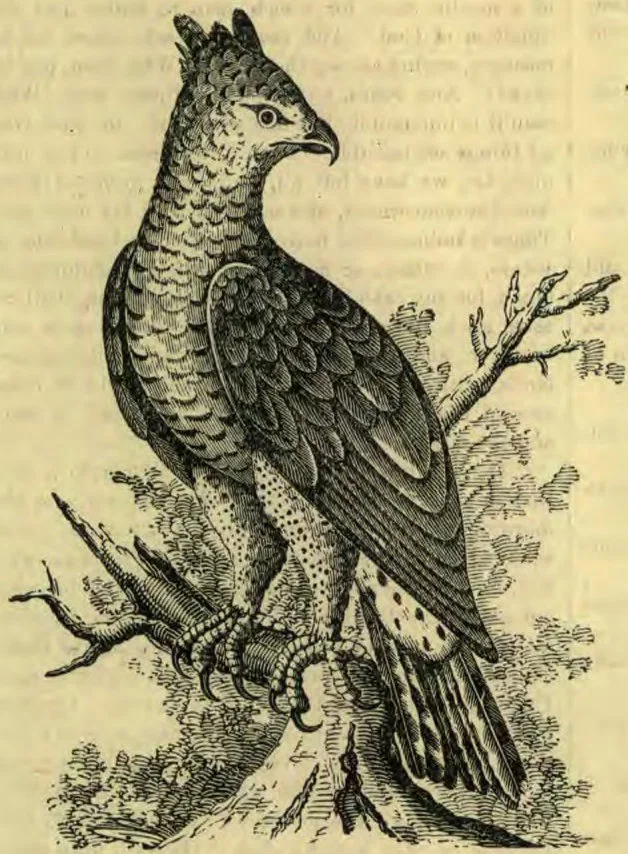
THE FALCON.

The falcon is a bird of prey, and in olden times it was taught to help the hunters in catching their game. This was before guns and gunpowder were invented. The people of England and other countries of Europe used to think that hunting was the best sport they could have, and the rich men, nobles, and even kings, kept great numbers of dogs and falcons to help them. These birds were very carefully trained, and almost any fine morning you might have seen a company of hunters galloping away on their fine horses, with their dogs at their side, and their falcons sitting proudly on their wrists. And there the falcon would stay, never flying off, until at a word from his master he would dart away after a bird which they wished to take. This strange hunter was of course trained to bring the game which he caught to his master, instead of making a meal of it himself. A ring with the owner's name on it, was usually tied to one of the falcon's legs, and to this was fastened a string of tiny bells, so that if he was lost in the hunt, the master might easily find him.
The falcon is a very strong and courageous bird, and also a very intelligent one. He can be taught many curious tricks, and soon learns to obey a word and even a sign from his master. There are several kinds of these birds, some of which are found in almost every part of the world, even in the cold regions of the north. The largest kind is about the size of the eagle, while some are not more than sixteen inches long. Their feathers are usually brown and white, though they are flecked and spotted in many different ways. Some are all of brown, with a few white spots; others are almost pure white, with perhaps a few flecks of brown.
The falcon in its wild state, usually builds its nest along the rocky shore of some bay. It is very shy, and its nest is not easily found; but Mr. Audubon, the great American naturalist, speaks of finding one on a rocky cleft by the sea. The nest itself was about two feet across, flat, and made of sticks, sea-weed, and mosses. The eggs, he says, were dull white, spotted with brown, looking very much like some of the birds themselves.
E. B.

The Bearer of Burdens.

THERE were three men walking up a steep hill, each very tired, with a heavy burden on his back. Then there stepped up to them a strong, kind man, who said to them, “Let me take your burdens, I will carry them for you.” But the first man said, “I have no burden,” for he had carried his burden so long that it seemed like his clothes, or like part of his body, so that he did not feel it, and did not know how much better he could walk without it. So the first man would not have his burden touched.
The second man was very selfish and unkind himself, and he thought all other people must be selfish and unkind, so he said, “You want to play me some trick; I do not believe you want to carry my burden; I will not let you touch it.”
The third man was very tired indeed, and was saying to himself, “Oh, who can help me? for I feel that I cannot carry this terrible weight any further;” and when he felt the stranger touch him on the shoulder, and offer to take his burden, he said at once, “It is very kind of you; I am very thankful; please take it, for I see you can bear it, and I cannot.”
The strong one is Jesus. The burden is sin. If we do not feel our sin, Jesus cannot bear it for us. If we do not trust him, he cannot bear it. But if we are tired of our sins, and turn from them, and trust in Jesus, he will take the terrible weight of our sins away.

HE MISTOOK THE LIGHT.

AND what was the consequence? Why, one of the largest steamships ever built, the Great Britain, which cost two hundred thousand pounds in building, and left port in fine trim, with a company of three hundred souls on board and a rich cargo, was wrecked, in a dark and stormy night, on the most dangerous part of the coast of Ireland. Yet the captain and his officers were on the lookout; the chart was well examined; the usual precautions seemed to have been taken. But a light appeared which was not noted on the chart, and the captain was misled by it. He mistook it for another light which was on the chart, and so when he supposed he was running out to sea, he was really running in upon the breakers. Such was the mistake, and so terrible were the consequences!
Every reader of these lines is voyaging on a dangerous sea, where thousands of false lights are lighted to deceive. Let all remember that the only true guide is to keep close to the unerring chart of Holy Scripture. Trust to no other guide. Trust to no other light.—Child's Own Magazine.

ASKING FOR WISDOM.

How beautiful the language of Solomon, when in a dream by night the Lord appeared to him, and said: “Ask what I shall give thee.” Solomon had been anointed king over Israel. In his expressions to the Lord he says, “I am but a little child; I know not how to go out or come in.” With such a great people to reign over, that could not be counted for multitude, it is not to be wondered that he felt as a child, with such great responsibility resting upon him. His desire that he might have understanding to discern and judge rightly so pleased the Lord that wisdom was given him; and none before or after him were to be as wise as was Solomon.
It is the privilege of every one to ask for that wisdom which cometh from above,—the wisdom that will make us wise unto salvation, and guide our feet in right paths; so that our way may be pleasant and peaceful. God is well pleased to have us seek his face, and believe and trust his word. To fear him is the beginning of wisdom. If we seek his guidance and direction in all things, he will keep our “going out and coming in from this time forth even for evermore.”—Selected.

GIFTS FOR THE KING.

The wise may bring their learning, The rich may bring their wealth, And some may bring their greatness, And some bring strength and health. We too would bring our treasures To offer to the King: We have no wealth or learning, What shall we children bring?
We'll bring him hearts that love him, We'll bring him thankful praise, And young souls meekly striving To walk in holy ways; And these shall be the treasures We offer to the King; And these are gifts that ever The poorest child may bring.
We'll bring the little duties, We have to do each day: We'll try our best to please him At home, at school, at play. And better far these treasures To offer to our King Than richest gifts without them; Yet these a child may bring.

You have reached the end of this edition.

The Youth’s Instructor · Apr 26, 1882