Your ShelfYour Projects

The American Sentinel, Vol. 11, No. 51.

Christmas: Its Pagan Sun-Festival Origins
Earlier text: Christmas: Its Pagan Sun-Festival Origins

ARE OUR LAWS INFALLIBLE?

BY M. E. KELLOGG.
Lawmakers generally see and promulgate correct principles, putting them into the form of law; but prejudices are often stronger than laws, and, under what seems to them to be peculiar and extraordinary circumstances, the persons who make laws based on principles of justice will sometimes justify actions contrary to the principles they have accepted and embodied in the law. Justice looks good to them in principle, as seen in the aggregate; but if it is applied in a way that conflicts with their strong prejudices, in a way they did not conceive that it could be done when they accepted the principles, they rebel at their own actions, or try to make an exception in the general application of the principles.
Thus many people who affect to believe in equal religious rights for every religious sect to preach and make converts wherever its missionaries can gain a hearing, actually limit such liberties to certain privileged churches and sects; and should a Mormon missionary, or a preacher of some other (to them) obnoxious sect, come into their vicinity, they would feel it to be the proper thing to ignore the principles of religious liberty which they have themselves accepted, and, with violence if necessary, drive the hated sectarian from their midst.
Those who do this, while claiming to accept the principles of religious liberty and to obey the laws of their State which accord liberty of conscience to all, really ignore both the law and the principle of justice upon which it is founded, and establish, as far as they can, a national religion, including in it those sects which they think should be protected or tolerated, and rigorously excluding all others.
In opposition to this common course of action toward the Mormons, we are pleased to see the following from the editorial columns of the Christian Advocate, of Nov. 19:—
The question is started whether Mormons should be suppressed by law in the United States if they attempt to promote the spread of Mormonism; and whether, if mobbed, the authorities should protect them.
So long as the Mormons do not teach the violation of the laws of the State, they are entitled to all the liberties enjoyed by the most orthodox Christian sects. Exclusive of polygamy, their religion is not as demoralizing as modern Spiritualism, nor any more absurd; and while such unsettlers of the foundations of morality, to say nothing of religion, as Ingersoll are allowed free speech, there is no consistency in interfering by law with any teacher of religion, unless he advocates treason or the violation of the statute laws. This country has committed itself to free speech, freedom of the conscience, and freedom in religion, with all their consequences for good and evil, subject only to restrictions of universal application; and their application to freedom in religion is totally independent of the natural or supernatural origin thereof. But if Mormons teach polygamy and practice the same, they are amenable to the law just as they would be if they taught and practiced “free love.”
We said that we were pleased to see this article; and we are. The question of the relation of the State and State laws to the former practice of polygamy by any Mormon, is correct. The practice of polygamy is a civil wrong, and, as a civil wrong, the civil law has a right to prohibit it.
But while this position of the Advocate is correct, there is in this article another general principle apparently laid down, which, while right as applied to polygamy, may be very dangerous as applied to some other things. It asserts that “there is no consistency in interfering by law with any teacher of religion, unless he advocates treason or the violation of statute laws.” This rule, once adopted, would justify the State in interfering by law against any teacher of religion who taught something which some law of the State condemned. Now for State law to be right in every case, it would be absolutely necessary that the laws of the State should be so perfectly in harmony with the purest principles of justice that they condemn all evil, and nothing but evil, and promote all virtue, and nothing but virtue. And that is to say that the laws of the State must be absolutely perfect and infallible; and this in regard to religion as well as to civil affairs! Will anyone presume to say that such is the condition in any country in the world? Such a theory, carried out to its logical sequence, would deify the State, and change the greatest questions in morals and ethics from “Is it right?” to “Is it the law?”
The question of “Is it law?” has been used many times to serve the basest purposes, but the more important question “Is it right?” has, in numerous instances, been the mainspring of great and beneficent reforms.
To see how this principle has worked, it is only necessary to recall the days immediately preceding the great civil war in this country. When the Constitution of this nation was adopted, slavery was strongly entrenched in certain States of the Union. In those States it received the cordial support of the people as a whole, including the members of the various churches and their clergy. As the people of other States did not look with such favor upon slavery, there was a fear that some State at some time might become an asylum for runaway slaves, and hence, to protect the interest of the slave-holder, the following carefully-worded article was made a portion of the United States Constitution:
No person held to service or labor in one State, under the laws thereof, escaping into another, shall, in consequence of any law or regulation therein, be discharged from such service or labor; but shall be delivered up, on claim of the party to whom such service or labor may be due.
The word “slave” is not here used, but slavery was meant; and in harmony with this section of the Constitution, a special law was passed by Congress in 1793 providing for the recapture of slaves. As time progressed and the evil and sinfulness of slavery became more clearly apparent, the law was not obeyed: many Christians holding that it was a Christian duty to assist in secreting slaves, and aiding them on their way to Canada. So much of this was done that in 1850 a new and more stringent law to the same effect was enacted by Congress. This law was known as the “Fugitive Slave Law.” But it also was disregarded, and the friction arising over this and other features of the slavery question led to the great anti-slavery movement, the formation of a new party, the election of Lincoln and the extinction of slavery.
During those stormy days preceding the war, many Christians paid little regard to the Fugitive Slave Law. Yet it was the law, and based on a clause in the Constitution, the highest law of all for the nation. They believed that the law was wrong, and hence disregarded it. Time has justified, and posterity approved, their conduct. But if law were the only criterion, those men were wrong, and deserving of severe condemnation and punishment; for, in the most persistent manner, they advocated the “violation of the statutes.”
Another later illustration of the danger of allowing the “statutes in such cases made and provided” to be the rule of conscience may be seen in the law of Florida known as the “Sheats’ Law.” This law made it a penal offence for anyone to teach negroes and white children in the same building. The Christian Advocate, in its issue of Nov. 5, referring to this law, says that “the missionaries who were directly affected by this discriminating and unjust legislation disregarded it for the most part;” and evidently approves their conduct in so doing. That law has now been declared void by the Supreme Court of that State. But if law is to be obeyed blindly, irrespective of the greater question of whether it is right or wrong, the Sheats’ Law, as well as the Fugitive Slave Law, should have been scrupulously obeyed. Of course whoever violates a law must expect to take the penalty, whether the law is right or wrong; but often the violation of an iniquitous law is the best and perhaps the only means of calling attention to it, and securing its modification or repeal.
To say that all the laws that now exist in regard to civil affairs, even in our own country, are absolutely right would stretch one’s credulity to the utmost. But how much greater danger there is that laws relating to religion are decidedly wrong; for in making such laws the State is entirely outside of its province, and under such circumstances it cannot fail to be wrong. In support of this conclusion evidence might be drawn from the history of every nation under the sun from the earliest times down to our own day.
Our own country has afforded many illustrations of this truth from colonial times until the present generation. Some of these laws have been repealed, others have died from disuse—yet exist in an atrophied form; others, like the laws for the observance of Sunday, still remain, and their votaries claim for them the same infallibility which has been believed in the past to sanction other unjust religious laws of the same nature which long ago were consigned to oblivion.
Entirely to eliminate religious laws from our statute books would greatly simplify the question of law and obedience as related to civil affairs, and would be a great step toward the attainment of the probably unattainable ideal of civil law—absolute perfection. At the present time no one can truthfully say that this ideal has been achieved.
As long as all men, do not see their religious duties precisely alike, and as long as the religious ideas of certain persons are enforced by civil law, we may expect that there will be those who will not accept the idea of the infallibility of the State and State laws. And should they be accused of violating these laws, which menace their religious rights, they will say, as did certain ones of old whom we all delight to honor, and who were similarly charged, “We ought to obey God rather than man.”

WHICH SHALL REIGN?

BY ALBERT C. HOPKINS.
I SAW, recently, a picture of the assembled society of Christian Endeavor, standing in the foreground and flooding with fresh color and young life, the long and broad steps of the national Capitol, a more welcome advent than that of Coxey’s army, indeed a most imposing, significant and magnificent spectacle.
I read, too, in connection with it, the statement that it was and is the avowed purpose of this Christian Endeavor, to promote and establish “the reign of Christ on Capitol Hill.” This statement and avowal is, doubtless, open to several different interpretations.
What shall we understand by “the reign of Christ in the national Capitol?” It is fit that we carefully consider what is its best meaning. If the spirit of Christ, the full justice, the willing personal sacrifice, the large religious freedom, the all-embracing fellowship and love, that truly represent the Christ, shall come to reign in the minds and thoughts of those who make and execute the laws at the national Capital, then only will the true Christ reign on Capitol Hill.
It is justly feared, however, that this is not the interpretation of the Society of Christian Endeavor. Evidently it needs to be said and recognized, that any effort on the part of professed Christians to force their religious views into the Constitution and the laws of the United States—whose proposed new and true name is the United State—is not a Christian but an unchristian endeavor. Such action will not promote, but certainly and seriously retard and prevent, the reign of the true Christ on Capitol Hill.

“THE LOGICAL CONCLUSION.”

The New York Journal defends the Sunday newspaper upon the ground that general acceptance of an article demonstrates its worth. As the Journal is defending the Sunday paper against a religious class who would have it suppressed on the ground that Sunday is the Sabbath, it makes use of logic which cannot well be assailed from the “orthodox” standpoint. “We recall,” says the Journal, “that a few weeks ago the Rev. Lyman Abbott defended democracy while attacking the theory that government exists by consent of the governed. He said that government by the majority of all was right not because of the implied consent of the minority, but because the majority of the people were more likely to act in accordance with divine law than an individual, as in a monarchy, or a class, as in an oligarchy, would be. Now a majority of the people in New York read a Sunday paper. Hence—but we will leave the logical conclusion to the clergy.”
A majority of those professing the Christian religion sanction the first day of the week as the Christian Sabbath; and in the absence of any divine sanction for the same, this fact is advanced as convincing proof that Sunday is indeed the true Sabbath. The logic of the Journal in support of the Sunday newspaper is “orthodox,” and must be accepted by all who appeal to popular custom in support of the first-day sabbath.

Moody on Sunday Newspapers and the Sabbath Commandment

EVANGELIST D. L. MOODY said, recently, in answer to a query from the New York Journal, that the publication of Sunday newspapers is a violation of the divine commandment to keep holy the Sabbath day. If Mr. Moody had only quoted the text which forbids newspaper publishing or other work on the first day of the week, his reply would have been of intense interest to the whole religious world. But for some reason he omitted to do this,—perhaps because he believes in following a precedent established by other popular preachers. So the public are left to take Mr. Moody’s word for it, —unless they are willing to believe that the Creator means just what he says in the Sabbath commandment, viz., that “the seventh day is the Sabbath.”

POLITICS IN THE PULPIT.

[Reading (Pa.) Herald.]
THE clergymen who believe it is meet to turn their pulpits into lecture platforms and proper to convert their sermons into stump speeches were out in full force on Thanksgiving day. They took occasion to gloat over the late Republican victory and to rub it into the poor defeated Democrats in splendid rhetorical periods and rich bursts of eloquence. Some of their hearers, who had gone to church for religious and not political purposes, walked out during the sermonizing, and a good many others were ready to do so.
It would appear that there are still many pulpiteers in this land of the free who find the contents of the Bible too circumscribed, and who must needs seek themes for their effective discourses in other fields. Whatever excuse there may have been in the very unusual campaign that is now happily ended for proclaiming national honor and upholding popular probity in the pulpit, there is no excuse for an offensive partisanship on the minister’s part to-day. To haul out the issues of a dead-and-gone campaign, and to flaunt them in the faces of the defeated as a cause of thanksgiving, is neither generous, just, nor prudent. It is decidedly inappropriate. It is entirely unnecessary. It will not advance the cause of Christianity. It cannot help the affairs of the nation.

Holiness to the Lord: Badges, Trains, and Constantine's Bridle

We would never have thought of crediting the following to Dr. Wayland Hoyt, yet it is quoted as from his pen by the Golden Rule of December 10:—
The old prophecy says that holiness to the Lord is to be written on the bells of the horses. The nineteenth century fulfillment of the prophecy is the emblazoning of railroad trains with devotion to Jesus Christ.
The allusion is to the train-loads of Christian Endeavorers going to their conventions, each wearing a badge which proclaims him or her to be a Christian. History records that the “Christian” Emperor Constantine fulfilled this same prophecy—as he asserted—by taking some nails from the true cross—genuine of course—and having them made into bits for guiding the horse which he rode on State occasions. And there is as good ground for believing that Constantine fulfilled the prophecy, as for believing that it can be fulfilled at all by outward show.
The quotation shows how even the best minds become “flighty” when filled with the intoxicating idea of “Christian citizenship.”

Making the Sunday Sermon More Interesting Than the Newspaper

A PROMINENT clergyman of New York City, Rev. Madison C. Peters, says that the remedy for non-attendance of church members at the house of worship on Sunday, is to make the Sunday sermon more interesting than the Sunday newspaper. Certainly; this is the only legitimate way, though it may not be the easiest way for the preachers. The effort made by the latter to suppress the Sunday newspaper is a virtual confession that they are unable to compete with it in producing that which will interest the people. It is just as true now as it ever was, however, that the power of the word of God is infinitely greater than any power that can be exercised by the Sunday newspaper or any other means that is of earth. If preachers would only stop trying to compete with the Sunday paper in the line of that which the latter contains and on the plane where it stands, and turn to the simple preaching of the divine Word, their work would be attended by “the power of God unto salvation to everyone that believeth,” and the world might again see with wonder three thousand people converted by one sermon, instead of one person converted by three thousand sermons.

Christian Statesman Offers Free Copies to College Students

The Christian Statesman of December 12, announces that “many presidents of colleges have written to us, . . . sending a selected list of twenty names of worthy students” to whom the Statesman will be sent this winter.
It hopes “to reach at least 50,000 [college students] before the winter is over.” What are you doing, reader, to extend the circulation of the AMERICAN SENTINEL?

INTERESTING FACTS.

At this time when so much is being said concerning the nations of Europe, we believe it will be interesting to everybody to see the picture of some of the people who stand at the head of the various governments. The above heading is the name of a little book, which contains besides 74 pages of very interesting facts brought out in various ways, an album of 21 fine half-tone cuts direct from the photographs of European royalty, and includes Victoria, Queen of England; Christian IX., King of Denmark, and his Queen; Frederick, Crown Prince of Denmark; Oscar, King of Sweden; Sophia, Queen of Sweden; the King and Queen of Greece; Alexander III., Czar of Russia; and Maria Dagmar, Czarina of Russia; Wilhelm II., Emperor of Germany, and his wife; Josef I., Emperor of Austria, his Queen and her son; and others of equal importance and renown.
This little book contains a total of 96 pages, nicely bound, in heavy paper, and was sold by the publisher at 25 cents. We will send it post-paid, for 13 cents per copy, two copies for 25 cents. Send now. Postage stamps will be received.
Address, PACIFIC PRESS PUBLISHING CO., 39 Bond St., New York City.

THE CYCLONE STILL WHIRLS.

Be Sure You Don't Miss the Whirl this Fall and Winter.

For if you do you will miss a chance of a lifetime to make fine wages at a time of the year when nothing else can be accomplished. It will win you friends, and hold its trade as no other article that is now on the market will do.

Give it a trial and your success is certain

See what others say:

Battle Creek, Mich., Oct. 16, 1896.
MESSRS. COON BROS., Battle Creek, Mich.
Gentlemen: In 14 hours' work in the city of Battle Creek, selling the “Cyclone Washer,” I have sold seven. It is the best selling article that I have ever handled.
Yours truly,
H. M. LITTLE.
Asbury Park, N. J., Oct. 21, 1896.
MESSRS. COON BROS., Battle Creek, Mich.
Gentlemen: Since writing you before we have had the “Cyclone” used in our family, and all are delighted. Money is close here as elsewhere, and will be until confidence is restored by the election of McKinley and Hobart. We are taking the merits of the machines with confidence, and hope to increase the orders as its use extends.
Yours truly,
H. & G. MARTIN.

His Glorious Appearing.

An Exposition of Matthew 24.

REVISED, ENLARGED, AND ILLUSTRATED.

Contains ninety-six pages, with twenty full-page illustrations. The work takes up Christ’s second coming, and the signs of the times are clearly pointed out in relation to that greatest of all events.

JUST THE BOOK FOR THE TIMES.

Interesting, Timely, and Instructive.
Price, attractive board cover, - - .25 With Sentinel, one year, - - $1.10
ADDRESS, AMERICAN SENTINEL, 39 Bond St., New York.

SAFETY PENCIL POCKET.

NEAT, CHEAP, SERVICEABLE.
It perfectly secures pen or pencil in the pocket, so that it can not fall out when stooping. Can be easily and safely attached to any part of the clothing. A small investment will prevent the loss of a valuable pen or pencil.

PRICES.

No. 1. Russia leather, for 2 pens 10c.
No. 2. “ “ 3 “ 15c.
No. 3. Sealskin, 2 “ 15c.
No. 4. “ 3 “ 25c.
No. 5. Russia leather, for 4 “ 25c.
No. 6. Sealskin, 4 “ 40c.
Sent by mail on receipt of price. We guarantee these pockets superior in every particular to similar styles formerly sold and still offered at much higher prices.
PACIFIC PRESS PUBLISHING CO.,
39 Bond St., New York.
Oakland, Cal.      Kansas City, Mo.

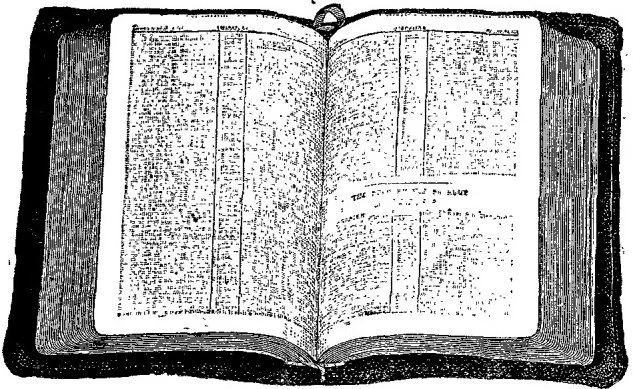
A NEW BIBLE, Or rather the Old Bible in a New Style.

They that sealed the covenant.
NEHEMIAH, X.
The points of the covenant.
They have dominion over our bodies, and over our cattle, at their pleasure, and we are in great distress. 38 And because of all this we make a sure covenant, and write it; and our princes, Levites, and priests seal unto it.

CHAPTER X.

The names of them that sealed the covenant. The points of the covenant.
NOW those that sealed were, Nē-he-mī'ah, the Tir'sha-tha, the son of Hach-a-li'ah, and Zīd-kī'jah, 2 Ser-a-ī'ah, Âz-a-rī'ah, Jêr-e-mī'-ah, 3 Pâsh'ûr, Âm-a-rī'ah, Mâl-chī'jah, 4 Hât'tûsh, Shêb-a-nī'ah, Mâl'luch, 5 Hâ'rîm, Mêr'e-môth, Ô-ba-dî'ah, 6 Dân'iel, Gîn'nê-thon, Bâ'ruch, 7 Mê-shûl'lam, Â-bî'jah, Mîj'a-mîn, 8 Mâ-a-zî'ah, Bil'gai, Shê-m-a-ī'ah: these were the priests. 9 And the Levites: both Jêsh'u-â the son of Az-a-nî-ah, Bîn'nû-i of the sons of Hên'a-dad, Kâd'mî-el; 10 And their brethren, Shêb-a-nī'ah, Hô-dî'jah, Kêl'î-tâ, Pêl-a-ī'ah, Hâ'nan, 11 Mî'châ, Rê'hôb, Hash-a-bî'ah, 12 Zâc'eur, Shêr-e-bî'ah, Shêb-a-nī'ah, 13 Hô-dî'jah, Bâ'nî, Bên'î-nû. 14 The chief of the people; Pâ'rôsh, Pâ'hath-mô'ab, Ê'lam, Zât'thu, Bâ'nî, 15 Bûn'nî, Âz'gad, Bêb'â-i, 16 Âd-ô-nî'jah, Bîg'vâ-i, Â'dîn, 17 Â'têr, Hîz-kî'jah, Âz'zûr, 18 Hô-dî'jah, Hâ'shum, Bê'zâi, 19 Hâ'rîph, Ân'a-thôth, Nêb'a-i, 20 Mâg'pî-ash, Mê-shûl'lam, Hê'zîr, 21 Mê-shêz'a-be-el, Zâ'dôk, Jad'dûa, 22 Pêl-a-tî'ah, Hâ'nan, Ân-a-ī'ah, 23 Hô-shê'â, Hân-a-nî'ah, Hâ'shub, 24 Hâl-lô'hesh, Pîl'e-hâ, Shô'bek, 25 Rê'hûm, Hâ-shâb'nah, Mâ-a-sê'jah, 26 And Â-bî'jah, Hâ'nan, Â'nan, 27 Mâl'luch, Hâ'rîm, Bâ'ânah. 28 And the rest of the people, the priests, the Levites, the porters, the singers, the Nethinims, and all they that had separated themselves from the people of the lands unto the law of God, their wives, their sons, and their daughters, every one having knowledge, and having understanding;

SOME OF ITS FEATURES.

SELF-PRONOUNCING. All proper names divided into syllables; all vowels have diacritical marks; hence the reading of such names is made easy.
LARGE TYPE. Size, Bourgeois. (See specimen.)
COMBINATION. This feature belongs exclusively to this line of Bibles. It is found in no other, and consists of a blending of both old and new versions in one volume, by convenient reference to foot notes. Where they differ, the reading of the new version is found at the bottom of the page.
BOOK NOT BULKY. Although it has both versions, quite a complete concordance, and a full complement of excellent maps (no other helps), it measures but 5¾ x 8 x 1½ inches.
BINDING. It is nicely bound in Tampico Morocco, divinity circuit, leather lined, round corners, red under gold edges.
PRICE. The regular price of this Bible is $8.00, but to introduce it we will send it postpaid for $5.00.
Order number 63.
Send to us for circular giving full information regarding this line of Bibles.
Address, PACIFIC PRESS PUBLISHING CO., 39 Bond Street, New York City.

THE STORY OF PITCAIRN ISLAND. (SECOND EDITION.)

BY ROSALIND AMELIA YOUNG
A Native Daughter.
Pitcairn Island, one of the volcanic gems of the Pacific, has been heard of wherever the English language has been spoken. The story of the working out of the problem of human life on its limited territory reads stranger and more thrillingly in many respects than a romance. But most, if not all, of the tales told and books printed have either been too fragmentary or incorrect and misleading. It will be interesting to the friends of that miniature world to know that an authentic history has been written, and that by a native of the island, one to the manor born. Miss Rosa Young is one of the direct descendants of the mutineers of the Bounty. The book is a plain, unvarnished tale of Pitcairn and its inhabitants from its settlement to the year 1894. It is written with a charming simplicity of style which refreshes the reader and invites a continual perusal. Illustrated with 26 engravings by the half-tone process, and its 23 chapters have each a neatly engraved heading.
Price, $1.00
With Sentinel, 1.50
ADDRESS, AMERICAN SENTINEL, 39 Bond St., New York.

Enforce the Laws: Legal Light Versus the Light of Life

UNDER the heading “Enforce the Laws,” the Union Signal says that “more requests came the past year for legal light than for any other one thing; for that matter, more than all others put together.” But what good is legal light to Christians? The light of life is what men need, Christians and all others. And it is written, “He that followeth Me, shall not walk in darkness, but shall have the light of life.” But as, in the work of the W. C. T. U., more requests are made for legal light than for all other things put together, it would appear that in that work they are following this other thing more than they are following Christ. The Signal considers this “a hopeful sign.” It may be a hopeful sign of the thing they have in view; but as for anything pertaining to Christianity, it is everything else than a hopeful sign.

Turning the Other Cheek: Christian Forbearance Questioned

A WESTERN religio political journal raises the query how far a Christian can follow the divine injunction to “turn the other cheek” to the smiter before reaching the point where “forbearance ceases to be a virtue.” It mentions by way of illustration that a certain minister in an Iowa town had been active recently in securing the indictment of a druggist for violation of the prohibition law, whereupon the druggist becoming angry, undertook one day to chastise the preacher upon the street, but the latter drew a revolver and shot him, inflicting a dangerous wound. This was a “regretable” outcome, the journal says, but it adds that “it is a stern question how long the champions of law and order may be expected to stand dumb before the insults and assaults of law-breakers and assassins.”
Was this a case of “Christian” shooting? And if the wound proved fatal—as perchance it did—was the druggist killed in a “Christian” way? This may not have been any better for him than if the shot had been fired by a highway robber, but the minister thereby avenged the “insults” offered him and perchance avoided bodily injury.
How far did Jesus Christ go in submitting without resentment to the insults and violence offered him? How long did he suffer them before striking his persecutors to the ground? It might be profitable for those who profess to do all things in His name, to consider these questions in their bearing upon this subject.

New Monitor Warship the Puritan Commissioned

THE United States Government put into commission the other day a new monitor war ship, which is said to be “the Terror of the Sea.” It is called the Puritan. That is a very appropriate name.

Petitions for a Sunday Law in Washington

From Washington, D. C., news comes that already petitions containing between two hundred and three hundred thousand signatures have been presented to Congress asking for a Sunday law for the District of Columbia.

Is the King James Bible the Constitution?

JOHN G. WOOLLEY calls the Bible “King James’s version of the Constitution of the United States.” This is a mistake. Our English Bible is the King James version of the Constitution of the Kingdom of God. The United States is not the Kingdom of God, and never will be. It is not even a kingdom of men. It is a republic of men.

Christian Citizens Called to Consider Their Duty

THE Union Signal says that “It is believed that this is a good time for Christian citizens, irrespective of party or denomination, to come together and consider their duty in the light of Christ’s law.” Yes, that is believed by a large number of people: and we most heartily wish that they would do it. And until all can get together, we wish such as do meet would really do this. It would work great changes and do immense good.

Wages and the Poor: A Storm Death

IN the late big storm in this city a man perished because he had no shelter, although he had worked the day before. When his employer saw him dead, he exclaimed, “Why, that’s Louis Bressler. He went to work for us yesterday. We would have paid him to-day if he had not died.” The Lord has said, “The wages of him that is hired shall not abide with thee all night until the morning.” What untold blessings would come to the poor if only those who have it in their power would do as the Bible says.

Anti-Saloon League Delegation Meets the President

A WASHINGTON, D. C., correspondent sends us the following: “A delegation of members of the Anti-saloon League called on the President and had a conversation with him with reference to proposed religious legislation. They referred to the criticisms that had been made in the papers with reference to his Thanksgiving proclamation; and as they reported in their public meetings, the President said emphatically that this is indeed a Christian nation, and it was only a matter of time when everyone would have to come to accept the situation.” Evidently it was due to no oversight on the President’s part that his Thanksgiving proclamation for 1896 read as it did.

American Sentinel New Year's Number Announcement

THE next number of the AMERICAN SENTINEL will be the New Year's number. It will be in new dress, new form, and sixteen pages. Get ready to read it over carefully, and show it to your neighbor, and so recommend it to him that he will become a subscriber. The price remains the same.

Talmage's Sermon on Heaven and Spiritualism

In a sermon not long ago Dr. Talmage said that he was not a Spiritualist. His sermon Sunday, December 6, on “Heaven and Its Employments,” proves that he is now very much of a Spiritualist. The veil that he mentions in the former sermon as growing thinner and thinner between this world and the spiritual world, will soon be so very thin that he can communicate with his departed friends who, he insists, “are much more alive than they ever were.”

Leo XIII and the Apostolic Delegation in America

AMONGST Catholics and in Catholic papers of the United States it is being said that “when Leo XIII. takes his place beside the popes surnamed great, among the things that made his greatness, historians will first name the establishment of the apostolic delegation in the United States.”

Cardinal Gibbons on the Catholic Church and American Institutions

IN a letter to The Church, Boston, Mass., lately, on “The Relation of the Catholic Church to American Institutions,” Cardinal Gibbons said:—
The American nation is a Christian nation. This is manifest from its Constitution, from its legislation, and from its observance of certain holidays such as Thanksgiving and Christmas. Now it is this very Christian spirit that the Catholic Church tries to strengthen in every way possible. Convinced that in her alone resides the fullness of divine revelation, she desires to draw all to herself through the sweet bonds of charity and religious persuasion.
And that this work of drawing all to herself is being steadily and persistently carried on, the following dispatch is in evidence:—
ROME, Dec. 16.—It is learned on excellent authority that the pope will probably renew negotiations with the United States for the creation of an American legation to the Vatican.
His Holiness has not any greater hopes of succeeding with President McKinley than with President Cleveland, but he takes these steps by way of homage to a principle which, according to the Vatican, must sooner or later triumph.
As President Cleveland has declared that “it is only a matter of time when all will have to accept the situation” of this being “indeed a Christian nation,” Rome can be depended on to do her part in seeing that “all will have to accept the situation.”

You have reached the end of this edition.

The American Sentinel · Dec 24, 1896