Your ShelfYour Projects

Review and Herald, Vol. 92, No. 22.

JAPAN MISSION ADMINISTRATION BUILDING

Review and Herald

May 6, 1915

Review and Herald Publishing Association · Takoma Park Station, Washington, D. C. · May 6, 1915
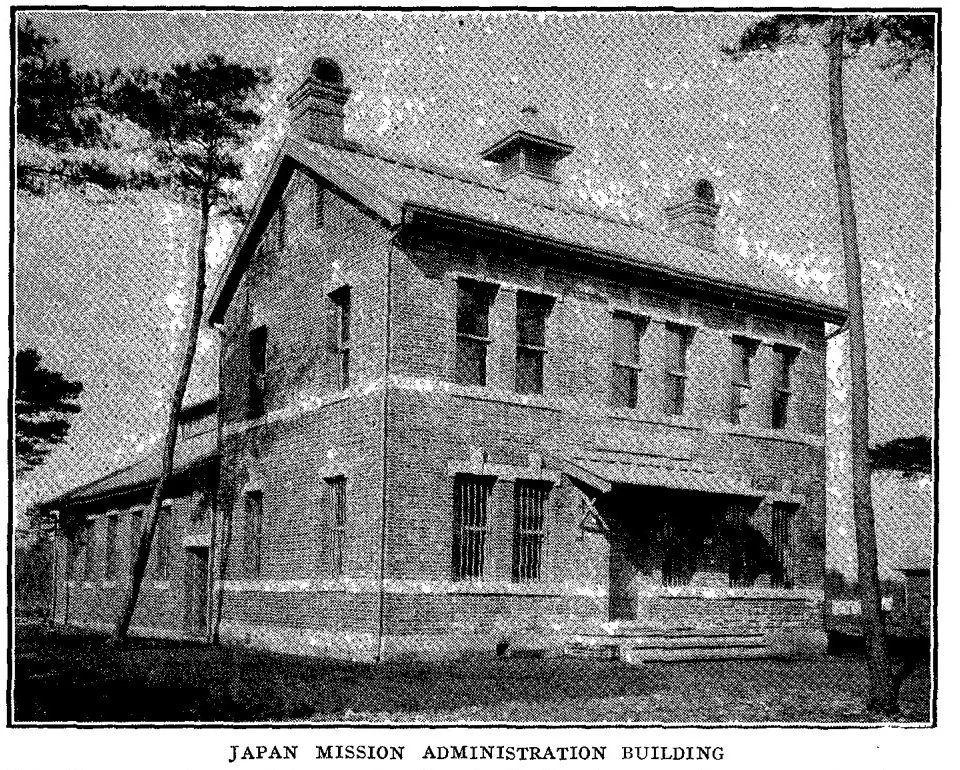
JAPAN MISSION ADMINISTRATION BUILDING

JAPAN MISSION ADMINISTRATION BUILDING

First floor, secretary and treasurer's office, book depository, stock room, and vault. Second floor, mission superintendent's office, Sabbath school secretary's and field secretary's offices, and editorial rooms. Rear, printing office. The building faces the east.
The erection of substantial buildings for our mission headquarters gives permanency and stability to our work. In connection with a view of the administration building on this page, read the article on Japan, in our World-Wide Field department. Accompanying this interesting article is given a view of the homes which have been recently built for some of our mission workers. What has been done in Japan in providing these facilities should be done in some of our other mission fields which are without the proper means for carrying forward their work and safeguarding the lives of the workers.

Missionary Literature

Berean Library

PRICE EACH
  1. Steps to Christ ................. $ .25
  2. Thoughts on Daniel ............... .25
  3. Thoughts on Revelation ........... .35
  4. His Glorious Appearing ........... .15
  5. Sabbath in the Scriptures ......... .25
  6. Sabbath in History ................ .50
  7. Capital and Labor ................. .25
  8. Here and Hereafter ................ .25
  9. Bible Footlights .................. .35
  10. Our Paradise Home ................ .15
  11. Religious Liberty in America ...... .35
  12. The Coming King .................. .50

Signs of the Times Leaflets

  1. The Sure Word of Prophecy.
  2. Prophetic History of the World.
  3. Second Coming of Christ.
  4. Signs of Our Times.
  5. The Sanctuary.
  6. The 2300 Days.
  7. The Law of God.
  8. The Sabbath of the Bible.
  9. The First Day of the Bible.
  10. Who Changed the Sabbath?
  11. The Great Threefold Message.
  12. The Seal of God and the Mark of the Beast.
  13. Church and State.
  14. Life and Immortality.
  15. The Great Judgment Day.
  16. The Home of the Saved.
Per 100 ......................... $ .10 1 pound (about 18 of each) .......... .40

Religious Liberty Leaflets

PER 100
  1. Principles Too Little Understood ..... $ .50
  2. Sunday Laws .......................... .50
  3. Logic of Sabbath Legislation .......... .50
  4. The Civil Sabbath ..................... .75
  5. Civil Government and the Church ....... .25
  6. Religious Liberty ..................... .75
  7. The Church's Greatest Need Today ...... .25
  8. Church Federation ..................... .75
  9. Limits of Civil Authority ............. .25
  10. Is the Sabbath a Civil Institution? ... .50
  11. What Are Works of Charity and Necessity? ... .25
  12. “Backward States” .................... .50
  13. Campbell on Moral Societies .......... 1.50
  14. Garrison on Sunday Laws .............. .50
  15. Sunday Mail Reports .................. .50
  16. Why Sunday Laws Are Wrong ............ .50
  17. Religion in the Public Schools ....... .75

Temperance Leaflets

PRICE EACH
  1. Alcohol and Disease .................. $ .00½
  2. Liquor and Poverty ..................... .00½
  3. Counting the Cost of Alcohol .......... .00½
  4. Is Alcohol a Food? ..................... .00½
  5. The Cure for National Intemperance .... .00½
  6. Some Effects of Tobacco Using ......... .00½
  7. Pointed Facts About Tobacco ........... .00¼
  8. Wine Industry .......................... .01
  9. The Tobacco Habit ...................... .05
  10. Tobacco Using ......................... .01½
  11. Medical Use of Alcohol ............... .00¾
  12. My Tobacco-Loving Brother ............ .00½

Missionary Volunteer Post Cards

(TWO COLOR)
  1. Stand.
  2. God Give Us Men
  3. Just Where You Stand.
  4. Work for All.
  5. If.
  6. Where'er the Path May Lead.
  7. How Much Shall I Give This Year to Missions?
  8. God Cares! Do We?
  9. Blest Be the Tongue That Speaks No Ill.
  10. Do Today's Work Today.
  11. Others.
  12. Seven Rules for Christian Growth.
  13. She Did Her Best.
  14. Take Life as You Find It.
  15. Power to Serve God Never Fails.
  16. Harsh Words Can't Be Killed.
Per 100 of one kind ................. $ .70 Per set of 16 ........................ .15

Words of Truth Selections

  1. The Coming of the Lord ............ $ .00¼
  2. A Challenge to Protestants .......... .00½
  3. Is the End Near? .................... .00½
  4. The Rest Day ......................... .02½
  5. Ownership and Tithing ............... .00½
  6. Important Questions on Great Events .00½
  7. Can We Know? ........................ .00½
  8. Present Truth ....................... .02
  9. The Third Angel's Message ........... .00¼
  10. We Would See Jesus ................... .01
  11. Signs of Our Times ................... .01
  12. What Do These Things Mean? .......... .01
  13. Christ's Second Coming .............. .02
  14. An Appeal to Clergy ................. .00½
  15. Court Week in Heaven ................ .00¼
  16. Rome's Challenge ..................... .02
  17. Spiritualism ........................ .00½
Where numbers are given, order by number from your tract society.

ORDER OF YOUR TRACT SOCIETY

The Healing of Hezekiah

MRS. E. G. WHITE
In the midst of his prosperous reign, King Hezekiah was suddenly stricken with a fatal malady. “Sick unto death,” his case was beyond the power of man to help. And the last vestige of hope seemed removed when the prophet Isaiah appeared before him with the message, “Thus saith the Lord, Set thine house in order: for thou shalt die, and not live.” Isa. 38:1.
The outlook seemed utterly dark; yet the king could still pray to the One who had hitherto been his “refuge and strength, a very present help in trouble.” Ps. 46:1. And so “he turned his face to the wall, and prayed unto the Lord, saying, I beseech thee, O Lord, remember now how I have walked before thee in truth and with a perfect heart, and have done that which is good in thy sight. And Hezekiah wept sore.” 2 Kings 20:2, 3.
Since the days of David, there had reigned no king who had wrought so mightily for the upbuilding of the kingdom of God in a time of apostasy and discouragement as had Hezekiah. The dying ruler had served his God faithfully, and had done much to strengthen the confidence of the people in Jehovah as their Supreme Ruler. And, like David, he could now plead: “Let my prayer come before thee: incline thine ear unto my cry; for my soul is full of troubles: and my life draweth nigh unto the grave.” “Thou art my hope, O Lord God: thou art my trust from my youth. By thee have I been holden up. . . . Forsake me not when my strength faileth. . . . O God, be not far from me: O my God, make haste for my help. . . . O God, forsake me not; until I have showed thy strength unto this generation, and thy power to every one that is to come.” Ps. 88:2, 3; 71:5-18.
He whose “compassions fail not” (Lam. 3:22) heard the prayer of his servant. “It came to pass, afore Isaiah was gone out into the middle court, that the word of the Lord came to him, saying, Turn again, and tell Hezekiah the captain of my people, Thus saith the Lord, the God of David thy father, I have heard thy prayer, I have seen thy tears: behold, I will heal thee: on the third day thou shalt go up unto the house of the Lord. And I will add unto thy days fifteen years; and I will deliver thee and this city out of the hand of the king of Assyria; and I will defend this city for mine own sake, and for my servant David’s sake.” 2 Kings 20:4-6.
Gladly the prophet returned with the words of assurance and hope. Directing that a lump of figs be laid upon the diseased part, Isaiah delivered to the king the message of God’s mercy and protecting care.
Like Moses in the land of Midian, like Gideon in the presence of the heavenly messenger, like Elisha just before the ascension of his master, Hezekiah pleaded for some sign that the message was from heaven. “What shall be the sign,” he inquired of the prophet, “that the Lord will heal me, and that I shall go up into the house of the Lord the third day?”
“This sign shalt thou have of the Lord,” the prophet answered, “that the Lord will do the thing that he hath spoken: shall the shadow go forward ten degrees, or go back ten degrees?” “It is a light thing,” Hezekiah replied, “for the shadow to go down ten degrees: nay, but let the shadow return backward ten degrees.”
Only by the direct interposition of God could the shadow on the sundial be made to turn back ten degrees; and this was to be the sign to Hezekiah that the Lord had heard his prayer. Accordingly, “the prophet cried unto the Lord: and he brought the shadow ten degrees backward, by which it had gone down in the dial of Ahaz.” 2 Kings 20:8-11.
Restored to his wonted strength, the king of Judah acknowledged in words of song the mercies of Jehovah, and vowed to spend his remaining days in willing service to the King of kings. His grateful recognition of God’s compassionate dealing with him is an inspiration to all who desire to spend their years to the glory of their Maker:— “I said in the cutting off of my days, I shall go to the gates of the grave: I am deprived of the residue of my years. I said, I shall not see the Lord, even the Lord, in the land of the living: I shall behold man no more with the inhabitants of the world. Mine age is departed, and is removed from me as a shepherd’s tent: I have cut off like a weaver my life: he will cut me off with pining sickness: from day even to night wilt thou make an end of me. I reckoned till morning, that, as a lion, so will he break all my bones: from day even to night wilt thou make an end of me. Like a crane or a swallow, so did I chatter: I did mourn as a dove: mine eyes fail with looking upward: O Lord, I am oppressed; undertake for me. What shall I say? he hath both spoken unto me, and himself hath done it: I shall go softly all my years in the bitterness of my soul. O Lord, by these things men live, and in all these things is the life of my spirit: so wilt thou recover me, and make me to live. Behold, for peace I had great bitterness: but thou hast in love to my soul delivered it from the pit of corruption: for thou hast cast all my sins behind thy back. For the grave cannot praise thee, death cannot celebrate thee: they that go down into the pit cannot hope for thy truth. . . . The Lord was ready to save me: therefore we will sing my songs to the stringed instruments all the days of our life in the house of the Lord.” Isa. 38:10-20.

What Is the Gospel?

C. P. BOLLMAN
I was reading a few days since, in a popular religious weekly, an article entitled “The Church of the Fat of the Land.” This heading did not reveal very much of the real nature of the article; but there were several pictures, and these with the descriptive lines under them disclosed the “slant” of the writer’s logic. It is not possible to reproduce the pictures, but here are some of the lines which appeared under them: “A church in a Western town has rented the opera house and exhibits ‘movies’ in it;” “Raising hens to the glory of God;” “Farmers gathering to hear a progressive pastor preach the gospel of better farming;” while a picture of road improvement is entitled “The Way of Salvation.”
For years I had been hearing of “the gospel of health,” “the gospel of good bread,” “the gospel of good housekeeping,” “the gospel of improved farming,” etc., but without thinking very much about what such expressions really meant, until I happened upon this article with its significant pictures and their still more significant descriptive titles, and especially the one entitled “The Way of Salvation.”
That line set me thinking, and I said to myself, “What is the gospel? and what the way of salvation?” Then my early religious training came to my assistance, and my memory answered the double question in the words of the apostle Paul, “I am not ashamed of the gospel of Christ: for it is the power of God unto salvation to every one that believeth; to the Jew first, and also to the Greek.” Rom. 1:16.
Then, too, I recalled Matt. 1:21: “She shall bring forth a son, and thou shalt call his name Jesus: for he shall save his people from their sins.” And then there came to mind the words of the gospel commission, which threw some additional light upon the subject, or at least served to add another testimony as to what the gospel really is, and what the salvation which it offers: “Go ye into all the world, and preach the gospel to every creature. He that believeth and is baptized, shall be saved; but he that believeth not shall be damned.” Mark 16:15, 16.
All these texts agreed well with my childhood understanding of what the gospel is, or at least what it was when I was a boy; but inasmuch as they did not seem to agree entirely with the ideas advanced in the article I had been reading, I asked myself, “How did those to whom the great commission was directly given understand it? and what did they present to the people of their day as the gospel?”
I remembered that the impetuous Peter was one of the original twelve, and turning to the Book to look up his record, I came in a few moments to the second chapter of the Acts of the Apostles, and to Luke’s account of that wonderful meeting in Jerusalem when the disciples were met together, not indeed to discuss the latest and most improved methods of farming, or road making, or fishing, but when they “all continued with one accord in prayer and supplication” for ten days.
I did not find in Luke’s record one word about any of the various “gospels” about which we now hear so much; but when Peter and the other apostles preached, their theme evidently was salvation from sin through faith in the Lord Jesus Christ. And as a result of the preaching many were pricked in their hearts and cried out, saying, “Men and brethren, what shall we do?” Peter did not say, Learn to be better farmers, more skillful fishermen, better bread makers, and in general more successful bread winners, but he did say, “Repent, and be baptized every one of you in the name of Jesus Christ for the remission of sins, and ye shall receive the gift of the Holy Ghost.”
And so I found it all through the Acts and the entire New Testament. It is true we are told that the apostle Paul was a tent maker, and doubtless he did good, honest work, but he said very little about it, either in his sermons or in his epistles. Indeed, he seems to have preached a great deal as did Peter, even going so far in one of his epistles as to say, “I determined not to know anything among you, save Jesus Christ, and him crucified.” The apostle was not narrow; for he did make a very broad application of Christianity when he said, “Whether therefore ye eat, or drink, or whatsoever ye do, do all to the glory of God.” That of course calls for good, honest work everywhere and all the time.
There is, however, this difference between the modern idea and that of the apostles: the apostles sought to sanctify all human activities by means of religion, while the modern, progressive plan seems at least to be to make a religion of human activities. An apple tree bears apples, not that it may be an apple tree, but because it is an apple tree. In like manner the Christian bears the fruits of the Spirit, not that he may be a Christian, but because he is a Christian.
So far as the record goes, we have no knowledge that any of the apostles ever gave even so much as a single lecture on farming, bread making, road building, fishing, tent making, or indeed upon any of the various industries by which men and women earn their bread. Not that it would have been wrong for them to have done so; but I mention this simply to emphasize the patent fact that they did not seem to consider these things the gospel or any part of the gospel. Every one of them evidently regarded the gospel as the power of God for the eradication of sin from the heart and life of the individual believer. True, the gospel has a bearing upon material things, on the temporalities of life, in that it makes men honest in all their activities and chaste in all their relations; but it seems never to have occurred to any Bible writer that any of these things were the gospel. They were the results rather than the cause.
However, times change, and men change with them, and today we see the gospel pulpit transformed into a popular lecture platform, and whatever contributes in any degree to the physical and material welfare of men is misnamed “the gospel,” and is preached as the gospel. Let it be understood, however, that calling a thing “the gospel” does not make it such indeed. The gospel “is the power of God unto salvation to every one that believeth.” It is God’s remedy for sin, not a modern method of road building or poultry husbandry, not scientific farming. Neither is a good road “the way of salvation;” and to call it so is nothing short of blasphemy.
The gospel is a great civilizer, but civilization is not the object of the gospel: the end of the gospel is salvation from sin; and sin is just as common and just as deep under a high degree of civilization as under barbarism or even savagery. It is only to the extent that civilization is leavened and sanctified by the gospel that it becomes moral. Some of the highest civilizations have been the most corrupt. It is when men become vain in their imaginations, when they even esteem themselves to be wise, that they forget God and depart the farthest from his law, as we learn from the first chapter of Romans.
Only that which has power to reach the heart and to transform the life, so that righteousness takes the place of unrighteousness, is entitled to be called the gospel, and this only the truth of God revealed in Jesus Christ can do; therefore the preaching of the gospel is the preaching of Jesus Christ as the Saviour, and the only Saviour of sinners.
There are many things that may be found helpful in preparing hearts to receive the gospel, but they are not therefore the gospel. A hungry man is not in a good condition to hear the gospel; and no one is in so good a position to teach him the gospel as the one who feeds him: but almsgiving is not the gospel. The same is true of every sort of Christian help work: properly done and properly mingled with saving truth, all this is gospel work, but it is not the gospel.
It was Mr. Moody who said, “The world is a sinking ship, and my business is to save as many as possible out of it.” And such should be the viewpoint and the attitude of every Christian. William Carey, who later in life became so well known as a missionary, when asked his business, replied, “My business is to preach the gospel, but I cobble shoes to make expenses.”
Here was the secret of Carey’s success as a Christian worker. This is the principle that should govern every Christian; everything we do should be done only as a means to the spread of the gospel. When this ceases to be our attitude, we ourselves need the gospel to save us from the sin of worldliness. May God save us from the mistake of degrading the gospel, even in our own thought, to the level of common things, and from the sin of thinking that the kingdom of God is “meat and drink,” rather than “righteousness, and peace, and joy in the Holy Ghost.”

The Nature of God’s Sealing Work

The Age-to-Come Doctrine — No. 9

The Nature of God’s Sealing Work

J. O. CORLISS
POSITIVE information has gone to the world that God is no respecter of persons. (Acts 10:34; Gal. 2:6), and we are informed that “in every nation he that feareth him, and worketh righteousness, is accepted of him.” It could not be otherwise according to the infallible law of heaven; for Christ, the favored Son of the Most High, being made righteousness to men (1 Cor. 1:30), it follows that where righteousness is found, there the favor of God must rest in equal proportions.
But one gathers from Pastor Russell’s teachings that these explicit specifications of Scripture must be modified. In order to uphold his favorite theory of a special probation to follow the coming of Christ. he attempts to avoid certain conclusions plainly drawn from inspired testimony. For instance, on page 195 of Volume III of his writings, when referring to the question put to Christ as to whether few or many would be saved, and the answer that it was necessary to strive for the prize because, when the Master should rise up to shut the door, no delinquent could afterwards be admitted, he declares that this scripture “has nothing whatever to do with the worldly. Thank God, it is not the door of mercy that here closes, not even the door of all favor.” On the following page he says that though the shut door “will never again open to their knock,” but commits them to weep and wail, “it still leaves them in the arms of God’s love and mercy, and even under his favor and special care.” It must be confessed that, to the ordinary mind, such interpretation of plain Scriptural statements is staggering and dissatisfying. When reading these statements, the first question to arise is, What possible object can one have in attempting such apparent evasions? Pastor Russell, while repudiating any conscious endeavor to reason falsely, will, with apparent self-reliance, answer that “the gospel age is merely an intervening parenthesis, during which the bride of Christ is selected, to be associated with her Lord in the great work of restitution which he comes to accomplish.”
The meaning of this unsupported statement, as explained in other isolated expressions, is that the shutting of the door is but the closing of the time of the Gentiles, because then the period has arrived when the number of the special elect is completed, who shall constitute the bride of Christ, to do the work the foregoing extract assigns them; namely, to assist in saving the world of those to be granted a millennium-age probation. The conclusion is therefore drawn that “the Lord’s return is the dawn of hope for the world, the time for the bestowment of the favors secured by the redemption” (the italics and many definite adjectives in the quotation are all his).
The author also undertakes an explanation of prophetic references to the special sealing work for God’s people, saying that it occupies the brief time between the casting off of Babylon (the Gentiles) and the pouring out of the last plagues, as told in Revelation 16. But it is evident from what he says that he does not grasp the import of that great work, in any degree; for he recites in Volume III, page 165, that “the forehead sealing indicates that a mental comprehension of the truth will be the mark, or seal, which will separate and distinguish the servants of God from the servants and votaries of Babylon.” But he affirms also that inasmuch as Babylon fell from favor in 1878, because of the shut door, the sealing work in their behalf is now going on, through the efforts of the elect in conjunction with the returned Saviour. But the tortuous path he chooses, at times, by which to reach conclusions, forbids any attempt to follow him in detail. It will therefore be more enlightening to take up one point at a time and follow each to its legitimate end.
To make the sealing work an effort to reach the Gentile world following the closed door and the second advent of Christ, destroys the force of that work as the Scriptures portray it. But before drawing definite conclusions about the sealing work, it may be said that the original sphragis, from which the word seal is derived, has the force of “impression,” or “inscription.” So in the examination of this sealing performance, one ought to look, not simply for an expressed belief in the plan of salvation, but for some badge of loyalty to the provisional work of Christ in the preparation for his advent.
The first notice in the book of Revelation of anybody or anything bearing God’s seals is a book held in the hand of him who sits on the throne of the universe. Rev. 5:1. The seals closing this book were removed by the Lord Christ, one after another, thus revealing in advance the events to take place in each of the periods of church history represented by the numbered seals (see chapter 6). These occurrences are followed through to a description of the approaching day of the Lord’s coming, at whose appearance the physical earth dissolves, and the rich, mighty men, with all those in lower rank, cry for a covering to hide them from the wrath at hand.
But amid these rapidly recurring signs, and the preparation of four angels commissioned to destroy the works of earth, another commanding angel rises to stay the threatened wrath. His voice is heard calling a halt in the proceedings until the servants of God have been sealed in their foreheads with the seal of God, which he himself is bearing toward them. The implication cannot fail to be conveyed by this language that when the sealing work has been accomplished, the work of earth’s destruction will at once proceed. However, the prophet watched until that effort was accomplished, and the number receiving that distinguishing mark was duly announced to be one hundred and forty-four thousand of all the tribes of Israel. Rev. 7:1-4. The work thus done was not upon the literal, fleshly tribes of Abraham’s progeny, for the record here exhibited excludes both Dan and Ephraim of those tribes. But these are rather those who have become Abraham’s seed, and been made heirs to his inheritance by having given themselves to Christ (Gal. 3:29), who is the intended Seed of the Abrahamic promises. Gal. 3:16.
Then again, the prophet next sees these sealed ones, the entire one hundred and forty-four thousand, standing with Christ on Mount Zion, having his Father’s name in their foreheads. Rev. 14:1. That this transference was to heaven itself, is made manifest from the fact that in that place they sing their victory song “before the throne” of God, in the presence of the four living creatures and the four and twenty elders, all of whom are ever in the presence of God. See verse 2 and chapter 5:8. The earthly sealing of the saints accomplished, the order is then given for the plagues of God’s wrath to fall upon all not having the seal in their foreheads. Rev. 15:1; 16:1.
The nature of this redemptive seal in the forehead is further certified by a second glance at Rev. 14:1. In that place the seal is said to be the “Father’s name.” So then one must conclude that the name of God constitutes his seal, which at the time pointed out in this prophecy, is impressed just prior to the Master’s coming, as the mark of abiding loyalty to God’s law, under deep and strong persecution. Those who refuse this mark of God are said to carry the mark of the beast either in the forehead or in the hand. These two classes thus designated, are presented in Rev. 14:9-12. It is here intimated, too, that this mark of the beast is received through worshiping (yielding obedience to) the beast, that is, the civil power, as symbolized in Revelation 13, whose requirements contravene God’s precepts. But the victory is gained by some, even those who keep God’s commandments and the faith of Jesus. Rev. 14:12. These are they who receive the mark of God’s name, which seals them to abide the day of his coming, and to sing the victor’s song on the “sea of glass.”
To pass the great test, therefore, by which God’s name is so deeply and permanently impressed upon minds, the creative power of Jehovah must be found sufficient to preserve, through the direct tribulation, him who commits the keeping of his soul to him in right doing as unto a faithful Creator. 1 Peter 4:19. Not only must one believe in the Creator to receive the mark of his name in the forehead, but he must also observe the divine sign of that knowledge and belief. Do you ask what that is? Here it is. God says: “I gave them my Sabbaths, to be a sign between me and them, that they might know that I am the Lord that sanctify them.” Eze. 20:12. From this text one is well assured that God has provided against the shortness of human memory, and so given one command which, if regarded, would bring his creative power, which saves, distinctly before men each seventh day.
But Pastor Russell has nothing of this sort entering into his sealing work. Moreover, his teaching divests it of every vestige of importance as the closing effort of probation for men. For, as already learned in this study, immediately following the sealing work is the pouring out of the plagues, which fill up the completeness of God’s wrath. Rev. 15:1. These are therefore let fall “without mixture” of mercy, which proves that all probationary work has been completed for the world’s lost, and that Jesus must then come to execute the judgment previously recorded as due to all earth’s inhabitants. Jude 14, 15.

“As It Is in All the World”

LANDING for the first time in South Africa, I hear from the lips of the brethren the same note of courage and devotion that rings in the testimony of believers in “the blessed hope” in all the world.
With us in America, these earnest times had led to increasing missionary activity and a revival in every department of soul-winning work. In passing through England I saw evidences of the same experience there. Now, after a ten-thousand-mile journey, I find exactly the same awakening blessing from God, and a feeling among the believers that the Lord is hastening his coming. Plainly the great Captain of our salvation is moving the world-wide ranks forward in close step with one another. The call of his providence that stirs our hearts in America is sounding in the hearts of the brethren and sisters here. As I have mingled with them these few days at the Cape, the words of the apostle have come again and again to my mind: “The word of the truth of the gospel; which is come unto you, as it is in all the world; and bringeth forth fruit, as it doth also in you, since the day ye heard of it.” Col. 1: 5, 6.
Wherever one finds the remnant church, keeping “the commandments of God and the faith of Jesus,” it is one folk—“our people”—the same people the world over.
This region of the Cape peninsula, as we have all known by report, is truly a beautiful spot. Within a few hours of landing I had looked down from the slopes of Table Mountain upon one of the most beautiful scenes the earth affords. But to me the most beautiful sight of that first landing day was the view of the faces of the brethren and sisters in their Wednesday night prayer meeting, glowing with love and devotion to the Lord Jesus, as some of the earlier believers told of the ever-increasing preciousness of “the blessed hope” to their hearts.
True, it was the same scene presented wherever those of “like precious faith” come to the prayer meeting, with the promised Presence “in the midst,” and that is why it was so glad a sight at the end of a long journey. It is a reminder of the meeting that will come at the end of the journey of the Advent people. In the words of old Samuel Rutherford, we may voice the bright anticipation and determination of our hearts,—
“The King there in his beauty, Without a veil is seen; It were a well-spent journey, Though seven deaths lay between.”
The faces of our brethren and sisters in South Africa are set Zionward, and they send their greetings to the believers in other lands.
W. A. S.
Cape Town.

Speaking to the Heart

When God speaks, he speaks to the hearts of his children. He declares: “Behold, I stand at the door, and knock: if any man hear my voice, and open the door, I will come unto him, and will sup with him, and he with me.” This door is the door of the heart. Christ knocks for entrance by his Holy Spirit. The heart is opened by its possessor’s willingness to open the door. He places his will on the side of God, and then God is able to possess the heart and control the life.
Christ speaks from the heart to the heart. His great heart overflows in love for the impenitent, and yearns for his salvation. In this way only can the child of God do effectual service for his Master. He must speak from his heart to the heart of the one for whom he labors. Appeals may be scholarly and logical; they may reach the intellect and convince the judgment; they may win for themselves praise as masterly addresses or as literary productions; but unless they come from the heart, they will fail to reach the heart, and thus their power and force will be spent in vain.
We need to cherish higher conceptions of the exalted character of the work of God. We need in our ministry higher standards of educational attainment. We need to have ideals so high and exalted that we shall never be able to reach them. But let us remember, however important is this intellectual attainment and material preparation, that overtopping all this in importance is the need of the Spirit of God in the heart, the need of that connection with the Lord Jesus Christ that from our hearts we shall be able to speak to the hearts of the people. In this is the great power of the gospel ministry. F. M. W.
Continue reading: Breaking the Chains of Slavery