The Youth’s Instructor, Vol. 31, No. 46.

THE ETERNAL GOODNESS

The Youth’s Instructor

Nov 14, 1883

S. D. A. Publishing Association · Battle Creek, Mich. · Nov 14, 1883

THE ETERNAL GOODNESS.

I know not what the future hath Of marvel and surprise, Assured alone that life and death His mercy underlies.
No offering of my own I have, Nor works by faith to prove; I can but give the gifts He gave, And plead His love for love.
And so beside the silent sea I wait the muffled oar; No harm from Him can come to me, On ocean or on shore.
I know not where His islands lift Their fronded palms in air; I only know I cannot drift Beyond his love and care. —J. G. Whittier.

An Alpine Scene

Written for the Instructor.

An Alpine Scene

Far across the waters of the mighty Atlantic, in the heart of Europe, lies a land, small, but nevertheless very attractive,—the home of the hardy Swiss. Here peaks rise on peaks, crowned with the snows of perpetual winter, while far below them the valleys have all of summer’s fresh greenness. The meadows are dotted over with bright flowers, and in their season are to be found large banks of wild strawberries, as large and sweet as any cultivated ones. Farther up on the mountain-side grow forests of pine and fir. Nestled cosily at the foot of the mountains lies many a placid lake, whose clear cold waters reflect the images of the tall peaks above them. Here and there a mountain torrent dashes over its rocky bed, or a little brook ripples and gurgles over the pebbles.
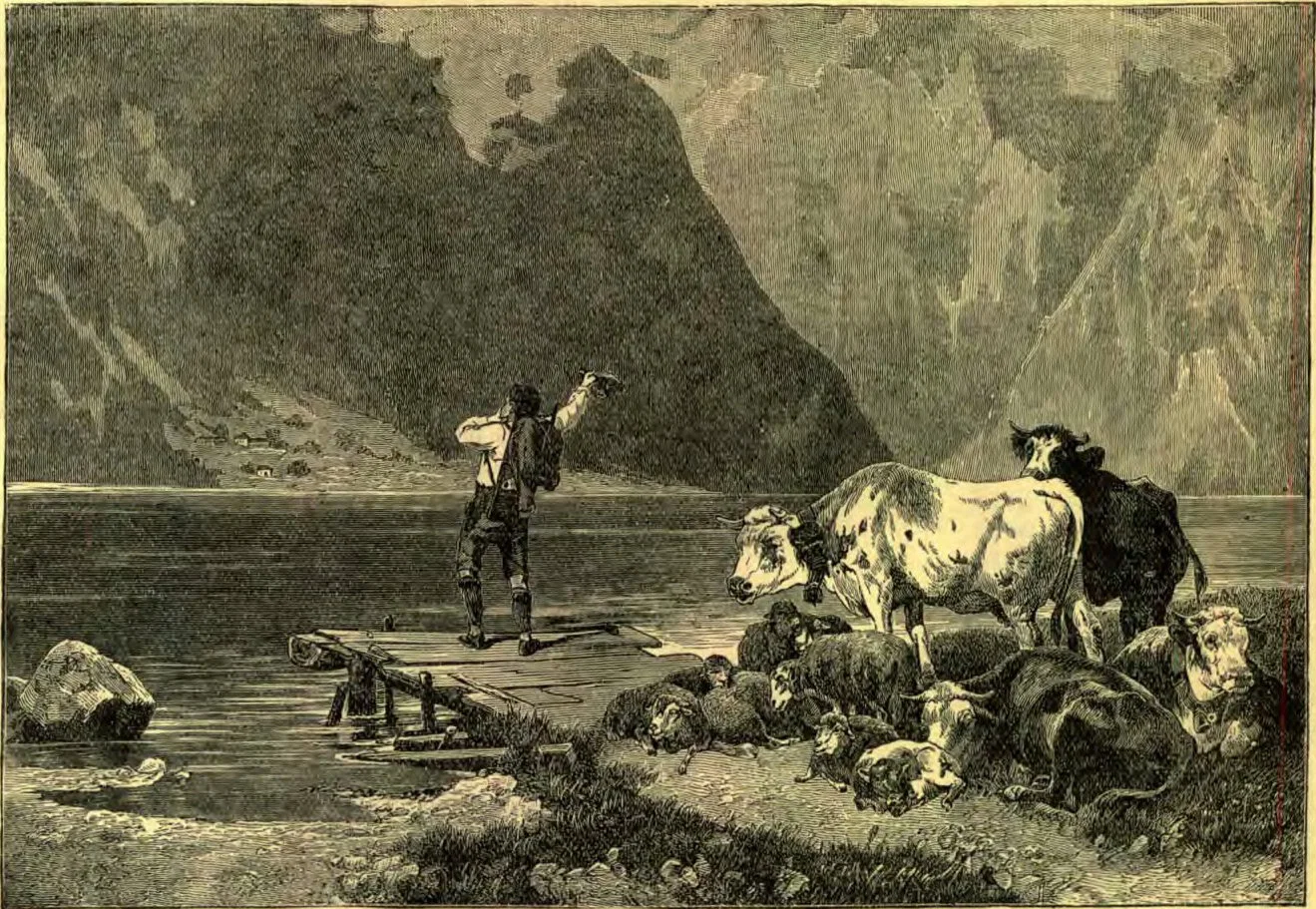
Perched far up on the mountain-sides are rude cottages, or chalets, as they are called. To these the herdsman comes in the spring of the year from the valley below. All through the summer months he makes this his home, caring for his cattle while they find pasturage on the heights above him. They are oftentimes his only companions, and grow to know him as a friend. They learn to recognize the sound of his voice among all others, and love the very songs that he sings; and when the evening shadows fall over the mountain-tops, they obediently return to the chalet at his call, and are safely sheltered for the night. Perhaps the herdsman in the picture is calling his cattle home, or he may be signaling for one of the rude ferry-boats that ply between the shores of the lake, to come and bear him and his charge over its bosom, to one of the homes on the opposite slope.
The chalets are not as comfortable as might be supposed; for through the rude log walls the keen wind blows, and the rain drives. These cottages contain little besides the utensils used by the herdsman in his work. Many of them are built simply to contain hay, which is so much valued that the poor people climb up dangerous rocks and paths, that even goats do not travel, in search of grass. The herdsman has to work very hard, having oftentimes nearly a hundred cows to milk and the cheese to make.
In some parts of the country, chamois hunting is followed for a living by father and sons for generations; and the hunter often incurs great danger in scaling the rocks over yawning chasms and dark ravines, where a single misstep would dash him to pieces on the rocks hundreds of feet below.
Lower down than the hunting grounds and the pasture lands lie the vineyards. This land is so dear that, we are told, “five hundred pounds an acre is given for the best vineyard land, which yet, when bought, needs constant labor at all times when it is not covered with snow.” Many laborers, too, are needed, and they work for small wages; while, in order to make the property pay, every bit of the vine is used, the stalks and leaves serving as food for the cattle, and the husks, after being pressed and wedged into molds, and dried, are used for fuel, burning something as peat does. A busy, stirring scene is presented, when, in the springtime, the peasants go to their labor in the vineyards.
They are a hard-working yet happy class of people, passionately fond of music and dancing. They are independent, resolute, and constant, being influenced perhaps by the grand display of the Creator’s handiwork which every day greets them. No wonder is it, then, that amid such a class of people as the Swiss and their neighbors, the Germans, the Reformation should have taken such a strong hold and made its influence so far felt.
W. E. L.

Judging Others by the Visible Life

We may not know each the other's life, nor the world in which he is living. If we ourselves are misjudged by others, who judge us by the visible life, and not by the real life which is unseen, we may find argument for patience and cheerfulness under wrongful condemnation, in the knowledge that One sees and knows, who sees within us the pulsating of a life which others do not see.

THE WHITE BUTTERFLY.

AN ALLEGORY.

VERY slowly and wearily, over road and hedge, flew a white butterfly one calm summer evening; its wings had been torn and battered in its flight, and it was sick nigh unto death. On, on went the fugitive, until it came to a little garden so sweet and quiet that it rested from its flight, and said, “Here, at least, I shall find peace; these lovely flowers will give me shelter.” Then, with eager swiftness, it flew to a stately lily; “Oh! give me shelter, beautiful flower,” it murmured, as it rested for a second upon its snowy petals—a second only, for with a jerk and exclamation of disgust, the lily cast the butterfly to the ground. With a low sigh it turned to the pansy near. The pansy wished to be kind, but the butterfly was really very tattered and dirty, and then velvet soils so easily that she must beg to be excused; and besides she was small, and the lily was stately, how could the lily do aught but right? The wall-flower, naturally frank and good-natured, had been so tormented all day by those troublesome bees, and then it was really the butterfly’s fault that she was in such a state, that she solemnly vowed she would do nothing more for anybody. The tulips were asleep, and the other flowers, trying to pattern after fair lady lily, held their heads so very high that they, of course, did not hear the low, soft cry, “Oh! will no one give me shelter?” “I will, gladly,” at last answered, in a shy but earnest voice, a thick, thorny bush that grew by the road-side, and helped to protect the more dainty beauties from the rough blasts of a sometimes too boisterous wind, and for this service the flowers looked upon the briar as a good, useful thing, respectable enough in its way, but not an equal.
With gratitude the forlorn butterfly rested all night in the bosom of one of the briar’s simple white blossoms. When night had gone, and the bright sun came gliding up from the east, calling on nature to awake, the flowers raised their heads in all the pride of renewed beauty, and saluted one another. Where was the butterfly? Ah! where? They saw it no more; but over the white blossom where it had rested, there hovered a tiny fairy in shining, changing sheen, her wand sparkling with dewdrops. She looked down on the flowers with gentle, reproachful eyes, while they bent in wonder and admiration.
“Who is it?” they asked. “How beautiful! how lovely!”
The fairy heard them with a smile, and said, “Fair flowers, I was a forsaken butterfly; what I am you see. I came to you poor, weary, and heart-broken; and because I was poor and weary, you shut me out from your hearts.”
The pansy and the wall-flower bent their heads, and the rose blushed with shame.
“If I had only known,” murmured the lily, “but who would have thought it?”
“Who, indeed?” laughed the fairy. “But learn, proud lily, that he who thinks always of self loses much of life’s sweetness—far more than he ever suspects; for goodness is as the dew of the heart, and yieldeth refreshment and happiness, even if it win no other recompense. But it is meet that it should be rewarded. Behold, all of you!” and the fairy touched with her wand the white blossom on which she had rested, saying, “For thy sweetness be thou loved forever!” At these words a thrill of happiness stirred the sap of the rough, uncultured briar, and a soft, lovely blush suffused the petals of its flowers, and from its green leaves came forth an exquisite odor, perfuming the whole garden, and eclipsing the other flowers in their pride.—Christian at Work.

RAISING SILK-WORMS.

DURING the past few years there have been several articles in the INSTRUCTOR in regard to silk-worms, which have told some things about their appearance, habits, and the use to which they were put. But perhaps it never occurred to any of our boys and girls that they could raise silk-worms. At any rate, you may be interested in hearing of the experience of a young girl who has tried it successfully for several years.
When only thirteen years old, Nellie Rossiter, a little girl living in or near Philadelphia, thought she would like to try raising silk-worms. The first year she raised only three hundred, but so good was her success that before she was fourteen, she received a diploma from the Pennsylvania State Agricultural Society for “excellent quality of cocoons and silk.” She has continued in the business, raising each year from one hundred thousand to one hundred and fifty thousand worms, and selling the silk and eggs obtained from them. Though now but seventeen years old, Miss Rossiter is quite an experienced silk-grower, and has published several editions of a little pamphlet on silk-culture.
A few weeks ago we received from this young lady a little box containing a hank of silk wound from cocoons by her this summer. The silk is of a bright orange color. The box also contained five cocoons of different colors,—white, pale pink, straw color, orange, and pale green. The cocoons are about one inch long, and measure about an inch and a half around. We wish that every one of the INSTRUCTOR boys and girls might see them, as they are very pretty and interesting.
Miss Rossiter is very much interested in silk-raising herself, and thinks it may be successfully carried on, in a small way, at least, by any energetic boy or girl who is willing to give time to it. She offers to answer all questions, or give any information desired to those who are interested enough to write her, inclosing stamp for return. Perhaps but few who read this may care to go into silk raising as a business (though it is said to be very profitable), but doubtless many of you will like to raise a few worms for the amusement and interest of yourself and friends. Let any who want to know more about it, address Nellie Lincoln Rossiter, Sixty-first and Vine Streets, Philadelphia, Pa., and be sure not to forget to inclose a stamp, if you want a reply. E. B. G.

CAPTURE OF JERUSALEM BY THE CHALDEANS.

It was at midnight on the 9th day of July, 586 years before Christ, that the besieging army of the Chaldeans forced their way within the walls of Jerusalem. For eighteen months they had beleaguered the Holy City, casting up gigantic mounds and forts overtopping the walls. They had swept away all the pleasant country homes and rural retreats in the neighborhood of the city. A Babylonian chief had planted his throne in view of each of the city gates.
All the horrors usually attendant upon a siege were suffered by the population cooped within the walls. Famine was followed by pestilence. The once beautiful countenances of the nobles became ghastly with starvation. The richly-clad ladies of Jerusalem sat down in despair upon dunghills, or sought from these foul heaps the morsels by which they eked out their supply of food. Little children with parched tongues fainted in the streets with hunger, or even became food for their starving parents. The one road which still remained open toward Jericho was infested with wild Arab tribes, Edomites, who rejoiced to aid in rendering the downfall of the city and the nation complete.
Led by six princes of the king of Babylon, the Chaldean guards broke through the walls on the north, overpowered the night-watch, and, probably without occasioning any alarm, made their way to the middle gateway in front of the brazen altar of the temple. Here, doubtless, they encountered those who had fled to the temple as their last place of refuge, those who fondly hoped that the divine protection would make the holy house impregnable, and those whose office made it their duty to defend it with their lives. Indignant that the heathen should set foot within the sacred precincts, they threw themselves with a last mighty effort upon the invaders, and perished in the vain attempt.
The noise of this conflict doubtless was borne to the ears of the king in his palace, whether the invaders had not yet come. Gathering together his family and his body-guard while yet the summer morning had not dawned, Zedekiah stealthily glided among dark and crooked streets to a passageway or opening between two walls at the southeastern corner of the city, which were not guarded as were the gates. Down past the royal pleasure-gardens, sad reminders of joys now forever gone, the broken-hearted fugitives made their way. They descended the steep and rugged defiles through which the higher country breaks down into the deep chasm of the Jordan; they reached the plains of Jericho breathless and fatigued with their rapid flight over such a road. Could they have crossed the Jordan, they would, like David in his flight from Absalom, have felt themselves safe. But the Chaldean soldiers were upon their track. Jeremiah says they were swifter than the eagles of heaven. Overtaken by their pursuers in the plains of Jericho, the wornout and dispirited guards forsook their king and scattered in every direction. He and his family became an easy prey to the Chaldeans. In chains they were carried northward to Riblah, the headquarters of Nebuchadnezzar, the Chaldean king. The fate of Zedekiah exactly fulfilled two prophecies which, like some other Scripture passages, appear to a careless reader quite contradictory. Jeremiah carried a prophetic message from God to the king in these words: “Thine eyes shall behold the eyes of the king of Babylon, and he shall speak with thee mouth to mouth, and thou shalt go to Babylon.” Ezekiel, on the other hand, says: “I will bring him to Babylon, to the land of the Chaldeans; yet shall he not see it, though he shall die there.” At Riblah, Zedekiah beheld Nebuchadnezzar, the Babylonian king. He also was compelled to witness the slaughter of his sons and his courtiers who had attended him in his flight; and then, before he was carried to Babylon, his own eyes were put out. He spent his life there, and worked, like a slave, in a mill, but Babylon he never saw.
With the fall of Zedekiah ended forever the Jewish monarchy. Since the anointing of Saul it had lasted five hundred years. With the monarchy fell also the State. The history of the Jews as an independent nation was virtually finished. It had lasted from the crossing of the Red Sea, 1491 years before Christ, just nine centuries. Many, indeed, and fierce, were the struggles by which the Jews endeavored to regain their national existence, but brief successes were gained only to be followed by more complete overthrow.
They fell and perished as a nation; their monarchy was overthrown; their land became the possession of strangers; they were exiled and scattered over the known world, as a final and deserved retribution for obstinate rebellion, idolatry, and unfaithfulness. They became the most marked example among all nations of the fact that God governs the world, and that he will deal with nations according to their deserts. Having given express laws to the Jews, and having accompanied them with distinct promises and threatenings, it was needful that he should keep his word before all the world in their overthrow.—From Exile to Overthrow.

THE TWO MEN OF COLOGNE.

A LONG time ago, there lived, in Cologne, Otto von Hiller and Rupert van Tone, And Otto wrote fables, But Rupert made tables— “The very best tables that ever were known!” So said every sensible frau in Cologne.
“Friend Rupert,” said Otto von Hiller one day, “Come, tell me the wonderful reason, I pray, Why men call you clever, When really you never Professed to have very much learning, you know, And I—well, in truth, I’ve enough for a show.
“I’m master of Latin, I’m famous in Greek, Both French and Italian I fluently speak; I could talk by the year Of our nation’s career; Yet, some one has said—to his shame be it known— That I am the stupidest man in Cologne!”
Said Rupert van Tone: “If you’ll promise to try it, I’ll tell you a secret,—I’ve learned to keep quiet.” “But I’ve so much to say!”— “’Twont spoil in a day; Who lets his tongue run like a vibrating lever Stands very small chance of being called clever.”
But he’d “so much to say,” this Otto von Hiller:— ’Twas now to the judge, and now to the miller; He’d appear without warning, And stay all the morning, Till his hearers would sigh as he left, “What a drone! He is truly the stupidest man in Cologne.”
But Rupert van Tone worked on at his trade; He listened and thought, but his words he well weighed, Till at twoscore and twenty He’d money in plenty; And through summer and winter his mansion was As the home of the cleverest man in Cologne.
— Emma C. Dowd.

NEW-TESTAMENT HISTORY.

LESSON 161.—SPIRITUAL GIFTS AND THE RESURRECTION.

Paul speaks of the experiences of the children of Israel in the wilderness as examples of God’s dealing with men. They were written for our learning and admonition, that by heeding them we might avoid the fate of those who perished for disobedience. He seems to regard the passage through the Red Sea as a type of baptism, and intimates that the manna, and the water from the rock, were emblems of the bread and wine of the Lord’s Supper. In the depths of the sea, the people were buried from sight by the immense wall of waters on either hand, and by the dense cloud that overhung their pathway; and since the manna was angel’s food, it fitly represented the Bread of Heaven, while the water from the rock, like the blood of Christ, was a gift from God to save the perishing.
But although the Jews all enjoyed such wonderful tokens of the favor of God, many of them were afterward so headstrong and self-willed that he could not take them through to the Promised Land. They fell by the way, as will many in the present dispensation. Presuming upon the goodness of God, who had done such great things for them, they boldly disobeyed him, thus bringing upon themselves sudden destruction, as Paul shows by referring to instances in which thousands fell in a day. “Wherefore,” says the apostle, “let him that thinketh he standeth take heed lest he fall.” To encourage those who might be disheartened, he adds: “There hath no temptation taken you but such as is common to man; but God is faithful, who will not suffer you to be tempted above that ye are able; but will with the temptation also make a way to escape, that ye may be able to bear it.”
After thus warning his Corinthian brethren against giving way to their lusts, Paul admonishes them not to join in the profane feasts of their idolatrous neighbors, and reproves them for their careless manner of celebrating the Lord’s Supper. He tells them that the cup they bless is the communion of the blood of Christ, and the bread they break is the communion of the body of Christ. Such an occasion is no time for feasting, or even for satisfying hunger. Those who partake of this supper without recognizing its sacredness, bring a curse upon themselves rather than a blessing.
In speaking of Spiritual gifts, the apostle says that they are all bestowed through the agency of the same Spirit, the special gifts being but different manifestations of the one Spirit. This he illustrates by the human body, all the members being essential to the whole, and each alike important in its appropriate office.
Paul then admonishes them to seek earnestly the best gifts; but recommends charity, or the love of God in the heart, as more to be desired than all things else. The choicest gifts unsanctified by this love are of no avail. The love of God will fill the soul, and give it unutterable joy, when the gifts of prophecy, of healing, and of tongues, are no longer needed. As the sun causes the stars to disappear in the sky, so will the perfect light and knowledge of the world to come, eclipse the brightest gifts now bestowed upon men.
With all the tender solicitude of a father, Paul urges the church at Corinth to exercise toward one another that Christian charity which he has so highly recommended. They are to be orderly and quiet in all their assemblies; to consider carefully what effect their words and actions may have upon others; to avoid making any display of the gifts they may possess; and always to speak in such a way as to strengthen and comfort their brethren, rather than to discourage even the weakest. He says, “Let no man seek his own, but every man another’s wealth, . . . . even as I please all men in all things, not seeking mine own profit, but the profit of many, that they may be saved.”
It seems that some had denied the resurrection of the dead, but Paul tells them that if the dead are not to be raised, then Christ has not risen; and if Christ is not risen, both his preaching and their faith are vain, and all who have preached the resurrection of Christ are false witnesses. He declares that Christ has risen from the dead; and that as in Adam all die, even so in Christ shall all be made alive.
In answer to the questions, “How are the dead raised up? and with what body do they come?” Paul says: “It is sown in corruption; it is raised in incorruption: it is sown in dishonor; it is raised in glory: it is sown in weakness; it is raised in power: it is sown a natural body; it is raised a spiritual body.” And again: “Behold, I show you a mystery: We shall not all sleep, but we shall all be changed in a moment, in the twinkling of an eye, at the last trump; for the trumpet shall sound, and the dead shall be raised incorruptible, and we shall be changed.”
“Therefore, my beloved brethren, be ye steadfast, unmoveable, always abounding in the work of the Lord.”

QUESTIONS.

1. How does Paul present to the Corinthians the experiences of the Israelites in the wilderness? 1 Cor. 10: 6.
2. For what purpose does he say these experiences were recorded? Verse 11.
3. What does he regard as a type of baptism?
4. In what particulars does the passage through the Red Sea resemble baptism?
5. What does he seem to regard as emblems of the bread and wine of the Lord’s Supper?
6. What appropriateness may be discovered in this figure?
7. Notwithstanding the ancient Israelites enjoyed so many tokens of God’s favor, what was the sad fate of many of them?
8. Why could not the Lord take them through to the Promised Land?
9. How did they bring sudden destruction upon themselves?
10. What instances does Paul enumerate? 1 Cor. 10: 6–10; Num. 11: 4, 33, 34; Psalms 106; Ex. 32; Num. 25; Num. 21: 4–6; Num. 14.
11. How does Paul conclude his warning? 1 Cor. 10: 12.
12. What does he then add for the encouragement of those who might be disheartened? 1. Cor. 10: 13.
13. What caution does he give them in reference to feasts?
14. For what does he reprove them?
15. What does he say about the cup they bless, and the bread they break?
16. How does he caution them against making the Lord’s Supper like the feasts of the heathen worshipers in Corinth?
17. What does he say of those who do not recognize the sacredness of this solemn ordinance?
18. What does he say of the origin of Spiritual gifts? Chapter 12.
19. By what figure does he illustrate the unity and harmony of these gifts?
20. What does he admonish them to earnestly seek?
21. What does he recommend as more to be desired than all things else?
22. What will the choicest gifts avail, unsanctified by this love? Chapter 13.
23. What does he say of the enduring nature of charity?
24. What does Paul, with the most tender solicitude, urge the church at Corinth to do?
25. What specifications does he make?
26. What general principle does he lay down? 1 Cor. 10: 24.
27. What does he say of his own course? Verse 33.
28. How does Paul argue for the resurrection of the dead? Chapter 15.
29. What does he say in answer to the questions, “How are the dead raised up? and with what body do they come?” Verses 42–44.
30. Repeat verses 51 and 52.
31. With what admonition does he close his remarks on this subject? Verse 58.

PARENTAL AFFECTION.

A PAIR of sparrows, which had built in the thatched roof of a house, were observed to continue their regular visits to the nest long after the time when the young birds ought naturally to have taken flight. This unusual circumstance continued throughout the year; until in the winter a gentleman, who all along had observed them, determined on finding out the cause. He therefore placed a ladder, and, on mounting it, found one of the young ones detained a prisoner by means of a string or scrap of worsted, which formed part of the nest, and had become accidentally twisted round its leg. Being thus disabled from procuring its own living, it had been fed by the continued exertions of the parents.

MANNERS BETWEEN BOYS.

There is a good deal of rudeness between boys in their intercourse and bearing with one another, that is not really intended as such, but is not therefore any the less to be disapproved. It is often simply the overflow of jolly good humor. But the overflow of the very best good humor, unrestrained by proper bounds and limitations, may become the most positive incivility. We often apologize for the coarseness of people by saying, “He means well.” It is well we can make such an apology for them; for, if their rudeness is really intentional, they are not fit to be received into any good person’s society. But they who mean well should also do well, and the ways of politeness are never so easily learned as in youth. The boy who is habitually coarse and rude in his bearing toward other boys will be such as a man toward men, and all his life will never gain the reputation of being a gentleman.—Children’s Friend.

God Values Faithful Labor Over Natural Gifts

God does not look so much to what we are as to what we do, while we are what we are; nor will he be so likely to praise us for being what he has made us, as for doing manfully and laboriously what others, better fitted for that service perhaps than we, have failed to do.

SOME YOUNG HEROES.

In a certain school a knot of boys had their heads together, disputing about something. You could never guess what if you tried. All would have seemed strange to you,—the school-room, the teacher, and the scholars, their odd dress and odder speech. It was in far-off Asia, and the scholars were not as orderly as ours. The boys talked when they pleased, and made so much din that one could scarcely hear himself think.
Missionaries had come to this city, and opened schools and churches to teach the people that they must worship God alone, and that Jesus died to save them. When the natives found that their boys were beginning to stray into Protestant schools, they said, “We must start schools of our own;” and so they started one, but it was too late. Some of the boys had already learned to love Jesus, sing sweet hymns, and read the Bible.
The teacher in this school was a very bitter enemy of the new religion, so he listened sharply that day when he heard a discussion going on among the boys. It was not in our language, but it was something like this:—
One boy said it was not right to worship pictures of saints, nor to kiss them, and burn candles before them. Another one said, “It is right; it’s the only true religion.”
Others joined in with the first boy, and said it was wrong, and that we must worship none but God. Then the dispute grew warmer, and there were cries of “Heretic! heretic! mean old heretic! mean old Protestant!” and so on.
The teacher had made up his mind that this thing must be stopped; that the boys must not go any more where they would hear such bad doctrine, so he said in a loud, strong voice,—
“Boys, stand up!” They all stood up.
“Now let all the Protestants step out.”
He did not suppose that any one would dare to confess to him that he was a Protestant, but those little Christians must have remembered the solemn words of the Saviour, when he said: “If any man will confess me on the earth, I also will confess him before my Father which is in heaven.”
There was a moment’s pause, then seven little fellows stepped out. The teacher was amazed.
“What!” he said, “don’t you believe in worshiping the pictures of saints?”
“No, sir, we don’t; and please, sir,” said the bravest of them all, “if Jesus wanted us to worship pictures of the saints, wouldn’t he have left us his own picture to worship?”
This was too hard for the tyrant teacher, but he did not let them know how they had cornered him. He said, “Boys, how shall these heretics be punished?” and the boys decided they must be “spit upon.”
So the whole school formed a line and marched around those seven, spitting upon them as they went.
“Now sing!” the teacher said, and all the school except the seven struck up one of their patriotic songs.
“Sing, I tell you!” he said to the seven.
“We will, if you will sing the songs of Jesus,” was the grand answer of the martyrs.
“Sing it yourselves!” said the teacher; and, wonderful to tell, this sweet song came to the ears of the astonished teacher:
“Must Jesus bear the cross alone, And all the world go free? No, there’s a cross for every one, And there’s a cross for me.” —The Pansy.

Insect's Wings.

There is nothing more delicate than the wings of insects. They are like gauze, but they have a framework that makes them quite firm, just as the leaves on the trees are firm from the little ribs that are in them.
These wings are all covered with hair. You could see it under the magnifying-glass, but not without.
In some small gnats the hairs spring from each side of the veins, like butterflies' feathers, or like blossoms on the twigs in springtime.
Even the wing of a common fly is very beautiful. Did you ever notice that if you take a butterfly by the wings, a colored dust is all over your fingers? Then the wings are left transparent where they have been touched. If you should put some of this dust on a slip of glass and examine it, you would find that each particle is a little scale of regular form, and sometimes most beautifully shaped. But the insect flies just as well without the dust.
Besides his regular wings, the fly has others for sails. They are all lifted by a great number of little tough muscles in his sides. Thus he moves in the air and darts away. Before he goes, he “plumes” his wings just like a bird.—Our Little Ones.

SOLDIER AND THISTLE.

Minnie, in her eagerness after flowers, had wounded her hand on a sharp, prickly thistle. This made her cry with pain at first and pout with vexation afterward.
“I do wish there was no such a thing as a thistle in the world,” she said pettishly.
“And yet the Scottish nation think so much of it they engrave it on the national arms,” said her mother.
“It is the last flower that I should pick out,” said Minnie. “I am sure they might have found a great many nicer ones, even among the weeds.”
“But the thistle did them such good service once,” said her mother, “they learned to esteem it very highly. One time the Danes invaded Scotland, and they prepared to make a night attack on a sleeping garrison. So they crept along barefooted as still as possible, until they were almost on the spot. Just at that moment a barefooted soldier stepped on a great thistle, and the hurt made him utter a sharp, shrill cry of pain. The sound awoke the sleepers, and each man sprang to his arms. They fought with great bravery, and the invaders were driven back with much loss. So, you see, the thistle saved Scotland, and ever since it has been placed on their seal as their national flower.”
“Well, I never thought that so small a thing could save a nation,” said Minnie thoughtfully.—The Young Churchman.

“ASHAMED TO TELL MOTHER.”

Such was a little boy’s reply to his comrades, who were trying to tempt him to do wrong.
“But you need not tell her; no one will know anything about it.”
“I would know all about it myself, and I’d feel very mean if I could not tell mother.”
“It’s a pity you are not a girl. The idea of a boy’s running and telling his mother every little thing!”
“You may laugh if you want to,” said the noble boy, “but I’ve made up my mind as long as I live not to do anything I would be ashamed to tell mother.”
Noble resolve! and one which will make any life true and useful. Let it be the rule of every boy and girl to do nothing of which they would be ashamed to tell their mother.

Lost Time Cannot Be Recovered

Lost wealth may be replaced by industry; lost knowledge, by study; lost health, by temperance or medicine; but lost time is gone forever.

IN THE ORCHARD.

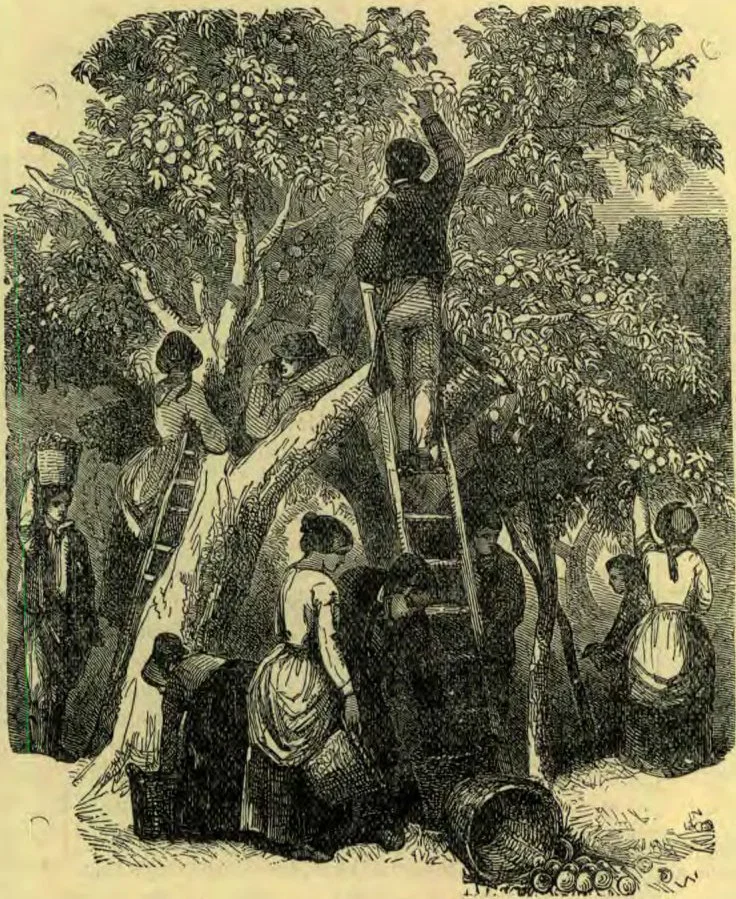
Apples red and apples green, Apples rich and ripe are seen In the orchard near the road,— Apples, apples, by the load!
In the spring the trees were white, Apple-blossoms, such a sight! Little apples filled the trees, Fanned all summer by the breeze.
Little apples grew and grew, Living on the rain and dew; Now the fruit in great rich stores Harvest in the orchard pours.
Glad the farmer’s swelling heart! Glad the little children start For the orchard, where they play “Picking apples” all the day. — Uncle Forrester.

You have reached the end of this edition.

The Youth’s Instructor · Nov 14, 1883