The Youth’s Instructor, Vol. 35, No. 44.

THE SONG OF THE BREEZE

The Youth’s Instructor

Nov 2, 1887

S. D. A. Publishing Association · Battle Creek, Mich. · Nov 2, 1887

THE SONG OF THE BREEZE.
Aunt Jemima’s flower-bed certainly did need weeding. Tommy had promised to keep it in order, and it looked very well the first part of the summer, but later on there were so many things more delightful to do than weeding. There was fishing, and Tommy had such a beautiful new rod, and such good luck fishing! Then there were picnics, and excursions down the river to the seashore, and the blackberry parties, and base-ball matches, and tennis, and archery, and foot-ball. The summer days went by so fast! At first the weeds were a little timid about starting up, fearful of attracting attention; but as no one noticed their shy advances, they became bolder, and they grew, and grew, until the little discouraged geraniums and rose-bushes hid their heads, and could not be seen at all.
“Why, I do declare!” said Tommy, one bright morning as he was hurrying by, and caught sight of the tall, flaunting weeds. Aunt Jemima had just made some particularly nice apple turn-overs, and Tommy’s conscience gave a decided twinge at the thought of her unfailing kindness to him. “It is too bad,” said he, pulling off his jacket; “I’ll go to work right off, and clear out that bed before noon?”
But the sun was very hot, and the weeds were very large, and their roots were very long, and it took many a strong tug to pull even one up.
“My!” exclaimed Tommy, the perspiration rolling down his face, “what tough old customers these are! How did they ever get such a start?”
At length the shade of a neighboring apple-tree seemed very inviting, and Tommy threw himself down on the grass beneath the branches for a moment’s rest. A breeze happened to be wandering by, and stopped to cool off Tommy’s hot face. “How nice!” he sighed. “I wish I were a breeze, just to fly about all the time, and play among the leaves and grasses, and have nothing else to do!”
“Dear little boy!” the breeze seemed to murmur, “now listen and hear. I’ll whisper a secret just into your ear. You think ’t would be lovely to dance and play, and frolic about the whole long day, but it would be tiresome soon to you, with nothing else in the world to do.”
“Ha! ha! ha!” laughed Tommy, “I’d like to try it just once; no dull school-room, no sums, no weeding in the hot sun.”
Here the breeze playfully tickled his ear with a spear of grass, as it whispered: “It is certainly hard, all the weeding you’ve done beneath the hot beams of the summer sun! Let me see how long—one hour or two—you have been working here, and are not yet through! Don’t you think you’d better return to your charge?—for the weeds are strong, and the bed is large. For when at length the task is done, the rest of vacation is nothing but fun!”
“No,” said Tommy, “I’m not going back quite yet; you don’t know how hard it is.”
“But, dear little boy, I’d have you know, this is true of all the breezes that blow:—through all the moments of bright daylight, and on through the silent hours of night, we are busy and working, each doing his share, no rest or vacation for us anywhere.”
“Why! what on earth have you got to do?” asked Tommy. “You’re joking! there’s nothing for you to do!”
The breeze began softly rocking the branches of the old apple-tree, and seemed to sing among the rustling leaves. “Nothing to do, nothing to do! Indeed, my work is never through. From ‘lands of sun to lands of snow,’ over the whole wide world I go. I marshal the clouds that bring the showers, and hurry them on to the thirsty flowers, and when they have given the blessed rain, then I must scatter them all again, and show the depths of the sky so blue, with the beautiful sunlight shining through. Lazily rocking upon the sea, the ships are waiting and watching for me. The sailor sighs for the favoring gales, when lo! I come and fill the sails, and off and away they swiftly glide, dashing the water on either side, bearing rich cargo from far and near, or carrying home some loved one dear. Then on I fly to that distant land where, gaunt and grim, great windmills stand. They beckon to me to hurry and blow, helpless they are without me they know. Then off to the city’s narrow street I travel to drive away the heat, and bring new life and fresher air to those who are toiling and stifling there,—a breath from the country, of pastures that lie sweet and green ’neath the summer sky, or a cooling whiff from the neighboring sea, that quickens the pulses to life more free.”
“Then over the hills I hurry with speed to plants where I promised to carry their seed to a different soil or a richer field that shall an abundant harvest yield. By a window an invalid sits in her chair, and I come to bring her a breath of air, and blow softly in that she may get the scent of the blossoming mignonette. Then on to the north with fiercer blast, I whirl the snowflakes thick and fast, and over the plants, in their winter’s sleep, I lay a white cover soft and deep, and tuck them in singly, to keep them warm, away from the Frost King’s mighty arm. Down chimneys wide I whistle and sing, and up start the bright flames quivering on the farm-house hearth from birchlogs dry, and the children laugh at the sparks that fly. I watch their faces redden and glow, as the fire to brighter flames I blow; then around the house I shout and roar, and rattle the windows and shake the door. The farmer’s wife stops her work to hear, and smiles at thought of the comfort near, and her loved ones sheltered from stormy blast, and I laugh and shout as I hurry past. I lash the waves into seething foam, and hurry the lingering fisherman home. Now I am stopping and idling here just to whisper a secret into your ear. From early morn to set of sun, there’s always work that must be done; and, little boy, you should do your share in this world of nature so wide and fair, and learn a lesson from birds and bees, from running brooks and murmuring breeze. The rest is sweetest that toil has won, and the happiest play when the task is done.”
At that moment a little green apple dropped down onto Tommy’s face. He jumped up and rubbed his eyes. The wind was blowing, and a cloud had covered the sun. “Well!” said Tommy, looking all around, “it certainly is queer; how very queer it all was!” He went thoughtfully back to the garden-bed and the tall weeds, and worked with such good will that by afternoon they were all cleared out, and the bed was raked carefully over, and the rose-bushes really looked as if they could hold up their heads.
Tommy had a beautiful time fishing next day in the reservoir, and caught a bass and six perch, while the words kept ringing in his ears,—
“Rest is sweetest that toil has won, “And the happiest play when the task is done.”
—Anna L. Hyde, in S. S. Times.

A Child's Heart and the Heart of God

Every true desire from a child's heart finds some true answer in the heart of God.

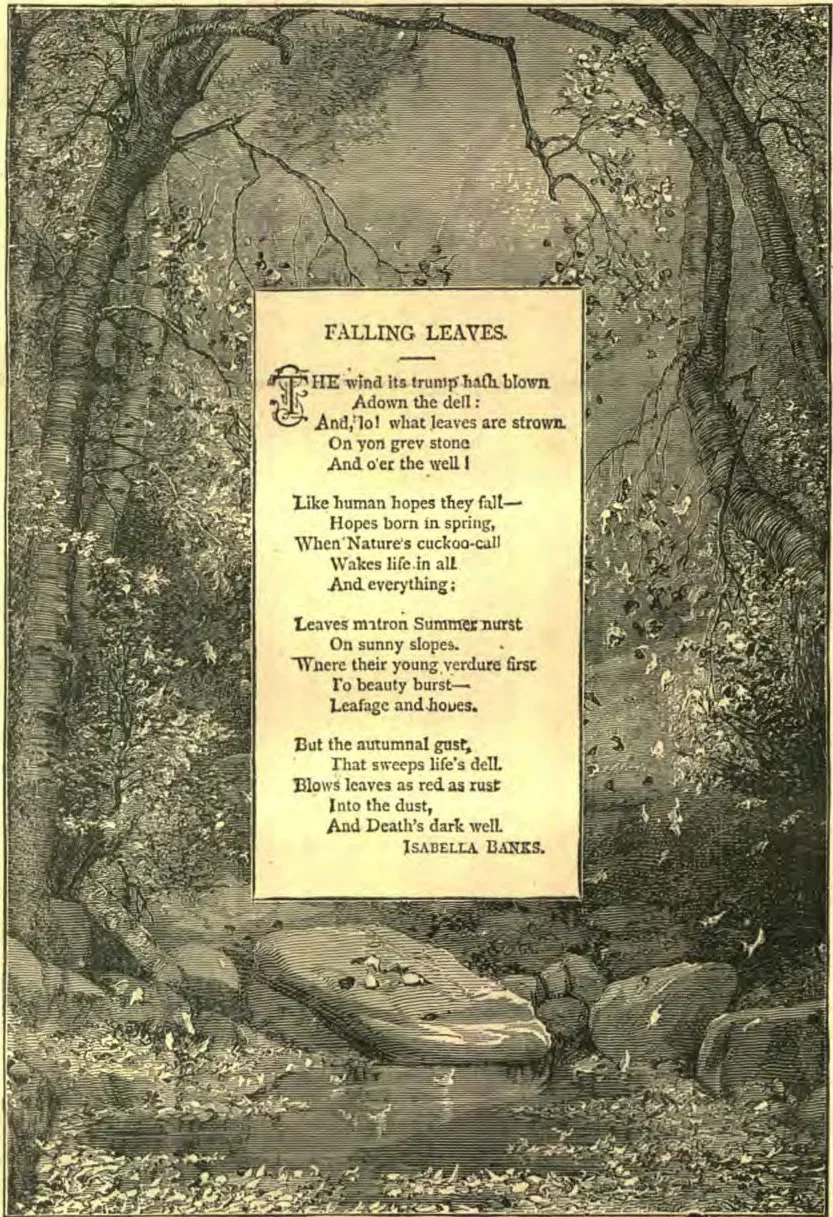
Falling Leaves.

The wind its trump hath blown Adown the dell: And, lo! what leaves are strewn On yon grey stone And o'er the well!
Like human hopes they fall— Hopes born in spring, When Nature's cuckoo-call Wakes life in all, And everything:
Leaves that Summer nurst On sunny slopes, Where their young verdure first To beauty burst— Leafage and hopes.
But the autumnal gust, That sweeps life's dell, Blows leaves as red as rust Into the dust, And Death's dark well.
ISABELLA BANKS.

The Gothenburg System for Regulating Liquor Sales

THE GOTHENBURG SYSTEM, which takes its name from the place where it originated, is a good one. It has been adopted in Sweden and Norway, and no intoxicant can be sold except at a place where good food and non-alcoholic drinks are also kept constantly on hand. The dealer is allowed to make a profit on these, but he is stringently prohibited from selling any liquor except at cost. The idea is that dealers will thus endeavor to promote the sale of edibles and non-intoxicating drinks, upon which he does make a profit, and discourage buyers from drinking liquors upon which he makes none. It is said to work like a charm. It would be well to adopt the Gothenburg system all over the land.—Poly Larkin, in Pet. Courier.

A PEEP AT AFRICA.—NO 6.

The weather was exceedingly cold during July and August in the winter of 1652. “Table Mountain was white with snow, and so much rain fell that the land resembled a sea. There was much sickness, and several deaths among the garrison. But all the privations and discomforts of these months were forgotten with the advent of the Cape spring, in September, when the verdure of the hills and the valleys afforded pleasure to the eye; and the commander had the satisfaction of enjoying some of the products of his own garden.” For several years these colonists lived peaceably with the natives, trading various articles with them for their sheep and cattle. Finally Van Riebeeck suggested to the authorities in Holland the idea of extending the settlement and of allowing those who would do so to become “boers,” that is, farmers. When the natives saw these farmers plough their land from which they had been in the habit of digging roots for their winter food, and upon which their cattle had grazed for centuries, they became alarmed. It seemed to these Hottentots as though the white men would take possession of their country; so they concluded to “dishearten the colonists by taking away their cattle; and if that did not produce the effect, then to burn their houses and corn till they were forced to go away.” Thus began the first colonial war, which lasted for many months. Finally on the 6th of April, 1660, a treaty of peace was formed.
Van Riebeeck’s Journal relating to this treaty, speaks as follows: “This day peace was renewed at the fort with the Captain and chief of the Capemans, Herry and all the principal and oldest of the tribe. . . . They dwelt long upon our taking every day for our own use more of the land, which had belonged to them from all ages, and on which they were accustomed to pasture their cattle, etc. They also asked, whether, if they were to come into Holland, they would be permitted to act in a similar manner, saying, What would it signify if you remained here at the Fort; but you come quite into the interior, selecting the best for yourselves, and never once ask us whether we like it, or whether it will put us to any inconvenience.” They therefore insisted very strenuously that they should be again allowed free access to the pasture. It was at first objected that there was not grass enough for their cattle and for ours also. They said in reply, “Have we then no cause to prevent you from procuring any cattle? For if you get many cattle, you come and occupy our pasture with them, and then say the land is not wide enough for us both. Who then can be required, with the greatest degree of justice, to give way,—the natural owners, or the foreign invaders?” The Colonists at last told them that they had now been deprived of their lands, and that henceforth they must abandon them.
In 1679, Van Riebeeck was succeeded in the Governorship by Simon Van der Stell, who established a Government farm and planned the beautiful village of Stellenbosch on the Eerste River, about thirty miles from Cape Town. The number of colonists were constantly increased from the Germans, Danes, Dutch, and Flemings, who, year after year, would take their discharge from the military service to try their fortune as colonial farmers, so that in 1680 the European population amounted to six hundred.
About this time the Protestant refugees, driven from France on the Revocation of the Edict of Nantes, were kindly received and protected by Holland. To these exiles for conscience’ sake, the East India Company offered a home in their African possessions. This they joyfully accepted, and about three hundred men, women, and children went thither, arriving in the colony in 1688 and 1689. Van der Stell was informed by the Chambers of Amsterdam that among others there were some French and Piedmontese refugees willing to emigrate to the Cape. Speaking of this class, the dispatch says, “They are persons who understand the culture of the vine, who will in time be able to benefit the Company and themselves. We consider that as these people know how to manage with very little, they will without difficulty be able to accommodate themselves to their work at the Cape, also especially as they feel themselves safe under a mild Government and freed from the persecution which they suffered. It will be your duty, as they are destitute of everything, on their arrival to furnish them with what they may require for their subsistence, until they are settled and can earn their own livelihood.”
For a few years these refugees held religious service in the French language; but when they made an application to form a congregation of their own, and elect the necessary church officers, Van der Stell sternly refused their request. They tried to preserve their language, and teach it to their children; but in this they were discouraged. The Company by its order directed that “French should, in time, entirely die out, and nothing but Dutch should be taught to the young to read and write. . . . In 1709 the use of the French in addressing the Government upon official matters was publicly prohibited; and in 1724, the reading of the lessons at the church service in the French language took place for the last time.” The public records of the Colony contain a register of nearly all the names of these refugees, and many of their descendants are now scattered all over South Africa, among whom are men and women of sterling integrity, who have been successful in acquiring a competency with which they are now giving to their children the advantages of an education, which was denied them.
D. A. ROBINSON.

MARGARET PLACE.

In the city of New Orleans, at the corner of Camp and Prytania streets, is a beautiful little park called “Margaret Place.” It is laid out in the form of a triangle, and is covered with small shade trees. It has a fine fountain containing gold fish, and has nice, hard, smooth walks. Men are employed by the city to keep the place neat and clean. The grass is mown with a lawn mower, and everything looks as fresh and green as springtime, nearly the whole year round.
We want to tell the INSTRUCTOR family, and especially the Margaret's of the family, how this valuable piece of ground, right in the heart of a great city of nearly three hundred thousand people, received such a name.
Quite a number of years ago, there was a kind-hearted girl named Margaret, who was employed as a servant in the family of a dairyman. The man owned a good many cows; and as Margaret was a stout, healthy girl, it became part of her work to help milk, every night and morning. Her wages were small, yet she managed to save quite a good part of them. She did not, like most girls, spend her money for fine clothes, useless toys, or candy. She dressed very plain, indeed. She was seldom seen save in a calico dress and sun-bonnet, and she wore very common shoes.
She had a generous, kind heart, and instead of spending her money foolishly, she gave a little now and then to help some poor orphan girl. She soon had money enough to start a small bakery. Her patronage was so extensive, and her business increased so rapidly, that it became necessary to have a larger building and greater facilities. This was soon erected. Her bakery then ranked among the largest and most prosperous in the city. All the while she was engaged in her bakery business she did not forget the little orphan girls. Many and many a basket full of bread, cake, and pie, went from her shop to the hungry orphans.
In a few years she was so prospered in her business that she was able to put up a large building to be used for the object of her affections. So, now, right in the rear of this park, stands the large three story brick building, known as the “New Orleans Female Orphan Asylum.” She built it all with her own money. Tonight, as I rode by on the street car, I heard the voices of scores of little children seemingly perfectly happy in their orphan home.
Margaret is now dead, and in the center of this fine triangular park is a small monument, that stands on a circular mound, erected to her memory. Her statue has been carved out and placed upon its top. She is represented as sitting in a chair with her arm gently thrown around a little destitute orphan girl. At the end of the park a sign is painted on a board, Margaret Place.
The people of the city have been to the expense of fitting up this little park, and erecting this monument to her memory, because she was so good to the poor.
Dear readers, remember that the best way to make a real success in life is to begin in youth. Be economical with your little means. Instead of spending your money for nuts and candy, save it up to help some poor child who is suffering for something to eat, or for clothing to wear. Perhaps you cannot be as successful as Margaret was, but you can do some good. May be you can save up enough to buy some poor orphan boy or girl a pair of shoes, and by so doing encourage them to come to your Sabbath-school, and there learn of Jesus and his love. Then when they have found the Saviour, they would have a good, true friend to depend on all through life. You know the Bible says, “He that hath pity upon the poor lendeth unto the Lord; and that which he hath given will he pay him again.” Prov. 19: 17. You may not get your pay in this life, but when he comes to gather his sheep and lambs, he will pay you back many times the amount you lend him, and give you a life without end in which to enjoy it. E. HILLIARD.

BLESSING

IT is the Word of God divine, That fills the soul which ponders The holy lore, by page and line, Delighting in its wonders: No volume owns so precious store To yield the reader more and more. Whatever in this Book we learn, Should be to heavenly guiding: No faithful heart from it will turn, But spread the gracious tidings. Beside all waters they who sow The blessing of their God shall know.
—Hazel Wylde, in the Home Guardian.

AUTUMN COLORS.

The russet has more variety than any other single color of our autumn. Russet of maple is one thing, of oak another, of elm still another. Russet of cherry is one shade, and different from russet of apple. Russet of linden is rarely unmixed; it is mottled. Russets of pines vary among themselves—the tamarix, the pine, the hemlock. Then there comes a day when all the landscape is russet-clothed, but in infinite relief of shades. There is the brown of corn in the stack, the brown of buckwheat, the brown of decaying stubble, the brown of fresh-turned autumnal plowing, and changing under the passing harrow as plush changes under a pass of the hand, till the field is regularly and prettily belted. There is one shade of brown on the forest to the east, another under the western sky. There is a brown in the near view which is entirely different from the brown in the distant.
The autumn has this peculiarity; it is the day of older trees. Saplings are for once left fairly behind in the race of beauty, by the gnarled old fellows which were saplings when this republic was born, if not before that. Now an old tree can do one thing that a young one never can. It can change to that unspeakable yellow which is like nothing else in all pigments. An aged maple will gather up during the summer the yellow of the morning and evening twilights, will store itself with what is vaguely called the “golden” ray, and then suddenly burst forth in late October with all these twilights on its head. Standing underneath the boughs on a cloudy day, even, and with the incipient chill as of November in the air, you yet look up and have the sense of August warmth.
Old trees are capable of maroon, and that, too, which is very pertinacious. Younger growths may assume this warm color for a day or two, but they seem incapable of holding it, and soon lapse into rust and blotch.
The mixed brown and red which we name maroon, is wonderfully striking on a hillside in the brilliant light of noon during early November. As the sun declines, you lose the proper angle for the delicate sheen.
On taking an individual oak-leaf in my hand, its red-brown polish was so pronounced that I have been unable to explain why the whole forest did not fairly flash. Doubtless the infinite variation of visual angles prevents, whereas grasses and grain, each spear bending the same arc to you as they bow before the wind, will flash almost prismatic at times.
I know of no color on the American forest, except maroon, that glistens. The green, to be sure, flashes after rains, but that is a different thing from the burnished aspect to which I am calling attention.—N. Y. Evening Post.

ASHAMED OF MOTHER.

YOUR mother, perhaps, does not dress as stylishly as some women, or talk as fluently or grammatically. What if she be not fashionable? She has a heart, and it is as true and loving, as noble and faithful, as is the heart of the best mother living. No matter how ashamed a son may be of his mother, he finds her his best friend in time of need. When he is ill, no one will care for him so patiently, so tenderly, as she; no one will forget his faults so quickly, nor be as charitable; no one else will try so hard to make others look kindly upon him. The best friend a young man has in this world is his mother, and to be ashamed of her because of her dress or her old-fashioned ways is to prove him either bad or defective in moral capacity.—Forward.

Happiness Depends on Our Estimate of What We Have

HAPPINESS is not dependent on what one has, but on one's estimate of what he has. “I look at what I have not, and think myself unhappy,” says a wise thinker; “others look at what I have, and think me happy.” Happiness is more likely to be found in the heart of one whom the world deems sore tried, than in the heart of one who seems favored above others. Happiness comes of a grateful trust in God, who has ordered lovingly and wisely all the lot of the trusting ones.—S. S. Times.

PRAYER

LESSON 13.—POSTURE IN PRAYER.

1. What position did Solomon take when he prayed before all the people at the dedication of the temple? 1 Kings 8:22; 2 Chron. 6:12, 13.
2. What must we conclude from these passages?—That he either stood first and kneeled afterward, or that he stood upon his knees on the scaffold.
3. How does our Saviour recognize the standing position as acceptable in prayer? Mark 11:25.
4. How did Abraham’s servant pray? Gen. 24:52.
5. What example did Moses set? Ex. 34:8.
6. What exhortation did David make? Ps. 95:6.
7. What seems to be a reasonable conclusion from all these passages?—That the proper position depends upon the occasion and the attendant circumstances.

WHAT SHOULD ACCOMPANY PRAYER.

8. Where may we find a prayer that consists mainly of praise to God? 1 Chron. 29:10–19.
9. What prophet made a prayer that has the same peculiarity? Jer. 32:16–22.
10. What is said of him that offereth praise? Ps. 50:23.
11. What psalms consist almost wholly of praise? Ps. 103; 104; 106; 111; 112; 113; 117; 138; 145–150.
12. What would be an appropriate prayer for any Christian? Ps. 51:15.
13. What should be our constant desire? Ps. 71:8.
14. What would be the result if all the people would praise the Lord? Ps. 67:5, 6.
15. What is it a good thing to do? Repeat Ps. 92:1, 2.
16. What command is given in 1 Chron. 16:8?
17. Why should we sing unto the Lord? Isa. 12:5.
18. What exhortation does the Psalmist give? Ps. 95:2.
19. What is one appropriate way of giving thanks? Ps. 147:7.
20. What is the express will of God with reference to thanksgiving? 1 Thess. 5:18.
21. When should thanks be given, and for what? Eph. 5:20.

SUPPLEMENTARY QUESTIONS.

1. Tell briefly how David cried to God for deliverance from trouble; and what he asked for. Ps. 143:6–11.
2. Relate some of the experiences of Moses when he was in great trouble. Ex. 17:4–6.
3. What was David’s experience in affliction? Ps. 118:5; 18:6.
4. What words of comfort are spoken to the afflicted and the poor? Ps. 22:24; 40:17.
5. Give a brief account of some of the experiences of the children of Israel. Ps. 107:11–14.
6. From whose experience may we learn that it is better to trust in God than to oppose our enemies in our own strength? Ps. 143:9; 59:1–4, 9.
7. What wonderful example has God given of his power to protect his people? Isa. 37:1–36.

COMPENDIUM.

In the account of Solomon’s prayer at the dedication of the temple, he is spoken of both as standing and kneeling. He might have stood first, and kneeled afterwards, or an upright position on his knees might have been called standing, in distinction from kneeling and bowing the face to the earth.
Our Saviour recognizes the standing position as acceptable, in the words, “And when ye stand praying, forgive, if ye have ought against any.” Abraham’s servant “worshiped the Lord, bowing himself to the earth.” Moses “bowed his head to the earth and worshiped;” and David says, “Let us worship and bow down; let us kneel before the Lord our Maker.” From all these passages we conclude that any of the positions therein described may be acceptable.
Some of the recorded prayers of holy men consist almost entirely of praise to God, and the Lord himself says, “Whoso offereth praise, glorifieth me.” Many of the psalms are wholly, or almost wholly, made up of praise. In view of these examples, a Christian might well say, “O Lord, open thou my lips, and my mouth shall show forth thy praise;” “Let my mouth be filled with thy praise and with thy honor all the day.” If all the people would praise the Lord, we have the promise that the earth would yield her increase, and that God would bless us. David says, “It is a good thing to give thanks unto the Lord, to sing praises unto thy name, O Most High; to show forth thy loving kindness in the morning, and thy faithfulness every night.” The prophet Isaiah says, “Sing unto the Lord; for he hath done excellent things;” and the psalmist exhorts: “Let us come before his presence with thanksgiving, and make a joyful noise unto him with psalms;” “sing unto the Lord with thanksgiving, sing praise upon the harp unto our God.” The will of God is thus expressed by the apostle Paul; “In everything give thanks, for this is the will of God in Christ Jesus concerning you;” “Giving thanks always for all things unto God and the Father in the name of our Lord Jesus Christ.”

CONDENSED ANALYSIS.

1. Examples of different positions in prayer. 2. Examples of psalms and other prayers that consist mainly of praise to God. 3. Exhortations to praise, both in prayer and song. 4. The giving of thanks enjoined in connection with prayer.

Curious Facts, No. 2: Heat, Cold, and Gases

CURIOUS FACTS.—NO. 2.

—If the temperature of the body is increased one twelfth, an animal will die.
—Hemp, cotton, matting, etc., if greasy, or covered with lamp-black, will generate heat, and by exposure to the air may ignite spontaneously.
—Eggs are hatched at 104 degrees of heat.
—The coldest hour of the day is 5 A. M. The warmest between 2 and 3 P. M.
—As far back as 1830, London had over 1,000 miles of gas pipe.
—A poker laid over a fire concentrates the heat of the passing smoke, and creates a draught through the fire.
—When water freezes, it forms into crystals with hollow places, and expands. This is why ice floats.
—Melted snow produces exactly one-eighth of its bulk of water.
—Frost travels downward, heat upward.
—The cold air in winter sinking to the bottom of silver mines in Norway, 300 ft. deep, keep them covered perpetually with snow formed in the mines.
—It is the pressure of the air that keeps the gas among atoms of water. When the pressure is removed, or lessened, the gas escapes, and the atoms crystallize or freeze.
—A pin stuck into the wick of a candle will carry off the heat from the wick, and put out the light. So in a safety lamp for miners, the flame is incased in a wire gauze and the flame loses so much of its heat in passing through the gauze as not to be capable of igniting inflammable substances.
—Blagden and others have entered rooms heated to 280 degrees without experiencing any inconvenience in breathing, and the heat of their bodies did not rise above 99½ degrees; and Chabot entered an oven at 500 degrees safely, while metals acquired the full heat, and water boiled. Fish have been known to live in baths heated to 158 degrees, and trees to grow in a bath at 174 degrees, flowers near a volcano at 210 degrees, and water plants are found in boiling springs.
—The nitrogen in animal substances distinguishes them from vegetable. In decomposing, after death, vegetables display their oxygen by their acidity, and animals by their alkalinity, by forming ammonia.
—The greatest artificial cold ever produced was 91 degrees below zero.
—In steam engines every nineteen cubic inches of water produces 20 feet of steam, or one horse-power, using up one-fourth pound of coal.
W. S. CHAPMAN.

DOST THOU A BLESSING CRAVE? GO WORK

No man is born into the world whose work Is not born with him; there is always work And tools to work withal for those who will, And blessed are the horny hands of toil! The busy world shoves angrily aside The man who stands with arms akimbo set, Until occasion tells him what to do; And he who waits to have his task marked out Shall die and leave his errand unfulfilled. — J. R. Lowell.

CONTRAST IN SPEED.

The slow traveling of a century or more ago would be considered very wearisome to people who can now be taken across the continent at the rate of forty or fifty miles per hour. Once it was thought to be fast traveling to make the distance between New York and Philadelphia in two days, whereas now the journey can be accomplished in as many hours. The S. S. Classmate has recently published a curious advertisement of a journey between the two cities (queer spelling, odd names, and all), as it appeared in the Weekly Mercury of March 8, 1759. It was like this:—
“Philadelphia STAGE-WAGGON, and New-York STAGE-BOAT performs their Stages twice a Week.
“JOHN BUTLER, with his waggon, sets out on Mondays from his House, at the Sign of the Death of the Fox, in Strawberry ally, and drives the same day to Trenton Ferry, when Francis Holman meets him, and proceeds on Tuesday to Brunswick, and the passengers and goods being shifted into the waggon of Isaac Fitzrandolph, he takes them to the New Blazing-Star, to Jacob Fitzrandolph’s the same day, where Rubin Fitzrandolph, with a boat well suited, will receive them, and take them to New-York that night. John Butler, returning to Philadelphia on Tuesday with the passengers and goods delivered to him by Francis Holman, will again set out for Trenton Ferry on Thursday, and Francis Holman, etc., will carry his passengers and goods, with the same expedition as above to New-York.”

ANIMAL MEDICINE.

ANIMALS get rid of their parasites by using dust, mud, clay, etc. Those suffering from fever restrict their diet, keep quiet, seek dark, airy places, drink water, and sometimes plunge into it. When a dog has lost his appetite, he eats that species of grass known as dog grass, which acts as an emetic and purgative. Cats also eat grass. Sheep and cows, when ill, also seek out certain herbs. An animal suffering from chronic rheumatism always keeps, as far as possible, in the sun. The warrior ants have regularly organized ambulances. Latrelle cut the antennae of an ant, and other ants came and covered the wounded part with a transparent fluid secreted in their little mouths.
If a chimpanzee is wounded, it stops the bleeding by placing its hand on the wound and dressing it with leaves or grass. When an animal has a wounded leg or arm hanging on, it completes the amputation with its teeth. A dog, on being stung on the muzzle by a viper, was observed to plunge its head repeatedly for several days in running water. The animal eventually recovered.
A sporting dog was run over by a carriage. During three weeks in winter it remained lying in a brook, where its food was taken to it. The animal recovered. A terrier hurt its right eye; it remained under a counter, avoided heat and light, although it habitually kept close to the fire; it adopted a general treatment, rest and abstinence from food. The local treatment consisted in licking the upper surface of the paw, which it applied to the wounded eye; again licking the paw when it became dry.
Animals suffering from rheumatic fever treat themselves by the continued application of cold water, which M. Delauney considers to be more certain than any of the other methods. In view of these interesting facts we are, he thinks, forced to admit that hygiene and therapeutics, as produced by animals, may, in the interest of physiology, be studied with advantage. Many physicians have been observers of animals, their diseases, and the methods adopted by them in their instinct to cure themselves, and have appropriated the knowledge so brought under their observation in their practice.—Boston Budget.

TOWSER, THE MAT-SHAKER.

Towser is a little black dog. He belongs to the janitor who has charge of a large school-house. While the janitor sweeps, he will tell Towser to go and shake the mats. There are several of them; and away goes the dog, at his master's command, carrying them into the street. Seizing a mat by the corner with his mouth, he beats it against the pavement until he is in such a cloud of dust that you can hardly see Towser at all.
If any one attempts to touch his work, he will bark and growl. When he has finished his task, Towser will carry the mats in and put them into their places,—not exactly as they should be, perhaps, but each mat on the spot where it belongs. He then creeps up to his master, who pats him on the head, and gives him a piece of meat. This story is all true.—Nursery.

HOW TO GLUE A JOINT.

Experienced wood-workers always say that a glue joint, properly done, is stronger than the wood itself. And yet joints often give way at the surface, even where a good quality of glue is used. The Builder and Wood-Worker says, a good job may be secured by applying the glue hot, but not extremely so, to one surface, which should be cold, while the other surface should be heated at the stove, but should have no glue upon it. By this method the glue will permeate the wood, and bind the surfaces together firmer than nature binds the fibres.—Treasure-Trove.
Continue reading: READY BEFOREHAND