A NEW SPECIAL COURSE FOR MEDICAL MISSIONARY NURSES.
By John Harvey Kellogg
A NEW special course for missionary nurses is now being organized. Twenty-five young women and ten or twelve young men can be received within the next few weeks. The qualifications must be first-class, good health, good natural ability, good education, and, above all, a thorough consecration to the work are required. Those who simply wish to obtain an education or training for their own benefit, and those who have no expectation of engaging actively in medical missionary work either at home or abroad, need not apply, as such are not wanted. We want young men and women who are prepared to throw their whole life and energies into this work, and who desire to secure the best possible fitness for it. A new course of instruction has been arranged, whereby those who are anxious to get into the field soon can be prepared for certain lines of work in one year; but all who engage in the work are expected to enlist in it for a considerable length of time, and to give their whole time and energies to it.
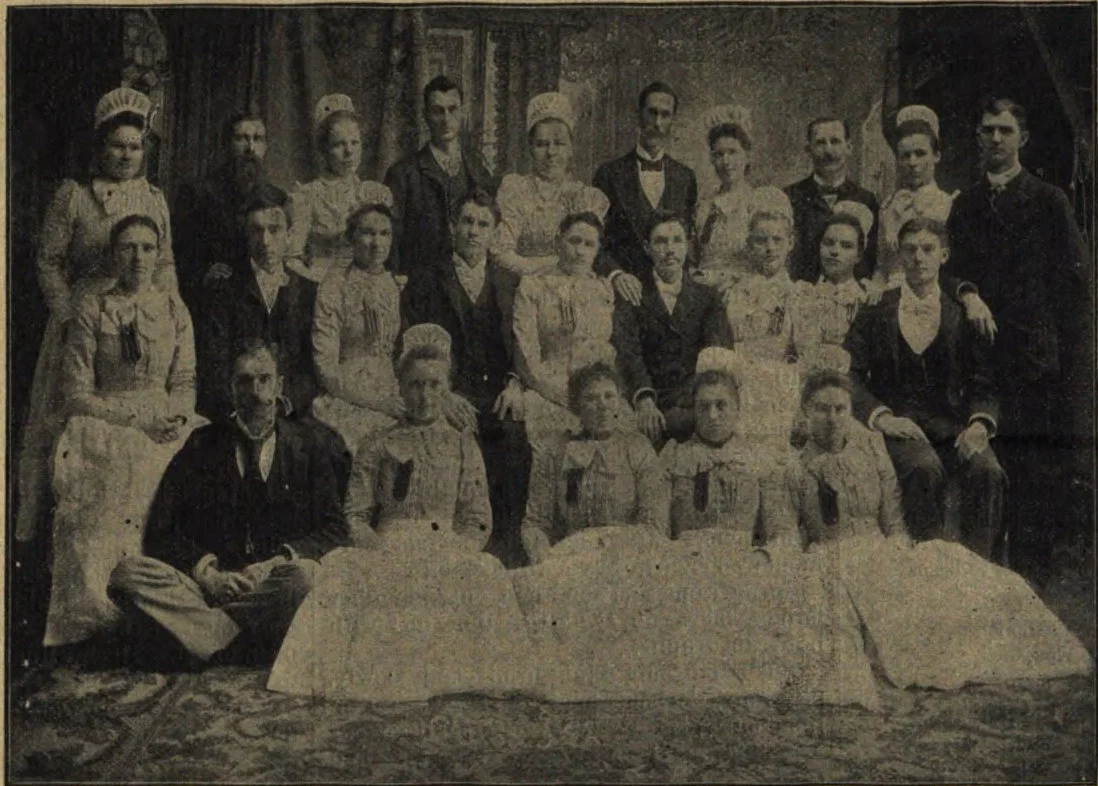
Sanitarium Missionary Nurses' Class of 1892.
There is also room for a few more missionary mothers in the mothers' class. This new department has proven an exceedingly interesting and profitable one. It is especially adapted to women of education and culture from 30 to 45 years of age, especially those who have had experience in caring for children and who love to work for the little ones.
Young men and women who have in view a medical education at some future time, should take the special course preparatory to more advanced studies. The course of study is so arranged that those who desire to do so can enter at any time during the next two months, but the sooner they enter the better. It is desired, however, that a number should enter at once. Those who take the special course, if able to meet the requirements mentioned above, will be able to enter upon medical work in a short time after entering upon the course. Those who come right away can enter upon work in the line of their study almost immediately.
Those interested should address the undersigned at once. J. H. KELLOGG, M. D., Battle Creek, Mich.
THE VEDDAHS OF CEYLON.
Perhaps the following account of a chance visit to a Veddah village in Ceylon may interest some of your numerous readers. Certainly the visit interested myself and colleague greatly. At a short distance from Kalkuda, on the southeast coast of Ceylon, through the jungle, is a small collection of huts inhabited by these most peculiar people, who marry and intermarry only amongst themselves, and whose belief is only in the devil, whom they try to propitiate on every possible occasion. He is fully represented by their chief, who is the personification of ugliness—hair matted and tangled, dirty in appearance and habits, and whose evil eye is said to have immediate effect upon his fellow-"denizens" of this jungle. It appears that it is a custom with them that if anyone dies, they dig just below the surface, cover the body up, and remove, lock, stock, and barrel, elsewhere. Under no circumstances would they ever live in the same place again. Never, under any circumstances, do they save anything for a rainy day; they put by nothing. Their food is Indian corn and roots of various kinds; their clothing, a rag around their loins; their dwellings, simply bamboo huts, about three or four feet above-ground, with an opening at each end; in the middle is the sleeping place, no bedclothes or cover of any kind.
One dark-eyed beauty, as soon as she perceived our approach, skipped joyfully under cover, and into her inner sanctum. Others were about pounding the corn in a pestle and mortar arrangement—a most capital thing to take away round shoulders and improve the chest; others were attending to some kids and goats, others looking after the cooking arrangements. Fishing forms part of the men’s occupation, but should any one of the men folks return home without any fish, his wife simply laughs and is quite satisfied to wait for better luck next time. Wet or dry, they expose themselves to all weathers, and are fully nature’s children. The wigwam of the North American Indian, the mia mia of the Australian, and the kraals of the South African are all separate and distinct from these most primitive builders of huts. Coming13homewards, we are introduced to a native school, which has been established through the kindness of Rev. H. L. Wait, Church of England minister at Batticaloa, and here a curious sight met us. Seated on the sandy floor—boys on one side, girls on another—twenty-two little mites were diligently learning their multiplication table, but how do you think? Why, simply making the figures in the sand, rubbing each one out after calling over its number, and so on through the whole numerals. We were so pleased with these twenty-two pieces of black humanity that we invited both teacher and scholars to the rest house and regaled them with cakes and bananas to their fill, and were amply rewarded by some singing the little mites favored us with. Their mothers looked wistfully on the while, and seemed delighted to be taken notice of.
The man to whom we are indebted for this treat is the sub-collector of customs at Kalkuda, a most worthy, well-educated man, and one who takes an interest in his neighbors. It appears the feminine gender like tobacco; we did not know this, or would have provided some. We are also told they like to be visited by white women, as then they are sure to get some cotton for clothing. So here we are in the nineteenth century in a beautiful island, near to civilization and still out of it, and but for the kindness and self-denial of Rev. H. L. Wait, likely to continue so, as far as Veddahs are concerned. All honor to him and men of his stamp.—Ceylon Observer.
STUNTED BY TOBACCO.
RECLAIMING children from a slow death by nicotine poisoning is a work which Mrs. Florence Kelley, the Illinois state factory inspector, has undertaken. She has discovered that over one thousand boys and girls are employed in cigar factories and tobacco packing establishments in Chicago. Without exception, where the child has worked in the factory for any length of time, his physical condition has been found most lamentable. The tobacco has affected the eyes; the skin is yellow, almost green, from the effect of the nicotine, and there are disorders which medical examination has shown to prevail in eight cases out of every ten.
“The rooms in which they work,” said Mrs. Kelley, “are almost stifling with the strong smell of tobacco. Girls who strip the stems from the leaf bend over their work with their faces close to the tobacco. In long rows at tables, divided into scores of compartments, sit girls who are rolling cigars. Some are employed in packing the goods. Most of those who have been employed in factories for two months or over have sore eyes. This is explained by the fact that when the children are tired and their eyes are weary, they habitually rub them with their hands stained with the nicotine, which causes irritation. For the most part the children are weak and puny. There is a noticeable depression of energy. The constant inhalation of tobacco causes dyspepsia; the action of the heart is affected, and the general physical condition of the tobacco-working children is far below the average.”—Reformatory Record.
A JAPANESE GIRL’S SIMILE.
At a class meeting in Japan where a number of our Christian girls were gathered together, the subject was, “How to Glorify Christ by Our Lives.” One of the girls said: “It seems to me like this: One spring my mother got some flower seeds, little, ugly, black things, and planted them; they grew and blossomed beautifully. One day a neighbor, coming in and seeing these flowers, said: ‘O, how beautiful! I must have some too. Won’t you please give me some seed?’ Now if this neighbor had only just seen the flower seeds she wouldn’t have called for them; ’twas only when she saw how beautiful was the blossom that she wanted the seed. And so with Christianity; when we speak to our friends of the truths of the Bible, they seem to them hard and uninteresting, and they say, ‘We don’t care to hear about these things; they are not so interesting as our stories.’ But when they see these same truths blossoming out into our lives, into kindly words and good acts, then they say: ‘How beautiful these lives! What makes them different from other lives?’ And when they hear that ’tis the Jesus teaching, then they say, ‘We must have it too.’ And thus, by our lives, more than by our tongues, we preach Christ to our unbelieving friends.”—Selected.
MISSIONARY NURSES.
In connection with Dr. Kellogg’s call for missionaries we give a cut of the class which graduated in 1892. They were natives of four different countries,—United States, Australia, Switzerland, and Germany. Nine states and territories are represented. May the Lord bless the missionary nurses.
LITERATURE NEEDED.
One of the greatest needs of India at the present time is a Christian literature. Formerly comparatively few persons could read, but now the government and mission schools are turning out thousands of young people yearly who can and will read. Yet there is very little within their reach that is favorable either to Christianity or righteousness. The vernacular presses of the country are busy turning out great numbers of cheap books, the influence of which is usually prejudicial to Christianity; and, added to the indigenous supply, great numbers of English and French skeptical books have been poured into the country, and some of the worst are translated and published. These are to be found everywhere, and very often it is all the literature obtainable by these young people just coming out of the schools. If this is to be their intellectual food, we can expect nothing from them but opposition. The various mission presses are trying to remedy this condition of things, and to a certain extent are succeeding. Take as an example our own Lucknow Publishing House. It is almost wholly dependent on its own resources, yet during the past year it issued Christian literature equal to about fifty million 8vo pages. It is situated in the very center of the great movement that is now being made toward Christianity, and has taxed its resources to the utmost in providing commentaries, books, pamphlets, papers, and tracts suitable for the new converts.
This is well so far as it goes, but the non-Christians are also learning to read, and their attitude toward us will depend much upon what is put into their hands. By a wide circulation of preparatory literature we can make them favorable to our cause. Otherwise they will be prejudiced against us by the vague rumors they hear on every side about the new religion. Very often they fear and oppose us simply because they do not know us. The rumors they hear transform Christianity into something terrible. They perish for lack of knowledge. We need a sort of literature adapted to the poorer and more ignorant classes that will remove this obstacle.
Tracts, wisely-written tracts, will do this effectually. Instances almost without number could be given where people have received their first true ideas of Christ and his religion through these little messengers, and many a missionary on entering remote fields has found a welcome for himself, and soil prepared for the sowing, because a tract had preceded him. They are forerunners, preparing the way of the Lord. We need more of these preparatory tracts, and need them badly. Last year the publishing house began the bimonthly issue of a series of Bishop Thoburn’s tracts, and they were so popular that at once the demand ran up to two hundred thousand pages of each issue.—Lucknow cor. N. Y. Christian Advocate.
FURNITURE AT ANY PRICE
AT THE
PEOPLE'S FURNITURE STORE, OAKLAND, CAL.
421 and 423 Sixth Street,
Between Broadway and Franklin Streets.
Bedroom Sets, Carpets, Oilcloth, Stoves, Crockery, Glassware and Tinware. Furniture sold on easy installments. Please call on us before purchasing elsewhere.
CHILDREN'S HAPPY HOME, 1020
Adeline Street, Oakland, California.
A Pleasant Home for Children, with Kindergarten advantages, and a Christian mother's care and supervision. A public school handy by for older children. Charges reasonable. References exchanged. Correspondence solicited.
Address, Mrs. T. C. Howell.
THE LORD'S DAY
By Milton C. Wilcox
THE TEST OF THE AGES.
By MILTON C. WILCOX.
A new publication on the all-important Sabbath question. It treats the subject in the light of the Dispensations. In fact, it is, in a nutshell
THE SABBATH FROM EDEN TO EDEN.
It presents, in a brief, simple way, the important portion of the Bible evidence on both sides of the Sabbath question.
New and Original Illustrations and Diagrams
The book contains 12 chapters, 128 pages, and is issued as No. 134 of the Bible Students' Library.
PRICE 15 CENTS
Address,
PACIFIC PRESS PUBLISHING CO.,
OAKLAND, CAL.
KANSAS CITY, MO. N. Y. CITY.
BIBLE ELECTION.
By M. C. Wilcox
By M. C. Wilcox. A brief presentation of God's plan and purpose concerning man, showing that the doctrine of election, or predestination, according to the Bible, is full of comfort and instruction. It throws new light on old controversies. Bible Students' Library, No. 67; 24 pp.; price 3 cents. Address Pacific Press Pub. Co., Oakland, Cal. Kansas City, Mo. New York City, N. Y.
Interlinear Greek-English New Testament
With the Authorized Version conveniently printed in the margin for ready reference, together with the various readings of the Greek text of the editions of Elzevir 1624, Griesbach, Lachman, Tischendorf, Tregelles, Alford, and Wordsworth.
LOVE,
Bible scholars know should replace the word “charity” in 1st Corinthians XIII. There are thousands of similar instances. In all such instances that other word, “the word that illumines,” may be found at a moment’s notice, and on the instant in the INTERLINEAR NEW TESTAMENT.
The text is well printed, with a PROPERLY ACCENTED GREEK TEXT, and where the arrangement of the word-for-word rendering is likely to be mistaken by a person unacquainted with the Greek idiom, the words are numbered to assist the student. It will be of real help to any Bible student.
SPECIAL INSTALLMENT TERMS TO CLERGYMEN.
Neatly bound in dark olive green cloth, stamped in gold. 670 pages.
PRICE $3.00, POSTPAID.
Address,
PACIFIC PRESS PUBLISHING CO.,
Kansas City, Mo., and New York
OAKLAND, CAL.
NOW READY
Christ our Advocate:
His Ministry in the True Tabernacle.
An illustrated pamphlet on the work of Christ in the Sanctuary in Heaven.
The pamphlet was not especially prepared as a “help” to the study of the S. S. Lessons for the first quarter of 1895, and yet it treats on the same subject and will be most valuable for this purpose.
CHRIST, OUR ADVOCATE, is published as No. 128 of Bible Students’ Library, and contains 112 pages, with ten illustrations and diagrams.
Price 10 cents, postpaid.
For sale at all State Tract Society Depositories, or by
PACIFIC PRESS PUBLISHING CO.,
Kansas City, Mo. OAKLAND, CAL.
New York City.
Acceptable Service
What kind of service God accepts and how we may render it. Order Apples of Gold Library, No. 21. Price 50 cents per hundred or one cent each in small quantities. Address PACIFIC PRESS PUBLISHING CO., Oakland, Cal.; Kansas City, Mo.; or New York City, N. Y.
TEACHERS' BIBLES
GENUINE OXFORD EDITIONS
From $1.25 to $20.00 in price. Send for price list.
PACIFIC PRESS PUBLISHING CO.
OAKLAND, CALIFORNIA.
Kansas City, Mo. New York City, N. Y.
PUBLICATIONS ON THE SECOND COMING OF CHRIST
MATTHEW 24, OR THE SECOND COMING OF CHRIST. An exposition of the twenty-fourth chapter of Matthew’s Gospel. 96 pages, paper covers. Price 10 cents.
SUN OF RIGHTEOUSNESS. A brief resume of the advents of Christ and the prophecies which cluster around these events. Two diagrams assist in the study. 80 pages, paper covers. Price 10 cents.
CHRIST OUR ADVOCATE. Showing the work that Christ accomplishes in the Sanctuary in Heaven, before his second coming. 112 pages, paper covers. Price 10 cents.
SURE WORD OF PROPHECY. A consideration of the important prophecies of the book of Daniel, the last chapter of which brings us to the “time of the end,” just previous to Christ’s second coming. 96 pages, paper covers. Price 10 cents.
Send for complete catalogue with description and price list of other publications on this and kindred topics.
1. At what time was Daniel’s mind directed to Jeremiah’s prophecy? Verses 1, 2. (See note .)
2. Upon what point in that prophecy was his mind exercised? Verse 2. (See note .)
3. What did he do? Verse 3.
4. For what object was the burden of his prayer? Verses 16, 17.
5. With what words of entreaty did his prayer close? Verses 18, 19.
6. While he was praying, who came to him? Verses 20, 21.
7. What did he first say to Daniel? Verse 22.
8. When was he commanded to come and explain the vision? Verse 23.
9. How did he say Daniel was regarded in the heavenly courts? Verse 23.
10. How long a time did Gabriel say was allotted to Daniel’s people and city? Verse 24.
11. What events would occur during that period? Verse 24.
12. With what commandment were the seventy weeks to begin? Verse 25. (See note .)
13. How long from that date till Messiah the Prince? Verse 25. See note .
14. What was done during the first seven weeks? Verse 25. (See note .)
15. What is said of the city and sanctuary to which Daniel looked with so much interest? Verse 26. (See note .)
16. When Messiah should come, what would he do? Verse 27. (See note .)
17. When was Jesus crucified?—In the spring of A.D. 31. See “Sanctuary and Its Cleansing,” pp. 82-90, and “Christ Our Advocate,” No. 128 Bible Students’ Library.
18. Then when would the seventy weeks end?—In the autumn of A.D. 34. (See note .)
19. Of what do the seventy weeks form a part?—Of the 2,300 days of Daniel 8:14. (See note .)
20. How much would remain of that period?—1,810 years. (See note .)
21. To what date would we be brought then for the end of the 2,300 days?—The autumn of 1844. (See note .)
[NOTE.—The questions which follow are merely suggestive for the student on the leading points of the lesson; it is presumed that the thorough student will think of many more as he studies the subject. References, where verses alone are given, always refer to the lesson scripture printed above. All other references are given in book, chapter, and verse. The text printed is that of the Revised Version, not because it is especially preferred, but because it is not found in every family, as is the common version.]
NOTE.—The section to which this lesson belongs in the International scheme of lessons, takes in the eighth, ninth, tenth, and eleventh appearances of Jesus, and his ascension. See Matt. 28:16-20; Mark 16:15-20; Acts 1:3-12; 1 Cor. 15:6, 7. The time of the teachings of this lesson was of course during the forty days between the resurrection and the ascension. The place of the ascension was from the Mount of Olives, near Bethany. It would be well for the teacher to review the different appearances of Jesus.
44. And he said unto them, These are my words which I spake unto you, while I was yet with you, how that all things must needs be fulfilled, which are written in the law of Moses, and the prophets, and the psalms, concerning me.
45. Then opened he their mind, that they might understand the Scriptures.
46. And he said unto them, Thus it is written, that the Christ should suffer, and rise again from the dead the third day;
47. And that repentance and remission of sins should be preached in his name unto all the nations, beginning from Jerusalem.
48. Ye are witnesses of these things.
49. And behold, I send forth the promise of my Father upon you, but tarry ye in the city, until ye be clothed with power from on high.
50. And he led them out until they were over against Bethany; and he lifted up his hands, and blessed them.
51. And it came to pass, while he blessed them, he parted from them, and was carried up into heaven.
52. And they worshiped him, and returned to Jerusalem with great joy;
53. And were continually in the temple, blessing God.
Golden Text: “Go ye therefore, and teach all nations.” Matt. 28:19.
SUGGESTIVE QUESTIONS.
(1) As our Lord was present with his disciples, of what did he remind them? Verse 44. (2) What did he say had testified of all these things? Same verse. Note 1. (3) What did he then do? Verse 45. (4) What did he say was the duty of the Christ? Verse 46. (5) In consequence of Christ's work, what would be done? Verse 47. (6) What did he say of his disciples? Verse 48. (7) In order that they might be effectual and accurate witnesses, what did he promise them? Verse 49. (8) What command did he give them? Same verse. Note 2. (9) After thus instructing his disciples, what did he do? Verse 50. (10) While he was blessing them, what occurred? Verse 51. Note 3. (11) What did his disciples then do? Verse 52. (12) How was their faith in him manifested? Verse 53.
NOTES.
1. In these days of church infidelity, as especially manifested in the higher criticism of the Old Testament, it is well for Christians to remember Christ's regard for these writings. He did not discriminate in any way in the law of Moses. The prophets and the Psalms were all confirmatory witnesses of his work and mission. It would be difficult, indeed, to find a teacher in any age who used the Scriptures of truth more reverently than did He in whom dwelt all the treasures of wisdom and knowledge.
2. HERE again we have the commission of our Lord to his disciples. It is not given in the same words as in either Mark or Matthew, but the meaning is the same. It is not, evidently, another account of the same conversation; but it was the repetition of the same truth by our Lord. Christ was to15be preached to all the nations of the world, and he was to be preached from what are now called the Old Testament Scriptures, for it was for that very purpose that he opened their mind to understand them. In order that they might teach correctly the word of God, he bestowed upon them his Holy Spirit, that which would lead them into all truth. And that gift he placed in the church. The word of God as interpreted by his Spirit is the only infallible standard. As that word was given by the inspiration of the Spirit, it can be understood only by the enlightening power of the Spirit. Note further what they were to teach. Matthew expresses it, “All things whatsoever I have commanded you.” It is worthy of note here, especially in view of the present world-wide agitation of the Sabbath question, that in all our Lord's teachings and commandments he never said aught concerning a change of the Sabbath. He everywhere confirmed the Decalogue. In no instance did his words imply that any other day was to be set apart as a holy day.
3. It would be well in connection with this question to consider Acts 1:9-11, where the precious promise is given that as he went into heaven so he would return again.
NEWS AND NOTES
SINCE OUR LAST ISSUE.
FOREIGN.
—On May 27 the French steamer Dom Pedro was wrecked off the coast of Galicia, and it is estimated that 100 people, mostly passengers, lost their lives. The captain, with 26, nearly all of whom were of the crew, reached land in a boat.
—There seems to be no abatement of the strained condition of affairs in Armenia. The news from that locality is fragmentary and necessarily indefinite, but sufficient, nevertheless, to show that there is continual clashing between the Kurds, Turks, and Armenians. It is stated that considerable feeling has been aroused against the Christians in Persia also, yet the shah has thus far furnished protection, as his sympathies are with them.
—An event of great commercial importance is the completion of the canal in the northern part of Germany, connecting the North Sea, or German Ocean, with the Baltic Sea. The traffic through the dangerous water way between the two seas is enormous, more than 40,000 vessels passing through annually, as compared with the 3,000 or 4,000 vessels using the Suez Canal. A large portion of this shipping will now go through the new canal, which has consumed eight years in its construction. The new water way also places Germany on a naval footing not hitherto available.
DOMESTIC.
—Secretary of State W. Q. Gresham died on the morning of May 28, aged 63.
—A bill has been introduced in the Florida Legislature to make it a punishable offense for any school in that state, either public or private, to allow white and colored pupils to be educated together.
—On Monday morning, May 27, the passenger steamer Colima, from San Francisco to Panama, foundered near Manzanillo, Mexico, and 187 lives were lost. Only 26 of the 213 persons aboard reached shore.
—A decision has just been rendered by the Supreme Court sustaining the Geary Exclusion Law. Questions of entry are in the hands of collectors for decision, the only appeal possible being to the Secretary of the Treasury.
—Despatches from Central America state that a defensive and offensive alliance has been established between Nicaragua and Honduras. This seems to be an initial step towards a closer bond of union between these states and several smaller ones.
—The production of aluminum has thus far been almost entirely limited to two forms, one in Switzerland, and the other in the United States. An important factor in the use of articles made from this light material is that the metal resists acids, but is destroyed by alkalies.
—As a further result of the reformatory sittings of New York's Police Commissioners, Superintendent Byrnes, who has been connected with the department since 1863, and chief since 1892, has resigned. He is said to have amassed a fortune during his term of office, but is nevertheless retired on a pension of $3,000 a year.
—The growth of the electric trolley system has aroused the determined opposition of steam and railroad companies in at least two states of the Union. In both Pennsylvania and Connecticut legal decisions have been obtained enjoining trolley companies from building lines between cities and towns, these decisions being based upon existing statutes governing steam roads, or the use of public highways. In view of the rapid development of methods of transportation with electricity as a factor, the fight of the steam railroad companies is regarded as a blow at progress, although an effort toward self-protection. The trolley companies will of course seek for remedial legislation at once.
—It is announced that a daily newspaper is about to be started in Chicago which will contain no criminal news. However desirable it might be to scan the news of the day without being constantly confronted by items of murder, theft, arson, etc., we fear the enterprise will not succeed. Such things are a part of this world's history, and are on the increase. In a sense it is well to be informed of the growth of evil. The world will be no better, even though some attempt to shut their eyes to the evil in it, and the man who sees the signs of the times and recognizes the extreme condition is in a position to prepare himself for the end of it, and the ushering in of a better state. 2 Tim. 3:13; 1 Peter 4:7; 2 Peter 3:7-13.
—According to a report made by the Knights of Labor, the recent trolley strike in Brooklyn cost the labor organizations $13,740.
—A story has been published in Catholic papers to the effect that Father A. L. Lambert, a convert to Protestantism, has been confined in an insane asylum, his mental aberration being due to his departure from the Roman Church. The editor of the Converted Catholic publishes a statement in the Christian Advocate showing that the whole pretended item of news and hint at retributive judgment is a falsehood. Mr. Lambert, who left the Catholic Church about a year ago, is now laboring in a mission field in the West Indies, to which he has recently gone, and a letter from him is published in the refutation. Prior to his departure he was engaged in public ministerial work in New York City. The bold attempt to make capital of this affair seems to be another instance of Rome's implacable methods in following up heretics.
—The U. S. Supreme Court has rendered a decision in the case of E. V. Debs and others, leaders in the railroad strike of 1894. It holds that the Circuit Court has final jurisdiction, and its acts are therefore not reviewable by the Supreme Court in the petition for writ of habeas corpus. The original sentence therefore stands, and Mr. Debs and his associates who have been found guilty of obstructing the U. S. mails and interfering with interstate commerce, must serve their time in jail. One point in the decision is specially worthy of note, that the remedy for the supposed or real wrongs done to labor is in the courts and by the ballot. A resort to force is subversive of governmental authority, and can be only so regarded in all incipient stages. It is not pleasant to forecast what the effect or results might have been with the more turbulent elements within the nation had the appeal to the higher court resulted in a favorable decision for the leaders of the strike.
THE JUDGMENT
By John Nevins Andrews
By the late J. N. ANDREWS
The Events of the Judgment and their Order. Following are principal chapter headings: The Investigative Judgment, Examination of the Books, God the Father the Judge, Offices of Christ, Messages to the World, The Sanctuary in Heaven, The Crowning of Christ, The Executive Judgment, The Saints Sitting in Judgment. Bible Students' Library No. 55. 136 pages. Paper covers. Price, 15 cents.