The Youth’s Instructor, Vol. 30, No. 50.

LEBANON AND ITS CEDARS

The Youth’s Instructor

Dec 13, 1882

S. D. A. Publishing Association · Battle Creek, Mich. · Dec 13, 1882

LEBANON AND ITS CEDARS.

NORTH of Palestine lies the hilly region known as Lebanon. It takes its name from the two parallel ridges of mountains of which it consists,—Lebanon and Anti-Lebanon. Lebanon means white, and these mountains are doubtless so called from the whitish limestone of which they are composed, and partly perhaps from their snowy whiteness in winter. Their average height is from 5,000 to 8,000 feet, though the highest peak, the Mt. Hermon of Scripture, lifts its lofty, snow-crowned head 10,000 feet, thus giving a fine view of all Palestine and Syria. It is thought by many that one of the southern spurs of Hermon was the scene of the Saviour’s transfiguration.
Between these two ranges of mountains lies a beautiful and fertile valley, seventy miles long and from three to seven wide; and through it flows the river Litany, anciently called Orontes, which empties its waters into the Mediterranean just north of Tyre. During a part of its course this river runs through a very deep chasm, which is the admiration of all travelers. For some distance the rocks rise not less than nine hundred feet above the stream, and the high, perpendicular cliffs come so near together in some places that the branches of trees growing on opposite sides of the chasm are said to meet and interlock. “At the bottom, like a silvery ribbon, the current rushes from rapid to rapid, foaming among the rocks, and decked with the gay blossoms of the oleander along its margin. At one spot there is a natural bridge formed by the falling of masses of rock from above, leaving a channel for the stream a few hundred feet below them.”
To the traveler approaching the mountains of Lebanon, they look barren enough; but the truth is that the soil, though scanty, is very productive. The cultivation is wonderful, and every available spot of earth is put to use, as far up as anything will grow. “Fig-trees cling to the almost naked rock; vines are trained along narrow ledges; long ranges of mulberries, on terraces like steps of stairs, cover the more gentle declivities; and dense groves of olives fill up the bottoms of the glens.” When one looks upward from below, the vegetation on the terraces is not seen, so “the whole mountain side appears as if composed only of immense rugged masses of whitish rock, severed by deep, wide ravines running down precipitously to the plain. No one would suspect, among these rocks, the existence of a vast multitude of thrifty villages, and a numerous population of mountaineers, hardy, industrious, and brave. But so it is. Hundreds of villages are seen—here built amid labyrinths of rocks, there clinging like swallows’ nests to the sides of cliffs; while convents no less numerous are perched on the top of almost every peak.” At the great bend of the Litany, where it turns westward toward the Mediterranean, perched on the summit of a naked ridge, which rises almost perpendicularly from the right bank of the river to a height of more than fifteen hundred feet, stands the celebrated fortress of the Crusaders, overtopping the neighboring hills, and commanding an extensive view of the surrounding country. “The tower of Lebanon, which looketh toward Damascus” mentioned by Solomon, is brought to mind by the accounts given by modern travelers of the ruins of ancient temples, built of stones of vast size. Many such ruinous temples have been discovered in different parts of Lebanon, several on conspicuous points high up in the mountains, where the labor of erecting them must have been stupendous.
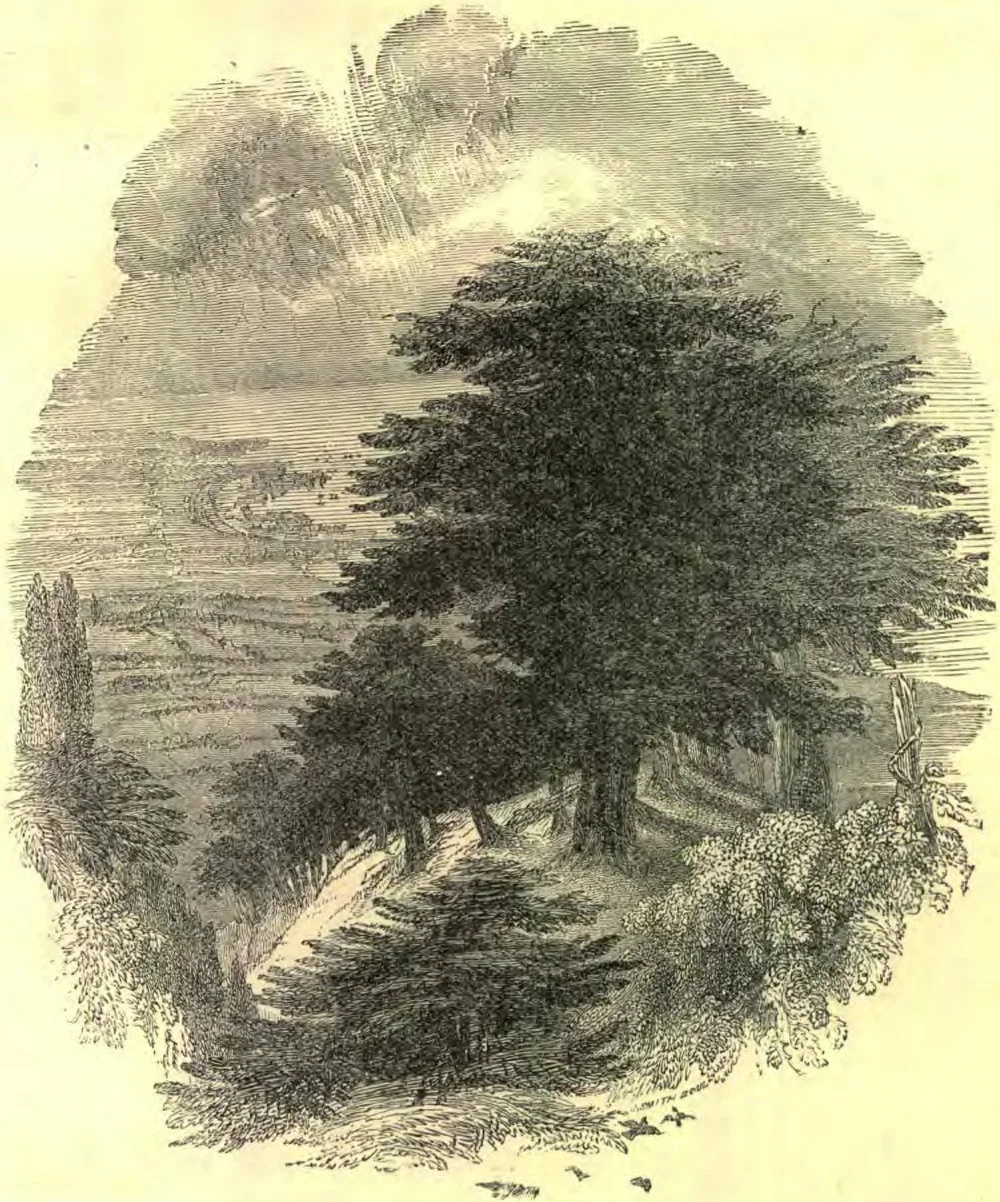
The olive and the mulberry trees are widely cultivated in Lebanon, the one for its oil and the other as food for silk-worms. The wine of Lebanon was celebrated of old, and though much less is now made than formerly, it is still accounted of superior excellence. Extensive vineyards surround many of the villages, though the fruit is mostly eaten, or made into raisins. But the glory of Lebanon in ancient days was its vast forests of cedar. This wood is peculiarly adapted to building purposes, because it will not decay nor be eaten by worms. It is of a red color, beautiful, solid, and free from knots. It was to these forests of Lebanon that Solomon sent for cedar to build the temple at Jerusalem and also his own palaces. The “house of the forest of Lebanon” was probably so called from the quantity of this wood used in its building. But the “glory of Lebanon is departed,” and its vast forests are no more. There are still some scattered trees in different parts resembling the cedar, but the largest and most ancient ones, generally thought to be the only genuine cedars, are found in a grove lying a little off the road which crosses Lebanon from Baalbec to Tripoli. Above it rise the loftiest summits of Lebanon, streaked with perpetual snow. The grove is now scarcely half a mile in circumference, and contains about four hundred trees, but they are not all large or old. There are about a dozen very ancient ones, probably as old as the time of Christ, and the rest are of various smaller sizes. A view of a part of this grove is given in our picture. One or two of the oldest of these trees measure more than forty feet around, and have a very ancient and weather beaten appearance. They often part at the trunk as into several trees, and the shadow of their horizontal arms is sometimes a hundred feet or more.
The Hebrew writers of the Old Testament often refer to these sublime mountains rising like a vast barrier on their north. “They speak of its sea of foliage shaken by the gales, Psa. 72:16; of its noble cedars and other trees, Isa. 60:13; Jer. 22:23; of its innumerable herds, the whole of which, however, could not atone for one sin, Isa. 40:16; of its balsamic perfume and its excellent wine, Hos. 14:5, 7.” When God told Moses, his servant, that he should not go into the land of Canaan, because of his sin at the waters of Meribah, Moses still pleaded with the Lord to let him “go over and see the goodly land that is beyond Jordan, that goodly mountain [probably Hermon] and Lebanon.” David says in the Psalms, “The trees of the Lord are full of sap, the cedars of Lebanon which he has planted.”
But the word of the Lord is sure; and in Lebanon as in other countries against which God spake by the mouth of the prophets, his judgments have been poured out because of the sins of the people. “Therefore, shall the Lord of hosts send among his fat ones leanness, and under his glory he shall kindle a burning like the burning of a fire, and shall consume the glory of his forests: and the rest of the trees of his forest shall be few, that a child may write them.” Isa. 10:16-19. E. R. C.

THE FIRE BY THE SEA.

There were seven fishers with nets in their hands, And they walked and talked by the sea-side sands; Yet sweet as the sweet dew-fall The words they spake, though they spake so low, Across the long, dim centuries, flow, And we know them, one and all,— Aye! know them and love them all.
Seven sad men in the days of old, And one was gentle, and one was bold, And they walked with downward eyes; The bold was Peter, the gentle was John; And they all were sad, for the Lord was gone, And they knew not if he would rise,— Knew not if the dead would rise.
The livelong night till the moon went out, In the drowning waters they beat about,— Beat slow through the fog their way,— And the sails drooped down with wringing wet, And no man drew but an empty net; And now ’twas the break of the day,— The great, glad break of the day.
“Cast in your nets on the other side!” (’T was Jesus speaking across the tide;) And they cast and were dragging hard; But that disciple whom Jesus loved Cried straightway out, for his heart was moved! “It is our risen Lord,— Our Master and our Lord!”
Then Simon, girding his fisher’s coat, Went over the nets and out of the boat— Aye! first of them all was he; Repenting sore the denial past, He feared no longer his heart to cast Like an anchor into the sea,— Down deep in the hungry sea.
And the others, through the mists so dim, In a little ship came after him, Dragging their nets through the tide; And when they had gotten close to the land They saw a fire of coals on the sand, And with arms of love so wide, Jesus, the crucified!
’Tis long, and long, and long ago Since the rosy light began to flow O’er the hills of Galilee; And with eager eyes and lifted hands The seven fishers saw on the sands The fire of coals by the sea,— On the wet, wild sands by the sea.
’Tis long ago, yet faith in our souls Is kindled just by that fire of coals That streamed o’er the mists of the sea; Where Peter, girding his fisher’s coat, Went over the nets and out of the boat, To answer, “Lov’st thou me?” Thrice over, “Lov’st thou me?”
—Alice Cary.

Duties and Opportunities for Faithful Service

It is our business to study our lessons well, to serve one another, to be prompt, to do all that falls to us to do, and to make the best of all our opportunities to do good and improve ourselves.

TAKING A CITY.

Miss Delworth’s Sabbath-school class of young girls were gathered around their teacher, each pair of bright eyes kindling with interest in the lesson.
Miss Delworth was telling the story of Babylon’s grandeur and strength; and even Minerva Talbot forgot that her blue silk ruffles were lying against Hepzibah Riggs’s six-cent calico dress, and exclaimed,—
“How splendid! It sounds just like the ‘Arabian Nights!’”
But as the story advanced, and the skillful daring of Cyrus, the Persian, was graphically described, wonder and admiration were at their height. It was Miss Delworth’s practice at the close of each lesson to give the class an appropriate passage of Scripture for a text during the week.
“Here is your verse, my dear girls,” she said. “Try to live up to it each day, and next Sabbath every one of you may be greater than the mighty conqueror I have told you about to-day.”
Then slowly and earnestly she repeated these words: “He that ruleth his spirit, is greater than he that taketh a city.”
“Miss Delworth must have meant that for me,” said Sue Gray, as she walked slowly home, with no laughter in her hazel eyes, and no saucy dimples playing about her mouth.
Sue was evidently in a thoughtful mood. She was a bright girl, but very impulsive and impatient. A slight provocation would often bring a sharp retort to her lips for which she would be “so sorry” the next moment.
“I’m going to begin this minute, and keep down the quick, cross words,” she said to herself, entering her home, and shutting the front door very hard by way of emphasis. While running up the stairs to her room, she heard Aunt Clara singing in the parlor:—
“Ask the Saviour to help you, Comfort, strengthen, and keep you; He is willing to aid you, He will carry you through.”
The young girl suddenly remembered that Sue Gray was a very unreliable person, and, kneeling in the curtained alcove of her chamber, prayed:—
“Dear Jesus, I can’t trust myself. Help me to take my city.”
Nothing happened through all the afternoon to test Sue’s new purpose. Her small, irrepressible brothers were spending the day at grandmother’s, and she was left to read her Sabbath-school book in peace.
Next morning she started for school, filled with firm determination; but everything there went along wonderfully smooth, and at noon she went home really disappointed that she had been given no opportunity for “ruling her spirit.” It was late in the afternoon, when she sat copying a prize composition for the next day. The school-room was warm, the air dusty, chalky, and oppressive. The unceasing hum of voices and buzzing of flies was drearily monotonous. Outside, a sunny, sweet spring day, echoing with the songs of birds, smiled temptingly; and as the school children bent over their tasks, they thought of the ramble in the fragrant woods and the hunt for shy blossoms that would follow when the lazy old clock should strike “four.”
Sue’s composition was nearly completed, and she surveyed its fair, delicately traced pages with a good deal of satisfaction. Giving a sigh of relief, she added a quotation from a favorite poet, and proceeded to sign her name. She did not see Jim Burton coming down the narrow aisle from the third class in arithmetic.
Poor Jim! a great, overgrown, awkward, blundering boy, the laughing-stock of the school, at the foot of the lowest classes. As he shuffled toward his seat, his eyes happened to fall on Sue.
The golden glint of her hair, the blush-rose tint of her ribbons, the daintiness of her fluted apron and soft gray dress, appealed to some dim sense of beauty in his queer heart, and he continued to stare absently until a sudden trip of his great feet, a sudden jarring against a desk, made him realize that a river of very, very black ink was running over the white composition and dainty apron of Susie Gray. For a second Sue’s eyes flashed. She wanted to say, “You horrid, good-for-nothing, careless boy! It’s just like you!” with a look that would mean more than the words, but quickly came the thought of her verse:—
“He that ruleth his spirit, is greater than he that taketh a city.”
Poor, confused Jim, stammering out an awkward apology, was bewildered by a very kind smile, and these pleasant words:—
“Never mind, Jim; accidents will happen; but please be more thoughtful next time.”
Jim went home in a daze that afternoon. Sue relinquished the flower expedition, and remained in the school-room till tea-time, carefully rewriting her work; but the toil was a pleasure, for she had entered her city in triumph.—Orphan’s Friend.

SCENES IN THE LIFE OF CHRIST.

LESSON 100.—THE PASSOVER SUPPER.

It is supposed that Jesus spent the day on Wednesday in Bethany, and that it was on this day that the chief priests and the elders held their council, and hired Judas to betray his Lord. On Thursday the disciples asked Jesus where they should make ready to eat the Passover; for it was at the close of this day that the lamb was to be slain, and the Passover was to begin. He told them to go into the city, and they would there meet a man bearing a pitcher of water; and that if they should follow him, he would show them a large upper room where they might eat the Passover. The disciples did as their Master told them, and found everything as he had said.
When the proper time had come, Jesus and the twelve apostles assembled in this room to eat the paschal lamb, as it was called. As they were gathered about the table, and before the meal began, Jesus said unto them, “With desire have I desired to eat this Passover with you, before I suffer; for I say unto you, I will not any more eat thereof, until it be fulfilled in the kingdom of God.” Then, taking a cup of wine, he gave thanks, and said, “Take this, and divide it among yourselves; for I say unto you, I will not drink of the fruit of the vine, until the kingdom of God shall come.”
And there was a contention among the disciples as to which of them should be greatest. Then Jesus said unto them, “The kings of the Gentiles exercise lordship over them, and they that exercise lordship over them are called benefactors. But ye shall not be so; but he that is greatest among you, let him be as the younger; and he that is chief, as he that doth serve. For whether is greater, he that sitteth at meat; or he that serveth? Is not he that sitteth at meat? But I am among you, as he that serveth. He promised them, that since they had continued with him in his temptations, and had been faithful, he would appoint them a kingdom, as his Father had appointed him a kingdom; that in his kingdom they might eat and drink at his table, and sit on thrones, judging the twelve tribes of Israel.
While they were eating supper, Jesus rose, laid aside his garments, and girding himself with a towel, poured water into a basin, and began to wash the disciples’ feet, wiping them with the towel. Peter was not willing to have his Lord condescend to wash his feet; but when Jesus made him understand that this ceremony was necessary, he submitted, saying, “Not my feet only, but my hands and my head.” Then Jesus said unto them, “Ye call me Master and Lord: and ye say well; for so I am. If I then, your Lord and Master, have washed your feet; ye also ought to wash one another’s feet. For I have given you an example, that ye should do as I have done to you. Verily, verily, I say unto you, The servant is not greater than his Lord; neither is he that is sent, greater than he that sent him. If ye know these things, happy are ye if ye do them.”
Then Jesus was troubled in spirit, and said to the disciples, “One of you shall betray me.” The disciples looked one upon another, and began to be sorrowful, saying unto him, one by one, “Is it I?” Then Peter requested John, who was leaning on the breast of Jesus, to ask him who it was. And Jesus said, “He it is to whom I shall give the sop, when I have dipped it.”
When Jesus had dipped the sop, he gave it to Judas Iscariot, the son of Simon. Then Judas said, “Master, is it I?” And Jesus answered, “Thou hast said.” Then Satan entered into Judas. And Jesus said unto him, “That thou doest, do quickly.” When Jesus spoke these words, Judas, having received the sop, went immediately out; and it was night. After Judas had gone, Jesus talked with the disciples, telling them that he should be with them but a little while, and that he was going where they could not follow him. Then said he, “A new commandment I give unto you, that ye love one another: as I have loved you, that ye also love one another. By this shall all men know that ye are my disciples, if ye have love one for another.”

QUESTIONS.

1. Where is Jesus supposed to have spent the last Wednesday before his crucifixion?
2. What events are thought to have taken place on that day? Matt. 26:1–5; Luke 22:3–6.
3. What did the disciples ask Jesus on Thursday? Matt. 26:17; Mark 14:12.
4. Why did they make this inquiry?
5. What did he tell them to do? Luke 22:10, 11.
6. For what purpose did they meet in this room at evening?
7. What did Jesus say to them, as they were gathered about the table, before the meal began? Luke 22:14–16.
8. What did he do before the meal began? Verses 17, 18.
9. What did the disciples contend about? Verse 24.
10. What did Jesus say to them? Verses 25, 26.
11. What question did he ask them? Verse 27.
12. What promise did he make them?
13. Why were they to be thus favored?
14. What did Jesus do, as they were at supper? John 13:2–6.
15. Who refused to have his feet washed?
16. Why was he unwilling to have his Lord serve him thus?
17. What explanation did Jesus make?
18. What did Peter then say?
19. What remarks did Jesus then make about the lesson that he meant to teach by this ceremony? Verses 12–14.
20. What did he say about the example he had set them?
21. What did he say that should cause all his servants to keep humble? Verses 16, 17.
22. What caused Jesus to be troubled in spirit at this time?
23. How did he speak of this to his disciples? John 13:21.
24. How did this remark make the disciples feel? Mark 14:19.
25. What did they say to him?
26. What way did Peter take to find out whom Jesus meant?
27. What sign did Jesus then give by which they might know who was to betray him? John 13:26.
28. To whom did Jesus give the sop when he had dipped it?
29. What did Judas say? Matt. 26:25.
30. How did Jesus reply to his question?
31. By whom was Judas urged on to betray his Lord? John 13:27.
32. What admonition did Jesus give him?
33. What did Judas immediately do?
34. What did Jesus say to the disciples after Judas had gone?
35. What new commandment did he give them?
36. How are all men to know who Christ’s disciples are?

NEW-TESTAMENT HISTORY.

LESSON 113.—JESUS AT THE SEA OF GALILEE.

When Jesus had, by eating food, convinced the disciples that he was not a spirit, he again said unto them, “Peace be unto you; as my Father hath sent me, even so send I you.” After this he breathed on them, saying, “Receive ye the Holy Ghost: whosesoever sins ye remit, they are remitted unto them; and whosesoever sins ye retain, they are retained.”
Thomas, one of the twelve disciples, was not present at that time, and when he came in, the other disciples said unto him, “We have seen the Lord.” But Thomas was incredulous, and said unto them, “Except I shall see in his hands the print of the nails, and put my finger into the print of the nails, and thrust my hand into his side, I will not believe.”
“And after eight days again his disciples were within, and Thomas with them; then came Jesus, the doors being shut, and stood in the midst, and said, Peace be unto you. Then saith he to Thomas, Reach hither thy finger, and behold my hands; and reach hither thy hand, and thrust it into my side: and be not faithless, but believing. And Thomas answered and said unto him, My Lord and my God. Jesus said unto him, Thomas, because thou hast seen me, thou hast believed; blessed are they that have not seen, and yet have believed.”
“After these things Jesus showed himself again to the disciples at the sea of Tiberias; and on this wise showed he himself. There were together Simon Peter, and Thomas called Didymus, and Nathanael of Cana in Galilee, and the sons of Zebedee, and two other of his disciples. Simon Peter said unto them, I go a fishing. They say unto him, We also go with thee. They went forth, and entered into a ship immediately; and that night they caught nothing. But when the morning was now come, Jesus stood on the shore; but the disciples knew not that it was Jesus. Then Jesus said unto them, Children, have ye any meat? They answered him, No. And he said unto them, Cast the net on the right side of the ship, and ye shall find. They cast therefore, and now they were not able to draw it for the multitude of fishes. Therefore that disciple whom Jesus loved said unto Peter, It is the Lord. Now when Simon Peter heard that it was the Lord, he girded his fisher’s coat unto him, (for he was naked,) and did cast himself into the sea. And the other disciples came in a little ship; (for they were not far from land, but as it were two hundred cubits,) dragging the net with fishes. As soon then as they were come to land, they saw a fire of coals there, and fish laid thereon, and bread. Jesus saith unto them, Bring of the fish which ye have now caught. Simon Peter went up, and drew the net to land full of great fishes, an hundred and fifty and three; and for all there were so many, yet was not the net broken. Jesus saith unto them, Come and dine. And none of the disciples durst ask him, Who art thou? knowing that it was the Lord. Jesus then cometh and taketh bread, and giveth them, and fish likewise. This is now the third time that Jesus showed himself to his disciples, after that he was risen from the dead.”
“So when they had dined, Jesus said to Simon Peter, Simon, son of Jonas, lovest thou me more than these? He saith unto him, Yea, Lord; thou knowest that I love thee. He saith unto him, Feed my lambs. He saith unto him again the second time, Simon, son of Jonas, lovest thou me? He saith unto him, Yea, Lord; thou knowest that I love thee. He saith unto him, Feed my sheep. He saith unto him the third time, Simon, son of Jonas, lovest thou me? Peter was grieved because he said unto him the third time, Lovest thou me? And he said unto him, Lord, thou knowest all things; thou knowest that I love thee. Jesus saith unto him, Feed my sheep. Verily, verily, I say unto thee, When thou wast young, thou girdedst thyself, and walkedst whither thou wouldest; but when thou shalt be old, thou shalt stretch forth thy hands, and another shall gird thee, and carry thee whither thou wouldest not. This spake he, signifying by what death he should glorify God. And when he had spoken this, he saith unto him, Follow me.”
“Then Peter, turning about, seeth the disciple whom Jesus loved following, which also leaned on his breast at supper, and said, Lord, which is he that betrayeth thee? Peter seeing him, saith to Jesus, Lord, and what shall this man do? Jesus saith unto him, If I will that he tarry till I come, what is that to thee? follow thou me. Then went this saying abroad among the brethren, that that disciple should not die: yet Jesus said not unto him, He shall not die; but, If I will that he tarry till I come, what is that to thee?”
“This is the disciple which testifieth of these things, and wrote these things; and we know that his testimony is true.”

QUESTIONS.

1. How did Jesus convince the disciples that he was not a mere spirit, or phantom? Luke 24:41-43.
2. What benediction did he repeat? John 20:21.
3. What did he say about sending them forth?
4. What solemn ceremony did he then perform? Verse 22.
5. Which one of the disciples was absent when Jesus partook of meat before his disciples?
6. When he came, what did the other disciples say to him?
7. What response did Thomas make?
8. How long before Jesus appeared to his disciples again? John 20:26.
9. What seems miraculous about his appearance at that time?
10. Whom did he especially address?
11. What did he say to him?
12. What reply did the disciple make?
13. By what remark did Jesus then set forth the nature of true faith?
14. After these things, where did Jesus again show himself? John 21:1.
15. Which of the disciples were together at that time?
16. Relate some of their conversation. Verse 3.
17. What experience did they have that night?
18. Who stood on the shore in the morning?
19. How did he address them?
20. Did they recognize him?
21. What did he tell them to do?
22. What was the result?
23. What did he then say?
24. What did this cause Peter to do?
25. How did the other disciples make their way to land?
26. What did they see on their arrival there?
27. What did Jesus tell them to do?
28. What was there remarkable about the draught of fishes which they took in?
29. What invitation did Jesus give them?
30. How did he serve them?
31. After they had dined, what did Jesus say to Peter?
32. What reply did Peter make?
33. What admonition did Jesus then give him?
34. Tell how these words were repeated.
35. How did Peter feel when the question was asked him the third time?
36. What prediction did Jesus make concerning this ardent disciple?
37. To what did he refer?
38. How was Peter disturbed when Jesus had called him aside from the other disciples?
39. What question did he ask?
40. What answer did he receive?
41. What saying was spread abroad from this remark?
42. How does that disciple assure us that his record is true?

I'LL TRY.

A LAWN, all covered with mounds of cut grass fast turning into sweet-smelling hay. A small boy on one of the hammocks near the gate that led through the garden, looking very sad, and not a little cross. The gate opened, and his father came in on his way to the house.
“What’s the matter, Vinton? Why are you not playing or studying your lessons?”
“Can’t do my sums,” said the little boy, crossly. His father made no reply, but stood looking down on the ground for a few moments. Presently he said:—
“Come here, my son. Now sit and watch that for a little while, and see if it won’t help you,” and passed on into the house.
This is what Vinton saw: A little ant-hill, and near it a small black ant trying with all its might to roll a large white crumb up the hill. First he would push it on one side; then pull it on the other, only to gain a little ground, and have it roll back on him again. Over and over, this happened; but the little black ant never gave up, never seemed to despair.
Vinton got very much interested, and sat and watched for some time. At last, the patient effort was crowned with success; and the little ant stood on top of the hill with a large white crumb before him, and pushed it down into his hole.
Vinton clapped his hands, and cried, “Bravo,” then stood looking sober for a minute, turned, and went into the house.
He took up his slate and pencil, and sat down once more to the neglected task. He had to try very hard, fix his attention upon it closely, and reckon the figures over and over again. But, at last, he, too, succeeded. They were all right, and he put the answers down, as he said, “in black and white.”
Then he went to mamma, exclaiming very cheerfully:—
“I have done my sums, and who do you think helped me? My ant!”
“What, Aunt Mary? I did not know she was here,” said mamma.
“No, the little black ant in the garden, that papa showed me.” And then he sat down and told her all about it.
“Mamma, I think I’ll take for my motto, ‘If you find you don’t succeed, try, try, try again.’”
“And a very good one it is, too,” said mamma.
There are not a few lessons little folks might learn, and large ones, too, from the insects.—Leigh Nath.
Continue reading: WATCHING