The Youth’s Instructor, Vol. 37, No. 9.

WINTER

The Youth’s Instructor

Feb 27, 1889

S. D. A. Publishing Association · Battle Creek, Mich. · Feb 27, 1889

WINTER

THE ice-mailed winter boards the tender spring, And nips her children with untimely frost: Discrowned and shoreless, doth the warrior-king Return to battle for his empire lost! He blurs the edges of her robes of green, And with his frozen armies, snow and hail. Encamps upon the hill and gorge between, And bids the north-wind ride the whistling gale! The waves dash howling on the rocky coast, Or climb with giant strides the flinty sands; While o'er the billows, like a tortured ghost, The noble ship drifts wildly, ere it strands. The earth is dumb, and spring imploring waits The sun's advancement through the vernal gates.
—Mrs. R. S. Nichols.

A BRAVE BOY.

“Car carmook, agartook, meo bunga.”
AWAY up in the cold, barren region of Labrador there lived once a boy called Tallook. He was an Esquimau. Like the rest of his race, he was very short and stout, with hard flesh and slant eyes, very black, and his were very wide open. Like them, too, he was very brave, hardy, and enduring.
He had been picked up when quite young, and left at a Moravian mission station, where he had been cared for and brought up.
He proved himself of great service in the station, as he was so brave and faithful. He feared no cold or exposure. Once when one of the men dropped his gun into the water, he plunged into the ice-floating mass up to the shoulders to rescue it.
He became a whole-hearted Christian, and often brought natives to Mr. Eberson and his helpers that they might teach them the “way of peace.” He would say:—
“You better be Christians, too. Christians don’t fear anything.”
He had learned the true spirit of our Saviour’s Golden Rule, and acted it out with his fellows. His way of saying it was, “Car carmook, agartook, meo bungs,”—“What me want you do me, me do you.”
Once when some spiteful fellows threw a young cub in his face, and looked to see him fling it back at them, he flung it on the other side. When asked why he did so, he answered:—
“Me think me no want that in my face, so me no throw it in boy’s face. Jesus no loves me if me do.”
No wonder that he was loved by missionaries and natives, and many a work of trust was given him to do. No one could get along as well with the natives, as he knew so well how to approach them, and they had learned to trust him.
One day Mr. Eberson heard that a fishing schooner had been wrecked at Okkak, about 70 miles from Target Inlet, the mission station. He tried hard to get some of the men to carry supplies to the suffering fishermen, but none could be found who would leave their warm fires and rude comforts at home, for such a long, cold trip in such a severe climate.
When Tallook heard that the men had refused to undertake the trip, he volunteered his services.
Soon the dogs were hitched to the snow-sledge, and the sledge well ladened with 150 pounds of bread, meat, rum, and other provisions for the poor sufferers.
Peter Heder was persuaded to go with the brave boy. So away they sped over hill and vale, the dogs urged on by the cold.
But soon the calm of the morning was followed by a terrific storm. The heavens became black, the wind whirled and raged around, tearing everything before it. The dogs had to be unhitched, turned and lashed to stones, as the fearful wind was in their faces. Heder went home, and tried to persuade Tallook also to go back, but he refused. The storm continued, though somewhat abated, and the cold became intense. Still Tallook urged on his dog team.
Thirteen days after they had set out, when the missionaries had almost despaired of hearing from their boy and team, they saw the dogs hastening up to the station. But Tallook was not among the number in the sledge. Captain Hannen and three other sailors were the occupants. Three days after Heder had left Tallook, the fishermen were aroused by the barking of dogs; and hurrying to a great ridge of snow, they found the dogs unhitched from the sledge, the driver frozen dead, with a knife in his hand, as if he had been cutting meat for the dogs. Almost there, Tallook had lost his way. These hungry animals had gnawed the sacks of provision, but nothing more. The starving fishermen secured the provision, and thus saved their lives. But the poor boy who had saved them had given his own life for theirs.
After much wandering without a guide, they had at last found the station of the good men. How thankful they were to be saved, and how grateful to the boy who had saved them! Could they ever forget to love and cherish the memory of him who died to save them?
Boys and girls, don’t this remind you of that loving Friend who died for you? Worse than cold and storm and all Tallook’s sufferings was that cross, that spitting upon, buffeting of men and displeasure of God, that Jesus suffered for us. Shall we ever forget to love him and try to please him after all he has done for us? Surely we ought to be as grateful as these fishermen,—Youth’s Evangelist.

“MOTHER MUST KNOW IT.”

Myron Fielding was not quite fourteen when the leader of the “Newton Band” asked him if he thought he could beat the tenor drum.
His father had been a drummer-boy during the war, and Myron took to music as a fish takes to water; so with his mother’s consent, he became a member of the “Band,” as well as the envy of all the town boys.
It was a proud day in his life when, dressed in his bright new uniform, he made his first appearance with the band boys in public. Several times through the summer he went with his companions to play at exhibitions, fairs, and political meetings. No boy could have entered into the pleasures of these little trips with more delight than Myron, whose excursions hitherto had been confined to the neighboring villages.
A few weeks ago, the band was invited to play at a soldiers’ reunion, and on that occasion the soldier’s son was allowed to beat the drum that had so often cheered the brave men when carried by his father.
For several years after the war was over, his father had been accustomed to take his old place in the regimental band at these reunions, but since his death, the men had marched to the beat of a stranger; and when they learned that the little drummer was the son of their old comrade, they gave him a royal welcome.
The band had arranged to return home on the morning of the third day, but at the close of the second night’s camp-fire, Colonel Madox announced that the regiment had accepted a very pressing invitation to attend the dedication of the new court-house in the adjoining county, and that an extra train would be at the service of the soldiers at nine o’clock in the morning.
“I cannot go,” said Myron, positively, when he learned that the band had arranged to accompany the regiment.
“But you must,” replied John Travers, the leader. “What would a military parade be worth without a drum? Of course you must go; for we want to do our best, and every fellow must be at his post and do his duty.”
“I cannot go, unless I can find some way of sending mother word,” insisted the boy.
“You can drop her a card, for that matter,” answered the young man.
“But she would not get it until evening. You know the mail does not reach Newton until four o’clock in the afternoon.”
“I can’t see what difference that makes. We will be home in the morning, and twenty-four hours will not change any of your engagements seriously.”
“It is not that,” argued Myron; “I have no special work calling me back, but I will not leave mother in suspense a whole day. She is not strong, and her anxiety would be very apt to cause her a sick spell.”
“She is not so foolish as you try to make her out,” said Travers. “She will know that some new arrangement has been made.”
“I can go home on the four o’clock train and back on the eight,” answered Myron, after a moment’s thought.
“And walk eight miles between trains! for you know it is fully four miles from the station to Newton,” was the reply.
“I can soon skip over that distance,” said Myron.
“You are a queer chap,” laughed Travers. “Mind, if you fail us to-morrow, some other fellow will get your place.”
“I’ll be on hand. It only takes about thirty minutes for the train to make the distance. This will leave me three solid hours for my walk. I’ll not disappoint you.”
The next morning, at a little after six, he rang the bell at his mother’s front door.
“Is that you, Myron? I’ll be down in a minute. We were not looking for you so early,” said his mother, thrusting her head from the window above.
“Never mind, mother. I have only a short time to stay. I just came to tell you that we are going down to Ashland, to the dedication of the court-house, and will not be home until to-morrow. I must be back at the station by a quarter past eight, so as to catch the accommodation.”
“And you took this long tramp altogether to save me a day’s anxiety! Not many boys would have been so thoughtful, I am sure,” declared his mother, proudly.
Hastily swallowing his breakfast, he hurried back to keep his appointment with Travers.
“Where is our little drummer-boy?” asked Col. Madox, when the regiment was about to break camp.
“He’ll be here on time,” said Travers, and then he went on to explain what the little fellow had done.
“He is a queer chap, Colonel, but he will be here on time if he has to walk every step of the way.”
“It is a pity that there are not more queer fellows like him,” replied the Colonel. “Boys who will not give their mothers an hour’s uneasiness will not be apt to go very far astray. I admire the little fellow’s pluck, and will hold our train back until he arrives.”
“He’ll be on hand. I never knew him to break an engagement in his life,” said Travers. “Here he comes now,” he added, as Myron made his appearance round a curve.
“You’re just in time, my boy,” said the Colonel, grasping his hand. “I trust you found your mother well and happy. Always be good to your mother, and never do anything that you would be ashamed for her to know. Mothers are the best friends boys have, but it takes some fellows a whole lifetime to find it out.”—Youth’s Evangelist.

A HALF HOUR IN THE UNITED STATES TREASURY.

THROUGH the kindness of Dr. Eaton, acting chief of one of the departments of the treasury building, we were conducted through that part of the work directly under his charge, and shown the process through which paper money must pass before it goes into circulation.
It is first printed at the Bureau of Engraving, a building set apart almost entirely for that purpose. The large room where that work is done, has in it two hundred hand printing-presses, each press requiring two persons, a man and a woman, to work it. The paper on which the money is printed is cut into sheets just large enough to print of silver certificates four, and of gold three, bills. These are printed from steel plates. After each sheet has been printed, the man operating the press rolls ink over the steel plate, and then carefully wipes it with a cloth, rubbing off all the ink except that which is to make the delicate lines on the face or back of the bill. The woman then deftly lays on the sheet, when it is passed under the pressure of the machine, and comes out printed in only one color.
These bills are then counted, and the number on each one registered, when the bills are wet in water, and put into a press to remain over night. They are then taken back to the printers, and another color put on, when they must again be counted and registered before being put into the wet press for another night, an operation which must be gone through with for every color or shade the bill receives. The bills are counted every time they pass through a person's hands. Those of one class are counted thirty-four times, and those of the other fifty-two times. This is done so that if a bill is lost, it can be traced to the one who lost it, by examining his register of them as they passed through his hands. In this way, frauds are prevented, and no one gets that which does not belong to him. Even the steel plates from which the bills are printed must be locked up in the huge safe every night, when the work on them for the day is done. A receipt is given, and they are returned to the workmen and receipted for in the morning.
Even when the bills are printed, and bear the signature of the treasurer, they are not worth anything in the commercial world. They still lack a finishing stroke, without which they will not pass current. Whoever will examine a bill will notice that it has on its face a red stamp. It is this which gives the bill currency and not the signatures which it bears. This seal is put on in the treasury building. When the bills arrive there, they are still connected in sheets of three or four, and must be counted and registered again every time they pass through a person's hands.
In the room over which Dr. Eaton presides, forty persons are engaged. Through this room must pass all the money which goes into circulation by authority of the government. In here are six steam presses, by means of which the red seal of the United States is printed on every bill. Each sheet is counted into the machine, and counted out and registered, after which the money is put up in large packages, with the amount placed on each package.
Should a mistake be made by any one person, in feeding the sheets through the press, or in cutting them apart, or in any other way, that bill or sheet of bills must be thrown out, and other bills printed, bearing the same number on the face as those thrown out.
Dr. Eaton showed us his book in which he kept the final register of the work done. In it was the name of each person in his department who handled the bill bearing such a number; and if anything was found to be wrong with that bill, it could be shown in whose hands the defect was made, whether pressman, feeder, counter, separator, or receiver. On one page I saw where four bills bearing certain numbers had been thrown out because they were cut too close to the engraving. The fault was easily traced to the separator, and he must bear the consequence, whatever that might be.
While looking at that book, I thought, If the government of the United States, only an imperfect earthly power, keeps such accurate record of each of its employees, and marks each failure made by any one of them, so that the most insignificant is held directly amenable to the government, will not the government of God keep just as strict an account with each of us? and can any one of us, however small a part we bear in the affairs of life, hope to escape, if through carelessness we mar the symmetry of the character work, the execution of which God has intrusted to each of us? This is truly a solemn thought, which all will do well to keep before them every day.
J. O. C.

LIFE

FORENOON and afternoon and night—forenoon, And afternoon, and night—forenoon, and—what? The empty song repeats itself. No more? Yea, that is Life; make this forenoon sublime, This afternoon a psalm, this night a prayer. And time is conquered, and thy crown is won. —Edward Rowland Sill.

GEORGE WASHINGTON AT PRAYER.

WHEN the American troops were in their winter quarters at Valley Forge, they suffered a great deal. It was a time of great trial—a time that tried men's souls.
One day a Quaker by the name of Potts passed through a grove near Washington's headquarters. He heard a human voice, and after a while saw a man kneeling with his back to him. It was George Washington, the great general of the American army. No man ever becomes so great that he does not need to pray to the almighty God.
When Mr. Potts reached home, he broke out in this language to his wife:—
“All's well! All's well! Yes, George Washington is sure to beat the British—sure!”
“What is the matter with thee, Isaac?” replied the startled Sarah. “Thee seems to be much moved about something.”
“Well, what if I am moved? Who would not be moved at such a sight as I have seen to-day?”
“And what hast thou seen, Isaac?”
“Seen! I've seen a man at prayer—in the woods. George Washington himself! And now I say just what I have said, ‘George Washington is sure to beat the British!—sure.’”
George Washington did beat the British, and who dare say that his prayers had less to do with his victory than his skill as a general had? Prayer and hard work are conditions of success.—S. S. Messenger.

AN INDEX TO CHARACTER.

Some years ago, there lived in New York a shrewd old merchant named Aymar. He used to receive cargoes of mahogany and logwood, which were sold at auction.
On one occasion a cargo was to be sold at Jersey City, and all hands started from the auctioneer’s room to cross the ferry. When they were going to the gate, Mr. Aymar noticed one of the largest buyers slip through without paying the two cents fare. He told the auctioneer not to take a bid from that man.
“Why?” said the auctioneer; “I thought he was good.”
“So did I,” answered Mr. Aymar; “but I have changed my mind, and I will not trust him one dollar.”
A few months proved the accuracy of the judgment of Mr. Aymar; for the slippery merchant failed, and did not pay five cents on the dollar.
It does not by any means follow that business disaster will come as a retribution to a dishonest trader; but this is certain—that a man who will steal even so trifling a sum as would pay his fare in the horse-car or the ferry-boat will be likely to cheat you out of a larger sum.—Sel.

BE IN SEASON.

Said Oliver Wendell Holmes: “When weeds are little, they pull easily; but they soon get such a grip on the ground that the stalk isn't strong enough to wrench out the radix, and you have a broken root to start again to plague you. So, young man, be in season about out-plucking a bad habit. As Queen Margaret said—for Shakespeare understood these things well:—
‘Now ’tis the spring, and weeds are shallow-rooted; Suffer them now, and they’ll o’ergrow the garden, And choke the herbs for want of husbandry.’”

CHILDREN'S PET ANIMALS.

CAN any one suppose there are any little boys or girls who do not enjoy a ride on a fine day? If there are any, they are few; for most little people like to ride so well they do not care much how they are drawn over the ground, if only they can go pretty fast, and feel that they are not in danger from accident.
Children like to drive, too, even though they cannot ride at the same time they drive, as you may know by the way they amuse themselves in playing horse with sticks and with one another, almost as soon as they can walk.
But whether they go riding or driving by themselves, I suspect they like a small animal best,—may be a pony, donkey, or some other small creature,—one that they have no fear will run away with them. Ponies and donkeys are nice animals for children to pet and drive; but they cost so much that but few can have them.
A certain small animal that a good many boys already own can be trained to be harnessed and hitched up. May be you don't all know what a good horse the dog will make, if treated kindly. Some kinds can be hitched to a cart or sled, and made to haul little loads of wood, vegetables, and many other things. They can be made quite helpful, too, in preparing the ground for your missionary gardens. Some dogs are large and strong enough to draw the baby, and so keep it quiet while mamma is doing her work. There are INSTRUCTOR boys who own dogs that can do all of these things. But the dog, like all other animals, should not be overworked.
Even pussy is sometimes made to serve for a horse by the little girls who hitch her up to draw dolly. But she is so fiery and balky that she is most always let alone after one or two trials.
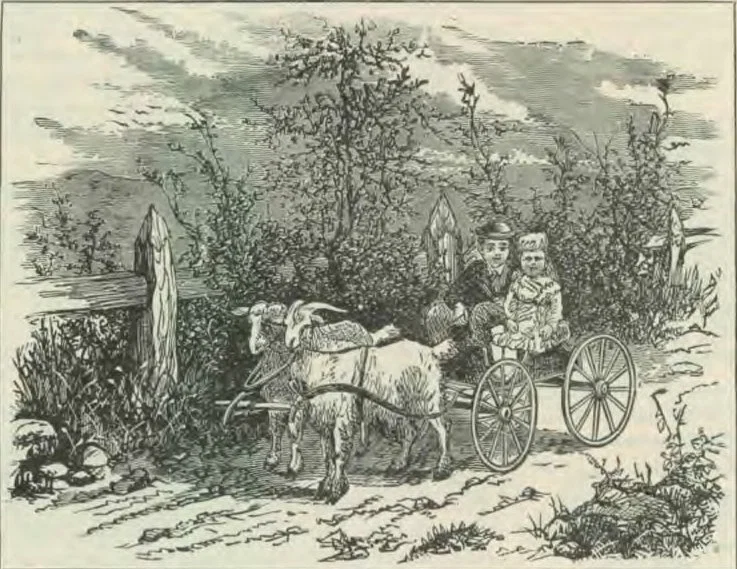
The picture shows driving animals differing from any I have mentioned. These can be trained to go side by side almost as well as a pony team. May be some of you have ridden after a goat team.
I once read a story about a little boy who owned a pair of goats. He lived in Massachusetts. His name was Charlie. The names of the goats were Nellie and Lucy.
Charlie was not old enough to read, but his mother had read him a pretty goat story, which made him feel that he would like to own a pair. He was an only boy, and very much petted, and to please and amuse him, his papa bought him a pair of jet black goats, with wagon, harness, whip, and all. The team was already well trained when it came to Charlie, so he thought all he had to do was to jump into the wagon and take a fast ride all at once.
No doubt Charlie was a little proud of his nice team; and as his playmates were standing around, he thought he would let them see what a fine teamster he was. But pride must have a fall, they say, and so it proved with Charlie; for he had gone but a little way, when the goats, in going down a short hill, turned one side, upset the wagon, threw the boy out, and started for home.
Charlie felt rather foolish when he picked himself up. But he made up his mind that he wouldn't be beaten in that way, and so he hurried up, caught the goats, and drove them safely home.
After that he had no more trouble with his goats; for he treated them so kindly they soon learned to love their new master, and to go where he guided them.
Let us believe Charlie learned a lesson by his unfortunate ride,—that because he had blessings some others had not, he should not think more highly of himself than he ought to think, and selfishly enjoy them alone; but instead, he should lovingly invite his little sister and playmates to share them with him.
A little girl has written the Budget about her pet donkey. If there was space here, I would like to tell you the story of a little boy's missionary donkey. I may tell it at another time.
But whatever blessings the Lord sends you, whether pet animals or something else, do all the good in all the ways you can with them. If the Lord finds he can trust you with blessings, he will send you more.
M. J. C.

A GOOD THING TO WRITE.

“WHAT shall I write on my slate?” said Harry to himself.
He could not write very well, but he sat down and did the best he could.
This is what he wrote:—
“A GOOD BOY.”
He took it and showed it to his mamma.
“That looks very well,” she said. “That is a good thing to write. I hope you will write it on your life as well as on your slate.”
“How can I write it on my life, mamma?” said he, laughing.
“By being a good boy every day and hour of your life. Then you will write it on your face too, for the face of a good boy always tells its own sweet story. It looks kind and bright and happy.”
“Where else can I write it, mamma?”
“If you write ‘a good boy’ on your life, my darling, there will be something still better written for you.”
“What is that, mamma?”
“Your name in the Lamb’s book of life. No name can ever be written in a higher, better place.”
I hope every little boy who reads this will try to have his own name written in the book of life by the Saviour’s loving hand.—Sel.

TIM'S DOVE.

One day when little Tim was picking berries in a field, he found a dove with a broken wing. He carried it home, and bound the wing close to the dove's side with a linen band. Soon the wing was as well as ever, and the dove could fly again; but it did not want to fly away from Tim, for it had grown very tame. Tim was glad to have it stay, for he had no toy or pets.
When he went to pick berries, the dove would go too, perched on his shoulder. Tim named it Fairy, and taught it to come at his call, and to eat from his hand. At night the dove would roost on the head of Tim's bed.
Tim's mother was taken very sick. There was no one to nurse her but Tim; and when she could not eat, and began to grow worse, Tim went for a doctor.
“She will get well if she has good food,” said the doctor. “She must have chicken or meat broth.”
Tim had no money to buy meat; but all at once he thought of his dove. He knew it would make good broth, but he could not bear to kill it.
He saw a neighbor going by the house, and he went out and put the dove into her hands. “Please kill my dove, and make my mother some broth,” he said, “she is so sick.”
Then he ran into the house, and tried not to think of his poor little dove. He did not want his mother to see him cry, for she would have said the dove should not be killed.
In about an hour, the neighbor brought some good hot broth; and when Tim's mother ate it, she said she felt almost well again.
“You shall have some more to-morrow,” said the woman. “I will make broth for you every day until you are well.”
Tim followed the woman to the door as she went out, and said, so that his mother could not hear, that he had no more doves, and did not know how to get meat for more broth.
Before the neighbor could speak, there was a rustle of wings, and Fairy flew in and perched on Tim's shoulder.
“Coo! coo!” she said, pecking at his cheek.
“You see I did not kill your dove,” said the woman. “I made the broth from a chicken, and I have plenty more at home. You were a good boy to be willing to have your pet dove killed to make broth for your mother.”
How happy Tim was! He loved his dove better than ever, now that he had it back again. His mother did not know until she was quite well how near she had come to eating poor little Fairy.—Our Little Ones.

WHAT AILED OLIVER?

“Ah! You are lying in bed too long. Breakfast will soon be ready. The canary bird has taken his bath, and is now singing a sweet song. Get up! get up! or I shall throw this pillow at you!”
“Don’t throw the pillow at me!” cried Oliver. “I’ll promise to get up in five minutes.”
“If you would be healthy, wealthy, and wise, you must rise early,” said Charlotte.
When Oliver came down to the breakfast table, his father said, “How is this, Oliver? You are late again.”
“I went to sleep, and forgot all about it,” said Oliver.
“Come here, my boy, and let me feel your pulse,” said his father. “I should not wonder if Oliver were suffering from a disease which is very common at this time.”
Oliver gave his hand to his father, who, after feeling his pulse, said, “Yes, it is as I thought. Poor Oliver has Slack’s disease. Take him up to bed again. Put his breakfast by the side of the bed, and when he feels strong enough, he may eat it. He may stay at home from school to-day.”
The little boy went upstairs with his sister, and was put to bed. He could not sleep, however. He heard children playing outdoors, he heard Ponto barking, and he heard Tommy, the canary bird, singing a sweet song.
Then Oliver called his sister, and said, “What is Slack’s disease? Is it dangerous?”
“I rather think not,” said Charlotte. “You little simpleton! don’t you know what father meant? He just meant that you were troubled with laziness; that’s all.”
Since that day Oliver has been the first one up in the house. He is no longer troubled with Slack’s disease.
Would it not be a good plan for all the boys and girls who read this to be on the lookout for the first symptoms of this disease?—Selected.

A QUEER LITTLE FELLOW.

A queer little fellow indeed was Tommy Dick. Why, he would give away the last marble he had, if a boy wanted it. He would run on errands all day long, and never grumble. He would always give the best place to somebody else, no matter who, and feel so honestly glad in seeing other folks have a good time that he really forgot all about himself.
Don’t you see he was a very queer little fellow?
But, somehow, everybody liked to have the “queer little fellow” around. Grandma always smiled all over her face when she saw Tommy coming. Aunt Lois, who was a very busy woman, used to say: “Well, now you’ve come in time, Tommy. Run, and”—
When Tommy went to spend the day with grandma or Aunt Lois, the folks at home all missed him. One would say, “Where’s Tommy? I wish he would come home.” And another, “Now if Tommy were only here.”
You see, Tommy was one of the unselfish helpers; and what a tiresome world this would be if there were not a good sprinkling of such people!
Are there any Tommies at your house? It wouldn’t do any harm if there were more than one, you know. Indeed, half a dozen boys and girls, with the spirit of Tommy Dick, would make home a very pleasant place.—Selected.

A BED-TIME SONG.

SWAY to and fro in the twilight gray, This is the ferry for Shadowtown; It always sails at the end of the day, Just as the darkness is closing down.
Rest, little head, on my shoulder, so; A sleepy kiss is the only fare; Drifting away from the world we go, Baby and I in the rocking-chair.
See, where the fire-logs glow and spark, Glitter the lights of Shadowland; The winter rain on the window—hark! Are ripples lapping upon its strand.
There where the mirror is glancing dim, A lake lies shimmering, cool and still; Blossoms are waving above its brim— Those over there on the window-sill.
Rock slow, more slow, in the dusky light; Silently lower the anchor down; Dear little passenger, say, "Good-night;" We've reached the harbor of Shadowtown.
—Selected.
Continue reading: OLD TESTAMENT HISTORY