The Youth’s Instructor, Vol. 37, No. 42.

THE MAID IN SYRIA

The Youth’s Instructor

Oct 16, 1889

S. D. A. Publishing Association · Battle Creek, Mich. · Oct 16, 1889

THE MAID IN SYRIA.
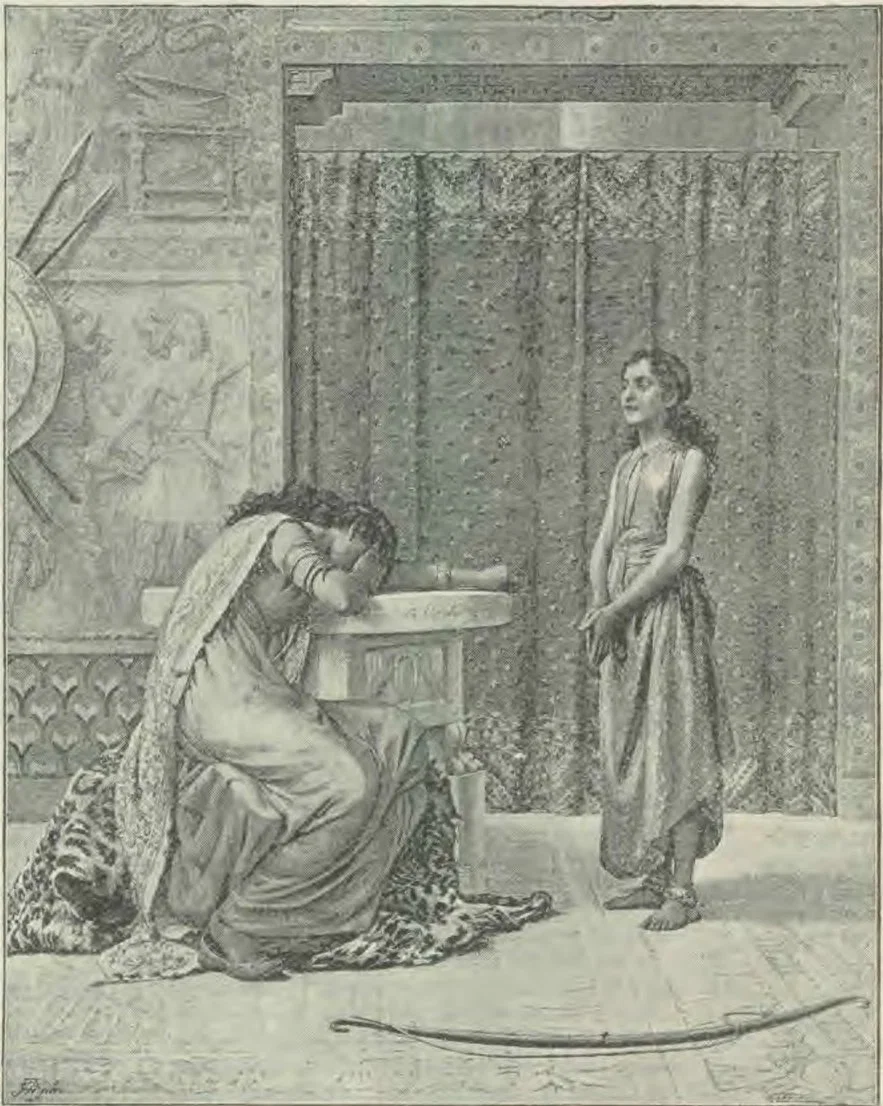
“WHY dost thou sigh, my Jewish maid, And sprinkle tears upon my braid, Like diamond drops? Be not afraid What grief can cast on thee a shade?— So young, so joyous! All the day Thy songs of Israel make their way In gleeful note, at work or play, Till I have heard my servants say, ‘Would Naaman’s wife were half as gay?’”
The Jewish maid let drop the braid Of rich, dark hair. She bowed her head, And burst in passionate sobs, and said, “My heart seems heavy and dismayed. I dreamed of Israel’s glorious light, Her fair, dim hills, and temple bright, And seemed my mother’s hand was laid Upon my brow just yester-night,— I woke a captive from her sight.”
Then Naaman’s wife drew close the child: Her eyes were sorrowful and mild. “Thy grief will heal; ’tis undefiled. My heart holds sorrow far more wild, O Jewish maid. Like a blown leaf, Some change will sweep woe from thy wreath Time, love, and youth will bring joy’s sheen To thy young heart; but no relief Years bring to me, but added grief.”
The Jewish maid was closer pressed Against the heaving of her breast, And the wild sobs broke, unrepressed, From a great sorrow, long suppressed. The little maid drew back in fear And pity, and the falling tear Dried on her cheek. Her mistress dear, So beautiful, so rich, bowed here, Weeping, and sore in need of cheer!
What could it mean? She thought no more Of what had made her own heart sore; She knelt, appealing, on the floor, And wept; but not as just before. Nay, not for self; but for the grief To which no years could bring relief, And sympathy hath potent healing, And through love’s tears was upward stealing, Soothing and easing, giving rest Unto the heavy-laden breast.
The captive’s tears upon her hand Seemed drops of balm from some rare land, ’T was no more maid and mistress there, But human hearts, that met to share A common woe. In the maid’s hair The mistress laid her hand so fair,
And her heart, touched with sympathy, Gave back again responsively, In the same measure. “Ah!” she said, “How dear thou art, my Jewish maid! But if thou’rt weary and dismayed, Thou shalt be free. Be not afraid.”
“O mistress, talk no more of this; Tell me thy secret wretchedness. Would I could heal! But list! there is One who can give thee rest and bliss. The God of Israel lives, and he Can take away thy grief for thee.”
The maid stood up, spoke eagerly,— Not now of her captivity,— But of the God who maketh free In heaven’s own sweet liberty.
The mistress’ heart was stirred. There grew A hope that her maid’s words were true; And then with tears of grief anew She told her sorrow, broken through With passionate words of love. “O maid,
He who is honorable is dead: E’en while he liveth! Leprous, dread, My Naaman walks where death doth tread. Soon all life’s sunshine will be fled; A deepening shadow falls each day, And darkens all my life’s pathway. Is there a balm for this? O, say, Hath thy God power such night to stay? Or must it fall, and blight love’s day?”
The little maid was trembling now. The light of joy was on her brow.
“Yes! yes!” she cried, “in Israel There lives a prophet I know well. Let thy lord go, and so inquire, And thou shalt have thy heart’s desire; For many wondrous things hath he Wrought out through God most gloriously.”
Now tears were o’er. With hair half dressed The mistress turned in eager quest To find her lord, and would not rest Till his train passed for Israel blest. Then how they waited! Oft the maid Cheered when her mistress grew afraid; Often they knelt upon the floor, The God of Israel to implore. The mistress learned a prayer to repeat From the poor captive at her feet; Learned to wait patiently until Jehovah should reveal his will, And one day, far across the hill, They heard a psalm the silence fill. “It is thy lord!” the maiden cried;
“He comes! the guards are at his side; But now his horse ahead doth ride— O let the Lord be magnified! Thy Naaman lives! Behold, he flies To meet the welcome of thine eyes! List! how he sings, rejoicingly, ‘Who forgiveth thine iniquity, Who healeth thy disease.’ Rejoice, For triumph rings within his voice.”
Now clangs the gate. “At last, at last, My Naaman, do I hold thee fast?
O blest be Israel’s God! O blest The love that brought our captive best To touch of him! No more, no more, Shall Ashtoreth be mine to adore. My heart is God’s and thine! O blest Be Israel’s God, who giveth rest!”
Then Naaman spoke, and then unveiled How Israel’s prophet had prevailed; And in the twilight, calm and rare, Naaman’s household gathered there, And joined in broken, heartfelt prayer, While o’er them hovered angels fair.
And in the worlds above, great fame Was given to a captive’s name, And when the hosts redeemed shall march Under the heaven’s expanded arch, A little captive maid will sing, And on her head sweet heaven’s King Will place a crown, that no rust mars, And it will shine with untold stars.
O captive maid! You still are here In the dark Syrian land, I fear; And yet God knows and watches you, To see if you, too, will be true; To see if in a time of woe, You will forget for others so The grief that’s yours, and win a gem For Christ’s eternal diadem.
FRANCIS E. BOLTON.

MISS WEST'S CLASS TALK ABOUT WORDS.

The lesson commences at the chapter about volcanoes,” said little Harry, in his Physical Geography class, in answer to his teacher’s question.
“‘Commences?’” repeated Miss West, smiling. “Why don’t you keep to our old Saxon word, ‘begins’?” “What is a Saxon word, please?” asked wide-awake Nettie Gay.
“One in the tongue of the Saxon people, who came to England long ago, and laid the foundation of the English we are speaking to-day.”
“And what kind of word is ‘commence’?” asked Harry.
“A French one; we have many of them, and of Latin words too, in our language.”
“Why?” asked Nettie again.
“From the time of the Cæsars until the present, Latin words have in various ways been brought into England. The Romans first visited England before the days of Christ; and they had conquered a great part of it by the end of the first century of the Christian era.”
“Were the Saxons there, then?” questioned Johnnie. Johnnie had once been praised for remembering dates, and he was now very correct about the time of every event.
“No; not for three or four hundred years afterwards. When the empire of Rome grew corrupt and weak, the Roman soldiers were called home from England. The Britons asked what they should do without their help when the Scots and Picts swept down upon them from the North, and the Romans answered, scornfully, ‘Help yourselves.’”
“There is a tradition, however, that the poor Britons had so grown into the habit of leaning upon others that they did not dare to trust to their own strength; so their rulers called the fierce Saxons over from Germany to aid them. The Saxons indeed drove back their Northern foes, but they brought a worse enemy than they expelled.”
“Oh, who was it?” cried Willie Small.
“Themselves. They found the country so much better than their own, that they drove the poor natives into Wales and Cornwall, and took possession.”
“Is all this true, or only tradition?” asked Johnny Smart, loftily.
Perfectly true that they came to England, but only tradition that they were invited there by the Britons.
“From the Angles, who came at about the same time, and who are considered by some a branch of the Saxon race, the name Angle-land, or England, is taken. The French call it ‘Angle-terre,’ ‘terre’ meaning land.”
“So the Romans came first?” said Harry.
“Undoubtedly.”
“And the Saxons before the French?”
“O yes; don’t you remember the battle of Hastings in 1066, when William, Duke of Normandy, was defeated and slew Harold of England, and received the name of Conqueror for this victory, which gained him a kingdom?”
“And I have read somewhere,” said Grace Morris, “that he even tried to make the school-children learn their lessons and talk in French, so that they might forget all about their own language. But he didn’t succeed anywhere except at court.”
“I almost wish he had,” sighed poor Kitty Currier, who had been spending her last hour over French idioms.
“Silly child!” retorted Nettie Gay, contemptuously, “that wouldn’t have helped you any; you’d only have had some other language to study.”
“No,” said Miss West, “William did not succeed; for it is much easier to conquer a kingdom than to change a language. Yet very many French words were brought into use then, and have always remained with us.”
“But if we ought to use Saxon words instead of French, I don’t see why we shouldn’t use Latin instead of Saxon; that would be in the right order,” broke in Harry triumphantly, as eager for a chance to prove his point as if he had been ten or twenty years older.
“We certainly must use them every hour in the day,” said Miss West; “they are more or less in our most common expressions. Yet we often have a choice: sometimes that choice is merely a question of taste, as between ‘commence’ and ‘begin,’ sometimes much more, and the reason is this: In spite of Danish and Norman grafts, the Saxon race is the trunk of our ancestral tree, and we are most our genuine selves in Saxon words.”
“Now, if you were listening to an account of some wonderful adventure given in such a bungling way that you could understand nothing about it, which would you cry out in your impatience, ‘Commence at the commencement of your recital, I entreat you, and relate to me all the circumstances lucidly,’ or, ‘Begin at the beginning of your story, I beg of you, and tell me everything just as it happened’?”
“O, ‘Begin at the beginning,’ of course,” answered a chorus of voices.
“Why?”
“Because it’s easier to say, and comes into one’s head first.”
“The very reason. We are more Saxons at heart than anything else; so when our hearts speak warmly and without forethought, it is the Saxon words that most readily flow. Orators and poets understand this, and when they most carry away hearts with them, they speak and sing in such every-day words that you wonder where the power and music come from, and almost believe that you could use those easy words in the same way yourself—until you try.”
“We gladly take the words that come to us from other languages, since our own is all the richer for them. To refuse them would be as ridiculous as to say we will not eat dates, and figs, and bananas, and the many other choice foreign fruits, because they do not grow in our own country. Listen to what people say in any sudden and strong excitement, and you will find what words can give the most meaning in the shortest time. I think, too, you will see that for the most part they are Saxon ones.”
“But, Miss West,” piped the shrill voice of Lizzie Day, “don’t you like nice, long, elegant words that sound well?”
“Very much indeed,” was the answer. “Do any of you know how sculptors make their clay models before they touch the marble?”
“No, no! tell us, please.”
“I saw one once at work upon a statue for a soldier’s monument; it was only partially done, and I noticed that he had at first modeled the form, that every curve and muscle might be true to life, and then, with more clay added to that, was clothing it; for one foot was bare while the other had its boot; the head was bare, and a soldier’s cap was hanging near by, ready to be copied.”
“Now that is the very way, I think, in which we should learn to use language. First, we should know how to express exactly and simply every thought we utter. Then, by all means, let us add whatever will give grace and refinement to our speech. But remember that embellishments are to beautify language to perfection, not to cover up inaccuracies of thought and word.”
“But our lesson!” cried Miss West, interrupting herself. “Willie, what is a volcano?”—Wide Awake.

WHO WINS?

I HEARD a story the other day about an old Indian who had borrowed some tobacco from a white man. After he had got to his wigwam, he found some money rolled up in the tobacco, and at first was quite delighted to get it, thinking only of how many pounds of tobacco it could be exchanged for. But during the night the Indian grew restless, and could not sleep; the thought of the money began to trouble him, and he could not make up his mind that it belonged to him. So the next morning he rose bright and early, and came and asked for the “white man.” Upon his appearance, the Indian said:—
“I found some money in the tobacco you gave me.”
“Why didn’t you keep it?” asked the white man.
“Because,” said the Indian, pointing to his breast, “I’ve got two men here. One man say, ‘It is not mine; give it back to the owner.’ The other man say, ‘Keep it; it is yours.’ Then the one man say, ‘No, no; give it back, it is not yours;’ and the other man say, ‘Yes, yes, it is yours; keep it.’ So I don’t know what to do; the two men inside keep talking all night, and they so trouble me I bring the money back, and now I feel good.”
Dear children, these “two men inside” are Temptation and Conscience, and they are within you just the same as they were within the old Indian. The bad man is Temptation, the good man Conscience, and they are talking together all the time for and against your duty, and prompting you to do right or wrong. Who wins?—Selected.

WATCH THE WEAK POINTS.

Life is a battle, not to be cowardly shunned and shirked, but one into which we should enter bravely, firmly relying upon Him who is both able and willing to give the victory. For he says: “Be of good cheer; I have overcome the world.” Let our reliance be continually in Him, let us be clothed in the complete panoply of heaven, let us bravely and firmly resist evil in heart and life, and victory is certain, and its rewards glorious.
We should always guard the weak points of character—the places where we are most likely to yield to temptation and sin. No chain is stronger than its weakest link. No fortification is stronger than its weakest point. The farmer’s fence may be good and strong, but as long as the gate is broken off its hinges and standing wide open, the fence will be of no value. So may we guard our character at every point save one; but through that open door the tempter may enter, and ruin follow. “He had only one fault!” Ah, but that one fault was enough to destroy his usefulness and happiness and hopes.
Here is what a gifted writer said recently about the little things which many count too trifling to notice:—
“It is these weak places, and these personal failures, when some one blunders and does not do his duty, that are forever causing disaster in this world. An operator on the railway fails to give the right signal, and a train whirls on, to collision and wreck. A drug clerk reads a prescription carelessly, and a patient is hurried into eternity. A general makes his plan of battle, and leaves no contingency unprovided for, but at a critical point one officer fails or loiters, and all is lost. A bit of information about a road is said to have cost Napoleon the field at Waterloo, with all that it involved. A little strip of sunken road was overlooked by the engineers, and threw all the magnificent plans into disarray, and led to defeat. In an obscure shop, where the great irons are cast, one piece is carelessly handled; a bubble of air creeps into the casting. Five years afterward there is a terrible disaster. The bridge breaks down under the heavy train, and hundreds of lives are lost. It was that bubble of air that did it. A child is being trained in a home, and one bad habit is allowed to go uncorrected. Years after, a man fails in the midst of a promising career,—fails because of one weakness in his character. It is the old, uncorrected bad habit in the child, developing itself, and causing wreck of all. The lesson is obvious, and no more important one can be taught to the young. Weakness brought failure, dishonor, and death. Flaws covered up in youth bring ruin later on. In the culture of character, nothing is a trifle; for the smallest defect may lead to utter wreck.”
“It is the little rift within the lute That by and by will make the music mute; And, ever widening, slowly silence all.” —Selected.

“BOYS WILL BE BOYS.”

“BOYS will be boys!” Yes, if boys may be pure, Models for men; If their thoughts may be modest, their truthfulness sure, Say it again! If boys will be boys such as boys ought to be, Boys full of sweet-minded, light-hearted glee, Let boys be boys, brave, loving, and free, Till they are men! —Christian Union.

THE WORD OF GOD IS FREE.

A MISSIONARY in India one day found a company of twenty-seven people approaching his bungalow. He invited them in, and they sat down together on the floor. He found they had walked in from a village seventeen miles off. They talked, and he asked if there was anything he could do for them.
Their leader said: “Can the teacher give us a Bible in the Persian language? We have sent to Calcutta, to Bombay, to Benares, to Allahabad, but cannot get one in any of these places. Can the teacher give us one?”
The missionary said: “I have indeed one copy, but only one, and I do not know where to get another. If I give it to you, what can I do when I want to read out of it to the people?”
Still they pleaded for it. “And why,” said he, “do you want this book?”
“We want it because it tells of the Lord Jesus and the way to heaven.”
The missionary could not resist that appeal, and gave it to them. The leader clasped the book to his heart, and kissed it again and again. He then took out a little bag full of gold and precious stones, and begged the missionary to take it. But he refused, saying, like the Vandois teacher,—
“Nay, keep thy gold, I ask it not; For the word of God is free.”
“The book was a present to me,” he said, “I give, I cannot sell it. And now what will you do with it?”
“I will go out by the temple every morning, and there I will read for twenty minutes to all who will hear.”
And when we last heard of him, he was faithfully keeping his word.—Exchange.

WORSHIPING THE GOD OF SELF-RESTRAINT.

It is related that for generations a certain Japanese family had a box into which they put percentages. Said one of them: “If I want to buy a garment that costs one dollar, I buy it for eighty cents; or give a feast that would cost five dollars, I give it for four dollars; or to build a house for one hundred dollars, I build it for eighty dollars, and put the remainder into the box. At the end of the year we meet, open the box, and give the contents to the poor. It costs us some self-denial, but we are always prosperous and happy.” They call this worshiping “the great, bright god of Self-restraint.”—Sel.

LOOKING AT THE BIBLE.

The following incident is related of an old Alaskan: The day before he died, a missionary saw a Bible tied to the top of a stick about three feet long, set in the ground near his head, and asked why the book was tied there. The old man said: “I can't read, but I know that is the Great Word; so when my heart gets weak, I just look up at that book, and say, ‘Father, that is your book; no one to teach me to read; very good, you help me.’ Then my heart gets stronger; the bad goes away.”—Sel.

“DID GOD SEND YOU, SIR?”

A GENTLEMAN saw two children before him in the cars, a boy and a girl. Both looked tired. They were dressed poorly but neatly, and were traveling alone. Toward noon the little girl got up from her seat. Presently he found her kneeling on the floor, with her head bowed in the cushion. Was she sick? Did she find this an easy way to sleep?—No; she was praying.
“What are you doing, my little girl?” he asked when she got up.
“I was saying, ‘Our Father who art in heaven,’” she said.
“And what were you saying it for now?” he asked again.
“I’m so hungry,” she said.
“We have been traveling two days,” said the boy, “and our luncheon is all gone.”
The gentleman wished he had something in his pocket, but it was empty. At the next stopping-place, he went out himself, and bought something for the children to eat.
When he handed it to the child, she said, looking up with a blush of joy upon her face, “I knew it would come. Did God send you, sir?”
Yes; God sent the gentleman. The child did not see how the cars were to furnish the “daily bread,” going so fast, and no pantry. But the Son of God taught her to pray, “Give us this day our daily bread,” and the little girl believed it. She asked him, and God well knows ever so many ways to answer our prayers. You see he used a kind gentleman to answer hers.
There is a small word in the Bible, of which some people ask, “What does it mean?” The word is faith. What is faith?
It is asking God, believing and trusting him. This is what the little girl did: and it is the kind of asking which God loves, and loves to answer.—Selected.

IF I WERE YOU.

WHAT would I do if I were you? First thing I'd make a rule To put my hat and books in place When I came home from school.
What would I do if I were you? I wouldn't pout and cry, Because I couldn't have my way About a piece of pie.
What would I do if I were you? I'd speak a pleasant word To this and that one in the house, And not be sour as curd;
And when a body asked my help, I'd try to do a favor So that it should not always have A disobliging flavor.
If I were you, my little friend, I'd try to be so good That my example all around Might follow, if they would.
I'd go to Jesus now and give To him my naughty heart, Ask him to make it new and pure, And his own love impart.
—Selected.

TRAVELING IN BOGOTA.

EVEN our young readers, I suspect, can tell what a mountain is, although they may never have seen one. It is wonderful how many there are upon the earth, and some of them so very, very high!
If you will look upon a map of the world, you will see pictured out upon the western coast of America (and here I mean both North and South America) a long chain of mountains. It reaches from one end of the continent to the other. There are many other chains of mountains upon the earth, but this is probably the longest one.
This long mountain range is not called by one name. In South America it is named the Andes; in the northern and western parts of America, the Rocky Mountains; in the central part of America and in Mexico, the Cordilleras and the Sierras.
Among these mountains are some peaks that rise thousands and thousands of feet higher than the waters of the sea; so high that no man can climb to their top, which is always covered with snow and ice. There are but few peaks in the world higher than some of these.
You have learned in your geographies that a valley is the low land between hills and mountains, and that table-land is level land way up on high land. Some mountains rise, peak by peak, away up into the clouds, with hardly a resting-place for the foot of the traveler. Others rise hundreds and thousands of feet, when there will appear a great level tract of land, sometimes many miles long and wide, around which peaks several thousand feet higher lift their lofty heads. May be you have learned the names of some of these high peaks.
Well, that part of America which lies within the tropics (how many of our small boys and girls know where the tropics are?) has some wonderful valleys and table-lands. You will find many of these about Quito and Bogota in South America, and in Mexico.
One, the table-land of Quito, called also the valley of Quito, is thirty miles wide, and two hundred miles long from north to south. It is a level tract of land upon the Andes mountain range, 10,000 feet higher than the sea, so you know why it is called table-land.
But I think I hear you ask how it can be a valley; for the school books say that low land between hills and mountains is a valley.
Quito table-land is surrounded by some twenty great peaks that rise several thousand feet still higher, making this low land when compared with the great mountains on all sides of it. The table-land of Quito is a high valley.
The valley is on the equator, and the climate is said to be more nearly perfect than anywhere else upon the globe. It is neither too hot nor too cold, but is fine spring and autumn weather the year round. The atmosphere is so pure that persons with good habits are hardly ever sick; and it is so clear, too, that the cloaks of the horsemen have been seen when eight miles away.
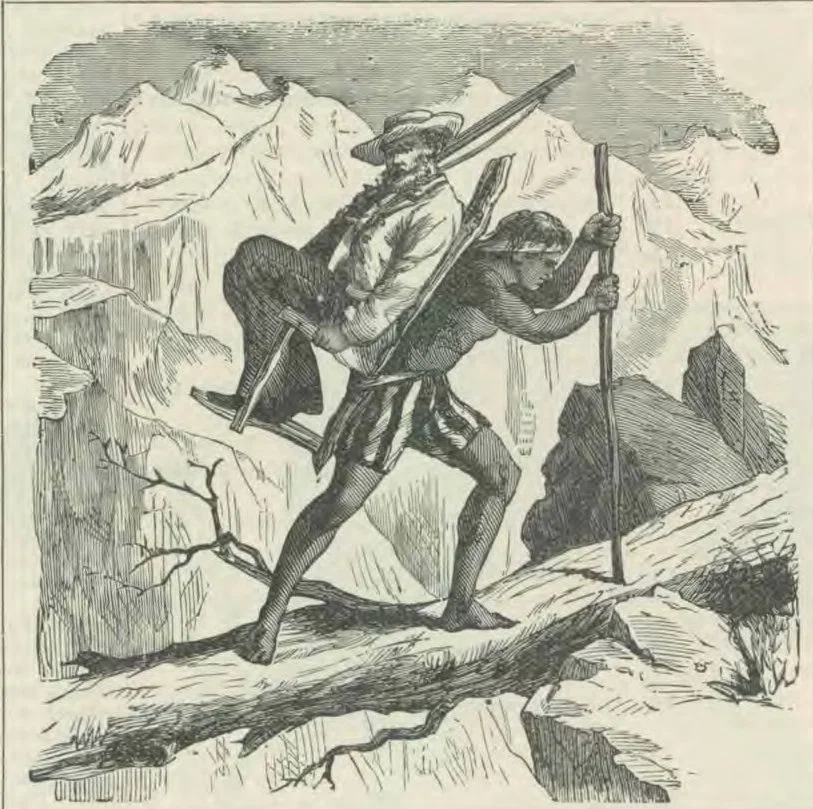
There is much you should know about the Quito valley, and of the hard times the traveler has climbing the mountains before he reaches it; but I must hasten to tell you something of another great table-land two or three hundred miles farther north; for our engraving shows you a traveler making his way towards it—the Bogota table-land.
One writer says if you will pile the Catskill Mountains of New York on the top of Mt. Washington, N. H., and then level off a tract about half as large as Connecticut, you will have the great Bogota table-land, which the people who live there think is the pleasantest place in the world.
But like Quito it is a hard place to reach; for after sailing up the Magdalena River two or three hundred miles, one has to go over two ridges 3,000 feet high before he gets to the foot of the mountain, where it rises up like a great wall. Up this wall a crooked path winds something like a circular staircase.
The plain of Bogota is not far from the equator, and is lower down the mountain side, yet it is much colder than Quito. Wheat, barley, and grass, with a few roots, are the most that will grow there. People who live in the plains away down the mountains supply the Bogota markets.
Men and women climb the mountain with great loads of fish or plantains, and if they happen to sell them while trudging over the plain, they think themselves fortunate. Often before they go back down the mountain, they will climb still higher, up some one of the peaks that lie around Bogota, to buy oranges and other tropical fruits to take home with them.
But you must not get the idea that these grow away up on the mountains above Bogota. No, they are brought from the valleys ever so much lower down than Bogota, on the other side of the mountain.
We would none of us think Bogota a nice place to live in; for it is so cold and rainy there, most all the time; but every one thinks his native land the best. When the inhabitants want a very good time, in a warmer climate, they make a visit to the plains lower down, or at the foot of the mountain. One village where they like to go is a long way down, and to reach it they have first to climb a mountain one thousand feet higher than the table-land where they live, and then go down three thousand feet on the opposite side of it.
There are two ways of traveling,—“mule-back” and “man-back.” When traveling with a mule, they usually load him down with luggage, leaving room for only themselves to ride.
The women generally ride man-back, or by silla; and so do the men quite often. A bamboo chair is strapped to a man’s back, as seen in the picture, and the rider sits there perfectly helpless. I think he must have a good deal of faith in his sillero, as the man is called who carries the passenger.
But a story is told that one time a Spaniard, wearing huge spurs, was riding in this way near Bogota, when he began pricking his sillero as though he were a mule. The sillero gave a sudden jerk, and threw him down a precipice, and then ran away, and was never caught.
M. J. C.
Continue reading: A WORKING BOY