The Youth’s Instructor, Vol. 37, No. 28.

A PSALM OF DAVID

The Youth’s Instructor

Jul 10, 1889

S. D. A. Publishing Association · Battle Creek, Mich. · Jul 10, 1889

A PSALM OF DAVID.

My Shepherd is the Lord; Want I shall never know: He maketh me to lie Where verdant grasses grow.
Beside the waters still He ever leadeth me; He strengtheneth my soul, That I may righteous be.
No evil will I fear, Though death come near to me: For thou art ever near, Thy staff, it comforts me.
For me thou dost provide In the presence of my foes; How can I e'er thank thee? With joy my cup o'erflows.
Through all the days of life, Shall mercy follow me; And in thy house, O God, I will abide with thee.
MABEL ROBBINS.

AN ANCIENT WARRIOR'S ARMOR.

As long as war has been one of the conditions of life of the human family, so long have various methods and means of personal protection been used. The ancient methods of warfare, and the arms used in war, were very different from those used at the present day. Then it was a hand-to-hand conflict, with swords and spears and arrows; but the invention of gunpowder has entirely changed all these. And while these various contrivances for protection might have been of much service in those days, with the methods and instruments of war then used, at the present time they would be worse than useless, by their cumbersome weight and their impediment to the free movements of the wearer, and their inability to shield the wearer against the terrible missiles that are hurled from the mouths of rifles and cannons by the force of exploded powder.
The history of the many kinds of armor that have been used in war by the various nations is very interesting. It is asserted by some writers that the skins of wild beasts formed the first means of defense of the body. But it is certain that bronze, or brass, was very early used as the material of these helmets and body armor; for we learn from sacred history that away back in the days of David's youth, when he went forth with the armies of King Saul to fight the Philistines, in the valley of Elah, that a haughty giant Philistine, who came out and bade them defiance, “had an helmet of brass upon his head, and he was armed with a coat of mail, and the weight of the coat was 5,000 shekels of brass; and he had greaves of brass upon his legs, and a target of brass upon his shoulders,” etc., and when David told King Saul that he would go and fight the haughty Philistine alone, Saul, thinking to protect him from the weapons of his adversary, “armed him with his armor, and put an helmet of brass upon his head; also he armed him with a coat of mail.” But as David did not like these, he finally put them off, and went forth armed only with a simple sling and five smooth pebbles from the brook.
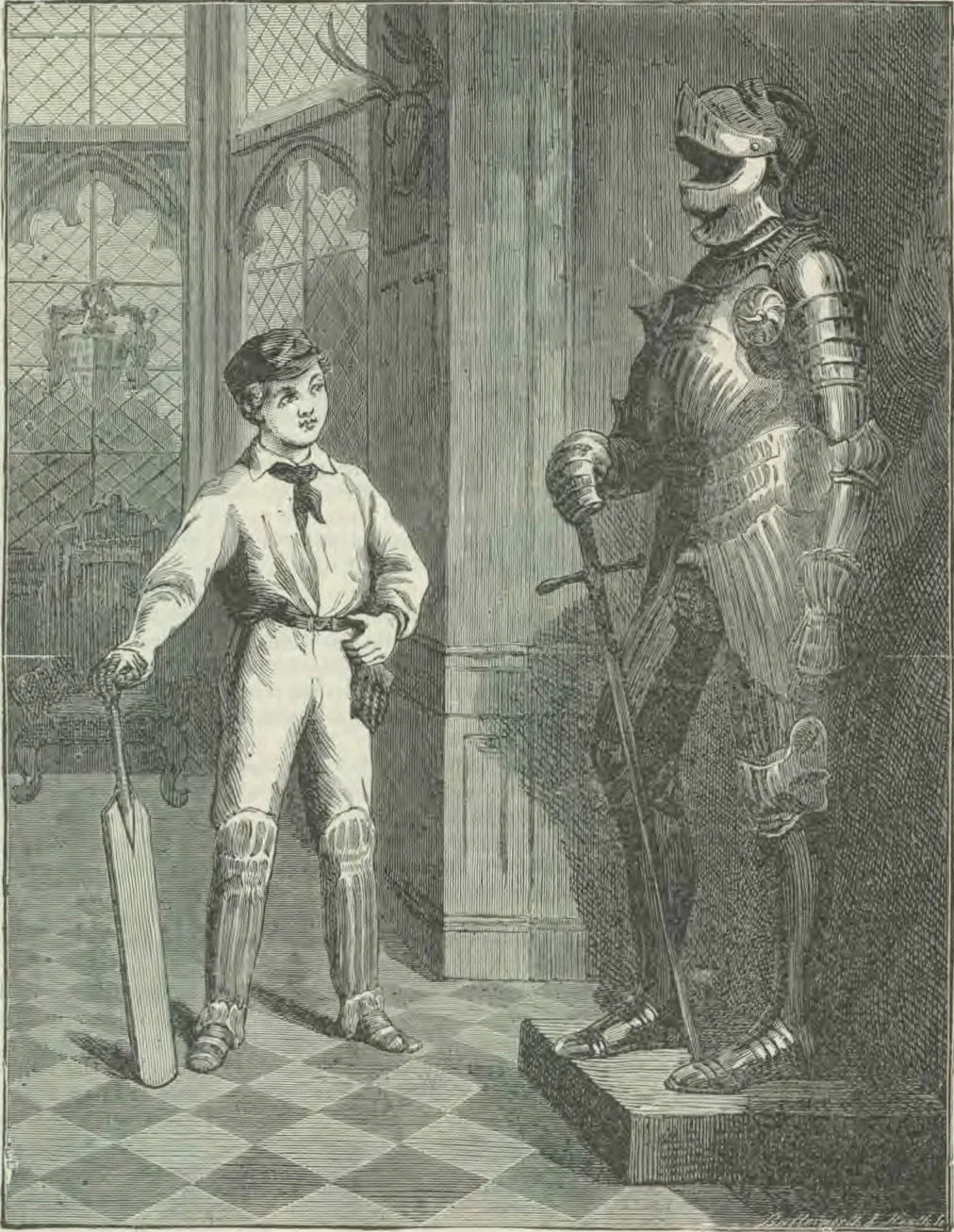
The accompanying engraving presents a very good illustration of a complete suit of armor as worn by the ancients. With different nations its construction and form were changed. While some adopted a style which covered the entire body, with the exception of a portion of the face, others wore an armor which left many parts of the body exposed. We also learn that the ancients possessed a secret by which they accomplished that which modern science has failed to do,—the tempering of copper, or bronze, so that it would carry a cutting edge, and would repel a sword-blow or a spear-thrust, without bending.
From that of a rude piece of workmanship, these armors became very ornamental, and the splendor of their construction became a matter of much attention. Froissart records the case of Raymond, a nephew of Pope Clement, “who was taken prisoner, but afterward put to death for his beautiful armor.” Miniature wings were attached to the back and shoulders, the caps were adorned with plumes and feathers, and much effort was made to make them exceedingly showy.
Thus as the methods of warfare changed, these things changed also, until, instead of being worn only as a means of protection in battle, they were worn solely at tournaments and on festive occasions.
In the Tower of London there is preserved an unbroken series of specimens of the armor of every reign from the time of Henry VI. to that of James II., with whose time the use of the complete armor is said to have ceased. So perfect and complete had this armor become, that historians tell us that in Italy, where the best armor was made, two armies fought from nine o'clock in the morning until four in the afternoon, and not only was no person killed, but no one was wounded.
This armor is frequently spoken of, not only by the writers of the Old Testament, but also by those of the New. The Apostle Paul, in his writings to the churches, uses it to enforce upon the minds of his brethren the truths he was endeavoring to teach them, exhorting them to, “Put on the whole armor of God, that ye may be able to withstand the wiles [or attacks] of the Devil.” And that Paul was familiar with that of which he was speaking is shown by his enumeration of the various articles of armor deemed necessary for complete protection against the weapons of the enemy. He says: “Stand, therefore, having your loins girt about with truth, and having on the breastplate of righteousness; and your feet shod with the preparation of the gospel of peace: above all, taking the shield of faith, wherewith ye shall be able to quench all the fiery darts of the wicked. And take the helmet of salvation and the sword of the Spirit,” etc. Eph. 6:14-17.
If it was necessary for the ancient warrior to so thoroughly equip himself with the armor provided for him, it is equally as important that the Christian, fighting the spiritual warfare, be thoroughly clad in the armor provided for him. The foe he has to meet is a strong and wily one, by long experience, and he readily sees the weak and unprotected points in the Christian's character. While such complete provision has been made for our protection in this warfare, let us be diligent to heed the apostle's injunction to “put on the whole armor, that we may be able to stand.”
J. W. B.

Pleasant Temptations and the Danger of Compromise

He who, meeting a pleasant temptation, stops to shake hands with it, will generally end by going with it wherever it chooses to lead him.

WHAT JUST ONE MAY BE DOING.

“That is a splendid tree before the door!” says somebody.
Yes, a vast surface of rich foliage; a garment by day and a roof by night, a fan in the wind and a screen against the sun, all of a deep emerald. And yet it is just a beauty of leaves, single leaves, this one here, another there, all over the tree.
Yonder is a luxuriant meadow of green grass, rolling in waves before the wind; in the morning sparkling with dew-drops, or dark in the cloud-shadows, and then lustrous in the sunshine. But all this richness of the emerald meadow can be separated into a beauty of individual grass-blades, each one growing thriftily in its place, and so helping to make the attractiveness of the whole.
Again, you see a great glory in the western sky at twilight, or a like magnificence in the east at morn; huge piles of jasper, ruby, topaz,—one great jewel-heap. And still, after all, it is only a mass of flecks of vapor, little separate atoms, each illumined into a rare stone in the sunlight.
So all the world over it is the same fact that summer emphasizes in its lovely valleys and on its lofty hills,—the importance of the unit, which, through its beauty and richness, contributes to and helps make the glory of the whole. The one makes the many. Units multiply into and determine the tens, hundreds, thousands.
Do we remember this in our separate lives? Do young people bear it in mind?
“Of no account!” says a lad stepping out into life. “What do I amount to?”
The leaves don’t act as if they felt that way. Each grows luxuriantly, and all spread out their beauty and usefulness.
“Of no account!” moans the young, despondent girl.
Bits of vapor are not influenced by any such reasoning. They all do their duty, and as if weavers at the King’s loom, what glorious patterns they hang up in the sky!
Just do your best. You count one every time. Be honest, then; be pure, be self-denying, be Christian. You will be a joy to your home, an ornament to the community, a pillar in the church, and what honor you will bring to God!
Neither will your record be a short one. Leaves and grass-blades must wither. Bits of vapor must be blown away or borne to the earth. Character, though, the one soul, will grow more beautiful, useful, grand, and grow—forever!—S. S. Classmate.

“DOES IT MATTER?”

THERE was a boy whose name was Arthur, who often asked this question. He was not a bad boy, nor a careless boy, but he did not like a fuss, and very seldom made one if he could help it. He took things quietly, if they were such as could not be avoided, and he was one of the best-tempered boys in the whole school.
Because of this, some of his classmates tried to tease him into being angry. They said among themselves, “Arthur thinks things do not matter when they touch us; I wonder what he will say if we do something to vex him.”
That was because he had been trying to make peace between two lads who would certainly have fought if he had not persuaded them not to do so.
“It is unnecessary,” he said. “Supposing you do not quite understand each other, it really does not matter. Keep quiet for a few minutes, and you will soon feel all right again.”
The boys took his advice, and a quarrel was prevented. But I am really afraid that even this did not please all the boys. Some of them would rather have enjoyed seeing this dispute carried a little farther; for they were not peacemakers.
“What can we do to vex Arthur?” one said.
Various things were suggested. But that which found most favor was that they would hide his clothes the next morning, and so make him late for breakfast. They knew there was a rule to the effect that if a boy were ten minutes late to breakfast, he would lose the meal altogether; and they decided to try the effect of hunger upon the temper of Arthur.
They always had breakfast at seven in the morning, and the boys were expected to be ready. Arthur was very punctual. He was never late if he could possibly prevent it, and the boys knew that, and thought it gave them a better chance to annoy him.
The next morning the bell rang, and the boys began to dress. Arthur sprang out of bed, and a look of surprise came over his face when he could not see his clothes in their usual place.
“What did I do with them?” he said to himself.
The boys kept their faces grave.
“I say, you fellows, have you been playing any pranks?” he cried.
But the boys were particularly busy just then, dressing or washing, and did not appear to hear him. They were, in fact, rather too deeply occupied, and Arthur began to suspect them.
“Who has taken my things away? You might tell me,” he said.
“What things? What a fuss you are making, Art. Why don’t you look for your things?”
“I have looked. They are not here.”
“Surely they are where you left them.”
“Indeed they are not.”
The boys went on with their occupations, and for a moment Arthur felt rather vexed. But he speedily controlled himself.
“It does not matter. It is not worth while to lose my temper over it,” he said to himself. “At the worst, I shall only have to go without my breakfast, and I am not very hungry.”
So he got into bed again, taking with him a book which he was studying, and coolly began his day’s work. The boys looked at each other.
“It does not matter, does it, Arthur?” said one.
“Oh, no, it does not matter,” he replied.
The boys were determined to carry it through, and Arthur lost his breakfast. But they did not dare keep him longer in bed; and so they gave him his clothes in time for morning school.
“He is a good-humored lad,” said one of the oldest boys, “and it is a shame to try to vex him. I wonder if anything matters to him.”
He had not to wait very long to know that certain things mattered very much to Arthur; but they were not things that concerned only himself. He put up patiently with almost any treatment if it concerned none but him. But when, late in the day, a few big boys were dealing harshly with one who was too little and feeble to help himself, Arthur appeared in a new character.
“Leave him alone!” cried he, with crimson cheeks and flashing eyes. “None of you shall touch him again while I am here.”
“It does not matter, does it?” sneered one of the boys.
“You shall see,” said Arthur.
But the other seemed to think it better to release the little boy, and not molest him further.
Will you be surprised to learn that, as time passed on, no one in all the school was more respected than Arthur?—Marianne Farningham.

CAST THEM IN.

CAST it in, your little pebble! Cast it into the broad sea! Is it very, very tiny, Just a speck beside the sea?
Will the great rough waves laugh at it As it falls and sinks below To be lost? Will they not feel it? Try. Now give it a good throw!
There it goes! Ah, watch the circles! See! they larger, wider grow, Till each drop of those vast waters Has felt that wee pebble's blow.
Cast it in, your little effort, Cast it into love's broad sea! God will make its influence widen; It shall reach eternity.
—Morning Star.

WHO WILL BE SAVED?

WHEN we read the letters in the Budget, we find many little people saying they “want to be saved when Jesus comes,” or they “want a home in the new earth.”
Not long ago I heard a good lady tell how she felt about this when she was a child. She had a good father and mother, but they did not talk freely with their children about religion, and she did not dare to tell them what was in her mind. She would often lie awake nights and cry, because she wanted to know whether the Lord had forgiven her sins. She heard a schoolmate say that she knew her own sins were forgiven; but even then this little girl did not dare to ask any questions.
By and by revival meetings were held in the place where she lived, and her father responded to the call for backsliders to come forward for prayers. Taking his little daughter by the hand, he invited her to go with him. How glad she was to take this step in the service of God! She was induced to join the church; yet she did not dare to ask the questions she so much wished to have answered, and by degrees her anxiety wore off. But at times the old yearnings came back, and the Spirit of the Lord pleaded with her to lead a devoted Christian life. Still she was too timid to make the inquiries she thought she ought to make.
She is a woman now, and has learned to know that God loves her, and has forgiven her sins because he has promised that he will forgive the sins of all who repent, and she believes he is a God of truth. But she is very sorry she did not know how to trust God when she was a child; for she thinks her whole after-life would have been better and more useful than it has been.
Dear children, if any of you feel anxious to know that God has forgiven your sins, don’t be afraid to talk with your parents or some Christian friend about it. God is love. He is faithful to do all he has promised, and he will begin to do it just as soon as you begin to do what he has told you to do.
Read the Bible, and if you cannot find the places where the Lord talks to you about your duty, ask some one to find them for you.
The angels are watching you. They are anxious to determine by your actions who of you truly want to be saved. You may profess religion, and speak in meeting every Sabbath, and say you want to serve the Lord and be saved; but it is how you act every day that will tell whether you really do want to be saved or not. If you are very careful to keep all the commandments of God, because you would rather please the Lord than have your own way, then you show to the angels and to all who know you that you want to be saved.
MRS. H. W. PIERCE.

CHINESE CHILDREN.

DID any of the boys and girls who read the INSTRUCTOR ever see a Chinese child or baby? Their parents call them “Wa-wa’s” when they are small. If a boy, when he becomes old enough to run around, he must have his head shaved; and it is done in a way that little tufts grow out again, all over his head. These are what could be called “queue sprouts,” and they are all braided as they grow, and kept tied up, until finally all are shaved off but one, which remains as the “queue.” At this time he puts on, for the first time, trousers with pockets in them, and is just as proud of them as any American boy is of his.
“Chinese boys have a great many amusements open to them. They play marbles as we do, only the marbles are rolled with the foot instead of the fingers. They play a game like battledore and shuttle-cock, only the sole of the foot takes the place of the battledore. It is wonderful what skill they acquire in the game, and the length of time they will keep the little tuft of feathers in the air, never allowing it once to touch the ground.
“Kite-flying is universal in China, though that is rather a man’s amusement there. But the range of toys for children is almost endless in its variety, and while they are ruder and far cheaper than the elaborate clockwork contrivances with us, they serve their purpose equally well.
“But boy life in China is not all made up of play. His preparation for manhood is made much the same as with us; and when he reaches a suitable age, he is either sent to school, or put to work. Schools are found in all the cities and villages, not supported by a tax, but by subscription or by tuition fees; and all Chinese parents who can possibly afford it, send their sons to school. The sons of the poorest peasants—poor with a poverty of which we know nothing—may aspire to the highest offices of the State, excepting only the Imperial throne.
“This is not a mere theory. All the offices in the gift of the Emperor are filled with the sons of common people. The pathway to these successes is education. Hence every nerve is strained, every sacrifice is made, to keep the boy at school.” W. S. C.

Our True Knowledge Is Knowing Our Ignorance

Our true knowledge is to know our own ignorance. Our true strength is to know our own weakness. Our true dignity is to confess that we have no dignity, and are nothing and nobody in ourselves, and to cast ourselves down before the dignity of God, under the shadow of whose wings and in the smile of whose countenance alone is any created being safe. Let us cling to our Father in heaven, as a child, walking in the night, clings to his father's hand.—Rev. Charles Kingsley.

Christ Enthroned in the Whole Character

The memory should be a cabinet full of Christ, the conscience a witness for Christ, the will the servant of Christ, the affections the throne of Christ, and the whole character a mirror of Christ.

OLD-TIME SCHOOL DAYS.

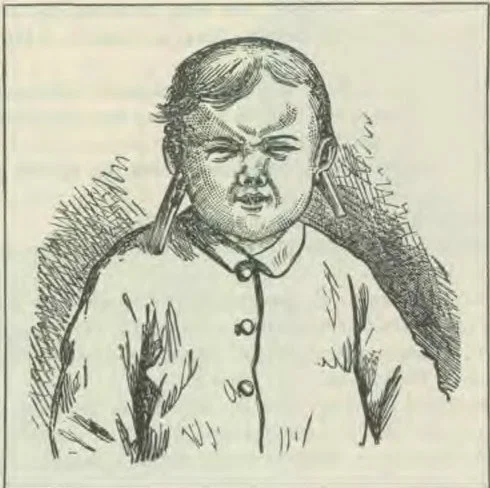
“O MAMMA, what does ail the little boy? See his funny ears; and how he squints his eyes?”
“Why, don’t you see the little fellow’s ears are being pinched? This is why he scowls so. If you would like to know how his ears feel, you can cut a slit in a stick and crowd it on to the tip of your own ear. Then, too, if you should look into the glass before you took it off, I think you would see another squint-eyed boy.”
“Does he put the sticks on to his ears in play, mamma?”
“He might do that for ‘just a little minute,’ as you say; but boys and girls don’t like to feel pain well enough to play that way very often. The sticks were put upon this little boy’s ears at school, to punish him for being naughty.”
“My teacher never punishes that way.”
“I don’t think teachers do so very often now-a-days; but ever and ever so long ago, as many as forty or fifty years, and more, they had a great many queer ways to correct naughty children. They seemed to think the most curious way was the best.”
“Don’t you know some of them to tell me, mamma?”
“May be I can tell you some things that happened at school when I was a little girl. One thing in particular I remember. In the teacher’s desk in those old-time school days there was always a ferule. This, as I think you have been told before, was a flat piece of wood two or three inches wide and some twenty or more inches long. With it and the whips the boys brought from the fields at the master’s bidding, disobedient children were sometimes pretty severely punished.”
“But the ferule was the stand-by, and was used in a great many ways besides in giving blows upon the open hand. The transgressor was often made to balance it upon his head for an hour or more while walking about the room. At another time he had to hold it upon the tips of his fingers with his arm stretched to its full length.”
“Some teachers would oblige the boys to bend over and place the fore finger of one hand upon a crack of the floor. Permission was given to change from one hand to the other once in awhile, but in some cases, to make the punishment more severe, the teacher would aim now and then a blow upon the bend of the body.”
“It was the most vexing to the boys to be given a ‘cutter ride,’ as the teacher named it. The pupil would take a position upon his hands and feet like a four-footed beast, and then have given him several rousing blows with the ferule upon the bend of his body.”
“To stand or sit upon the ‘dunce-block’ for breaking the rules of school, did not seem very hard, unless the teacher, to shame the scholar, dressed him in some ridiculous way.”
“One kind of punishment for lying was to place upon the end of the tongue a split stick like those upon the boy’s ears. Another punishment for this and other sins of the tongue was to place in the wide-open mouth a stick called a gag, to be held there as long as the teacher chose to leave it. Much as little boys like to open their mouths to laugh, talk, whistle, and sing, after being gagged a long time, you may believe they were glad to keep it closed a good long while.”
“I have read of scholars who, for lying, had mustard put upon the end of the tongue; and for some other misconduct had their hands held over hot coals until nearly burned.”
“While some teachers were very, very cruel, causing all the bodily suffering possible, others chose to mortify the feelings, making the scholars appear ridiculous in some way.”
“People laugh about the old-fashioned way of governing children; but in trying to do better, they too often neglect to punish them at all, so that many boys and girls of to-day are no better trained than were those away back there.”
“The Bible says it is necessary to correct faults. ‘The rod and reproof give wisdom; but a child left to himself bringeth his mother to shame.’ ‘Correct thy son, and he shall give thee rest; yea, he shall give delight unto thy soul.’ Prov. 29:15, 17.”
“To punish a child by making him appear ridiculous to a laughing crowd, does no good. It only makes him angry, and destroys his self-respect. Reproof and the rod should be given kindly and in love.”
“There was much good, however, in the old-time schools. Reverence for God, respect for parents, and courtesy to strangers were generally taught, and we thought it very disgraceful to meet or pass a stranger without making a low bow.”
“School was usually dismissed with a sort of benediction, said by teacher and scholars, and we went to our homes with a feeling of dependence upon our Maker.”
“Those days have gone by, and the little boys and girls may be glad for the many improvements in ways of teaching and governing the child. He is, too, the wisest, who improves his time best.” M. J. C.

THE STORY OF THE ANGEL.

One bright summer morning some children were waiting about the door of the village school-house. They were talking pleasantly together and listening to the song of a merry mocking-bird across the way, when Master Lewis himself came up, and said, in a cheery, hearty voice, just as he always did:—
“Welcome, my children!”
“Welcome, master!” cried they.
Then they went into the school-room and took their seats, and they sat very still while the master read a few verses from the Bible, and then prayed that God would bless and teach them all through that day.
The thumb-worn books were brought out of the desks, and school began. The lazy boys forgot to sigh and frown and wish for recess that morning; for Master Lewis talked so kindly to them, and made all their lessons so clear and simple by the way in which he taught them, that the hours passed by very quickly.
When the studies were over, the master took from his desk an odd-looking box, with pictures of birds painted upon it. He called the boys to his desk, and told them that he had brought each one of them a little present. Then, while they stood around, he drew out of it some white and pink shells and some pretty toys, which he gave to them with kind and pleasant words.
But the most lovely thing of all was a little statue of an angel. She stood with her small white hands folded over her breast, and her face uplifted, and appeared so fair and so pure that the children gazed at her with eyes full of joy. They had never seen anything like it.
“Oh, the dear angel, the beautiful angel!” they cried.
The good master smiled, and said:—
“This little angel is too lovely to be given to any child who is not good and true of heart. But the one who brings me to-morrow the brightest thing on earth shall have the angel for his own.”
The children looked at one another, not feeling sure that they understood the master. But he said no more, and they went home.
The next day, after the lessons were finished, the children gathered around the master to show him what they had brought. Some had picked up sparkling stones by the roadside; one had polished a small piece of silver until it shone like a mirror; another had brought a watch crystal which his father had given him; and Henry, the merchant’s son, had brought a breast-pin, with a stone set in its center that shone like a diamond.
“Ah! mine is the greatest!” cried Henry.
“But where is little Carl?” asked Master Lewis, looking around. “We cannot decide until Carl brings his offering.”
At that moment little Carl, the baker’s only son, came running into the room. In his hand, held up lovingly against his neck, was a snow-white dove. Some red drops upon its downy breast showed that it had been hurt.
“O master,” cried Carl, “I was looking for something bright, when I came upon this poor dove. Some cruel boys were throwing stones at it, and I caught it up quickly, and ran here. Oh, I am afraid it will die!”
Even as he spoke, the dove closed its soft eyes; it nestled closer to Carl’s neck, dropped its little head, and died.
Carl sank upon his knees beside the master’s desk, and from his eyes there fell upon the poor dove’s broken wing two tears, large and bright.
The master took the dead bird from his hands, and laid it tenderly upon his desk. Then turning to the school-boys, he said: “My children, there is no brighter thing on earth than a tender, pitying tear.”
“Give the white angel to little Carl!” cried the boys. “We know now what you mean, and his offering is better than any of ours.”—Selected.

THE LITTLE PINE-TREE.

From the German.
Once a little Pine-tree, In the forest ways, Sadly sighed and murmured Thro' the summer days. "I am clad in needles— Hateful things"—he cried, "All the trees about me Laugh in scornful pride: Broad their leaves and fair to see, Worthless needles cover me.
"Ah, could I have chosen! Then, instead of these, Shining leaves should crown me, Shaming all the trees; Broad as theirs and brighter, Dazzling to behold: All of gleaming silver— Nay, of burnished gold! Then the rest would weep and sigh; None would be so fine as I."
Slept the little Pine-tree! When the night came down, While the leaves he wished for Budded on his crown. All the forest wondered, At the dawn, to see What a golden fortune Decked this little tree. Then he sang, and laughed aloud; Glad was he and very proud.
Foolish little Pine-tree At the close of day, Thro' the gloomy twilight, Came a thief that way. Soon the treasure vanished; Sighed the Pine, "Alas! Would that I had chosen Leaves of crystal glass." Long and bitterly he wept, But with night again he slept.
Gladly in the dawning Did he wake to find That the gentle fairies Had again been kind. How his blazing crystals Lit the morning air! Never had the forest Seen a sight so fair. Then a driving storm did pass; All his leaves were shattered glass.
Humbly said the Pine-tree, "I have learned 'tis best Not to wish for fortunes Fairer than the rest. Glad were I, and thankful, If I might be seen, Like the trees about me, Clad in tender green." Once again he slumbered, sad; Once again his wish he had.
Broad his leaves and fragrant, Rich were they and fine, Till a goat at noonday Halted there to dine, Then her kids came, skipping Round the fated tree; All his leaves could scarcely Make a meal for three. Every tender bud was nipt, Every branch and twig was stript.
Then the wretched Pine-tree Cried in deep despair, "Would I had my needles; They were green and fair, Never would I change them," Sighed the little tree, "Just as nature gave them, They were the best for me." So he slept, and waked, and found All his needles safe and sound!
—St. Nicholas.

WHAT IS A MISSIONARY?

WHAT is a missionary? We commonly speak of him as one who carries the good news to the heathen and makes them good and glad. Every boy and girl should be a little missionary at home, making their little brothers and sisters good by setting them a good example, and making their fathers and mothers glad by obedience, kindness, and love. By thus following Jesus, and being little “home” missionaries, you will become better fitted for being big missionaries by and by.

THE CANOE OF THE WATER MOTH.

The gnat builds his egg boat. The water moth, another little creature, puts together a real canoe. It is a very curious thing, made of bits of straw and reeds, all matted-together. It is just the shape of the caterpillar that lives in it. The insect breathes with gills just like a fish, and yet cannot swim.
So he fastens this straw and grass together, winding them all around with his own silk. The body of the caterpillar is soft and delicate, you know, and might get hurt if it was left exposed. This is the reason why he covers it so carefully, all but his head.
This funny sort of canoe is open at both ends. It is so fixed that when the grub is tired of sailing, he can sink down upon the sand. Reaching out of the upper end are his six little feet, with which he drags his small boat after him whenever he wants to get his dinner or put up for the night. After a few days he not only creeps out of this strange house, but out of his skin, at the same time taking on moth wings.
Many people call these queer creatures “caddis worms.” If you hunt for them with your young eyes, you can find these little nests of stone and gravel and leaves, made by the grubs, though they are very small. They seem to have great taste in fixing them. You should see the houses they make of fresh leaves, curiously put together. They hang from their shoulders like so many wings. They are even more like a bud just ready to open.
These pretty cases of leaves are glued together, leaving an opening at its top just large enough for the little creatures to put out their head and shoulders when they want to look about for food; others of the same species cut pieces of reed or wood into lengths, or strips, and join them together as they go on with their work. They use a certain kind of cement, which is better able to stand water than any ever made by man. And they often finish up the whole by putting a broad piece, longer than all the rest, overhead, to shade the doorway, so that no one shall see them work. Some of these funny grubs break off bits of the stems of rushes, which, you know, grow in the water, and weave them into a sort of round ball. Then they hang them together on the stem of some other water plant, making a little cell in the middle to live in. Some use tiny shells, even, with snails and other animals alive in them. They keep these poor things just as if they were in prison, and drag them all about with them.—Mrs. G. Hall.

JAPANESE BABIES.

“The babies in Japan,” says a writer in St. Nicholas, “have sparkling eyes and funny little tufts of hair; they look so quaint and old-fashioned, exactly like those doll-babies that are sent over here to America. Now in our country very young babies are apt to put everything into their mouths; a button, a pin, or anything goes straight to the little rosy, wide-opened mouth, and the nurse or mamma must always watch and take great care that baby does not swallow something dangerous. But in Japan they put the small babies right down in the sand by the door of the house, or on the floor; but I never saw them attempt to put anything into their mouths unless they were told to do so, and no one seemed to be anxious about them. When little boys or girls in Japan are naughty and disobedient, they must be punished, of course; but the punishment is very strange. There are very small pieces of rice-paper called moxa, and these are lighted with a match, and then put upon the finger, or hand, or arm of the naughty child, and they burn a spot on the tender skin that hurts very much. The child screams with pain, and the red-hot moxa sticks to the skin for a moment or two and then goes out, but the smarting burn reminds the little child of his fault. I do not like these moxas. I think it is cruel punishment. But perhaps it is better than whipping.”

Nellie's Love: "A Whole World Full"

NELLIE tells her mamma that she loves her “a whole world full.” “But,” says papa, “tell me how much you mind her, and I’ll understand better how much you love her.”
Continue reading: TITHES AND OFFERINGS