The Youth’s Instructor, Vol. 27, No. 36.

ORANGES AND ORANGE TREES

The Youth’s Instructor

Sep 16, 1879

S. D. A. Publishing Association · Battle Creek, Mich. · Sep 16, 1879

ORANGES AND ORANGE TREES.

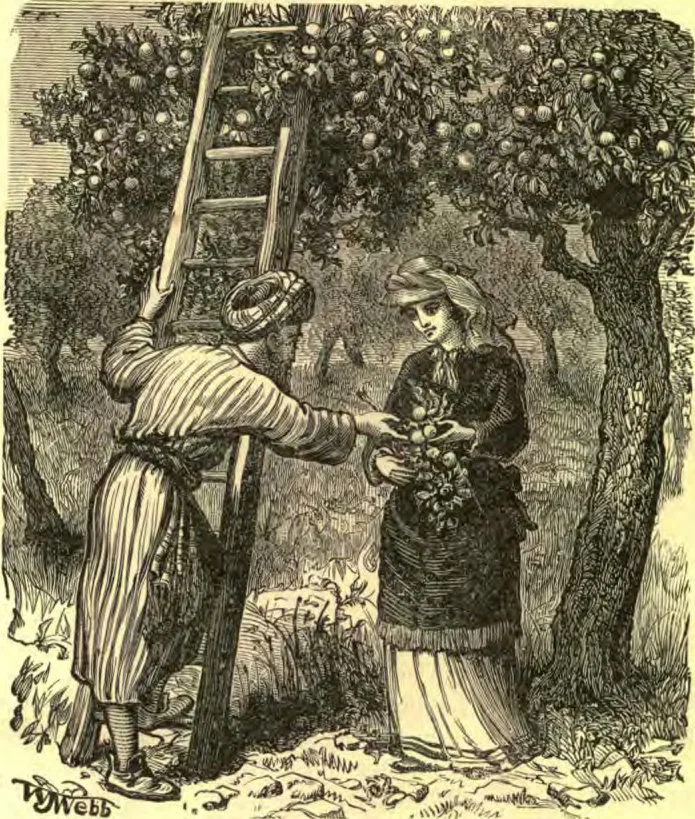
“WHAT a beautiful picture!” says one; “It fairly makes my mouth water!” cries out another; “Do look at the tree bending beneath its load of oranges!” chimes in a third. But let us restrain our admiration of the picture, and look a little farther.
The scene suggested by the engraving is one which but few of the readers of the INSTRUCTOR are privileged to behold. The costume of the man suggests some oriental country. Perhaps it is the Holy Land, or some Asiatic country, as Persia or Arabia. May be the young lady is a traveler, from England or America. Be this as it may, the scene is truly interesting, and as we cannot at this time, like the gardener in the picture, go into the orangery and pick the fruit, we may, at least, talk about oranges. And first,
Where do oranges come from? Oranges are now largely grown in most of the countries of the Mediterranean, especially in Italy and Portugal, in the Azores, the West Indies, and in some of the Southern States of America. Indeed, they are raised in nearly all the warm countries on the globe, but in no country are there to be found better oranges than in our own State of Florida. This delightful fruit comes from a fine evergreen tree, beautiful for its verdure and fragrance. It was originally brought from Asia, probably from Northern India, the native country of the lemon, lime, and citron.
The common sweet orange is found upon the hillsides in the forests of the Himalayas, and in China. This species is largely cultivated for its delicious fruit, and for the purposes of commerce.
In the south of Italy, about Sorrento, whole forests of orange trees exist, the fruit of which is carefully harvested. The French poet, Lamartine, sang,
“On the sonorous shore, where the sea of Sorrento / At the foot of the orange unrolls its blue wave.”
The orange tree sometimes attains great age and dimensions. In the orangery of Versailles is a magnificent bitter orange, familiarly called “the Great Constable,” which is known to be four hundred and fifty years old. Its trunk is thirty inches in circumference. It is growing with its roots in a large box. This tree was planted by the gardener of the queen of Navarre.
In 1780 there was at Nice a tree which usually bore upwards of five thousand oranges. It was more than fifty feet high, and was so large that it took two men to grasp around its trunk.
The orange tree at St. Sabina, at Rome, dates from the year 1200 A. D.; it is about thirty-three feet in height.
Although oranges are so plenty in some of our Southern States, they are not “native trees,” but have sprung from seed brought there by the Spaniards, three hundred years ago.
The fruit of the wild orange is not much sought after in our country, except in some cases to make a beverage called orange wine. Indeed, the great bulk of the wild fruit perishes by natural decay. In some places a thousand bushels of such fruit may be seen at one view lying upon the ground. So says Solon Robinson, the distinguished writer on horticulture.
There are with oranges, as with apples and peaches, very many varieties. The principal of these are, the China orange, a round, smooth fruit, with golden rind; the orange of Nice, large and of a dark yellow color, and one of the finest in all respects; the St. Michael’s orange, from one of the Azore Islands, small, seedless, and extremely sweet; the sweet-skinned orange of Paris shops, called “forbidden fruit,” a sub-acid pulp, with soft, fleshy rind; the blood, or Maltese orange, a reddish-yellow fruit, with crimson pulp; the mandarin orange, a species so highly esteemed in China as to be employed for presents to officers of state, whence its name; the ribbed orange, of little value; the pear-shaped orange, a rare variety; the fingered orange, with an occasional lobe or horn of monstrous growth; and the egg orange of Malta.
The Seville orange, or bitter fruit, is the species from which the highly valued orange-water of the perfumer is obtained; from its flowers is extracted the oil of Neroli, the most important ingredient in cologne; and the crushed pulp, mixed with sugar, makes the delicious orange marmalade. There are numerous varieties of the bitter orange, some of which are cultivated in Southern Europe chiefly for their flowers, which are large, showy, and fragrant.
The bergamot orange yields a very fragrant fruit, and from this and the flowers is procured the oil of bergamot. The rind of the fruit retains its perfume a long time after it has been dried. It is often pressed into molds, to form little boxes for sweetmeats and lozenges. It receives its name from Bergamo, where it is largely cultivated. There are several other varieties.
The orange tree is remarkably prolific; a single plant will often produce as many as twenty thousand oranges, and sometimes more than twice that number.
The orange does not seem to have been known to the ancient Greeks and Romans, but was probably brought to Europe by the Moors. It was introduced into Italy about the fourteenth century.
The orange crop begins to arrive early in November, and the steamers and cars continue to bring them until spring, and later. In England alone, about one million bushels of oranges are consumed annually.
G. W. A.

The Well of Loch Maree.

Calm on the breast of Loch Maree A little isle reposes; A shadow woven of the oak And willow o’er it closes.
Within, a Druid’s mound is seen, Set round with stony warders; A fountain gushing through the turf, Flows o’er its grassy borders;
And whoso bathes therein his brow With care or madness burning, Feels once again his healthful thought And sense of peace returning.
O restless heart and fevered brain, Unquiet and unstable, That holy well of Loch Maree Is more than idle fable.
Life’s changes vex, its discords stun, Its glaring sunshine blindeth, And blest is he who on his way That fount of healing findeth.
The shadows of a humbled will And contrite heart are o’er it; Go read its legend, “Trust in God,” On Faith’s white stones before it.

From Sea to Sea: Chicago and the Great Lakes

FROM SEA TO SEA.—NO. 14.

Chicago is about two thousand four hundred miles from San Francisco, and over nine hundred miles from New York City. It is situated on Lake Michigan, and is the head of navigation in the chain of great lakes surrounding the State of Michigan, and forming, in part, the boundary line between Canada and the United States. These lakes are called Michigan, Superior, Huron, St. Clair, Erie, and Ontario. Their waters flow from one lake to another in the order above mentioned, until at last they empty into the grand St. Lawrence River, thus forming a great thoroughfare for travel and commerce from Chicago and intermediate points to the ocean.
Forty years ago, this city was denominated the “far West,” and a trip from Montreal or Quebec, through this chain of lakes, was a perilous undertaking. Many steamers have been wrecked upon these waters, in a sudden gale, and many persons have thus found a watery grave. The great through lines of railroad from New York, Boston, and other points, to the Pacific Coast, with about fifty branches diverging from Chicago in every direction, have made a wonderful change in the peril of travel. Now the three-thousand-mile trip from Boston to the Pacific Ocean is considered a much less dangerous undertaking than the few hundred miles of lake travel then.
Fifty years ago, Chicago was only a small village, a trading point for Indian furs, and the home of a few white settlers who had begun to plow the prairie soil. Now it is one of the most important commercial cities in the United States, and the greatest railroad center, grain market, and cattle market, in the world.
Twenty-seven years ago I passed through this city for the first time. It is now more than four times as large as it was then, and even the oldest part of the city has given place to a style of buildings far superior in size and beauty to the best it then contained.
As its inhabitants multiplied, thus extending the city to the shores of Lake Michigan on one side, and into “Mud Prairie” on the other, the serious question arose, and was considered for many years, how to supply the city with healthful water. A great tunnel was finally constructed two miles out under the lake, and the water is conveyed through the tunnel to a huge reservoir in the city. By means of powerful engines it is lifted into a tower, whence its own weight distributes it through a system of water-pipes, giving an abundance of pure, cool water to all the people. This tunnel is one of the curiosities of the city.
Another object of interest, especially to the agriculturist, is the grain elevators. These are large buildings, many feet in height, strongly constructed, and covering acres of ground. They are furnished with bins in which are stored millions of bushels of grain, the product of the fertile prairie farms of the West and Northwest. Some of these buildings are near the wharf on Lake Michigan, but the greater number are near the railroads. When a cargo of grain is to be sent to other parts of the world, it is interesting to see how soon cars can be filled by simply hoisting a gate of the bin, and letting the grain run through large, strong tubes directly into the cars.
During our stay here we visited that part of the city which was desolated by the great fire in October, 1871. Of all the buildings in the city, nearly one-third in number, and fully one-half in value, were destroyed. Vast stone structures crumbled down before the flames like wood fully dry. Those who witnessed the scene say that it was terrible beyond description. The whole atmosphere seemed to be on fire. One man, in describing it, said that there was but one comparison he could think of at the time, and that was God’s act, in ancient times, of raining fire and brimstone upon Sodom and Gomorrah. Like most large cities, Chicago contains many wicked, as well as some good, people. Many thought, and so expressed themselves, that this awful conflagration was a judgment of God upon the inhabitants for their great wickedness. The water-supply of the city was so abundant that the citizens had often boasted of their security from extensive fires; but, early in the progress of the flames, the large water-pipe broke, so that water could not be obtained, which greatly increased the suffering, and added calamity to calamity. Many a rich man was, in the short space of two hours, stripped of his wealth and brought to actual beggary. How uncertain are riches, and how often they take to themselves wings and fly away!
The city is now mostly rebuilt, and but few traces of the fire remain. J. N. L.

THE MAN WHO SWALLOWED A BIBLE.

Did you ever hear of a man swallowing a Bible? A father once invited his son to accompany him on a visit to a man who he said had swallowed one. The son's curiosity was greatly excited, and not until he heard the words of Scripture fall from the lips of this aged servant did he understand the meaning of his father's words. This individual had so learned the Scriptures that they “dwelt in him richly in all wisdom,” and his mind was like a store-house of precious things, from which could be drawn plentifully, like drawing from an inexhaustible fountain.
After their return, the father asked his son what he thought of the man having swallowed a Bible. “Think, father,” said he, “I think that he has indeed swallowed a Bible, for the word of God seems like meat and drink to him.” Other individuals have been known who thus acquainted themselves with the Scriptures, and were able to repeat nearly every text, giving chapter and verse where found.
Now if it is true that our natures partake largely of the kind of food upon which we principally subsist, if the mind be nourished with scriptural food the thoughts and aspirations, as a natural consequence, will be of a holy character, so that those persons who desire to purify their thoughts and lives will work most advantageously while making the Bible their chief study.
We wish the great INSTRUCTOR family could appreciate their superior advantages for studying the word of God; for we are instructed that a little way in the future it will be required of us to give the reasons of our peculiar faith. The truths of God's word are now being made so plain, even for the children, that those who come up to the time of great temptation without a perfect understanding of these things will be left without excuse. May the word of God be indeed our meat and drink, that we may have a weapon of defense in the time of every temptation, and finally stand on the sea of glass with those who shall escape the seven last plagues.
M. J. C.

LESSONS FOR CHILDREN.

LESSON XXXVI.—REVIEW ON LESSONS XXXIII-XXXV.

1. WITH whom did Saul carry on war? 1 Sam. 14: 47, 48.
2. Did Saul obey the Lord? Read 1 Sam. 15.
3. What did the Lord command Samuel to do? 1 Sam. 16: 1.
4. When Samuel had come to Bethlehem, and Jesse’s sons were brought before him, which did he think must be the one that the Lord had chosen to be king?
5. What did the Lord say about it?
6. Which of the sons of Jesse was anointed?
7. From what place did he have to be called?
8. Why did not Jesse bring him forward with his other sons at the first?
9. What rested upon David from the time that he was anointed? 1 Sam. 16: 13.
10. In what condition was Saul left? Verse 14.
11. How was this evil spirit sometimes driven away? Verses 15-23.
12. Tell how Goliath, the giant, defied the armies of Israel.
13. How did David come to go down to the army?
14. Tell how David killed Goliath.
15. How did Saul honor David? 1 Sam. 18: 2, 5.
16. How did Jonathan feel toward David?
17. What did he do for him?
18. What made Saul angry toward David? Verses 6-8.
19. How did he try to take David’s life?
20. What plan did he lay for having him slain by the Philistines?
21. When this plan failed, what course did Saul pursue?
22. How did all the people feel toward David?
23. Who persuaded Saul to spare David’s life?
24. What caused Saul to try a second time to kill David by casting a javelin at him while David was playing on a harp to amuse the king?
25. After David had escaped to his own house, how did his wife help him to escape from the messengers that Saul sent to kill him?
26. How were Saul and his messengers kept from taking David when he was with Samuel and the other prophets?

BIBLE LESSONS FOR YOUTH.

LESSON LXII.—REVIEW ON LESSONS LIX-LXI.

1. WHAT caused the people throughout the land to prepare for war?
2. Who made war against the Gibeonites?
3. Why did they do this?
4. Who helped the Gibeonites against their enemies?
5. How did the battle go?
6. What miracles were performed to aid in destroying the enemies of Israel?
7. What became of the five kings that made war against Gibeon?
8. Describe Joshua’s conquests in the south of Palestine.
9. Who gathered the kings of the North to battle?
10. At what place did this great host assemble?
11. Describe this army and its defeat by Joshua.
12. What course did Joshua pursue toward the cities in the north of Palestine?
13. How long did he continue to make war?
14. After he had conquered the whole land, what did he do?
15. When he had grown old, what charge did he give the people?
16. What did he have them do?
17. Which was older at his death, Joseph or Joshua?
18. What course did the people pursue after the death of Joshua?
19. What was the consequence of their worshiping strange gods?
20. How did the Lord deliver them whenever they forsook their idols, and turned to him?
21. Name the judges in their order.
22. What exploit did Ehud perform? Shamgar?
23. How long did the land have rest after this?
24. Who next oppressed Israel?
25. How were they delivered from him?
26. How were they afterward treated by the Midianites?
27. What brought such trouble upon them?
28. Who was raised up to deliver them?
29. What sign of victory did the Lord give Gideon?
30. Describe Gideon’s army, and its attack upon the Midianites.
31. What was the fate of Gideon’s family?
32. Who judged Israel between Gideon and Jephthah?
33. From whom did Jephthah deliver Israel?
34. Who next held dominion over the people of God?
35. Who judged the people during this time?
36. Who judged them between Jephthah and Samson?
37. Who succeeded Eli and Samson as judge?
38. What caused the death of Eli?
39. How did Samuel deliver the people from the Philistines?
G. H. BELL.

Lessons from Athletic Contests: Keep Your Eye on the Race

PAUL used to find a great many illustrations of important truth in the popular athletic games of his day. A similar use may be made of some of the modern trials of strength and endurance. For example, it is said that in a recent Philadelphia “walking match” one of the contestants who was well ahead lost his place, and dropped hopelessly behind, through stopping to bandy words with some of the surrounding crowd who annoyed him. That was the most foolish thing in the world for a man to do who had a race to win. His business was walking, not talking. If anybody else had time for wrangling, he had none. His time was all needed for the work before him. So in every race of life. What if people do laugh at you, or abuse you; call your motives, or your spirit, or your orthodoxy in question? If you take time to argue with them, or to give them back word for word, you might as well be counted out of the race first as last. The better way is to keep your mouth shut, and push ahead. Then “let those laugh who win.”—S. S. World.

HOW TO MAINTAIN ORDER IN THE CLASS.

1. Be in your place five minutes before the opening of the school, to receive your scholars. See that they take their proper places in silence.
2. Request your scholars to face the Superintendent during singing and remarks, and to close their eyes during prayer.
3. Place yourself and your scholars in such a position that you can easily, and at all times, have command over them, and see what they are doing.
4. Let silence and attention be the watchwords in your class, and whenever these are disturbed, cease teaching, and give your attention to the cause till order is again restored. When teaching, see that every scholar is attentive and hears what you say.
5. Let instant attention be given to the sound of the bell or the Superintendent’s voice, and when any change takes place in the routine of school duties, be especially vigilant in repressing any risings of disorder.
6. Strictly adhere to the regulations of the school, and see that the scholars do the same, so far as they are concerned, and give them clearly to understand what you expect from them as scholars.
7. Do not leave your class during school time; at the close of the school lead your scholars out, and see that they disperse quietly.
8. In case of absence, provide a substitute, or give timely notice to the Superintendent.
9. Visit your scholars at their own homes, especially absentees.
10. Govern with absolute firmness, teach with attractive kindness, and prepare your lessons beforehand.
If these suggestions are carried out perseveringly and prayerfully, they will add much to your own comfort and usefulness, and tend to secure the improvement and salvation of the souls of the children committed to your care.—Teachers’ Golden Hour.

HARD WORK.

If any one is resolved to do good to others, he may be assured that it will require hard work.
The true teacher and the good scholar must accept hard work as a condition of success. Everything really valuable costs something. By sweat of the brow we earn daily bread, and by sweat of the brain we gather knowledge for ourselves or for others. It is to be feared that many teachers fail to recognize hard work as an essential element of success. Hard work for the teacher points to HARD STUDY; 1st, of the word; 2d, of his class; 3d, of adaptation.
The Bible is a mine which must be worked patiently and perseveringly, if we would find its hidden treasures. Various methods of studying the lesson might be suggested, but not one of them is of any value, unless it call out all the energies of the student. The careful perusal of the text; the use of such helps as are available; prayerful meditation on its true meaning and use, call for more than mere child's play. This work requires as much time as can be devoted to it through the entire week, and should be commenced as early in the week as possible.
No two pupils are alike in any one trait of character, and the teacher who would successfully instruct and interest each one, must make each a study. This study of persons will demand thought, as well as calls at the homes of the scholars. There the teacher can get an insight into the character, habits, and peculiar temperaments of each. As Audubon, the great naturalist, was willing to spend days in the forests, studying the habits of the birds, so must the one who seeks for souls, have a holy enthusiasm which will glory in toil or sacrifice, if it only enables him to accomplish his purpose of leading souls to Christ.
To know how to adapt the lesson to the learner, and give to each his portion of meat in due season, is a task which requires scarcely less patient thought than either of the other subjects named. Many an excellent discourse utterly fails of its object, because it shoots over, or wide of the mark. The lodgment of the truth in the heart requires skill as well as toil; and this skill is to be acquired largely by persistent practice.
Men work hard in order to secure worldly gains; they are content to rise early and toil late; they try every method which promises success; much more should the Sabbath-school teacher be willing to labor diligently in his work, so that even though he sow in tears, he may bring back his sheaves rejoicing.
Let each teacher make up his mind to work, and work hard, on every service of the year.—Presbyterian at Work.

THE TEACHER'S WORK.

THE life-long work of the Sabbath-school teacher should be to furnish to the young recruits weapons and armor, and teach them to fight the good fight of faith.
Let them understand that there are no “thirty-day men” in this army, but that, from rank to rank, its soldiers fight on and fight always, clear down to the invalid corps and the veterans; all sentinels on duty; all recruiting officers.

PATTY AND THE LARKS.

ONE bright, sunny day in harvest-time little Patty thought she would like to go out to the field to see papa. So she started off, down the grassy lane and across the meadow. When she came into the wheat-field, she could see men going down one side, following the reaper and leaving a shining row of bundles behind. Patty tried to catch up, but they worked very fast, and by-and-by, growing tired, she sat down to rest where an old beech-tree cast a cool, pleasant shade.
Suddenly a bird flew out of the wheat near by, singing a rich, clear song. Patty clapped her hands in delight, and as the bird rose higher, and the notes grew fainter and sweeter in the distance, she fairly held her breath lest she should lose one of those delicious sounds.
“Perhaps there is a nest in there,” thought Patty, when it was still again; and “in there” she went, looking with a pair of bright eyes eagerly about; and yes, there it was, surely,—a nest, and three of the dearest, sweetest little birds, with tiny bills wide open! It was a nice place for a nest, Patty thought. The grain was like a golden forest, high above her head, and she laughed softly to herself, thinking of it. She did not know of any danger near, and the men, coming rapidly along, knew nothing of the little girl hidden by the yellow straw. On they came, the machine leading them, the horses drawing steadily and the knives cutting sharp and sure.
What was it, do you suppose, that made the farmer stop his team all at once? Did he know his little daughter was in danger? No, indeed. He thought she was safely cared for at home. But he was a noble man, with a large, kind heart, and he would not willingly hurt the least of God’s creatures; so he said to one of his men, “Here, Tom, come and hold the team. There’s a lark’s nest near the old tree yonder. I’ll hunt it up, and you can drive around, so as not to hurt the birds.”
What a cry of surprise papa uttered when he found his darling Patty sitting there! How fast his heart beat when he thought of the danger she had been in, and how it thrilled and softened as he caught her up in his arms, covering her face with kisses, and saying, “It was the birds that saved her!”
When the first excitement was over, and Patty had been carried safely home in her father’s arms, and the men were going down the field again, leaving a wide, uncut space round the lark’s nest, somebody—it was a great, rough-looking man—said, while the tears glistened in his eyes and his voice grew husky, “God bless the little birds!”

KEEPING A SITUATION.

Lay down as a foundation rule, that you will “be faithful in that which is least.” Pick up the loose nails, bits of twine, clean wrapping paper, etc., and put them in their places. Be ready to throw in an odd half hour or an hour’s time when it will be an accommodation, and don’t seem to make a merit of it. Do it heartily. Though not a word be said, be sure your employer will make a note of it. Make yourself indispensable to him, and he will lose many of the opposite kind before he will part with you. Those young men who watch the time to see the very second the working hour is up—who leave, no matter what state the work may be in, at precisely the instant—who are lavish with their employer’s goods, will always be the first to receive notice that times are dull, and their services are no longer required.

HOW PRAIRIE DOGS GET WATER.

It has always been a subject of curiosity as to how and where prairie dogs, living on the prairie, far from any river or stream, obtained their water. Mr. F. Leach, formerly of Mercer County, Pa., and a frontiersman of experience, asserts that the dogs dig their own wells, each village having one with a concealed opening. It matters not how far down the water may be, the dogs will keep on digging until they reach it. He knows of one such well two hundred feet deep, and having a circular staircase leading down to the water. Every time a dog wants to drink he descends the staircase, which, considering the distance, is no mean task. In digging for water the animals display as much pluck as in resisting the efforts of settlers to expel them from the land of their progenitors.
Mr. Leach’s statements have been verified by Prof. Aughey, a well-known geologist, who has discovered such wells in Northern Nebraska.

LETTER BUDGET.

Moscow, Mich.
DEAR EDITORS: I am a little girl eleven years old. I take the INSTRUCTOR, and like it very much. I like to read the Letter Budget especially. I am trying to be a good girl, so that I may meet the INSTRUCTOR family in the earth made new. I love to go to Sabbath-school, and I love my teacher. Yours truly,
CARRIE LOWER.

ROME, N. Y

DEAR EDITORS: I am a little girl nine years old. My mother, two sisters, one cousin, and one aunty are all keeping the Sabbath. We have a very good class in Sabbath-school. I learn the lessons in the INSTRUCTOR. My father and brother do not keep the Sabbath, but I hope they will soon. Pray for me that I may be saved when our Saviour comes.
CHARLOTTE TEDD.
Continue reading: Singing as I Go: A Poem of Nature and Faith