Your ShelfYour Projects

Review and Herald, Vol. 62, No. 8.

NOTES OF TRAVEL
Earlier text: THE SALVATION ARMY AND OTHERS

MEETINGS IN IOWA.

We attended the State meeting at Eagle Lake, Minn., Jan. 17-19, and the next Sabbath met with the church at Elkhorn, Iowa. The church is about equally divided into two sections, which are eight or ten miles apart. At Elkhorn is located the meeting-house, and the elder lives in the other place. It was thought best by some that a division should be made, and another church formed, as it is difficult for them all to meet together. In fact, preliminary steps had been taken for such a division. But upon more mature deliberation it was thought best to continue the organization as it is, arranging, however, that the ordinances shall be celebrated in both places. This seemed to meet with general approval. This people are located in a country that seems to be very favorable for making money, and they are generally improving it for that purpose, some of them, it is sad to say, to the detriment of their spiritual interests. Worldly prosperity often proves fatal to eternal interests. We divided the time equally between the two localities mentioned, holding meetings two days in each.
From here we went to meet with the Weston church, located about fifteen miles east of Council Bluffs. They have just finished a neat meeting-house, which was dedicated on first-day, Feb. 1. This church is very much scattered, the members living isolated, and none of them nearer than three miles from the meeting-house. It is a little over a year since we visited them, and during this time they have built their house. In this they have done well. But the best of counsel has not prevailed with all, and the enemy has been present to sow discord and discouragement. Some have fallen out by the way. We earnestly sought the blessing of God as we labored for them, and felt that we had some of his help. Although we could not do all that we wished to see done, yet we were glad to see hope and courage come in, and a better state of things introduced. Eld. John Wilson was unanimously chosen elder of the church.
The Weston and Elkhorn churches are almost entirely composed of Scandinavians, so our services were mostly in that language. Bro. Tenney usually held one service in English each day. Our meetings here continued over Monday. The business meeting on that day was characterized by harmony and the blessing of God. Bro. Olsen held a meeting at Council Bluffs on Tuesday evening with those who reside there. One person for the first time took a stand for the truth. We met with the Logan church Tuesday evening and continued over Wednesday. These brethren are also much scattered. This circumstance, with unfavorable weather and lack of interest, rendered our meetings there quite small. They, too, have a neat but small house of worship nearly finished. But they have made a mistake in locating it so far out of town that but few of the citizens can attend the meetings. Only one family lives in the village; the rest are at a distance of several miles. The distance is a cause of discouragement, and it is often difficult for them to attend meetings. They are in need of help; but just how to bring it about seems a difficult question, unless each member of the church shall make a special effort to seek the blessing of God for himself and upon the church. This they may do, and the Lord will build them up. Up to this time we enjoyed the company of Eld. John Wilson, who has the oversight of the work in that part of the State. From this point he left us, returning to Council Bluffs.
Our next appointment was at Battle Creek, Iowa, Feb. 7, 8. On our way there we passed through Odebolt, where we stopped and held one meeting with quite a good congregation. Here we met Eld. A. G. Daniells, who had been laboring here for a time. He does not report much interest at Odebolt, but a few worthy people are seeking for the light. Bro. D. accompanied us to Battle Creek, where we found a new house of worship, which was dedicated to the cause of God. The company here is small, and have done well to build and pay for a pleasant house 24x36. Our meetings here were quite small. The company has been reduced by removals, and a severe storm prevailed during almost the entire time of our meetings. The friends seemed to be deeply impressed by the solemn truths, and desire to become united heart and hand in the work of God. May his blessing attend them.
On account of the storm no trains ran from Sunday to Wednesday. So we were unable to meet our appointment at Smithland, which we regretted very much. We trust they will be visited soon. A telegram from Adel informed us that the meetings at that point were postponed on account of the small-pox prevailing there; so we have turned our course to Knoxville, by way of State Center.
We meet with some discouragements while we look at the indifference manifested by many of our people in reference to our solemn work and position; and we have also realized some of the blessing of God in trying to call their attention to these things. We have no time to spend in interminable church trials and investigations. We feel to call on those who are interested in these things to become converted, and get the love and forbearance of Christ in their hearts. Time is short. “Behold the Judge standeth at the door.”
O. A. Olsen. G. C. Tenney.

Being Pitiful and Generous in Judging Others

—Being ourselves tempted, let us be pitiful and considerate and generous in judging others.—

News of the Week.

“Tidings of these things came.”—Acts 11:22.
FOR WEEK ENDING FEBRUARY 21.

DOMESTIC.

—A petroleum well, gushing twenty-five barrels an hour, has been struck in Dallas, Wy. T.
—A bill prohibiting the sale of tobacco to minors has passed both houses of the Nebraska Legislature.
—The injury by intense cold to fruit trees in Michigan has been so severe that but half a crop is anticipated next season.
—Business failures for the week number 273, against 330 last week, and 243 in the corresponding period of 1884.
—Announcement was made in all parts of the Hocking Valley Sunday that no more aid could be given the striking miners, and advising the men to go to work.
—The list of contributions to the Garfield monument includes, it is said, $5 from England, and $1,149 from France.
—Clearing House exchanges last week—$716,698,111—are $6,082,902 less than the previous week; and as compared with the corresponding week of 1884 there is a falling off of 27.6 per cent.
—Some distance north of South Haven seventeen men of the missing steamer Michigan came ashore, having traveled on the ice a distance of twenty-three miles from the vessel. There are yet thirteen men aboard, with rations for a month and ninety tons of coal.

FOREIGN.

—Mozart, who, while he lived, wanted bread, now gets a stone. Vienna is building him a monument to cost $50,000, which is much more than he received for the whole work of his life. He died in want, and his uncoffined corpse was thrust into a trench in the potter’s field.
—Many members of the Liberal party in England are reported as in favor of handing the control of the Soudan over to the Sultan, as the best way out of the Egyptian troubles. At the council of war it was resolved to increase the Indian contingent for the re-enforcement of General Wolseley to 3,500 men, and thus raise the force of General Graham for his Suakim expedition to 11,500 men. Canada and Victoria have offered to send contingents to the Soudan.

RELIGIOUS INTELLIGENCE.

—The Rev. J. H. Vincent of Chautauqua fame is out in a tersely-expressed opinion that Methodism should more vigorously protest against the dance, the theatre, and card-table. He says: “We must impress upon the minds of Methodist youth that these pleasures impart no good to humanity. No compromise can be made with amusements.”
—The American Bible Society has published for distribution at the New Orleans Exposition a pamphlet containing specimen verses in all the languages and dialects in which the Holy Scriptures have been printed by the American Bible Society and the British and Foreign Society, numbering 242. It is a very interesting souvenir as well as a suggestive indication of the wide circulation of the word of God.
—The prospect of union between the Waldensian church and the free Italian church grows brighter. The people of the churches in the cities of Italy, where both are established, are meeting together in a very cordial way, and lately an extraordinary synod of the Free Italian church was convened, at which it was unanimously agreed that the union is desirable. A committee was appointed to consider how the union should be advanced, and what must be the terms of union.—Interior.
—One town in Illinois, with a population including 3,000 young men, on a recent Sunday had by actual count one hundred and forty young men in attendance at the Protestant churches in the morning, and one hundred and sixty-one in the evening. On the previous evening one hundred and five young men entered a single saloon in this city in only one hour, and there were thirty-six more saloons open at the same time.—Y. M. C. A. Watchman.
—The Christian Union says: “A church now building in Michigan is to have as seats arm-chairs of cherry wood, mahogany finished, with tilting backs, each chair being furnished with hat, shawl, cloak, book, umbrella, and cane rack, and a foot-rest. Nothing else seems needed to make a model church except sound doctrine, live Christianity, and a pastor capable of keeping the occupants of the luxurious chairs awake all the time.”

CHICAGO & GRAND TRUNK R. R.

Time Table, in effect November 16, 1884.
Going west Stations Going east
Chi’go Pass. Mail Day Exp. Pacific Exp. B. Creek Pass. Mail Lmtd Exp. Atlto Exp. Sun. Pass. Pt. H’n Pass.
... am 6.35 am 7.50 pm 8.00 pm 4.10 Dep. Port Huron Arr. pm 10.20 am 1.26 am 7.50 ... am 10.40
... 8.15 9.12 9.28 5.40 Lapeer 8.37 12.07 6.29 ... 9.12
... 9.07 9.55 10.05 6.20 Flint 6.57 11.05 5.55 ... 8.25
... 9.45 10.30 10.45 7.00 Durand 7.50 11.05 5.16 ... 7.20
... 11.00 11.32 11.50 8.28 Lansing 6.37 10.12 4.10 ... 6.09
... 11.40 12.08 12.25 9.07 Charlotte 5.02 ... 3.32 ... 5.32
am 12.40 1.05 1.20 10.05 ... † BATTLE CREEK1 4.08 8.55 2.35 ... 4.35
5.00 pm 1.35 1.25 pm ... Vicksburg 4.03 8.50 2.30 ... am
5.48 ... 2.10 2.17 ... Schoolcraft 3.14 8.10 1.46 ... ...
6.00 ... 2.20 2.28 ... Cassopolis 3.02 ... 1.35 ... ...
6.47 ... 3.05 3.19 ... South Bend 2.10 7.21 12.51 ... ...
7.30 ... 3.50 4.08 ... Haskell’s 1.26 6.44 12.10 ... ...
8.43 ... ... ... ... Valparaiso 12.07 ... ... pm 3.40
9.00 ... 5.27 5.52 ... Chicago 11.30 5.27 10.41 1.15 ...
am ... pm am ... Arr. am pm pm pm ...
Stops only on signal. Where no time is given, train does not stop.
Trains run by Central Standard Time.
The Day Express, Battle Creek Passenger, Chicago Passenger, Pt. Huron Passenger, and Mail trains, daily except Sunday.
Pacific, Limited, and Atlantic Expresses, daily.
Sunday Passenger, Sunday only.
GEO. B. REEVE, Traffic Manager.
W. J. SPICER, General Manager.

Obituary Notices.

“Blessed are the dead which die in the Lord from henceforth.”—Rev. 14:13.
LEWIS.—Died of so-called chronic anemia, at Buck’s Bridge, N. Y., July 10, 1884, my father, Oliver Lewis, aged 63 years, 8 months, and 17 days. He spent his entire life within two miles of the place of his birth, passing the borders of the county less than a half dozen times and probably never going one hundred miles from home. Father was a man of sterling integrity; he despised a small action, and hated shams. These with his love for his home and family were his prominent traits of character. The latter characteristic was manifest to an unusual degree. It was with the greatest difficulty that he could suffer any member of his family to go from home, even though convinced that it was for the best interest of all. He never made a profession of religion until a few weeks before his death, though he read the Bible much during the last two years of his life, and said that he often prayed in secret. It was my privilege to be with him several weeks during his sickness, and to explain as best I could the plan of salvation. For some time he stumbled over his own unworthiness and the simplicity of faith; but he was finally able to cast himself upon the mercy of God, and believe that his sins were forgiven. He sleeps; we mourn, but not without hope. Sermon by Eld. Townsend (Methodist) from Ps. 17:15. C. C. L.
TEMPLE.—Died at the home of her son, in Jamaica Plain, Mass., Dec. 26, 1884, Mrs. Elizabeth Temple, aged 76 years. She had been quite unwell for several weeks, but was confined to her bed only one week. When she became ill, a physician was sent for, who told her she had a tumor, which rapidly grew and caused her death. A few weeks before her death she attended meeting in Boston. She said she had an impression that she should not live long, and was anxious to do some missionary work while she could. She took with her a quantity of publications, visited families, prayed with them, and some of them since have become interested in the truth. She felt that God had warned her a few weeks before she died that she was not to live. This was a consolation to her in her last sickness. She felt that her work was over, and was prepared to meet her God in peace. Sr. Temple embraced the Advent doctrine in 1843, and there are many marked instances during her life of God’s providence being over her. None who had been acquainted with her could at all question her devotion and consecration to the truth she believed. Sermon by the writer from 1 Thess. 4:13-18. S. N. HASKELL.
SHEARER.—Died of heart disease and dropsy, in Greencastle, Sullivan Co., Mo., at the residence of her son, Dr. W. W. Shearer, Mrs. Juliette Shearer, aged 73 years. Mother Shearer was born in Franklin Co., Penn., in the year 1812. Immediately after her marriage to Jacob Shearer, in 1835, she moved to Clear Spring, Md., where she remained until 1847. During that year she moved to Bellville, O., and in 1867 to Greencastle, Mo. In early life she joined the Protestant Methodists. After her removal to Ohio she united with the Cumberland Presbyterians. In 1866 Eld. Van Horn, a Seventh-day Adventist, held a four weeks’ tent meeting in Bellville. Under his ministration she with many others embraced the doctrines of that church. She was a strict Sabbath-keeper, and died in the belief that one day she would inherit the new earth. Her kindness of character drew to her the warm friendship of the whole community. She leaves a large family of grown children to mourn her loss. W. W. SHEARER.
REES.—Died in Battle Creek, Mich., Oct. 31, 1884, of typho-malarial fever, Mary E., daughter of Morris and Mary J. Rees, aged about sixteen years. About a year ago Mary came to Battle Creek from Logan, Iowa, to attend school; but at the time she was taken ill she was working at the Sanitarium. In October, 1883, she was baptized and joined the Battle Creek church. She had a quiet, peaceable nature, and was loved by teachers, schoolmates, and many friends. After three weeks of great suffering, which she bore patiently, we laid her away to sleep till the resurrection morn. Words of comfort by Eld. H. Nicola. ANNA REES.
BARBER.—Died in Grant, Monona Co., Ia., Jan. 24, 1885, Mary Luretta, daughter of C. J. and L. M. Barber, aged 15 years, 3 months, and 3 days. Mary was converted in the spring of 1882 under the labors of Eld. C. A. Washburn, receiving baptism and uniting with the church at Smithland the same year. She was a faithful member until death. Mary was a very affectionate and pleasant child, and she will be very much missed in the Sabbath-school. We laid her away to rest until the Life-giver shall come. Services were held at the house. The writer spoke to a very large and sympathizing congregation from Rev. 14:13. J. M. WILLOUGHBY.
SPECK.—Died near Mt. Vernon, Ohio, Oct. 20, 1884, Bertha Olive, oldest child of Clinton and Zoe Speck, aged 2 years, 9 months, and 2 days. The parents feel that they have sustained a great loss; but may they look forward to the time when their loved one shall come again from the land of the enemy. The funeral services were conducted by Eld. Bedell, Baptist. M. E. RICHARDSON.
ATWATER.—Died of diphtheria at Medford, Minn., Jan. 18, 1885, Susie, oldest daughter of James and Nettie Atwater, aged 12 years, 6 months, and 6 days. The loss of this dear child falls with heavy weight upon the bereaved family; but we feel assured that for comfort in their affliction they can safely look forward to the glad morning of the resurrection when Jesus will bring their loved one from the land of the enemy. May this hope sustain them in their trial. Susie was one of our faithful Sabbath-school scholars, and we deeply mourn her loss. Words of comfort by the writer. W. B. WHITE.
LARKEE.—At the residence of her uncle, Rev. C. Anderson, Rockford, Ill., Dec. 14, 1884, our beloved daughter, Sophie Larkee, departed this life in loving trust and faith in her Saviour. Her illness was a long and lingering one of nearly a year’s duration. Age 27 years. MARGARET A. AND FREDERICK LARKEE.

Publishers’ Department.

“Not slothful in business.”—Rom. 12:11.
THE CONFLICT BETWEEN TRUTH AND FALSEHOOD: A poem by G. K. Owen. This little work is designed to picture in a new and pleasing manner the conflict between Truth and Falsehood “from the time when man was first intoxicated by the cup of Falsehood, and Truth was rudely repelled from the earth,” until the final overthrow and destruction of Falsehood and the father of falsehood. The leading battles between these two forces are presented “in changing rhythm” before the mind of the reader. The design of the author is by this means to attract the attention of some to the truth who would not otherwise be reached. The price of the work is ten cents, post-paid. Address, Hattie House, REVIEW AND HERALD, Battle Creek, Mich.
My post office address will be Barton Landing, Vt., till further notice. To treasurers wishing to do business with me, I would say that this is a money order office. A. S. HUTCHINS.

Business Notices.

[Under this head short business notices will be inserted at $1.00 for each notice of four lines or under. Over four lines, 25c. a line. Persons unknown to the managers of THE REVIEW must give good references as to their standing and responsibility. Ten words constitute a line.]
WANTED.—An efficient middle-aged woman as help in a boarding-house; must be a Sabbath-keeper, and come well recommended. Address for one month, Mrs. Julia Trexler, No. 174½ N. Western Ave., Chicago, Ill.
WANTED.—A good farm hand, a Sabbath-keeper, for 8 months, to commence March 1 or 10. Will pay $14 for the first month and $17 per month for the other seven months, with washing and mending included. Address D. Glunt, Osceola, Clark Co., Ia.
A young man, a Sabbath-keeper, wishes to find employment among Sabbath-keepers. Can do all kinds of farm work, but is willing to do work of any nature. Address G. C. Iles, Chesterville, Morrow Co., O.

Receipts.

Notice of expiration of subscription will be given by special stamp on the margin of the paper. We should be pleased to receive your renewal at once.
NOTICE.—The change of figures on the address labels will be in all cases a sufficient receipt for money sent for the paper. If these changes do not in due time appear, and if books ordered by mail are not received, notice should be given. All other business is acknowledged below.
Books Sent by Express.—F O Hammond, Wm Black, Phoeba Kintner, Mrs S J Myers, S A Whittier, Chas Scheipor, J N Bunch, Sophia Wahlberg, J P Henderson.
Books Sent by Freight.—N H Druillard, Clara E Low, Beem Craig, Geo R Drew.
Cash Rec’d on Account.—Kan T & M Soc per C W Gibbs $30.93, Mo T & M Soc per C E Low 110., Minn T & M Soc per Mary Heileson 2000., Mich T & M Soc per S C V M Soc 290., Mich T & M Soc per Hattie House 190.74, Kan T & M Soc per C W Gibbs 31., Mich Gen Fund per Mary Van Horn 10.
General Conference.—U C Conf $58.
Inter. T. & M. Soc.—Mo T & M Soc $11.25, Jennie Lowry 5., G W Bliss 5., Stephen Worden 1., Sally Worden 1.
European Mission.—Mo T & M Soc $4.25, R Axelson 10., C F Wilcox & wife 2., a friend 1., J W Hare 5., Sally Worden 1., G W Bliss 5., J M Lowry 5.
Scand. Mission.—Mo T & M Soc $2.25, J M Lowry 5.
Australian Mission.—A friend $25., a friend 1., Rome S S 15.
Chicago Mission.—A Hamilton $100.
British Mission.—Mo T & M Soc $3.25, “Thank offering” 1., J M Lowry 5., Stephen Worden 1., Sally Worden 1.

G. C. TENNEY

Appointments.

“And he said unto them, Go ye into all the world, and preach the gospel to every creature.”—Mark 16:15.
I SHALL be at Fargo, Dakota, Sabbath, March 7. There will be services at my house near the west end of 4th Avenue; and we shall be glad to welcome all who can meet with us.

G. C. TENNEY

Place Date
REEDSVILLE, Ohio, March 5-9
Wheelersburgh, “ “ 12-16
Leesburgh, “ “ 20-24
New Antioch, “ “ 27—
Meetings will begin on the evening of the first date. We hope to see all our brethren in these localities, and many others who are seeking for the truth.
R. A. UNDERWOOD.
Place Date
EAST OTTO, Penn., Feb. 28 and Mar. 1
Steamburgh, “ Mar. 7, 8
Sinclairville, “ “ 14, 15
Falconer, “ “ 21, 22
It will be seen that the Falconer meeting is postponed one week from the time first named in Review. This is because Eld. Raymond is called home, and will not be able to accompany us as expected. It is now hoped that Eld. Saunders will be able to attend most of these meetings.
D. B. OVIATT.
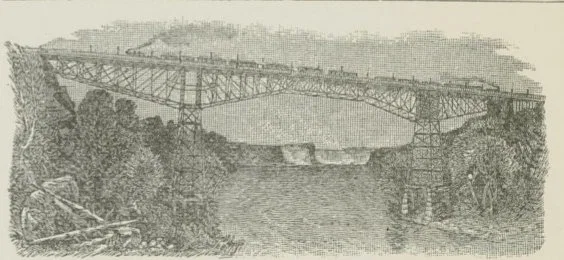
MICHIGAN CENTRAL NEW CANTILEVER BRIDGE, NIAGARA FALLS.

MICHIGAN CENTRAL RAILROAD.

GOING EAST STATIONS GOING WEST
Mail Day Exp. N. Y. Exp. Atlantic Exp. Night Exp. Ar. / Dep. Pacific Exp. Evening Exp. Gr Rap Kal Exp. Day Exp. Mail
p.m. p.m. p.m. a.m. a.m. p.m. p.m. p.m. a.m. a.m.
4.05 6.25 11.59 5.55 8.30 Detroit 9.00 8.00 4.00 9.00 6.30
4.32 5.12 10.54 4.35 7.12 Ann Arbor 9.18 9.20 5.12 10.12 8.00
3.05 4.03 10.10 3.25 5.55 Jackson 11.55 10.35 6.50 11.30 9.38
1.50 3.05 9.07 2.09 4.46 Marshall 1.07 11.48 8.07 12.45 10.46
1.05 2.23 8.47 1.42 4.22 Battle Creek 1.42 12.15 8.47 1.05 11.13
12.03 1.45 8.10 1.00 3.35 Kalamazoo 2.27 1.07 9.40 1.45 12.03
10.20 12.13 6.59 11.40 2.7 Niles 4.05 3.00 ...... 3.10 2.00
8.58 11.06 6.02 10.42 12.46 Mich. City 5.18 4.38 ...... 4.27 3.23
6.45 8.55 4.15 8.40 10.30 Chicago 7.55 7.30 ...... 6.53 5.45
a.m. p.m. p.m. p.m. p.m. Dep. / Ar. a.m. a.m. p.m. p.m. p.m.
Grand Rapids and Detroit Express leaves Kalamazoo at 6.45 A.M., Battle Creek 7.33, arrives at Detroit 11.45 A.M. All trains run by Ninetieth Meridian, or Central Standard Time.
Day Express and Mail, east and west, daily except Sunday. Pacific and Evening Expresses west, and Atlantic and New York Expresses east, daily. Night Express east daily except Saturdays.
Nov. 16, 1884. O. W. RUGGLES, Gen. Pass. Agt., Chicago.

CHICAGO, BURLINGTON & QUINCY R. R.

Union Passenger Station and Ticket Office, Canal St., between Madison and Adams.
Jan., 1885.
LEAVE. TRAINS TO AND FROM CHICAGO. ARRIVE.
† 8.45 a.m. Galesburg, Ottawa and Streator Express † 7.10 p.m.
† 10.00 a.m. Freeport, Dubuque & Sioux City Express † 2.50 p.m.
† 4.45 p.m. Amboy, Rock Falls, Sterling Express † 12.20 a.m.
* 12.30 p.m. Kansas City & South Pacific Express * 2.15 p.m.
* 12.30 p.m. Omaha Express * 2.15 p.m.
* 12.30 p.m. St. Joseph, Atchison & Topeka Express * 2.15 p.m.
* 12.30 p.m. Denver Fast Express * 2.15 p.m.
* 12.30 p.m. Montana & Pacific Express * 2.15 p.m.
† 3.20 p.m. Aurora Passenger † 7.45 p.m.
† 4.45 p.m. Mendota & Ottawa Express † 10.30 a.m.
† 5.15 p.m. St. Louis Fast Owl Express † 7.55 a.m.
† 4.45 p.m. Rockford & Forreston Express † 11.30 a.m.
† 6.20 p.m. Aurora Passenger † 8.45 a.m.
† 9.30 p.m. Freeport & Dubuque Express † 6.35 a.m.
* 10.00 p.m. Des Moines, Omaha, Lincoln, Denver & California Express * 6.55 a.m.
† 10.00 p.m. Texas Express § 5.45 a.m.
* 10.00 p.m. Kansas City and St. Joseph Night Express § 5.45 a.m.
1.20 p.m. Aurora Sunday Passenger 10.15 a.m.
Freeport, Dubuque, and Sioux City trains leave and arrive from Central Depot, foot of Lake street.
PERCEVAL LOWELL, Gen. Pass. Agt.

PLEASE EXPLAIN.

EDITOR OF THE REVIEW: In examining 1 Cor. 1: 27, 28 as it reads in our common version, I find statements which, if they are to be taken literally, seem squarely opposed to facts as they appear. It names five agencies which God has chosen to carry on the mighty work of the gospel. They are as follows: (1) The foolish things of the world; (2) the weak things of the world; (3) the base things of the world; (4) the things which are despised; and (5) the things which are not. Now just look at that list: Foolish things, weak thing, base things, despised things, and things which are not! How can the world ever be converted by such unlikely means as these? Then look at the facts as we see them to-day. Look at the real working force of the Christian church as we know it to be. See her wise bishops, her honored doctors of divinity, her learned professors, wealthy members, institutions of learning, fine churches, immense revenues, and millions of members who are the honorable of earth. Surely these cannot be called the foolish, weak, base, and despised things of the world. Has not God now chosen these to do his work on earth? and are they not doing it grandly and triumphantly? But what, then, is the meaning of the text? Does King James’s version give the correct idea of the original? Do not some of the old versions or new versions, the early fathers or modern commentators, give us something more in harmony with the actual facts in the case as we know them to exist to-day? May not the text be an interpolation? or has it not become obsolete, out of date, and unapplicable to the advanced light and intelligence of this progressive age? There must be some reasonable explanation of the apparent difficulty in this text. As a believer in the Bible, and an editor of a Christian paper, you ought to be able to clear up the matter, which I hope you will do.
Yours for the truth, D. M. CANRIGHT.
P. S. I know there is a foolish, weak, despised, base, and insignificant people who claim to be doing the work of the Lord for this generation. But who believes it? None of the wise and prudent,—none of the lights and dignitaries of the church,—have joined them. Of course you would not apply the text to them. D. M. C.
NOTE.—In the days of the apostle, yes, in the days of Christ himself, not many of the religious doctors, the great ones of either the church or the world, would believe on him, or accept the truth for that time; and we apprehend it is very much now as it was when that scripture was first penned.—ED.

COLLEGE ITEMS.

PRESENTATION.

Eld. J. Byington, a venerable minister well known in our denomination, recently presented to the College $100. Eld. Byington has now reached the extreme age of eighty-seven years. In donating what he has to the College he furnishes a touching illustration of that tender regard for the young which is so often felt by those advanced in years. It reminds one of the saying of the beloved John, who was well stricken in years when he wrote: “I have written unto you, young men, because ye are strong.” 1 John 2: 14.

PREACHING SERVICES.

Eld. Geo. I. Butler has on two occasions favored the students with stirring discourses of great practical value. His efforts were highly appreciated.

GAS.

The College is lighted now by gas from the city gas works. The light thus provided is abundant, and furnishes a striking contrast in this particular to the light furnished last year by the naphtha gas.

LETTERS.

Persons addressing students by letter should write to them in care of the College. Some commence the superscription with the name of the College. This produces confusion. The following address will furnish a proper model:—
J. H. Garland, College, Battle Creek, Mich.

ENVELOPES.

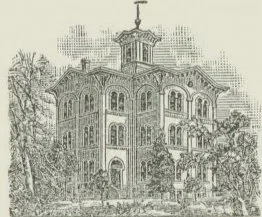
The College book-stand has just procured a fine lot of white, amber, and cream colored envelopes, which it offers at the following rates to those who would like to assist in advertising the College without any extra expense to themselves: 2 packages, post-paid to any address, for 25 cents. On the left-hand end of the envelopes is a neat cut of the College, etc., as represented below.
“Not How Much, but How Well.”
It will be observed that in the imprint on the envelopes now offered, provision has been made for the insertion in writing of the name and address of the sender of the letter. This is a marked improvement on the envelopes offered last year, inasmuch as it secures the return to the writer of all letters which fail to reach the hands of those to whom they are addressed. Some of the white envelopes are five, and some four, inches long. The amber and cream are all five inches long.

LECTURES.

As stated in last week's REVIEW, it is proposed to commence a series of lectures on the evening of Feb. 24, covering the points of faith peculiar to our people. These lectures will be delivered in the Tabernacle for the double purpose of giving the citizens of Battle Creek an opportunity to become acquainted with the reasons of our faith, and to give those of our students who design to enter the ministry the privilege of studying the methods of those who have had a large experience in the matter of presenting the truth to the people. As it is expected that the attendance from the outside will be quite large, it is believed that the lectures will partake so largely of the nature of actual work in the field, that they will offer to candidates for the ministry even greater advantages than could be obtained in connection with ordinary tent work.

TEACHERS.

As Prof. W. B. Gregory's health is such that he has found it necessary to spend a short time in rest and recreation, Prof. G. H. Bell has been employed to take charge of his classes during his absence.

CONTENTS OF THIS NUMBER.

[All articles, except in the departments of Choice Selections and The Home, which contain no signature or other credit, will be understood as coming from the Editor. All signatures to articles written for the REVIEW will be printed in SMALL CAPITALS; to selections, in italics.]

Poetry.

Our God, ELIZA H. MORTON, 113
All is Well, VIOLA E. SMITH, 114
To-day, Elizabeth Cummings, 119
Work for All, Sel., 123

Our Contributors.

Notes of Travel, Mrs. E. G. WHITE, 113
The Temple in Heaven, Eld. W. H. LITTLEJOHN, 114
Dedication, JOSEPH CLARKE, 116
Unselfishness, J. T. CROCKETT, 116
The Two Laws, JOSEPH CLARKE, 117
Some Curious Facts, J. S. MILLER, 117
Our Great Responsibility, J. M. HOPKINS, 117
Love and Assurance, J. F. BAHLER, 117

The Sabbath-School.

Lesson for the first Sabbath in March, C. C. L., 118
Sketches of Sabbath-School History,—No. 3, C. C. L., 118

Our Tract Societies.

Ohio Tract Society, IDA GATES, SEC., 119
Michigan Tract Society, HATTIE HOUSE, Sec., 119
A Valuable Suggestion, J. M. HOPKINS, 119

Editorial.

The Judgment of the Great Day, (Continued), 120
Too Plain to be Denied, 121
Advent Experience,—No. 3, G. I. B., 121
Recollections of the Past,—No. 11, J. N. LOUGHBOROUGH, 122
The Salvation Army and Others, D. M. CANRIGHT, 123
The South Lancaster School, A. S. HUTCHINS, 123

Progress of the Cause.

Reports from Northern Italy,—Minnesota—Illinois—Michigan—Arkansas—Vermont—Kansas—New England—Dakota—Wisconsin—Iowa—Tennessee—Pennsylvania—Indiana, 123—125
Meetings in Iowa, O. A. OLSEN, G. C. TENNEY, 126
News, 126
Obituaries, 127
Publishers, 127
Appointments, 127
Editorial Notes, 128

Call for Facts on Sabbath-School Work History

THE attention of our brethren is called to the articles now appearing in the REVIEW, on the history of the rise and progress of the Sabbath-school work among us; and criticisms are invited if any inaccuracies are detected in any of the statements presented. Other interesting facts may be in possession of some of our brethren not accessible by any here at the Office. If so, they would oblige us by communicating them. This is an interesting and important part of our work, and it is desirable to have its history in tangible form. It is also designed to make use of the principal facts in the forth-coming new edition of the History of the Sabbath.
Continue reading: AN OLD ACQUAINTANCE STILL PRIZED