Your ShelfYour Projects

Review and Herald, Vol. 73, No. 47.

THE RIGHT USE OF GOD'S GIFTS

Review and Herald

Nov 24, 1896

Seventh-day Adventist Publishing Association · Battle Creek, Mich. · Nov 24, 1896

THE RIGHT USE OF GOD'S GIFTS.

BY MRS. E. G. WHITE.
The love and benevolence of God and the merciful designs of his government are proclaimed in his word. “The eyes of all wait upon thee,” writes the psalmist, “and thou givest them their meat in due season. Thou openest thine hand, and satisfiest the desire of every living thing.” To God we are indebted for life itself. In him “we live, and move, and have our being,” receiving from him “life, and breath, and all things.” The sun, which brings us light, and ripens that which the earth produces, is his gift. Were it not for his miracle-working power, which by day and by night causes vegetation to flourish, there would be no harvest to gather. His blessings are new every morning, and his loving care is extended to all his creatures.
God crowned his love and benevolence by the wonderful gift of his Son. He “so loved the world, that he gave his only begotten Son, that whosoever believeth in him should not perish, but have everlasting life.” The streams of salvation are poured into our hearts by the grace of Christ; every blessing, whether temporal or spiritual, comes to us as the purchase of his blood. And God desires that now, in the year 1896, our memories be freshened, and our hearts be filled with gratitude, as we connect our outward, worldly blessings with the great sacrifice, the wonderful atonement, made in our behalf.
Our indebtedness to God and our entire dependence upon him should lead us to acknowledge him as the giver of all our blessings, and by our offerings we acknowledge this. Of the bounties he has bestowed upon us, he requires that a portion be returned to him. By giving to the Lord his due, we declare to the world that all our mercies are from him, that all we possess belongs to him.
In every offering to God we are to acknowledge the one great Gift; that alone can make our service acceptable to him. When Abel offered the firstling of the flock, he acknowledged God, not only as the giver of his temporal blessings, but also as the giver of the Saviour. Abel’s gift was the very choicest he could bring; for it was the Lord’s specified claim. But Cain brought only of the fruit of the ground, and his offering was not accepted by the Lord. It did not express faith in Christ. All our offerings must be sprinkled with the blood of the atonement. As the purchased possession of the Son of God, we are to give the Lord our own individual lives.
Right and appropriate was the festal anthem of the Jewish nation, “Hosanna; . . . blessed is he that cometh in the name of the Lord.” When the Jews held their services of thanksgiving, after the ingathering of nature’s treasure, they offered sacrifices to God. To us it might seem strange that sacrificial offerings should have formed so important a part of the universal rejoicing; and to outward appearance, it was a strange combination to mingle the sacrifice of beasts with the expressions of joy. But this was built upon the true foundation; for Christ himself was the object of these ceremonial services. When, in these festal gatherings, blood was shed, and offerings were made to God, the people were not only thanking him for his present mercies, but they were thanking him for the promise of a Saviour, and by this expressing the truth that without the shedding of the blood of the Son of God, there could be no forgiveness of sins. These celebrations were right and acceptable in the sight of God. Christ is to be regarded and appreciated as the source whence all our blessings flow.
But when the Jewish people departed from God, they lost sight of the true significance of these festal celebrations. Christ, with his divinity clothed with humanity, stood among them, witnessing their jubilant festivities and solemn services, but he was unrecognized. He was the foundation and antitype of these services, but he was not honored by those who were celebrating them. His eye looked upon the leafy encampments, his ear heard the words of song and understood their deep import; but the actors knew not the deep meaning of the words they uttered. Thousands of voices shouted, “Hosanna; . . . blessed is he that cometh in the name of the Lord;” thousands of voices prayed for the coming of Him who even then stood among them, and whom they would not receive. “He came unto his own, and his own received him not.”
Thus by precept and example the Jews tore down what they were trying to maintain by outward ceremonies. So enveloped were they in darkness and unbelief, that the influence of their words and offerings of thanksgiving were destroyed by their example. The principles represented were not accepted by God. Their offerings did not bear the divine credentials; for they were neutralized by a wrong practise. While they praised God with their lips, they pledged themselves with the same mind to murder his Son. Their hearts were devoid of the spirit of true worship, and were filled with wicked purposes, hypocrisy, and all manner of corruption.
“Take heed, brethren, lest there be in any of you an evil heart of unbelief, in departing from the living God.” Beware lest, like the Jews, you thank God with your lips only. He will not accept this offering. “The sacrifices of God are a broken spirit,” a heart filled with thanksgiving to him, and willing to prove the sincerity of its devotion by acts of ready obedience.
The Lord has committed talents to men, that they may be better fitted to honor and glorify him. To some he has entrusted means; to others, special qualifications for service; to others, tact and influence. Some have five talents, others two, and others one. From the highest to the lowliest, each has been entrusted with some gift. These talents are not our own. They belong to God. He has given them to us for conscientious use, and he will one day ask for an account of them.
The great lesson we are daily to learn is that we are stewards of God’s gifts,—stewards of money, of reason, of intellect, of influence. As stewards of the Lord’s gifts, we are to trade upon these talents, however small they may be. Many neglect this work because they think their talent too small to honor God. But you should not thus estimate the talents God has given you. Because you do not seem to be so highly favored as some others, you should not underrate your entrusted gifts, hiding them in the earth. We cannot place an accurate estimate upon our powers. However small your talent may appear, use it in God’s service, for he has need of it. If it is wisely used, you may bring to God one soul who also will dedicate his powers to the Master’s service. That soul may win other souls and thus one talent, faithfully used, may gain many talents.
God has bestowed gifts upon every man according to his several ability. Each one is to work in God’s great moral vineyard. He bids you use your entrusted gifts, large or small, in whatever sphere you may be called to act, employing every capability, and improving the smallest gift for him. Many have left the one and the two and the five talents out of their reckoning; but by so doing, they rob God. He expects all to do their best, and he will require the interest in proportion to the amount of entrusted capital. It is our privilege, on the great reckoning day, to bring our talents to the Lord, saying, “Lord, thou deliveredst unto me five talents; behold, I have gained beside them five talents more.”
God would have us realize that he has a right to mind, soul, body, and spirit,—to all that we possess. We are his by creation and by redemption. As our Creator, he claims our entire service. As our Redeemer, he has a claim of love as well as of right,—of love without a parallel. This claim we should realize every moment of our existence.
Before believers and unbelievers we must constantly recognize our dependence upon God. Our bodies, our souls, our lives, are his, not only because they are his free gift, but because he constantly supplies us with his benefits, and gives us strength to use our faculties. By returning to him his own, by willingly laboring for him, we show that we recognize our dependence upon him.
Jesus asks us to consecrate ourselves to him. He has placed signal honor upon the human race; for he says, “As many as received him, to them gave he power to become the sons of God, even to them that believe on his name.” Shall we not, then, give to Christ that which he has died to redeem? If you will do this, he will quicken your conscience, renew your heart, sanctify your affections, purify your thoughts, and set all your powers at work for him. Every motive and every thought will be brought into captivity to Jesus Christ.
Those who are sons of God will represent Christ in character. Their works will be perfumed by the infinite tenderness, compassion, love, and purity of the Son of God. And the more completely mind and body are yielded to the Holy Spirit, the greater will be the fragrance of our offering to him.
If the spirit of self-denial and self-sacrifice imbued the hearts of all who claim to be children of God, every one would represent Jesus to the world. It is because of self-seeking on the part of his professed followers that the gospel of Christ is, to so great a degree, robbed of its power. If our hearts were free from all selfishness, the water of life, flowing from Christ to the world,—the gift of righteousness and immortality, brought to light through the gospel,—would be imparted to those who are ready to perish. By our unselfish devotion, other souls would be won to Christ.
God has ordained that men and women and children should be educated by his word to become co-laborers with Christ in the great work of dispensing his gifts to the world. But those who do this work must be like Christ. They must bear his image, and live his pure, unselfish life. By too many the incarnation and work of the Son of God are but dimly comprehended. He was the Majesty of heaven, the King of Glory; “yet for your sakes he became poor, that ye through his poverty might be rich.” He pleased not himself, but cheerfully gave his life to ransom the world. He went about doing good, and this we must do if we would co-operate with him. Selfishness, self-pleasing, self-serving, can find no place in the life of the true Christian.
The life of Christ is an example of what a Christian can do with the powers given him of God. Do not become discouraged because your gift is not so large as that of some one else. Cheerfully give what you have, and God will bless your efforts. As you press close to the bleeding side of Christ, you will be actuated by his Spirit, and your heart will respond to his call. You will work as he worked, revealing his loving, unselfish spirit. Your faith will be strong, working by love and purifying your soul. Strengthened by power from above, you will be enabled to meet the Lord’s requirements, applying yourself resolutely to irksome tasks and self-sacrificing deeds for the Master’s sake.

GIVE ME THY PEACE. ISA. 48:18.

BY MRS. L. D. AVERY-STUTTLE.
(Battle Creek, Mich.)
The world cries out for peace! Earth’s weary sons and daughters seek in vain; For earth’s most perfect peace is mixed with pain. O give them peace like gentle showers of rain, Which cheer and vivify the parched plain, ’Mid summer’s drouth.
Give me thy peace, O God,— Peace like a river flowing calm and free,— My troubled spirit crieth out for thee. O give me peace, my God, and comfort me, And let me wander ’mid green meadows free, Led by thy hand.
Yes, give me perfect peace,— Wealth gives it not, nor gems, nor riches bright; Though purest gold the glittering orb of light, Though turned to “diamonds all the stars of night,” And I could grasp them by my feeble might, ’T would give no peace.
But thou canst give me peace,— Sweet, perfect peace,— and with my hand in thine, Grief may not cause my spirit to repine. These ills shall but the dross of earth refine. Then, O my God, let thy sweet peace be mine Forevermore.

“WHICH SPIRITUALLY IS CALLED SODOM.”

“They were Haughty and Committed Abomination.”
BY PROF. P. T. MAGAN.
(Battle Creek College.)
“Sodom” is the term which the Lord has used to describe the state of society in France for some time before and during the Revolution. The last sin mentioned in the list of the iniquities of Sodom is licentiousness. This, the most debasing trait of human frailty, was the greatest sin of Sodom and of France. It was, however, nothing but the legitimate result, the logical consequence, of all the other sins of Sodom and of France.
An overwrought civilization undoubtedly does veneer and polish, but it does not assuage the fiercer and baser passions of human nature. What the world calls “refined life” corrupts while it makes polite the intercourse of the sexes. “The gross appetite of love becomes more dangerous when it is elevated, or rather, indeed, disguised, by sentimental passion. The elegance of dress, of motion, and of manners, gives a luster to beauty, and inflames the senses through the imagination. Luxurious entertainments, midnight dances, and licentious spectacles, present at once temptation and opportunity to human frailty.”
It was in the very nature of things that the French clergy and nobility, who spent their time in dressing, playing, and banqueting, should be immoral. Taine has truly said, “Gaiety is a sort of intoxication which draws the cask down to the dregs, and when the wine is gone, it draws on the lees.” Wherever there are eating and drinking and pleasure to excess, there are also fornication and moral uncleanness.
The upper ranks of French society were, in fact, as vicious as they were polite. Refined and courteous they undoubtedly were. “To praise a woman’s beauty to her face would have been to disparage her modesty. . . . No well-bred man would then appear in a lady’s room carelessly dressed or in boots. In speech between the sexes, the third person was generally used, and a gentleman, in speaking to a lady, dropped his voice to a lower tone than he employed to men. Gentlemen were careful before ladies not to treat even one another with familiarity. Still less would one of them, however intimate he might be with a lady’s husband or brother, speak to her of his friend by any name less formal than his title.” All this may sound very nice; but when the reverse side of the picture is exhibited, it will only serve to make more plain the undeniable fact that good manners are not by any means always accompanied by good morals.
During the century preceding the Revolution, from the kings and queens upon their thrones, to the lowest nobles, society was literally reeking in moral pollution. “Never, perhaps, in a Christian country, have offenses against the laws of marriage been so readily condoned, where outward decency was not violated, as in the upper circles of France in the century preceding the Revolution.” For more than half a hundred years before the bursting of the storm, the throne was occupied by Louis XV. This man, even in those evil days, was noted as an indolent, frivolous, and sensual debauchee. In vileness he was without a peer, save only for his still viler mistresses, of whom Madame de Pompadour was the most illustrious example. It was this woman, together with the other courtezans of the palace, who ruled the nation. How beautiful their garments, how resplendent their jewels, but how hideous their souls! “Even the great goddess Lubricity,” to use Matthew Arnold’s graphic metaphor, is worshiped without hypocrisy, but in a tasty drapery purloined from chastity’s wardrobe; yes, refined to the last degree of exquisiteness. However hollow or even rotten inside, the form was of masterful design, and the polish unsurpassable in luster and delicacy.”
During the reign of this monarch, society in Paris and at Versailles presented a curious character. “Adultery had acquired a regular standing, and connections dependent upon it were openly, if tacitly, recognized. Such illicit alliances were even governed by a morality of their own, and the attempt to induce a woman to be unfaithful to her criminal lover might be treated as an insult.” If the records of the times are at all reliable, the rich and idle society of France was literally honeycombed with marital unfaithfulness.
Queen Marie Antoinette, the unfortunate wife of the unfortunate Louis XVI, was shamefully deficient in morals. Men and women of notorious reputation were her constant companions. Her brother, Joseph II of Austria, was shocked at the familiar manners which she permitted. One house which she was in the habit of frequenting he called “a real gambling hell.” If any one ought to set an example in good morals, it is the queen of a great country; but Marie Antoinette was continually surrounded by dissipated young noblemen who, on race days, were allowed to come into her presence in costumes which shocked conservative people.

SEEKING JESUS.

BY MRS. M. E. DURKEE.
(Battle Creek, Mich.)
AFTER seasons of refreshing, when people have been fed with food from heaven, they are apt to allow the cares of life to absorb their thoughts, and thus they for a time seem to forget Jesus. Not so the multitude that Jesus fed with a few loaves and two fishes; for the record says they came the next day, “seeking Jesus.” No doubt there were various reasons for their coming; perhaps some came to hear his precious words of instruction, probably the larger number hoped again to be fed and witness another miracle. How quickly will a crowd gather around a man who gives away something to eat! Many people are so willing to accept that which costs them nothing that they will even take what they do not need, if it is given to them, thereby depriving others who needed it more than they.
But those who seek Jesus must work. He did not sanction idleness. That multitude had to go to the other side of the sea to find him. It seemed like a game of hide and-seek when Jesus withdrew from them so mysteriously, and they looked for him in one place, but after long searching found him in another. They knew there was but one boat, which the disciples had entered, and Jesus was not with them. No wonder they queried, “Rabbi, when camest thou hither?” In this circumstance Jesus teaches us that we need to draw apart from even our dearest friends and seek him alone, and that sometimes we must go some distance to find him. He wants us to take some pains, often inconvenience, to seek him; perhaps at a camp-meeting or some other large gathering, where he will give special instruction to his people. It is very unsafe to go on a journey without taking Jesus with us. The disciples rowed all night to cross that little sea, yet as soon as Jesus was on board, immediately they came to land.

“WHAT A SPECTACLE!”

BY A. F. BALLENGER.
(New York City.)
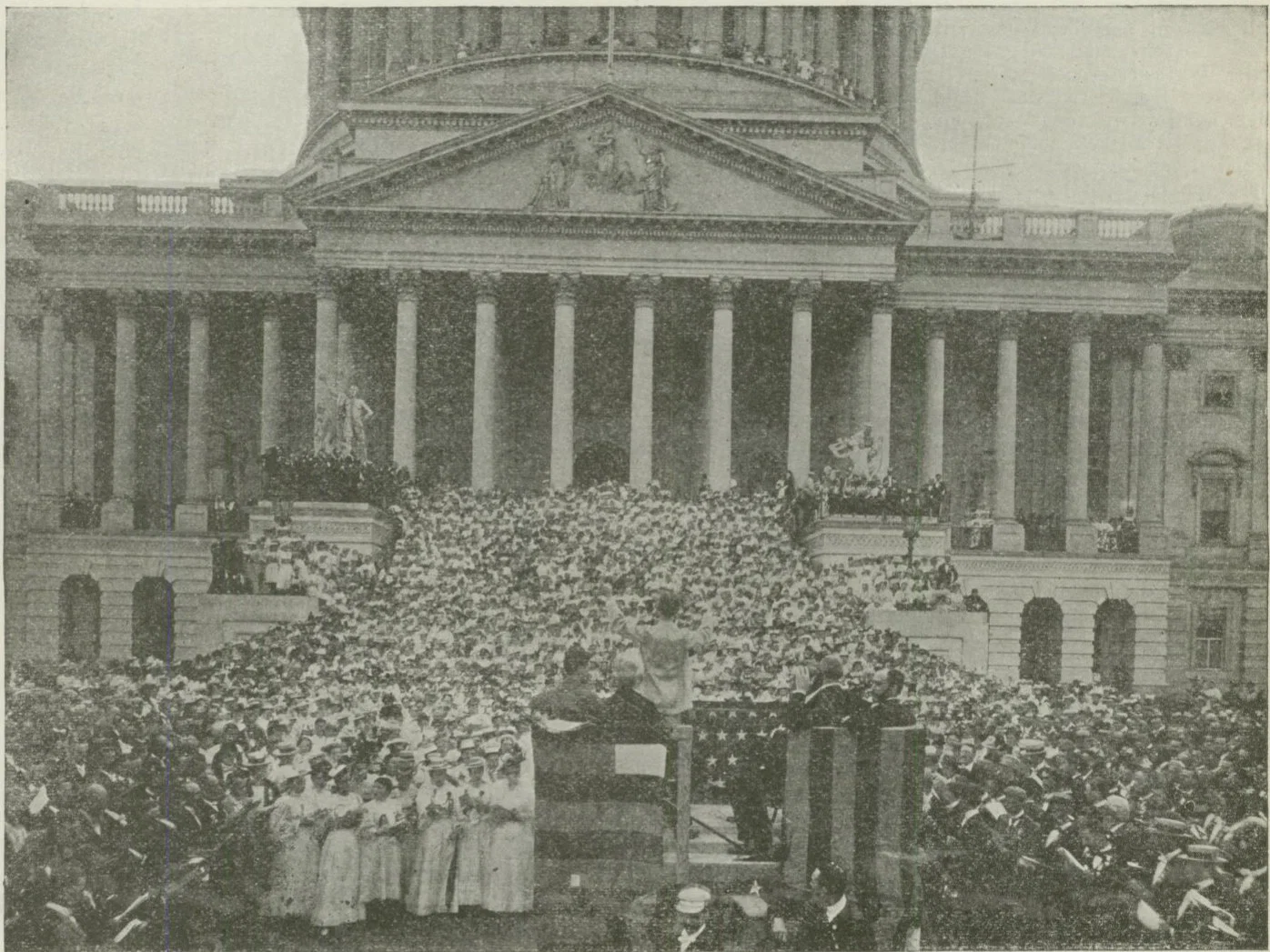
Sabbath afternoon, July 11, 1896, fifty thousand “National Reformers” were assembled at the nation’s capital. The report reads:—
THE OPEN-AIR PATRIOTIC SONG SERVICE. CHORUS OF 4600 VOICES UPON THE CAPITOL STEPS.
“What a spectacle! The wide space enclosed by the east and west wings of the national Capitol was a sea of human beings,—a flowing sea, with currents and tides, with streams of humanity pouring into it from all avenues, with great bays stretching out along East Capitol street and Delaware and Maryland avenues, and with three mighty waves breaking upon and covering the flights of the Capitol steps. “The Capitol windows were crowded, and the crowd overflowed onto the library grounds, and surged up on the pedestals of statues and bases of fountains, and pushed hard on the full areas allotted to carriages. . . . And the white figure of George Washington rose serene from the midst of it all. Was the spirit of the great patriot there, rejoicing over this, the mightiest gathering of young patriots ever seen in the country he loved, or in this wide world? Never before has our government permitted the area around the Capitol, the very heart of the nation, to be used for other than governmental purposes. And indeed a governmental purpose was that, since the fifty thousand represent nearly three million young people whose force of character will make them the country’s governors before many a moon has passed. That grand exhibition of young manhood and womanhood is the clearest omen yet seen of the coming time when Christ, whose right it is to reign, shall be supreme on Capitol Hill.”
The foregoing is a partial description of a scene at Washington during the Christian Endeavor Convention held there last July, and is taken from pages 288 and 289 of the society’s “Official Report.” The reader may ask, Why call it a convention of fifty thousand National Reformers? The answer will be made plain. Let the description of the scene continue: “The trustees of the united societies filled one stone outpost. Justice Harlan’s strong face and giant form were conspicuous in the fair setting of the topmost row of the chorus. The speaker’s stand was filled with Dr. Clark, Secretary Baer, Chairman Smith, Director Foster, Dr. McCrory, of Pennsylvania, and Dr. J. Z. Tyler, of Ohio. ‘Holy, holy, holy!’ fit opening chorus that! And how the over four thousand young voices bore that glorious hymn to heaven! Dr. McCrory offered prayer, and then Dr. Clark made a brief address.”
Dr. Clark is the founder and president of the Christian Endeavor Society, and the occasion was the presentation of the “Christian Citizenship Banner.” The Christian Endeavor Society has a “Christian Citizenship Banner” which it presents annually to the local society which has been the most active in the modern church movement known as “Christian Citizenship.” One of the principal objects of this movement is the enforcement of Sunday laws. In presenting this banner Dr. Clark said, in part:—
Just a word before I present the banner to the local union that has reported the best work in promoting Christian Citizenship. What a glorious spectacle is this—these tens of thousands! I think this scene will be photographed upon our minds as long as we live. We shall never forget this sight at the Capitol of the nation. It means that Christian Endeavor stands for Christian Citizenship. [Italics mine.] That is the significance of this meeting. . . . Many cities have done excellently, but Cleveland excelled them all. . . . In the name of the united societies I present this banner to the representative of Cleveland, Rev. J. Z. Tyler, D. D., who will accept it in the name of the fair city by the lake.
Dr. Tyler, in his speech accepting the banner, said:—
No clearer demonstration of the divine touch upon the heart of him who has led us in this movement can be found anywhere than in the suggestion that Christian Endeavor shall give special attention to Christian Citizenship. The “Official Report” gives this description of the scene that followed Dr. Tyler’s speech:— After these stirring exercises came the praise service. Of course the Marine Band made matchless music. Of course the regiments of Endeavorers faithfully applauded every patriotic piece, gaily swinging flags and hats and umbrellas to the more sprightly tunes, such as “Yankee Doodle.” And of course Mr. Foster’s tremendous chorus took hold on the very heavens. The international hymn, “America,” “There is a Royal Banner,” Dr. S. F. Smith’s “The Cross and Victory,” and Mr. Foster’s own “Loyal Soldiers,”—those were the songs they sang. “What a spectacle!” What momentous meaning in these marching thousands with the millions they represent! Marching behind a banner which embodies the blighting principles of national reform, of state-churchism, of Roman Catholicism, of the “image of the beast”! What a scene for the vision of the student of prophecy is this mighty army of twenty-five federated churches, fifty thousand strong, the representatives of many millions more, with crusader enthusiasm, marching in confident expectation that through Christian Citizenship—through human law—they are to bring Christ to reign as King on Capitol Hill!
Thursday evening preceding the scenes here described, was devoted to the subject of Christian Citizenship. Fifty-three pages of the “Official Report” were devoted to a report of the addresses on this theme. A few quotations from the speeches will convince the reader that this movement embodies the principles of national reform which Seventh-day Adventists have been watching for more than thirty years:— If we are praying for the preservation of our Sabbath, we must demand the nomination and election of men who will uphold its sanctity.—“Official Report,” page 105. The trouble at the garden of Eden was that Adam and Eve went out, and Satan stayed in. Here we must stay in, and put Satan out, and we will have paradise regained. What are some of the evils which threaten to spoil the Almighty’s design in America? What are some of the devils which Christian Citizenship should cast out? . . . The second great evil which, on account of its direful effect, may be called a devil, is Sabbath desecration. . . . Upon our national sky are clouds as black and threatening as ever threw their shadows or rolled their thunders over a people. Place your ear to the ground, and you will hear voices that bode no good to our country. . . . Let it [Christian Citizenship] stand for the Sabbath. Let it apply the gospel, and all of it, to the faith of the nation.—Pages 106–108.
Taking an interest in politics does not mean that the minister of the gospel should bring politics into the pulpit, but it does mean that he should take his pulpit into politics. It does not mean that he should bring politics into church, but it does mean, most emphatically, that the church should be translated into political power.—Page 109.
Any Endeavorer may be as much a missionary of God in American politics as in the forests of Africa.—Page 117.
To the Christian Endeavorer, politics means an instrument of righteousness, and party but the scaffolding around the rising kingdom of God.—Page 111.
To whom should our country look to give us these [a new conception of patriotism, a comprehension of civic duty] but to us, her Christian young people? . . . With our sisters we will strike hands that this country shall cast out her devils, and, sitting at the feet of Jesus, be clothed and in her right mind. We will no longer be silence-keepers to hell, but we will live for God, we will fight for God. And when we can no longer fight, we will pray for the mildew of God’s wrath on whosoever worketh abomination, or would delay the coming of the kingdom of God. . . . We will force respect for the Sabbath.—Page 123.
The next recorded speech is that delivered by Dr. J. T. McCrory, one of the directors of the National Reform Association, a contributing editor of the Christian Statesman, its official organ, and president of the Pennsylvania Christian Endeavor Association. This speaker saw everything to encourage the hearts of the National Reformers. A great change has come over the Christian Endeavor movement. This change was noted by Chairman Page, who presided at the Christian Citizenship meeting held in Central Hall. He said:— A few years ago it might have been necessary to apologize for introducing the subject of Christian Citizenship into a Christian Endeavor meeting, but it is now a timely topic.—Page 129. Dr. McCrory, referring to this same change in sentiment, said:— Let me call your attention to the fact that the aspect of the cross is undergoing a great change in this regard. There was a time, not so long ago, either, when the cross was viewed almost exclusively in reference to the salvation of the individual. . . . Now, if I understand it aright, it is one purpose of this great Endeavor movement to enthrone Christ in our national life. . . . The Covenanters stood, in their day, for what they called “the crown rights of King Jesus,”—the same thing precisely that the Christian Citizenship movement of Christian Endeavorers stands for in this country to-day.—Pages 125–7. It will only be when Christian men, whose thought has been quickened by the divine life and energized by the Holy Spirit, are elevated to the places of trust and honor, and lauded as heroes by the patriotic sentiment of the republic, that Christian Citizenship will have reached the acme of its claims, and the government will become, in fact as well as in name, a Christian government.—Page 139. Stand by every business man who closes store or factory on Sunday. Patronize him as far as possible. Bring all possible pressure to bear upon any who refuse to close.—Page 303. We have a right to make and enforce human statutes that call for the observance of the laws of God. Let us see to it that laws now in existence are enforced. . . . The home mission problem in all the denominations will be largely solved as soon as Sabbath laws are enforced.—Pages 304, 305. The foregoing quotations are sufficient to sustain the assertion that the Christian Endeavor Society has been transformed into a great National Reform Association, and is engaged in disseminating with startling rapidity among the rank and file of the twenty-five confederated denominations which it represents, the cruel, persecuting principles of state-enforced religion. No one who has not attended these Christian Citizenship meetings can begin to realize the zeal and enthusiasm manifested. These gatherings are composed largely of young people be- tween the ages of twenty and forty, who are thoroughly persuaded that their organization is destined to usher in the kingdom of God,—a millennium of righteousness,—when he whose right it is will come and reign. This strong incentive, together with the fact that they have coupled with this movement some worthy objects, such as temperance reform, etc., make of them a zealous host hardly second in enthusiasm to the Crusaders of the middle ages.
The writer has attended a number of National Reform conventions before the rise of this movement, and was wont to wonder how the rank and file of the popular churches were to become sufficiently stirred with these principles to insure the final fulfilment of the prophecy. He wonders no longer.
But in the light of these stirring developments, what are Seventh-day Adventists doing? Have they kept pace with the progress of these movements? In 1892 we were startled with the sudden successful attack on the religious liberty principles of our government. We saw in the determined, destructive onslaught upon the citadel of our nation’s liberties, a force which, if successfully united and wielded by a master hand, would fulfil every specification of the prophecy, even to the death decree. We were stirred. We sought God. We gave of our means. The work prospered. Missionaries were sent by scores to distant lands to proclaim the gospel of the kingdom. But the attacking army retired. It seemed to disband. Some grew careless. They said, in act if not in word, “My Lord delayeth his coming.” Means was withheld from the cause, and those upon whom we had laid the burden of despatching and sustaining these missionaries have been greatly embarrassed for want of means. But instead of the armies’ disbanding, in the very next year, 1893, they began to reorganize and recruit within the Christian Endeavor Society under the name of “Christian Citizenship.” And now we awake, if we do awake, to find ourselves confronted with a confederacy of twenty-five churches, numbering millions, thoroughly organized, and actuated by the very principles and purposes necessary to complete the predicted work of persecution.
The call is to repentance. Let us seek God for forgiveness for having said in our hearts, “My Lord delayeth his coming.” Let us seek the Lord for the outpouring of his Holy Spirit to fit us for the work and suffering before us. Let us go to work with a zeal befitting our work and our time. “The work which the church has failed to do in a time of peace and prosperity, she will have to do in a terrible crisis, under the most discouraging, forbidding circumstances.”

THANKSGIVING

BY FANNIE BOLTON.
(Battle Creek, Mich.)
For sunshine, Lord, In solemn splendor, For clouds and rain, For dew so tender, For rose and leaf, And green things slender, For stars steadfast, Fire on the fender, I thank thee, Lord.
For helping hands That lift and bless, For gentle eyes, The kind caress, For tender thoughts That heartaches guess, For pardoning love E'er lips confess, I thank thee, Lord.
For daily sweet, The common token, That comforts so The heart grief-broken; For cross and shade, Thy love unspoken, Linking me still In chains unbroken, I thank thee, Lord.
Let me bow low,— Yea, low and lower,— Humbly to take Thy glorious dower Of common mercy In sun and shower, In love to love From hour to hour,— Let me bow low.
Here at this place Of sweet contrition, Thou and thy grace Point out high mission, Exceeding above All my sad wishing; Take me for love Without condition, Take me, O God!
Here, like to those Who aid as brothers,— Here, for the helping And cheer of others,— And after this That life that covers Eternity's joys with thyself And all lovers, Take me, O God!

DUTY TO THE POOR.

BY M. E. KELLOGG.
(Battle Creek, Mich.)
Few seem to realize how much of Christianity is embraced in doing good to others, particularly to the poor, the sick, and the afflicted. Much of the four Gospels is taken up with the records of Christ’s labors of love for the people. It is true that he taught in their streets and synagogues, but he also healed their sick, and fed those who were hungry. When the disciples were given their first commission, it was to “preach the kingdom of God, and to heal the sick.” Luke 9:1, 2. After the day of Pentecost, one of the first acts of importance which is recorded is that of the appointment of “seven men of honest report,” who were to devote themselves to caring for the widows. Acts 6:1–4.
One of the most striking evidences of the great importance attached to this particular portion of gospel work, may be gathered from an expression found in Gal. 2:9, 10. Speaking of the great council held at Jerusalem and the division of labor there made, Paul says: “They [Peter, James, and John] gave to me and Barnabas the right hands of fellowship; that we should go unto the heathen, and they unto the circumcision. Only they would that we should remember the poor; the same which I also was forward to do.” Referring to the record of this council as described in the fifteenth chapter of Acts, we find that only those things of great consequence were taken into consideration. It thus appears that the first Christian council took cognizance of the state of the poor, and laid plans for the amelioration of their condition; and when the gospel field was divided, Paul and Barnabas going to the Gentiles, the apostles and elders at Jerusalem thought it worthy of their attention especially to request those taking the Gentile field to remember the poor. And this request was not in vain; for Paul says, “The same which I also was forward to do.”
Years afterward we find Paul giving directions for the “collection for the saints,” and also journeying to Jerusalem to carry it to the poor saints there (1 Cor. 16:1, 2); and in his letters the obligation to care for the poor is often referred to as a part of Christianity. Thus the duty of all Christians to care for their own aged, dependent relatives is plainly stated: “If any man or woman that believeth have widows, let them relieve them, and let not the church be charged; that it may relieve them that are widows indeed.” 1 Tim. 5:16. Some may ask, How far in the line of relation does this command extend? Does it extend further than that children must have a regard for their own parents?—Yes, it goes further than that. Hear the apostle further: “Honor [care for and support] widows that are widows indeed [or those who have no relatives]. But if any widow have children or nephews, let them learn first to show piety at home, and to requite their parents: for that is good and acceptable before God.” Verses 3, 4.
In one thing, his poverty, every poor person represents Christ. To despise one simply because he is poor, is to despise Christ. The poor are to be always with us, and as long as they are with us, they become the means of a continual test of our generosity and Christianity. Many people seem to think that poverty is but another name for idleness and extravagance. This is no more true than another fallacy,—that wealth always represents selfishness and dishonesty. It is true that men make themselves rich, and that men make themselves poor, by their own course of conduct. It is also true that circumstances over which they have no control do the same things for many persons. Men become rich from legacies and through honest business methods; and men also become poor through misfortune, sickness, and other causes. If we must err in our dealings with the poor, it is better to err upon the side of charity rather than on the side of selfish disregard for their condition and wants.
A long, cold winter is before us. Thousands of men, women, and children will be only partially clothed and poorly fed. Some of them will make known their wants; others will suffer greatly rather than allow any one to know their condition. There will be abundant opportunity for those who wish to follow Christ in dispensing temporal blessings, to seek out many persons who otherwise must suffer. To feed the hungry and to clothe the naked are as much a part of Christianity as to believe on the Lord Jesus Christ and be baptized. There is altogether too much one-sided Christianity in the world,—too much that makes a high profession, and says to the suffering, “Depart in peace, be ye warmed and filled.” Let us have a whole religion. “Pure religion and undefiled before God and the Father is this, To visit the fatherless and widows in their affliction, and to keep himself unspotted from the world.”
To say to one naked and destitute of daily food, “Depart in peace, be ye warmed and filled; notwithstanding ye give them not those things which are needful to the body, what doth it profit?” Please read also Matt. 25:31–46.
Continue reading: HOW WE SHOULD PRAY