The Youth’s Instructor, Vol. LI, No. 13

The Pioneers of Spring

The Youth’s Instructor

April 2, 1903

Review and Herald Publishing Company · Battle Creek, Michigan · April 2, 1903

The Pioneers of Spring
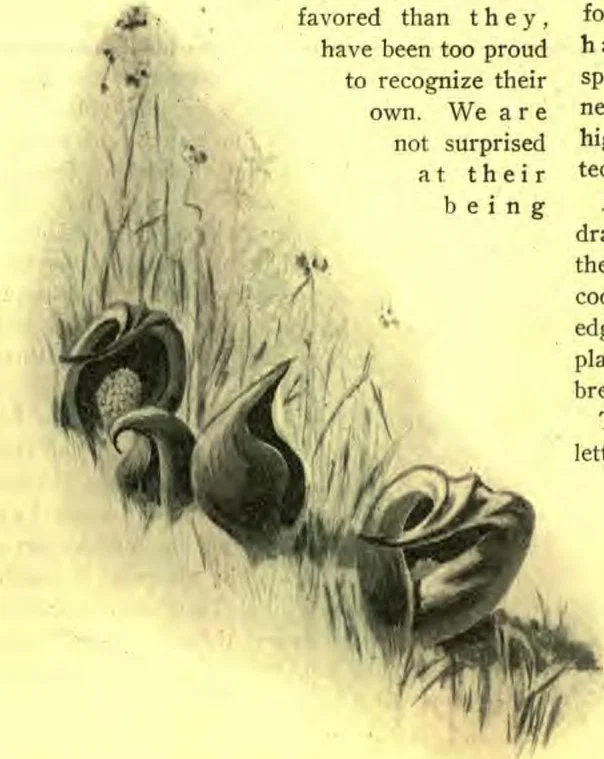
THE Skunk Cabbage has been called the courier of the spring. He leads the procession of the flowers. He is so far ahead of the other plants that he dwells alone, the hermit of the bog. Already the honey-bees have found him, and we follow them to the low places to “welcome the prophet that pierces the snow, the pioneer that lifts the banners of ice to tell us of the message he has received from mother-earth, long before the wood flower hears it in the south wind, or the lisp of the bluebird tells it to the trees.”
The Skunk Cabbage is the “poor relation” of the spotless Calla Lily and the cheerful Jack-in-the-Pulpit. Of course they hate to own it, and have been quite successful in keeping the secret from the rest of the world. And, by the way, this is not the first time that creatures even more favored than they, have been too proud to recognize their own. We are not surprised at their being ashamed of the odorous, homely, livid-colored Cabbage, they form with it so great a contrast.
Who ever named the Adder's-tongue, I wonder? I doubt if more contradictions were ever put into the title of a thing before. The only thing I know of that in any wise resembles it is the calling a black man Snowball, or giving a white man the title of Mr. Black.
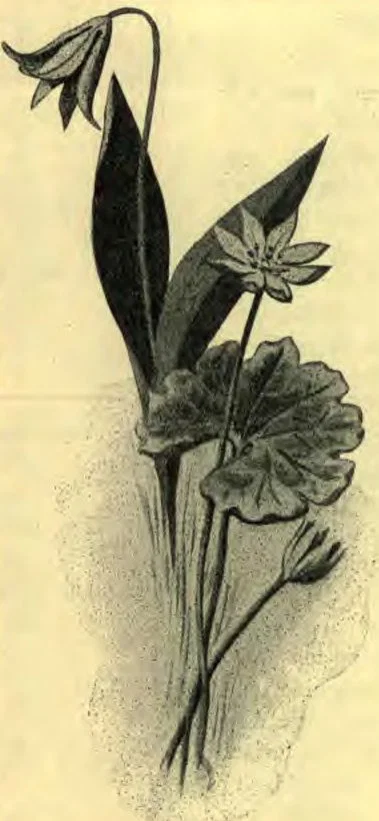
Adder's-tongue, or Dog's-tooth Violet! It is not a violet in shape or color; it is really a lily, and the blossom is usually a russet-yellow. You will find nothing about it that looks like an adder's tongue, though there is a slightly snaky look to the leaves, due to their mottled appearance; but then you will find some specimens that bear not the slightest trace of this mottled color. Further, the only possible resemblance any part of the plant bears to a dog's tooth must be in the root, which is usually in the ground, out of sight, and this resemblance is nine tenths imagination. Mr. Burroughs has suggested for this plant the appropriate name of “fawn lily,” or “trout lily,” and it would be well to call it so.
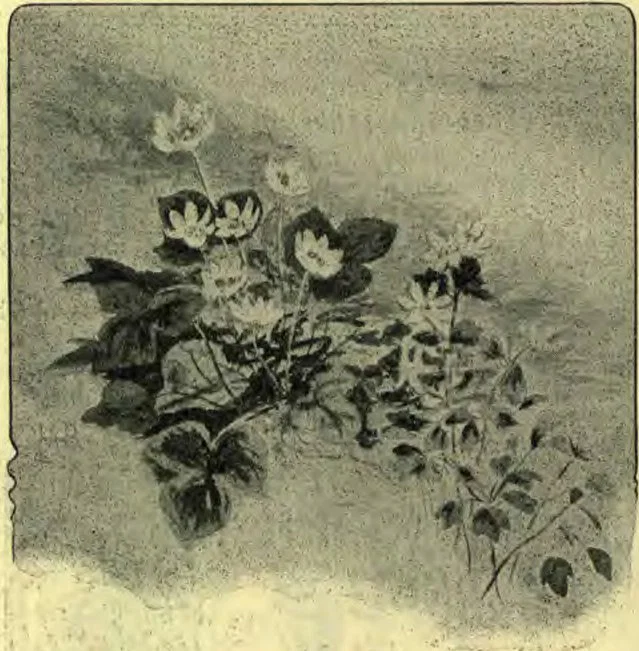
The Anemones and the Bloodroot are among the frailest of the spring flowers. The juice of the Bloodroot is orange-red, and is said to be a specific for coughs and colds. I have observed beautiful specimens of this plant nearly eighteen inches high in the sunny and protected Minnehaha Valley.
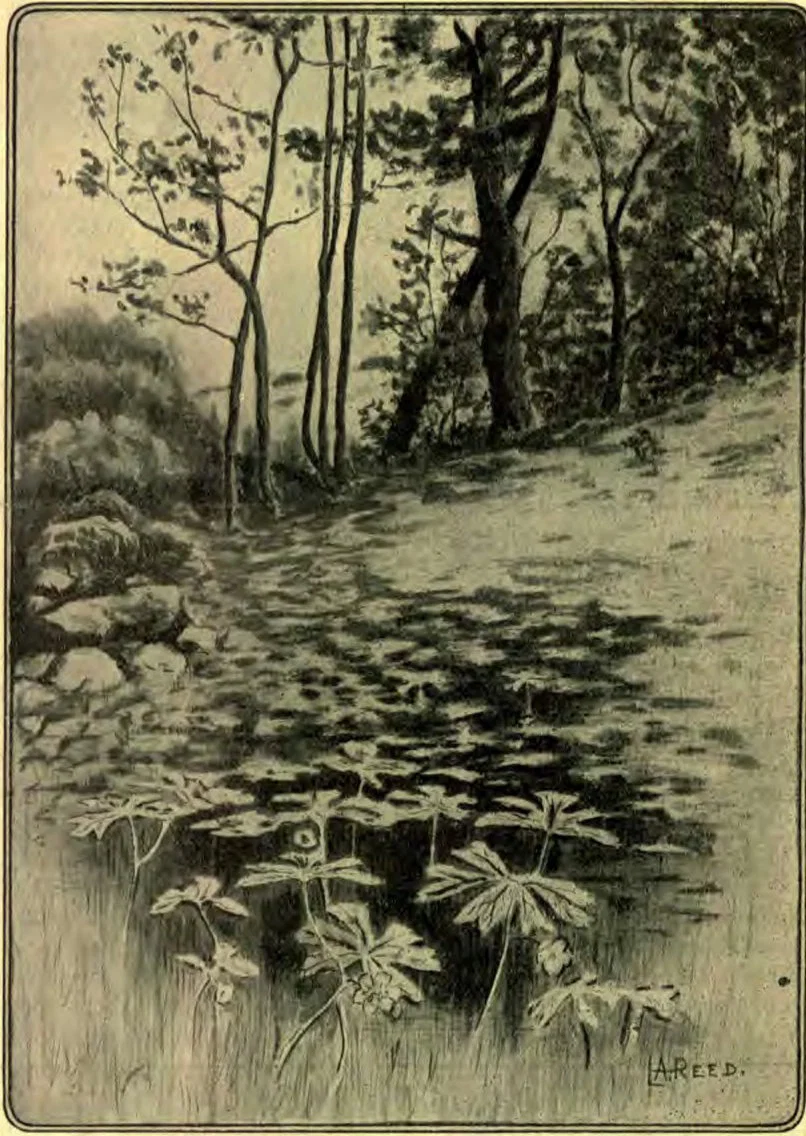
As children, how we watched for the Mandrakes, though that is not the name we gave them. If, perchance, after walking through some cool stretch of woodland, we came, just at the edge of the trees, upon a host of these stately plants, how we all cried out, in glee, “The umbrellas are out! The umbrellas are out!”
Truly, the times we spend with nature are red-letter days. Unfortunate, indeed, is he who can not conjure up memories “of lush green tangles, of water-weeds and lily-pads, of rippling brooks and dipping oars; placid lakes, cool forest glades, and meadows redolent with bloom.” All that nature has been, she still is, and ever will be, and with her there is healing for failing bodies and rest for tired nerves. We may “go forth under the open sky, and list to nature's teachings.”
L. A. REED.

The Unfolding of the Leaves

LET us glance over the crowd of leaves that unfold before us in the spring, noting that even under the individual peculiarities of families, we can trace some seven or eight broad lines of action, to which all more or less conform.
The first to attract our notice are plants which hold their leaves aloft, and uncoil them, flag-like, in majestic manner. The stem bearing each leaf is continued as a strong rib up through the leaf, and round it the leaf is wrapped as a flag is furled. In one of these we recognize the arum lily, a stately plant, which, in its warm and comfortable quarters, can well afford to be imperial in its bearing; for it has none of the struggle which such a plant as the primrose knows when it bravely faces the snows of February and the bitter winds of March.
“THE UMBRELLAS ARE OUT”
And the primrose leaves bear evidence of the struggle in their very attitude. They are not held aloft like the arum flag, for the cold would nip them through and through; but instead, each little leaf, putting a brave front on the matter, only appears on its face as a stout rib of lightish green. But turn over the baby leaf, and you will find two little tight rolls of delicate green tissue wrapped away snugly on its back behind the rib. The more fragile parts of the leaf naturally shrink from the cold wind, and curl themselves up, and shelter behind the more robust parts.
Pick up leaves of older growth, taking them in their various stages from youth to maturity, and you will see how gradually the little tight coils enclose as the baby leaf grows, and becomes more able to bear exposure, helped, too, in its development by the softening influence of approaching spring. The rolls unwind, moving farther and farther from one another, and the face of the leaf broadens at either side, until at length the full-grown familiar primrose leaf lies before us. The crocus and the large dock leaves are among those that follow the example of the primrose in curling themselves backward in their youth.
HEPATICA
HEPATICA
Other leaves start life rolled up in much the same way, but forward, not backward, and thus at first carefully hide their main central rib. As they grow, the coils roll back, like curtains, on either hand, and show the face of the leaf. The violet is a good illustration of this habit, and so, too, are the leaves of the little pink begonia.
The pear leaf rolls up on its face also, but quite differently from either the violet or begonia. Its long, straight, sausage-like rolls loosen, rather than unroll, until the edges just touch one another.
For a contrast to the neat little rolls of these leaves, turn to others, of which the delicate green columbine is an example. The columbine's way of doing things is much like a conjuror's. First a crumpled ball of green tissue, then a larger ball of endless edges and pieces, shaking out gradually from chaos to order, until an elaborate system of leaves appears, a stem, too, on which three branches arise, and on each branch many leaflets—all hidden, till now, in the little crumpled ball.
The roses and the wild elders arrive at the same result, but in a neat and precise way, which leaves no room for sensation, or doubt as to what will happen. There is in them no ball of crumpled possibilities to awaken curiosity, but instead each tiny leaflet is, from the very beginning, neatly folded in half by itself, and all are laid carefully one on the top of the other, in the most orderly way. As the days pass, the leaflets lift themselves one from another, and spread out a little, and at the same time each begins to open, the stalk lengthens, and, all in order and due time, the leaf arranges itself.
But all leaves are not neat and orderly in their unfolding. Many are simply crumpled up at their birth, and only smooth out as their development progresses. A baby geranium or poppy leaf, for instance, is a rough, crumpled little ball, folded up higgledy-piggledy, and covered with hairs. Still, as is the case with many an unpromising beginner, time smooths things over, and by degrees the creases disappear, the crumpled folds fall into place, and though the rough surface never becomes really smooth, yet the leaf takes its place as a decent member of plant society, and does its work no worse for its lack of polish.
The leaves of the cherry and the peach are simple, undivided, and oblong, and their upper surfaces are rather delicate to begin with, so each begins life folded in half like a book, the middle rib being the back of the book. So exactly are the halves placed one on the other, that it is often difficult to tell that there are two layers and not one; moreover, sometimes the halves of the leaves are stuck together with a sticky substance during the earlier period of their development. Thus folded, then, they grow until they are almost full size; then, like a book, they open.
In contrast to the simple method of the cherry, notice the dainty way in which the beech folds up a very similarly shaped leaf. The ribs of the leaf run out parallel to one another from the center rib, and play the part of the sticks, while the pale-green tissue between the ribs is as delicate as any silk or gauze which fashions a fan. Just as a fan unfolds, so does the leaf; the pleats open out gradually, the ribs stretch apart, until finally the leaf, like a fan, is a plain, unpleated surface. In many other trees besides the beech this fan-like unfolding may be traced. The horse-chestnut, for instance, pleats each of the finger-like parts of its leaf, and then places them all together more or less tidily, like a bundle of sticks.
One very curious unfolding—the unfolding of the ferns—must not be overlooked in our brief survey of leaves. Instead of rolling themselves up from side to side, as do almost all the other leaves which adopt the rolling action, they coil themselves from apex to base. At the very beginning of their life, the whole main axis is wound up tightly, like a watch-spring; as development progresses, the coil gradually unwinds and straightens out. And now it can be seen that every little branch is wound up in the same peculiar way, and all are unwinding as they grow.
A few leaves do not have any manner of folding in their youth; some come up sturdily, straight through the ground in their natural form, only trusting to a thick skin for protection; such are the daffodils and the iris. Others arise on the branches, perfect leaves in miniature, simply growing larger and larger until they attain their full size.
DOG'S-TOOTH VIOLET — BLOODROOT
But the majority are folded, rolled, or crumpled. They may be folded in half, or fan-wise, or arranged to fit one on to the other; they may be rolled from side to side, or from apex to base, or in double rolls forward or backward; they may be merely crumpled, or they may adopt a modification or a combination of several of these methods, and in this they show their individuality.
The strawberry leaf, for instance, has the same method of folding as the roses, but, to make protection doubly sure, has combined with it the pleating of the beech, and then added a coat of hairs for further warmth.
The convolvulus shows its individuality in a very quaint way. A glance at the ends of the young shoots recalls irresistibly to mind a toy monkey climbing a stick. Each little leaflet clings tightly round the parent stalk, and not until it is well grown does its clasp relax, and then it throws itself back to face the sky, and begin its work.—G. Clarke Nuttall.

— Frank Dempster Sherman, in Scribner’s

Arbutus

ALONG the woods’ brown edge The wind goes wandering To find the first pink pledge— The hint of spring.
The withered leaves around, She scatters every one, And gives to wintry ground A glimpse of sun.
And to the woodland dumb And desolate so long She calls the birds to come With happy song.
Then the arbutus! This The pledge, the hint, she sought— The blush, the breath, the kiss— Spring’s very thought!

— Frank Dempster Sherman, in Scribner’s

The Spider's Way Out

A CLOSE observer, says the Well Spring, never has to travel away from home for entertainment and instruction. One bright-eyed young person, tired of reading, tells in an English paper how he found a spider an interesting playmate:—
I took a wash-bowl, and fastened up a stick in it like a vessel's mast, and then poured in water enough to turn the mast into an island for my spider, whom I named Crusoe, and put on the mast. As soon as he was fairly cast away, he anxiously began to run around to find the mainland. He'd scamper down the mast to the water, stick out a foot, get it wet, shake it, run round the stick, and try the other side, and then run back to the top again.
Pretty soon it became a serious matter, and he sat down to think over it. As in a moment he acted as if he were going to shout for a boat, and as if he were afraid he was going to be hungry, I put molasses on the stick. A fly came, but Crusoe wasn't hungry for flies just then. He was homesick for his web in the corner of the wood-shed. He went slowly down the pole to the water, and touched it all round, shaking his feet like pussy when she wets her stockings in the grass. Suddenly a thought appeared to strike him.
Up he went like a rocket to the top, and began playing circus. He held one foot in the air, then another, and turned round two or three times.
He became excited, and nearly stood on his head, before I found out what he knew, and that was this: that the draught of air made by the fire would carry a line ashore, on which he could escape from his desert island. He pushed out a web that went floating in the air until it caught on the table. Then he hauled on the rope until it was tight, struck it several times to see if it was strong enough to hold him, and walked ashore.
I thought he had earned his liberty, so I put him back in the wood-shed again.

Profit Afoot

A JUBILANT reach of rolling road And a new-made morning sky, Masterful muscles that need no goad, And a spirit that dances high!
Then a-swing and a-plod through a dozen miles Of the fragrance of ferns and hay, Of woodsy shadows and meadow smiles And the sweet of the blossoming day!
Oh, what are the heapings of pride and pelf, The sum of an emperor’s bliss, When a man may have the whole earth to himself On a glorious morning like this?
So a-swing and a-plod through the opening day, And the joy of a virginal sun, While the air is unsullied and vibrant and gay, And the earth and the sky are at one;
Till the masterful muscles are blessedly worn, The miles are triumphantly trod, And the soul is aglow with a benison, born Of vigor, and nature, and God!
— Amos R. Wells.

All and in All

As the sun is the great primary source of natural light, and the whole family of planets and satellites receive their light from the sun, so Christ is the one great source of light, natural, mental, or spiritual. In the annals of biography we have the lives of many illustrious men and women, each shining with a luster peculiar to himself or herself. But every ray of light displayed by human beings comes first from Jesus. If men exhibit virtue or wisdom, it is because they have received it from above. “Every good gift and every perfect gift is from above, and cometh down from the Father of lights.”
Men do not always acknowledge this truth. They often love to take the honor to themselves, as if they were the originators of knowledge; and they hold the world in debt to them for what they have imparted. But whether men own the fact or not, it is true that there is nothing in this world, save sin and its consequences, that did not come from Christ. Inventive skill, literary talent, financial ability, political wisdom, as well as the Christian graces, are special endowments from Christ.
So, while we get much good from the study of the lives of those who have succeeded well in their appointed work, we shall find greater good in considering Jesus Christ. One of the chief benefits to be obtained from the human biographies is the knowledge of where their mistakes lay, that we may avoid them. From their triumphs or achievements we should learn the power of divine grace rather than of human genius.
Over and over we may study the life and character of Christ with undiminished profit because it is a fountain springing up to everlasting life. Human models only touch the border of perfection in one or two places. But Jesus, the divine pattern, is perfection itself. If we fall as far below the human model as it is below Christ, we shall not be worth a mention. In order not to do so, it will be necessary for us to look unto Jesus continually.
The life and character of our Saviour is a wonderful source of wisdom and knowledge. The apostle says that in him “are hid all the treasures of wisdom and knowledge.” Again he says that “Christ is all, and in all.” The word “all” may be given its fullest scope when it is applied to such a subject. It is simply marvelous how Christ forms the center of every fact and principle in art or nature, in philosophy or sentiment, as well as in moral and spiritual things. Around Christ, as satellites around a sun, all earthly objects revolve, and they are but the shadowy reflection of the one great reality in existence, and that one reality is God manifest in Jesus Christ.
The bread we eat, the water we drink, the clothes we wear, the flowers, the trees, the vines, the brooks, the rivers,—everything that God has made,—has its reality in Christ. He is the truth—the only truth. Do not say that this is too abstruse, too far-fetched. On the contrary, it is written over and again in the Bible. It is Christ’s own word; yes, it is written all over the open book of nature.
With what delight, then, and with what profit, we should study Christ. As the connecting bond between the divine and the human, between God and man, the study of Christ begins with his human life, and leads to the study of the divine. He is the Way as well as the Truth. We come to the Father by him. G. C. TENNEY.

The Birds of April

DURING the first ten days of April those of us who are noting the arrival of the birds may not have a chance to add many to our March list; but before the middle of the month, probably by the tenth, there will be several newcomers.
The friendly chipping sparrows begin to hop about the garden walks. Do you know these little fellows from the English sparrows? The chippies are smaller, with smooth gray breasts, crowns of cinnamon-brown, and black lines through the eyes, which make them look as if they had spectacles on. The purple finches are here, too. They also are related to the sparrows. Handsome birds they are, the ordinary brownish sparrow shades suffused with a reddish tint. Mr. Burroughs says of it: “The color is peculiar, and looks as if it might have been imparted by dipping a brown bird in diluted pokeberry juice.” Look for the purple finch among the blossoms of the fruit-trees. Well he knows the dainty flavor of cherry buds.
Now we may be on the lookout for the first warbler. It will probably appear by the tenth of the month, and will stay with us for five or six weeks before it leaves for its summer residence in northern New England or Canada. This is the myrtle or yellow-rumped warbler. Like all the warblers, it is small,—a little over five and one-half inches in length. It is a beautiful little bird, with the upper parts of bluish-gray streaked with black, some white on wings and tail, white throat and breast, the latter with curious black markings. Four bright spots of yellow mark the crown and rump and either side of the breast. Whole flocks of these merry, flitting little fellows may be found among the bayberry or myrtle bushes by the sides of quiet roads or in the dry fields.
The swallows appear at different times during the month, the tree-swallows usually coming first. These are our famous fliers, with their strong, long wings. There are many species, but the most common are the tree-, barn-, cliff-, and bank-swallows, and the purple martins. The upper parts of all these, except the bank-swallow, show burnished, steel-blue coloring. The bank-swallow is brownish-gray, with a brownish-gray band across the white breast. The under parts of the tree-swallow are pure-white; the throat and breast of the barn-swallow show a rufous color; the cliff-swallow has a breast of brownish-gray, with a steel-blue spot in its center. The purple martin is all of a shining blue-black. It is the barn-swallow whose tail is most deeply forked. The chimney-swift is often called a swallow, but, while he resembles the swallows in his powers of flight, his structure is quite different. The chimney-swift can fly farther without resting than any other bird we have, except the miraculous little hummingbird. The swifts appear in April, too, with the swallows. Their color is sooty-brown all over, except the throat, which is a light-gray. Their wings are so long that they extend away beyond the tail when folded.
During the last ten days of the month come the least flycatchers, the chewinks or ground robins, the catbirds, wood-thrushes, brown thrashers, the black-and-white warblers, and the ovenbirds.
“Chebec! chebec!” you will hear some morning; and there, on a bare twig or a fence-post, sits a bit of an olive-gray bird, very erect, with bright eyes, a soft, whitish throat, and the most alert manner possible. There he darts after a passing insect, and then back he comes to the very same perch to call “chebec” again, and keep his eyes open for the next choice morsel that flies by. This is the least flycatcher,—a relative of the phoebe,—one of our most constant and busy and fearless little house-yard companions.
You must look for the chewink in low bushes and undergrowth. Perhaps you will find him on the ground among the dead leaves. His harsh note, “to-whee,” or “chewink,” will attract your attention. There he goes, in short, bobbing flights. He is a little over eight inches long, upper parts, head, and breast black, the latter sharply defined against the ash of the under parts; the sides are chestnut; the outer tail feathers are tipped with white. Perhaps you will get near enough to see that the iris of his eye is red.
The gray catbird and the tiny brown wren probably need no description.
The wood-thrush and the brown thrasher are both reddish-brown above and white below, spotted with brown; but the wood-thrush is but eight inches long, and the brown thrasher measures eleven inches. The brownish color of the wood-thrush is brightest on the head. The brown thrasher has a long tail and two white wing-bars. The wood-thrush may be oftenest found in the woods, though he sometimes visits shaded lawns. The brown thrasher lingers about hedgerows, scrubby thickets, or the borders of the woods. Both birds are fine singers, though some one has said that the brown thrasher seems conscious of the magnificence of his performance, and that it lacks the spiritual quality of the wood-thrush’s flute-like notes.
May is the month of warblers, but the black-and-white warbler comes in April, and we may see him creeping (he is sometimes called the black-and-white creeper) up and under and around the tree branches with surprising ability. He is daintily striped with black and white, and shows no other color. His song is a fine, insect-like call, not often heard.
The oven-bird, sometimes called the golden-crowned thrush, is properly a warbler also. His colors are olive above, white below, streaked with black, and he has a stripe of brownish-orange through the crown, bordered with black. He gets his name from the shape of his nest,—a little, roofed dwelling, built on the ground, and resembling an old-fashioned Dutch oven in shape. You should see him walk,—such a pompous little strut for such a small bird! You should hear him sing,—such a powerful performance for so slender a throat! “Teacher, teacher, teacher, TEACHER, TEACHER!” he calls, louder and louder and faster and faster. The woods ring with it. Does he never tire of singing? you wonder. Does he feel the need of an instructor so passionately, do you suppose, or is he simply proclaiming his own vocation?—Estelle M. Hart, in Sunday School Times.

Don't Mind the Thorns

“Well, I declare!” exclaimed one of a dozen berry-pickers, “if Maude hasn’t filled another basket! Her row must be a good one!”
“Oh, no, it isn’t,” replied another girl; “for it was all picked over day before yesterday. It’s just because she doesn’t stop for the thorns, that’s all.”
“Well,” said the other, impatiently, “I’m glad I can wear gloves, and don’t have to tear my hands out for a few pennies!”
Of course Maude paid her way to college that fall. The other girls didn’t. Why?—Because they didn’t have any chance!
Such is human nature. A great chance came to Maude that summer in fruit and in berry-picking. She saw it; and though it was a way of thorns and pain and inconvenience, she was strong enough and brave enough to go ahead and win. So opportunities come to all of us, and we must see to it that we are brave enough to disregard the thorns for the prize. What a sad picture is that of the man or the woman who “never had a chance.” The expression tells its own story. It is the berry-patch again, with its way of thorns. It tells of many opportunities, many chances, but none wholly free from the thorns and the thistles that were sent to be blessings.
How shall it be with you? You have in you the making of a great man, a great woman, but have you the priceless dare of the great? Have you the lion-heart? If you haven’t, O boy! O girl! I want to tell you right now you had better put away your dreams of greatness. You can not succeed unless you are willing at every step to pay the price of success, and the price of success is dare. EDISON DRIVER.

April

DEAR wilful April, petulant and sweet, A rainbow arching o'er thy rain-wet hair, Glad songs of little lovers in the air, Quick-springing grasses ’neath thy glancing feet! When the fierce winds of noisy March retreat, And wild-flowers in the barren pastures dare To meet in little companies, and share With thee earth’s happiness a moment fleet, We too, earth’s children, happy in the sun, With grateful hearts by fair procession greet; Along thy violet-bordered pathways run The old-time pleasures of thy reign to greet, While the same loving power that brings thee here Renews in us the gladness of the year.
— Mary F. Betts.
Continue reading: THE WEEKLY STUDY