The Youth’s Instructor, Vol. 33, No. 10.

CHRIST'S MINISTRY

The Youth’s Instructor

Mar 25, 1885

S. D. A. Publishing Association · Battle Creek, Mich. · Mar 25, 1885

CHRIST'S MINISTRY.
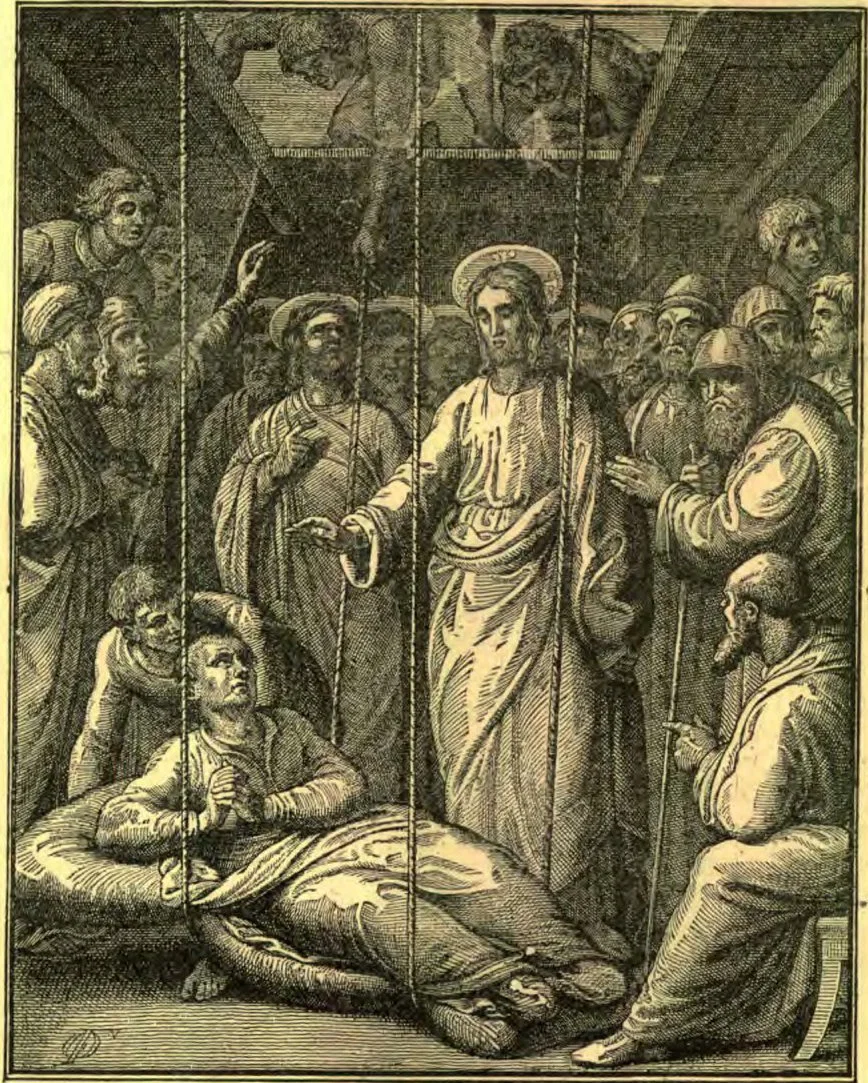
No portion of the Scriptures is so interesting, so full of instruction in all that is great and generous, beautiful and good, as that which records the wonderful works of our Saviour. The record of the first thirty years of his life is brief, simply giving his birth in Bethlehem, the flight into Egypt and the return to Israel, and his quiet life in Nazareth with his parents, to whom he was subject; and, with the exception of the incident which occurred when he, at the age of twelve years, accompanied his parents to Jerusalem, nothing remarkable is related of him until he was baptized of John in the Jordan. The last three years of his life, however, beginning with his ministry, were crowded with events of the most thrilling character.
Soon after his baptism, the Saviour began his public labors in Nazareth; but the Jews rejected his message, and tried to take his life. Escaping from them, he took up his abode in Capernaum, another city of Galilee, or, rather, he made that place his headquarters; and from this time it is recorded that “Jesus went about all Galilee, teaching in their synagogues, and preaching the gospel of the kingdom, and healing all manner of disease among the people. And his fame spread throughout all Syria.” And they brought people that were sick with every sort of disease, and lunatics, and those possessed with devils, “and he healed them.”
Although Jesus went about all that country teaching and doing his mighty works, no place was more honored with his labors and presence than Capernaum, the city chosen as his home. Probably the people here were more ready to listen to his teachings. It was in this vicinity that the wonderful sermon on the mount was delivered, and where he uttered a number of his parables. Here, too, he performed many miracles of healing, and raised the daughter of Jairus to life.
March. 9, 1885.
March. 9, 1885.
Such crowds followed the Saviour in the streets of Capernaum, wherever he went, that it was often difficult for the afflicted to get access to him. Upon one occasion, it is recorded that the only way a sick man could be taken into his presence, was by letting him down through an opening in the roof of the house, an illustration of which is shown upon this page.
Do any of our young friends query how they could let a person down through the roof, on a bed, they must bring to mind what has been told them a number of times in the INSTRUCTOR,—that Eastern house-roofs are flat, and are covered with material which can be readily removed and replaced again; also the bed upon which the sick man lay was a thick quilt or mattress, which could be easily folded up and carried. You remember that after this palsied man was healed, the Lord said to him, “Arise, take up thy bed, and go unto thine house”! His walking off with his bed was sufficient evidence that the man was cured.
How natural for us all to feel, Oh, if I could have been upon the earth when the Saviour performed his miracles, how easily I could have believed! But how was it with those cities of Galilee, where he did those mighty works? Hear the Saviour’s own words: “Woe unto thee, Chorazin! woe unto thee, Bethsaida! for if the mighty works, which were done in you, had been done in Tyre and Sidon, they would have repented long ago in sackcloth and ashes.” “It shall be more tolerable for Tyre and Sidon at the day of Judgment than for you.” “And thou Capernaum, which art exalted to heaven, shalt be brought down to hell; for if the mighty works, which have been done in thee, had been done in Sodom, it would have remained until this day.”
We have the accumulated evidence of the preceding ages that those mighty works were wrought of God; shall we wait for further light, and perish, as did those ancient cities? or shall we believe and be saved? M. J. C.

KINDNESS

“KINDNESS,” some one has beautifully said, “is stowed away in the heart, like the rose-leaves in a drawer, to sweeten every object around.”
A little girl, about nine years old, was walking along a muddy street in Chicago; her father held her hand, and seemed very tender in his care of her. The quality and style of their garments betokened wealth; while the strong, good face of the father, and the loving, sweet one of the child, told of something better than wealth, even depth of heart. Just as they reached a crossing, where the mud was thick, and the wind blew strong, and vehicles of all descriptions passed each other in tiresome confusion, they noticed a poorly clad old woman, on whose arm rested a large basket heavily laden. Standing on the corner, as if fearful of crossing over, she looked anxiously at the whirling carts and depreciatingly at the passers-by. No one seemed to heed her, as the well-dressed throng hurried along.
“Come, Edith,” said the father, “this is a dangerous crossing; I will carry you across.”
He put out his arm as he spoke. But the child only whispered:—
“Papa, I have rubbers; I’m not afraid of the mud. See that poor old woman, she seems afraid of something; see how she trembles! Couldn’t you help her, while I run ahead?”
For answer, the gentleman approached the old woman, saying, in a low voice,—
“This is a tiresome crossing, madam; let me lead you across; give me the basket, please.”
Could you have seen the rested, thankful look on the weary old face, as the woman found herself safe on the other side, I think you would have echoed her fervent cry: “God bless that man, and the blessed child too!”
There were sneering smiles on some countenances which witnessed the quiet act of helpfulness; but it mattered not so long as one knew that around the great white throne there were smiles of joy because two of his followers had not in selfishness neglected doing a favor to even the “least of these.”
Into a very elegant palace car entered a weary-faced, poorly-dressed woman, with three little children, one a baby in her arms. A look of joy crept into her face as she sat down in one of the luxurious chairs. But it was quickly dispelled as she was asked rudely to “start her boots.”
A smile of amusement was seen on several faces, as the frightened group hurried out to enter one of the common cars. Upon one young face, however, there was a look which shamed the countenances of the others.
“Auntie,” said the boy to the lady beside him, “I am going to carry my basket of fruit and this box of sandwiches to the poor woman in the next car. You are willing, of course?”
He spoke eagerly, but she answered: “Don’t be foolish, dear; you may need them yourself, and perhaps the woman is an impostor.”
“No, I’ll not need them,” he answered, decidedly, but in a very low tone. “You know I had a hearty breakfast, and I don’t need a lunch. The woman looks hungry, auntie, and so tired too, with those three little babies clinging to her. I’ll be back in a minute. I know mother wouldn’t like it if I didn’t speak a kind word to the ‘least of these’ when I meet them.”
The worldly aunt brushed a tear from her eyes after the boy left her, and said, audibly: “Just like his mother.”
About five minutes later, as a lady passed the mother and the three children, she saw a pretty sight,—the family feasting as perhaps they had never feasted before. The dainty sandwiches were eagerly eaten; the tempting fruit-basket stood open.
The oldest child, with her mouth filled with bread and butter, said: “Was the pretty boy an angel, mamma?”
“No,” answered the mother, as a grateful look brightened her faded eyes, “not now; but he will be on the other side; bless his dear heart!”
And we said, too, “Bless his heart!”—S. S. Times.

MARCH

THE breezy March days! O the gay and arch days! When deep in sheltered valleys a thought of spring-time rallies To wake the frozen music that winter left behind; And up the hills advancing, the soft gray clouds come dancing, To the bonny lulling measure of the whistling o' the wind!
O the breezy March time! O the gay and arch time! When brave and bright and nipping, the longer days come tripping, And Nature, sharp but cheery, calls out in accents kind; For who would mind her bluster, amid the joys that cluster, Where we hear the summer answer to the whistling o' the wind. — Wide-Awake.

THREE PRECIOUS SPICES.

A prince was once overtaken by a shower during his morning walk, and took refuge in a peasant’s cottage. The children were just at their dinner, which consisted of a large dish of oatmeal porridge. They all seemed to enjoy it very much, and looked as fresh and red as roses.
“How is it possible,” said the prince to their mother, “that they can eat such coarse food with so good an appetite?”
The mother answered: “That comes from the spices which I put into it.”
“What spices are those?” asked the prince.
“In the first place,” said the mother, “I always make the children earn their dinner; secondly, I never give them anything except at mealtimes, that they may bring hunger with them to the table; and, thirdly, I have accustomed them to be contented with what they have by never giving them dainties and titbits.”
The most valuable spices to be met with are work, hunger, and content.
Written for the INSTRUCTOR.

An Old Survivor.

It was a hot day in midsummer, the eighth day of July. On the green in front of the State House was gathered a vast throng of people, appareled in holiday dress. There were men in knee-breeches, powdered wigs, and cocked hats; and women in snowy caps, gay gowns, and high-heeled shoes. The State House was also decked out for the holiday. From windows and doors, gay flags and banners fluttered in the breeze.
As noontide came, the crowd pressed closer to the balcony, their numbers rapidly growing larger as the hour of twelve drew near. Just as the clock pointed the hour, out into the yard marched many of the members of Congress, the officers of the city, and the Committee of Safety and of Inspection. The hum of busy voices ceased. The silence grew intense, as from the balcony of the observatory, John Nixon, one of the Committee of Safety, advanced with a roll in his hand. In a loud, clear voice, so that all the people could hear, he read a document that ends like this: “That these United Colonies are, and of a right ought to be, free and independent States; and that they are absolved from all allegiance to the British crown,” etc.
As the speaker finished, cheer after cheer arose from the assembled multitude. The old bell in the State House tower caught up the joyous strain, and in a jubilant chorus, for two whole hours led all the bells in the city in proclaiming “liberty throughout all the land unto all the inhabitants thereof.” Such a holiday America never saw before,—such a solemnly joyous and grateful day.
Nor was the rejoicing confined to Philadelphia alone. All over the country, wherever the Declaration was received, the people manifested their joy. They tore down and destroyed everything that showed the authority of the king of England. In New York City they tore down the leaden statue of King George III. The head they carried in a wheelbarrow to the English governor’s house, and laid it down before the door. The rest of the statue was afterward run into bullets to be shot at the soldiers of the king.
All this, and the sharp struggle that followed to maintain this independence, happened over a hundred years ago.
When, in the war that followed, the British entered Philadelphia, the old bell that led in proclaiming liberty, was taken down and hidden by the patriots.
For fifty years its peals rung out from the tower. Then a crack destroyed its sound, and it can ring no more.
A few weeks ago, the liberty bell took another journey, the first it has taken since 1777. It went to the New Orleans Exposition. A guard of honor accompanied it to protect it. There was great rejoicing in the Crescent City when this time-honored relic arrived. Bells were rung, guns were fired, and whistles sounded.
The old bell is silent now, but it is an eloquent silence. It has done more than any other bell to proclaim liberty and freedom among men. W. E. L.

Written for the Instructor

DANIEL MORGAN.

When the Revolutionary war broke out, Daniel Morgan joined the side of the colonies, and became a major general, distinguishing himself by his bravery. He was called “the bravest of the brave.” The early teachings of a pious mother were never eradicated; he always remained a believer in Christianity.
When he was dying, he related to his minister some things he had not before mentioned. “People thought,” said he, “that Daniel Morgan never prayed. People said old Morgan never was afraid. Old Morgan was often miserably afraid.” Then he told him that the night they stormed Quebec, while waiting in the darkness and storm, he felt unhappy; he thought that nothing less than a miracle could bring them off victorious against such odds. He stepped aside, and kneeling by the side of a cannon, prayed most fervently that the Almighty God would be his shield and defense; for nothing less would protect him. He continued on his knees till the word passed along the line. He fully believed that his safety, during that night of peril, was due to the interposition of God.
At another time he retreated as long as he could; halting his army, he went to the woods in the rear. He kneeled in an old tree-top, and poured out a prayer to God, for his army, for himself, and for his country. He then met the enemy and gained a great victory.
J. R. Calkins.

“IT TAKES NINE TAILORS TO MAKE A MAN.”

THIS proverb is common enough. But whether it means that the skill of one tailor alone could not transform some individuals into even the semblance of a man, so far are they from proper manhood, or whether it means that some tailors are only one ninth men, we have never quite decided. It seems that it does not matter or the saying never meant tailors at all but tailers, and came about in this way. We read it from an English paper:—
In country villages in England it used to be the custom, and is now in rare instances, when a person died at night, to tell the sexton, who then tolled the bell of the village church. He first rang a short peal, and then finished up with “tailers” —three “tailers” for a child, six “tailers” for a woman, and “nine tailers made a man.” Nearly all old sayings and superstitions may be traced to like simple sources. One of the most common inn or “public-house” signs in England is “the goat and compasses,” with a picture of a goat astride a pair of compasses. The origin of this is, that in old days, generally the only place of refreshment for the traveler was to be found in the monasteries. Over the gate of the monastery there was the motto, “God Encompasseth Us,” which, in the course of time, was corrupted into “goat and compasses.”—The Well-Spring.

WALKS ABOUT BOSTON.—1.

I wonder if the readers of the Instructor would not like to learn something about this old city, one of the oldest on our continent! I have been over many cities, but none ever interested me as much as Boston. It is so intimately connected with the early history of our country, that we cannot understand American history without being familiar with the history of Boston. You will soon see this, when I tell you what has happened here.
Let us begin, then, by finding where it is located. Can you tell? Many persons read about places,—places in the Bible, places in history, and places mentioned in the papers, and never know where they are located. In this way they lose much of the benefit of what they read. If possible, you should always have an atlas handy, and look up any prominent place about which you are reading. This is an excellent way to study geography. If you will do this, you will soon become familiar with all the great places on the earth. So get down your atlas. If you have n't one, buy one; or if you can't do that, borrow one. Some one will give you an old one, if you look around a little.
Boston is noted for the peculiar manner in which its streets are laid out. Because they are so straight and long? No; they are so crooked, the most of them so short, and crossing each other in such queer ways, that it is generally said that they were laid out by the cows! That is, the first inhabitants built their houses along the cow-paths. It really looks so; for the streets run in every possible direction, without any apparent order. Many streets are only ten or fifteen rods long.
Boston is known, the country over, as the “Hub.” Why? Because, being the first, largest, and most important city in New England, everything was supposed to center here as the spokes in a wheel all center in the hub. So Boston was the hub of New England. It has also been called the “Athens of America,” because it has been the recognized center of education, of literature, and the fine arts. It maintains this position to-day; so you see it is a place worthy of our attention and study.
But where is Boston? In California or Texas? Michigan or Maine? If you will look in Massachusetts, away over east on the great Atlantic Ocean, you will find it. It is located on Massachusetts Bay. It was settled in 1630, over two hundred and fifty years ago. John Winthrop was the first governor. In those far-off days, they used to hang witches, whip people for being Baptists, persecute the Quakers, and murder heretics. I am glad I didn't live here then. They held slaves in Boston at that time and for a long while after.
The very first newspaper ever published in America was issued in Boston, April 24, 1704. It was called “The Boston News-Letter.” That was one hundred and eighty-one years ago. I have seen the early copies of this paper,—old and yellow, with queer-looking letters and odd spelling. And yet that frail old paper is more enduring than the men who made it. The people have gone, while the paper remains. What a lesson on the shortness of life!
Benjamin Franklin, that great printer, philosopher, and statesman, was born here in 1706. I have stood on the very place where he was born. What can you tell about this great man? If you don't know about him, ask somebody; or better still, look it up for yourself in a history of the United States or in some encyclopedia. We learn by inquiring all about persons and things of which we read or hear.
Here, in 1750, began the first agitation of the opposition to the tax on tea, which England imposed on the colonists. A little later, meetings were held about it under an old elm, called “Liberty Tree.” I have been where it stood. The people vowed that they would not use any more tea till that tax was removed. On Dec. 16, 1773, occurred the most memorable “tea party” ever held in the world. Every boy and girl ought to be able to tell all about that tea party. A lot of men, dressed and painted as Indians, went on board of several vessels in the harbor, and threw into the sea three hundred and forty-two chests of tea! The fish must have drank tea for a while then!
Here in 1775 began the great struggle for independence, the war of the Revolution. I have been all over these places where the very first battles were fought, have seen the very cannons, the balls, the swords, and the guns used there. I have stood in the same rooms, in the same old halls and churches, where those immortal patriots, Samuel Adams, Warren, Hancock, and others, made those first grand speeches against Old England. Next time I will tell you about them.
D. M. Canright.

ENEMIES

It is said that bees and wasps will not sting a person whose skin is covered with honey. Hence, those who are much exposed to the venom of these little creatures, when they have occasion to hive bees or take a nest of wasps, smear their faces and hands with honey, which is found to be the best preventive.
When we are annoyed with insult, persecution, and opposition from perverse and malignant persons, the best defense against their venom is to have the spirit bathed in honey. Let every part be saturated with meekness, gentleness, forbearance, and patience, and the most spiteful enemy will be disappointed in his endeavors to inflict a sting.—Selected.

THEIR FATHER ALWAYS HEARS.

ONE day a lady began to talk pretty hard about a person who was not present. But soon she saw that a sister of this absent friend was in the room. Then she was very sorry for all she had said, and wished she could take it all back.
I suppose that we are all more apt to say hard things about persons when neither they nor their friends can hear us. But we should not forget that their best friend knows every word we say about them. Their best friend is their Father in heaven, and he knows every word we speak, even before we utter it. Should not this make us very careful what we say?—Selected.

Chinese New Year Visits to Mothers

WE call the Chinese heathen, and yet they have some customs that would do credit to a Christian people. On every New Year morning, each man and boy, from the emperor to the lowest peasant, pays a visit to his mother. He carries her a present, varying in value according to his station, thanks her for all she has done for him, and asks a continuance of her favor another year. They are taught to believe that mothers have an influence for good over their sons all through life.—Selected.

IMPORTANT BIBLE SUBJECTS.

LESSON 37.—INHERITANCE OF THE SAINTS.

REVIEW.

[NOTE TO THE STUDENT.—Do not consider the lesson learned until you can give at least the substance of every text, with the correct reference for each. The references in black letters indicate those texts that should be committed to memory. A little diligent application each day will enable you to do this.]
  1. What must characterize every follower of Jesus?
  2. What is promised to those who have this grace?
  3. How does God manifest his pleasure in his people? Luke 12:32.
  4. Do his people now possess the kingdom? Quote proof.
  5. What and how extensive is the kingdom that is to be given to those who love God? Dan. 7:27.
  6. Who has the disposal of this dominion?
  7. To whom was it first given?
  8. What was the condition of the dominion at that time?
  9. What can you say of man at that time?
  10. Did man retain the dominion intrusted to him?
  11. By what act did he lose it?
  12. To whom was his dominion forfeited?
  13. By Adam’s transgression, what title did Satan acquire?
  14. How much power does Satan claim for himself? Luke 4:5, 6.
  15. Did Christ acknowledge Satan’s claim? Luke 4:8.
  16. Who is absolute ruler of the world? Ps. 24:1; Dan. 4:25.
  17. What must be done before the meek can possess their promised inheritance?

Test-Questioning Measures Both Teacher and Scholar

EVER bear in mind this truth, as both an incentive and a guide in your test-questioning: The true measure of your scholar’s knowledge on any subject of study, is not what you have declared to him, not what he seemed to understand of your teaching, but what he can restate to you in his own language as you and he go over it again together. It is a very common thing for us to say, when we are asked about one thing or another—about something that we have often had in our minds—that we know all about it, but cannot express our knowledge in words. As a rule, this is not a true statement of the case. If we have definite knowledge on a given subject of inquiry, we can express that knowledge in words; and just to the extent of our inability to so express ourselves, we are lacking in definiteness of knowledge. The truth is, that we have a good many vague ideas on many a subject, which we confound with real knowledge of that subject. And so it is with our scholars.
Test-questioning is a test of the teacher’s success quite as fully as it is of the scholar’s attainment. It is alike important and valuable to both teacher and scholar.—Selected.

Teacher Stability and Punctual Attendance in Sabbath School

You would not break up a class willfully, and yet as teacher you may do it carelessly. To do it effectually, you need only be one of those provoking teachers forever not there. A teacher’s stability leads to the permanence of the class. Promptness in attendance comes before skill in teaching or fervency in prayer. If you want trout, watch your line.

Prayer and Heart-Preparation for the Sabbath School Teacher

If you dread the difficulties and responsibilities that meet you in your class, as Jacob dreaded the meeting of Esau, tarry alone at the Peniel of prayer and look into God’s face, and your heart shall grow strong for your work.
Besides all our teachers’ meetings for intellectual preparation, we need such a teachers’ meeting as Moses had above the clouds, from which he came with shining face and burning heart to teach God’s law to his Bible-class of three millions of people; such a teachers’ meeting as Peter had in the upper room, that God keeps open for us still, from which he came transformed, and taught an Old-Testament lesson so powerfully that three thousand were converted in a single day. We also shall succeed if we go to the class-room “through the upper room.” This lesson of tenderness, trust, heart-culture, is, then, the first lesson that we learn from the study of childhood.

ELIZABETH, QUEEN OF ROUMANIA.

HIS lovely queen has other names besides that of Elizabeth. Her friends used to call her the “wild rose-bud of Weid.” She was born December 29, 1843, in the principality of Weid on the Rhine.
She was taught to read when three years old, to give her something to do. She was a good scholar. She was taught also to sew and cook.
She had an invalid brother. The mother, to strengthen the little fellow, had a farm laid out for the two to work on. So the Princess Elizabeth and this brother sowed grain and planted corn, milked their cows, and took care of their hens.
Her favorite book, at one time, was The Wide, Wide World. Sometimes she hid it between the covers of a school book, to read, I suppose, when she should have been studying. Often she tucked it at night under her pillow. Princesses never go to school, and they miss a good deal of pleasure and fun in that way. One day, when she was ten years old, she ran away to the village school.
She joined in the singing lesson with all her might. She did not often have a chance to sing as loud as she could.
A little girl who sat beside her tried to sing louder than Elizabeth; and when she found she couldn’t, she clapped her hand over the Princess’s mouth! Just then a servant came from the castle for Elizabeth, and she was not allowed to go out again for several days, as a punishment for running away.
But what was done to the little girl, who dared to put her hand over the mouth of a princess, I do not know!
In 1868, the Princess Elizabeth became Queen of Roumania. Roumania is a mountainous country lying between Russia and Turkey. The Roumanians call their country “Purin,” which means “my darling.”
Her people call Queen Elizabeth “Little Mother,” because she is always finding out ways to do them good, like a mother. She has founded hospitals and schools, day-nurseries for little children, and soup kitchens for the poor.
She has had one little daughter, only, the Princess Maria. She died at four of scarlet fever. The sorrowing mother said, “I am happy to have had her at least so long.”
Visitors to the Queen see, in her own room, among tall plants and flowers and birds, the bust of that little daughter.
In 1877–78 Roumania was the battle-ground of the war between Russia and Turkey. Then the Queen had another name given her—“The Mother of the Wounded.” She provided hospitals for the wounded, and often tended them with her own hands. In the public place at Bucharest is a statue of the Queen giving a drink of water to a wounded soldier. This statue was paid for by the wives of soldiers. Bucharest is the capital of Roumania.
The Queen is a busy woman. She rises in the morning at four, trims her own lamp, and works till eight. This is all the time she can call her own to write and do what she likes. The rest of the day she is “Queen of Roumania,” and her time belongs to others. She cannot, like the queen of England, live in retirement. Only three precious weeks in the whole year does she have for her very own. Those are in the autumn. Then she goes to a little châlet she has built in the woods near a river.
She sometimes has to talk to different people from twelve to fifteen hours; and when she and King Charles sit down to dinner, they are too tired to speak a word!
You will like to know that she has written a book of fairy tales for her little people of Roumania, and illustrated it herself!—Little Men and Women.

EYE SERVICE.

Upon going into an office, I saw two boys at work addressing envelopes—or rather, one was at work, while the other, with his pen in his hand, was looking out of the window. Their employer was seated near by; and when he caught my eye, he smiled.
“Which of those two boys is the better workman and of the most value do you think?” he asked, in a low voice.
“The one at work, I suppose,” I rejoined.
“No, sir; that lad who is looking from the window now does so because he thinks there is no harm in it—does it, you see, under my eyes. On the other hand, while my eye is on them, the other boy is most industrious, but I find in my absence he does nothing. So you see he adds deceit to his fault. I would not trust him out of sight.”
“It seems to me that neither of them is worth very much.”
“To be sure,” came the immediate answer, “a boy who attended to his duties at all times would be best; but a boy who renders eye-service merely, who cannot be trusted to work without watching, is not to be tolerated.”
The man who said this had seen much of the world; he knew whereof he spoke, and perhaps some of our readers will profit by his words.—Children's Friend.

Little by Little: A Poem on Daily Choices

LITTLE by little, sure and slow, We fashion our future bliss or woe, As the present passes away. Our feet are climbing the stairway bright, Up to the regions of endless light, Or gliding downward into the night, Little by little, day by day. —Selected.

Love in the Heart Brings Rainbows

It is hard to find anything good in that provoking play-mate? Hear what a good man says: “When there is love in the heart, there are rainbows in the eyes which cover every black cloud with gorgeous hues.”

Letter Budget.

GRACE VIOLA MOON, of Blue Earth Co., Minn., writes: “I am a little adopted girl. I will be seven years old next April. I have attended Sabbath-school ever since I was two years old. I have learned Lessons for Little Ones No. 1, and I am almost through No. 2. I read in the Third Reader. I have never attended day school; mamma teaches me at home. I can say all the ten commandments, and I am trying to keep them. Grandpa Moon lives with us; he is almost eighty years old. I want a big doll for Christmas. Mamma had to write this for me.”
Gracie’s letter seems so cheerful we think she is adopted into a pleasant family. Are there any other adopted children among our boys and girls, we mean adopted into the family of Jesus Christ? You know that all who are will have a home in the beautiful mansions he has gone to prepare.
MAMIE A. WILD, of Oneida Co., N. Y., writes: “This is the first time I have ever written for the INSTRUCTOR. I am twelve years old. I am staying at Eld. Brown’s at Rome. I expect to attend school here next term. My sister Carrie is in Albany, with papa and mamma, doing missionary work. I went to Utica with the Rome school during the holidays, to canvass for the Signs and ‘Sunshine at Home.’ I like to canvass very well, because I know it may be the means of saving some souls in the kingdom of heaven. I go to Sabbath-school here, and learn the INSTRUCTOR lessons. I like to read our paper, particularly the ‘Letter Budget.’ I am trying to be a faithful Christian, that I at last may meet the INSTRUCTOR family in the new earth.”
By doing missionary work through the holidays, the Rome school were taking a fast hold of the instruction they had received during the school term. You have excellent advantages, Mamie, which we trust you fully appreciate.
ARTHUR and ALFRED ANDREWS, of Todd Co., Minn., write: “We are twin brothers, ten years old. We live on Lake Latimer. We have never lived here in summer. It is nice in winter, although it is quite cold. The thermometer was forty-four degrees below zero on Christmas. We go to school every day, if it is cold. We also go to Sabbath-school. Our school teacher is superintendent of our Sabbath-school. He gave us a card with the ten commandments on it. We are trying to learn them, also to do as they teach. We ask the prayers of the INSTRUCTOR family, that we may meet them in heaven.”
Boys and girls can most always go quite long distances, even when it is cold, to attend day school. We like to hear them say they go to Sabbath-school also, when it is cold. Will not these twin brothers tell their little friends something about Lake Latimer next summer?

AN ANSWER TO A PUZZLE.

Dear little girl, chiding the morning long, With pouting lip, and eyes all wet and blue, Counting it as a hardship and a wrong That other children are more loved than you.
“’Tis so unjust,” you say, “and so unkind,” Bending the while a puzzled, angry brow— “How can you help it?”—If you will not mind, Nor think me cruel, I will tell you how.
Sweet things from sweet, and fair from fair must be; Hearts have their wages, reckonings strict are made; We scold, rebel, but other people see That, soon or late, we are exactly paid.
The willing love which counts not any cost, But daily lavishes its first and best, Although to careless eyes its pains seem lost, Reaps in the end a tenfold interest;
While selfish souls, who keep a strict account, And tally, like a huckster in his stall, Of all they give and feel, and the amount, Get back their dues, indeed, but that is all.
Love is not free to take, like sun and air; Nor given away for naught to any one; It is no common right for men to share— Like all things precious, it is sought and won.
So if another is more loved than you, Say not: “It is unjust,” but say: “If she Has earned more love than I, it is her due; When I deserve more, it will come to me.”
But if your longing be for love, indeed, I’ll teach you how to win it—a sure way: Love and be lovely; that is all you need, And all you wish for will be yours some day.
—Susan Coolidge.

You have reached the end of this edition.

The Youth’s Instructor · Mar 25, 1885