Your ShelfYour Projects

Signs of the Times, Vol. 29, No. 24.

THE PASSING GLORY OF EARTH

Signs of the Times

Jun 17, 1903

Pacific Press Publishing Company · Oakland, California · Jun 17, 1903

THE PASSING GLORY OF EARTH.

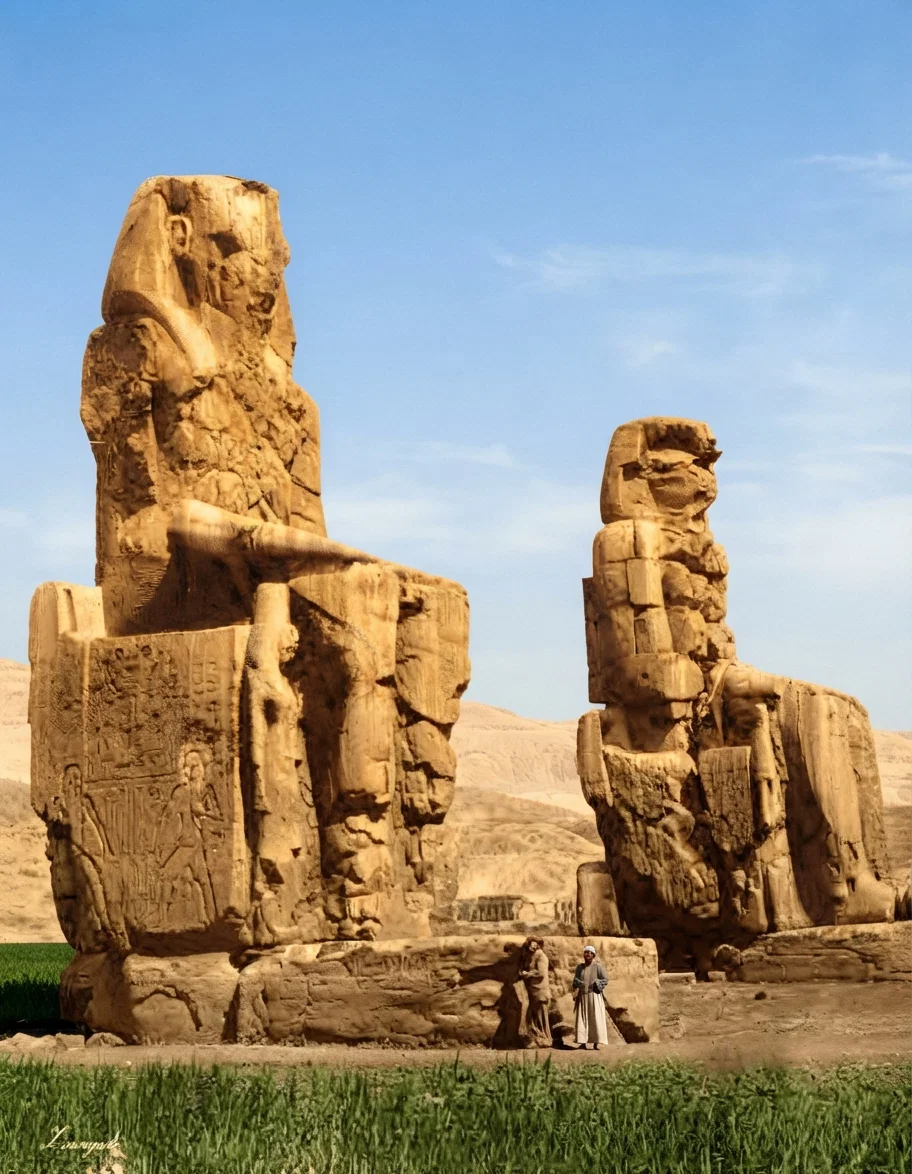
THE illustration on this page carries us back to the time of Israel's sojourn in Egypt, B. C. 1500, when the Egyptian empire was at the height of its glory. The reigning Pharaoh was Amenhotep III., or sometimes called Amenophis, or Maatneb-Ra. This king was not noted for his warlike deeds, as were some of his ancestors; but he was a great monarch, a dealer in slaves, and a mighty builder. Doubtless much of the wealth possessed by the Egyptian kings, available at this time for the building of these great monuments, came through the administration of Joseph, and the laws made at that time for the support of the realm. The government came into possession of all the land save that which belonged to the priests, and received as its revenue one-fifth of all the income. But, be this as it may, we know the revenue must have been large from the mighty buildings, monuments, statues, temples, and propylons erected.

AMENHOTEP III.,

like many other kings and men, was very vain and egotistic. The mighty temples and statues everywhere reflect himself. It is a common vice. There is much professed love of country which is but expanded egotism. That is, we love the country because it is our country. "It is a great country; we have many great men; we are a great nation." The "we" is but the plural of the "I." With Amenhotep III., and many other puny mortals, it was and is all the "I." They lift themselves above their fellows and assume to be one of the god-head.
OUR illustration is a photo-engraving of the two great colossal statues of Amenhotep III.;
No 660 Thèbes colosses de Memnon.
they are the mightiest in the world. Each was originally formed of a single block of sandstone, and at the time when set up must have been not less than seventy feet high. As placed by the sculptor they have sat there on the west bank of the Nile, in ancient Thebes for more than three thousand years. One traveler calls them "the most immovable thrones that have ever been established upon this earth." The sculptor who carved them, whose name is almost identical with that of the king, sings thus of his own greatness and the permanency of his work:—
"I immortalized the name of the king, and no one has done the like of me in my works. I executed two portrait statues of the king, astonishing for their breadth and height; their completed form dwarfed the temple tower—forty cubits was their measure. They were cut in the splendid sandstone mountain on either side, the eastern and the western. I caused to be built eight ships, whereon the statues were carried up the river; they were emplaced in their sublime temple; they will last as long as heaven."
AND for more than three millenniums they have sat with hands on their knees, in wonderful majesty, dignity, and repose, looking straight on as if their sightless eyes would pierce the future. But time has left its traces. In the year A. D. 27 a mighty earthquake shook Thebes to its foundation, and decapitated one of the huge images. Then for two centuries at sunrise it occasionally gave forth sounds, as attested by many witnesses, doubtless owing to cracks in the stone and changes of temperature, reaching the climax about sunrise. Man sought to mend the broken colossi by adding a head, but the sound ceased forever. The action of the weather has also greatly affected the sandstone, and the crowns and much of the heads and faces have disappeared. And so in time the softest, gentlest things of nature—the falling rain, the wind, and the sunshine—would crumble them to dust.SO WILL perish all the works of men which have been wrought for self and self glory. Better was one poor slave, who swept these magnificent temples, than all the mammoth works of art and skill piled up by Egyptian rulers; for to every human is given the privilege of existing forever, while all the works of men shall crumble to everlasting decay. And this is the lesson which God would teach all the children of men by these remains of human glory. Read from the Gospel-prophet God's ever-present message to the men of this world:—
"The voice of One saying, Cry. And one said, What shall I cry? All flesh is grass, And all the goodliness thereof is as the flower of the field. The grass withereth, the flower fadeth, Because the breath of Jehovah bloweth upon it; Surely the people is grass. The grass withereth, the flower fadeth, But the Word of our God shall stand forever." Isa. 40:6-8.
And God's admonition to us is:— "Fear God, and give Him glory; For the hour of His judgment is come; And worship Him That made the heaven and the earth And sea and fountains of waters." Rev. 14:7.
The glory of man, however great and enduring it may appear, will pass with the world and its lusts and unholy ambitions; "but he that doeth the will of God abideth forever." 1 John 2:17.

THE HOPE OF THE WORLD.

MRS. E. G. WHITE.
We can not understand the mystery of redemption. It is enough for us to know that God so loved the world that He gave His only-begotten Son to die for us. The penalty of our transgression fell upon a pure, holy, innocent Substitute, even the Son of God. He bore our sins in His own body on the tree, that we might at last stand before God clothed in the robe of sinlessness.
The Gospel is the hope of the world. The cross is God's agency for counterworking Satan's plans, and restoring man to his original purity. The plan of salvation devised by the Father and the Son will be a grand success. Christ's atoning sacrifice will arouse the sluggish mind, quickening into activity man's mental and spiritual powers.

A Teacher Sent from God.

Darkness had covered the earth, and gross darkness the people. The time had come when a Teacher from heaven must be sent to the world. Prophecy had foretold the advent of this teacher. "Moses truly said unto the fathers, A prophet shall the Lord your God raise up unto you of your brethren, like unto me; Him shall ye hear in all things whatsoever He shall say unto you. And it shall come to pass, that every soul, which will not hear that prophet, shall be destroyed from among the people. Yea, and all the prophets from Samuel and those that follow after, as many as have spoken, have likewise foretold of these days,"—the days when Christ's authority would be supreme and His power invincible.
As the scroll is further unrolled, we read, "O Zion, that bringest good tidings, get thee up into the high mountains; O Jerusalem, that bringest good tidings, lift up thy voice with strength; lift it up, be not afraid; say unto the cities of Judah, Behold your God! Behold, the Lord God will come with strong hand, and His arm shall rule for Him; behold, His reward is with Him, and His work before Him. He shall feed His flock like a shepherd; He shall gather the lambs with His arms, and carry them in His bosom, and shall gently lead those that are with young."
It is by the power of the cross that man is to be redeemed. "Behold my servant, whom I uphold," God says; "mine elect, in whom My soul delighteth; I have put My spirit upon Him; He shall bring forth judgment to the Gentiles. He shall not cry, nor lift up, nor cause His voice to be heard in the street. A bruised reed shall He not break, and the smoking flax shall He not quench; He shall bring forth judgment unto truth. He shall not fail nor be discouraged, till He have set judgment in the earth; and the isles shall wait for His law."
"Thus saith God the Lord, . . . I the Lord have called thee in righteousness, and will hold thine hand, and will keep thee, and give thee for a covenant of the people, for a light of the Gentiles; to open the blind eyes, to bring out the prisoners from the prison, and them that sit in darkness out of the prison-house. . . . Sing unto the Lord a new song, and His praise from the end of the earth, ye that go down to the sea, and all that is therein; the isles, and the inhabitants thereof. . . . I will bring the blind by a way that they knew not; I will lead them in paths that they have not known; I will make darkness light before them, and crooked things straight. These things will I do unto them, and not forsake them."
"Every high priest taken from among men is ordained for men in things pertaining to God, that he may offer both gifts and sacrifices for sins; who can have compassion on the ignorant, and on them that are out of the way; for that he himself also is compassed with infirmity."

Delivered from Death.

Christ laid aside His royal robe and kingly crown, and clothed His divinity with humanity, that He might know for Himself the sufferings and the temptations of human beings. He came to be their Surety, to overcome in their behalf, to live for them a sinless life, that through His power they might obtain the victory over evil. He came, saying, "I will declare Thy name unto My brethren, in the midst of the church will I sing praise unto thee." He placed Himself on a level with human beings, saying, I will stand at the head of the race, that through My humiliation they may be accepted as members of the royal family. I will declare the name of God unto my brethren. "I will put my trust in Him,"—just as I desire My disciples to do.
Only by bearing the penalty of our disobedience could Christ deliver us from eternal death. He became sin for us, that we might become the righteousness of God in Him.
Thus He placed us on vantage ground, where we could live pure, sinless lives. Repentant sinners stand before God justified and accepted, because the Innocent One has borne their guilt. The undeserving are made deserving, because in their behalf the Deserving became the undeserving.
"Forasmuch then as the children are partakers of flesh and blood, He also Himself likewise took part of the same; that through death He might destroy Him that had the power of death, that is, the devil; and deliver them who through fear of death were all their lifetime subject to bondage." "In all things it behoved Him to be made like unto His brethren, that He might be a merciful and faithful High Priest in things pertaining to God, to make reconciliation for the sins of the people. For in that He Himself hath suffered being tempted, He is able to succor them that are tempted."

Rich in an Eternal Inheritance.

Christ died to purchase salvation for us. He was raised for our justification, and He ever lives to make intercession for us. His life and death bring salvation to every believing child of God. By His death we are reconciled to God; by His life, as it is wrought out in our life, we shall be saved. We may be poor in temporal things, but we are rich in the treasure that endures forever. We have the deeds to an immortal inheritance, the title papers to a life that measures with the life of God.

“NOTHING BETTERED.”

TWELVE years seeking a cure of a distressing physical malady and “nothing bettered,” but growing worse. Earthly physicians failed, money failed, and “nothing bettered.” Thousands to-day, everywhere, are having a like sad and unsatisfying experience with the woman of sacred mention.
O that many of these might obtain the latter experience of that poor, but at last happy and healthy woman. O that every afflicted and heavy-laden soul would only go to the same Jesus, who is the same yesterday, to-day, and forever, just as accessible now as when the poor woman sought Him as a last resort. Soul-sick or body-sick ones press through the multitude of cares, discouragements, and doubts, reach forth the finger of faith and touch the hem of His garment. Jesus, the Holy One, is still the Healing One—an unfailing and inexhaustible Fountain of life and light, of healing and health.
Right where you are you may believe unto salvation and be made whole from the wounds of sin. “The great Physician now is near, the sympathizing Jesus.” Buy wine and milk, mercy and medicine, without money and without price. Jesus is now passing by. “Call ye upon Him while He is near.” His ear is open to your cry, His heart is open to your burden, His hand is open to your need. All you need for body, soul, or spirit you may find in fulness in Jesus. Let Him not pass you by forever.
H. A. ST. JOHN.

REFLECTION.

HE spake and all beauty sprang forth. The lily reflected His smile. That which dwelt within radiated the universe and shone from the garb of nature. It spoke fellowship with the great I AM. The angle of reflection being equal to the angle of vision, loving-kindness utters her voice through the silence of light, that gives back choicest fruitage of vale and hill, filling the freighted air-balm with praises richly due the Keeper—the Creator of all.
Fellowship with the Divinity becomes the perfect angle when the blinding hydra of self-glory no longer hides the adjusted prism. What joy in its strength-giving power. All hearts are akin. The weary, the weak, the helpless, the no-chance ones, whom we shall have always with us, reflect the cheering smile and tender words, which add gems to their fading crown. While these cost us nothing, they dispel the shades of critical prejudice from the hungry soul as it by faith looks to live, from dying hearts eager to gain an upward footstep in the rugged pathway of life.
The lighted, illuminated temple, reflecting the glory within, guides the lost, wandering feet in hope toward their waiting home.
MRS. H. P. BOOTH. Knoxville, Tenn.

Living Near God

WOULDST thou bring the world unto God? Then live near to Him thyself. If divine life pervades thine own soul, everything that touches thee will receive the electric spark, tho thou mayst be unconscious of being charged therewith.—L. M. Child.

PHASES OF THE PAPACY.

A Brief Review.
BRIEFLY to review the ground over which we have passed, we have learned:—
  1. That the woman of Revelation 12 symbolizes the church of Christ;
  2. That the Man Child born of that woman is our Lord Jesus Christ;
  3. That the dragon is, as expressly declared, a symbol of Satan in his relation to the work and people of God through earthly systems of government under his control;
  4. That he at first fell from heaven and “drew after him a third part of heaven’s sons,” the angels;
  5. That in his conflict of the pre-advent ages with Michael our Lord, culminating in the crucifixion and its attendant events, our Lord was not only victorious in Himself, but assured eternal victory to all who trust in Him;
  6. That the dragonic watching and waiting before the travailing church began with her captivity in Babylon; and that with Babylon, the beginning of kingdoms, began that infernal system of Church-and-State government which has intoxicated, perverted, and cursed, with a curse of which there is none heavier, all the nations of the earth; and that the first head in this system of government through which Satan has especially wrought, is Babylon;
  7. That the same system was continued throughout Medo-Persia, Grecia, and Pagan Rome, under the latter of which the Man Child was born, who gloriously conquered in the conflict, and was caught up to God and His throne;
  8. That, following this defeat, the dragon—Satan—continues his work by persecuting the woman, the church, clear through to the end, he, the devil, being behind every persecuting power and the instigator of all the persecution;
  9. That in chapter 13 we have presented before us, not the symbol of Satan as the chief instigator of persecution, but his active agent, the Church-and-State system, symbolized by a wild composite beast of seven heads and ten horns, the horns contemporaneous, and the heads successive;
  10. That this beast shows the unity of the Satanic principle and system manifest in the four beasts of Daniel 7,—lion, bear, leopard, and ten-horned beast,—in Daniel they being represented as separate and distinct empires, in the Revelation as one continued system under seven heads, each head giving a distinct character to the beast or system during the time it exists;
  11. That the head or form of Church-and-State government which followed Pagan Rome was Papal Rome, during the continuance of which head the beast was a papal beast;
  12. That Papal Rome—the beast system—received its power and seat and authority from the dragon, the devil, and exercised it during a period of 1,260 years.

Some Primary Considerations.

But before enlarging upon the specifications given in our last of Rev. 13:1-10 we wish to present before the reader two very important considerations: (1) Why these prophecies are given, and why we present this exposition of them; (2) a definition of terms relative to the Papacy; and the various phases of the Papacy. An understanding of these will help materially to an understanding of the prophecy in question.

1. Object of the Prophecy.

God’s object in giving this prophecy is the same as His object in giving all prophecy. It is stated by Peter, who speaks of the “more sure word of prophecy, whereunto ye do well that ye take heed, as unto a light that shineth in a dark place, until the day dawn, and the day star arise in your hearts” (2 Peter 1:19); and again, as stated in Rev. 1:1, it is given “to show unto His servants things which must shortly come to pass.” God gives light to lead men out of darkness. He points out the evil and good in both principle and practise, that we may shun or refuse the evil and choose the good. He does not present before us the evils of the Jewish nation, the sins of Sodom, or the corruptions and persecutions of apostate Christianity, because He hates any soul in connection with any of them. He reveals the past, with its evil and evil consequences, that by it we may take warning. He has warned us against the development of the Papacy, not because He does not love the men connected therewith, but because the system is evil.
It is for this cause that we expound these prophecies. It is that we may show to those who may be connected with the papal system, both within and without the Roman Catholic Church, that the system is evil and tends only to evil ends. Against one soul connected with it we bear no ill will, no malice. We war not with men, but with principles of evil which pervert righteousness and truth, mould characters for evil, elevate things above men for whom Christ died, and turn men into demons. We entreat the reader to lay aside all prejudice, and examine the underlying principles. If they are evil, reject them; if they are good, lay hold of them. God will care for the rest.

2. A Definition of Terms.

By the term “Papacy” we refer to that system of ecclesiastical government known as the Roman Catholic Church, of which the pope is the supreme head. Many of its principles are, however, dominant in organizations outside of that body.
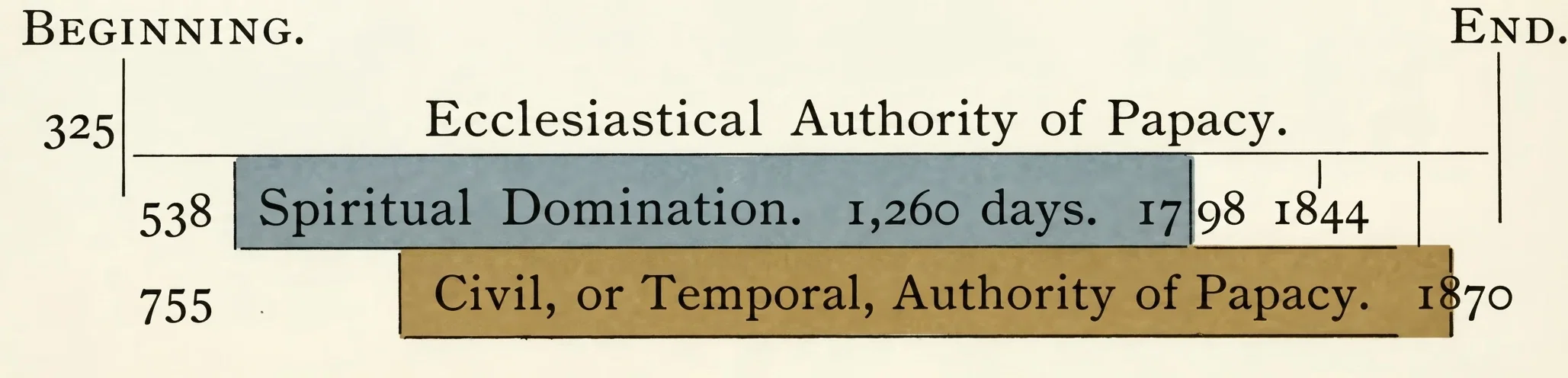
By the Temporal Power of the Papacy we refer to the rule of the succession of popes over the States of the Church which began with the grant of Pepin, king of France, in 755, and ended with the utter taking away of his dominion in 1870.
The Ecclesiastical Power of the Papacy, or Roman Catholic Church, may be said to have begun at the Council of Nice, 325, when the Roman Catholic Church was established by law, through the Emperor Constantine.
The Spiritual Domination of the Papacy, the power by which it possessed the means to persecute, began in 538 and ended in 1798, and will again be restored.
These phases may, perhaps, best be set forth by the following diagram:—
PROPHECY OF REVELATION
The Ecclesiastical authority or power of the Papacy, or Roman Catholic Church, is that which she possesses in common with other ecclesiastical organizations. While logically it leads to a union with the State, it can exist and flourish separate from the State. There is, we believe, in it much of deadly error, but we also believe that in its fold it embraces, despite its errors, many devoted, earnest, whole-souled, self-sacrificing Christians. In this condition it holds only that power and influence over its membership which its teachings and threats have upon the consciences and fears of its devotees. This power and this authority lie wholly within itself apart from civil power. It elects, chooses, or appoints its own rulers and orders from pope to nun. It possessed this power previous to its spiritual domination and temporal dominion and after it lost them; therefore the ecclesiastical or church system of Rome is not dependent upon them.
Its Spiritual Domination began in 538. This is marked by two important events. In 533 Justinian, emperor of Rome, declared that the bishop of Rome should be “Head of All the Churches.” The account of this, says Croly, is “to be found in the ‘Annals of Baronius,’ vol. 7, p. 194, fol. Antwerpae.” In Justinian’s letter, addressed to “the most holy archbishop of our city of Rome, and patriarch,” occur the following statements:—
Therefore we have made no delay in subjecting and uniting to your holiness all the priests of the whole East. . . . We can not suffer that anything which relates to the state of the church, however manifest or unquestionable, should be moved without the knowledge of your Holiness, who are the Head of All the Holy Churches.*
The letter also mentions that the incumbent of the rival See, the archbishop of Constantinople, was “desirous in all things to follow the apostolic authority of his Blessedness,” the pope of Rome.
The same year, March 25, in a letter to Epiphanius, Justinian refers to his letter to the bishop of Rome, and, says Croly, “repeats his decision, that all affairs touching the church shall be referred to the pope, ‘Head of all Bishops, and the True and Effective Corrector of Heretics.’”
In the same month of the following year, 534, the pope returned an answer repeating the language of the emperor, applauding his homage to the See, and adopting the titles of the imperial mandate. He observes that, among the virtues of Justinian, “one shines as a star, his reverence for the apostolic chair, to which he has subjected and united all the churches, it being truly the Head of all; as was testified by the rules of the Fathers, the laws of princes, and the declaration of the emperor’s piety.”*
This letter of Justinian is not all the evidence of this action concerning the See of Rome. The 131st edict of the “Novelloe” of the Justinian code on ecclesiastical titles and privileges, chapter 2, states: “We therefore decree that the most holy pope of the elder Rome is the first of all the priesthood.” The archbishop of Constantinople was given second rank. The ninth edict states that in Rome “was the supremacy of the pontificate.”*
But this decree could not be carried out at once. Italy was possessed by the Arian Ostrogoths, who believed, at least to a limited extent, in religious liberty. This was pre-eminently true of Theodoric, who reigned till 526. The next year Justinian came upon the stage of action, with the ambition “to unite all men into one faith.” As above shown, he elevated to the head of the church the bishop of Rome, the incumbent of which at that time was John II. After the death of Theodoric the Arian Ostrogoths had become divided. Justinian began his crusade against them by sendingBelisarius against the Arian Vandals of Africa, over whom Gelimer was king. This expedition was in the interests of “the faith.” Belisarius was successful, and Gelimer was captured, and the Vandals overthrown in 534. The Arian worship was suppressed, and the Catholic Church established. Having suppressed the Arians and established the Catholic faith in what were the Vandal dominions, in 536 Belisarius entered Italy. He entered Rome December 10 of the same year. But this was not the conquest of Italy. The Gothic nation, aroused, besieged Belisarius in Rome. Says Gibbon:—
The whole nation of the Ostrogoths had been assembled for the attack, and was almost entirely consumed in the siege of Rome.
One year and nine days after (538), they were utterly defeated, and Rome was in the hands of Belisarius. It was the third kingdom plucked up before the unholy ambitions of the Papacy, as set forth in Dan. 7:8, 24. These were as follows: Heruli, 493; Vandals, 534; Ostrogoths, 538.
Here began the supremacy of the Papacy, or its spiritual domination, as a world power, acknowledged as such by the ruling power of earth. It was then truly “Head over All the Churches” and “the True and Effective Corrector of Heretics.” And altho this power was not at once exercised, here it began in decree, and here it began in the prophecy. This acknowledgment was the basis of its persecuting power. Here the papal head came fully into existence as having control of the diabolic system of Church-and-State government. It was formed by this union of Church and State. The Papacy was given the power to define heresy and declare what its punishment should be, and its decrees were executed by the civil power, except where God’s providence interposed to check her unholy ambition and revengeful spirit.

What Makes a Persecuting Power?

It is in the light of persecuting powers or different phases of one great world-wide persecuting system, that the heads are presented in prophecy; and a persecuting power is always made up of a union of Church and State. To this two things are essential:—
  1. It must be a religious power or it will not persecute;
  2. It must have civil power to enforce its decrees or it can not persecute.
The Roman Catholic Church has no power to persecute in England or Italy to-day. The Papacy exists in both countries in strength, but only as an ecclesiastical power. For a hundred years and more the Federal Government of the United States has not persecuted. It would not in the very nature of the case, because it had no connection with the church. But let the civil power acknowledge the claim of the ecclesiastical to define heresy and to declare its punishment, and a persecuting power is immediately formed. As regards the beast, a new head springs into existence.
The deadly wounding, or destruction, of that head—of a persecuting power—may be accomplished either by destroying the ecclesiastical system, which would be nearly equivalent to destroying the people who espouse it; or by breaking the connection with the civil power, which, at the demands of the ecclesiastical, punished heresy. Either would be a deadly blow, but the former would be almost impossible and entirely improbable. The latter would be the only probable way.

Civil Power of the Papacy.

The third phase of the Papacy, as shown in the diagram, is her civil or temporal authority, which began under grant of Pepin, 755, of the States of the church, and ended in 1870, when Victor Emmanuel wrested from the pope his last vestige of temporal power. The taking away of this power is thus set forth in Dan. 7:26:—
“But the judgment shall sit, and they shall take away his dominion, to consume and to destroy it unto the end.”
The spiritual domination of the Papacy, of the 1,260 years, ended in 1798. The “judgment” here referred to is that mentioned in verses 9 and 10, which began in 1844.
“They shall take away his dominion.” “They” evidently refers to the other horns, or the governments symbolized by them. And history upon this point confirms the prophecy. In 1844 the States of the Church had an area of 16,000 square miles, and a population of 3,000,000. Four years afterward began the Revolution in France and northern Italy. This greatly affected the Papal States. In the following year they revolted, but through the aid of the French were brought to submission. Peace reigned outwardly till 1859, when the slumbering fires of revolution were again manifest in the revolt of Romagna, which was not opposed. This province was annexed to Sardinia in 1860. The same year the provinces of Umbria and Marches revolted, and placed themselves under Victor Emmanuel. These provinces were also annexed to Sardinia. Thus from 1848 to 1860 the consuming process had reduced the territory of the Papacy from 16,000 square miles to 4,500, and its population from 3,000,000 to 700,000. In 1870 the last vestige of temporal dominion was taken away.
[The exposition of Revelation 13 will be continued next week.]

WHY NOT FIND HIM HERE?

ONE winter in the city of New York, not many years ago, a man in the employ of a large ice firm, filling a very important position in the office, was tested as to the validity of his professed connection with the Lord. He had but recently given his heart to the Lord, and desired to be used of Him to help others. To this end he had prayed.
One evening at the close of a very busy day he found himself alone in the office attending to the closing up of some little details in the work when one of the teamsters, a naturally good-hearted boy, who had come in from the country (as so many boys unwisely do), bustled into the office, swearing about something that had gone wrong.
Mr. Palmer objected to this kind of language in his inner man, and interrupted by saying:—
"Jack, what makes you swear this way? You didn't do this when you first began working here."
Jack ceased and began to think, and as he thought he remembered some of the good counsel of his mother up among the rugged hills in Vermont. His eyes were fast filling with tears.
Mr. Palmer, observing the Lord was working upon the young man's heart, continued:—
"Your association with the rough class of men at the barns is leading you to ruin. You need the Lord to hold you and keep you in this wicked city."
"But how shall I find Him?" broke in Jack.
"Well," suggested the man who had found the Lord, "down at the Baptist Church there is being held every night a revival service. It is on the corner of—"
"O, I can't go way down there to find the Lord," interrupted Jack; "what is the matter with our finding Him right here, now?"
This came as a surprise, and was something the Christian did not feel equal to undertaking. But thoughts rushed into his mind, "Have I not been asking the Lord to show me how I could do something for Him?" "Have I not given myself to Him to be used?" and "Am I not to be a witness for Him in every place?" and this was taken as a call to prayer. But where could they pray? The office was in plain view to the passers-by on the street. Yet here was a soul seeking God. No time was to be lost, so down on their knees they went, and prayed that God would rescue this poor young man from the snare of sin, and let the power of God keep him in the right way. God heard. Peace and pardon came while there upon their knees.
Jack stood the test. He began laboring for the men at the stables. He was at first ridiculed. They called him their preacher. But he labored on and soon left the barns to continue work for other poor souls on the road to ruin. He became an active missionary, and later started and conducted a very successful mission in this great, wicked city, where many were won to Christ.
Thus resulted a little definite, personal work for the Lord, and Jack, as well as his office friend, found the Lord could be found right where they were, and then.
T. E. BOWEN.

PRINCIPLE VERSUS POLICY.

It has been said that "Honesty is the best policy," but if a man's honesty is a matter of policy at all, he will be honest only so long as the policy holds out. True honesty is not policy at all. It is an everlasting principle that holds good through all conditions of life.
Policy put Daniel in the lion's den, but principle went in with him and brought him through unharmed. Principle is fireproof. It goes through the fiery furnace and comes out unsinged, while policy is often burned in the effort to throw principle in the fire.
Policy schemes in his easy chair, while principle prays in a prison cell.
Policy is the wolf that lies down with the lamb after the lamb is inside of the wolf. Principle is the faithful dog that lies down with the lamb to keep the wolf away.
Principle is oft derided While a cruel crown of thorns Shaped by policy's devising, Her pale, bleeding brow adorns. Principle is oft uplifted, Nailed upon a rugged cross, Buried in the earth's cold bosom, While we mourn our fearful loss. But the day is fast approaching When true principle will rise, Over policy triumphant, And be carried to the skies.
Geo. A. Snyder.

A PARALLEL IN TRADITION.

THE old rabbis, the doctors of the Jewish church, had their fable of oral traditions handed down from Moses to the men of the Great Synagogue, who later put them into writing, with interpretations and comments, without which it was thought to be impossible to understand the Scriptures. Just so the Catholic doctrine of tradition substitutes the vagaries of the "fathers" for the pure words of God. And they are said to have received the traditions from the apostle just as the Jewish rabbinical writers received their traditions through Moses, who talked with God. Thus the Jews made void the commandments of God by their traditions, and thus the Catholic Church has made void the Word by tradition. Drink of the Fountainhead.—Waggoner.
Continue reading: THE FIRST AND SECOND ADAM