The Youth’s Instructor, Vol. 29, No. 35.

THE JAPANESE

The Youth’s Instructor

Aug 31, 1881

S. D. A. Publishing Association · Battle Creek, Mich. · Aug 31, 1881

THE JAPANESE.

JAPAN, sometimes called the Sunrise Kingdom, consists of a body of islands, forming an empire lying off the coast of Asia. The coasts of Japan are much broken by bays and inlets, and are very difficult of access, not only from the multitude of rocks and islands that surround them, but from the prevalence of gales and fogs. The rivers are numerous, but none are large; they are mostly mountain torrents, with short and rapid courses. Though there are some large plains, the surface of the country is in general very much broken by hills and valleys. The soil is fertile, and is almost everywhere cultivated. Even the rugged mountain sides, where the plough cannot be used, are often built up in terraces and tilled by hand. The abundant rains of spring and summer make a luxuriant growth of vegetation. The weather, however, is subject to sudden changes, and violent thunder-storms are very frequent. Earthquakes are so common that the natives pay very little regard to them.
The Japanese people are of medium size, and mostly of a yellow color, though some are brown and others nearly white. Their eyes are small, oblique, and deeply sunk in the head. Their noses are thick and short, and their hair heavy, black, and glossy. Some of the ladies who are not exposed to the sun have perfectly fair skins and blooming cheeks. The dress of men and women is very much alike. It consists of a number of loose, wide gowns worn over each other, and fastened at the waist by a girdle. The sleeves are very long and wide, and the part of the sleeve that hangs below the arm is used as a pocket. The women usually wear brighter colors than the men, and often border their robes with gay embroidery or gold. Upon occasions of full dress, a cloak is worn, together with a sort of trousers called hakkama. Within doors, socks are the only covering for the feet, but shoes are worn out of doors. These shoes consist of soles of straw matting, or wood, and would seem very awkward and inconvenient to us. They are always taken off and left at the door on entering the house. Neither men nor women wear any covering on their heads, except occasionally as a protection from the rain. They screen their faces from the sun by the fan, which is carried by all classes,—ladies, priests, soldiers, and beggars.
These people have many curious customs. If you were to make them a morning call, they would at once offer you a cup of tea and a pipe. At the conclusion of the visit, sweetmeats are handed you on a sheet of white paper ornamented with tinsel; these are to be be eaten with chopsticks, and if you do not eat the whole, you are expected to fold up the remainder in the paper and carry them away with you. At grand dinners each guest is expected to take with him a servant or two to carry off in baskets the remnants of the banquet. Thus many things are made custom with them, which in our country would be considered quite rude.
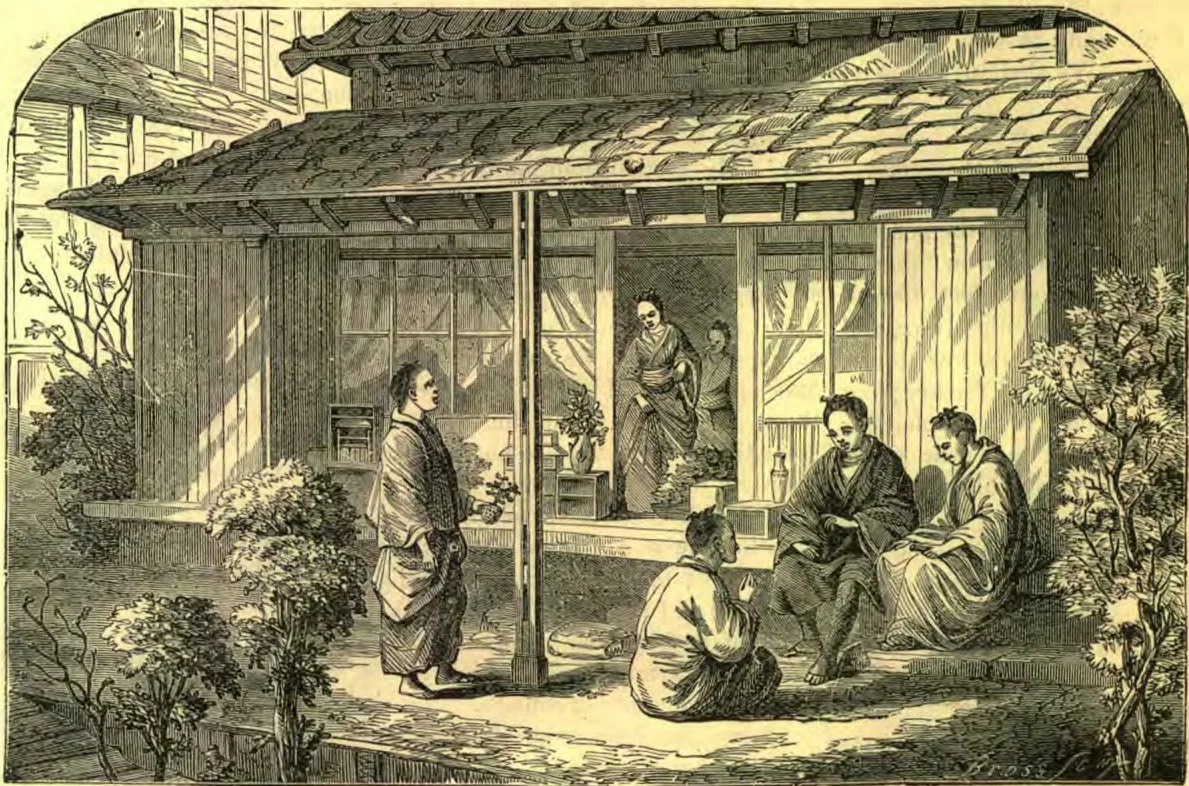
The houses of the Japanese are as singular as the people. Of the better classes, the houses are of stone, or are constructed of a frame-work of bamboo, or lath, covered with tenacious mud; this being covered with a coat of plaster, is either painted or becomes bleached by exposure. Moldings are often arranged in diagonal lines over the surface of the building, and these being painted white, and contrasting with the dark ground behind, give the houses a curious piebald look. The roofs are often of tiles, colored alternately black and white, the eaves being extended low down in front of the walls, so as to protect the inmates from the sun, and the oiled paper windows from the effects of the rain. At night, sliding doors, or shutters, are put on outside the paper windows.
A raised floor extends over the whole area of the house inside. This floor is a neat platform about two feet high, and is always covered with thick matting, except that on the front edge there is a strip of bare plank. The mats are neatly woven, and bound with cloth; they are all of uniform size, and placed in rows upon the floor so neatly as to have the appearance of one piece. One who has visited these houses says: “This matting is always clean as clean can be, and the naked part of the floor not only clean, but polished until it fairly glistens.” In the house there is no furniture, no table, no chairs, no bedsteads. Upon the clean mats the people sit to take their meals, and to converse with their friends, and on them they lie down at night to sleep, having then a stuffed quilt for a cover and a hard box for a pillow.
Taken as a whole, the Japanese are an intelligent and interesting people. Those who wish to learn more about them will find no lack of books on the subject. Of late they are becoming very much interested in having their young people educated, and numbers of them have been sent to this country to receive an American education.
E. B.
FRONT OF A JAPANESE HOUSE.

THE PUREST PEARL.

Beside the church-door, aweary and alone, A blind woman sat on the cold door-stone. The wind was bitter, the snow fell fast, And a mocking voice in the fitful blast Seemed ever to echo her moaning cry, As she begged for alms of the passers by: “Have pity on me, have pity, I pray; My back is bent and my head is gray.”
The bells were ringing the hour of prayer, And many good people were gathering there, But covered with furs and mantle warm, They hurried past through the wintry storm.
Some were hoping their souls to save, And some were thinking of death and the grave; And, alas! they had no time to heed The poor soul asking for charity’s need.
And some were blooming with beauty’s grace, Closely muffled in veils of lace; They saw not the sorrow nor heard the moan Of her who sat on the cold door-stone.
At last came one of noble name, By the city counted the wealthiest dame, And her pearls that o’er her neck were strung She proudly these to the beggar flung.
Then followed a maiden young and fair, Adorned with clusters of golden hair; But her dress was thin and scanty and worn— Not even the beggar seemed more forlorn; With a tearful look, and a pitiful sigh, She whispered soft, “No jewels have I, But I give you my prayers, good friend,” said she, “And surely I know God listens to me.”
On her poor, weak hand, so shrunken and small, The blind woman felt a tear-drop fall, Then kissed it, and said to the weeping girl— “It is you that have given the purest pearl.”
—Jennie A. Harmon.

SOUNDING ON FOREVER.

Some boys who had been told of a wonderful echo among the hills set out in search of it, wandering from one nook to another, until a solid rock barred their further progress in the direction in which they had been walking.
One, more impatient than his fellows, uttered an oath; and the terrible words were repeated until they seemed to pierce his very brain. Angry at this, another profane exclamation passed his lips, to be echoed and re-echoed in what seemed to him a voice of thunder.
“Mercy! what have I done?” he cried, clasping his head with his hands.
“Taken the name of your God in vain,” came the answer, clear and distinct; and the echoes of question and answer mingled in strange confusion.
“Come away!” called a companion. “Don’t stand on that stone another minute. We shall all be crazy, if you do.”
“I believe I am crazy.”
“You are more wicked than crazy.”
Half-frightened at this response, the swearer sprang from the position he had occupied, and threw himself upon the ground several feet distant.
At length the echoes died away, and the boys conversed in low tones. They had no need to go further; but there was a mystery yet unexplained: there must be some one near them, and there must be a double echo.
“I don’t care about the mystery, or the echo either,” said he who had tested its power. “I don’t believe I shall ever dare to say another wicked word as long as I live, for fear it will go sounding on forever.”
“Sounding on forever.”
A young man, standing upon the very spot where the profane boy had stood, repeated his concluding remark, thus giving a new message to the echo.
“Boys, I think I owe you an apology for my plain speaking,” said the stranger, as he came toward them.
“This is the second day I have been among the hills, hoping to hear the wonderful echo. I came up on the other side of the rock; and when I heard the exclamations following the oath, I responded almost involuntarily. I am always grieved and sorry when I hear an oath, because I know it will go sounding on forever. Perhaps none of you ever thought of it in that way.”
“I never thought of it in that way,” at length replied one of the party.
“I don’t believe any of us did,” said another.
“Yet it is true that not a word, good or bad, is ever lost. Every word has an influence. It will be echoed—silently, perhaps, but really echoed— —through all the ages of time. It may seem to die away in the distance; but somewhere it is doing its work. That may sound to you like a sermon; but it is regarded by many as a scientific fact.”
“How so? Please tell us.” And now every boy’s attention was gained.
“Some philosophers maintain, that, in the upper air, there is a blending of all sounds heard here on earth. There is the sweetest of harmony, and the most terrible of discords.”
“No one can be sure of that.”
“Certainly not; but we are sure that we shall be called to account for every word we speak, and that God will not hold the swearer guiltless. No word we speak will ever be forgotten. Somewhere there is an unfading record. Our words will be echoed, too, by some one with whom we associate. Some child who looks up to you as superiors will be likely to talk as you talk.”
“I know that is so. Small boys always want to talk and act as large boys do.”
“Yes; and often small boys are ruined in that way. When I was about twelve years old, I swore for the first time in my life, and within an hour my little brother, only four years old, repeated my words in my mother’s hearing. She was shocked, as well she might be; but the child justified himself by quoting my example: ‘Brother Will said it, and he’s a big boy.’ My mother told me that if he grew up to be a profane, wicked man, the sin would lie at my door. The words clung to him, until it seemed as though he would never forget them; and even now, good Christian as I believe he is, he says he would give a great deal if he had never heard them. That is my punishment; and since then I have tried to put a guard upon my lips.”
“I didn’t mean to swear this morning; but the words came without my thinking of them. I know swearing is wicked and vulgar; but I got in the habit of it from hearing a man who used to work for father.”
“Then you are his echo.”
“I suppose I am; but I ought to echo good words instead of bad ones. I will try to break myself of swearing.”
“I am sure you will, if you remember how your words are to be echoed and re-echoed. Now, suppose we try the echo with some singing, so that we may leave a pleasant sound here.”
This suggestion was received with favor; and, after some further conversation, and a careful selection of the exact spot where the best effect could be produced, they joined in a hymn of praise to Him whose name is exalted above every name; and as the rocks gave back the echo, they rejoiced that their words would go sounding on forever.—Well-Spring.

Ancient Britain: Danish Invasions and the Rise of Alfred

ANCIENT BRITAIN.—NO. 12.

In our last we called attention to a flourishing state of things in England, when schools were being established, churches erected, and civilization rapidly progressing; but this soon met with a severe check. Some bad kings came into power, who quarreled with each other. Some of these sought to expel the Christians. The king of East-Anglia resolved to serve Christ and the other gods together, so he had had a pagan and a Christian altar constructed fronting one another in the same royal temple.
While this state of things existed here, an outside foe was preparing to strike terror. The Scandinavians, by the aid of a series of great sovereigns, had established order in their kingdom. The bold spirits who would not submit were driven to the sea, and embraced a life of piracy and war. These Danes, as the Northmen were then called, came down the eastern coast of England. Crossing the river Humber, they soon conquered all north of the Thames. Britain again witnessed scenes similar to those when the Saxons and Angles came. Homesteads were burned, men were slaughtered, women and children were driven off into slavery, and Christian priests were slain beside their altars by the worshipers of Woden.
These heathens tied Edmund, the Christian king of East-Anglia, to a tree, and shot him to death with arrows. This martyred king is the St. Sebastian of English legend.
To stop this slaughter there was raised up a king called Alfred. He was both handsome and brave. Even in his youth he had a great love for learning. After he was proclaimed king, he had more than fifty battles to fight in order to subdue the Danes. When the people first selected him as their king, there was not one town where the people dared publicly proclaim him, for fear of the Danes. He disguised himself in poor clothes and went to live as a servant with a farmer in the Isle of Athelney, Somersetshire. The farmer did not know who he was. While there as a servant, his friends would come and tell him how the country was going on, and take messages from him to his friends. They advised him to stay in obscurity until they could collect soldiers enough to fight the Danes in that neighborhood.
One day the good farmer’s wife had made some cakes for supper and laid them before the fire to toast, requesting Alfred to watch them and turn them, so as not to let them burn. Alfred had just heard some news about the Danes, and was so absorbed in thinking how to deliver England from them, that he forgot the cakes, and they were burned quite black. The farmer’s wife scolded Alfred severely for his carelessness. Just then her husband came in with some of Alfred’s friends who told him they had beaten the Danes in a battle and that the people wanted him, the king, to appear. The farmer’s wife was now greatly agitated and surprised, and humbly asked Alfred’s forgiveness for the scolding. He simply smiled, and said he forgave her for the scolding if she forgave him for burning the cakes.
King Alfred’s monument, at Athelney Station, is in sight of the railway from Taunton to Southampton, eight miles from Taunton. It is a pillar constructed of brick. It is said to be on the identical spot where King Alfred burned the cakes.
J. N. Loughborough.

A Child Learns the Secret of Happiness

A LITTLE child, seven years old, one day said to her mother, “Mother, I have learned to be happy.” “My dear, how can this be done?” said her mother. The child answered, “It is not caring about myself, but trying to make everybody else happy.”

LUTHER'S SNOW SONG.

On a cold, dark night, when the wind was blowing hard and the snow falling fast, Conrad, a worthy citizen of a little town in Germany, sat playing his flute, while Ursula, his wife, was preparing supper. They heard a sweet voice singing outside:—
“Foxes to their holes have gone, Every bird unto its nest; But I wander here alone, And for me there is no rest.”
Tears filled the good man’s eyes as he said: “What a fine, sweet voice! What a pity it should be spoiled by being tried in such weather!”
“I think it is the voice of a child. Let us open the door and see,” said the wife, who had lost a little boy not long before, and whose heart was opened to take pity on the little wanderer.
Conrad opened the door, and saw a ragged child, who said,—
“Charity, good sir, for Christ’s sake!”
“Come in, my little one,” said he. “You shall rest with me for the night.”
The boy said, “Thank God!” and entered. The heat of the room made him faint, but Ursula’s kind care soon revived him. They gave him some supper, and then he told them he was the son of a poor miner, and wanted to be a scholar. He wandered about and sang, and lived on the money people gave him. His kind friends would not let him talk much, but sent him to bed. When he was asleep, they looked in upon him, and were so pleased with his pleasant countenance that they determined to keep him, if he was willing. In the morning they found that he was only too glad to remain with them.
They sent him to school, and afterward he went into a monastery. There one day he found a Bible, which he read, and learned the way of life. The sweet voice of the little singer became a strong echo of the good news: “Justified by faith, we have peace with God through our Lord Jesus Christ.” Conrad and Ursula, when they took the little street singer into their house, little thought they were nourishing the great champion of the Reformation. The poor child was Martin Luther.—Christian at Work.

God's Messages in the Summer Days

The beautiful summer days bring to us many very sweet messages from God. Every flower reminds us of him; for Jesus said that he clothes the flowers. Then the birds as they sing speak of him; for he feeds them. Let us always remember that God’s hand makes every lovely thing we see.

SHARON AND CARMEL.

“The glory of Lebanon shall be given unto it, the excellency of Carmel and Sharon, they shall see the glory of the Lord, and the excellency of our God.” Isa. 35 : 2.
SHARON and Carmel are enshrined in sacred poetry. In addition to the holy associations that cluster round them as scenes of Bible history, they bring up before the mind’s eye plains spangled with “the rose of Sharon,” meadows powdered with “the lily of the valley,” uplands waving with “forests,” and mountains crowned with “the excellency of Carmel.” Nor are one’s glowing expectations much disappointed when he traverses Sharon, or climbs the heights of Carmel in early spring. The plain stretches out before him as far as the eye can follow it, in gentle undulations of luxuriant pasture, varied here and there by a clump of old forest trees, or a thicket of canes and shrubs round a fountain, or a grey tell strewn with the ruins of some primeval city. And the mountain chain rises in easy slopes, wooded from base to summit; seamed by many a glen, and broken by many a cliff. The curse has fallen lightly upon Sharon and Carmel. Still it is true that the great cities which once lined the sea-board are gone. The restless waves dash in sheets of foam over the engulfed ruins of its once famous harbors. Dor and Cæsarea, Hepha and Athlit, are no more. Towns and villages which thickly studded in ancient days inland plain and mountain side, are gone too. Corn fields, olive groves, and vineyards are now few and far between; and even the pastures are deserted save by the flocks of a few poor nomads. Notwithstanding the grass, and the flowers, and the beauty of Sharon, it is “like a wilderness.” “Its highways lie waste, the wayfaring man ceaseth” (Isa. 33 : 9). And notwithstanding Carmel’s waving woods and green forest glades, it has “shaken off its fruit,”—the fruit of human industry. The mountain still deserves its ancient name, “the fruitful.” The “excellency (beauty) of Carmel” is yet conspicuous; but even there, in the loveliest glades and richest dells, solitude keeps unbroken sabbath.
My first view of Sharon was from the sea. From the vessel’s deck I looked with as much eagerness as an old Crusader on the white strand, and the sandy downs, and the broad plain, shut in on the east by the blue hills of Samaria. The Cape of Carmel was far behind me, dipping gracefully, but not so “bluff” as is usually represented in pictures, into the Mediterranean. Away far ahead a little white rounded hill began to rise slowly from a flat coast. “What hill is that?” I asked of the French officer at my side. “That is Joppa.” “And those ruins we passed some time ago, which you can yet see yonder glittering in the sun—what are they?” “The ruins of Cæsarea,” was the reply. Historic names are wonderfully suggestive. Especially so when connected with sacred history, and when the eye first rests on the places to which they are attached. Memory then becomes a diorama. It brings before us the great events of other ages. So it was with me. In succession I saw the ships of Hiram conducting rafts of cedar and pine along the sea to Joppa for Solomon’s Temple. I saw the great merchant vessel of Adramyttium leaving the harbor of Cæsarea, while on its deck stood the apostle of the Gentiles, guarded by Roman soldiers, and with fettered hands waving a final adieu to weeping friends. I saw the proud galleys of the Crusaders bearing down upon the shores, crowded with mail-clad knights, Europe’s best and bravest warriors, bent on the recovery of the Holy Sepulchre. And then, when the picture vanished, my eye rested on deserted harbors, ruined cities, a dreary desolate shore, silent alike to the bustle of commerce and the din of battle; as if to show that while man is mortal, his glory fleeting, and all his works perishable, God’s Word is true and can never fail. Five and twenty centuries ago that Word pronounced the doom of Palestine: “I beheld, and, lo, the fruitful place (Hebrew Carmel) was a wilderness, and all the cities thereof were broken down at the presence of the Lord, and by his fierce anger. For thus hath the Lord said, The whole land shall be desolate” (Jer. 4 : 26).
I landed at Joppa, a bustling town of five thousand inhabitants, beautifully situated on the western slope of a hill, looking down into the blue waters of the Mediterranean. It is still the port of Jerusalem; but it has no harbor, and it is only under favourable circumstances of wind and weather a vessel can ride at the distance of a mile or so from the shore. Guided by a young Jew, I went at once to “the house of Simon the tanner.” The house is modern; but it probably occupies the old site, for its Mohammedan owner considers it sacred. It stands “by the sea-side,” as St. Luke tells us (Acts 10 : 6); and from its roof—“flat” now as in ancient times—I looked out on that same boundless sea on which the apostle must have looked when “he went up upon the house-top to pray.” The hour too was the same—“the sixth hour,” or noon. There was something deeply impressive in being thus brought as it were into immediate connection with that wondrous vision which the Lord employed as a key to open the Gentile world to Christ’s Gospel.
From Simon’s house I went through crooked streets to the top of the hill. The way was not pleasant, but the glorious view amply repaid me. On the land side Joppa is girt about with its orchards—the finest in Palestine, and, perhaps, unsurpassed in the world. Away beyond them spreads out a boundless plain; on the north Sharon, and on the south Philistia. My eye soon caught and followed the line of the old road which winds northward along the coast to Cæsarea. That was the road by which the apostle Peter went on his divine mission to Cornelius. (Acts 10). Lydda was hid behind a rising ground; but the mountains of Judah was sharply defined against the bright eastern sky, and their colouring was beautiful—shaded off from soft grayish blue to deep purple.
To procure horses and a guide was a work of time and trouble, and the afternoon was far advanced ere I rode out of the crowded gate of Joppa. How pleasant was the change from the heat and dust of the narrow streets to the freedom and freshness of the country! It was autumn; and never did autumn’s richness appear to greater advantage than in these orchards of Sharon. Orange, lemon, and citron trees were there laden with golden fruit. Among them appeared the russet foliage and bright red globes of the pomegranate. Here and there the broad-leafed banana grew in wild luxuriance, shut in by tall hedges and impenetrable thickets of cactus; while ever and anon palm trees shot up far overhead, as if to show the great clusters of dates that hung round their tapering necks, or to entice the soft evening breezes to sport with their feathery foliage.
I took the road to Lydda,—the same road by which Peter was brought to raise Dorcas from the dead, after he had, by his miraculous cure of Eneas, converted “all that dwell in Lydda and Saron,” (the Greek form of Sharon, Acts 9 : 34). For more than an hour I rode through those shady, fragrant orchards, and then crossed the gray monotonous plain to Lydda. Thence I went to the ancient Gimzo (2 Chron. 28 : 18), now a poor village, and onward to the pass of Beth-horon, up which I wound my way to Gibeon and Jerusalem. The southern end of Sharon, which I thus crossed, measures about fifteen miles; while the length of the plain from Joppa to Carmel is nearly fifty. In addition to Joppa and Lydda, there are ten or twelve villages in this part of the plain, and small portions of the rich soil are cultivated by the inhabitants; but further north the country is almost deserted.
—Syria’s Holy Places.

SCENES IN THE LIFE OF CHRIST.

LESSON 32—THE DISCIPLES TAUGHT TO AVOID THE WAYS OF HYPOCRITES.

In this lesson we will continue to study the sermon on the mount. Some of the Jews had the habit of giving to the poor, and doing other good deeds, in the sight of men, so that they might be praised for their goodness. This they had done till they seemed to think it all right, and were even glad to have a trumpet sounded whenever they bestowed a gift. It was wrong for them to do so; for they did not give because they loved God, or pitied the poor, but because they wanted to be honored of men. Such giving would not make them tender and loving, but would make them grow more selfish continually. They did not do these things for God, and so they could not have any reward from him. Jesus said to them, “Take heed that ye do not your alms before men to be seen of them; otherwise ye have no reward of your Father which is in heaven. Therefore when thou doest thine alms, do not sound a trumpet before thee, as the hypocrites do in the synagogues and in the streets, that they may have glory of men. Verily I say unto you, they have their reward. But when thou doest alms, let not thy left hand know what thy right hand doest; that thine alms may be in secret; and thy Father which seeth in secret himself shall reward thee openly.”
“And when thou prayest, thou shalt not be as the hypocrites are; for they love to pray standing in the synagogues and in the corners of the streets, that they may be seen of men. Verily I say unto you, They have their reward. But thou, when thou prayest, enter into thy closet, and when thou hast shut thy door, pray to thy Father which is in secret, and thy Father which seeth in secret shall reward thee openly. But when ye pray, use not vain repetitions, as the heathen do; for they think that they shall be heard for their much speaking. Be not ye therefore like unto them; for your Father knoweth what things ye have need of, before ye ask him. After this manner therefore pray ye: Our Father which art in heaven, Hallowed be thy name. Thy kingdom come. Thy will be done in earth, as it is in heaven. Give us this day our daily bread. And forgive us our debts, as we forgive our debtors. And lead us not into temptation, but deliver us from evil; for thine is the kingdom, and the power, and the glory, for ever. Amen. For if ye forgive men their trespasses, your Heavenly Father will also forgive you; but if ye forgive not men their trespasses, neither will your Father forgive your trespasses. Moreover when ye fast, be not, as the hypocrites, of a sad countenance; for they disfigure their faces, that they may appear unto men to fast. Verily I say unto you, They have their reward. But thou, when thou fastest, anoint thine head and wash thy face; that thou appear not unto men to fast, but unto thy Father which is in secret; and thy Father which seeth in secret shall reward thee openly.”

QUESTIONS.

  1. What do we continue in this lesson?
  2. What bad habit did the Jews have in their way of giving alms?
  3. Did they seem to realize that such a spirit was wrong?
  4. What were they glad to have done whenever they gave alms?
  5. Why was it wrong for them to do so?
  6. What would be the effect of such a way of giving?
  7. Why could they not have any reward from God if they gave just to be praised of men?
  1. What did Jesus say to them about doing alms? Matt. 6:1.
  2. What did he say they must not do? Verse 2.
  3. What does he mean by saying that the hypocrites have their reward?—They get just what they seek for,—the glory of men.
  4. Will they have any other reward?
  5. Who will reward those who do their alms in secret?
  6. Does this mean that we should never give except in secret?—No; but that we should not care to have any one know of our giving.
  7. What caution did our Lord give in regard to praying?
  8. Where did the hypocrites pray? Why?
  9. What reward did they have?
  10. Where should we go for secret prayer? Verse 6.
  11. Does this mean that no other secret place will do as well as a closet?—No; a closet is used as an example of a secret place.
  12. Against what bad practice of the heathen did Jesus warn his disciples?
  13. Why do the heathen pray in this way?
  14. Who understands all our wants before we speak of them?
  15. Repeat the model prayer which our Lord gave his disciples.
  16. Is that prayer as well suited to us as it was to the people of those days?
  17. When will God’s kingdom come, and his will be done on earth as it is done in heaven?—When Jesus comes in person to rule over immortal saints in the new earth.
  18. Why should we be anxious to have that time come?—Because then there will be no sin, no sickness, pain, nor death; but all will be pure and beautiful.
  19. Is it possible for us to have part in that kingdom? How?
  20. Do we depend upon our Heavenly Father for our daily bread?
  21. How does he give it to us?
  22. This prayer teaches us to ask forgiveness of God in what way?
  23. Will God forgive us unless we forgive others?
  24. What other bad practice of hypocrites did Jesus warn his disciples to avoid? Verse 16.
  25. Why did the hypocrites disfigure their faces?
  26. What does Jesus mean by saying, “They have their reward”?
  27. How did Jesus tell his disciples to do when they fasted?
  28. What promise is made to those who fast unto the Lord, and not to be praised by men?

NEW-TESTAMENT HISTORY.

LESSON 45.—REVIEW.

1. What were the most important events in our Saviour’s history from his birth to the time when he began to preach?
2. What were the chief events from the beginning of his public ministry to the time when he preached the sermon on the mount?
3. What caused Jesus to say, “I have not found so great faith, no, not in Israel”?
4. Tell how he raised to life the son of a widow of Nain.
5. Where was John the Baptist at this time?
6. For what purpose did he send two of his disciples to Jesus?
7. What message did Jesus give them for their master?
8. What did Jesus say about John after these messengers had departed?
9. Tell how the woman anointed the feet of Jesus in the house of the Pharisee.
10. Relate what the Pharisee said when he saw this.
11. How did Jesus show that this woman had more love for her Saviour than the Pharisee had?
12. Who, about this time, accompanied Jesus on another tour through Galilee?
13. What did the Pharisees say when they saw Jesus cast a devil out of a man, and at the same time restore his sight and hearing?
14. How did Jesus refute the charge?
15. What did he say about the sin against the Holy Ghost?
16. By what figure did Jesus show that a man’s character is indicated by his actions? Matt. 12:33.
17. What title did he apply to the scribes and Pharisees? Verse 34.
18. Why could not they speak good things?
19. What is the treasure-house from which our words and actions proceed?
20. How did Jesus show the importance of our words?
21. Who asked Jesus for a sign?
22. What did he say to them?
23. Who did he say should rise up in judgment against that generation? Why?
24. What did he say of a man to whom an unclean spirit returns after having been once cast out. Matt. 12:43–45; Luke 11:24–26.
25. What did Jesus say to the woman who thought his mother was blessed? Luke 11:27, 28.
26. How does Jesus compare the enlightening influences of the Holy Spirit to the natural light which enables us to distinguish objects clearly? Verses 33–36.
27. How can those who are thus enlightened let their light shine like a candle in a dark room, so that all may see by it?—By bringing their lives into harmony with the divine teachings of the Spirit of God.
28. How may we keep the eye single, and thus secure this heavenly enlightening?—By having a single and undeviating purpose to follow the leadings of the Holy Spirit in all things.
Continue reading: STOP THIEF!