The Youth’s Instructor, Vol. 30, No. 28.

THE MOCKING-BIRD

The Youth’s Instructor

Jul 12, 1882

S. D. A. Publishing Association · Battle Creek, Mich. · Jul 12, 1882

THE MOCKING-BIRD.
EARLY on a pleasant day In the poet’s month of May, Field and forest looked so fair, So refreshing was the air, That, in spite of morning dew, Forth I walked where tangling grew Many a thorn and breezy bush; When the redbreast and the thrush Gayly raised their early lay, Thankful for returning day.
Every thicket, bush, and tree Swelled the grateful harmony; As it mildly swept along, Echo seemed to catch the song: But the plain was wide and clear Echo never whispered near. From a neighboring mocking-bird Came the answering notes I heard.
Soft and low the song began: I scarcely caught it as it ran Through the melancholy trill Of the plaintive whippoorwill, Through the ringdove’s gentle wail— Chattering jay and whistling quail, Sparrow’s twitter, catbird’s cry, Redbird’s whistle, robin’s sigh; Blackbird, bluebird, swallow, lark, Each his native note might mark.
Oft he tried the lesson o’er, Each time louder than before. Burst at length the finished song; Loud and clear it poured along; All the choir in silence heard. Hushed before this wondrous bird, All transported and amazed, Scarcely breathing, long I gazed.
Now it reached the loudest swell; Lower, lower, now it fell, Lower, lower still; Scarce it sounded o’er the rill. Now the warbler ceased to sing; Then he spread his russet wing, And I saw him take his flight Other regions to delight. —J. R. Drake.
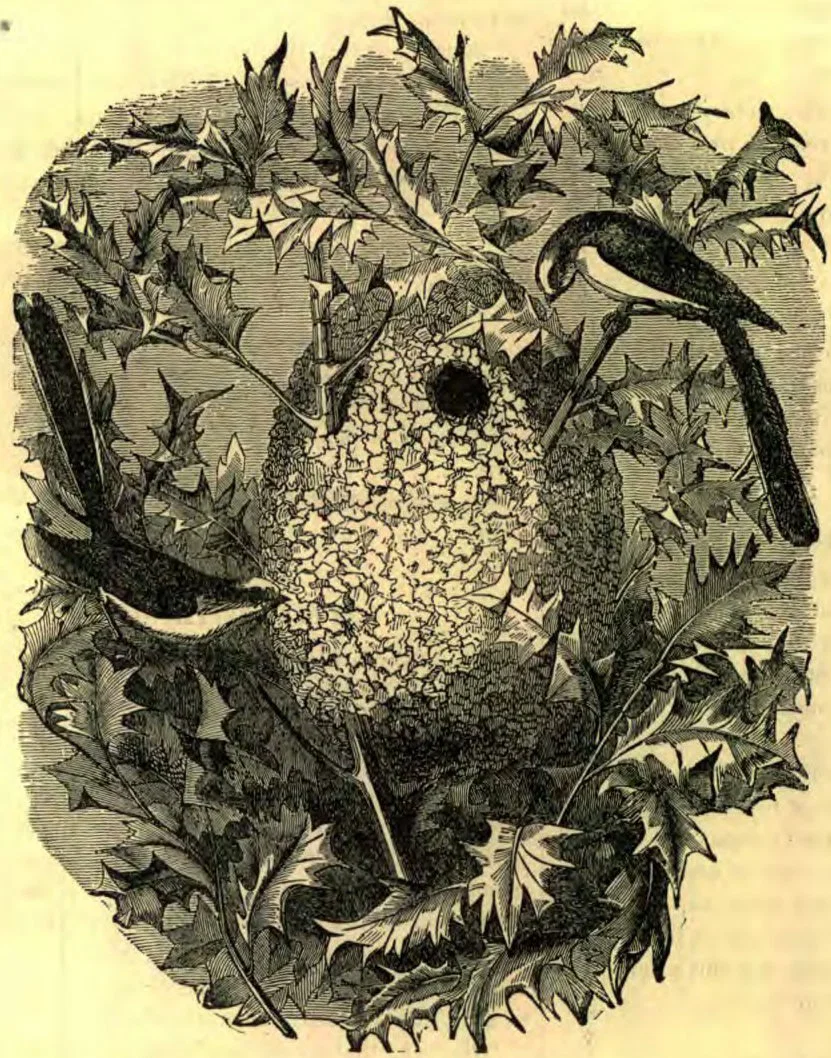
In the picture can be seen a pair of these wonderful birds, and their peculiar shaped nest, much resembling that of the swallow. Their power of imitation is something astonishing, and many amusing stories are related of their mischievous pranks. Mr. Wilson, in describing the habits of this most wonderful of all the feathered tribe, says: “He whistles for the dog; Cæsar starts up, wags his tail, and runs to meet his master. He squeaks out like a hurt chicken, and the hen hurries about with hanging wings and bristled feathers, clucking, to protect her injured brood. The barking of the dog, the mewing of the cat, the creaking of the passing wheelbarrow, follow with great truth and rapidity. He even repeats the tune taught him by his master, though of considerable length, fully and faithfully.”
Besides having the power of imitation, the mocking-bird has a song of his own, which rivals that of the nightingale in mellowness, modulations and gradations, extent of compass, and brilliancy of execution. Indeed, some who have heard both, regard the song of the mocking-bird as far sweeter and more enjoyable than that of the far-famed songster of the moonlight night.

HOW ROBERT ELMER SPENT THE FOURTH.

“I say, Rob—Robert Elmer!”
But the curly head, shaded by a torn straw hat, did not move. The speaker gave a shrill whistle, and then a round, rosy face appeared above the onion-tops. Soon the body of a boy followed, and with two bounds Robert Elmer was at the fence where Richard Lester was standing.
“Ain’t it awful hot work weeding onions? What do you get?”
“Hot enough! I get my board and clothes.”
“Pooh! your father’d have to give you them, anyway. He’d ought to pay you, so you’d have some money for the Fourth. See here!” Dick drew a handful of pennies from his pocket. “Don’t your mother ever send you to the store?”
“Yes, very often.”
“Does she always ask for the change when you get back? You ought to have some pay for working so hard, and if your father don’t think so, why, pay yourself. I know a trick or two.” This was said with a sly wink.
“What do you think I am, Dick Lester? You don’t catch me lying or stealing. No, siree!”
“Who said anything about lying or stealing? If there was some change, and your mother didn’t ask for it, ’twould belong to you. I’ve got money in that way lots of times. What are you goin’ to do on the Fourth?”
“Nothing. We always have lamb and peas and strawberries for dinner, though.”
“Why not come with us? Two or three of us fellers are goin’ to buy some gunpowder and have a jolly time. If you should happen to find a little money before then”—another wink—“why, bring it along.”
Robbie slowly shook his head.
“Oh, of course it don’t make any difference to me. Tho’t you’d like to. Well, you think about it, and meet us down by the big rock to-night and talk it over. Keep mum, anyway.”
“Robbie! Robbie Elmer!”
This time it was his mother’s voice, and Robert ran to the house, while Dick walked down the road. “I want you to go to the store and get me half a dollar’s worth of white sugar and a pound of raisins. Here are five dozen eggs in this pail; they’re twelve cents a dozen, and that’ll be just enough. Don’t fall and break ’em.”
Rob soon reached the store. As the storekeeper counted out the eggs he remarked, “Eggs have gone up six cents within a week, so I owe you thirty cents, young man;” and he handed the boy a bright quarter of a dollar and a five-cent piece.
Walking slowly homeward, Robert looked at the shining silver, and as he looked he thought of what Dick had said. “It’s a fact, I do work hard,” he thought to himself, “and I don’t have much money. How I would like to go with those big boys! They don’t ask little fellows very often. Gunpowder, too! I could ask father to let me go to Uncle Fred’s, and he’d never know. What’s the use of saying anything about the money?” He put it in his pocket, half resolved to follow Dick’s suggestion. “Mother would think ’twas wrong, I s’pose, but there are lots of things worse than that. I do n’t play truant nor take birds’ nests nor swear nor—” He wanted to say “lie nor steal,” but conscience whispered those were just the words by which he had called the act he now meditated. “It’s mine; I earned it,” he said aloud, and then looked around frightened lest he had been overheard. His mind was far from easy, and once more the money was taken out and looked at. How it shone in the sunlight! How nicely the figures were stamped upon it! “I will keep it,” he said. Just then some letters on the five-cent piece he had not noticed before caught his eye. Looking more closely, he read, “In God we trust.”
“Wonder if that’s in the Bible? I’ll learn it for Sabbath-school, it’s so easy.” Then he thought of the verse he had recited the day before: “My son, if sinners entice thee, consent thou not.” He started: “Why, I never thought what that meant before. It means me, and that I mustn’t have anything to do with boys that want me to do wrong.” He stopped a moment right there in the road as if to gain the strength he needed. “And I won’t!” he added resolutely. “They won’t see me by the big rock to-night.”
The struggle was over, the victory won. Mrs. Elmer noticed his bright eyes and rosy cheeks, but attributed them to his walk.
“You’ve been a good boy, Robbie, and I’m going to let you invite half a dozen boys to spend the afternoon here Tuesday. You may keep the change; you’ll want a little money to spend.”
Fourth of July was ushered in with tin horns and fire-crackers. The morning was spent in rowing on the lake and gathering water-lilies; then in the afternoon came the party, and what a good time those seven boys had running and shouting and playing games! And how they enjoyed the supper of cold chicken, bread and butter, strawberries, tarts, turnovers, frosted cake, and lemonade that had been spread for them under the shade-trees! After supper they all joined in singing “America” and the “Star Spangled Banner,” and, having given three rousing cheers for Independence Day, separated.
In the evening old Charlie was harnessed, and the family rode to the village to see the fireworks.
As Robbie sat on Uncle Fred’s piazza and watched the Roman candles and sky-rockets and other fiery things sputter and flash and blaze, he thought he had never before seen anything half so fine.
“Quite an accident up your way this afternoon,” said Uncle Fred as they were leaving.
“Ah! what was that?”
“Dick Lester and a couple other young scapegraces got hold of some gunpowder, and they thought ’twould be a grand thing to blow up Widow Munroe’s pig-pen; but they were too sneaky to do it themselves, and got little Jimmy Lawton for cat’s-paw. He didn’t understand how, and when he went to touch the match the powder flashed in his face and burned him badly. The doctor thinks he’ll be blind for life.”
The ride home was a very quiet one, and Rob’s parents thought he was asleep, but his eyes were open very wide. He was thinking of his narrow escape. Before going to bed he told his mother all about the temptation, and how near he had come to going with Dick Lester: “But I didn’t, and this has been the best Fourth of my life.”
Tears were in Mrs. Elmer’s eyes as she kissed him: “Your eyesight might not have been destroyed even had you yielded, but your conscience must have suffered. Mother is more than glad that you resisted temptation.”—S. S. Advocate.

MISTAKEN GENEROSITY OF A CANARY.

A LADY in this city has a bird hanging in its cage by the window, the door of which is occasionally opened, and his canaryship permitted to indulge in the freedom of the room. A day or two since, he happened to fly on the mantel-shelf, whereon was a mirror. Here was a new discovery of the most profound interest. He gazed long and curiously at himself and came to the conclusion he had found a mate. Going back to his cage, he selected a seed from its box, and brought it in his bill as an offering to the stranger. In vain he exerted himself to make his new friend partake, and becoming weary of that tried another tack. Stepping back a few inches from the glass, he poured forth his sweetest notes, pausing now and then for a reply. None came, and moody and disgusted he flew back to his perch, hanging his head in shame and silence for the rest of the day, and although the door was repeatedly left open, refused to come out again.—Dubuque Times.

SCENES IN THE LIFE OF CHRIST.

LESSON 77.—THE RAISING OF LAZARUS.

When Martha had said to Jesus, “I believe that thou art the Christ, the Son of God, who should come into the world,” she went back to her home and secretly called her sister Mary, saying, “the Master is come, and calleth for thee.” As soon as Mary heard this, she arose quickly and came to Jesus; for he was still in the place where Martha met him and had not yet come into the town.
Now the Jews who had come to comfort the bereaved sisters, were in the house with Mary, and when they saw her rise up hastily and go out, thought she was going to the grave of her brother to weep there; so they followed her.
When Mary came where Jesus was, she fell down at his feet, saying, “If thou hadst been here, my brother had not died.” When Jesus therefore saw her weeping, and the Jews also weeping which came with her, he groaned in the spirit, and was troubled, and said, Where have ye laid him? They said unto him, Lord, come and see. Jesus wept. Then said the Jews, Behold how he loved him! And some of them said, Could not this man which opened the eyes of the blind, have caused that even this man should not have died? Jesus therefore again groaning in himself cometh to the grave. It was a cave, and a stone lay upon it. Jesus said, Take ye away the stone. Martha, the sister of him that was dead saith unto him, Lord, by this time he stinketh; for he hath been dead four days. Jesus saith unto her, Said I not unto thee, that, if thou wouldest believe, thou shouldest see the glory of God! Then they took away the stone from the place where the dead was laid. And Jesus lifted up his eyes, and said, Father, I thank thee that thou hast heard me. And I knew that thou hearest me always; but because of the people which stand by I said it, that they may believe that thou hast sent me. And when he thus had spoken, he cried with a loud voice, Lazarus, come forth. And he that was dead came forth, bound hand and foot with grave clothes; and his face was bound about with a napkin. Jesus saith unto them, Loose him, and let him go. Then many of the Jews which came to Mary, and had seen the things which Jesus did, believed on him. But some of them went their ways to the Pharisees, and told them what things Jesus had done.”
Then the chief priests and Pharisees gathered a council, and began to inquire among themselves what they should do; for said they, “This man doeth many miracles, and if we let him thus alone all men will believe on him, and the Romans will come and take away both our place and nation.” But Caiaphas, one of the council, being high priest that year, said unto them, “Ye know nothing at all, nor consider that it is expedient for us that one man should die for the people and that the whole nation perish not.
“And this spake he not of himself; but being high priest that year, he prophesied that Jesus should die for that nation; and not for that nation only, but that also he should gather together in one the children of God that were scattered abroad. Then from that day forth they took counsel together for to put him to death. Jesus therefore walked no more openly among the Jews; but went thence unto a country near to the wilderness, into a city called Ephraim, and there continued with his disciples.”

QUESTIONS.

1. What did Martha do when she had said, “I believe that thou art the Christ, the Son of God, who should come into the world”? John 11 : 28.
2. What did she say to Mary?
3. What did Mary do as soon as she heard this?
4. Where did she find Jesus?
5. Who were in the house with Mary when Martha called her?
6. When they saw her rise up hastily and go out, what did they do?
7. Where did they think she was going?
8. When Mary came where Jesus was, what did she do and say?
9. How was Jesus affected by the sight of Mary weeping, and of the Jews also weeping who came with her?
10. What question did he ask?
11. How did he show his tender feelings?
12. What did the Jews say when they saw him weep? Verse 36.
13. What question did some of them ask?
14. Describe the approach to the place where Lazarus was buried. Verse 38.
15. What did Martha say when Jesus said, “Take ye away the stone.”?
16. How did Jesus reply to her?
17. When they had taken away the stone, what did Jesus do? Verse 41.
18. Repeat verse 42.
19. When Jesus had thus spoken, what did he do?
20. How were his words obeyed?
21. As Lazarus came forth, what did Jesus say to those who stood by?
22. What effect did this miracle have upon the Jews who witnessed it?
23. What course did some of them take? Verse 46.
24. What did this cause the chief priests and Pharisees to do? Verse 47.
25. What were they obliged to acknowledge?
26. What did they think would be the consequence if they let him alone?
27. What did Caiaphas, the high priest, say to them?
28. What did he prophesy concerning Jesus?
29. From that day forward what did these wicked men try to do?
30. How did Jesus keep out of their reach?

LITTLE THINGS.

“GEORGE is dreadfully fussy about little things,” cried Ben. “He is very particular to tell the exact truth, and he thinks over a thing a long while, to be sure that it is quite right, or that his mother and father will like it.”
“Glad to hear this,” said Mr. Trueman. “Look out, Ben! What you call little things have spoiled many a life. Do you remember the old story about the farmer and his horseshoe?”
“Never heard it, sir,” said Ben.
“You can find it in a book of German tales, my boy. One day a farmer went to market, made good sales, filled his purse, and then left for home, intending to reach there in the evening.
“For a while his horse trotted on all right, carrying him and his bags. After a rest at noon, when the farmer was ready to resume his journey, the boy at the inn said, ‘Your horse has lost a nail out of one of his shoes.’
“‘Never mind,’ said the man; ‘we shall get home all right.’
“Late in the afternoon he stopped again to rest and to feed his horse. Just as he was leaving, another boy spoke to him about the nail.
“‘Ah,’ cried the farmer, ‘I’ll venture to go a few more miles without it.’”
“Soon, however, the horse began to limp, and then to stumble; presently he fell and broke his leg. There was no help for the man then. He was obliged to leave his horse lying in the road, while he himself walked home, carrying the bags on his back.
“‘Alas!’ he thought, ‘all this trouble has come upon me for want of one nail in my horse’s shoe.’”
“He was a foolish man,” declared Ben.
“Don’t forget him, Ben, when you feel tempted to laugh at a careful, conscientious boy like George. Remember what is said about the ‘little foxes’ in the Song of Solomon, second chapter and fifteenth verse.”
Ben ran to find the chapter and verse. What did he read, and what did it mean? S. S. Visitor.

THE BEST REFERENCE.

“HAVE you a recommendation?”
“Yes, sir.”
Robert had been seeking a situation for almost a week, and now that he had at last met with something that promised success, he was nervous as a boy can be. His hand went down into his jacket pocket—a handkerchief, a strap, but no recommendation. He emptied another pocket, and another, and another without success. “Ah, there it is, I suppose; you have dropped it on the floor,” said the gentleman who was standing by, waiting, as a bit of paper fluttered to the floor.
“No, sir; that’s only my pledge,” Robert answered, stooping to pick up the paper.
“Your pledge?”
“Yes, sir. My temperance pledge.”
“May I see it?”
Robert handed it to him, and continued his search for the missing paper, growing more nervous as the search proceeded.
“Never mind, my boy. I don’t need any further reference,” said the gentleman, after reading the pledge. “I am willing to trust a boy who puts his name to a promise like this. That boy is his own reference.”—Royal Road.

“IF YOU PLEASE.”

“If you please,” makes people willing to help you and serve you.
“If you please,” makes people sweeter and happier.
“If you please,” is the key which unlocks more doors of kindness in family life than all the cross and ordering words in the whole dictionary. See if it does not.

HELPING THE MINISTER.

“ONE thing helped me very much while I was preaching to-day,” said a clergyman.
“What was that?” inquired a friend.
“It was the attention of a little girl who kept her eyes fixed on me, and seemed to try to understand every word I said. She was a great help to me.”
Think of that, little ones, and when you go to church fix your eyes on the minister, and try to understand what he says, for he is speaking to you as well as to the grown-up people. He is telling about the Lord Jesus, who loves the little ones.

Be Gentle: Strength and Sweetness of Character

Be gentle. Strength of character and sweetness of disposition are in nowise incompatible. Doubtless the most winsome nature on earth is that which combines the naturalness and dependence of a child with the strength of a true woman. There are people whose touch is balm to us; restful persons, whose companionship is a benediction, who draw out the best of our natures, whose presence we may scarcely note, but whose absence creates a void which the heart hungers to have filled.
Continue reading: NEW-TESTAMENT HISTORY