The American Sentinel, Vol. 9, No. 40.

Lexow Committee Exposes Police Corruption in New York
Earlier text: Lexow Committee Exposes Police Corruption in New York

A Revival, Not of Religion, but of Mediaevalism!

WE are upon the eve of a great revival. But it is not a revival of religion! It is a revival of the satanic spirit of mediaevalism! It is not altogether in barbaric nations that we see evidences of it, but in so-called Christian governments as well. In Russia the “Imperial Holy Church” has decreed that Stundists and Baptists must be re-baptized into the Greek Church at once. In case of refusal their children are taken from them and placed in convents or in Greek Catholic families; their goods confiscated and they banished to Siberia. All of which, and more, these Christians are called upon to suffer for conscience’ sake. Their churches are burned, their cattle killed, and they are inhumanly beaten by the officers and insulted by the mob. This in the name of religion!
In the dominions of the queen, in Australia, Seventh-day Adventists are under the ban of an old Sunday law, a law enacted under Charles II., in 1649; of whom Macaulay said that he “was indolent, unambitious, depraved, and a secret Catholic.” But as antiquated as it is, and hoary with age, and notwithstanding the unsavory reputation of religious laws of that remote period, it answers the purpose of superstition, prejudice, bigotry, and intolerance; and causes the arrest of Christian men—two brothers,—who, without being allowed to plead their God-given rights as a reason for their conduct (they worked on their fruit farm on Sunday), the magistrate peremptorily required to plead, “Guilty or not guilty:” and when they acknowledged that they had worked on Sunday, the sentence was at once announced; being a fine of five shillings, or two hours’ confinement in the public stocks! This also in the name of religion! Now where is the difference between the persecution of Baptists and Stundists in Russia, and of these Adventists in Australia? The only difference is in the severity, and not in the spirit that actuates it.
Come to our own boasted land of light and liberty, and what do we find? We find a continued demand for more stringent Sunday laws, State and national, by which offenders may be punished. Not only so, but Sunday leagues are multiplied which, according to their own showing, are for the purpose of compelling men, by the power of the civil law, to serve God. And this is not all. Note the continued arrests for violation of Sunday laws in various parts of the country. Nor is this all. No one can close his eyes to the continued persecutions of Seventh-day Adventists in Maryland, Georgia, and Tennessee. Denied their rights as citizens, confined in damp and dismal jails, dragged from court to court, compelled to work alongside of common criminals in the chain-gang, ordered by the courts to educate their consciences according to the laws of the State; some of these men hounded to the very death: and all this in the name of religion! And in this “Christian” nation!
Now I ask: Where is the difference between the three? The only difference is in the degree of severity. It certainly cannot be in the spirit that actuates these persecutors, whether in Russia, Australia, or in this “land of liberty.” When will Christians cease persecuting Christians? But have they not already done so? Indeed: have Christians ever persecuted? Men who professed to be Christians have persecuted. Men of the same stamp are now persecuting. But to be a Christian is to be Christ-like, and Christ never persecuted. Therefore it is true, that no Christian ever was or ever can be guilty of persecution. And, therefore, we conclude that all who ever persecuted, or who may now be engaged in that diabolical work, are not Christians, even though they profess to be Christians, but are antichristian, and are actuated by the spirit of antichrist.—H. F. Phelps, in Protestant American, Aug. 1, 1894.

Pertinent Paragraphs.

SOME of the propositions put forward by prominent advocates of religious equality, are the following:—
“Religion is none of the concerns of government.”
“The duty of the civil magistrate to religion is to let it alone.”
“The province of the civil ruler about religion is to have no province at all.”
“No privilege or advantage shall be conceded to Christianity or any other special religion.”
“Civil legislation ought not to extend beyond the outward and secular affairs of communities.”
“The entire political system shall be founded and administered on a purely secular basis.”
“The civil ruler is forbidden by Him who is ‘Lord of the conscience’ to exercise his official power in any way that involves any recognition and assistance of the Church.”
“The system of Establishment ‘invades the divine prerogative,’ and violates the rights of conscience.”
“‘Religious freedom’ consists in giving ‘Heaven’s truth a fair field against the devil’s lie.’”
“To own the magistrate’s right to employ the national resources for the support of any section of the Church, is to place Cæsar on the throne of Christ.”
“It is not within the province of the State to provide religious instruction for the subject.”
“The most perfect religious equality can alone meet their just demands.”
“Government is like a banking institution or a railroad corporation, which has nothing to do with the religion of the shareholders.”
“The best legislation on the subject of religion is to repeal all previous legislation on the subject.”—Compiled by Rev. Jas. Kerr, Glasgow, Scotland.

“Christian Nation” Curses.

AMONG the falsehoods of the father of lies, few are more disastrous to true Christianity than the “Christian nation” error. No one acquainted with pure and undefiled Christianity, who attended the World’s Congress of Religions, and listened to the withering denunciations of the crimes of so-called Christian nations by representatives of heathen religions, could fail to see that the heathen judges and condemns Christianity by the crimes committed by nations claiming to be Christian. The missionary from the “Christian nation” has come to them, accompanied with “Christian nation” soldiers, bayonets, swords, muskets, and cannons. “Christian nations” have massacred their people and robbed them of their homes. The missionary from the “Christian nation” has been followed by “Christian nation” opium and “Christian nation” “fire water,” and the people who survived “Christian nation” lead and steel, have been debauched by “Christian nation” opium and whiskey. All this has been so deeply impressed upon the heathen mind, that the real Christian missionary must first explain the difference between the Christianity of Christ and the Christianity of a “Christian nation,” before the seeds of truth can take root.
But the baneful influence of the “Christian nation” idea is not alone manifest in heathen lands; its poisonous effects are seen at home. Not long since a revivalist began work for the salvation of sinners in the congregation of Rev. Mr. Bradley, a Methodist, at Williamsport, Pa. At the close of the first service, the evangelist asked all the Christians in the audience to rise, and to his great astonishment the entire audience stood up. The puzzled preacher dismissed the audience and hastened to inquire of the local pastor the meaning of the vote. The pastor explained that since this nation was understood to be a Christian nation, the people believed that when born into this nation they were in a sense born Christian. “Now,” said the pastor, “to-morrow night ask them the same question, and then, after they are again seated, ask all those to rise who have been born again—converted—and see if there is not some work to be done.” The evangelist followed this advice, and, in response to the call for men and women to arise, who had been born again, only a few arose. He had now torn the mask from his “Christian nation” sinners, and he began in earnest an effort to convert “Christian nation” sinners to the Christianity of Christ.
And now that so many D.D.’s are turning their attention to doctoring the Christianity of this “Christian nation” by the application of legal lotions, let Christians redouble their efforts to convert “Christian nation” sinners, those “having a form of godliness but denying the power thereof,” as well as common sinners.

Significant Paragraphs.

[We publish under this heading paragraphs more or less significant, without either approval or dissent, and without comment. The careful observer of the signs of the times will readily discern the pertinent facts and opinions, and will know how to turn them to account in the great controversy between truth and error.]

Cardinal Gibbons on Labor.

FROSTBURG, Md., Sept. 30.—Cardinal Gibbons preached on “Labor” to a large congregation in St. Michael’s Church today. In his sermon he said:—
“In our times there is a great tendency in every department of business throughout the United States, as well as Great Britain, to form companies. There is a continuous network of companies and partnerships. When corporations combine it is quite natural for the laboring men to follow their example.
“But labor societies have many dangers menacing them. They are composed of men formidable in numbers, varying in character and nationality. They are naturally more difficult to manage and more liable to be dissolved than companies or corporations. They are in need of leaders of tact and ability who will aid the employés of the societies without infringing upon their employers.
“One of the most difficult questions in our times to discuss is the question of strikes. Perhaps this is not an unfavorable time to allude to this subject, as the great strike is ended and men are disposed to be more dispassionate in their judgments than they were some months ago. Strikes, as experience has demonstrated, are very questionable for the redress of the laborer’s grievances. They check industry, excite passion. They often lead to the destruction of property, and they result in inflicting many injuries by keeping the laborer in idleness, while his mind is clouded by discontent, and his family not unfrequently suffer for the comforts and necessities of life.
“From statistics furnished by Carrol D. Wright, of the eight years ending December 31, 1888, we find that the loss to the employés by strikes amounted to nearly $73,000,000, while the employers lost only one-half this amount. I earnestly hope that some efficient remedy will be found to put an end to our recurring strikes, and arbitration seems to be the most potent method that can be conceived of. A method that entails misery and loss is not the best means of adjusting labor grievances. A plan that will carry with it good and true Christian civilization should be sought for and adopted.”—N. Y. Sun, Oct. 1.

Nuisance on the Causeway.

THE young men that live on the south side make a general practice of playing games of baseball on the Sabbath day. It is really a sin, for these young men; and even small children, some not ten years of age, are engaged in such games. Such practice should be abandoned, and the attention of the officers is called to the same. The children that should come to the Sabbath-schools are hindered by these worldly affairs. The Bible tells us to “honor the Sabbath day to keep it holy.”—Clergyman, in Daily Republican, Wilmington, Del.

Stop Sunday Work.

CONSIDERABLE complaint has been made by the people living on Tatnall Street between Twenty-second and Twenty-third Streets about a man living in that square, who works the greater part of each Sunday making rowboats. Something should be done to break up the nuisance, and to learn the man that Sunday is a day of rest.—Daily Republican, Wilmington, Del.

A Religious Federation.

PITTSBURG, Pa., Oct. 1.—At its meeting in the Crafton Church to-morrow, the Pittsburg Presbytery will consider the greatest scheme ever brought before it for a federal union of the Cumberland Presbyterian Church, the United Presbyterian Church, the Associate Reformed Synod of the South, the German Reformed Church, the General Synod of the Dutch Reformed Church, and the Presbyterian Church.
Rev. Dr. James M. Maxwell, of Monongahela City, will present an elaborate report on the subject. The plan of federation, as sent down to the lower judicatories by the highest church courts in America, is a federal union of the above-named denominations, to promote coöperation in their home and foreign missionary work, to keep watch on current religious, moral, and social movements, and take such action as may concentrate the influence of all the churches in the maintenance of the truth that our nation is a Protestant Christian nation, and of all that is therein involved. It is an effort to consolidate forces, organize more effectually, and centralize the dissenting forces, in order to move in union and rapidly on a given command.—Washington Post, Oct. 2.

Seventh-day Adventists Not Wanted.

THAT the new law and order movement, which was launched last night at the Second United Presbyterian Church, under the significant name of the Allegheny County Vigilance League, will be ruled according to dogmatic principles, was demonstrated by an incident that happened at its initial meeting. It was brought about through the probable ignorance or mistake of those who sent out notices of the meeting, but it none the less shows that none except those who follow the dictates of the leader will be allowed any say in the management of the league.
Invitations had been sent to all the churches in the two cities, inviting each to send representatives to the meeting. Among the others the congregation of the Seventh-day Adventists received its notice and selected Thomas D. Gibson, William Zeidler and John Williamson as a committee to attend the meeting in a representative capacity. When the discussion of the objects of the new purifier of public morals had proceeded for some time the representatives of the Seventh-day Adventists found that the views of those at the head of the movement did not exactly coincide with those of their church. Mr. Williamson took the floor to express his views on the subject of Sunday observance, holding that no one or no organization had a right to enforce the observance of any one day as Sunday. The chair recognized him, and according to Mr. Williamson’s idea of the meeting, he had a right to express his views, as he was there as a delegate, and the discussion was understood to be open to all.
It did not turn out this way, however; as the speaker had said only enough to let it be understood that he had opinions of his own on this subject, and that these opinions did not agree with those of the men at the head of the meeting; Rev. J. T. McCrory raised the question that the speaker was out of order and had him shut off.
The incident caused a flutter of excitement in the meeting, but notwithstanding the injustice done the speaker, there was no recourse to the ruling, as the sentiment among the majority of those present was evidently against him. The proceedings of the meeting went on without further interruption. One of the delegates said he supposed the secretary had made a mistake in sending the notice to Seventh-day Adventists, forgetting that they were Christians every day of the week, while others were such only one day out of the seven.—Pittsburg (Pa.) Press, Sept. 26.

The Incoming Tide of Bigotry.

THE Republican State Convention felt the effects of the A. P. A. If rumor be well founded the influence of the infamous conspiracy forced the setting aside of a gentleman who would otherwise have been the candidate of the Republicans for lieutenant-governor. The objection made to his candidature was that though he is not himself a Catholic, his wife is! . . .
Mr. Van Schaick, whoever he is, appeared at the Republican Convention as the representative of the A. P. A. and, according to the reports of his conversation published, announced that 110 of the delegates to that convention were members of the A. P. A. Of course he refused to give the names of these men. According to the regulations of this conspiracy, as exposed in the West, no member is allowed to give to the outside world the name of another member. Now it is just as well for these persons to understand that within a year or two at the farthest the names of all of them that are of any consequence will be known and published. By the oath which they have taken, they have sworn substantially to injure Catholics to the best of their ability. The proper way to punish such fanatics would be to give them a dose of their medicine, and that they will receive. Some of them are engaged in the professions, as physicians and lawyers, others in business as storekeepers. All these will be known in time and published in their own localities.—Catholic Review, New York.

Watching the Lexow Committee.

NEW YORK, Sept. 13.—Rev. Father Ducy, in a letter to the New York World, reviews the work done by the Senate Investigating Committee in this city. He declares that he was delegated by the Vatican to carefully watch the proceedings of the committee and make a report to Rome. He continues: “It is very unfortunate that people have been unkind enough to couple Tammany corruption with the Catholic name, and it is very fortunate for our good name that the Catholics as well as the non-Catholics of New York can have the assurance that Leo XIII. and those close to him at the Vatican are vigilant watchers in the watch-tower; are sacredly guarding the good name of the Catholics in this great city of the Republic. I am informed that the communications that have reached the Vatican in relation to Tammany have produced a deep impression; so deep, in fact, that I have been instructed to put certain information in form and forward it immediately to Rome. I am delighted at the interest for a moral purification taken by the head of the church, and I trust that my non-Catholic brethren will be kind enough to stop impugning the fair name of our church and not hold it responsible for the corruption in its midst. The priesthood is deeply interested in all that concerns the welfare and purity of this city, and in its ranks there are men who have sacrificed themselves in many ways to add to the fair name of New York and of the whole country. In conclusion I should say that I am instructed by telegraph how to act in these matters of so much public importance.”—Inter Ocean, Chicago, Sept. 14.

The Growth of Ritualism.

IN a recent number of Word and Work, an English religious journal, Mr. A. H. Forbes, writing from the standpoint of a member of the Church of England, supports his assertion of an immense Romeward advance in that communion by the following startling figures: Clerical supporters of ritualism, 7,000 in 1892, as against less than half that number in 1882; ritualistic churches in 1882, 2,581; in 1892, 5,043; churches adopting eucharistic vestments in 1882, 336, in 1892, 1,029; churches illegally using incense in 1882, 9, in 1892, 77; churches using altar lights in 1882, 581, in 1892, 2,048. In addition to these facts, says Mr. Forbes, “further figures would doubtless reveal a similar advance in banners, crucifixes, processions, adoration of the elements, confessionals, etc.” And the conclusion to which all this would seem to point is that in a few years “evangelical teaching will have been crushed out of the Church of England, and that body will have become a department of the church of Rome.” The only reassurance Mr. Forbes has to offer is his conviction that “the people of England will never tolerate a return to Romanism.” Probably he is right in so thinking. At the same time, the growing influence of ritualism is a serious, if not alarming, fact. It finds illustration, as well as bold expression, in the book lately published by Canon W. J. Knox Little, a zealous and very able leader of the ultra-ritualistic party, who has ventured to entitle his volume, “Sacerdotalism, if Rightly Understood, the Teaching of the Church of England.” He frankly denies that the Anglican Church is a Protestant Church; cuts it off wholly and absolutely from all Protestant bodies; unites it doctrinally and historically with the Roman and Greek churches; and insists on a practice and doctrine which differ from those of Rome chiefly in not conceding the infallibility of the pope. He insists on auricular confession as obligatory, considers fasting communion desirable, and defends the “non-communicating adoration of the wafer,” the real presence in a form scarcely distinguishable from transubstantiation, the sacrifice of the mass, the authoritative interpretation of Scripture by the Church (not to say its authority to supplement Scripture by its own traditions), and the most literal apostolic succession in the hierarchy of the Greek, Roman, and Anglican communions, which together form one Catholic Church. There is, in short, nothing in Canon Knox Little’s delineations of the English Church to justify its existence independent of the church of Rome; and while his extreme views may not be shared even by all ritualists, they undeniably show the direction in which the High Church party is tending.—Examiner.
WHEREVER the persecuting “patriotic” orders get into power, they dismiss all Catholic teachers from our public schools. They have done this in Kansas City, Kans., for instance, and now the priests of that place have petitioned their bishop to let them send all the parochial school children there to the public schools, so that the board of education, which is controlled by the A. P. A., may have the expense of providing for their education. If this were done everywhere, the tax-payers would groan, for we save them millions on millions of dollars every year by providing out of our pockets for the schooling of our own children, after paying our full portion of the taxes for the support of our public schools. If our children were all sent to the public schools, we would raise an agitation from one end of the country to the other, to make the public schools thoroughly “unsectarian,” instead of largely Protestant as they are at present. The short-sighted “patriots” would save themselves money and trouble by letting us alone. We suffer enough already. We are not here by their toleration or permission. We are in our fathers’ house—here by right of discovery, by right of first settlement, by right of inheritance, by right of faithful service to the Republic, by right of possession, by right of law. We ask no favors of them.—Catholic Review, Sept. 1.

A Good Book for the Children.

Beautifully Illuminated Covers!
Fifty-three Illustrations!
Interesting Reading!
Ninety-six pages,
Large print,
Good paper,
Strong-binding.
All this and more is combined in
“The Good Shepherd: The Life of the Saviour for Children.”
This book, which is 8x10½ inches and ½ inch in thickness, tells the story of the Life of Christ in a way that cannot fail to interest the little folks. It is exceptionally free from doctrinal errors, and should be in every family where there are children to be taught a Saviour’s love. The illustrations, which are nearly all good, add very much to its educational value. Price, only 50 cents.
Address, Pacific Press, 43 Bond Street, New York City.

You can Bind

One Sheet, or three hundred sheets, in ten seconds.
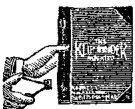
The Klip binds loose sheets, pamphlets, or magazines.
If you want covers also, you had better send for a Klip price-list—that’s free. If you will try the Klip, I will mail a sample dozen, six sizes, and a pair of Klip-Keys to put them on with for seventy-five cents.
H. H. BALLARD, 193, Pittsfield, Mass.

BIBLE STUDENTS' LIBRARY.

(Order by Number.)
No. 1. Bible Sanctification. By Mrs. E. G. White. This is a pamphlet of eighty-four pages, with eleven chapters. It sets forth the Bible doctrine on this subject in contrast with the false theories which are so prevalent, and should be read and circulated everywhere. Price, 10 cents.
No. 2. The Abiding Sabbath and the Lord's Day. A pamphlet of 174 pages, by A. T. Jones. Price, 20 cents.
No. 3. Views of National Reform. This is a pamphlet containing the first thirteen numbers of the Sentinel Library. It contains first principles on the subject of Church and State. Price, 15 cents.
No. 4. The Saints' Inheritance. A pamphlet of eighty-two pages, by J. N. Loughborough. It presents the precious promises of God's Word to his people in regard to the future home of the saved, and God's purpose concerning our work. This is an excellent work. It inspires hope and courage in the hearts of Christian pilgrims. Price, 10 cents.
No. 10. Scripture References. This valuable tract has been thoroughly revised. Many Scripture references are given upon all the great leading subjects of the Bible. It is indeed a valuable aid to the study of the Scriptures by subjects. Price, 4 cents.
No. 14. The Sufferings of Christ. By Mrs. E. G. White. This tract portrays with great vividness the scenes in Gethsemane and at Calvary during the last hours of the earth life of the world's Redeemer. This is an excellent tract for the prejudiced and the unconverted. Price, 4 cents.
No. 16. Christ in the Old Testament. By James White. This tract shows the relation which Christ sustained to the work and people of God prior to his first advent, and that men were saved by Christ and the gospel in Old Testament times as well as now. Price, 2 cents.
No. 24. Is Sunday the Sabbath? By M. C. Wilcox. This tract candidly considers all the texts in the New Testament which mention the first day of the week, and enables the reader to study the question in the light of the Scriptures. Price, 1 cent.
No. 25. The Sanctuary and the Judgment. By J. N. Andrews. This gives a brief but clear and candid exposition of the subject of the sanctuary and its relation to the Judgment. Price, 2 cents.
No. 26. The Sabbath in the New Testament. By James White. This tract presents in a clear and forcible manner the teaching of the New Testament concerning the day to be observed as the Sabbath, and the example of Christ and his apostles concerning the subject. Price, 2 cents.
No. 27. The Bible: Its Inspiration and Importance. By M. C. Wilcox. This is a good tract to place in the hands of the weak and doubting. It shows the purity of Bible teaching, its unity, its impartiality, and its comprehensive nature. Price, 2 cents.
No. 31. The Second Advent. By James White. This tract shows the manner, object, and nearness of Christ's coming. Price, 4 cents.
No. 34. God's Memorial. By James White. In this tract are shown the nature and object of a memorial. It presents the Sabbath as God's great memorial of creation, to be observed throughout “all generations.” A memorial of Christ's resurrection is also considered. Price, 2 cents.
No. 36. The Signs of the Times. This excellent tract has been revised up to date, so that the thrilling events of recent years are noted as evidence that the end of all things is at hand. Price, 2 cents.
No. 42. Elihu on the Sabbath. This is a brief but clear and forcible setting forth of the Bible argument on the Sabbath question. Price, 2 cents.
No. 43. The Ten Commandments Not Revised. By James White. This tract shows the utter fallacy and gross absurdity of the position that the old moral code of ten commandments has been revised. Price, 2 cents.
No. 46. Without Excuse. This is a most excellent tract, and deserves a very wide circulation. Price, 1 cent.
No. 47. Thoughts for the Candid. By J. N. Andrews. This tract presents the harmony and beauty of the truth in contrast to the inconsistency of false views based on certain passages of Scripture in regard to man's condition in death, and the fate of the ungodly. Price, 1 cent.
No. 48. Which Day Do You Keep, and Why? By G. W. Amadon. This is a clear, pithy tract, good for busy people. It gives God's answers to man's excuses for not keeping the Sabbath. Price, 1 cent.
No. 49. Can We Know? This shows that just before the second coming of Christ we may know that his coming is near. Price, 1 cent.
No. 50. Is the End Near? This gives evidence showing that the end of all things is at hand. Price, 1 cent.
No. 51. Is Man Immortal? This tract presents in a brief and concise manner the Bible doctrine of immortality by means of plain questions and Scripture answers. Price, 1 cent.
No. 52. Why Not Found Out Before? This tract shows why the Lord's Sabbath, the seventh day of the week, has been so long neglected and disregarded, and why it is now being proclaimed so widely and so many are beginning its observance. Price, 1 cent.
No. 53. The Sabbath and the Law. By J. N. Andrews. This is a pamphlet of 192 pages, giving an outline of the Biblical and secular history of the Sabbath for 6,000 years. It has ten chapters, and is a work of great importance. Price, 20 cents.
Any of the above may be obtained post free on receipt of price by addressing Pacific Press, Oakland, Cal.; 18 W. Fifth Street, Kansas City, Mo.; 43 Bond Street, New York City. Works on all phases of Bible truth. Send for catalogue.

Catholic and Episcopalian Arrested for Sunday Fishing in Maryland

A ROMAN CATHOLIC and an Episcopalian have been arrested at Kent Narrows, Queen Anne’s Co., Md., for fishing on Sunday, and fined five dollars and costs each. They have appealed to the circuit court, and the cases will be tried early in November, at Centreville. As there will be no religious prejudice in these cases, it will be interesting to note the outcome of them. It is stated that a desire for fees on the part of the constable led to the arrests.
W. B. CAPPS, the most recent victim of religious intolerance in Tennessee, writes us as follows:—
Dresden, Tenn., Oct. 1, 1894.
PUBLISHERS AMERICAN SENTINEL: You will please change my paper to Trezevant, Carroll Co., Tenn., I am released to-day. The American Hebrew, of New York, finished paying the costs in my case, $34.87. I will leave for home to-day after being held ninety-seven days by the wicked Sunday law.
Yours truly, W. B. CAPPS.
On receipt of this letter we called upon the American Hebrew and secured some interesting facts regarding the case of Mr. Capps, which will appear in our next issue.
WILLIAMSPORT, Pa., has organized a branch of the State Sunday Observance Association. The call under which the meeting for organization was effected, declares:—
Our city is in open rebellion against the divine laws. Our people are being corrupted with vile and debasing literature—also in other ways. The blessed Sabbath is being openly and shamefully violated and trampled upon by individuals and corporations. In view of these facts the time has come for our Christian and moral men to call a halt regarding this state of things, and change Williamsport into a model city. We therefore call upon all lovers of the right and of law and order to be present, etc., to devise ways and means to change the present condition of things in our city.
Of the proposed work of the association, the Williamsport Gazette and Bulletin says:—
The sale of newspapers on Sunday will be attacked and the venders will be promptly arrested and prosecuted. The strong arm of the law will be invoked to jerk the trolley wheel from the wire, and the man who wants to ride may, possibly, have to walk. In fact, it is to be a crusade against Sunday traffic of all kinds, and a red hot, lively time is anticipated.
It is yet too soon to report results from this organization, but as there are Seventh-day Adventists in Williamsport, and as they have been by the Christian Statesman declared to be the worst enemies of “the Sabbath” we may expect them to be among the first victims of the Sunday crusade.
THE Russian correspondent of the New York Observer says, in a recent letter to that paper: “One of the most remarkable phenomena connected with the religious life of Russia, is the perpetual sprouting forth of new and strange sects from the parent stem of the Orthodox Greek faith. This is all the more remarkable in a country where dead uniformity is so insisted on, and where deviations from the established order of things is visited with such condign penalties.” It is only a natural revolt against the tyranny of the Greek Church. And what wonder if the sheep in their efforts to escape the wolves in sheep’s clothing, become scattered.
IN commenting on the case of W. B. Capps, the Seventh-day Adventist, recently imprisoned in Dresden, Weakley Co., Tenn., for working on Sunday, the Boston Globe says:—
It ought not to take long for the next legislature of Tennessee to wipe out the stain on the State, by enacting such laws as shall do away with all musty statutes that invite bigotry to enter upon his work. Tennessee should secure for Jews, “seventh-day” keepers and men of all shades of religious opinion, the rights which belong to them in a land supposed to be the home of freedom, of conscience, and religious liberty.
The only legislation that would accomplish that which the Globe says should be accomplished, would be an act repealing the Sunday law of the State entirely. Sunday is a religious day, and laws requiring its observance are religious laws, and interfere with the rights of every man; for no man is free to do that which he must do. The Sunday keeper is not free under a Sunday law.
THE Jewish Times and Observer has this to say about the persecution of Jews in Russia:—
Hypocritical Russia occasionally announces to the world by some hired agent that the Jews are not told to leave that country. Before the world, Russia clasps the emblem which is held by the world to be the token of love, justice, mercy and charity, and calls herself, and gets herself called, holy. In the recesses of the empire, she manages to perform acts, diabolical in themselves, and rendered all the more so by the ingenuity she exercises to make them appear what Mr. Gladstone once called “domestic and internal arrangements” merely. To her Jews, her policy is summed up just in this: When she does not tell them to go, she makes it so uncomfortable for them, that they cannot stay.
The treatment of Sabbath-keepers in some of our American States is not essentially different; laws are made and enforced that they cannot conscientiously obey, and they are cooly told that if they don’t like it they can leave the country. Bigotry and intolerance are about the same everywhere.
COMMENCING this week the SENTINEL will publish a number of articles composed of quotations from the pen of Alexander Campbell against Sunday laws. Let the readers of the SENTINEL make a special effort to get these numbers into the hands of members of the Christian or Disciple Church.
Special attention is called to the position taken by Mr. Campbell that seventh-day observers cannot obey Sunday laws, and that to attempt to compel them to obey the Sunday institution in which they have no faith is to attempt to compel them to sin, and again that Sabbatarians may be conscientious in laboring on Sunday,—may “conscientiously drive their wagon on the Sabbath of the majority.”
IN concluding a letter to the German Roman Catholic Central Verein, in this city, September 17, Mgr. Satolli said:—
Please also to accept my best wishes for your next congress, and be sure that, although I cannot take part in it personally, my heart will be among you, by imploring from heaven the choicest blessings upon all of you in my name, and in the name of the Holy Father himself. Yours truly in X.,
FRANCIS ARCHB. SATOLLI, Delegate Apostolic.
The disciples were instructed to ask of the Father in the name of Jesus, and were assured that they should receive; and Christians from that day to this have asked in that all-prevailing name; but the “Delegate Apostolic” asks in his own name and in “the name of the Holy Father.” And it is to such a religion as this—a religion that gives to men the honor due to Christ—that the pope invites the “rulers and peoples of the universe!”

Work for the Sentinel.

A MINISTER in Canada writes thus concerning the SENTINEL:—
I have just finished reading the SENTINEL of Sept. 20th, and had a great feast, but it only makes me long for another. The SENTINEL is worth a thousand times its weight in gold, and is growing better all the time. God bless the SENTINEL!
A statesman of Tennessee writes of a recent issue:—
The whole paper is richly laden with the good things of truth and wisdom. I only say, by way of manifesting my indorsement, Go on in the good work as you have been going and surely you will be rewarded with a triumphant and joyous victory of truth over error and of the freedom of conscience over the shameful persecutions that have of late blackened the fair name of my own Tennessee, and other States.
Will not all lovers of liberty earnestly endeavor to increase the circulation of the SENTINEL? Why not call our neighbors to this weekly feast “of good things”? The SENTINEL ought to have a million readers, and this it could have if every appreciative reader of the paper would make an earnest effort to increase its circulation.

You have reached the end of this edition.

The American Sentinel · Oct 11, 1894