Pacific Press Publishing Company · New York · Feb 27, 1896
GOD'S WORD VS. MAN'S WORD.
WHEN the Jews sent priests and Levites to inquire of John the Baptist, “Who art thou?” he replied, “I am the voice of one crying in the wilderness, Make straight the way of the Lord, as said the prophet Esaias.” He was, in so far as he attracted the notice of men, the personification of the voice of God.
The same may be said of the great reformers who have lived in other ages of the world. They have stood out from amidst the multitudes of their day, as salient figures in a conflict between God’s word and the word of man; yet not as being themselves the cynosures of the public gaze, but as color bearers, holding high the standard of eternal truth—the word of the living God.
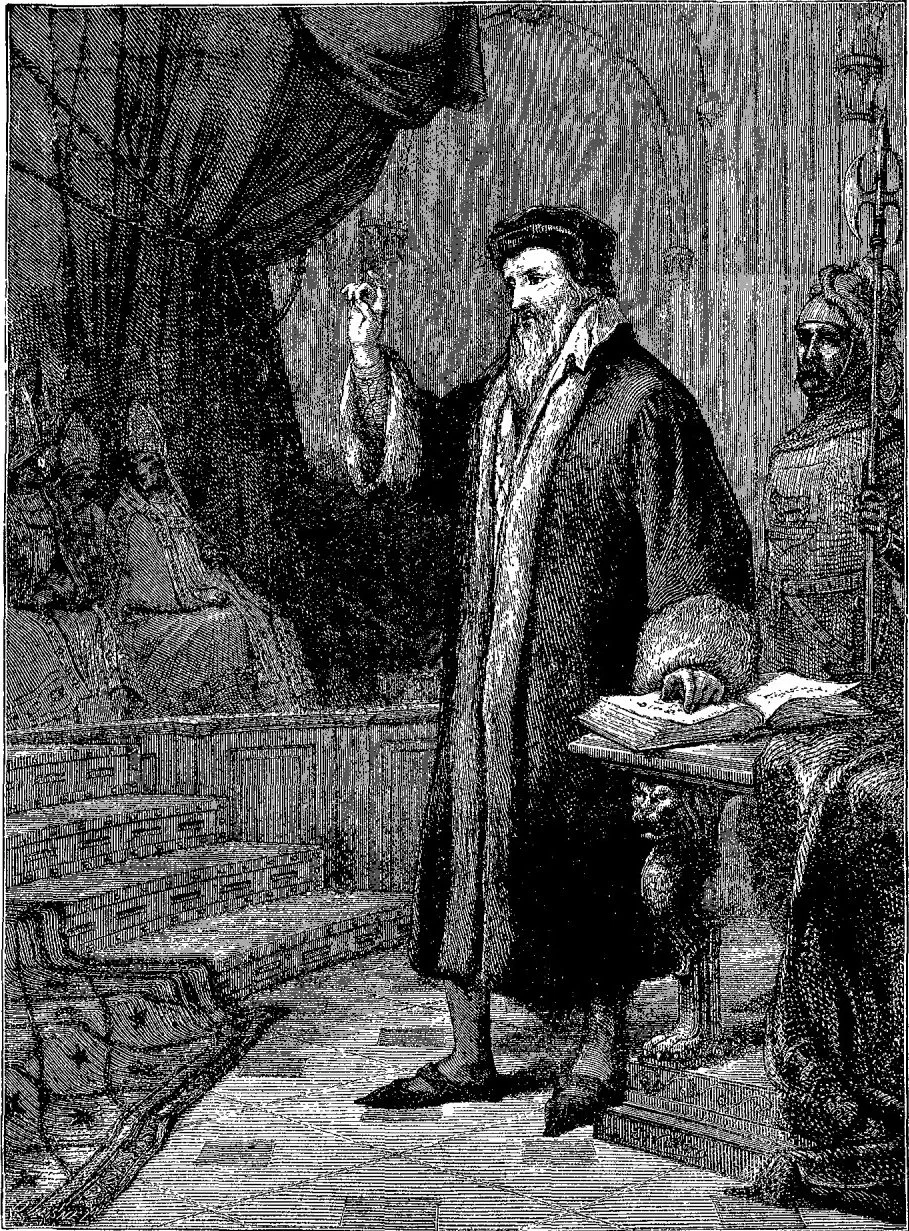
So it was with John Wycliffe, the first of the great reformers of modern times. Our illustration presents him standing before a convocation of Catholic prelates at Oxford. The scene is one characteristic of his whole experience as a reformer. He was never long free from the presence of the champions of popish dogmas and traditions. They opposed him with the word of man in its most exalted form,—the decrees of councils, the traditions of “the fathers,” and the bulls of “infallible” popes; and he replied to them with “Thus saith the Lord.” Sometimes surrounded by friends, but never leaning upon human support, he faced the foes of freedom and divine truth without flinching, and in his work was revealed again the truth of the prophet’s utterance, “All flesh is grass, and all the goodliness thereof is as the flower of the field; the grass withereth, the flower fadeth, . . . but the word of our God shall stand forever.” The life of Wycliffe as a reformer is but a record of the battles of the word of God with religious error in the form of the traditions and commandments of men, and of its triumphs over them. Wycliffe himself well knew that the conflict waged by them was not with him. When some monks came one day to enjoy the sight of the reformer lying ill upon what seemed his death-bed, and to predict to him the speedy downfall of his work, he raised himself upon his couch, and piercing them with his gaze, replied, “With what do you think you are contending? with a feeble old man, tottering upon the brink of the grave? No; but with truth—truth, which is mightier than you, and will one day vanquish you!” The monks withdrew discomfited.
The opposing forces of truth and error are still ranged against each other to-day; for the contest is not yet ended. To-day the same power that opposed Wycliffe stands glorying in its might, trusting even that all the world will yet bow in worship at its feet. It is holding forth the word of the mortal being whom it has pronounced “infallible,” with the commandments and traditions of men, as superseding the precepts of God. Nor does it flatter itself without reason, in human judgment, for all the world is looking upon it in wonder and admiration; all nations are working to confirm its decrees. In particular, that power is the Papacy; but in general, it is any earthly power, papal or Protestant, which clings to the evil principle of trust in the word of man.
The issue is joined to-day for a decisive combat. God’s Word declares, “The seventh day is the Sabbath of the Lord thy God; in it thou shalt not do any work.” On the other hand, the word of man—traditions, church precept, and the civil “law”—declares the first day to be the Sabbath. The first-day sabbath is Rome’s heralded token of the supremacy of her word in spiritual things; and in anticipation of her long-awaited triumph, she says in her heart, “I sit a queen, and am no widow, and shall see no sorrow.”66
Wycliffe Before the Convocation at Oxford.
She is stretching forth her hand to seize again her long-lost supremacy on earth. But in the heavens a mandate has gone forth, “It is time for thee, Lord, to work; for they have made void thy law.”
The dramatic scenes of Wycliffe’s time are to be reënacted. The champions of divine truth are again to stand before kings and rulers; the word of the Infinite is again to be seen towering in divine majesty above the precepts of mortal man. The triumphs of truth in every age culminate here. We have reached the climax of the great controversy. Over the issue of which day is the Sabbath—which of the signs of two opposing spiritual powers is to be given the honor of men—the battle will be fought to its conclusion. On the one hand stands the Sabbath of the Lord, the seventh day,—the sign of the Godhead of Him whose word has creative power; and on the other hand is the man-made sabbath—Sunday—the sign of that opposing power which has set its word above the word of the most High, claiming the right to change the Sabbath from the seventh day to the first. On that side and under that banner will stand all who, whether Catholic or Protestant in name, have given real or apparent assent to this change. In many places this assent is now called for by the civil law; but the word of the Creator upholds a different institution, and demands allegiance to it. Shall we choose Scripture? or tradition?—the word of God? or the word of man? The choice will determine our position in the conflict, and our final destiny.
A “BARRIER” TO THE CHURCH.
When the Saviour was about to be received up into heaven, having finished his mission upon earth, he said to his disciples, “All power is given unto me in heaven and in earth. Go ye therefore and teach all nations . . . all things whatsoever I have commanded you: and lo, I am with you alway, even unto the end of the world.” Matt. 28: 18-20.
Thus the followers of Christ were given the assurance that he would be with them even to the end of the world, having all power in heaven and in earth.
But now, it seems, the Church has met an impassable barrier to her progress. So we are told by Rev. C. N. Donaldson, in the Christian Statesman, of February 1. “What,” he says, “stands as a mountain barrier to the Church’s enlargement is the nation’s rebellion against God.” The Church has irresistible power, but has met an immovable obstacle! The nation must cease its “rebellion”—the barrier must take itself out of the way—before she can advance!
When the Saviour spoke these words of assurance to the little company whom he had led out from Jerusalem, on the day of his ascension, the nation of which they were subjects was the empire of Rome. It was an idolatrous nation, neither knowing nor caring about the God of the Christians. It was in rebellion against him, if ever a nation could be. Yet the gospel spread with marvelous rapidity throughout the empire, and thousands were converted to Christ in a single day. There was no “mountain barrier” to the Church then in “the nation’s rebellion against God.”
What is the trouble to-day? Has the promise of Christ failed? Is the fault with Christ, or with “the Church”? Has the power of the gospel ceased, or has “the Church” separated from Christ until she has lost it?
Christ has a Church to-day, of which he is the head; but his Church is not the church that seeks to an earthly government for power.
Are not the sins of “the Church” the real barrier that stands like a mountain in her path? Isa. 59: 1, 2.
CHRIST'S WILL AS THE CIVIL LAW.
The aim of the proposed "Christian" amendment to the Constitution, is to make the "revealed will" of Jesus Christ our "supreme authority in civil affairs." In other words, it is to make that revealed will the civil law of the land.
What is the revealed will of Jesus Christ? For a complete answer, it would be necessary to cite all that has been divinely revealed to man; for in both the "law and the prophets", which were until John the Baptist, and the writings of the apostles, it was the "Spirit of Christ" that testified the things that were spoken. But in brief, it may be said that the revealed will of Jesus Christ is the gospel of salvation through faith in him. And it is now proposed to make this the civil law of the land!
The revealed will of Christ is, that all persons should be saved from sin. And the gospel is "the power of God unto salvation [from sin] to every one that believeth." The power of God is seen in his work of creation. "He spake, and it was; he commanded, and it stood fast." Through faith in Jesus Christ, by the power of God, we are re-created in him. Being crucified with him, we also live with him—or rather, he lives in us, and while dead to self, we are alive unto God. We yield ourselves to his will, saying Amen to all his word, and by the infinite power of God, which was manifested in the creation of the world and all things in six days, we are put to death with Christ and created new, so that we are without sin. Being thus without sin, we are free from death, and fitted for eternal life with God. This is the "mystery of godliness"—the plan by which God saves men in his kingdom.
All this is the revealed will of Jesus Christ; and it is now seriously proposed to incorporate this into the civil law of this land! Did ever absurdity reach a more appalling height?
"The power of God unto salvation" is not experienced by all, but only by "every one that believeth." It is Christ's revealed will that every person should believe on his name; in other words, he wants all persons to be saved. But belief is a matter of free choice; for we are not automatons, but free moral agents, in order that we may develop character. Now it is proposed to make Christ's revealed will the civil law,—that is, to force all men to believe on him whether they want to or not! A "Christian" scheme, truly!
Christ wills that all men should love one another. "A new commandment I give unto you, that ye love one another." This is to be made the civil law, and men are to be forced to love each other, or punished by the usual legal penalties! This also is very "Christian," as well as reasonable!
Christ wills that all men should keep his Father's commandments. "Blessed are they that do his commandments, that they may have right to the tree of life, and may enter in through the gates into the city." But in a state of sin, men cannot keep God's commandments; "because the carnal mind is enmity against God; for it is not subject to the law of God, neither indeed can be. So then they that are in the flesh cannot please God." But now it is proposed to make Christ's will the civil law; so now that law will say to the sinner, No matter about your inability to do the will of God, you must do it whether you can or not. If you do not, you will be fined or imprisoned, or otherwise punished! How preëminently "Christian" is this!
We read that "without faith it is impossible to please him [God]." As it is the will of Christ that all men should have faith, the civil law (under this "Christian" amendment) will say to all, Have faith, or you will be accounted a criminal. We shall then see people converted by wholesale, no doubt!
Let this amendment be adopted, and an era of bigotry, hypocrisy, strife and persecution will be ushered in, the like of which this country has never witnessed.
The only way in which the revealed will of Christ can be carried into effect is by the power of God, through the operations of the Holy Spirit. And therefore this scheme to make his will the civil law of the land, is one which substitutes man's littleness for God's infinity,—man's weakness for God's strength, man's ignorance for God's wisdom, man's sinfulness for God's righteousness. And this scheme is labelled "Christian"! Verily it is true that "Satan himself is transformed into an angel of light"!
SERVING THE CHURCH.
“THE nation and kingdom that will not serve thee (i. e., the church) shall perish; yea, those nations shall be utterly wasted.” This among other texts of Scripture is quoted in the Christian Statesman, of January 18, by Rev. J. S. Martin, for the purpose of impressing upon the people their responsibility for the proposed “Christian” amendment to the Constitution. It will be understood, of course, what “the church” is,—namely, himself and his associates who are asking and lobbying for this amendment! So at least its advocates seem to think.
But will the nation accept their mere dictum in this matter? When the nation starts out to “serve the church” according to the ideas of those demanding religious legislation, how is the identity of “the church” to be determined? Will preponderance of numbers be the criterion? If so, then the Roman Catholic denomination is “the church.” This the papal church has always affirmed, and is doubtless as ready to receive the humble service of the United States Government to-day, as it was in past centuries to be served by the governments of the Old World.
But the amendment party doubtless do not contemplate giving any such advantage to the Catholic Church. They are thinking only of themselves. They are too short-sighted to discern that such an effort as they are asking of this Government in behalf of “the church” will set all the various denominations—each one of which is preëminently “the church” in its own opinion—against one another, and rekindle the smoldering fires of religious controversy to an appalling extent.
It is very certain that the text of Scripture invoked by the Rev. Mr. Martin does not call upon any government to determine which of the discordant sects is “the church,” or to enact any kind of religious legislation.
MAKING NOMINAL CHRISTIANS.
[Present Truth, London, England.]
A Japanese missionary, discussing the influence of missions in that country, says that the recent war with China has been the occasion of great changes in the general sentiment. Anxious to show that in their idea following the Lord does not in any wise hinder men from fighting and killing their neighbors, the natives professing Christianity distinguished themselves in the field, and the old dislike to “Christianity” has so “broken down that the whole army has been thrown open to Christian influences.”
The missionary hopes that the Educational Department will be influenced to take the same course, in which case he sees a rosy future before Japan.
It would not then be impossible that Christianity might take on the form called political, in which the upper classes would profess it and thus hasten the day when Japan would become nominally a Christian nation.
It is plain that the same danger that is before the churches in professedly Christian nations is before missionaries in these great heathen lands which are coming under Western influences. It is the temptation to make Christians in some easier way than by the preaching of the Cross. The missionaries who first went to these lands had no arm of flesh to rely upon, and in the face of the keenest opposition of the powers that be they proved the higher power of the Cross of Christ. As the primitive church endured the opposition of the Roman world and grew under it, but fell before the friendship of that world, so now in these older mission fields a greater danger confronts the gospel than the hostility of earthly powers.
This growing dependence on political influence for doing a religious work is a sign of the times. It is at the root of the Sunday-law movement and all the religio-political controversies continually agitating churches and legislative bodies. It is a sign of a weakening hold on gospel principles here, as it is in Japan. Indeed, the missionary whom we quote says that the life of the Japanese churches is not seen in large additions, “nor in any special activity in creating a Christian literature.” They “are suffering from the same world-causes that affect church attendance in our own land.” This explains the readiness with which an easier way of making nominal professors is welcomed. It is one of the dreams of the last days that all the world is to be Christianized. The prophet predicted this in the words: “And it shall come to pass in the last days, that the mountain of the Lord’s house shall be established in the top of the mountains, and shall be exalted above the hills; and all nations shall flow unto it. And many people shall go and say, Come ye, and let us go up to the house of the God of Jacob.” Isa. 2:2,3.
The “many people” make fair professions,—they will walk in the Lord’s ways, and beat their swords into ploughshares, and learn war no more. But while the nominal profession is made, and they say one to another, “Come ye and do these things,” we know from the Word that none of them will take the Lord’s way, nor give up swords and spears, however much they may cry peace. The actual practice will be directly contrary to the profession and, as Joel says, the ploughshares will be turned into swords, until the coming of the Lord brings his wrath upon the angry nations.
When it is shown that the warning messages of Revelation 14 are directed against the principles of the Papacy, it is sometimes asked how that can be when these great Eastern nations are professedly non-Christian. Really, the principles of the Papacy are but borrowed from the Oriental religions, and there is a striking similarity in doctrines and practices.
Nominal Christianity fused with pagan philosophy to make the papal religion. Now we see a like movement, by which Christianity is toned down to a mere philosophy, and it is considered a mark of breadth of view to be able to recognize points of contact between Christianity and the Oriental religions. A Sunday law passed in Korea at once leads religious journals to the conclusion that Korea is nearly a Christian country. Thus European Governments are made nominally Christian, and it perhaps not unreasonably supposed that the nations of the East will yet follow in the same way.
But it will be the work of the missionary with Christ’s message to teach that no nominal profession can save from unrighteousness. All the governments may unite to make it easy for the people to be nominal Christians, but only in the preaching of the Cross, with its denial of self and its crucifixion unto the world, will be found the power that actually saves from sin. And the world will always make it as difficult as possible to be this kind of Christian.
HAS GEORGIA RELIGIOUS LIBERTY?
By E. T. Hiscox
[Rev. E. T. Hiscox, D. D., of Mount Vernon, N. Y., in Christian Index, Atlanta, Georgia, Jan. 16, 1896. The Index is the organ of the Baptist denomination in Georgia. Dr. Hiscox is a well known Baptist minister and author.]
Does religious liberty exist in the State of Georgia? Yes; to a certain extent. To a considerable extent. But not fully. This may be a surprising statement to many of the citizens of that most noble and excellent State. Toleration generally prevails, but not universally. For while the Seventh-day Adventists are arrested, fined, and imprisoned for doing secular work on Sunday, the State assumes dictation in matters of conscience and religion, with which questions it has no right to meddle. And while the State makes laws to compel the observance of a Sunday sabbath, and to punish by civil penalties all who do any secular work on that day, it violates its own bill of rights as well as the Constitution of the United States, and the moral sense of the civilized world. And such laws should be universally reprobated. Those who observe Sunday as a day of rest and worship, have a right to be protected by law in the peaceable enjoyment of the day. If the Adventists do disturb them, they are amenable to law as disturbers of the peace. So have the Adventists and Jews the same right to be protected by law in the observance of Saturday as a Sabbath. As the Sabbath is a religious institution, each man is to decide for himself which is his sabbath, a question which the State has no right to determine for any citizen, any more than which church he shall attend, or to what Sunday schools his children shall go.
The persecution of these Adventists by several of the Southern States, notably Tennessee, Arkansas, Maryland, Missouri, and Georgia, is a shame and a disgrace to our so-called Christian civilization. It is persecution for conscience' sake, pure and simple; and would not surprise us did it occur in Russia. All right-minded people must deplore and condemn it, especially Baptists, who recall the hardships of their fathers two and a half centuries ago,—Roger Williams, Obadiah Holmes, John Clark and others in New England and Virginia.
I am not one of the Adventists, nor have I any personal knowledge of them, but my information comes from court records of their trials in those various States, and other authenticated documentary evidence. But who shall suffer for his religion's sake, be he Baptist, Jew, Mohammedan, or pagan, and I burn not, so long as he practices his religion without abridging or disturbing the equal rights of others?
More of these cases have occurred in Tennessee perhaps than in any other State, and but few in Georgia. In Arkansas they have been quite numerous.
Judge Parks, of Tennessee, before whom many cases were brought for trial, while sentencing them to fines and imprisonment, expressed his regret at being compelled by his oath of office to do it, and declared the men good neighbors, most peaceable and worthy citizens, with no fault, except that they were proven to have done some work on Sunday, which they acknowledged, but which the law forbade them to do. Other judges and other records have given like testimony. Their Sunday working consisted in one case of setting out strawberry plants; in another of hoeing in the field; in another of hauling wood for the fire; in another of helping a poor widow without compensation. Nobody was disturbed, and these acts for the most part were away from public notice, and were sought out by the complainants. At the same time no notice was taken of saloons running contrary to law; of rail trains and steam boats running for excursions or ordinary traffic, doing secular work on Sunday; of furnaces and factories operating with thousands of men, violating the State statutes, without question or restraint. All the force of unjust legislation and spiteful informers has been evoked against a harmless and devout people, whose only crime is that they observe Saturday as the Sabbath, according to the higher law, as they understand it, and go quietly about their secular duties on Sunday as we do on Monday.
Dr. Hawthorne said, at Saratoga, in May last, when a resolution condemnatory of this kind of persecution was under discussion before the Baptist Publication Society, if such things should be done in Georgia, they would hear from three hundred thousand Baptists in that State. Well, my dear doctor, just such a thing has been done in Georgia, but they have not yet heard from the three hundred thousand Baptists. Strictly speaking, according to the last year book, Georgia has 367,498 Baptist church members, with 2692 Baptist ministers. Surely enough to make their influence felt against unrighteous legislation, and for the repeal of unjust and oppressive laws. But they have not been heard from on this behalf, perhaps for the want of such a leader as Dr. Hawthorne has shown himself to be in the other fields of reform.
Now this is what happened in the great State of Georgia only about a week before that discussion in Saratoga: On May 15, Mr. J. Q. Allison, a Seventh-day Adventist, was tried before the circuit court at Douglasville, in Douglas county, for “sabbath breaking,” and sentenced to pay costs amounting to $22.05, or in default of payment to serve twelve months in the chain-gang, Judge Janes presiding. The offense for which Mr. Allison was tried and convicted was plowing in the field, the amount of the plowing being “a small garden spot,” as appears from the68testimony before the courts. No one was annoyed or disturbed by the plowing, but the act violated the statute. The State had fixed by statutes a sabbath and attempted to compel its observance by the enforcement of civil penalties.
Now a sabbath is a religious institution and when a State decrees religious institutions, and attempts to compel conformity, it violates and nullifies its own constitution, and the Constitution of the United States, both of which guarantee religious liberty to all the people, and forbid legislation on matters of religion. As to Mr. Allison, the judge pronounced him a worthy and estimable man, with nothing against him, save this charge of plowing on Sunday. The judge, however, told the defendant that he would let him off easy this time, by simply paying the costs; but if he came before him again, he would not fare so well. The costs, or the chain-gang! And further advised him that if he could not obey the laws, he had better move out of the State.
A letter received by a New York journal from a gentleman in Atlanta, Ga., late in June last, stated that a few days previous, he visited one of his brethren “in a loathesome prison, enclosed in an iron cage, with incendiaries, thieves and murderers, awaiting their departure for the chain-gang. He had done some work on Sunday, having observed Saturday as his Sabbath.” The clerk of the court told him he had lived neighbor to this condemned man for years and there was not a better man in the county. The sheriff declared him to be a good man. After prayer together they parted. It is to be noted that in all the other States where these harsh laws exist against the Seventh-day Baptists, the informers against them are almost invariably professing Christians, and not infidels, nor drunkards, nor pagans; quite frequently ministers of the gospel. In one case at least, shame to say, a Baptist minister, who probably never heard of Baptists being persecuted for conscience' sake. They of all others should “remember those in bonds as bound with them.” Of the hundreds of thousands of the Baptist faith in Georgia, there are not a few who occupy high and influential positions in the State. It would be strange if they did not strive to remove this foul stain of religious persecution from the record of so noble a commonwealth.