The Youth’s Instructor, Vol. 38, No. 45.

THE JUDGMENT HOUR

The Youth’s Instructor

Nov 5, 1890

S. D. A. Publishing Association · Battle Creek, Mich. · Nov 5, 1890

THE JUDGMENT HOUR.
It may be when my eyes are sealed in deepest slumber on my bed, that my life-work will be revealed, and my earth-name be read; and heaven will hush to hear my case, as down the columns God shall trace. O, if I sleep, then may I wake to plead, “Forgive, for Jesus’ sake!”
It may be it will come at morn, when tender light breaks in the east. O, will I not behold that dawn, and fly to Christ, my great High-priest? Will not my waiting angel lay a solemn hush upon that day? O, may I not be found remiss in such a solemn hour as this!
It may be it will be at noon, when all the world is full of strife, that Heaven will call my case, and soon be opened there my secret life; and then, ’neath Heaven’s scrutiny, be sealed my final destiny. O what will shield me? May it be Christ’s merits then shall plead for me!
It may be at the close of day when my last record’s borne on high, that up the isle my angel may be watched by many an eager eye, and from the first page to the last, they’ll scan the record of the past, blotted and tear-stained, full of shame. Will Christ confess me, own my name?
O judgment day! ’Tis every day, O judgment hour! ’Tis every hour. The columns will be read the way I live them now. There’ll come no power at that last moment to make white when my name’s called in Heaven’s light. What use to weep? what use to pray? God reads but what the records say.
But if ’tis writ, without, within, beside the failure I have been, that Christ’s my Saviour; through each hour I’ve lived alone by his rich power, Striv’n to fulfill the law transgressed, that all my sins have been confessed, then God will see his Son divine in every humble deed of mine.
What matter, then, if morn or night, so I am hidden, Lord, in thee? ’Twill all be well, ’twill all be right; for he will seal my destiny. When all the record’s done in heaven, then, Lord, shalt say, “Her sin’s forgiven; I claim her mine for now, for aye.” God grant me such a judgment day!
FANNIE BOLTON.
ELEPHANTA CAVES.
ELEPHANTA CAVES.

ROUND THE WORLD.—34.

BOMBAY TO HONG KONG.

At last the time for our sojourn in India is over. The visit had been intensely interesting, but time flies; we are getting anxious to see home again, and feel that we must speed upon our way. So the tenth of April finds us waiting upon the Apollo Bunder for the steam launch which is to take passengers for the steamship Rohilla. After a delay of nearly two hours, she arrived alongside, and all went aboard, while coolies carried on the baggage. The heat was intense, and we longed for the time when we would be away from the shelter of land, and get some of the breeze which we knew must be blowing, by the fluttering of the many flags floating from the halyards of the men-of-war in honor of the arrival of the new governor of Bombay. At last we were off, and oh, it was so delightful! In the cool air, it seemed almost like being in paradise, after the stifling heat we had been subjected to.
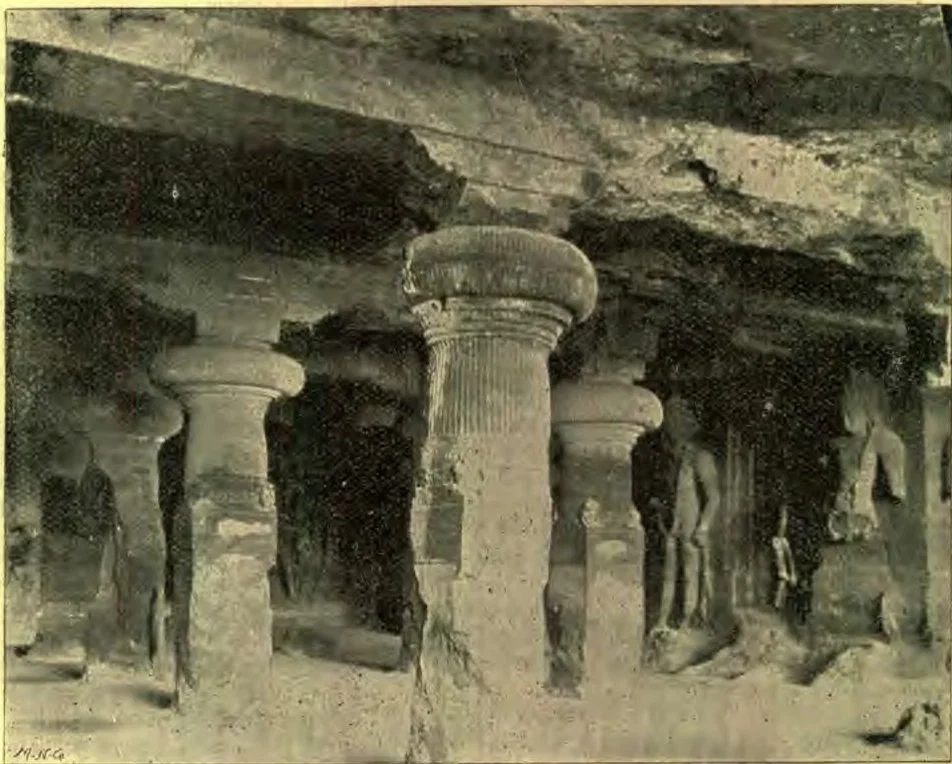
The harbor is nearly landlocked, and its area may be estimated at nearly fifty square miles. It is rendered very picturesque by the islands of Karanga, Butcher’s Island, and Elephanta. On the latter are some famous caves. Like many other rock excavations in India, they were originally used as temples. The island is composed of two long hills, with a narrow valley between them, richly covered with trees and plants. About two hundred yards to the right of the landing-place is a clumsy figure cut out of an insulated black rock, now very much defaced. A stone path, with steps, leads up to the temple, which is nearly half a mile from the landing-place. The entrance is supported by two ponderous figures and two pilasters, forming the openings, under a steep rock overhung by brushwood. The great temple is 133 feet broad, 130½ feet long, and 20 feet high. The roof is supported by ranges of massive pillars, with ornamental capitals of various designs, all hewn out of the solid rock. Opposite the entrance is a gigantic bust, with three heads, supposed to represent the Hindoo trinity. There are numerous other carved figures and shrines, and two smaller temples, one on each side of the larger one.
The period and authors of these extraordinary works are unknown, but there seems no ground for assigning them to a very remote antiquity, as the stone is of a soft and moldering nature, and has sustained great injury even during the short time that it has been known to Europeans. Little streams trickle over the floors, in which huge frogs or toads enjoy an easy life. The Fakirs permit no harm to come to them, for they are sacred; and woe to the European who ventures to expel them from the path with his toe!
As the golden sun is setting, the order, “Up anchor!” sounds from the bridge. The “tale-teller” rings out merrily, and its indicator stops at “Stand by, ahead!” It has also recorded the same in the engine-room, and we know that the engineer on watch is now at his post, one hand grasping the lever by which he can move the great leviathan ahead or astern, at half speed or full, as the order may be; with the other he is ready to “log” the next command and the time; for everything moves like well-ordered clock-work at sea. Soon the ringing is heard again, and this time it is for “Full speed, ahead,” and we are standing out to sea. The shades of night draw on, and the shores of India become dim, and are lost in the gathering darkness.
Of all the companies whose vessels brave the ocean, there is none with a more world-wide reputation, or who send better ships to battle with the elements on the deep, than the Peninsular and Oriental. Their motto, “Quis separabit” (Who shall separate us?), is an appropriate one; for they are like great floating iron links joining the mother of colonies to her children. The uniform of these ships is black, with a white line beneath the gunwale, while their house flag is made up of four triangles, one red, one blue, one yellow, and one white. They are built for safety and comfort. The Rohilla was manned by Lascar sailors. They are natives of India, and their trade is the sea. But they are never intrusted with the positions of greatest importance. An English seaman always stands at the wheel, watching the compass before him, and keeping the vessel’s head on to her course.
We had a pleasant company on board, and the calmness of the water seemed only to be outdone by that of the blue sky above. The weather was very warm, but soft, crisping breezes were blowing, which made it pleasant on the spar deck.
At night the scene was novel; cabins and bunks were deserted, and mattresses and robes were spread out on the weather side of the hurricane deck. Every one seemed anxious to secure a good, breezy place. Some were stowed away behind the wheel-house, where there was a through draft, others aft of the signal guns, and still others forward under the main bridge by the nettings, where they would be sure to get all the wind there was blowing. Sometimes they got too much, and a little salt water mingled with it. But nobody minds salt water on deck, although he does object to it in the state-room, whither it sometimes comes, and sends all one’s clothes and possessions floating about the floor, while polite stewards tender the welcome (?) piece of information that you will have to take a bunk in the saloon for that night. Your things are sure to be destroyed, and you feel very happy generally.
But these were beautiful nights, and every one was happy, delighted at the prospect of a “cool sleep.” It was a treat, after city hotels and stuffy country bungalows, to slumber beneath the star-lit canopy of heaven. There is not the din and rattle of carriages and drays hurrying to and fro in the crowded streets, or the screech of the steam whistle announcing the arrival or departure of trains; nothing but the throb of the great vessel’s heart, the engines, as the cylinders move restlessly up and down, each pulsation giving the propeller another revolution, and driving us farther on our way. In the bows stand a Lascar sailor and a quartermaster, keeping watch for other craft, and every half-hour, when the bell rings, the lusty “Coup deeta Hai” (I am keeping a bright look-out) resounds down decks from fore to aft. The voice has hardly died away upon the breeze, when in deep bass the quartermaster by his side is heard, “The light is shining brightly, sir, and all’s well.” Then back to him from the officer on the bridge floats the answer, “All’s well.” Then all is silent once more, save for the throb of the engine and the rippling of the waters, as the great iron mass speeds on her way through the darkness.
On the evening of the third day, the sailors declare that they smell cinnamon, and that the “Pearl of the Seas,” Ceylon, must be near. We awake in the night to find that the sailors are paying out the cables, and making fast to the buoy. Other lights are shining around us, and we gradually arouse to the fact that we are within the breakwater at Colombo, Ceylon.
We took a run ashore while the Rohilla was discharging cargo, which kept her till noon. The town is situated on a peninsula, surrounded on three sides by the sea, and having a moat with draw-bridges on the land side. The view from the water is exceedingly picturesque. From the beach the land is fringed with cocoanut trees, and the country behind is well wooded. The city looks old and dilapidated. One would think that its founder had taken a bucket of water and spilled it on the ground, and according to what courses the little rivulets had taken in the mud, had laid out the streets; for they run in every direction, without any attempt at order. Colombo has a population of 111,942, but they appear to be a sleepy lot.
Soon we are out to sea again, and steaming across the mouth of the Bay of Bengal for Penang on the west coast of the Malay Peninsula. Only two hours, and we are off again, running down the Malacca Straits to Singapore. This is a large English settlement, and is situated in latitude 1° 17′ north of the equator.
There is a dense growth of tropical vegetation, and the climate is very damp. It was here we had our first glimpse of John Chinaman in his native costume, for of late years the Celestials have flocked in great numbers to Singapore.
The residences of the gentry are very fine, and bespeak comfort and wealth, while the public gardens almost fill the mind’s vision of Eden itself. We passed through forests of huge bamboo, which the Chinese manufacture into almost every conceivable article of furniture.
A fruit known as the durin grows in large quantities at Singapore. It has a delicious flavor, but a most offensive odor, so much so that the legend is afloat that it cannot be eaten unless the one who would relish it first decorates his nose with a clothes-pin, so as to imprison the sense of smell.
After a run of five days more, we reach Hong Kong. The weather held fair till the last morning, when the sea commenced to run high, and, as “Jack” expresses it, the rain came down in lumps. It was a great change after having passed only a few days before directly under the sun, and being for the third time in our life without a shadow at midday. The thermometer fell to about 60°, and all commenced to shiver. Higher and higher rose the huge green seas, many of them breaking over the forecastle, and washing down the decks. Many of the passengers seemed suddenly to awake to the fact that they had not yet paid a tribute to the fish in whose domain they had been trespassing so long, and hastened to the side or below, to render homage, and pay their dues. But the rest of us enjoyed old Neptune’s anger, and paddled about the slippery decks, watching for land.
At last it hove in sight, and we entered the roadstead which forms the Hong Kong harbor. Mountains, enveloped in a thick mist, rose majestically on either side, but so heavy was the fog that the signal staff was hidden.
The Rohilla carried the mails, and so must announce their arrival by firing a cannon. The signal gun was loaded, and made ready, and the captain from the bridge gave the order to fire. In true sailor style, bare feet, and pants tucked up to the knees, the gunner seized his lanyard, and gave a vigorous tug. But the knot holding it to the trigger gave way without igniting the fuse, and more than this, the shock was too great for the gunner’s equilibrium, and over he went, measuring his length on the wet deck, amid a roar of laughter. He however picked himself up bravely, and tried his luck again, this time with good success, as the gun went off with a loud report, sending a cotton projectile just astern of the steam launch which had now come alongside.
The harbor is filled with junks, and sandpans, and Chinamen. It is stated that thousands of the last make their homes on the water, eating, drinking, and sleeping in the little cabins of their boats. Mariners say that if it were not that a big cyclone comes now and then and drowns a few thousand of them, the harbor would be overrun. The sandpans crowd around the Rohilla like a swarm of bees, their crews hooking on their bamboo poles and trying to board. The police launch was ordered to make them sheer off, which it did by running its iron bow’s head onto them; it almost seemed as if some must sink, but they cleared wonderfully quick. By this time we are wharfed, and now it is “Shore once more.” P. T. M.

DEAD AT THE ROOT.

Sarah Bowditch, on leaving school, resolved to be a model daughter and sister. She was the eldest of a large family, and duties pressed upon her on every side. She offered to serve as her father's typewriter for four hours of the day; she undertook to teach music to two of the younger girls, to help Bob prepare for college, to make dresses for the baby, to relieve her mother of the care of the desserts.
She soon found that the whole day was fully occupied. She had been in the habit of reading a chapter in her Bible night and morning, but there was so little time now that by degrees the chapter dwindled to a verse, and was finally forgotten altogether. She had been used to stop in her work several times a day; to be silent for a moment while she lifted her soul to heaven, and strengthened it with a thought of Christ's nearness to her and of his infinite love.
But she now gave up these hurried draughts of the water of life, and her thirsty soul grew weaker and more silent within her.
The world outside was noisy enough in its demands. It seemed to Sarah that her duties were never performed, work as hard as she would. The life died out of her efforts, too, though she could not have told the reason why it was so.
She had begun with a keen delight in being able to help those who were so dear to her. Now the work ground her to the earth; she thought her father exacting, her old mother weak and foolish, Bob impudent, the children and maids intolerably stupid. She herself had grown irritable and peevish. She was conscious that her work was ill done, that she helped nobody by word or deed.
In the garden outside of her window, there stood a tall young sapling which for several years had thrown out its strong green branches, and yielded both shade and fruit.
Sarah observed, one day, that it was beginning to wither. The leaves faded and dropped off; then the branches shriveled and grew brittle. In a month or two the bark upon the trunk began to shrink and crack.
“The tree is dead,” said her father. “It will be of no more use.”
“I could train vines upon it,” she suggested.
“No. The taproot has been cut. It is dead.” He looked at her gravely a moment, and then continued: “When a human being, like a tree, ceases to draw life into himself, he can be no support to others. He may make a fair show, and still stand erect among men. But he is dead. He is of no use in the world.”
Sarah went silently to her own chamber, and kneeling, cried to God. “Is it too late?” she asked. “Is it too late?”—Selected.

FITTING AND BEING FITTED.

A SMALL boy, wearing a coat many sizes too large for him, walked proudly up the street. A whole coat of any description was rare in his experience, and he was evidently delighted with this one.
“Seems to me your coat doesn’t fit you very well, Billy,” said a critical bystander.
“That wasn’t what ’twas made for,” answered Billy, with cheerful unconcern. “I’m expectin’ I’ll grow to fit it, ’stead of havin’ it fit me.”
There was not a little wisdom in Billy’s plan, and many other boys and girls—and older people also—would be far happier and more successful if they would but adopt it. You will find many things in this world that do not exactly suit you; they were not made expressly for that purpose, and the question is, What shall you do about it? There are persons, not a few, who seem to consider themselves the center of the universe around which everything ought to be fitted. All things are right or wrong, as they suit or do not suit their tastes, modes, and wishes. Do you not meet such ones even in the school-room and on the play-ground—those who always find the lessons too long, the rules unjust, the bright days too warm, and the cloudy days too cold? The trouble is that they are trying to make everything fit themselves. By and by, when they go out into the world, there will be just this same trouble with their work that they now find with games and studies. One situation will be too hard, another too confining, a third will not pay enough. They will wander from one place to another, always complaining, never putting any heart into the work, because it is not the kind that “suits” them, and so never achieving success.
Do not begin in that way. Make up your mind to take things as you find them, bravely and cheerily, and try to fit yourself to your surroundings, instead of waiting to be fitted. Is there some one in your home whose peculiarities fret you? Make room for these peculiarities; make a little path for yourself around them; there is no need of constantly running against them. If your work is not what you would have chosen, you can yet choose to do it so well that it will not only be lifted above mere drudgery, but will prove your fitness for a higher place. For that, after all, is the wonderful thing about this “growing to fit”—as soon as you have really learned to fill one place, a wider and better one is almost certain to open to you.
Those who go through life looking for the “streaks of luck,” the cozy places, the surroundings that just suit, are forever disappointed. There is a story of a brave young girl, who pushed her way through so many obstacles that the principal of the school where she graduated declared her “fully entitled to the degree of M. C.—Mistress of Circumstances.” If you would make your life happy, helpful, and successful—make it count for anything to yourself and others—you must not join the ranks of those who are impatiently waiting to be fitted, but of those who patiently and courageously make themselves fit.—The Interior.

UP

The oak-tree's boughs once touched the grass, But every year they grew A little farther from the ground, And nearer to the blue. So live that you each year may be, While time glides swiftly by, A little farther from the earth And nearer to the sky. —Selected.

PLEASANT THOUGHTS.

SOME one has said that “the pleasantest things in the world are pleasant thoughts, and the greatest art in life is to have as many of them as possible.”
One good way for boys and girls to add to their store of pleasant thoughts is to commit to memory beautiful and helpful lines of prose and poetry. It is remarkable how the mind will retain these little scraps, and how they will come, when no effort is made to recall them, at the most opportune times in life.
“I can’t tell,” said a bright young girl, “how often I have been kept from discouragement, and made hopeful and strong to do my daily work, by just those two lines of Longfellow’s:—
“Do thy duty; that is best; Leave unto thy Lord the rest.”
And another, whose life was so care-free that her friends wondered how she had attained such a helpful influence over her young companions, said in explanation, “It is all because of a little rhyme I learned when a child; it keeps coming into my mind upon every occasion:—
“If you’ve anything to say, True and needed, yea or nay, Say it.”
“I put the emphasis upon different words according to the occasion,” she added, “and I find I’ve almost always something ‘true and needed’ to say. I think, too, it keeps me on the watch for bright, helpful thoughts. I hear them in conversation, I find them in books and papers, and every day I add to my store from the Bible.”—Selected.

THE ARAB'S LESSON.

“My son,” said an Arab chieftain, “hasten to the spring, and bring me a basket of water.” The lad hastened, and worked long and diligently to fill the basket, but before he could return to the tent, the water leaked out. At length he saw that the labor was vain, and he returned to his father, and said, “Although I repeatedly filled the basket, the water would not stay.” Then his father took the basket, and said, “My son, what you say is true. The water did not stay, but see how clean and pure is the basket. So it will be with your heart. You may not be able to remember all the precepts you hear, but keep trying to treasure them; they will make your heart pure and fit for heavenly uses.”—Selected.

DOLLY’S LESSON.

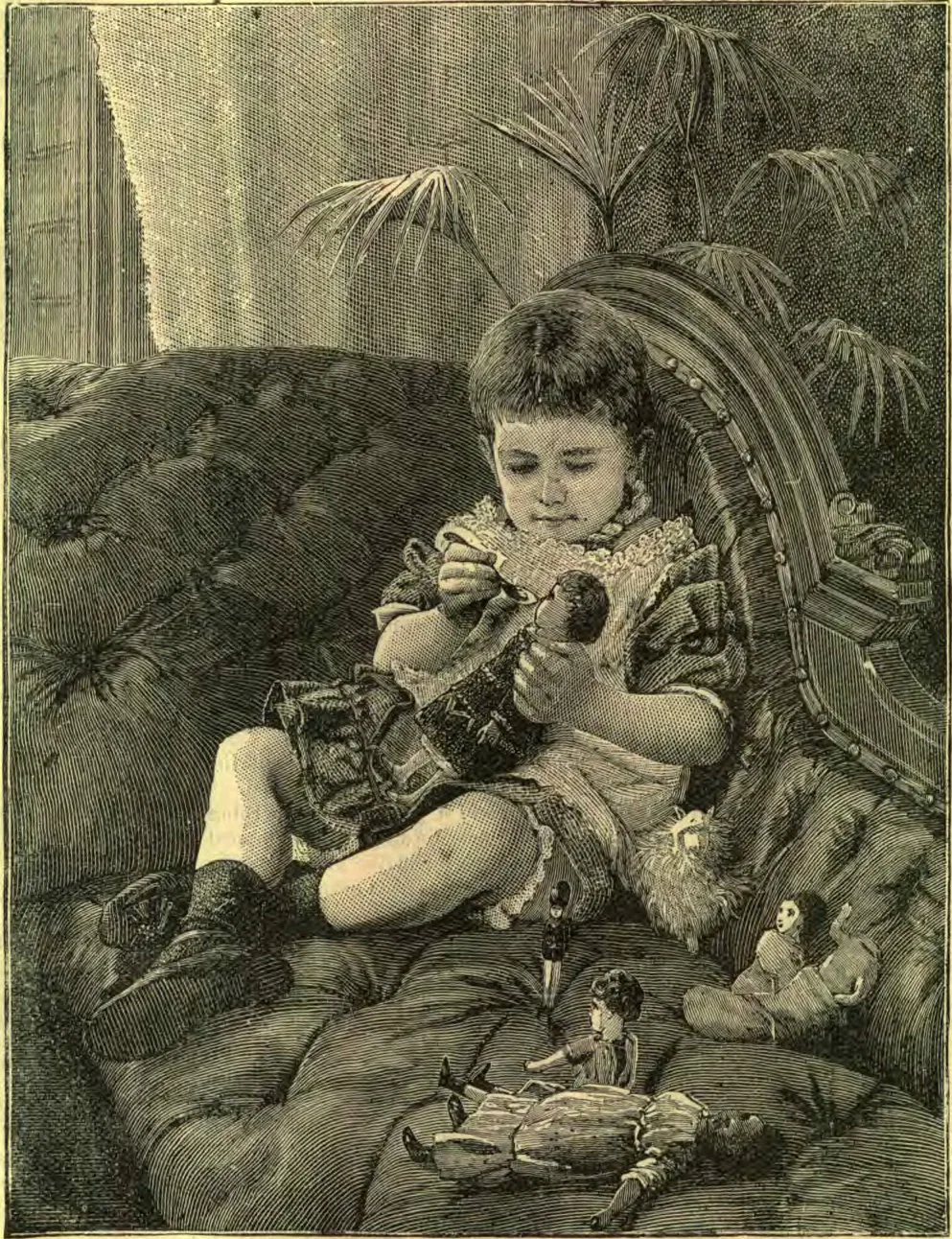
I WANT to teach my dolly— Her ig’rance is absurd, I really hate to ’fess it, But she cannot spell a word.
Tho’ I give her short examples, She never gets them done, For she doesn’t know her tables As far as one times one.
She pays the best of ’tention, And p’r’aps I am too strict, But sakes! she tries my patience When she studies ’rithmetic.
She’s careless ’bout her writin’, She scratches like a hen, And now she’s sprained her thumb so bad, She cannot hold a pen.
She ought to have a lib’ary, But what would be the use To get her books of poetry When she can’t read Mother Goose?
She must have a ed-in-ca-tion, For her mamma’d die of shame If dolly should get lost some day, When she couldn’t spell her name. —Anna M. Pratt.

THE MISSING LEAVES.

“Come, won't you come here, please?”
“What for, mamma?”
“Come and see, my child.”
“Yes, pretty soon.”
That is what Ione's Aunt Orpha heard, as she was working among her plants just outside the door.
Ione and her mamma were visiting at Aunt Orpha's; but mamma had become ill soon after they arrived, and was obliged to lie in bed most of the time for several days.
Aunt Orpha was a florist, and Ione very much enjoyed looking at the plants and flowers, and watching her aunt make bouquets, or making little ones herself, from the flowers she was allowed to have.
Sometimes she was so interested in the flowers that she did not like to leave them when her mamma called; and as her mamma felt too ill to try very hard to have her little girl obey her, Ione was often quite slow about minding.
She had been in her mamma's room that day, with some flowers, and had left some stems and leaves scattered on the table. These annoyed her sick mamma, who called her in order to have her pick them up and leave things looking more tidy.
Ione gathered up most of them, and started away; but her mamma said, “O my child, you haven't them all yet.”
“All but just a few,” replied the little girl; then she picked up a few more, but still left some scattered ones, which Aunt Orpha soon afterward removed.
“My dear,” came a call a little while later, “please come and draw down this window-shade.”
“What for, mamma? The sun doesn't shine in there, does it?”
Now if this small girl had simply wished to know why the shade was to be lowered, she could have inquired after she had done the work; but the fact is, she did not like to leave her play to do even so small a thing.
“My child, why don't you obey better?”
“Why, mamma, I do always obey.”
“But you wait, and ask questions, and act as though you did not like to do what I ask. That spoils the obedience. It is not whole obedience after that.”
But Ione didn't see the harm in such little things; and soon afterward, when the sick mamma asked for a drink, her little girl went for it so slowly that any one could see hers was not more than half-hearted obedience.
Presently Aunt Orpha, having been in her sister's room to see what she could do for her, said to her little niece, who was busy arranging pansies in a dish of wet sand, “Ione, do you want to go with me into the garden?”
“What for?” asked Ione, just because she had said that so many times she did so without thinking what she said; but then she remembered that there were still some late flowers in the garden, and she added, “Oh, yes, I want to go—in a minute.”
When she did go into the garden, she found her aunt holding in one hand a great, handsome dahlia, from which she was pulling the petals.
“O auntie! what makes you do that?” exclaimed Ione.
“Oh, I was waiting for you,” replied Aunt Orpha, handing her the marred flower. “Now would you like some gladiolas?”
“Oh, yes! may I have some?” for Ione delighted in gladiolas; and as her aunt plucked one, the little girl reached for it expectantly, but Aunt Orpha said, “In a minute.”
Then Ione gave a little gasp; for her aunt broke off one of the large, bright petals, before giving her the flower.
“Don't you think those pink ones are pretty, dear?”
Ione did think they were very pretty; but when one after another was handed to her with a part of the petals gone, she would surely have cried if there had been no one near. Soon she said, “Aunt Orpha, I think we have enough now.”
“O, there are not many! Don't you admire these other colors?”
“Yes, but—” and that was all she said; but her aunt proposed, “Suppose we pick a bouquet for your mamma, then. Do you know what she would like?”
“Pansies!” exclaimed Ione, happily. So to the pansy beds they went; but when the first lovely, velvety blossom was robbed of one of its petals, Ione exclaimed, “Oh, no!”
“Why? Don't you think your mamma would like that color?”
“Yes, but—whole ones!”
“Well, this is nearly whole—only one petal gone. If she is fond of whole ones, surely she will be pleased with this. Isn't that a beautiful one yonder?”
“Yes! Just like folks, aren't they, Aunt Orpha—like faces, I mean?”
“So they are. Shall we pick this one?”
“Yes, do—O Aunt Orpha, please don't!” as one of the velvety petals was about to disappear.
“Ione,” her auntie began slowly, “do you know of any other ways these broken flowers are like people?”
There was a moment's silence; then Ione replied, “Yes, ma'am, I think I do.”
“What is it?” Aunt Orpha asked.
Ione hesitated. “The broken flowers are like me when I don't mind quick, I guess.”
“And you do not think you like them so well as the whole ones?” her aunt questioned.
Ione shook her head.
After that, her aunt invited her to help pick the pansies, selecting whichever she liked; and soon a beautiful bouquet was almost ready for her mamma's room.
“Ione, come here, please.”
“What for, mam—” but then she stopped, quite frightened, and hurried to answer her mamma's call.
When she returned, she said shyly to Aunt Orpha, “I came near pulling off another leaf; but I think I won't do so any more.”
Do you know what she meant, my little girl? And do you, my boy?
MRS. ADA D. WELLMAN.

THE GOLDEN-ROD BROTHERS.

Five brothers all dressed in green lived together in a beautiful palace. With them lived their cousins and many dear friends, and they were all the children of the Great King of the palace.
This Great King loved to see his children happy, so he had all his workers, the painters, the weavers, and the spinners, always at work. No one was idle in the palace. The Great King himself was busier than any one, for he planned everything, and no one could do anything until he told them and showed them how.
The ceilings of the palace were made of opals, the floors were covered with the softest of green carpets, and as for the walls, the palace was so large that no one in it, except the Great King and his son, ever saw the walls.
As I said, many people lived in this palace; there were the Butterfly family, the Bird family, the Bee family, Father Sun and his Sunbeam children, Lady Wind, Prof. Rain, and many more than I have time to name.
These five brothers were called the Golden-rod Brothers. Surely they ought to have been happy. All of them were but one. He, I am sorry to say, was always complaining. He knew that some day the King would give all the Golden-rods yellow dresses and golden crowns, but he was not content to wait till the King saw fit. Silly little Golden-rod, he wanted them at once.
Prof. Rain, the Golden-rod’s school-master, was a dear, kind old man, and a fine teacher, and so the Golden-rods thought, all except the discontented one. This little one never learned his lesson, and then he would be cross when Prof. Rain told him to learn it for next day. And when the Sunbeam children came down to play, he moped by himself, and would not play with them.
“No, you shine too hard on me; let me alone,” he would say crossly. So after a little they left him alone, and played with the other brothers.
He did not grow tall and strong like the others, for he never did what he was told. He would not even take his food properly, it never just suited him; so after a while he shriveled up and went to sleep.
His brothers were very sorry, but they had to keep on growing, and at last one day the Great King, who had seen how well they tried to do, thought they deserved their pretty clothes and golden crown which he gives to all who are good and do what they can.
It was a beautiful day, the day of crowning. Father Sun shone brightly as he kissed his sunbeams, and sent them dancing gaily away to waken the inhabitants of the palace for the crowning.
Prof. Rain came gently in the morning to give the brothers a short lesson. How they did wish the other brother had been with them!
Then the Sunbeam fairy children placed the crowns on the Golden-rod brothers, and immediately the birds burst forth into a sweet song. The trees bent their stately heads as Lady Wind passed gently through to kiss the beautiful brothers. Everything seemed happy.
The brothers held a reception all day long. So many dear old friends came to see them, and to say how happy they were to see them crowned.
Their last visitor was a dear little boy who took them to a hospital to a little sick child, a poor, wee girl.
“She cannot come here to see the pretty things; may I take this Golden-rod to her, mamma?” he said, and the mother answered “Yes,” and smiled.
The Great King smiled too, and was pleased. When the sick little girl saw the Golden-rod brothers, she clapped her thin hands, and the Golden-rods nodded and smiled at her, and whispered, “Dear little girl, we are so glad to help make you happy. Our Father, the Great King, gave us these bright robes and these golden crowns. We love him so much, and we are trying more and more to be good and to do what we can. And you will try, too, and you will love him, for he loves us, every one.”
“And he will give me a golden crown, too?”
“Yes, he will crown every one of his loving children.”
Then the child fell asleep, and dreamed that the Great King brought a golden crown, and placed it on her head with his own loving hand, and that the Golden-rod brothers danced about her, and sang—
“He loves us, He loves us, every one.”
—The Kindergarten.
Continue reading: TALE OF KING KRISKROSS