The Youth’s Instructor, Vol. 30, No. 44.

KING CHARLES'S TOWER

The Youth’s Instructor

Nov 1, 1882

S. D. A. Publishing Association · Battle Creek, Mich. · Nov 1, 1882

KING CHARLES'S TOWER.
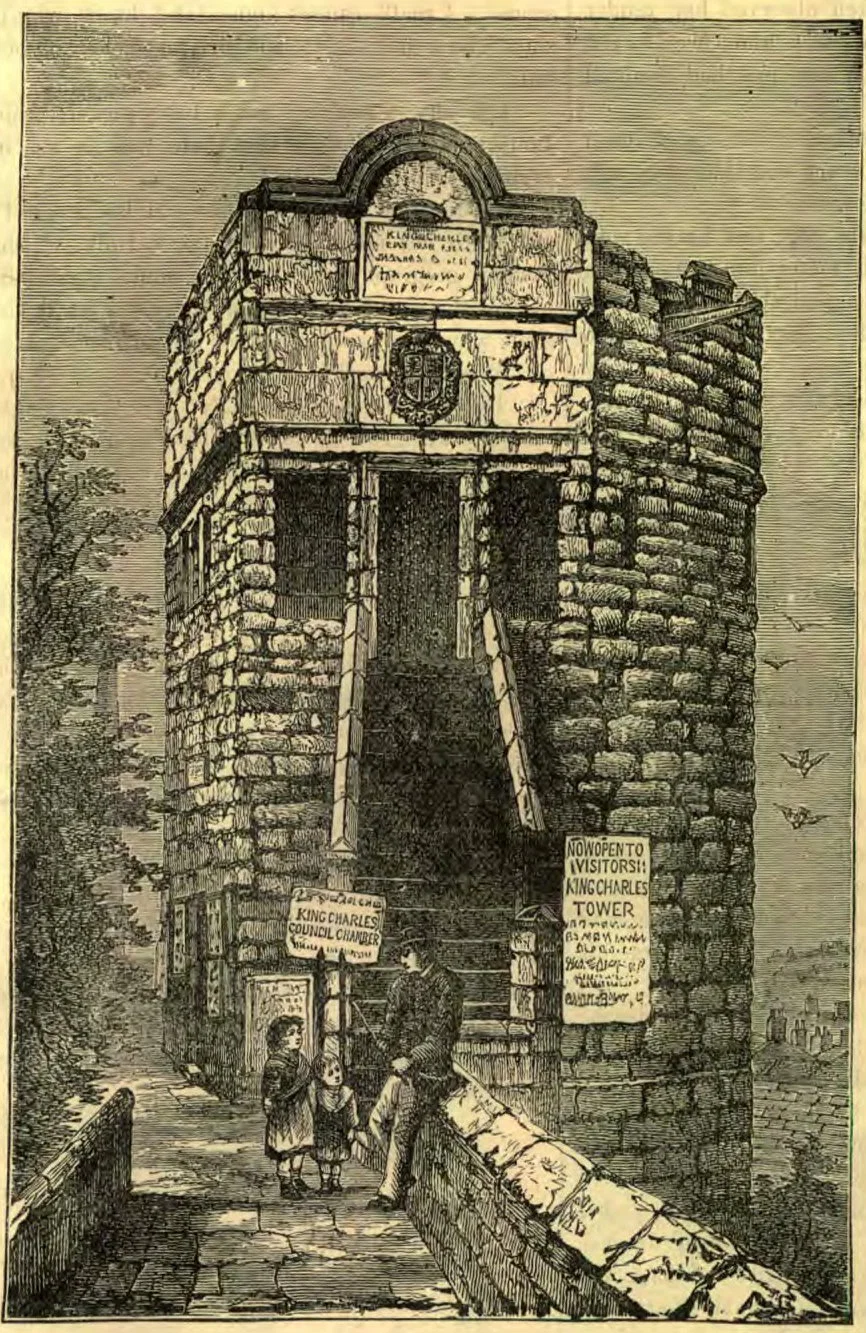
CHESTER is one of the oldest cities of England. It is situated on the River Dee, near where it flows into the Irish Sea, about one hundred sixty miles northwest of London. Built on a high rocky elevation, it is still surrounded by massive walls, erected many hundred years ago. On these walls were built, at regular intervals, round towers, which were once used as watch-towers. The picture shows one of these towers, which bears the name of King Charles I. How it came to be so called may be learned by the following story:—
King Charles reigned over England during the first part of the seventeenth century. Those were very troublous times in England, for the people were becoming tired of having their kings take so much power to themselves and not allow their subjects to have anything to say about the government. But Charles only went right on doing just as the kings had done before him. If he wished to undertake any war, he would do so of his own accord , and then make the people pay the expenses of it. And if any of his subjects displeased him, he would imprison them, or put them to death without allowing them a trial. The people at last became so angry at these and other acts of tyranny that many of them joined an invading army from Scotland, and determined to make the king come to terms. Most of the nobles stood by the king, and raised an army to defend him, and so a civil war began. The king was soon obliged to leave London and seek refuge in such towns as were friendly to his cause. Among these was the city of Chester, and from the tower shown in the picture the king witnessed the defeat of his forces in the plains below. The tower has a lower and an upper room. In the latter the king held a council just before the battle, and so it is still called the Council Chamber. The people of Chester thought so much of their king that they withstood the siege of his enemies until they were so much reduced as to feed on horses, dogs, and cats.
At last the king was so badly beaten that he surrendered himself to the Scots in the hope of securing their favor. But they turned him over to the English, who were by this time so angry at him that though foreign countries, his son, and many of his own countrymen interceded for his life, he was condemned to death and was executed on the scaffold.
With all his faults, King Charles had many good qualities, and was partly excusable for his course in that he only claimed the privileges that his fathers had exercised before him; and Christian charity cannot but condemn the people who went so far as to take his life.
C. H. G.

FRED'S SPELLING LESSON.

FRED MORRIS and his sister Alice were in their cosy sitting-room, learning their lessons for the morrow; and their mother sat at her sewing-table near them.
They were not studying Greek nor Hebrew, but something quite practical and very common,—a spelling lesson. Fred had been very quiet, for him, until suddenly he seemed to give vent to his feelings, as he closed his book with a bang, and shouted out, one syllable at a time, the last word in his lesson, which almost rang through the house. “A-bom-i-na-tion.” Then, turning to his mother, he said, “That is the last word.”
“So I thought,” she replied. “But do you not learn the definitions?”
“I know the meaning of all but that, mother. Will you please be dictionary for me, and save me the trouble of looking it up? I suppose I ought to know what it means, but I don’t exactly.”
“Your sister Alice just had a word in her lesson that I once learned to associate with it, not because it is like it, but on account of the contrast. The other word is ‘delight.’ Solomon uses both words in a verse in Proverbs, and tells their meaning quite plainly. He said, ‘Lying lips are abomination to the Lord, but they that deal truly are his delight.’ To make it still plainer, if you wish, I will consult Mr. Webster. ABOMINATION. ‘An object of hatred and disgust.’ And now that other word, DELIGHT, is spoken of as ‘lively pleasure, happiness, or joy.’”
Fred seemed quite impressed with his mother’s words, and said,—
“I guess some people I know don’t delight the Lord much.”
Little Alice listened attentively. But one would not have said she needed the lesson, for those who knew her, often observed her tender conscience and truthfulness; and even Fred would have resented it, if any one had doubted his sister’s word.
“I hope,” said their mother, “that my children will deal so justly with every one that they will indeed be a delight to the Lord.”
Fred was not a truthful boy, but he did not know that his mother had found him out. Even among his schoolmates, he had the reputation of telling untruths; and, when the reproof came so quietly from his mother’s lips, he wondered how much she knew of his deceitfulness. To be sure, she had often accused him of such things, and shed bitter tears while she told him what she feared; but he thought he had covered it by other falsehoods.
Fred had a handsome face, and he was vain enough to glance at his regular features with some satisfaction when he stood before his mirror; but that night, when he entered his room, he turned from the face reflected there with an expression of sorrow and distress, and, at the same moment putting his hand to his mouth, he muttered, “Abomination.”
He fell asleep, and dreamed that he had committed some dreadful crime and was about to be hung, when some one in authority said:—
“He can have his choice between hanging and another penalty. He can have branded upon his lips this word, ‘Abomination.’”
He hardly knew whether to choose that or death; and he sobbed aloud, while trying to repeat in broken accents that dreadful word.
His mother went to his bedside, roused him from his troubled sleep by imprinting a kiss upon his lips, and, in her tender, motherly way, said:—
“You have been troubled in your sleep, and I know from your words, uttered in your dreams, that you have a troubled conscience. I have understood you better than you thought, my boy; and I have prayed that God, who knows our thoughts even, would lead you to realize your danger. Let us thank God that it is not too late for you to be a ‘delight’ to him. May you learn to deal so justly and speak so truthfully that your lips may never seem to you or others to be branded, as you dreamed they were, with that word, ‘Abomination.’”—Well-Spring.

THE FOUR SUNBEAMS.

FOUR little sunbeams came earthward one day, Shining and dancing on their way, Resolved that their course should be blest. “Let us try,” they all whispered, “some kindness to do, Not seek our own pleasuring all the day through, Then meet in the eve at the west.”
One sunbeam ran in at a low cottage door, And played “hide-and-seek” with a child on the floor, Till baby laughed loud in his glee, And chased in delight his strange playmate so bright, The little hands grasping in vain for the light That ever before them would flee.
One crept to the couch where an invalid lay, And brought him a dream of the sweet summer day, Its bird-song, and beauty, and bloom, Till pain was forgotten, and weary unrest, And in fancy he roamed through the scenes he loved best, Far away from the dim, darkened room.
One stole to the heart of a flower that was sad, And loved and caressed her until she was glad, And lifted her white face again; For love brings content to the lowliest lot, And finds something sweet in the dreariest spot, And lightens all labor and pain.
And one where a little blind girl sat alone Not sharing the mirth of her playfellows, shone On hands that were folded and pale, And kissed the poor eyes that had never known sight, That never would gaze on the beautiful light Till angels had lifted the veil.
At last, when the shadows of evening were falling And the sun, their great father, his children was calling, Four sunbeams passed into the west. All said, “We have found, that in seeking the pleasure Of others, we fill to the full our own measure.” Then softly they sank to their rest.

Myra’s Friend.

“Myra Lambert, I am ashamed of you!” exclaimed Louis.
“Nonsense! Louis Lambert, you are a proud, disagreeable fellow!” cried Myra.
“What does this mean? I never heard you speak so unkindly to each other before,” said Cousin Lily, running into the library and looking with some alarm at the excited faces.
“Oh,” began Louis, “Myra makes friends with such queer people out here. Why, Cousin Lily, I actually saw her kiss that little girl that picks berries for you; besides, she asked her to come to see us when she goes to market in the autumn.”
“Well, Molly is a sweet little girl,” cried Myra. “She picks berries to help her lame mother, you know, and she tries hard to study between-times. When she comes to town, I mean to give her a lunch and some of my story-books. I am sure that mother will be willing.”
“But how would it look to see Myra kiss that girl in our hall? Suppose that some of the school-girls should run in just then?” said Louis.
“I wouldn’t care,” said Myra. “Molly is just as good as any of them. Some day she’ll be a real fine women.”
“I don’t doubt it,” said Cousin Lily warmly. “Myra is right about Molly’s kindness to her mother. She is as busy as a bee, too; she will learn more than many a girl who goes to a fine school. I really cannot understand, Louis, why it should be a disgrace for the girls to see her in your hall.”
“Oh, she is nothing but a berry-picker,” said Louis, who felt, though, that there was no use in arguing with Cousin Lily.
“The question is, How does she pick her berries?”
“With her might,” said Myra warmly. “She studies geography with all her might, too. She sweeps the cottage and makes toast and tea in the same way; she is what mother calls an ‘energetic’ girl at everything.”
“Indeed!” said Cousin Lily. “I don’t doubt that she will grow up to be a fine woman. I see no reason why you should be ashamed of her as a friend. All this reminds me of a story that I read.”
“A real true story?” asked Louis.
“Yes. A lawyer in an English court was pleading with great eloquence for his client; there was scarcely a doubt that he would win the case. The lawyer on the other side was a very haughty man, the son of a nobleman; he called out in an insulting tone to his opponent, ‘Who are you? Why, you were once a poor boy; I remember when you used to black my father’s boots.’
“‘Indeed,’ was the reply.” “Well, what of that? I trust that I blacked them well.”
“Remember,” continued Cousin Lily, “that it is not so important what one does—if the work be a right one—as how one does it. It is what persons are, rather than the outward things that they possess, that makes the true boy or girl, the real man or woman.”—S. S. Visitor.

“THE LORD IS THY KEEPER.”

Toward the close of the summer of 1874, a boy with a Bible was found by a Norwegian schooner on the middle of the North Sea, down toward the English Channel. The boy said that he was sitting on the English coast near his home, reading his Bible, but that he was scorned and annoyed by other boys, on which account he went and placed himself in a boat which lay at the strand. But, on a sudden, his persecutors cut the rope, and the boat drifted out on the sea. He was not able to row against the tide, which was very strong. In addition to this, a dense fog arose. At last, he was so overcome by weariness that he fell asleep. The crew of the Norwegian schooner could hardly wake him; and he was too weary to take hold of the rope which was thrown to him, because he had spent three days and two nights on the open sea. It is remarkable also that the captain, as he says himself, was moved by an unaccountable instinct to steer his ship in the direction in which he discovered the boat with the sleeping boy, since it was out of his proper course.
Does not God hear the prayers of those that confide in him? “I will lay me down in peace, and sleep; for thou, Lord, only makest me dwell in safety.” Ps. 4:8.

SOW BESIDE ALL WATERS.

“Blessed are ye that sow beside all waters.” Isa. 32:20.
Sow thy seed in morning hours, While the dew is yet upon the flowers; Sow thy seed when noontide beams; Still sow thy seed while twilight gleams.
Sow though tears bedim thine eyes, Sow saith the Master from the skies, Sow thy seed, and weary not, None of thy labor shall be forgot.
In the reaping-time the angels will come, To bear thee away to thy heavenly home, Where toil and sorrow will all be o’er, Thou shalt be faint nor weary, nevermore.
Then sow thy seed with a faithful hand, Sow everywhere, ’tis God’s command; Though some may fall on stony ground; Precious fruit will yet be found.
D. E. WALKER.

ONE STEP AT A TIME.

I ONCE stood at the foot of a Swiss mountain which towered up from the foot of the Vispbach Valley to a height of ten thousand feet. It looked like a tremendous pull to the top. But I said to myself, “Oh, it will require but one step at a time!” Before sunset I stood on the summit enjoying the magnificent view of the peaks around me, and right opposite to me flashed the icy crown of the Weisshorn, which Professor Tyndall was the first man to discover, by taking one step at a time.
Every boy who would master a difficult study, every youth who hopes to get on in the world, must keep this motto in mind. When the famous Arago was a school-boy, he got discouraged over mathematics. But one day he found on the waste leaf of the cover of his text book a short letter from D’Alembert to a youth discouraged like himself. The advice which D’Alembert gave was, “Go on, sir, go on.” “That little sentence,” says Arago, “was my best teacher in mathematics.” He did push on steadily until he became the greatest mathematician of his day by mastering one step at a time.

THE SWISS GOOD-NIGHT.

AMONG the lofty mountains and elevated valleys of Switzerland, the Alpine horn has another use besides that of sounding the far-famed Ranz des Vaches, or cow song; and this is of a very solemn and impressive nature. When the sun has set in the valley, and the snowy summits of the mountains gleam with golden light, the herdsman who dwells upon the highest habitable spot takes his horn, and pronounces clearly and loudly through it, as through a speaking trumpet, “Praise the Lord God!” As soon as the sound is heard by the neighboring herdsmen, they issue from their huts, take their Alpine horns, and repeat the same words. This frequently lasts a quarter of an hour, and the call resounds from all the mountains and rocky cliffs around. Silence settles over the scene. All the herdsmen kneel and pray with uncovered heads. Meantime, it has become quite dark. “Goodnight!” at last calls the highest herdsman through his horn. “Goodnight!” again resounds from all the mountains, the horns of the herdsmen and the rocky cliffs. The mountaineers then retire to their dwellings and to rest.

New-Testament History.

Lesson 107.—Jesus Led Forth to Be Crucified.

After scourging him, the soldiers of Pilate took Jesus into the common hall, called Prætorium, and calling together all their band, proceeded to clothe him in a purple robe, putting a reed in his hand, and a crown of thorns on his head. Then they bowed the knee before him mockingly, and said, “Hail, king of the Jews!” Then they spit upon him, and smote him with a reed.
Then Pilate went forth again to the Jews, saying, “Behold, I bring him forth to you, that ye may know that I find no fault in him.” And as Jesus came forth, wearing a crown of thorns and the purple robe, Pilate said, “Behold the man!” But when the chief priests and the officers saw him, they cried out, “Crucify him, crucify him.” Pilate said, “Take ye him and crucify him; for I find no fault in him.” Then said the Jews, “We have a law, and by our law he ought to die, because he made himself the Son of God.”
When Pilate heard that Jesus called himself the Son of God, he was all the more afraid, and taking Jesus again into the Judgment Hall, he said to him, “Whence art thou?” and on receiving no answer, he said, “Speakest thou not unto me? Knowest thou not that I have power to crucify thee, and have power to release thee?” But Jesus replied, saying, “Thou couldest have no power at all against me, except it were given thee from above: therefore he that delivereth me to thee hath the greater sin.”
From that time forward Pilate used his best endeavors to release Jesus; but the Jews insisted on his death, saying, “If thou let this man go, thou art not Cæsar’s friend: whosoever maketh himself a king, speaketh against Cæsar.”
“When Pilate therefore heard that saying, he brought Jesus forth, and sat down on the judgment seat, in a place that is called the Pavement, but in the Hebrew, Gabbatha. And it was the preparation of the Passover, [that is, the preparation day of the Passover week, Friday], and about the sixth hour: and he said unto the Jews, Behold your king! But they cried out, Away with him, away with him, crucify him.”
Pilate then said unto them, “Shall I crucify your king?” Then the chief priests made answer, saying, “We have no king but Cæsar.” Then Pilate delivered Jesus unto them to be crucified.
Then they took Jesus, and when they had mocked him, and replaced the purple robe by his own clothing, they led him forth to crucify him.
So Jesus went forth, bearing the cross on which he was to be crucified; but when they had gone a little way out of the city, they met a man by the name of Simon, and compelled him to bear the cross.
There followed him a great company of people, and many of them bewailed him, especially the women. When Jesus heard it, he said, “Daughters of Jerusalem, weep not for me, but weep for yourselves, and for your children.” He said that the days would come when the childless would be regarded as blessed, and when the people would cry for the mountains and hills to fall on them and to cover them from the majesty of the Son of God, as he should be revealed from heaven.
There were also two malefactors led forth with him to be crucified. And when they had come to a place called Golgotha, which means a place of a skull, they gave him wine to drink, mingled with myrrh; but when he had tasted, he refused to drink it. A learned writer says, “The drink offered was the acid, drugged wine, ordinarily given to those about to be crucified to dull the sense of pain.” Knowing this, our Lord rejected it, choosing to trust in God to sustain him.

Questions.

  1. After scourging Jesus, what did the Roman soldiers proceed to do with him? Matt. 27: 27, 28; Mark 15: 16, 17.
  2. How did they insult him?
  3. When Pilate went forth to the Jews again, what did he say to them? John 19: 4.
  4. What words did he utter as Jesus appeared in the purple robe, and wearing a crown of thorns?
  5. What did the chief priests and the officers cry out as they saw him?
  6. How did Pilate answer them?
  7. How did the Jews try to show the lawfulness of the murderous deed that they were about to perform?
  8. How was Pilate affected when he heard that Jesus called himself the Son of God?
  9. When he had taken Jesus back into the Judgment Hall, what question did he ask him? Verse 9.
  10. What did he say to Jesus about being so indifferent as not to answer him?
  11. What reply did Jesus make?
  12. What course did Pilate take from this time forward?
  13. How did the Jews cause him still to waver in his decision? Verse 12.
  14. What did Pilate do when he heard this saying?
  15. On what day of the week was this?
  16. About what time in the day?
  17. How did Pilate then address the Jews?
  18. How did they show the contempt and malice which they bore toward Jesus?
  19. What question did Pilate then ask them?
  20. What did they say about their king?
  21. What final action did Pilate then take?
  22. What did the Jews then do with Jesus?
  23. In what way did our Lord go forth from the city?
  24. What happened when he had gone a little way?
  25. Who followed him as he went to be crucified?
  26. How did they manifest their sorrow?
  27. How did Jesus address them? Luke 23: 28.
  28. What did he say of the days that were to come?
  29. Who were led forth with him?
  30. To what place did they take him?
  31. What did they offer him there?
  32. What does a learned writer say of this drink?
  33. Why did Jesus reject it?

SCENES IN THE LIFE OF CHRIST.

LESSON 33.—REVIEW.

1. What parables did Jesus give on the last day of his teaching in the temple?
2. What lesson did he teach by the parable of the two sons? Matt. 21:28.
3. Relate the parable of the wicked husbandmen.
4. Did the Jews understand the meaning of this parable?
5. How did they know that it was meant to reprove them?
6. Explain the parable concerning the marriage of the king’s son.
7. How was the case of the hypocrite represented? Matt. 22:11–14.
8. What cunning scheme did the Pharisees invent for the sake of getting Jesus to say something that might be brought against him? Matt. 22; Mark 12; Luke 20.
9. How did he answer their cunning question?
10. Describe the attempt made by the Sadducees.
11. How did Jesus answer their question, and at the same time show that their doctrine was false?
12. What did some of the scribes say about this answer?
13. Describe the last attempt made by the Pharisees to entangle Jesus in his talk.
14. How did Jesus answer the lawyer’s question?
15. How was the answer received?
16. How did Jesus then put the Pharisees to shame? Matt. 22:41–46.
17. What did he say to them about heeding the words of the scribes, who taught the law of Moses?
18. What did he say about following their example?
19. What traits of character did he condemn in them?
20. What fate did he say awaited them?
21. What did Jesus perceive as he sat in the court over against the temple?
22. What did he say of the offering cast in by the poor widow?
23. What encouragement should this give us?
24. What good lesson may we learn from what Jesus said about the pride of the scribes and Pharisees?

THE JOURNEY TO CALVARY.

By this time the news of the condemnation of Jesus had spread through all Jerusalem, striking terror and anguish to thousands of hearts, but bringing a malicious joy to many who had been reproved by the teachings of the Saviour. The priests had been bound by a promise not to molest any of his disciples if Jesus were delivered up to them; so all classes of people flocked to the scene of outrage, and Jerusalem was left almost empty. Nicodemus, and Joseph of Arimathea, had not been summoned to the Sanhedrim council, and their voices had nothing to do with condemning Jesus. They were present at his crucifixion, but were unable to change or modify his terrible sentence.
Jesus had scarcely passed the gate of Pilate’s house when the cross which had been prepared for Barabbas was brought out and laid on his bruised and bleeding shoulders. Crosses were also placed upon the companions of Barabbas, who were to suffer death at the same time with Jesus. The Saviour had borne his burden but a few rods, when from loss of blood and excessive weariness and pain, he fell fainting to the ground. As he lay beneath the heavy burden of the cross, how the heart of the mother of Christ longed to place a supporting hand beneath his wounded head, and bathe that brow that had once been pillowed upon her bosom. But, alas, that mournful privilege was denied her.
When Jesus revived, the cross was again placed upon his shoulders and he was forced forward. He staggered on for a few steps, bearing his heavy load, then fell as one lifeless to the ground. He was at first pronounced to be dead, but finally he again revived. The priests and rulers felt no compassion for their suffering victim; but they saw that it was impossible for him to carry the instrument of torture farther. They were puzzled to find any one who would humiliate himself to bear the cross to the place of execution. The Jews could not do it because of defilement, and their consequent inability to keep the coming passover festival.
While they were considering what to do, Simon, a Cyrenian, coming from an opposite direction, met the crowd, was seized at the instigation of the priests, and compelled to carry the cross of Christ. The sons of Simon were disciples of Jesus, but he himself had never been connected with him. This occasion was a profitable one for him. The cross he was forced to bear became the means of his conversion. His sympathies were deeply stirred in favor of Jesus; and the events of Calvary, and the words uttered by Jesus, caused him to acknowledge that he was the Son of God. Simon ever after felt grateful to God for the singular providence which placed him in a position to receive evidence for himself that Jesus was the world’s Redeemer.
When Jesus was thought to be dying beneath the burden of the cross, many women, who, though not believers in Christ, were touched with pity for his sufferings, broke forth into a mournful wailing. When Jesus revived, he looked upon them with tender compassion. He knew they were not lamenting him because he was a teacher sent from God, but from motives of common humanity. He looked upon the weeping women and said, “Daughters of Jerusalem, weep not for me, but for yourselves, and for your children.”
Jesus did not despise their tears, but the sympathy which they expressed wakened a deeper chord of sympathy in his own heart for them. He forgot his own grief in contemplating the future fate of Jerusalem. Only a short time ago the people had cried out, “His blood be on us and on our children.” How blindly had they invoked the doom they were soon to realize! Many of the very women who were weeping about Jesus, were to perish with their children in the siege of Jerusalem.
A great multitude followed the Saviour to Calvary, many mocking and deriding; but some were weeping and recounting his praise. Those whom he had healed of various infirmities, and those whom he had raised from the dead, declared his marvelous works with earnest voice, and demanded to know what Jesus had done that he should be treated as a malefactor. Only a few days before, they had attended him with joyful hosannas, and the waving of palm-branches, as he rode triumphantly to Jerusalem. But many who had then shouted his praise, because it was popular to do so, now swelled the cry of “Crucify him! Crucify him!” —Spirit of Prophecy.

COLIN'S RABBITS

Written for the INSTRUCTOR.

COLIN'S RABBITS.

Frau Hertz and her two boys, Fritz and Colin, lived on the edge of a vast forest, and not far away from a thrifty little village. Now it was the delight as well as the necessity of the boys of the neighborhood to go with their guns among the deep glades of the wood in search of game; for their parents depended for support on the meat which the boys brought home with them.
So it was with light hearts that Fritz and his little brother Colin, started for the woods one bright October day. Colin carried a large basket, in which was their dinner neatly covered by a clean white napkin and a close-fitting lid. Fritz carried the gun which had many a time furnished the family a famous dinner. To-day they were unusually lucky, and rabbits, quails, and partridges were added to their load, until it was almost as much as Fritz could do to lift it.
After gathering some nuts, they looked some time for the spring where hunters often sat to eat, and when they had found it, and had drunk some of the water, they opened the basket and commenced their dinner. “How good everything tastes!” said Colin. “I don't believe mother ever made such nice biscuit before.” “You think so because you are so hungry,” answered Fritz. “A crust of bread tastes good to one that is really hungry.”
When dinner was over, they went after more game, and before they knew it, the time had come for them to go home. Fritz let Colin take a rabbit and a partridge, and these, together with his big basket, was quite as much as the little fellow could carry; but he trudged along by his big brother, chattering merrily of the days that were coming.
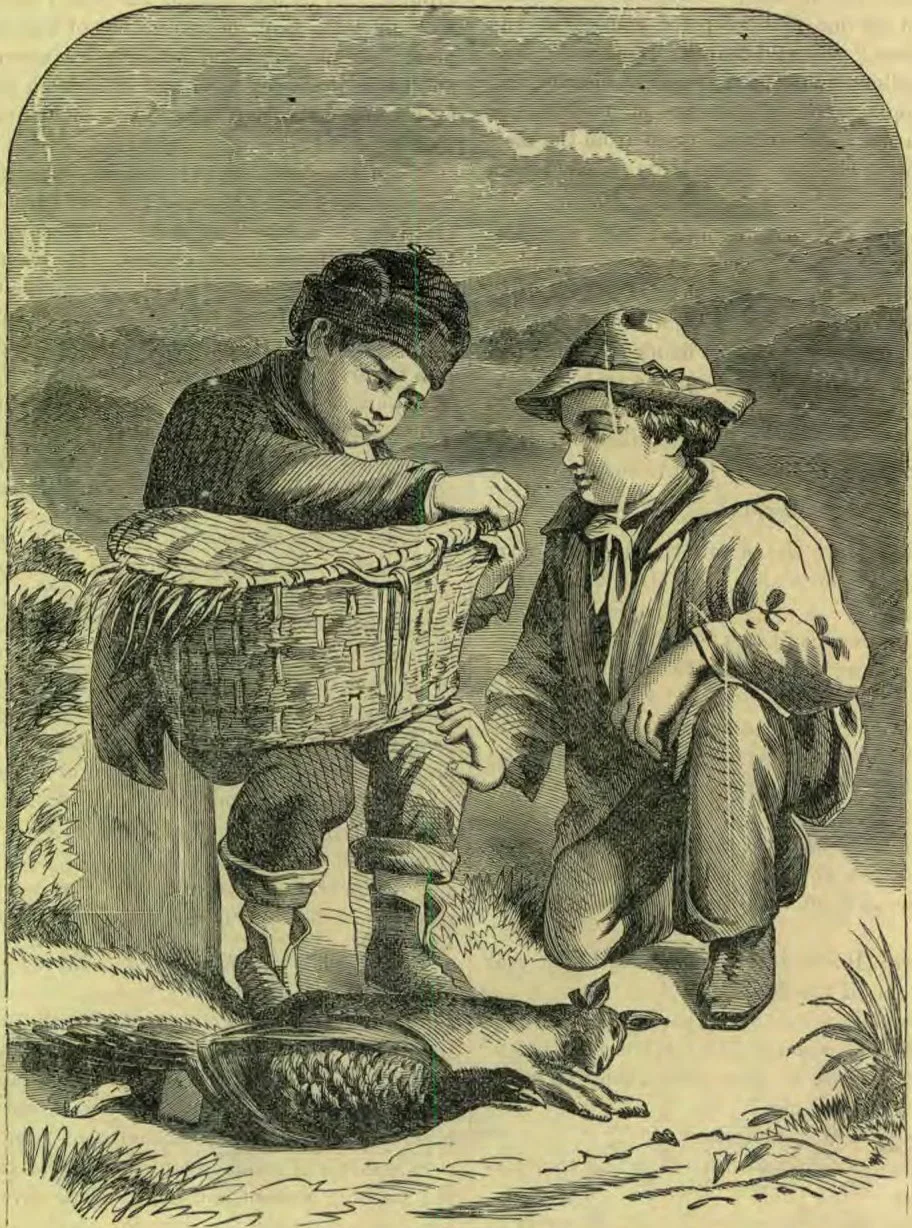
Just as they were leaving the woods, a rabbit ran by, and, strange enough! it did not seem one bit afraid of them, but looked up in their faces gaily as it hopped along. Fritz ran after it, and soon Colin heard his name called. He quickly found his brother, and what else do you suppose he found? Four little baby rabbits. Fritz took them up carefully and with their mother put them in the basket. “Now, Colin,” he said, “you can have them for your own, and if you are kind to them, and feed and care for them well, they will like you, and when they get large, will follow you wherever you go, so that you will not have to keep them shut up.” This pleased Colin very much, and all the way home he kept peeping under the cover of the basket to see his new pets.
When they were almost home they met little Carl Waymann, and Colin stopped to show his treasures, while Fritz went on home. Carl thought he had never seen such pretty rabbits, and the boys were very happy in smoothing the little creatures and calling them pet names. It did not take long for them to make a nice warm nest for the little mother and her babies in the barn, but they were never shut up. They were very tame, and all the children of the village came to see Colin's pets. He had many a happy day with them in the fields, but they never ran away to the woods again. Colin was so good to them, and gave them so much liberty, that Fritz said he guess they liked him better than the woods. M. A. S.

Letter Budget.

John Wakeham writes a letter to the “Budget,” but forgot to tell what State he lived in. He says his folks have taken the INSTRUCTOR for about six years. They have no meetings now that they can go to, because most of the Adventists have moved away from their place. His mother died nine years ago. Johnnie is trying to be a good boy, and asks the INSTRUCTOR family to remember him in their prayers.
May M. Christenson says: “I am, fourteen years old. I have a brother and two sisters. We keep the Sabbath with our father; our mother died when I was four years old. My youngest sister has not been home since, but she keeps the Sabbath, and comes to Sabbath-school. I was baptized last camp-meeting. We live seven miles from where meetings are held, but we go nearly every Sabbath. I am trying to be a good girl.”
Miss Clara J. Bixler, writes from Bellville, Ohio: “I cannot be counted among the little folks any more, but the ‘Letter Budget’ has always been interesting to me, and I would like to write a letter for it, if it would be proper. I have been taking the INSTRUCTOR nearly two years, and am much interested in its teachings and the lessons. I think it the best Sabbath-school paper I have ever read. May it long continue its mission of good! I am not a Sabbath-keeper, but I attend Sabbath-school regularly. We have a nice Sabbath-school and I like all the members very much. Our late superintendent, Wm. Richardson, and family have moved to Tenn. We loved them dearly and now miss them so much, but the Lord saw fit to send them to a new field of labor, where we hope they will be successful in doing much good. May the Lord raise up others in our school to take their places. I want to live so as to meet all the dear friends on the earth made new.”
Amy Darling writes from San Pasqual, Cal.: “We live in a nice valley with mountains all around it. We have a good Sabbath-school. Bro. Spears is our superintendent. We have no church, and so have meetings in the school-house. We are having a nice new school-house built. I like to go to Sabbath-school and am trying to be a good girl so when Jesus comes, he will take me with the rest of the good children to live with him in heaven. We save all our INSTRUCTORS and send them to a gentleman in Africa for the poor children. We sent a package of Sabbath-school cards. I am a little adopted girl ten years old. I never went to school until last winter, and could not write well enough to write this myself. I hope you will print this.”

DO YOU LOVE GOD?

Little child, whose tripping feet Tread the very earth He trod. Underneath the sunshine sweet, Do you love God?
Little child, in heaven above, By the angels he's adored; Yet he stoops to ask your love, Do you love God?
Each new morning, little child, Has he blessings on you poured: See, his arms are opened wide,— Do you love God?
Little child, seek him to-day! Who so worthy as the Lord? Begin this very hour to say, “I do love God!” —Marie Bell.

You have reached the end of this edition.

The Youth’s Instructor · Nov 1, 1882