The Youth’s Instructor, Vol. 2, No. 9

ISAAC AND ISHMAEL

The Youth’s Instructor

Sep 1854

Advent Review and Sabbath Herald Office · Rochester · Sep 1854

ISAAC AND ISHMAEL.

FAR away in Asia, is a country formerly called Canaan, and near to it is another, still known as Arabia. At the part where these two lands join, is a long and wide desert. Only a few trees and shrubs grow in this barren spot. There are no flowing rivers or broad streams of water. In some places a little rivulet slowly moves along in winter, but dries up in summer. The heat of the sun burns up nearly all the grass; yet there are a few places where water and pasturage are found. To these spots the shepherds of Arabia bring large flocks of sheep and goats, which quietly feed around the dark-looking tents.
Nearly four thousand years ago, a good man, named Abram, lived in this part of the world. He was rich, though his riches did not consist in houses and lands, or in gold and jewels, but in sheep and cattle. His house was a tent. This was the best kind of dwelling for him, as he often made long journeys with his flocks from place to place. He could soon take down his tent, and put it up again, as he went about the country.
Abram, or Abraham, as he was afterward called, was not born in Canaan; God brought him from his own land to live there. It was promised to him, that from his family or race the Saviour was to come. This was the great promise of God, and through it the greatest of all blessings was to be given to sinful man. It is said in the New Testament, that Abraham saw, or foresaw, the day of Jesus, and was glad. He was glad there was a Saviour for his own soul, who also would be a Saviour for all those who should believe in him, in every age.
Abraham had two sons; one named Ishmael, and the other Isaac. Though these brothers had the same father, they had not the same mother. Ishmael was the son of Hagar, and Isaac the son of Sarah. As Ishmael was several years older than his little brother, he ought to have been kind to him and set him a good example. But he did not love him, and was full of envy. Ishmael was so full of spite, that he used to mock his brother Isaac. Perhaps he called him ill names, because he knew it had been promised that Isaac should be the father of a great nation.
Abraham was much grieved at the bad conduct of his eldest son, and he sent the wicked boy and his mother away from the tent. We do not know that he would have done so, had not God told him that he would take care of them, and would make this child also the forefather of numerous tribes of people.
It was early in the morning when Ishmael and his mother were sent from the tent of Abraham. A leathern bottle, or rather bag, of water and some bread were given to them. They must have felt very sorry when they left such a good home as they had long enjoyed. The grief of Ishmael must have been the greater, as he knew it was his bad conduct which had led to their being put away.
The outcast mother and her boy went toward the desert. As she was a native of Egypt, she may have thought that she could reach that country and live among her own people. She had not traveled many miles before she came to a wild part of the country. What could she now do? She had lost her way, and went up and down the desert, and could find no one to guide her. In that part of the world there were no roads or paths, and the way was rough and painful, and the heat great. At last they had drunk all the water from the bottle, and they could see no well or river from which they could again fill it. Ishmael was now weary with walking, and faint from thirst and the heat of the sun. He could not go any further. How sad was the state of the poor mother and her boy! In her distress she cried, “Let me not see the death of the child.” So she laid him under a tree or bush, and “sat down over against him, a good way off.” She could not help him, but would not leave him to perish alone. Ishmael must now have known how foolish and wicked his conduct had been. He knew that he had brought himself and his mother into all this affliction, and he must have wished that they were once again in Abraham’s tent. Sin will always bring us into trouble.
As the lad lay weeping and moaning, a voice was heard. Where could it come from? Could she be mistaken in the sound? No; in the stillness of the solitude an angel spoke to her. He had been sent by God to comfort her in her distress. “Fear not,” said he, “for God hath heard the voice of the lad where he is.” And “God opened her eyes,” so that she saw a well not far off from where she sat. With new strength she rose from the ground, and with joy ran with her bottle to the well. Do we not think we see her, as soon as it was filled, hastening to her son, and before she tastes a drop herself, pressing it to his lips? See how she bathes his forehead with some of the cooling water, and as she finds him revive, how gently she raises him in her arms and kisses him.
When they were revived, they again fill their bottle for their journey, and went on their way. From that time “God was with the lad; and he grew and dwelt in the wilderness, and became an archer.”
There is no further account of the early days of Isaac and Ishmael in the Bible. We know that Isaac, under such pious parents as Abraham and Sarah, grew up in the love and fear of God; and we may hope that Ishmael did not forget the holy example and prayers which he had seen and heard when living in the tent of his father. There are two lessons to be learned from this account of the two brothers.
1. God can see us in every place. His eye is as much upon us in a desert, as when we are sitting by our own firesides. When we are brought into trouble by our own folly and sin, we may still pray unto God. Wherever we are, his ear will listen to our prayers, and his hand be ready to afford his gracious help.
2. God is displeased with those children who vex and mock their brothers and sisters. If there be an ill-behaved child in a family, he makes others unhappy besides himself. We should all try to live together in love and peace; and elder children should set a good example to the younger. The way for a family to be happy, is to love God and to be kind to one another.—Sabbath School Visitor.

EVENING HYMN FOR CHILDREN.

Thou from whom we never part, Thou whose love is every where, Thou who seest every heart, Listen to our evening prayer.
Father, fill our souls with love, Love unfailing, full and free; Love no injuries can move, Love that ever rests on Thee.
Heavenly Father! through the night Keep us safe from every ill; Cheerful as the morning light, May we wake to do Thy will.
[Selected.]

THE BIBLE.

The Bible is interesting in consequence of its antiquity. There is a great satisfaction in seeing things that are noted in consequence of their having existed in the days of old. In England the crowns of kings that reigned centuries ago are examined with interest. In this country relics of Indians and of the Puritan fathers are looked upon with delight. These are examples of regard for what existed in former times. The Bible is an ancient work. It is the oldest book. It contains, without doubt, the first writing ever written, and that is the law of the Lord, usually called the ten commandments, which were written by God himself. “I will give thee tables of stone, and a law and commandments which I have written.” Ex. xxiv, 12. That was done about 3300 years ago, and the five first books of the Bible were written by Moses not far from the same time. Other portions were written in the course of a few hundred years afterward. But old as the Scriptures are, to the pious who read them, they appear new. Although they have read them many times, yet as they continue to read, they appear new in that new truths, or clearer views of them are discovered; also new instructions, and new promises, which meet their peculiar circumstances as they progress in the divine life. And as a consequence of all this, they have new joys in searching the treasures of God’s word.
The Bible is the cheapest book. Once, on account of the imperfect state of writing, and probably before printing was invented, one hundred, and one hundred and fifty dollars, were sometimes paid for a copy of it. But now good Bibles cost but one dollar, and thousands pretty well executed, are offered for twenty-five cents a copy. It is almost without price. It is quite so in many instances, owing to the benevolence of the age. Bible Societies are giving them to the poor without pay. And yet, cheap as the Bible is, it is far the most valuable book in the world. He who should pay its weight in gold for it, would make the best of bargains, if he should read it with care and follow its doctrines.
Again, the Bible is remarkable for its simplicity. It may be easily understood. It reveals the character of God, his perfections, and his attributes, the condition of man, the nature of sin, and the method of salvation in so plain a manner that the ignorant, who sincerely inquire for truth, need not fail to understand it. All here, if they are disposed, can readily find the way of life, and by pursuing it, escape eternal death. Such a plain revelation makes it admirable. It distinguishes it as the work of God, and not the work of man. And yet there are things in the Bible “hard to be understood.” Portions of it are mysterious to great minds. There is mystery in the existence of God, the person of Christ, the operations of the Holy Spirit, and the like. But such mysteries do not preclude belief in them, as they are established by suitable and sufficient evidence.
The above are but a few of the many interesting characteristics of the Bible. It is a work that commends itself to the attention of fallen man, for whose particular benefit it was inspired by God, and written by holy men. Let those who are young search its pages as they would search for hidden treasures. Let the middle aged dismiss the world and learn daily of Christ. Let those who are bowed down under the infirmities of years, and whose eyes are dim, get others to read it in their hearing. It is a “word in season” for all. It points to Christ. It leads, if its directions are followed, to heaven.—The Myrtle

THE CROSS.

“But what is the Cross? Is it bars at right angles, Or is it a tree on which Jesus was slain, Or its symbol of Gold, ornamented with spangles, On the neck of yon fair one, attached to a chain?”
Ah! no—’tis the curb of our turbulent passions, A rein on the powers that lead us astray, Which bind down the soul to the world and its fashions, And lure it from wisdom and virtue away.”

Exhortation and Experience.

Dear Children:—I have long had it in my mind to say a few words to you through the Instructor, because I feel a great interest in your present and eternal well-being. I know that every charm that can be brought to captivate the mind, is spread out before this generation, to hold them in bondage, till he that is filthy, will be pronounced to be filthy still.
O could you once realize what it is to have the frown of God upon you, the allurements of the world would soon be disrobed of all their charms.
I have often been thankful that I had passed the season of youth, when the fascinations of earth take the strongest hold of our affections, lest I should have rejected those truths that are so well calculated to wean us from the world, and prepare us to dwell at the right hand of God. But O how precious are the promises to the young. I know of no class of individuals that have so much encouragement as those that early seek to walk in wisdom’s ways. I can truly say I never found the Lord more precious than I did at a very early age. I was only eight years old when the Lord forgave my sins, and yet, every circumstance connected with it, I remember as well as though it had transpired but yesterday. Such was the change that seemed in all nature, that I could hardly persuade myself that the sun was not shining around me. But it was the Sun of Righteousness shining in my heart that produced the change, and removed the fears of the judgment that had hung over my mind for weeks, that kept me from sleeping at night, and from comfort by day. And I have ever found that same Jesus a faithful friend, that has followed me when I have forsaken him. He has been saying, This is the way walk ye in it. When in sickness and near the gates of death, he has been my support and deliverer. O what should I have done in this dark world, through the scenes of sorrow that I have passed, without him.
Let every reader of this little sheet give him their hearts now. Fear not to give your best affections, your warmest love. He never will betray the confidence you repose in him, never leave nor forsake you. In the day of trouble he will not forget you. The last plagues will not reach you. And he will soon gather you into those mansions that he has gone to prepare for all those that love him. O will you not strive against every sin, that you may be spotless when he comes. I want to meet you there. I want, with you, to walk those golden streets and sing the song of victory. L. B. K.
Northfield, Vt.

Disobedience to Parents.

YOUNG man is that your father? How could you make use of language so disrespectful? You don't care! You will talk as you please, no matter who hears you! If we were in want of a clerk, and there was not another young man within ten hundred miles that we could engage, we would not consent to take you. We should be afraid to trust a boy who is disobedient to his parents, who shows so little respect for his father. A youth who was so saucy to his parents we never knew to turn out well. He respects nobody. If your father is in the wrong, and you are certain of it, that is no excuse for such language. No one will respect you for it. Everybody will condemn you. A parent should be treated with respect by his children, no matter how poor he may be, or how large his family may have grown.
There is too little respect paid to parental authority at the present day. It is grievous to go into some families, and hear the language daily used by the children. “I will,” “I won't,” “I don't care,” “It is none of your business; I am old enough to know what is right,” and the like expressions, are painfully common. Large boys, and grown-up girls even, do not hesitate to give their mothers the lie, and break away from their express commands. They will do as they please, and go where they have a mind. We wish such children could only see how they appear in the eyes of their acquaintances, and if they have any shame, it must flush their cheeks.
One thing is certain—an undutiful son and a disobedient daughter cannot long prosper. For a season they may appear well to the eye of a stranger, but their self-will and stubbornness are soon discovered, and they are despised. A child who disobeys his parents will not hesitate to abuse anybody. Neither age nor talents receive respect from him.

THE PROMISE.

One precious promise there is left, Though of all others I'm bereft; That courage plants within my soul, When o'er me life's rough billows roll, And will support and comfort me, Though earthly props and joys all flee, 'Tis, He relieves, when in distress, The widow and the fatherless. A. R. S.

SABBATH-SCHOOL LESSONS.

NUMBER V.

THE LAW OF GOD.

Having proved that the law of God was known to men from the beginning, though not written in the book of Genesis, we now proceed to search for it in Exodus. This book gives us the history of the exode, or going out of the Israelites from Egypt. We read the first fifteen chapters and do not find the law so much as mentioned. In the sixteenth chapter it is spoken of, but not written.
The Lord, having brought his people out of Egypt, now purposes to prove them, whether they will walk in his law, or no. Verse 4. Now, if we observe carefully how he tested them, whether they would walk in his law, we shall learn what some part, at least, of the law is. Take your Bible and read this chapter carefully as far as the 30th verse, and you will see that he proves them to see if they will keep the Sabbath. So we know that the Sabbath commandment was a part of the law of God, and this proving them took place a month before the law was spoken from Mt. Sinai.
They were in a desert place and wanted food to live upon. God gave them bread from heaven; but in giving it, he did not choose to give it in such a way that they need not labor on any day of the week: they must gather it; and they could not lay up a store of manna for a month, a week, or even another day, (except the Sabbath,) and thus be released from daily labor; for it would spoil in one night; but on the sixth day enough might be gathered and kept for the Sabbath. This arrangement gave them opportunity to labor on six days, prepare for the Sabbath, and keep it when it came. Thus he proved them.
Out of all his law, God selected the Sabbath commandment as a test of obedience; and who could choose a better one for that purpose? None could be better calculated to prove their love to him.
Suppose your father, wishing to test your obedience and love to him, should command you not to kill your brother: you would obey him; but who would know that you did so out of love for your father? You love your brother, and yourself too well to disobey that command. But suppose he requires you to leave some business of your own, with which you are highly pleased, in order to serve him. If you do it cheerfully, you know, and your father knows, that you do it to please him.
Thus we see the wisdom of God in choosing the Sabbath to prove his ancient people, before giving them the land of Canaan; and if he proves his people of this last generation by the same test, before giving them the promised inheritance, no one can justly complain that his ways are not equal.
QUESTIONS.—What was proved in your last lesson? In what book is the law not written? Where do we next search for it? How many chapters do we read and not find the law mentioned? In which chapter is it first spoken of? What does the Lord purpose to do concerning his people? If we observe carefully how he tested them, what shall we learn? What does he prove them with? What do we know from this? How long was this before the law was spoken from Sinai? What did the arrangement concerning the manna give them opportunity to do? What part of his law did God select as a test of obedience? What do we see in this choice? If He now uses the same test, who can justly complain?

NUMBER VI.

FROM what has been already seen, we may learn an important fact which we shall do well to remember; and that is, that the Sabbath commandment is the first one revealed in the Bible, as being a part of the law of God.
We now pass on to the twentieth chapter of Exodus. Here we find the law of God. It consists of ten commandments, and ends at the close of the seventeenth verse. God spoke them all to all Israel with his own voice, when he came down upon the top of Mount Sinai in fire, and the smoke thereof ascended as the smoke of a furnace, and the whole mount quaked greatly. See Gen. xix, 16, and onward. And He wrote them in two tables of stone.
These ten precepts are a whole, finished code of laws. That the Lord wished us to understand it so, is evident from the Scriptures. In Deut. iv, 13, Moses says, And he declared unto you his covenant, which he commanded you to perform, even ten commandments; and he wrote them upon two tables of stone. Also in Chap. v, 22, he says, These words the Lord spake unto all your assembly in the mount, out of the midst of the fire, and of the thick darkness, with a great voice: and he added no more; and he wrote them in two tables of stone, and delivered them unto me. These scriptures show that these ten precepts are a whole law; it was perfectly finished; therefore he added no more.
In these commandments are contained all the great principles of God's government. The principles of all moral duties are summed up in them. These principles or rules can be carried out more in detail, as they are in other parts of the Bible, but nothing can be added to them which will make them better. They are right altogether. In the language of inspiration by David, The law of the Lord is perfect. Ps. xix, 7. It is the perfect law of liberty of which the Apostle speaks. James i, 25. The person that is not condemned by it, enjoys the largest liberty; and whoever tells you that you are at liberty to break one of its precepts, knowing what he does, is himself the servant of corruption. 2 Pet. ii, 19; Matt. v, 19.
QUESTIONS.—What fact may be learned from the testimony already examined? In what chapter do we find the law? Of what does it consist? Who spoke them? From what mountain? What did he do besides speaking them? What are these ten precepts? Repeat Deut. iv, 13. Chapter v, 22. What do these scriptures prove? What are contained in the ten commandments? What can be added to them which will improve them? What is the language of inspiration concerning this law? Will you try to keep it?

NUMBER VII.

THE ten commandments are ten rules of action by which it is our duty to live. If all men lived by these rules, all would do right and all would be happy. God has taught us, by these ten laws, that there are ten ways in which we may sin against him. Perhaps you inquire, Are there only ten ways in which we can sin? Yes, there are a great variety of wrong actions, and affections, but there are ten classes or kinds of them.
To explain it, we will take ten classes or kinds of trees; as oak, ash, pine, elm, &c. In each class there are a number of varieties, as white oak, red oak, yellow oak, black oak, &c., white ash, black ash, yellow ash, &c.; some classes having a greater, and some a less number of varieties. Now if you are forbidden to cut down an oak in the forest, you know that all kinds of oak are meant; and so of every class of trees.
To apply this to the law of God, we will take the eighth commandment which says, Thou shalt not steal. This means that we must not take our neighbor's property wrongfully; and there are many ways in which we can do this. If I sell a quantity of wheat by the bushel, and take a measure that I know is a little too small and measure it by that, and my neighbor pays me the money agreed upon, perhaps you would say that I had not stolen his wheat or his money; but have I not violated the great principle of right which God has given to guard our property? Have I not taken that which belongs to my neighbor? We might mention many cases like this, and show a great many ways of breaking this commandment; and also show how the other commandments may be broken in many ways, but enough has been said to give you an idea of much more that might be said, proving that the Psalmist was right when he said, Thy commandment is exceeding broad. Ps. cxix, 96.
We have been talking about trees, and have seen that ten classes may include a great variety of trees; and now we say that one word will express all sorts. That word is, tree. So the law of God forbids every wrong action, and teaches every duty in ten precepts; and these duties may all be expressed in one word, and that is, love. For if we love God with all our hearts, and our neighbor as ourselves, it is evident that we should keep all the commandments. Thus we see the meaning of Paul when he says, Love worketh no ill to his neighbor; therefore love is the fulfilling of the law. Rom. xiii, 10.
QUESTIONS.—What are the ten commandments? What would be the case if all lived by these rules? In how many ways can we sin? Are there only ten wrong actions? How many? What is meant then by ten? To explain this, what is taken? When we say oak, what do we mean? To apply this figure to the law, which commandment is taken? What does it say? Are there more ways than one in which we can take property wrongfully? What can you say of the other commandments? What does the Psalmist say of them? There are many classes of trees, and many varieties in a class, but what word expresses every kind? What word expresses all our duties? If we love God and our neighbor as we ought, what is evident? What says Paul in Rom. xiii, 10?

NUMBER VIII.

LOVE is so abundant in our heavenly Father that an Apostle has said, that “God is love.” 1 John iv, 8, 16. Therefore his law is a law of love, for it must be like him. It comes from the fountain of love, and it requires us to be like God, that is, it requires us to love. Paul says to Timothy, The end of the commandment is charity out of a pure heart. 1 Tim. i, 5. Charity is love. The end or design of all the commandments of God is to teach us to love. Then if we keep them rightly, we shall be full of love; and God will love us. He that dwelleth in love dwelleth in God and God in him. 1 John iv, 16. He that loveth not, knoweth not God. Verse 8. And hereby we do know that we know him, if we keep his commandments. He that saith, I know him, and keepeth not his commandments, is a liar, and the truth is not in him. Chap. ii, 3, 4. For this is the love of God, that we keep his commandments; and his commandments are not grievous. Chap. v, 3.
From scriptures like these we learn three things. 1. That God is full of love. 2. That the design of his law is to teach us to love. 3. That we cannot love as we ought unless we keep it.
We will next consider the objects of our love. Whom ought we to love? It is evident that God, our kind Creator and Preserver—the Giver of every good and perfect gift, should be the first object of our love. In the second place, we should love those whom God has created—our fellow men. Jesus said, Thou shalt love the Lord thy God with all thy heart, and with all thy soul, and with all thy mind. This is the first and great commandment. And the second is like unto it, Thou shalt love thy neighbor as thyself. On these two commandments hang all the law and the prophets. Matt. xxii, 37–40.
All the teaching of the ten commandments is love; but there are two directions in which our love should flow—towards God, and towards men; therefore, the commandments are divided into two classes, and were written on two tables of stone. Of the first class there are four commandments. They teach us to have no gods but the Lord, to make no image to worship, to profane not the name of God, and to remember the day of his rest, to keep it holy. These teach us to love God with all our heart. Of the second class there are six commandments. They teach us to honor our parents, not to kill, not to commit adultery, not to steal, not to bear false witness, and not to covet what belongs to our neighbor. These teach us to love our neighbor as ourself.
Now we cannot love God and our fellow creatures as we ought, and break one of the ten commandments; for it is evident that Jesus, when he spoke of all the law as hanging upon the two directions of our love, meant that not less than ten commandments hang there.
QUESTIONS.—What has an Apostle said? What is God's law? It comes from what? What does it require us to do? What says Paul to Timothy? What is charity? What is the design of all the commandments? What is said in 1 John iv, 16? In verse 8? In chapter ii? In chapter v? Can we love God as we ought and not keep his law? Who should be the first object of our love? The second? What did Jesus say in Matt. xxii? In how many directions should our love flow? Into what are the commandments divided? How were they written? How many are of the first class? What are we taught by these? How many of the second class? What do these teach us? Can we love God and man as we ought and break one of the ten commandments?
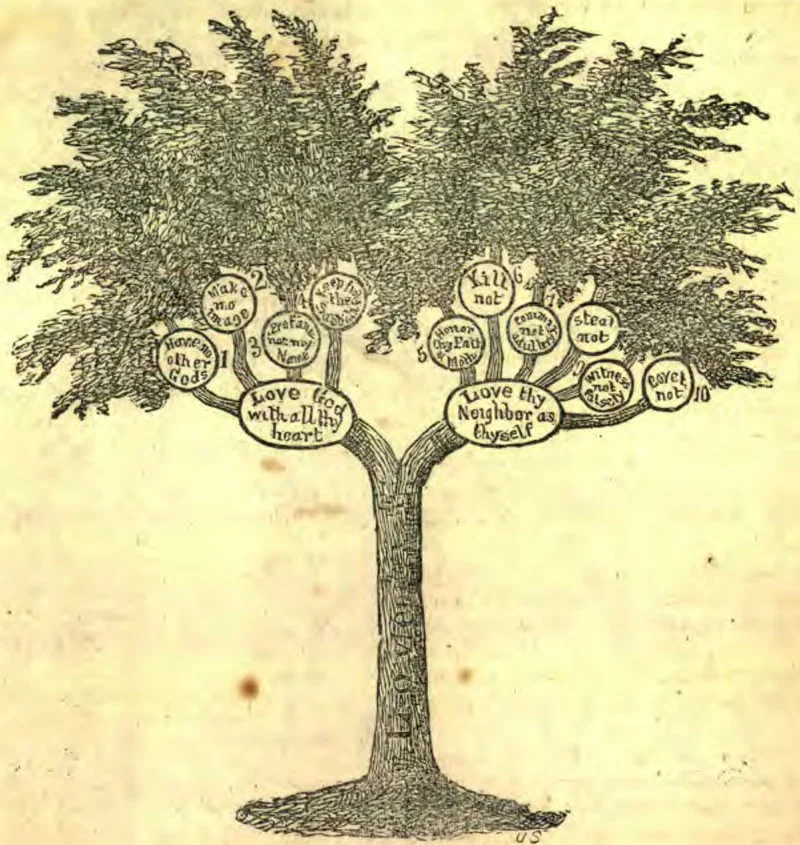
Now let us see what a beautiful tree is produced by obedience to the law of God. The name of the tree is Love; it is deep-rooted in God, the source of love. Its body is straight and its bark is smooth. Towards the top it is divided into two large branches. The name of the first is Love to God; the name of the second is Love to men.
The branch called Love to God parts again into four branches, called, Have no false Gods, Make no image, Profane not God's name, and Keep holy the Creator's Rest-day.
The branch called Love to men bears six principal branches which are named as follows:—Honor parents, Kill not, Commit not adultery, Steal not, Witness not falsely, and Covet not.
Thus there are ten principal branches supported by the two great ones, and the ten branch out again into all the various duties of life. The leaves cover the whole as a robe of righteousness, and the fruit is the fruit of the Spirit, which is love, joy, peace, long-suffering, gentleness, goodness, faith, meekness, temperance: against such there is no law. Gal. v, 22. These and many more of the kind, are the “peaceable fruits of righteousness,” or right doing.
It is said in the Proverbs, that The fruit of the righteous is a tree of life. Prov. xi, 30. The tree which we have been examining is a tree of love. But love fulfills the law; that is, keeps all its precepts, and thus becomes a tree of life; for Christ said, If thou wilt enter into life, keep the commandments. Matt. xix, 17. And again, Blessed are they that do his commandments, that they may have right to the tree of life, and may enter in through the gates into the city. Rev. xxii, 14.
We might describe the tree of Hatred, breaking all the commandments, and bringing forth fruit unto death; [See Rom. vi, 20–33;] but we turn from the disagreeable picture, and say, in the language of an Apostle, We are persuaded better things of you, things that accompany salvation. Heb. vi, 9.
QUESTIONS.—What object is used in this lesson to illustrate obedience? What is its name? How is it divided towards the top? What is the name of the first branch? Of the second? How many branches spring from Love to God? What are they called? How many from Love to men? What are their names? What upholds these ten branches? What grow out of the ten? What is the fruit of this tree? What is said in Proverbs? What is the tree we have been examining? What does love do? What does it become? What does Christ say in Matt. xix, 17? In Rev. xxii, 14? What is the fruit of breaking the commandments? Will you choose life, or death?

THE INSTRUCTOR.

WHEN we commenced the publication of the INSTRUCTOR, we intended to furnish original Sabbath-school Lessons, one for each week in the year. This we did do for several months; but poor health, and other duties obliged us to give them up. We then gave the best Lessons we could select from other works, but found it exceeding difficult to find a series of Lessons suited to the present wants of the youth. We feared the result—that the children would lose their interest in their little paper—that the Sabbath School in some places might be given up; but it was the best we could then do. We have not lost our interest for the religious instruction and salvation of the youth, and feel resolved to do our duty in this department.
Bro. Cottrell has undertaken the work of preparing Sabbath-school Lessons. Four of them were given in No. 8, and five in this No. They are excellent. They contain sound reasoning; and at the same time are simplified and brought to the capacity of children. Their value cannot be estimated. Children from six to ten years old may learn these Lessons, while experienced Bible readers may be instructed by them. There should be an interest by both parents and children to have these Lessons well committed to memory. JAMES WHITE.

Appeal for Subscribers to the Instructor

In order that the INSTRUCTOR be well sustained, we should have 1200 paying subscribers, or should be able to receipt $25 in each No. At present we send out about 900 copies, and our receipts are about one half what they should be. We hope that the friends of the INSTRUCTOR will obtain subscribers. Vol. II is now three-fourths completed, and many have forgotten (perhaps) to pay for it. Our terms are, “In advance or within three months.” If more convenient, send us 8 letter stamps.

RUTH GIBBS

From Ruth Gibbs.

YOUNG FRIENDS:—The signs are almost fulfilled; and soon the Son of man will be revealed in the clouds of heaven, with power and great glory. Oh, what a glorious day to those who will have gained the victory over the beast and his image! This mortal will put on immortality, and we shall be caught up to meet the Saviour, and be prepared to say, “This is our God; we have waited for him, and he will save us.” What a dreadful day to the wicked, crying to the rocks and mountains to fall upon them and hide them from the face of him that sitteth on the throne; for the great day of his wrath is come and who shall be able to stand? Those that have clean hands and pure hearts will be able to stand and none else.
Friends have you made your peace with God? if not, I would warn you to do so before it is too late, while our High Priest is interceding for us, that we might not perish, but have everlasting life. Then let us strive to be found of him without spot or blemish. May we have on the whole armor of God, having the faith of Jesus, is the prayer of your unworthy servant.
“Jesus soon is coming; This is my song— Cheers the heart when joys depart, And foes are pressing strong.”
I want at last to be so happy as to be one of that number that shall stand on mount Zion.

RUTH GIBBS

Hebron, Jefferson, Co., Wis., Aug. 9th, 1854.

COMMUNICATIONS

From M. D. Byington.
My Dear Young Friends:—I am thankful that God has put it into the hearts of his children to publish a paper for the instruction of the youth, to lead their minds away from the vanities and follies of earth, to things that pertain to their eternal salvation.
How true it is that we live in a world of sin, where temptations beset and an evil enemy is lurking about to deceive all he can, and keep them from the narrow way; and how grateful we ought to be to our Heavenly Father for not leaving us to be deceived by him, but for his kindness in letting the light of truth shine upon our path in these last days of peril.
It will be but a “little while and he that shall come will come, and will not tarry,” and we have not a moment to spend in the follies of the world, but every one should be improved in searching our hearts and getting ready for the appearing of Jesus. How important that we live and act in view of the “great day,” always remembering that all we say or do is known to God, and he is displeased with all who fear not to obey him but are careless and indifferent.
Christ now offers salvation to all that will receive it; and when here on earth he blest “little children” and said, Suffer them to come unto me and forbid them not, for of such is the kingdom of heaven, and he will never reject one that will come unto him with all his heart, but has promised him eternal life.
Then let us watch and pray that we may ever have the approbation of God, and have confidence to ask him for all the grace we need to live in this evil day, that when he sends his angels to gather in his elect, we may not be left with the “unholy” to be destroyed, but may be ready to stand before the throne “without spot or wrinkle or any such thing,” and forever enjoy the presence of Jesus, and sing the “song” that will be sung on “mount Zion.”
In hope. Martha D. Byington.

THE SHEPHERD MY GUIDE.

With thy counsel thou shalt guide me, O thou Shepherd of the flock; Safe from every tempest hide me Fixed upon the Living Rock.
Poor and needy, O receive me, Be thy rod my staff and stay; And that blessed portion give me Which no power can take away.

OBITUARY

DEAR CHILDREN:—I thought I would write a few lines concerning the sickness and death of Elizabeth, who has lived with us the last seven years.
She was converted about three and a half years ago, and since that time has tried to live faithful. She seemed willing to leave the vanities of the world, to suffer with the people of God.
After lingering with the consumption five or six months, she died, July 17th, aged 13 years and 4 months.
A few weeks before her death she was perfectly reconciled, and wanted to be taken over to the burying-ground. She was placed on a bed, in a little wagon, and was drawn over to see the place where she was to be buried.
After they returned, she seemed satisfied and said, “The grave-yard never looked so good to me before.” Death lost all its terror to her. Shortly before she died she said, “It seems sweet to die.” She seemed comforted with the thought of soon being raised up from the grave to dwell forever with the saints of God.
ELIAS GOODWIN.
Oswego, N. Y.

Receipts.

J. Wilber, E. Rew, E. Cartright, (for R. A. Mapes.) P. Collins, S. C. Hollis, P. N. Hollis, C. A. Southard, L. N. Savage, M. A. Eaton, G. H. Woodard, R. W. Avery, S. Allen, A. Warden, S. Woodhull, E. H. Wakefield, G. Waters, S. D. Merritt, J. H. Lowrey, L. Green, S. G. Morrill, J. Baker, each $0,25.
E. H. Wakefield, C. Paine, each $0,27. L. Carpenter, J. P. Ayers, a Friend, J. Chamberlain, G. Chamberlain, each $0,50. H. C. Crumb, $2,00.

You have reached the end of this edition.

The Youth’s Instructor · Sep 1854