The Youth’s Instructor, Vol. 49, No. 6.

TEGUCIGALPA TO THE SEA

The Youth’s Instructor

Feb 7, 1901

Review and Herald Publishing Company · Battle Creek, Michigan · Feb 7, 1901

TEGUCIGALPA TO THE SEA
The markets of the capital city are crowded in the early part of the day. Heaps of oranges, plums, pineapples, alligator pears; bread in the form of light rolls, unleavened biscuit, cheese-rolls (resembling doughnuts in form), sweet cakes; candies, sugar in brown cakes (suggesting our own maple product); white Spanish butter and cheese; sweet and Irish potatoes, pumpkins, yucca, rice, beans, and the ever-present tortillas,—all these crowd the quarters. Then come stalls devoted to cloth, red, purple, yellow, and green predominating in the gaudy array. At one stand, pictures of the saints were on sale; at another, native-made shoes, sandals, and belts. Earthenware for the kitchen was the specialty of another. Baskets, rope, and straw hats may be added to the list. All this is only a beginning; for, hidden away under the things seen, are the staples, which need no advertising,—corn in sacks, hides, etc.
Each heap of goods is attended by a woman of dark skin, deep-set eyes, high cheek-bones, and black, shining hair,—not that all look alike, but these are some of the characteristics of this race. There are no more faces that are ugly than would be seen in a like gathering in the United States; neither, it must be confessed, do we see the “beauties” that are popularly credited to the common people of this country. The erect carriage of these women with water-jars on their heads, and unrestrained ankles and waists, is to be admired. Children love the market, and many of them grow up there, their sticky hands and faces attesting to the sweetness of their mothers’ confections.
At the market, too, the soldiers buy their dinners. Pots of soup, beans, and meat are ranged along the outside of the market shed, and their attendants hand out these supplies, at trifling cost, in carefully measured ladlefuls, while the soldiers chat and eat.
A grand old stone bridge connects Tegucigalpa with Comayaguela, a suburb of the capital, though having its own city government.
Travelers have been reminded of Jerusalem by this city among the hills. Its churches are all Catholic, and the feast-days in honor of the saints are the great days of the country. The women attend mass in the early morning; the men gamble, and in the afternoon race ponies on the plain of Comayagua. The drinking of the day continues far into the night, and the strains from guitars and accordions are accompanied with the sound of dancing feet upon the tile floors. The Hondurasian house is well adapted to the dance; for its one large room contains only a few chairs, boxes, and light bed forms, which are easily removed.
The journey from the capital to the coast took us through Comayagua, the ancient capital, a city of ruined churches, and silent, grass-grown streets. The plain of Comayagua has in the past supported a large population; to-day it is a cactus-grown wilderness, shrinking under the rays of a burning sun.
At the crest of the mountain several villages could be seen in the haze of the valley below, and the sandy trails that connected them did not appear long; but once in the valley, with the burning sand underfoot and the scorching sun above, the shambling growth of guavas and cactus on either side seemed unbroken, the distances lengthened, and the leagues traveled that afternoon were the longest of the journey.
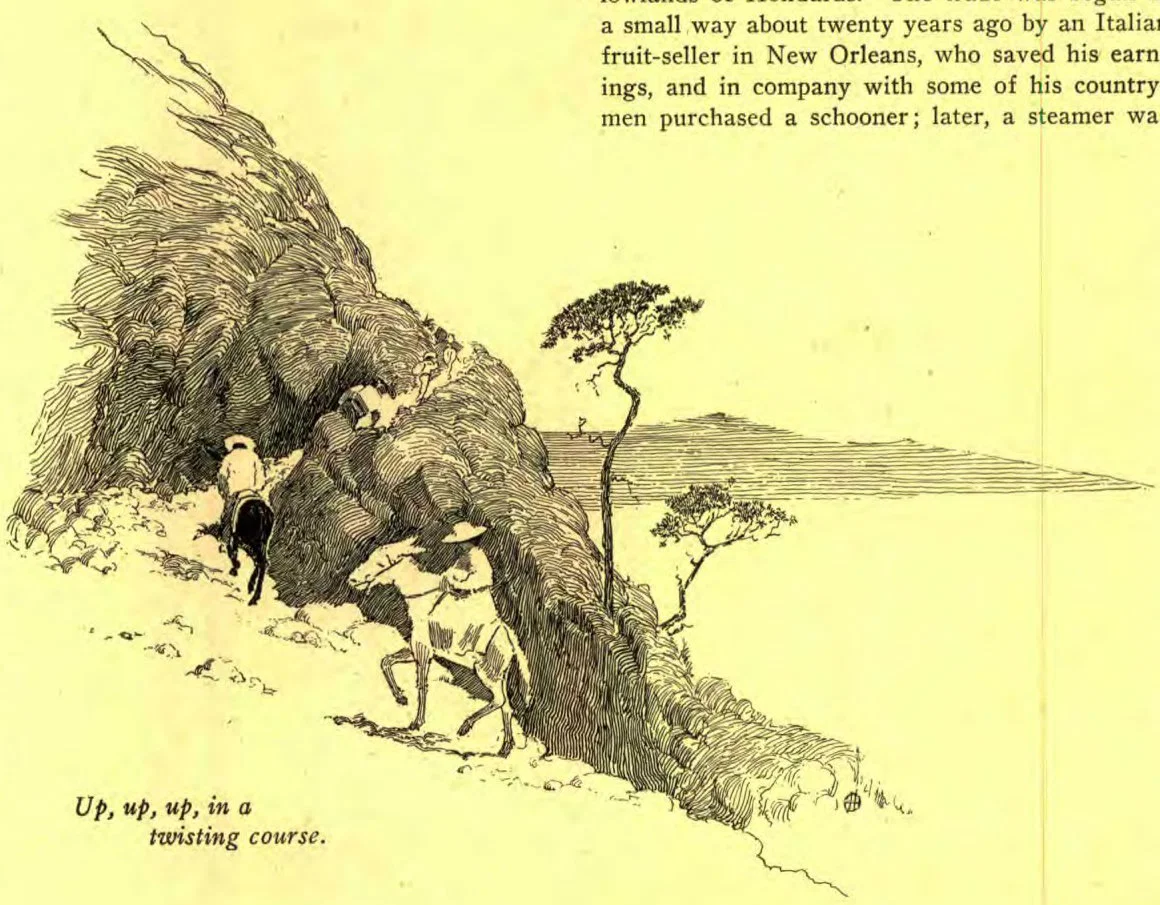
Up, up, up, in a twisting course.
A cross of wood kept upright by a heap of stones, marked the place where the road left the valley, and began the ascent of the mountains again. Some withered pine boughs lay at the foot of the cross,—a token left by pilgrims to the recent feasts at Comayagua.
Up, up, up, in a twisting course, until guavas and cactus gave way to pine and myrrh; then down again, across rivers swollen with the first winter rains, through the village of the Holy Cross and the town of St. Peter to the lowlands of the coast, where the mules waded knee-deep in ooze and tangled roots, and swarms of mosquitoes filled the air with a song in sharps, and parrots without number chatted an idiom of their own; where creeping vines ran riot, beautiful orchids grew from the knot-holes of trees, and every bog was made a special object of nature’s decoration,—this was the way home.
There is a railroad from Pemiento to the sea, a distance of sixty miles. On alternate days an engine of questionable repair, drawing a train of primitive coaches and freight-cars, starts for Puerto Cortez; the following day the return trip is made. The rails of this road have been woefully perverted from the parallel lines in which they were no doubt once laid. Weeds and grass grow in the road-bed, and overhead vine-laden branches sweep the tops of the cars. These things might be dangerous, but the speed of the train seldom reaches twelve miles an hour.
With all its failings the Honduras railroad is a wonderful thing for the country. After spending two years in a land that is two thousand years behind time, one discovers a keen appreciation for the conveniences of modern travel, even if those comforts are comparatively crude.
Quantities of bananas and coconuts are shipped to New Orleans and Mobile from the lowlands of Honduras. The trade was begun in a small way about twenty years ago by an Italian fruit-seller in New Orleans, who saved his earnings, and in company with some of his countrymen purchased a schooner; later, a steamer was put in, and to-day there is a considerable fleet of schooners and steamers in the trade.
The mainland of Honduras, with its Carib, Indian, and Spanish-Indian inhabitants, is practically an untouched field for Protestant missionary effort; but though the grain is scattered, and to the human eye this corner of the world seems to escape notice, the Lord of the harvest will send reapers even there. H. A. OWEN.

Wisdom, Patience, and Conquering Evil

He is a wise man that can avoid evil; he is a patient man that can endure it; but he is a valiant man that can conquer it.— Quarles.

Notes and Comments

Some Kingsley Paradoxes.— It was Charles Kingsley, an English writer of reputation, who wrote the following paradoxes: “Nothing is more anxious than carelessness; and every duty which is bidden to wait returns with seven fresh duties at its back.”
Determining Automobile Speeds.— Regulating the speed of automobiles by law amounts to nothing if the speed can not be exactly ascertained. However, M. Delmarre, a Frenchman, has devised a photographic method of determining the speed of any moving object. The invention consists of “an apparatus provided with a shutter, and an arrangement for obtaining upon the same plate two successive images at the interval of one second,” the displacement of the image enabling one to measure the space passed over by the moving object. With such an apparatus, however, it will be necessary to “operate upon a portion of the path of the automobile which is perpendicular to the axis of the lens;” and again, the lens used must have a fixed focus. But in spite of the difficulties in the way, the instrument is said to bid fair to be of an entirely practical nature.
Excellent Editorial Outfit.— The editor of the Christian Evangelist names the following as a necessary outfit for the editor of a first-class religious journal: “A good education, a good memory, a good library, a good dictionary, a good knowledge of about seven languages, a good encyclopedia of names, a good church directory, a good postal guide, a good pair of scissors, a good stenographer, a good typewriter, seven wise men to decipher crooked marks, a good blue pencil, a good-sized waste-basket, a good companion, a good copy-holder, a good proof-reader, a good pressman, a good stock of patience, and a good subscription list.” An exchange adds to this list “good health, good eyesight, good temper, and a good character,” and declares that “a religious editor needs to be the wisest, best, and sweetest of all the sons of men.” It seems to us, however, that a good Bible and a good concordance should have been included in the list of editorial requisites.
Arrested the King of Belgium.— M. Charron, the French automobile expert, recently gave the king of Belgium an automobile ride in the famous Bois de Boulogne, Paris. While they were speeding along, a French police guard arrested the king for “excessive speed.” M. Charron at once revealing the identity of his royal companion, the guard saluted, and said: “Not so fast, your majesty.”
One Chicago Building’s Mail.— Something of an idea of the enormous amount of business transacted daily within the walls of one of Chicago’s huge skyscrapers may be gleaned from the following statement: “The smallest postal district in the world is under the roof of the Monadnock building at Jackson, Dearborn, and Van Buren streets, in Chicago. The building alone comprises a separate and distinct district in itself. At the same time the volume of business there is the largest of all the sub-stations, or even districts, in the city, save that of the board of trade station. In this immense, seventeen-storied structure, which covers the small ground area of four hundred feet long by seventy feet wide, almost six thousand persons occupy the twelve hundred rooms. The carriers’ schedule in the building provides six deliveries every day except Sunday; and in these six deliveries the carriers distribute, on an average, twenty-five thousand pieces of mail daily in the great office structure.” And remember, this is but one of the many great buildings of the kind found in Chicago.
Trips around the Earth.— It is said that if a man were to walk day and night, without resting, it would take him four hundred and twenty-eight days to travel once around the earth; it would take an express-train forty days; sound, at a medium temperature, would require only thirty-two and one-half hours for the trip; a cannonball, twenty-one and three-fourths hours; light, a little over one tenth of a second; and electricity, passing over a copper wire, a little less than one tenth of a second. According to the statement of the Russian Minister of Railroads, as soon as the new Trans-Siberian Railway is completed (connecting Moscow with Vladivostock, a distance of four thousand seven hundred miles), travelers will be able to journey around the world in thirty-three days, as follows: From New York to Bremen, Germany, by steamer, seven days; Bremen to St. Petersburg, one and one-half days; St. Petersburg to Vladivostock, ten and one-half days; Vladivostock to San Francisco, by steamer, nine and one-half days; San Francisco to Chicago, three and one-half days; Chicago to New York, one day.
To Sweep the Straits of Dover.— In the event of a war between France and Great Britain, the English Channel might be found too narrow a defense for either country; for it appears that “the French government has just mounted a huge Creusot gun at Calais, as a set-off to the enormous harbor works that are in progress for the British Admiralty, at Dover. It is said that the new gun has a range of twenty miles; and as the Straits of Dover at this point are only eighteen miles in width, the gun will, if it proves satisfactory, be able to drop its projectiles upon British soil. The English government has mounted some exceptionally powerful ordnance at Dover within the last few months. Several guns that have been placed upon the forts there have a range varying from fifteen to eighteen miles, so that Dover practically sweeps the Channel at this point. Great activity is at present being displayed all along the southern coast. Modern ordnance is rapidly supplanting the obsolete muzzle-loading weapons, while several new batteries are being constructed.” This does not look as if England and France were carrying out the instructions of the Peace Conference. Augustin J. Bourdeau.

IDLENESS IS SIN

II

In the life-insurance plan given us in the first chapter of second Peter, a work of addition is presented. As in our character-building we add grace to grace, the great Giver will work for us on the plan of multiplication. Grace and peace will be multiplied to us. The young man who is seeking a preparation for usefulness needs to lay the foundation himself, by acquiring, through hard, diligent labor, the means to prosecute his designs. If the young men around him have allowed their parents to carry the burden of their education, let him say, I will never do that. I will, by using my physical and mental powers combined, make of myself all that it is possible.
No man is excusable for being without financial ability. Of many a man it may be said, He is kind, amiable, generous, a good man, and a Christian, but he is not qualified to manage his own business. As far as the proper outlay of money is concerned, he is a mere child. He has not been educated by his parents to understand and practice the principles of self-support. Such a man is not fitted to become a minister or a physician. The churches everywhere are suffering through the neglect of parents to train their children to bear hard, stern responsibilities. Too often the wicked love to do nothing but use the mind takes possession of children and youth. Then the enemy takes control, and makes the mind his workshop, using in his service the ability needed in the family and in the church.
Many are destitute of the stern virtues required to build up the church. They are not capable of devising methods and plans of a healthy, solid character. They are deficient in the qualifications necessary to the prosperity of the church. It is this kind of education that needs to be changed to an education that is sound and sensible, in harmony with Bible principles.
Let your aspirations and your motives be pure. In every business transaction be rigidly honest. However you may be tempted, never deceive nor prevaricate. At times a natural impulse may tempt you to vary from the straightforward path of honesty, but do not yield to this impulse. If in any matter you make a statement as to what you will do, and afterward find that you have favored others to your own loss, do not vary one hair’s breadth from principle. Carry out your agreement. By seeking to change your plans, you would show that you could not be depended on. And if you should draw back in small transactions, you would draw back in larger ones. Under such circumstances, some are tempted to deceive, saying that they were not understood. They did mean what they said, but lost the good impulse, and then wanted to draw back from their agreement, lest it prove a loss to them.
Let the youth set up well-defined landmarks, by which they may be governed in emergencies. When a crisis comes that demands active, well-developed physical powers, and a clear, strong, practical mind; when difficult work is to be done, where every stroke must tell, where perplexities will arise which can be met only by wisdom from on high, then the youth who have learned how to overcome difficulties can respond, to the call for workers, “Here am I; send me.” Let the hearts of young men and women be as clear as crystal. Let not their thoughts be trivial, but sanctified by virtue and holiness. If their thoughts are made pure by the sanctification of the Spirit, their lives will be elevated and ennobled.
I repeat: It should be the fixed purpose of the youth to aim high in all their plans for their life-work. They should adopt for their government in all things the standard which God’s word presents. This is the Christian’s positive duty, and it should be also his positive pleasure. Cultivate respect for yourself because you are Christ’s purchased possession. Success in the formation of right habits, advancement in that which is noble and just, will give you an influence that all will appreciate and value. Live for something besides self. If your motives are pure and unselfish, if you are ever looking for work to do, if you are always on the alert to show kindly attentions and do courteous deeds, you are unconsciously building your own monument. This is the work God calls upon all children and youth to do. Do good, if you would be cherished in the memory of others. Live to be a blessing to all with whom you come in contact, wherever your lot may be cast. Let the children and youth awake to their opportunities. By kindness and love, by self-sacrificing deeds, let them write their names in the hearts of those with whom they associate. MRS. E. G. WHITE.

WHEN THINGS GO WRONG

We all know what that means. There are some days when we go to our work with enthusiasm; when things go smoothly; when we can not only accomplish our allotted task with ease, but even go beyond it, and “make a record.” But then there are other times when we can scarcely get through the day. These are the days when things seem to get into a snarl. Our books are lost, our tools blunted, our fellow workmen perverse, our efforts disappointing. The vision fails, the back aches, the hand trembles, the tongue stumbles, the nerves throb, the brain falters. Everything goes wrong. What shall we do? Shall we go wrong, too? Shall we fret and scold, and let things take their course? Here is a more excellent way.
When things go wrong, slow up. Loosen the tension. Relax the energies for a little while, if possible. Improve the physical surroundings; air the room, or shut out the glare. Quit struggling. Troubles are sometimes like quicksands,—the more one flounders, the deeper he sinks. For the moment, quit striving, and take a long breath, physically as well as spiritually. Then quit worrying. Worry weakens the faculties of the mind as well as the powers of the soul. Yet some people will worry until they warp their judgment and weaken their will power. Yes, by all means, reduce the feverish temperature.
Next, put on a cheerful countenance. Take a cheerful attitude, no matter whether you feel cheerful or not. Whistle, if you can, or sing. The inner attitude of the mind and heart will be largely influenced by the outer attitude or expression. Realize that nothing matters much, neither success nor failure, if one only has the approval of God. So, whether things go right or wrong, be cheerful. This is not hypocrisy; it is Christian consideration for the feelings of others. What right have we to inflict upon others our own vexation? Surely, when things go wrong, we owe it to ourself and to others to be cheerful.
Then call in help. Not human help, but divine. For the world’s help one calls in vain when one is in trouble.
“Laugh, and the world laughs with you; Weep, and you weep alone.”
Retire into the privacy of your own soul, and begin to pray. Perhaps the prayer may be short; it will be none the worse for that. When the soldier is in action, there is no time for long prayer, but there is all the more need for frequent, earnest prayer. This prayer of faith is sure to be heard; so, above all else, pray.
Then is the time to lay hold on the reserve forces. A man’s own powers can avail something after he has laid hold upon God’s omnipotence. Realize the presence of God; realize that God cares; realize that God helps; realize that God commands; and so bring into the struggle all your reserve power.
If things go wrong, then let them go wrong. When God wills it, failure is the highest kind of success.—Rev. William F. Gibbons, in Well Spring.

SURRENDER

Laid on thine altar, O my Lord divine! Accept this gift to-day, for Jesus' sake. I have no jewels to adorn thy shrine, Nor any world-famed sacrifice to make; But here I bring, within my trembling hand, This will of mine,—a thing that seemeth small,— And thou alone, O Lord! canst understand How when I yield thee this, I yield thee all.
Hidden therein thy searching gaze can see Struggles of passion, visions of delight; All that I have, or am, or fain would be; Deep loves, fond hopes, and longings infinite; It hath been wet with tears and dimmed with sighs, Clenched in my grasp till beauty it hath none; Now from thy footstool, where it, vanquished, lies, The prayer ascendeth: May thy will be done!
Take it, O Father! ere my courage fail, And merge it so in thine own will, that e'en If in some desperate hour my cries prevail, And thou give back my gift, it may have been So changed, so purified, so fair have grown, So one with thee, so filled with peace divine, I may not know or feel it as mine own, But, gaining back my will, may find it thine.
— Selected.

FINE ARTS AND MUSIC AT THE EXPOSITION

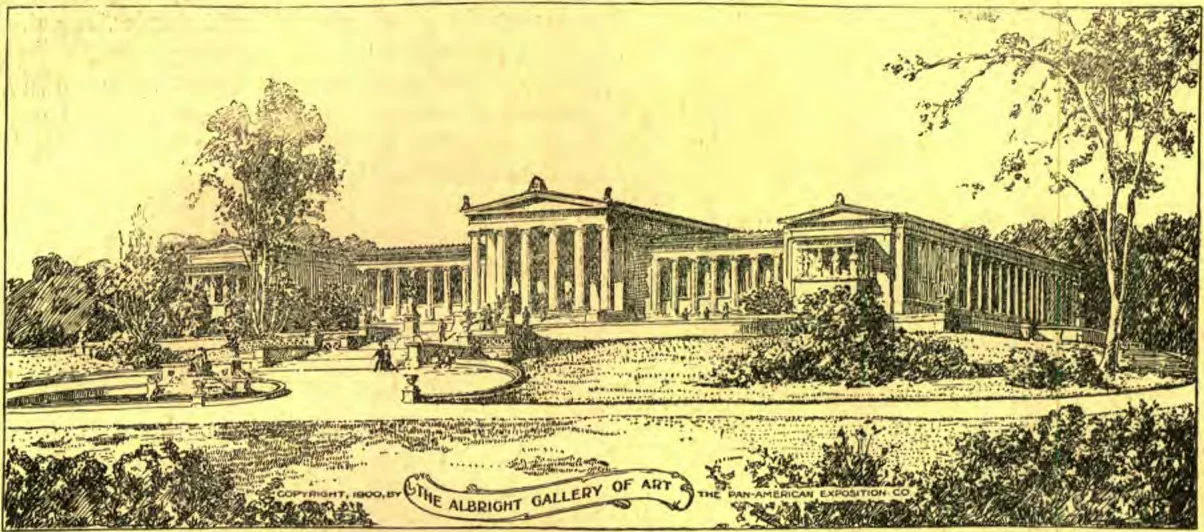
ON the artistic side the Pan-American Exposition promises to be a notable success. The statuary will not be confined to the fine arts exhibit within the walls of the Albright Gallery, interesting though that will be, but will be used in the adornment of the Court of Fountains, the Triumphal Bridge, the Esplanade, the Plaza, the Electric Tower, entrances to buildings, and in many other ways.
In a Pan-American Exposition it is appropriate, of course, that the purpose of the exhibit of the fine arts should be to show what has been achieved in this field of human effort upon the American continent. The exhibit will therefore be confined to the works of painters and sculptors of this continent, and collections owned by residents of Pan-America.
The Albright Gallery, which is to be the art palace of the Exposition, will afterward become the permanent home of the Buffalo Fine Arts Academy.
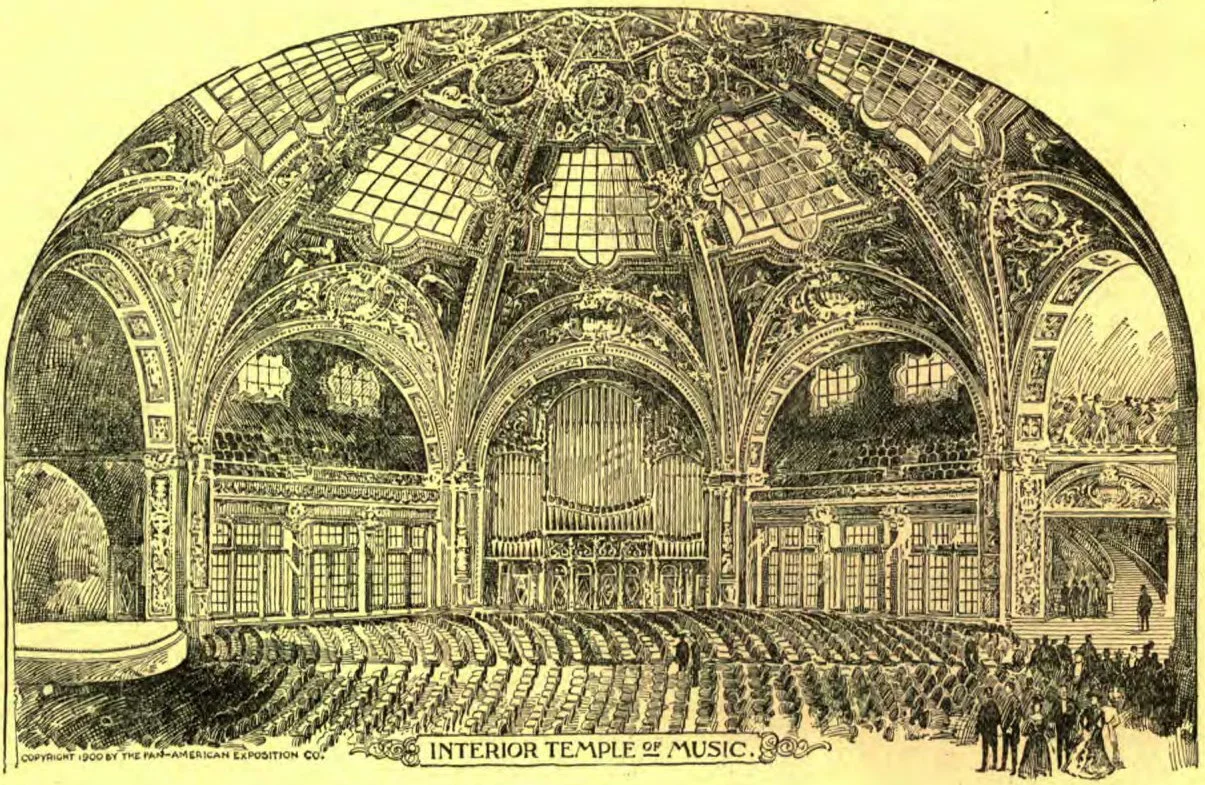
One of the chief architectural features at the Pan-American Exposition will be the Temple of Music. Music-lovers will naturally wend their way to this building very soon after arrival upon the grounds, and will always find some entertainment in progress, which will appeal to their love of musical art. It is octagonal in form, with pavilions at the corners. The interior of the temple will be particularly fine in its sculptural and color decorations. A dome whose crown is one hundred and thirty-six feet above grade, and whose interior is brilliant with golden tints and other rich hues, gives an imposing finish to the structure. The great auditorium will seat over twelve hundred persons, and with the balconies, over two thousand persons can be accommodated. The interior decorations will represent different musical subjects.

WHAT IS LIFE?

WHAT do I think of life? you ask. Then I would answer this: Life is a sea all full of pearls; Life is a wild abyss.
Life is a sea all full of pearls, Calm as the blue above, To mariners who anchor cast Deep in the sea of love.
Life is a wild abyss to those Who, though the day is bright, Wander at will till hope is lost, Lost in the storm and night.
What do you choose in life, my friend? Woe may be yours, or bliss. Life is a sea all full of pearls; Life is a wild abyss.
B. F. M. Sours.
INTERIOR TEMPLE OF MUSIC.

Things Become Beautiful When They Speak to Imagination

THINGS are pretty, graceful, rich, elegant, handsome, but, until they speak to the imagination, not yet beautiful.—Emerson.

BOOKS WORTH READING

THE popular mind resembles a current of electricity, which invariably goes in the direction of the least resistance. The enthusiastic mass of humanity that shouted “Halleluiah!” as Jesus made his triumphal entry into Jerusalem, was largely represented in the howling mob that shrieked, the following day, the horrible cry, ‘Crucify him! Crucify him!’ In a similar manner there is something that possesses humanity to worship an object, idea, or person to-day, and spurn the same to-morrow. This accounts, in part, for the marvelous popularity that certain books have recently attained. One book written within the last few years is supposed to have had a sale of six million copies; and yet no one has any idea that it will be even thought of in five years from now. When a book acquires such a notoriety, the idea often suggests itself to us that we are not “up with the times” if we do not forthwith purchase the same, read it, and thus become able to pass an opinion on it. This is a great mistake. The books that have left a lasting impression upon the race, and those of a similar character that are being written to-day, are the books we should literally digest, rather than chase after those that will endure only for a season.
It is taken for granted that the reader has already chosen the Bible as his dearest literary companion; but one need not infer that because the Bible is the book of all books, God has not, in his wise purpose, allowed other books to be printed from which we may secure much that is helpful, elevating, and inspiring.
Those who are interested in animals and animal life will read with absorbing interest and profit Mr. Thompson’s recent work, “Wild Animals I Have Known.” Those who are not interested in animals, unless their minds have become entirely calloused, will have such an awakening upon this subject by reading this excellent book that they will never regret the investment. Solomon advised a certain class of persons to go to the ant, and learn of its ways, and be wise; but Mr. Thompson has considered the ways of many other animals, and as the result has certainly received wisdom far above that of most living men.
Reasonable mature minds that already possess some elementary knowledge of natural phenomena will read with profit and pleasure three recently published volumes by Professor Elisha Gray, entitled, “Nature’s Miracles.” The author, one of the leading scientists of the day, has in these volumes pointed out in a reasonably simple and proper style, the fundamental principles underlying the phenomena in earth, water, sound, heat, light, explosives, and electricity.
One of the books recently issued by our own publishing houses, entitled, “Christ’s Object Lessons,” should be read if for no other reason than to secure the chapter on the talents. The young man or woman who carefully peruses this chapter can not but be better prepared for the active duties of daily life.
David Paulson, M. D.

THE LARGEST TURTLES

THE boy who lives in the Eastern States would perhaps say that the largest he had ever seen was the snapping-turtle, three feet long, and the boy from Louisiana might reply that in the Red River there is a much larger kind, known as the “alligator terrapin,” sometimes nearly five feet in length, and weighing one hundred and fifty pounds. This seems pretty large, and it is large beside the little pond-turtles that are so familiar to us from their habit of crawling out on sticks and stones to bask in the sun; but the sea-turtles are very much larger, the green turtle—the kind that is used for making the famous turtle soup—frequently reaching a weight of from one hundred and fifty to two hundred and fifty pounds; while its big-headed relative, well named the “loggerhead,” sometimes turns the scales at three hundred and fifty pounds, and now and then some giant is taken of nearly twice that weight. The largest of all sea-turtles now living is the trunk- or leather-turtle, which weighs from three hundred to one thousand pounds, and measures as much as six or seven feet in length, and seven or eight feet across the outstretched fore-flippers. The name of “leather-turtle” is given to this species because the “shell,” which bears five keels, or ridges, is not made of solid bone, but is a mosaic work of many irregular pieces embedded in a tough, leathery skin. Every summer a few of these big fellows are caught on our coast, between Norfolk and Newport, having come northward in the warm waters of the Gulf Stream. The flesh is said to be poisonous; so this great turtle is not so valuable as the others, which are used for food, or as the hawkbill, another sea-turtle found in tropical waters, whose shell furnishes the tortoise-shell used for making the fine combs worn by our great-grandmothers, and nowadays made into pretty ornaments by skilled Japanese workmen.
The most valuable turtle for its size is probably the diamond-back terrapin of the marshes along our Eastern coast to the south of New York; for this is considered such a delicacy that it brings from one to three dollars apiece, and it is an extra large terrapin whose shell is over eight inches long.
The largest of living land-turtles, or tortoises, come—or came, for they are almost eaten out of existence—from the Galapagos Islands off the coast of Ecuador. The shells of these turtles are three, four, even five feet long, and their owners are as many hundred pounds in weight. One of these tortoises is so strong that it can readily walk off with a full-grown man on its back; and they were once so numerous that whaling-vessels were accustomed to visit the island for the purpose of laying in a supply of them for food. It has been estimated that in this way no fewer than ten million tortoises were taken. Very similar tortoises are found on the island of Aldabra, and were once found on Mauritius and Bourbon; but on those two islands they were long ago all eaten up.
Tortoises grow very slowly, but they seem to keep on growing as long as they live, so the size of a tortoise tells us something of its age. One taken to Sydney in 1853 weighed fifty-three pounds, while at the time of its death, in 1896, it had increased to three hundred and sixty-eight pounds; so that the animal was probably from fifty to sixty years old. But fossils from northern India show that in ages gone by, tortoises grew even larger and stronger than this, and it has been imagined that legends of these giant turtles may possibly have given rise to the Hindu belief that the world rested on the back of an elephant, which in turn stood on the back of a great turtle,—but what the turtle stood on they didn’t know.
The king of all turtles, however, alive or dead,—Archelon is his name,—swam in the seas that once rolled over the State of Kansas. The head alone of this monster was larger than a big snapping-turtle,—that is to say, it was three feet long, and correspondingly broad,—while as nearly as we can estimate, the entire animal was twelve or fourteen feet long. Associated with this turtle were hosts of great marine reptiles and powerful fishes with teeth like spikes; and when these creatures were all hunting for a dinner, there must have been troublous times for the little fishes in those old Kansas seas!—F. A. Lucas, in St. Nicholas.

AFTERWARD

MANY the spots where thistles grow, But about them stretches the smooth, green sward; There are paths between them, and afterward The wayfarer over the narrow track, Upon his yesterday looking back, May see but the wild-flowers, row on row.
Many the sorrows of earthly days, But the blessings outnumber them o'er and o'er. Out of each grief there's a waiting door; And God, the tender leader and guide, Ever walks by the mourner's side In the path that leads to the open ways. — Mary F. Butts.

SKATING

This art, or amusement, can not be traced back with certainty to its origin; but it is believed to have originated in Scandinavia and Germany, in which countries it is still a common means of travel. Only one style of skating is there employed,—the “running,” or “fen,”—going straight ahead at great speed over the ice.
In Holland, Denmark, and North America, hundreds of persons engaged in winter traffic travel to and fro over the ice in this way. One would imagine that in Russia, with its cold and prolonged winters, skating would be a national amusement; but it is just the contrary, because it is seldom that any smooth ice is found, the current of the rivers being too rapid.
The first skating club was formed in London in 1830, and still remains the leading skating society of England. It controls a pond in Regent’s Park, and permits only “figure” skating. Its membership is limited to one hundred and seventy. “Rinks” of frozen water under sheds became common in this country soon after the close of the Rebellion, and the “roller” skate was introduced in New York City in 1869.
W. S. CHAPMAN.

THE WINTER PALACE

A WINTER palace was built last night, And glows like flame in the morn’s clear light. The lane of Lombardy poplars tall Has been transformed to a splendid hall, Where the sunbeams play In a wondrous way On a million mirrors ranged in line, And each reflecting the sparkle and shine From pillar of crystal and cornice of spar; Flashing backward and forward, both near and far, From ceiling and wall Adown the long hall, Till the eyes go blind with the sheen of it all.
The room for dining is gorgeous, too, And guests are fed the season through; It lies where sparrows, in saucy glee, Pluck scarlet hips from the bare rose-tree, Or the sweet seeds sown In the hard, brown cone Under the pine-trees, tall and straight, With boughs bent down ’neath a dazzling weight. It joins the bedrooms, where, rosy and sweet, All the fair flower-children of winter sleep In jewel-decked bed, With frosty lace spread, And cover of down tucked in snug at the head.
The winter palace’s great room of state, The apple orchard was of late; But crystal columns from roof to floor, And carpet sprinkled with jewels o’er, And the ivory white, And the sun-gold bright, All adorn this truly royal home For proud King Winter’s glittering throne.
With scepter of diamonds, and slippers of pearls, And a gemmed crown snatched from the North Wind’s curls, He rules for a time, ’Mid sparkle and shine, And then departs to some frostier clime.
MINNIE ROSILLA STEVENS.

A STRING OF PEARLS

JUST seven pearls upon a string, Pearls from a mountainside, I bring.
The string that holds them, that is mine; The gems all dropped from lips divine.
Blessed the poor, and they that mourn; Blessed the meek, who wrong have borne;
Who thirst and hunger, God will bless If hungering after righteousness.
The merciful and pure in heart In blessedness have royal part.
Thrice blessed they who make strife cease, And all their lives are making peace.
If they do please you, boys and girls, Then wear each day this string of pearls.
Each one is a beatitude, And He deserves your gratitude
Who dropped them on a mountainside, And for you on a mountain died.
— Selected.
Continue reading: CONSIDER THE LILIES