The Youth’s Instructor, Vol. 38, No. 7.

THE FISHERMEN'S SONG

The Youth’s Instructor

Feb 12, 1890

S. D. A. Publishing Association · Battle Creek, Mich. · Feb 12, 1890

THE FISHERMEN'S SONG.
HURRAH! the seaward breezes Sweep down the bay again; Heave up, my lads, the anchor! Run up the sail again! Leave to the lumber landsmen The rail-car and the steed; The stars of heaven shall guide us, The breath of heaven shall speed.
From the hill-top looks the steeple, And the light-house from the sand; And the scattered pines are waving Their farewell from the land. One glance, my lads, behind us, For the homes we leave one sigh, Ere we take the change and chances Of the ocean and the sky.
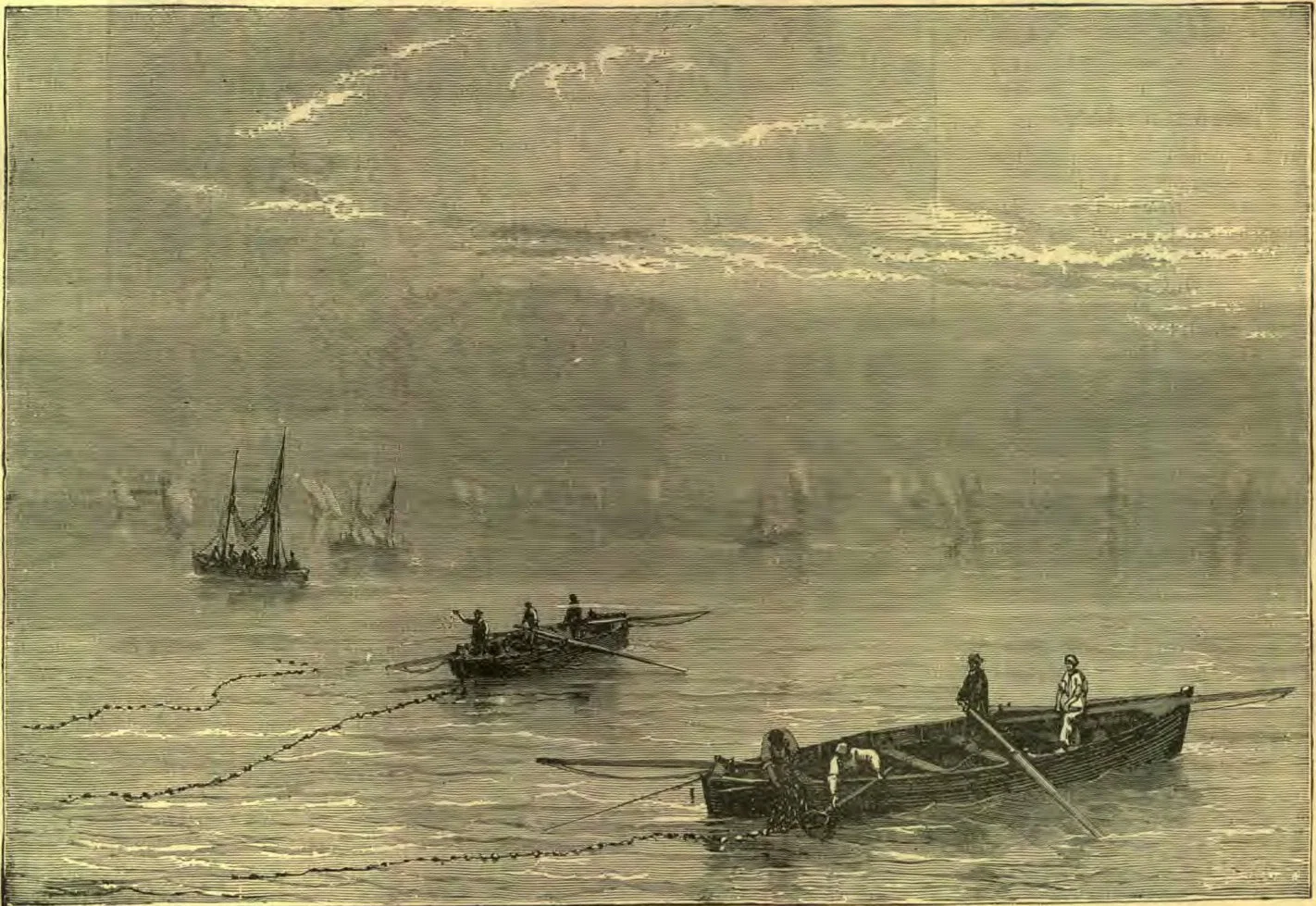
“A THOUSAND BOATS ARE HAILING, HORN ANSWERING UNTO HORN.”
Now, brothers, for the icebergs Of frozen Labrador, Floating spectral in the moonshine, Along the low, black shore! Where like snow the gannet's feathers On Bradore's rocks are shed, And the noisy murre are flying, Like black scuds, overhead; Where in mist the rock is hiding, And the sharp reef lurks below, And the white squall smites in summer, And the autumn tempests blow; Where, through gray and rolling vapor, From evening unto morn, A thousand boats are hailing, Horn answering unto horn.
There we'll drop our lines, and gather Old Ocean's treasures in, Where'er the mottled mackerel Turns up a steel-dark fin. The sea's our field of harvest, Its scaly tribes our grain; We'll reap the teeming waters As at home they reap the plain! Our wet hands spread the carpet, And light the hearth of home; From our fish, as in the old-time, The silver coin shall come. As the demon fled the chamber, Where the fish of Tobit lay, So ours from all our dwellings Shall frighten Want away.
In the darkness as in daylight, On the water as on land, God's eye is looking on us, And beneath us is his hand! Death will find us soon or later, On the deck or in the cot, And we cannot meet him better Than in working out our lot. —Whittier.

SADIE'S WINTER.

The withered vines over the arbor swung back and forth in the wind; the branches of the leafless elms creaked dismally against the house, as Sadie Crawford stood before the window of her pretty little room, looking out on the cold gray afternoon. But the chill winter picture outside did not sadden the young girl musing within.
“There is so much I want to do this winter,” she said half aloud. “It is so nice to be home again in my own sweet room. Last winter it was just up and down to some tiresome bell,—from one recitation room to another. Now I have graduated, that is all over. And this winter I want to try work outside the school-room. Tom wants me to read German with him; and mother needs rest and help, so I mean to keep house every other week. Father likes me to help him with his accounts, and I’m glad I can. I am going to have a class in Sabbath-school—such darling little girls! and I shall take such pains with my lessons through the week. And there’s some fancy work I would like to do: Father needs a new head-rest for his chair, and the table-cover is rather shabby in the sitting-room; and there are several poor families at the end of the village I ought to visit. I’ll make a list of all the things; then I can do them in order better.”
And Sadie opened her neat writing-desk, and after making out her memorandum, which grew under her hand, remembered she must write to her dearest friend, Annie Reed; and as her ready pen ran over the paper, Sadie forgot that the room was chilly, and her feet growing numb, until her mother called.—
“Sadie, dear, you are staying up-stairs without a fire too long.”
And Sadie, shivering, ran down to the sitting-room. “I have so many nice plans, mother,” she said gleefully, while warming her tingling feet and fingers. “I am only afraid the winter will not be long enough for all I want to do.”
Mother smiled, and said gently, “You must not forget, daughter, ‘Whereas ye know not what shall be on the morrow,’ and, ‘If the Lord will.’”
“Oh, yes, mother! but I think—I hope I am trying to work for Him this winter.”
Sadie hovered over the fire all the evening, but her chilliness would not pass away. She tried to talk with Tom of the proposed German studies; but queer little shiverings ran up and down her back, her head throbbed and felt heavy, and she could not count the stitches in her fancy knitting.
“I am afraid you have taken a very heavy cold, Sadie,” said her mother anxiously.
“Oh, I’ll sleep it off, I hope,” Sadie tried to respond cheerfully. But she did not sleep it off; and after a restless, painful night, the doctor was summoned, to pronounce Sadie in the first stages of rheumatic fever.
Then how long the days were, despite the winter time, and longer the wakeful nights. But how kind every one was! Mother and father, whom she had hoped to help so much, were untiring in their watch beside her. Tom softened his steps and voice, and was full of gentle attentions. And when, one weary day, Sadie begged him to read to her from “The Imitation,” he hesitated but a moment, and then cheerfully began. And so it came to pass that in a short while Tom would take one of her books of devotion as a matter of course, and ask, “Where shall we read, Sadie?”
The March winds were blowing, and although no leaves were yet to be seen, Tom had found some delicate spring flowers in the hollows, when Sadie, wrapped in shawls and propped with pillows, was just able to sit up for a few hours. She was in her own pretty room in which we first saw her, but a very different looking Sadie from the bright, energetic one of three months before.
“Let me have my portfolio, mother,” she said one day.
Sadie turned over the papers with her thin, white fingers. There, on the top, lay her list.
Some moments later, Mrs. Crawford entered, and found Sadie crying over the slip of paper.
“What is it, daughter?” she asked, tenderly.
“O mother!” sobbed Sadie, “here is my list I made of all the things I expected to do. I had planned such a busy, useful winter,—to be so much help to you and every one,—and I just had to lie here, and—”
“God’s holy will, my child,” said her mother, softly stroking the bowed head. “Don’t think you have had a wasted winter, dear. You have learned a great many things inside these four walls, and taught more than perhaps you could have done in health.”
“Taught, mother?” asked Sadie, looking up wonderingly; “how could I teach, and whom?”
“Have you not seen how ready and even eager for your religious reading Tom has become? I think he has been learning some lessons he might not have found outside of your sick-room.”
“Tom, dear Tom!” murmured Sadie, “I had not thought I could be of any use to him while lying here.”
“You had planned your German lessons together, but God planned these higher, heavenly lessons; were they not better?”
“Oh, yes,” said Sadie.
“God often puts aside some of the things we expect to do, even in his service,” said Mrs. Crawford, “so we may better perform some greater work he has for us. Although your illness was brought on by your own imprudence, he has made it work out good for us all.”
“I will keep that list,” said Sadie. “It may prevent me from boasting of to-morrow, or over-planning. I did not spend the winter as I had expected, but I dare not call it wasted.”
“Nor I,” said Tom, who had entered softly.—Selected.

ROUND THE WORLD.—7.

South Africa is generally looked upon as being one of the most barren, desert-like countries in the world; but although there are hundreds and hundreds of square miles of its territory that are arid plains, yet there are some spots, the loveliness of which rival lands will find it hard to surpass.
There are many beautiful trees and flowers in Cape Colony. The cypress is found almost everywhere. It is an evergreen, of which there are many different varieties. The tall and stately blue gum, or eucalyptus, has been largely planted. These trees are not only useful for shade and ornament, but when set out in large quantities, are said to attract moisture; so that in many places where, as we were told, there was a few years before nothing but a parched and barren plain, we now saw eucalyptus trees growing, surrounded by verdant crops of almost every description. Palm trees are not plentiful, but they grow in many of the gardens of the rich, and seem to thrive very well. They have been brought from farther north. The “bottle brush” grows in many parks and domains. It is a medium-sized tree; large and bushy at the top. The flowers are red, arranged in circular form on long peduncles, and the corollas stick out like the bristles of brushes made for cleaning lamp chimneys or narrow-necked bottles. “Silver-leaf” trees cover the sides of the gorges on the mountain. They are very beautiful, and the leaves, when once pressed, never lose their color or satin gloss. In the curio shops one finds many of these, with views of picturesque plains, ships, mottoes, etc., painted on them.
About the only tree or bush that adorns the plains is the “acacia,” or “white thorn,” as it is generally called. These are very different from the “white thorns” we have in America. On all the boughs, about three inches apart, and growing in pairs, are snow-white spines, varying in length from two to four inches. They are hollow, and the walls are about as thick as a quill. So sharp and powerful are they, that even the lion, the king of the forest, dreads them, and has been known to have met his death by becoming entangled in them.
Pomegranate trees form many of the hedge-rows. They grow up with numerous stalks from the ground, have a small dark-green leaf, very glossy, and rather a large red, cup-shaped flower, with yellow anthers. The fruit in appearance resembles, to some extent, an ordinary dark red apple. They have a strong shell and a thick pulp, neither of which are palatable. Within the pulp are a number of seeds, which look like cranberries, and these are the eatable part. This variety is supposed to be exactly the same as the pomegranate so often mentioned in the Bible.
Many of the farmers raise nothing but grapes, the greater part of which is made into wine. The vines are not permitted to twine around trellises, as in the northern States of America, but are cultivated on the Californian plan, being cropped close to the ground every year. The best variety is called the “honey pot.”
It is the month of November now. Next month brings the hottest weather of the season. Strawberries and cream and pine-apples are in bountiful supply. As a rule, the farmers in the western province are descendants of the Dutch boers, and they are not very thrifty. The land has an untidy appearance, and the machinery is even more crude than that used in the United States of America fifty years ago. There seems to be a universal fear of adopting anything that “my father” did not use. A gentleman informed me that a short time ago he was passing through a farm which the year before had borne splendid crops, but now was growing nothing but weeds. He asked the cause of this, supposing that there must be some plague on the land. The farmer replied that the land was all right, and bore such good crops the year before that they thought they would have enough to carry them through that year without doing anything; so they were taking their ease. This shows the sentiment of many.
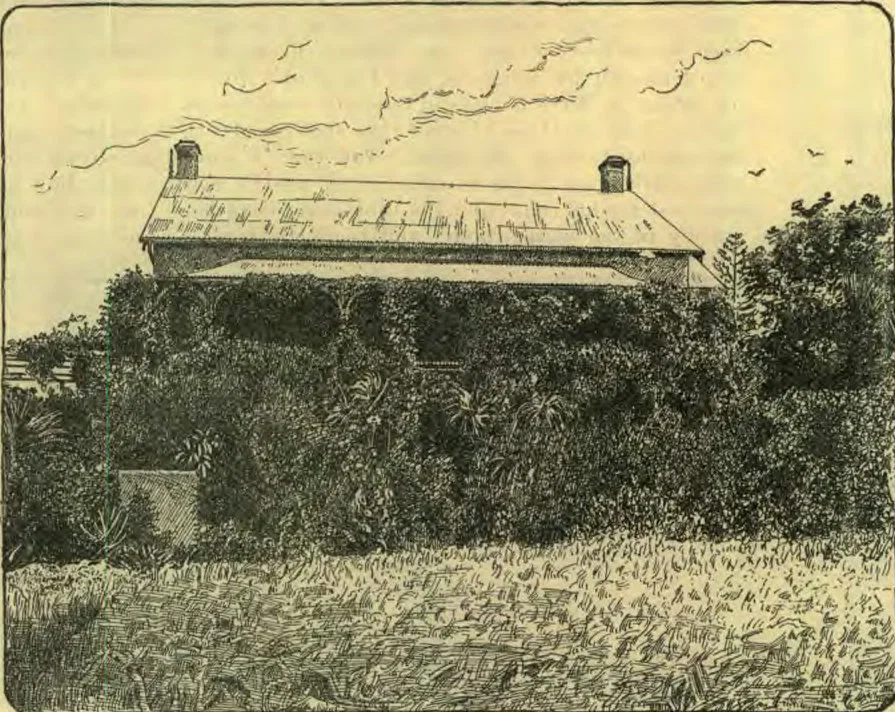
Lovely ferns and wild flowers in almost endless variety cover the mountain sides and the country in the vicinity of the Cape of Good Hope. Calla lilies adorn the meadows, and are so common that they are of no value. They are known by the name of “pig lilies.” Many of the hedges around the gardens are of thornless rose-bushes. Many of the houses are covered with Banksia roses, a small yellow or white variety, very pretty, but unscented. The accompanying cut shows a residence covered with roses. Geraniums cover the slopes of the mountains, and in the woods attain to a height of four or five feet, with a profusion of red blossoms. In some places maiden-hair ferns form a carpet of green over the ground.
Yes, there are in South Africa many spots where the traces of Eden may yet be discerned. Although the curse of God rests on the earth here as elsewhere, our Father has not forgotten, nor will he entirely forget this land.
P. T. M.

GIRLS

There are girls and girls. One test, and a pretty good one of girls, is their behavior toward their mother and their younger brothers and sisters. “Children are such a bore!” says Gertrude, scowling on the little people. “I envy girls who haven’t any brothers or sisters.” Her actions correspond with this heartless remark. To get away from the children that she may walk with a friend, practice a favorite stitch in her fancy-work, or read a fascinating book is her constant effort. The place that she is bound to fill as little mother, under the busy, tired, worried real mother, is empty, and a constant reproach to the undutiful girl. Yet Gertrude is brilliant, attractive, full of young force and sweetness that are at the service of everybody except those who have the strongest claim upon these qualities. Her mother often wears a wishful, disappointed expression when looking at her daughter; and one dreads for the careless Gertrude that sure-coming future when she will suffer many a heartache in consequence of her present neglect.
No one can be so helpful, so compensating, so pleasure-giving to a wearied mother as a sweet, unselfish daughter; and the girl who makes herself a treasure in the home is laying up for herself the truest of comfort for her own mature years.
Another test of the right sort of quality in girls is their manners toward old people, eccentric people, and the unfashionably dressed people who are for the time so situated as not to be able to do justice to themselves. Girls have been known to make serious mistakes by judging from appearances alone.
Sometimes persons whom they would be very glad to know fall under their criticism, because the case in which these diamond natures are hidden does not happen to be conveniently shaped and decorated. Courtesy, kindness, consideration, forbearance, are test qualities at home or abroad, but are especially so among those whose happiness God has confided to our keeping.—Selected.

AN ODD OCCUPATION.

Some years ago there were, in many large cities, a very numerous class of men called “finders,” who devoted their entire time to the finding of lost articles for the sake of the rewards offered. In New York City, only one of these characters, Dominick Burdell, now remains. He earns a nice livelihood in this way, dresses well, and is respected by the police as an honest man. All of his former co-laborers have died or drifted into crime. He haunts the cafés and saloons of the upper part of the city. Who he really is, even the police do not know. He is called Dominick Burdell, but his real name is unknown. He is strictly temperate, and visits saloons only to watch for lost articles, and learn who are present, and what they carry with them which they are likely to lose. He never intrudes upon any one, and is tolerated everywhere.
Many curious and interesting things are told of this man. He walks the streets with a slow, measured tread, with his eyes on the pavement, scanning every crevice where a lost article could possibly be hidden. Bright and early each morning he will be at the newspaper office to procure one of the first issues, scanning the “lost” and “reward” columns carefully, and then, having decided the location for his day’s work, he goes quickly to the spot, and begins his search. His main thoroughfares are Broadway and Fifth Avenues.
Once, years ago, Mr. Burdell was detected prowling at a very early hour among the graves surrounding Trinity church. The policeman on that “beat” saw him, and concealing himself behind a telegraph pole, watched his maneuvers. After a diligent search in the grass and leaves, his keen, practiced eye discovered the gem, lost the day before by a lady visitor, and within an hour the owner had again the diamond ring, and Mr. Burdell had the fifty dollars offered as a reward for its recovery.
There are “finders” without number in all large cities, but they are of an entirely different character. For instance, New York has an Italian that pays the city $1,500 per week for the privilege of sorting over the street sweepings; and all large cities have their rabble of rag-pickers, with their hooks, overhauling the garbage boxes, and young gamins searching store sweepings and gutters for any stray articles that may be in such places, but their earnings are small, and anything of value finds its way, not back to the owners, but to the pawn shop. The finders, of whom Burdell is the last in New York City, made the searching for lost articles a business for the rewards offered for their return. This made honesty an essential part of their character. It is a trite but true saying that one half the world does not know how the other half gains a livelihood. W. S. C.

Do Not Borrow Tomorrow's Burden

No man ever sank under the burden of the day. It is when to-morrow’s burden is added to the burden of to-day that the weight is more than a man can bear. Never load yourselves so, my friends. If you find yourselves so loaded, at least remember this: it is your own doing, not God’s. He begs you to leave the future to him, and mind the present. —G. Macdonald.

TED'S CONTRIBUTION.

“TEDDY,” said mamma one Sabbath, “you know Mr. Adams said to-day that next Sabbath the collection for foreign missions would be taken up. You heard him, didn’t you?”
“Oh, yes,” answered Teddy, secretly wondering what that had to do with him.
“Well,” continued mamma, “I’ve been thinking about it, and I’ve come to the conclusion that you are old enough to give something yourself. You have a great deal to be thankful for, Teddy, that you were born in a Christian land. You remember we were reading the other day about some of the cruel customs in heathen lands; don’t you think, out of gratitude for being born in your safe, happy home instead of in some of those sorrowful, benighted countries, that you ought to do something to help send missionaries and teachers out there?”
“Yes, ma’am,” responded Ted promptly. It would be quite agreeable to drop an envelope into the box, the same as the older people did. “How much will you give me to give?”
“Why, nothing, dear,” answered mamma. “If papa or I gave it to you to give, it would be our gift, not yours. You are old enough to get your own money now. You know you often save up your pennies to get something you want; cannot you plan and save for this cause? Think how much God has done for you. Don’t you want to do a little something in return?”
“Ye-es, but I don’t have so very great many pennies my own self, you know, and there’s such a lot of things I want.”
“And there’s such a lot of things you have, Teddy,” answered mamma, half laughing. “Just think them over if you can. You will forget more than half, I’m sure; but even if you do, don’t you think you have a great many, many blessings? And best of all, you live in a happy Christian land, where you can learn about God and his love to you, and how tenderly and willingly he will forgive you all your sins if only you’re sorry and ask to be forgiven; there’s no need to torture yourself or give costly offerings to dumb idols. O Teddy, don’t you want to give something to those poor little boys and girls who can only know about Jesus and his love from the teachers we send to them? You can think about it this week, and see how much you can give.”
Well, Teddy did think. He wanted to give something—he was quite sure he ought—but just now he did not see how he could spare very much.
Rob Harris, his special friend, had a new jack-knife, and Ted was in great haste to have one just like it. As he always lost his knives within a week after getting them, papa had refused to get him another for six months. To wait that length of time was impossible, Ted thought; besides Rob would undoubtedly break or lose his before then, and they could not have any fun with them together. So Ted was running errands and doing anything he could to earn money, and had enough within ten cents.
Of course he could give all or even part of this, but he had made up his mind that he should have his knife this week, and he did not feel like changing it.
“I don’t see why I need go and disappoint myself so dreadfully,” he reasoned to himself. “If I should put it all in the box, there wouldn’t be enough to do the heathen any good; they never will know the difference, and I shall. Rob will be disappointed too. I told him I’d surely have mine in a few days. I ought to think of him some.”
Mamma asked no questions; she preferred to have him settle the matter for himself.
Teddy said nothing. Toward the end of the week a big jackknife just like Rob’s rested in Ted’s pocket, and his money-box held—one solitary five-cent piece.
Truth to tell, Ted did not experience such pleasure with his knife as he had expected; perhaps it was partly because he did not feel like going to mamma with it, and showing her all its beauties, and partly because his conscience troubled him.
“I don’t believe it will make the least speck of difference with the heathen,” he said impatiently to himself, as he tossed restlessly about, unable to sleep that night. “And I just think it’s too bad if I can’t enjoy my knife after I’ve worked so hard for it.”
And then, before Teddy knew what had happened, he was not Teddy Arnold at all, but a little heathen boy, and I could not begin to tell you all that happened to him. Instead of kneeling down at night, and praying to a loving heavenly Father, he had to pray to hideous idols; and instead of feeling forgiven and helped, he had a hard and gloomy life, and at last he was almost crushed under the Juggernaut car. And all the time he knew there was a little boy in far-off America who could save him from all this if he would, but he would not, for he wanted to use all his money for a jackknife.
“He’s a mean, stingy, selfish thing!” said Teddy the heathen, just as the dreadful car was about to crush him, and then he woke up to find himself Teddy Arnold again.
“Mamma,” said Teddy rather shamefacedly the next morning, “you don’t want to buy a jackknife, do you? I should think it would be sort of handy for you to have, and maybe I could buy it back sometime by and by.”
“Have you one you would like to sell?”
“Ye-es, ma’am. You see I got it ’cause I thought it wouldn’t make any difference with the heathen, but I found it did with me; and I thought if you would buy it of me, I’d give them the money.”
Of course mamma came to the rescue, and Teddy’s envelope held fifty-five cents.
“I want to put it all in,” he said; “for I’m afraid that if I don’t, that little heathen boy will bother me again. I tell you what, mamma, it looks different when you’re in trouble yourself, and want folks to help you, don’t it? I’m going to try to remember it, and think how I should want them to do if I was them, and they were me.”
Which would be a very good way for us to do, as well as Teddy, I think; don’t you?—Kate S. Gates.

GRANDMA’S FIRST DAY AT SCHOOL.

Every one about the house knew that school was to begin on Monday, and Bess was saying for the twentieth time:—
“I’m all ready, grandma, everything. Just think! It’s only to-morrow!”
“How times have changed since I was a little girl and went to school!” said grandma, with that far-away look in her eyes that was always there when she was “memberin’,” as Bess said.
“O grandma, I never thought that you ever went to school, as old as you are.”
“I was just as young as you are once, my dear,” said grandma.
“Tell me ’bout when you went to school,” begged Bess, drawing closer to dear grandma.
“I was eight or nine years old before I started to school,” grandma began.
“We lived in Ohio, and it was more than sixty years ago.
“Every one had to pay to go, and the school only lasted three months in the winter, when it was too cold to work.
“My little brother John went with me.
“My mother wove a piece of flannel on the big loom from the wool off our own sheep. Then she colored it brown with walnut hulls. From this she made me a brand-new flannel dress, very long, with tucks in it to let out as I grew.
“Father went to the woods and shot a deer, and skinned him and tanned the hide. From this deer-skin he made me a pair of buckskin shoes. They were tied together with leather strings, and were stiff and heavy.
“Mother next sold some tallow, and bought a square of real store flannel of a bright red color. She cut this in two on the bias, so as to make one piece larger than the other. The smaller of these three-cornered pieces was for me to wear around my neck as a handkerchief. The larger one was to serve as a shawl and hat, for I wore it over my head.
“With all my new things on, and a little tin bucket in one hand, with our dinner in it, and the little primer my mother had bought me, hugged to my breast, we started to school right after breakfast, father, John, and I.
“Father carried his ax on his shoulder, going on before us, and ‘blazing’ the way. By ‘blazing’ I mean he chopped a large chip out of the trees on each side, and cut away the underbrush for a path. The school-house was a mile and a quarter from our house, over hills and through hollows.
“The school-house was built of big round logs, with clay stuffed in to fill up the cracks. There was a wide chimney, where a log fire burned.
“The seats were logs split, with stout legs stuck in them. We sat on the flat side. My feet never touched the floor. They used to get very tired hanging down, and I would swing them back and forth to rest them. There were no backs to these seats, and no desks in front of them.
“I did not know what a school was like, and I felt very strange. I was afraid of the teacher, too, he was such a large fellow, and went around carrying a big stick three or four feet long under his arm. He was called the master.
“Father told him our names, and then went home, telling us not to get lost, but to come straight home by the path he had made. I felt like crying when father left, everything was so strange.
“That day the teacher put all the big boys and girls in one class, and all the little ones in another.
“When noon came, we all opened our dinner baskets, and ate our dinners; for some of the children had come three miles.
“Then we all went outdoors, and the big boys played ball very much as boys do now. The girls and smaller boys played ‘blind man’s buff,’ ‘drop the handkerchief,’ and ‘black man,’ just as children do now. It was almost dark before we reached home that night. The teacher went with us to stay a week at our house, as he did with all the other pupils. That was the first day I ever spent at school.”—Youth’s Companion.

“A STITCH IN TIME SAVES NINE.”

“Come, Dolly, now, and mend your frock,” Said careful Grandma Gray. “That rent, though small, if it be left, Will widen every day.
“Here is your box well stocked with thread, And needles coarse and fine. A stitch in time saves nine, my dear,— A stitch in time saves nine.”
But thoughtless Dolly paid no heed; She only tossed her head; She only gave a saucy smile, As to herself she said,—
“I wish that grandma would not mind About such little things,” And down the garden path she skipped As light as bird on wings.
But as she went, the tiny rent Was caught upon a thorn, And ere her footsteps she could check, Her frock was sadly torn.
So now she needs must leave her play, And go with rueful face To sit within-doors for a while, And mend the tattered place.
While grandma, kind as kind can be, Gives help and words of cheer, And never hints, by look or tone, “I told you so, my dear.”
—M. E. N. Hathaway.

FUN

The boys were on their way home from school, when John exclaimed: “There comes Tom Brown. Let’s have some fun with him.”
Tom Brown was a half idiot youth, extremely shy and sensitive. He was quiet and harmless when let alone, but could be easily thrown into a violent passion, and some boys delighted in tormenting him. Tom was approaching the boys with a heavy basket of carpet warp, which he was carrying home for his mother. He had seen and recognized them, and had timidly stepped out of the road, waiting for them to pass.
“Capital!” said Charley; “we will pretend to take his basket from him, and see him fight.”
Willie Smith was a new-comer in the place, and had never seen Tom before. He heard the remarks of his companions, and comprehended the case at once.
“If you are going to have fun with that poor fellow,” he said, “I think I’ll have some too.”
“Oh, to be sure, we want you to help us,” they cried. “But I prefer to help him,” Willie said quietly. “I see he has a heavy basket, and I am going to help him carry it; and if you interfere with him, you’ll find me on his side.”
The boys looked at each other.
“I thought you wanted some fun,” said John.
“I think it will be much better fun to help a poor fellow like that than to torment him.”
Willie walked forward, and said kindly, “Is your basket so heavy that you have to stop and rest?”
Tom looked at him in wonder, and drew back, half afraid.
“I want to help you carry it a piece,” continued Willie, “so take hold of that side, and I’ll carry this.”
A gleam of pleasure kindled Tom’s dull eyes. “It is very heavy,” he said, “and I was afraid, but you will not let them hurt me.”
They took up the basket and carried it forward, passing John and Charles, who looked on in silent surprise.
“That’s the strangest fun I’ve seen yet,” said John.
“That’s a fact. It’s rather sober fun; but I do believe it is better than anything we’ve tried,” replied Charles, beginning to feel ashamed of himself.
Willie returned, and the three walked silently toward their homes. They were all too thoughtful for their usual talk. At last Charlie broke the silence.
“Tell me, Willie,” he said, “why you helped Tom carry that basket?”
“Because the Bible says, ‘Bear ye one another’s burdens, and so fulfill the law of Christ,’” was the reply.
I wonder what the boys who read this would do under such circumstances. Do they remember to help to bear the burdens of the weak?—Selected.

AN INDUSTRIOUS SQUIRREL.

A Danbury farmer last fall stored several bushels of butternuts in the second story of his cornhouse, and recently he noticed that they were disappearing much faster than the legitimate demand for his family supply warranted. He discovered soon afterward that a small red squirrel had found a hole under the eaves of the building, and was stocking her store-house with the nuts the farmer had gathered. As an experiment to learn how rapidly the squirrel had worked, he removed all but twenty nuts, and set a watch upon them. Six hours later every nut was gone. The distance from the cornhouse to the tree where the squirrel had its nest was just eighty rods. In going for a nut and returning with it, the sprightly little animal had to travel a distance of one hundred and sixty rods. Computation showed that the theft of twenty nuts required just ten miles of travel. But this did not include all. Several times dogs frightened the squirrel, and it had to turn back; and twice the family cat got after it, requiring it to take a circuitous route to reach the store-house. The nest was examined soon afterward, and a big, fat, lazy male squirrel was found snoozing quietly, while his little mate was performing a prodigious feat to supply him with food.—Exchange.

THE STAKES ON THE ROAD.

AMONG the highest ranges of the Smoky Mountains in Tennessee stands the hut of an old trapper who died some months ago at the age of ninety. For many years Israel had been blind, but he continued to live alone in the hut, and to support himself by trapping. A stranger who visited him several years ago watched him with surprise as he climbed with sure, quick steps the narrow path that led through steep gorges and over deep precipices from his hut to the traps. Even in the night and storm he trod this path without hesitation.
“It is not a matter of memory,” he said in answer to his friend’s questions; “I know I am safe. Look at these.” Along the edge of the path, on both sides, were stakes, which, if he slipped aside, at once warned him of his danger. “When I was a strong young fellow, I felt that blindness was coming on me, and I set these stakes,” he said. “I owe my life to them now.”
The hunter’s stakes were an apt illustration of the uses to old and middle-aged people of the good, every-day, practical habits which they had formed in early youth. The young man who has refrained from liquor until he is twenty-five is not likely after that age to be tempted by any misfortune or excitement to seek strength and comfort in it. The lad whose familiar associations up to manhood have been with gentlewomen, modest and well-bred, will not be apt in later life to find any attraction in coarse and dissolute companions. The child who has been taught from the cradle to go apart at a set time each day to find himself alone with a heavenly Father who waits to hear and grant his petition, will never, in after life, be able wholly to lose the consciousness of the actual presence of that loving, almighty Friend. The Quaker, no matter how irascible his temperament or how tragic his griefs in middle age, never loses the power of self-control, the repose taught him in childhood. “I trust all my life,” said Lord Brougham, “under God, to habit.” John Foster declared habit to be “in a religious character a strong protection and a great felicity.”
Do not, however, boys and girls, mistake the uses of habit; you will not win heaven by the formation of good habits. You may be a skeptic, a hypocrite, or a thief, and yet be sober and decent in your outer life, and may read your Bible and mumble set prayers at a certain hour each day. Good habits do not make the path to God. They only, like the old trapper’s stakes, warn you when you have left the path.—Youth’s Companion.

THE BONE-BAG.

FAR away in North-eastern Greenland, where life is so cold and cheerless that people can hardly be said to live, but simply to exist, the people have an odd way of keeping the family record. They have no written language, nor method of making such rude chronicles as we find even among many uncivilized people. One bit of history is carefully preserved, however, and this is the way it is done: Each baby at its birth is provided with a fur bag, which is kept as his most precious possession. When, after a long Arctic winter, the sun makes his appearance, the bag is opened, and a bone is put into it to mark a year of baby's life. So, each succeeding year, as the sun makes its yearly four-months' visit, another bone is added. This bag is regarded as something so very sacred that it never seems to enter into the head of the most impatient little Esquimau to add a bone to his collection “between times” to hurry himself into his teens.
How thankful should we be that we live in a land of books and education, and especially in a land of Bibles; and yet children who have ten thousand comforts often murmur and complain, while those who live amid ice and snow and poverty and desolation perhaps have more contented hearts than those who are burdened with blessings.—Selected.
Continue reading: Letter Budget