The Youth’s Instructor, Vol. 43, No. 1.

NEW YEAR’S GREETING
Earlier text: NEW YEAR’S GREETING

HOW PRINTING-TYPES ARE MADE.

PROBABLY but very few of the readers of the INSTRUCTOR know how the metal types which printers use are made, or even of what material they are composed. But this is nothing strange; for hundreds of newspaper and book men, and even type-setters themselves, practically know but very little concerning the manufacture of the type with which newspapers and books are set up.
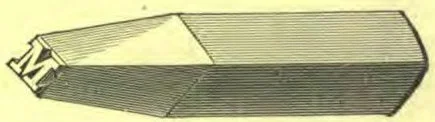
- PUNCH.
  • PUNCH.
A prominent type-founder in Chicago awhile since published an interesting description of how type is made, and the same with additions was issued in a neat circular by William C. Gage, of this city; and it is through his courtesy that we are enabled to present the illustrations given in this article.
Type metal is a composition of lead, tin, antimony, and copper, all of which metals are necessary to give the required ductility, hardness, and toughness. No other composition has ever been found which so well answers all the purposes for type-making, although aluminum, gutta-percha, and some other substances have been tried.
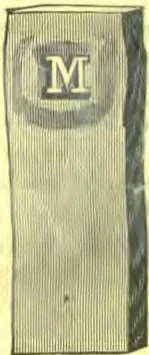
DRIVE.
DRIVE.
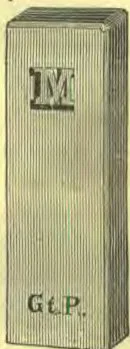
MATRIX.
MATRIX.
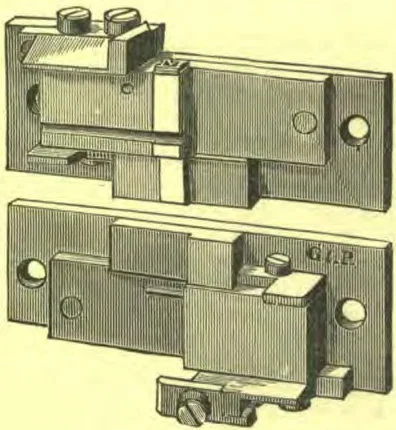
MOLD.
MOLD.
“The first step in the making of type is cutting the letter desired, on the end of a piece of fine steel, forming the punch, which is afterward hardened. This is an operation requiring great care and nicety—there being comparatively few adepts at it—so that the various sorts in a font may be exactly uniform in their width, height, and general proportion to each other. A separate punch is required for each character in every font of type, and the making of them is the most expensive portion of type-founding.
“During the process of its manufacture, the punch is frequently tested or measured by delicate gages, to insure its accuracy. When finished, a smoke proof is taken, and if the letter is pronounced perfect, it is driven into a piece of polished copper called the drive. This passes to the fitter, who makes the width and depth of the faces uniform throughout the font. They must then be made to line exactly with each other. [The reader will notice how perfectly the letters in a line of print line with one another.] When thus completed, the drive becomes the matrix, wherein the face of the type is made.
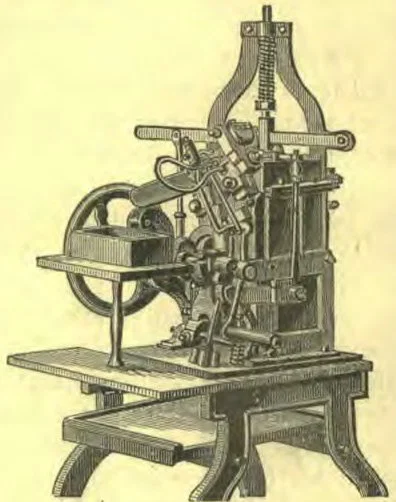
TYPE-CASTING MACHINE.
“This undergoes other processes in fitting and finishing, to make it true and square with the body of the type. Matrices are also made by the electotype process, for the purpose of copying and multiplying certain faces without incurring the great expense of cutting new punches. The mold in which the body is formed is made of hardened steel, in two parts; one part is fastened to the machine and is stationary, while the other is movable, so that it may be adjusted for the proper width of the letters, as one is wider than another. The necessity of perfect accuracy in these molds is manifest to every printer who knows that types must be mathematically square, else they could not be used.
“The matrix and mold are combined, and then adjusted to the type-casting machine, which is set at work manufacturing types at the rate of from one hundred to one hundred and seventy-five a minute.
“The type-casting machines in general use in this country and in Europe are of American origin. The American Printer gives the following description of their operation:—
“The metal is kept fluid by a little furnace underneath, and is projected into the mold by a pump, the spout of which is in front of the metal pot. The mold is movable, and at every revolution of the crank in the hand of the workman it comes up to the spout, takes a charge of metal, and flies back with a fully-formed type in its bosom; the upper half of the mold lifts, and out jumps a type. The spring in front holds close to the mold a copper matrix; the letter a, for instance, stamped in the matrix, sits directly opposite the aperture in the mold, which meets the spout of the pump; and when a due proportion of a is cast, another matrix with b stamped in it takes its place; and so on throughout the entire alphabet.”
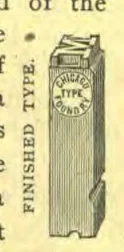
FINISHED TYPE
FINISHED TYPE
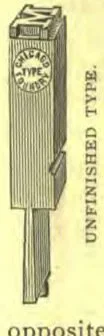
UNFINISHED TYPE.
UNFINISHED TYPE.
“In casting small fonts, where frequent changes are made in the molds, the machines are driven by hand power; but when the fonts are large, such as those made for the daily newspapers, steam is used as the propelling power, and the industrious little machines, with scarcely less than human intelligence, go thumping along at their work, requiring but little care or attention, except when changes in the matrices and molds become necessary. The only practicable method of making types is by casting them singly. All attempts at making them by swaging, cutting, or casting fifty or more at a time, have proven utter failures.”
“The types are not finished when they leave the machine. There will be found attached to each letter a wedge-shaped jet, somewhat similar to that on a bullet cast in a hand mold. The loose types are placed upon tables, around which are seated nimble-fingered boys or girls, who pick them up at the rate of from two thousand to five thousand an hour, at the same time breaking off the jets. A bur still adheres to the shoulder of the type, and this is taken off by the rubbers, who rub the sides of the letters on fine steel files, manufactured expressly for this purpose. Some type-founders have this work done on sandstones, and by the process called “bunching,” to save expense, but the printer need only to place one type by the side of another to detect at once the difference and the inferiority of the work.
“The kerned letters then go to the kerning machine, where they are dressed without disturbing the kern, or overhanging part of the type. The types next go to the setters, who set them in long lines ready for the dresser. He slips them into a long stick (dressing rod), turns them on their face, fastens them on a bench adapted for that purpose, and with a plane cuts a groove in the bottom which removes the bur left in breaking off the jet, and leaves each type with a pair of feet to stand upon, and then dresses off the under and upper sides.
“The picker (who is generally the dresser) now takes the type in hand, and, with the aid of a magnifying glass, picks out each defective letter, which is returned to the melting kettle. The types are then broken up into shorter lines, and put up in pages of about four and one half by six inches in size, when they are sent to the dividing room, where they are divided into fonts, each having its due proportion of the various characters, and made into pages or parts of pages. Afterward they are wrapped in papers, labeled, and sent to the wareroom, where they are packed, marked, and shipped to the purchaser, or put upon shelves to await orders.”
A recent invention, the Automatic Type-perfecting Machine, performs the manipulations necessary to make and finish type. This process has many advantages over the old method, as the type is made with very great accuracy. The type is cast absolutely true at the start, and in the finishing process it passes through gaging cutters that finish it smooth and perfect.
G. W. AMADON.

ORNAMENTING GLASS.

THE following is an example of the means of carrying out the inventor’s process: A coat of acid resist is laid upon the glass; from the parts forming the background to the design, the “resist” is removed with a stencil; soda and hydrofluoric acid are then poured upon the surface. Hydrofluoric acid is next applied; the resist is then removed, and the glass is cleaned. The glass is next coated with stain, and by means of a stencil, the ornament is freed from the stain, which remains as a protection from the background. The stain is then burned into the glass. The glass is then taken from the kiln, cleaned, and the required outline traced upon the glass, the background being filled with acid resist. The solution of soda and hydrofluoric acid is again poured on, so as to leave a white “mat” on the whole ornament, leaving the outline, which is protected by the resist, clear. The shading-in is then done, according to the ordinary process of the trade.—Scientific American.

ROSA A. YOUNG

But with brave hearts we travel on, Content, should ill befall, To trust our future in the hands Of Him who orders all.
To-day we meet, to-day we part, Our hearts not free from pain; We know not, as we say “Farewell,” If here we'll meet again.
So farewell teachers, schoolmates dear, Farewell bright scenes now fled; Farewell, a last farewell, to those Who sleep among the dead.

ROSA A. YOUNG

LESSON 3.—THE WORLDLY SANCTUARY (CONTINUED); MATERIAL FOR THE BUILDING.

(January 19, 1895.)
MEMORY VERSES.—Ex. 26: 1, 7, 14.
HINTS FOR REVIEW STUDY.—1. Did you learn how long the tabernacle was? If not, you would better figure it out. Better figure it out anyway; some one may have told you wrong. The necessary information will be found in Ex. 26: 16, 18. Was it thirty, forty-five, or fifty feet long? Remember to reckon a foot and a half for each cubit. 2. Was the tabernacle twelve feet wide or fifteen? Can you find out from Ex. 26: 22-25? Of course you see how high it was. Verse 16 tells you. 3. What kept the boards from falling down? Did they have more than one means of support? What were they? 4. When the boards are all set up, what kind of looking structure have you? Mark off its dimensions in the yard. Measure its height on the side of the house.
SUGGESTIONS FOR STUDY.—1. Now that we have set up the boards for the tabernacle, let us step inside and examine it. What do you see above? Nothing yet? Well, this lesson will tell you with what it was covered. Read Ex. 26: 1-14. Then read on until you finish the chapter, noticing the last seven verses particularly. 2. When the coverings are all on and the walls in position, imagine what the effect would be if you should enter with a light. How would the sides look? the ceiling? the curtains? Would you need a light?

MATERIALS FOR BUILDING.

1. Of what was the top of the sanctuary to be made? Ex. 26: 1.
2. What was worked in these curtains? Verse 1.
3. What was their length and breadth? Verse 2.
4. How many were coupled together to make one curtain? Verse 3.
5. How were these two curtains joined in one? Verses 4-6. (See note .)

THE COVERING OR TENT OF THE TABERNACLE.

6. Of what material was the first covering made? Verse 7. (See note .)
7. Of how many curtains was it composed? Verse 7.
8. What was the length and breadth of each? Verse 8.
9. How many were to be coupled together? Verse 9.
10. What was to be done with the sixth, or extra curtain? Verse 9.
11. How were the two compound curtains fastened together? Verses 10, 11.
12. What was done with the half of the curtain which remained? Verse 12.
13. What purpose did the extra length of the curtain serve? Verse 13.
14. Of what was the second covering made? Verse 14. (See note .)
15. Of what was the third and last covering composed? Verse 14. (See note .)
16. Of what was the door of the tabernacle made? Verse 36.
17. By what were these curtains supported? Verse 37.
18. What was made to divide between the holy place and the most holy? Verses 31, 33.
19. Upon what was it hung? Verse 32.
20. What is this vail called? Heb. 9: 3.
21. When erected, which way did the sanctuary face? Ex. 26: 22, 36; Num. 3: 23, 38. (See note .)

NOTES.

MUSIC IN ISRAEL.

ISRAEL had both musicians and singers. Music and musical instruments were used in the worship of God in all ages. We read in the fifteenth chapter of Exodus that wonderful song of deliverance, sung by Moses and the children of Israel. “I will sing unto the Lord, for he hath triumphed gloriously: the horse and his rider hath he thrown into the sea. The Lord is my strength and song, and he is become my salvation: he is my God, . . . and I will exalt him.” This song was given to the children of Israel by the Spirit of God, and that same spirit inspired the singers; so we may conclude correctly that the harmony was perfect.
“And Miriam the prophetess . . . took a timbrel in her hand; and all the women went out after her with timbrels.” The timbrel here spoken of is a simple tambourine used with cymbals.
God’s people praised him with music and song. When Solomon had finished the work of the house of the Lord, he assembled the elders of Israel, and all the heads of the tribes. Then the Levites took up the sacred ark, and all the holy vessels, while music, as described in 2 Chron. 5: 13, 14, played a prominent part in the occasion. Notice the perfect time of musician and singers: “It came even to pass, as the trumpeters and singers were as one, to make one sound to be heard in praising and thanking the Lord; and when they lifted up their voice with the trumpets and cymbals and instruments of musick, and praised the Lord, . . . then the house was filled with a cloud, even the house of the Lord.”
The trumpet here spoken of was straight and made of silver, terminating in a bell mouth, made according to the directions given to Moses, by the Lord, and was used to call an assembly or proclaim the march. God designed that those who praise him with music and song should do it beautifully. “Praise him upon the loud cymbals: praise him upon the high sounding cymbals,” “with song,” singing psalms and making melody in your hearts. In that last grand scene when God’s remnant people shall have gained the victory, the song of Moses and the Lamb will be sung. Then will we have harps of pure gold, crowns of life, and beautiful white robes given to us by Jesus himself. ANNA V. RUTHVEN.

Gold Believed Present in Ocean Water

THAT gold should exist in the ocean is an induction that Dr. Henry Wurtz claims to have presented in 1866, and in 1872 the discovery was announced by E. Sonstadt. A careful computation with the best data obtainable, on the basis of nine tenths of a grain of gold to a ton of sea water, about the proportion assigned by Sonstadt, shows that the great ocean should contain gold to the amount of over eighty quadrillion dollars. The getting of some of this by electrolysis, Dr. Wurtz now predicts, will be one of the problems of the future.—Invention.

Necessity and the Boldness of Prudence

WHERE necessity pinches, boldness is prudence.

A NEW YEAR'S THOUGHT.

Do you know the Scriptures better than you did a year ago? You ought to. Have you more places in your Bible to which you can go as the bird goes to her retreat? You ought to. Are there more precious spots in the Bible than there were once? There ought to be. Suppose some one had intrusted me with a great matter, and had given me written instructions as to how to conduct it; and suppose that when I felt like it, I went and read a sentence, and then, after a week, half a dozen sentences; I should have only the most fragmentary knowledge of the instructions. But how many Christians treat the Bible thus!—Wayland Hoyt, D. D.

A TRUE SOLDIER.

Nellie Gordon turned with a sigh from the window where she had been watching her brothers at play.
Presently her mother entered the room, and saw the cloud on Nellie’s usually bright face.
“What is the matter, little daughter?” she asked.
“O, I’ve been watching the boys playing soldier,” said Nellie, “and I most wish I was a boy too, because then some day I might be a real soldier.”
With unusual tenderness Mrs. Gordon drew the child to her, for Nellie’s father had been a “real soldier,” who had given his life to serve his country, and the same brave spirit animated his little daughter.
“Nellie, dear,” she said, “you can be a soldier, and have for your captain One who always wins the victory.”
“O, mother, tell me how?” said Nellie, delighted at the prospect of having her dearest wish realized.
“I believe my Nellie already loves the Lord Jesus,” replied Mrs. Gordon, “and wants to serve him.”
“Yes, mother,” she said soberly, “but what about the battles?”
Lovingly the mother talked of the struggles with sin and temptation, and how the enemy tries to conquer, but the victory is sure, with Christ on our side.
Nellie’s face shone with happiness as she said: “I mean to be a brave, true soldier in the army of Jesus, and maybe I can help someone else, too.”
A strange opportunity soon came to Nellie. On her way from school one afternoon she saw a crowd gathered about a neighbor’s door, and with childish curiosity, drew near to learn the cause.
“Poor man,” she heard one woman say to another, “he was too drunk to see the danger, and they do say he is mortally hurt; he has always been his own worst enemy.”
They were talking about John Hardy, Nellie discovered, and she ran home to tell her mother the news.
That evening, having begged permission to take him a few flowers from their pretty garden, she carried them to the house, and Mrs. Hardy allowed her to give them, herself, to the sick man.
The poor woman’s heart was very heavy, for, excepting this one terrible habit, he had been a good husband, and now, it seemed, he was going from her, and, worst of all, with his sins unforgiven. Nellie slipped quietly into the room, and put her flowers near the sufferer; then, seeing he was awake, she came closer to him, and laid her soft, cool hand on his head.
“I am so sorry,” she said; “the pain must be dreadfully bad.” Then, remembering her promise, she whispered, “Mr. Hardy, why don’t you ask Jesus to help you fight your enemy?”
The man looked at her half-angrily, then muttered, “I guess it would be no use, I’ve been too bad; besides, it’s too late now.”
“O no!” said Nellie; then as another brave thought came, she added, “I’ll ask Him to do it, and tell him how sick you are.”
In spite of his pain, John Hardy listened to that prayer, and as he heard the sweet, childish voice pleading with the friend of sinners, for him, strange feelings awakened in his sin-hardened heart.
“May I come again?” Nellie asked, as she rose to go.
“Yes, if you like,” he answered.
So, very often the child visited him, unconsciously helping him in his terrible struggles.
At length, after weeks of suffering, he recovered from the injuries which had so nearly proved fatal, and, better still, the heart which had been so bruised and battered by sin, was made clean and whole, and the life, so wonderfully preserved, was henceforth to be spent in the service of Nellie’s Captain.
He had been the leading spirit among his boon companions; now he meant to try to lead them into the better way, and greatly were his efforts blessed.
Several years passed, and Nellie, now grown to young womanhood, was fulfilling in her noble, unselfish life all the promise of her childhood.
Many a tempted one had been helped by her strong faith and courage, and bravely she stood true to her colors.
One day as she met Mr Hardy on the street, he stopped her, saying, “Nellie, a mission has been started in one of the worst parts of the city; will you come and help us fight the enemy in his own stronghold? There are sin-sick, perishing ones who have never heard of our Saviour’s love, and we want to carry the cross of Jesus into the midst of all the sin and misery, and tell them of Him who is mighty to save.”
Nellie hesitated a moment, then answered, “Yes, I will go, and help all I can.”
She found other noble Christian women among the band of workers, and bravely they labored together to seek and save the lost ones. Many sad hearts learned to love the sweet girl, who listened with such tender sympathy to the story of their sorrows, telling them always of the Great Deliverer who stood waiting to help them.
One day a message came from far across the seas for more laborers in that part of the Lord’s vineyard. Nellie with some others readily responded to the call, and bravely went forth, bearing the banner of the cross.
Loving letters come back telling of glorious victories, and Mrs. Gordon’s heart rejoices that her daughter has indeed become a true soldier of the Lord Jesus Christ.—Florence Clarkson, in Ram’s Horn.

CAST A LINE FOR YOURSELF.

A young man stood listlessly watching some anglers on a bridge. He was poor and dejected. At last, approaching a basket filled with wholesome-looking fish, he sighed, “If now I had these, I would be happy. I could sell them at a fair price, and buy me food and lodgings.”
“I will give you just as many and just as good fish,” said the owner, who had chanced to overhear his words, “if you will do me a trifling favor.”
“And what is that?” asked the other.
“Only to tend this line till I come back; I wish to go on a short errand.”
The proposal was gladly accepted. The old man was gone so long that the young man began to get impatient. Meanwhile the fish snapped greedily at the baited hook, and the young man lost all his depression in the excitement of pulling them in; and when the owner returned, he had caught a large number. Counting out from them as many as were in the basket, and presenting them to the young man, the old fisherman said, “I fulfil my promise from the fish you have caught, to teach you, whenever you see others earning, you need waste no time in foolish wishing, but cast a line for yourself.”—Selected.

SNOW MEN.

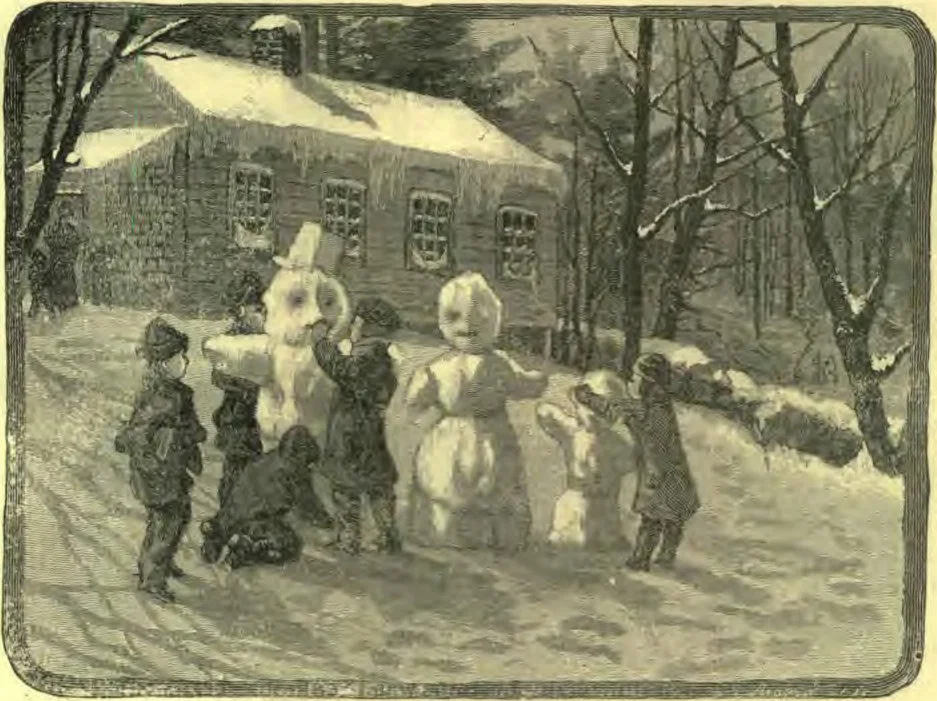
“Come, Tommy and Charlie and Willie and Dan; The school is out now, let us finish our man; Never mind ’bout our dinners; we never could eat While our poor old snowman hasn’t got any feet!
“Let us call his name ‘Adam’; and, then, I believe, While we are about it, we’d better make ‘Eve.’” “I’m goin’ to make Abel,” said little Tom Joy; “For I know they’ll be lonesome without any boy.”
So Tommy and Charlie and Willie and Dan At once all agreed to the wonderful plan, And all set to work without further ado, Until “Adam and Eve” and their little boy, too,— Three comical figures, with garments of snow, Like three marble statues,—stood all in a row. Ah, dear little men, in your innocent play! I think of my childhood, and love you to-day; And I pray from my heart that your spirits may grow As pure and as white as these statues of snow.
MRS. L. D. AVERY-STUTTLE.
“ALL SET TO WORK WITHOUT FURTHER ADO.”

Be True to Your Best Self

REMEMBER this, my young friend: you lower your own self every time you are guilty of an unworthy action because some one else is. Be true to your best self always, and no one can drag you down.

The Best Remedy for Idleness

THE best remedy for idleness is hard work.

SECONDARY SCHOOLS IN ENGLAND.

The school system of England is entirely different from ours. England’s “public schools” are not at all the same kind of institutions that we know by that name. An English public school is more like a great academy than anything else. Secondary education,—that above the primary grades,—is left to take care of itself. The state furnishes to the people nothing but the rudiments of learning. The gap between the primary school and the university is filled by private schools, private tutors, the public schools, and in a variety of other ways.
Many boys are educated, or “prepared,” by clergymen. They have the whole attention of their instructor for a part of each day. This is, we may imagine, a very pleasant way to study. The pupil accompanies his teacher upon his walks and rides, studies botany and natural history in the woods and fields, and classics in his teacher’s library. The private tutor is also well known in many English households of the upper classes. Under his guidance the young student is prepared for school. In some cases the tutor gives way in time to the clergyman, who, of course, is a highly educated man; and the acquaintance of Greek and Latin authors is made under his direction.
The public schools are not supported by the government. They, like the universities, were established by endowments. Such are Rugby, Eton, and Harrow. The dormitory system is in full operation in those schools. Restrictions surround the pupil on every hand. He is not yet of age, and must be under tutors and governors. He is a boy. By and by, when he goes up to Oxford or to Cambridge, he will be a man, and will be about as free as a student can be; but he must bide his time, go through the grind, and look well to his examinations.
Among these schools are some which bear peculiar names. There is in London, for instance, the Merchant Tailors’ school. Such names mean nothing now, except that they are reminders of the old days of guild labor. Then the guilds of craftsmen performed not only the office of our trades unions, but they occupied also the place of the modern insurance company, and the charitable organizations of the present time. Some of the guilds became immensely rich, and out of the funds schools, among other things, were endowed.
Akin to these schools are the military schools, where especial attention is given to preparing boys for army service. Much time is of course devoted to drill, and discipline is on military lines.
But the great multitude of English children are not educated in the public schools. It is for them that the “private adventure” schools exist. In every city there are hundreds of private schools, some of them large and some not so large. Some of them are more classes than schools, in point of size and publicity. Thousands of persons all over England make their living at teaching; and, unfortunately, it is to the immediate interest of these people to oppose popular education. For this reason, perhaps, the cry for free high schools is a very recent one. All grades of efficiency, it need scarcely be added, are represented by the private schools. Some are good indeed, and some are not to be spoken of.
It would be interesting to trace out the history of the call for free high schools,—or rather, cheap high schools, for England does not yet believe in free education. But it is too long a story. The gist of it is that Germany seemed to be outdoing England in manufacture, especially in such lines as required intricate machinery,—machinery dependent, moreover, upon the attendance of a scientifically educated workman for its successful operation. Furthermore, chemistry and the arts needed men of scientific training. The English young man was not sufficiently well educated to study science with profit. So the men on school-boards, who were not educators, but business men, became interested in an extension of the scope of the free school. The people in general began to demand something of the sort. Parliament appointed a commission, and perhaps cheap high schools will be a fact by the next generation.
One of the leading members of the royal commission has just finished a tour of inspection in this country, his purpose being to study our system of public high schools. The English do not look upon the matter of education as we do. To furnish the people with free high schools seems to them, even now, a questionable departure from the doctrine of individualism, and the support of universities by the state is, in their view, pure socialism.
C. B. MORRILL.
Continue reading: PUT YOUR HEART INTO IT