The Youth’s Instructor, Vol. 38, No. 47.

INDIAN SUMMER IN THE VALLEY

The Youth’s Instructor

Nov 19, 1890

S. D. A. Publishing Association · Battle Creek, Mich. · Nov 19, 1890

INDIAN SUMMER IN THE VALLEY.

The mountains, dim with caps of cloud, Are like the distant sea, The wild November wind blows loud Until the mighty pine is bowed Before its majesty.
The nuts in heavy showers fall Through the dead summer leaves, The black-birds from the tree-tops tall In piercing chorus shrilly call, Or hide among the sheaves.
The creepers wind the trunk around With leaves of brightest red, And higher still the vines surround The tree, which with the garland crowned, Holds high its stately head.
The maple leaves, a mass of gold, Would rouse a miser's greed, The rabbits, hiding from the cold, Peep shyly out from sheltered fold To where the black-birds feed.
The great logs blaze in fierce delight Within the manor hall. The clouds have shut the sun from sight, But all around a golden light Seems silently to fall.
—Harper's Young People.

"THE THUNDER OF WATERS."

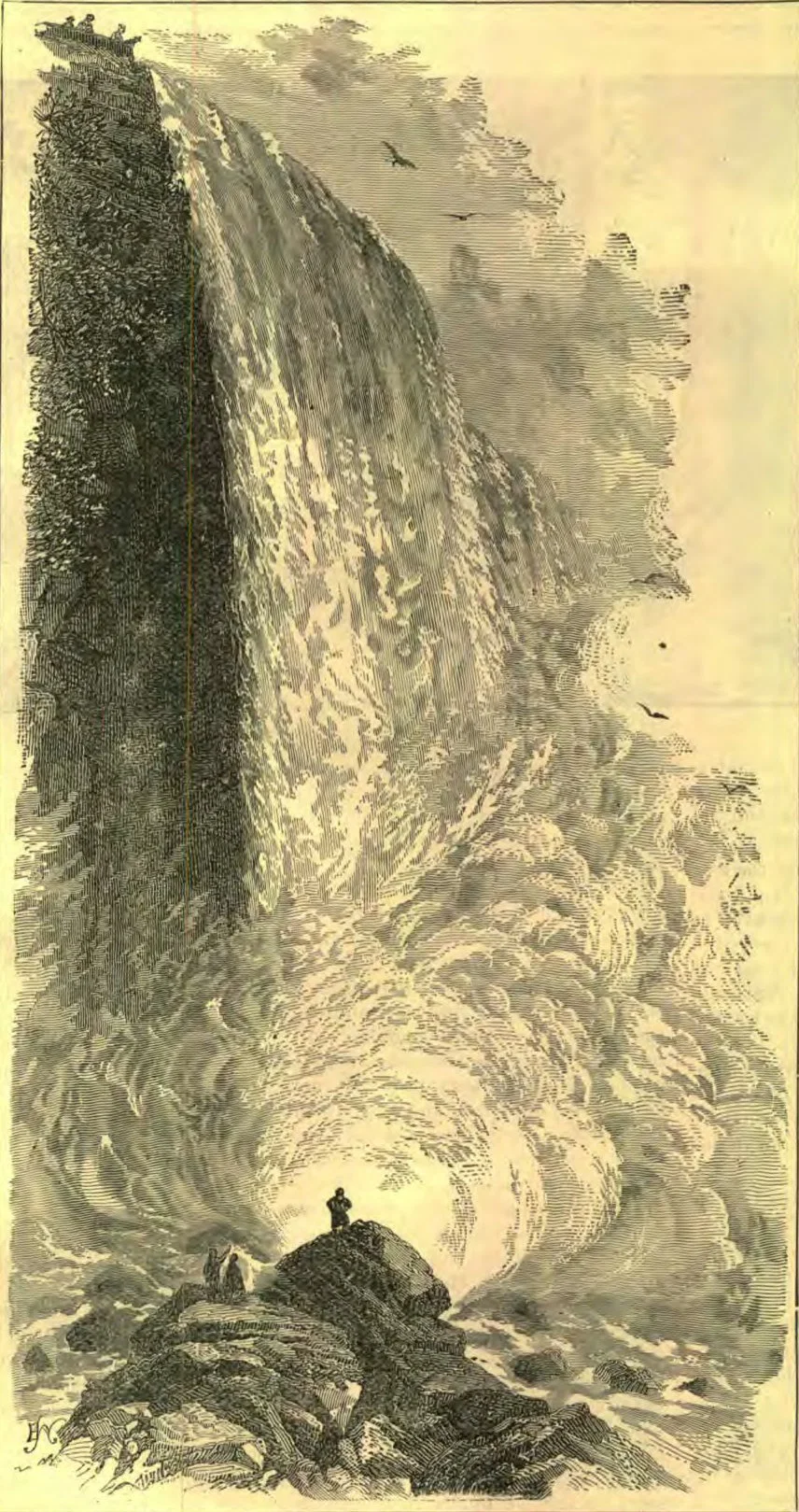
WHATEVER they may know about them now, people used to hold very queer notions concerning Niagara Falls. I read not long ago, in an ancient geography, that the waters of the Great Lakes here plunged over a precipice nearly 800 feet high, with a roar that could be heard at a distance of twenty leagues. Somewhere else I read that the rocky face over which the waters fell was wearing away at the rate of a foot in a year. As a small boy, I was greatly troubled by this statement, and feared that the great Falls would have worn their way back to Lake Erie, and become ordinary rapids, before I had a chance to see them. This fear was only dispelled when I learned that, as they were twenty-two miles from Lake Erie, they could not reach it, even at the rapid rate of a foot a year, under 116,000 years.
Now it is scientifically estimated that the rock is only worn away at the rate of half an inch in every five years. If any of you young people care to work out the problem thus suggested, you will become convinced that there is plenty of time left in which to see Niagara Falls before they disappear in Lake Erie. The answer is almost fourteen millions of years, is it not?
The world-famed cataract is divided into two great bodies of water by Goat Island, which contains about seventy-five acres of land, and hangs on the verge of the awful precipice, in the middle of the Niagara River. Of these the one on the United States side is called the American Fall, while the other, which is much the larger, is called the Horseshoe, or Canadian Fall. In spite of the old geographers, the Horseshoe is but 155 feet high, instead of 800, as they supposed. Still this is twenty feet higher than the almost any church steeple with which you are familiar. Niagara means, in the language of the Indians who named it, “The Thunder of Waters,” and a few years ago it also meant one of the most expensive places to visit and see anything that could be found. Besides being too expensive for any except wealthy people to enjoy, many of the chief beauties of the Falls were hidden behind the mills and factories that lined the river-bank at this point. At length the people of the State of New York awoke to the fact that they were being robbed of this, the greatest of their natural wonders, and they demanded that it be restored to them. So, about five years ago, their Legislature passed a bill appropriating a million and a half of dollars for the purpose of buying out the property owners near the Falls, and creating a State park that should be free to all who chose to visit it. Then the mills and factories were torn down, their sites were sodded, planted with trees, laid out in walks and drives, and bordered, even to the very brink of the roaring cataract, by a massive parapet of masonry.
Now, therefore, all the lands lying in a broad strip for half a mile above and below the Falls, as well as the islands in the river, are public property, over which any one may wander at will. Of course the visitor must still pay to ride down the inclined plane, and take a trip on the staunch little Maid of the Mist into the blinding spray clouds that rise from the foot of the Horseshoe. He must also pay a trifle for the use of the oil-skin suit that protects him from a drenching in the Cave of the Winds, behind the marvelous drop-curtain of tumbling waters. Everywhere else he may wander free of charge. If he prefers to ride, and cannot afford a private carriage, there are comfortable park wagons in which, for fifteen cents, he will be carried to all points of interest in the immediate vicinity of the Falls.
Thus Niagara is no longer an exclusive or expensive place, but has become one of the most popular excursion resorts in the country. Its daily visitors are now numbered by thousands.
The Niagara bridges, of which there are three, are all below the Falls; the nearest, which is a light suspended structure for carriages and foot-passengers only, being but a few hundred yards from them. The great suspension-bridge, bearing the tracks of the Grand-trunk Railway, and the famous cantilever of the Michigan Central, cross side by side nearly two miles below. Still further down stream is the awful Whirlpool, which can be very nearly reached by a five-cent horse-car ride from the Falls. Thus, at an outlay of less than a dollar, the visitor to Niagara may now enjoy all the sights and sensations that a few years ago would have cost him at least ten times that sum and probably more.—Harper’s Young People.

ROUND THE WORLD.—36.

Japan, in what once seemed the far-off Orient, is now our nearest western neighbor. Her people walk our streets; her youth sit peers and rivals of our students in the class-room; her art adorns our homes, and many elaborate designs in use in our factories have been drawn from the empire of the Mikado.
It was at the first centennial of our nation's birth that the wise men out of the West opened their treasuries, and brought forth silk, gold lacquer, bronzes, and porcelain. It was not until that time that we awakened to the fact that the Japanese were a people of refinement and taste.
In order to understand the people and their national life, it is necessary to understand something about their country, and the physical conditions to which they have been subjected for the past centuries before they came under our immediate observation, as at present. To enjoy thoroughly a beautiful picture, we must study the background.
Dai Nippon is the name that the Japanese have bestowed upon their fairy-like land. It lies in the North Pacific Ocean, in the temperate zone, bending like a crescent off the continent of Asia. The distance from the extreme north of the Island Empire to the mainland is so slight that it has often been crossed in a canoe.
The total area is nearly equal to that of the New England and Middle States of our great Union; and of the 150,000 square miles of surface, two-thirds consists of mountain land.
The picturesqueness of the landscape makes it a second Eden, and there is no place in any other part of the earth that can rival it for beauty and loveliness. All the arable ground is under a high state of cultivation, and has the appearance of a well-ordered garden. Fruit grows in large quantities, but, curious to say, while it thrives as well as anywhere else in the world, it is noted for being the most tasteless of any grown. Pears have the flavor and texture of wood, peaches of rubber. It is the home of the chrysanthemum and camellia, and magnolias flourish everywhere. It is indeed a fairy-land of flowers. Rice, maize, millets, etc., flourish all over the southern parts of the country, but in the far north little is grown.
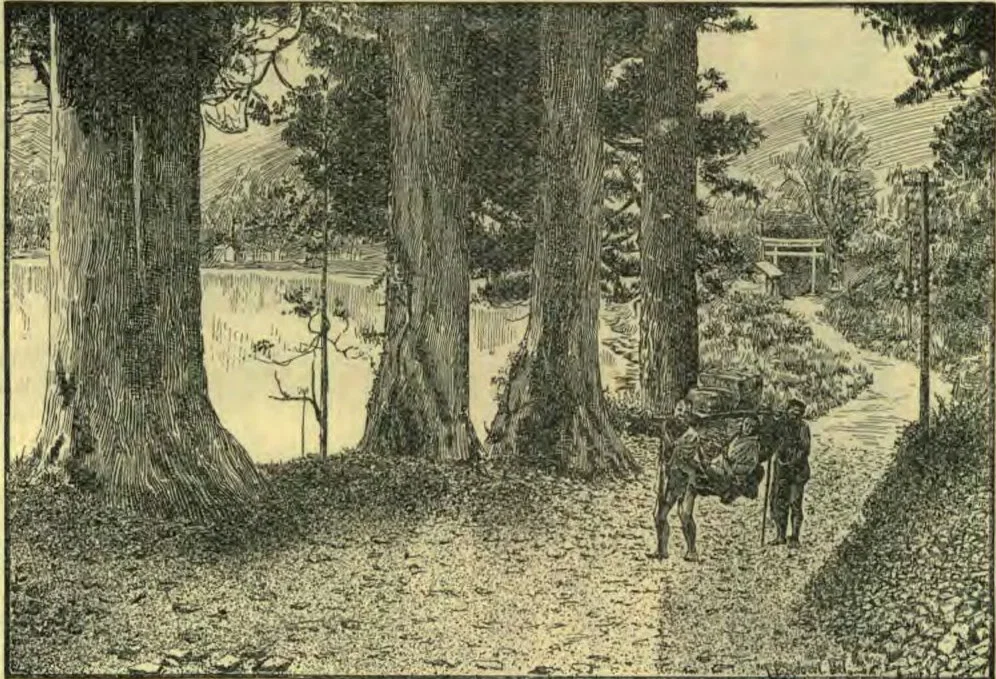
LANDSCAPE SCENE IN THE SUNRISE KINGDOM.
The good Creator has not only endowed Japan with a fertile soil, but gold, silver, and copper are also found in many places. Yet Japan cannot be said to be a rich country. The people are as a rule exceedingly poor. Rajahs, Nabobs, and Mandarins, such as exist in India and China, are unknown in the realms of the Mikado. If there is a failure in the rice crop, it means starvation to thousands.
But for beauty of scenery no country can rival it. Chains of mountains rise majestically all over the landscape, and they are clothed with an almost eternal verdure. Grandly irregular in form, they seem to point upward to the clear blue dome of heaven, as if to say, “We are too lovely for earth, we belong above.” Lower down their slopes waves the golden grain on terraced ground, such as we believed could only exist in a fairy-land. The little bamboo houses, with their pretty thatched roofs, nestle cosily in the ravines, and are only exceeded in uniqueness by their inmates.
The climate is delightful and bracing, and the winter months are just cold enough to impart that vigor to the human frame which seems to be essential in order to make a nation enterprising and successful. It is in this country of majestic splendor that the Japanese have lived for centuries upon centuries, with comparatively little intercourse with other nations.
The natives of Japan are divided into two branches. Both of these are of the Mongolian race. There are the Japanese proper and the Ainos. We will here make mention of the latter division only, and in our next tell something about the former.
The Ainos are the aboriginals, and they differ greatly from the modern Japanese.
In stature they are small, but strong and broad-shouldered. Their complexion, although materially influenced by the sun and well-ingrained dirt, has a brownish tint, which tends to pass into the coloring of the North American Indians. The Mongolian type is strongly marked in the face and in the hair. The face is somewhat angular, with projecting cheek-bones and thickish lips. The nose is depressed at the base, with wide nostrils and flatly-rounded end. The eyes are genuine slit-shape. The hair of both sexes has a luxuriant growth. In the case of the men, with their long, flowing beards, which have never been checked by razor or scissors, it imparts an aspect of manly dignity which the rest of their appearance by no means sustains.
Among the Ainos, the women can hardly be said to constitute the “fair sex.” Their appearance produces a less pleasing impression than that of the men, especially as they still further disfigure the heavy face, with the short kept hair, by a blue tattooing on the upper lip. In the distance this has the appearance of a mustache.
We vainly seek among the Ainos that sense of cleanliness so justly applauded among the Japanese. Nay, it is asserted that with many of them the washing of their bodies is unknown. We will not accuse them of being dirty, but would mildly insinuate that they are strangers to soap and water. They hold tenaciously to the old patriarchal habits and practices, and, despite of brilliant temptations, are extremely loth to abandon their simple implements, which serve chiefly for fishing and hunting; for as yet these children of nature have troubled themselves but little with agriculture and the cultivation of vegetables, even when soil and climate have been favorable.
Their simple clothing consists of a coarse smock-frock, with wide sleeves, open in front, and confined around the waist by a girdle. The brownish yellow thread used for these garments is manufactured from the smooth inner rind of a tree, a kind of elm, known to them as the Ohinyo.
The Aino dwelling is of the crudest kind. It is a low hut, supported on posts driven into the ground. The roof is a structure of poles covered over with reeds. There are but two orifices in these edifices,—one for light and the other for a door. The floor in the interior consists of smooth and down-trodden mud. Around the walls run raised benches, covered with coarse mats. These serve as sleeping- places. Heat, smoke, and vermin, as well as bad smells, make it unbearable for a stranger to stay in such habitations during the summer, while sufficient protection is hardly furnished against the cold of winter.
But little is really known of the Aino language and customs, and darkness to a great extent enshrouds their religious rites. Some authors state that they worship the sun and moon as well as the bear. The bear indeed plays a prominent part in the life of the Ainos. When a young cub has been hunted down by dogs in the spring, it is brought home to the village, and here reared by a nursing Aino woman on milk, as if it were a child. When the nursling has become somewhat bigger, it is fed upon fish, and thus by autumn obtains a considerable size. Then a great feast is prepared, at which it is killed in a peculiar fashion, and eaten with numerous ceremonies. The particularly striking and unintelligible part of this proceeding is the fact that while the young bear is being carefully reared, in the end to be sacrificed, its presence in the Aino household has not merely the object of affording reverence as a fetish, but indeed as a sort of higher and spiritual being. A peculiar custom, however, is the mounting upon the stakes of dead hedges or upon posts near the dwelling-house the skulls of bears which are killed in the chase.
Such are the people who dwell in the northern part of the Island Empire. They are not the Japanese about whom we read and hear so much, and do not seem to take so kindly to the civilized ideas of the West as do their brethren in the central and southern parts of the kingdom. They dwell chiefly in little villages along the coast and on the banks of the larger rivers, but not in the mountainous interior.
In character and morals the Ainos are stupid, brave, honest, faithful, and peaceful. Their method of salutation is a curious one. They raise the hand, with the palms upward, and stroke up and down the face, and then, if it be a man, down the beard.
Some authors assert that the Ainos are the ancestors of the modern Japanese, who inhabit the Central and Southern Provinces. They hold that the masses of the Japanese people are substantially of the Aino stock. An infusion of foreign blood, the long effects of the hot baths, and the warm climate of southern Japan, Chinese civilization, and the agriculturist's instead of the hunter's life, have wrought the change between the Aino and the Japanese.
History says that the early Ainos sprung from the Mongolian race, but their own tradition tells a different but rather an interesting story. They say that long ago a certain prince, named Kamui, in one of the kingdoms of Asia, had three daughters. Owing to family troubles, the youngest decided to leave her father's palace. In the middle of the night she fled to the sea-shore, and embarked in a canoe, with only a large dog for a companion. She went on a long journey to the East, and after many months' travel reached an uninhabited place in the mountains. Here she remained, and the gods sent to her a young boy and girl to be her companions in solitude. Their descendants married one with another, and were men of extraordinary valor and nimble hunters. After spending a long time in the land of their birth, they departed for the north, where they still live on the high and inaccessible table-lands above the mountains. Being immortal, they do not die, but direct by magical influences the actions and destinies of men—that is, the Ainos.
P. T. M.

DO YOUR BEST.

A GENTLEMAN once said to a physician, “I should think that at night you would feel so worried over the works of the day that you would not be able to sleep.”
“My head hardly touches the pillow till I fall asleep,” replied the physician. “I made up my mind,” he continued, “at the commencement of my professional career, to do my best under all circumstances; and so doing, I am not troubled by any misgivings.”
This is a good rule for us to follow. Too many are disposed to say, “No matter how I do this work now; next time I’ll do better.” The practice is as bad as the reasoning. “No matter how I learn this lesson in the lower class; when I get into a higher department, then I’ll study.” As well might the mother in knitting stockings say, “No matter how the tip is done; even if I do drop a stitch now and then, I’ll do better when I get farther along.” What kind of stocking would that be?
As well might the builder say, “I don’t care how I make the foundation of this house; anything will do here. Wait till I get to the top; then I’ll do good work.”
Said Sir Joshua Reynolds once to Dr. Samuel Johnson, “Pray tell me, sir, by what means have you attained such extraordinary accuracy and flow of language in the expression of your ideas?” “I laid it down as a fixed rule,” replied the doctor, “to do my best on every occasion, and in every company to impart what I know in the most forcible language I can put it.”—Well-Spring.

THE SAW OF CONTENTION.

“O FRANK, come and see how hot my saw gets when I rub it! When I draw it through the board, it’s most hot enough to set fire to it.”
“That’s the friction,” said Frank, with all the superior wisdom of two more years than Eddie boasted.
“Yes,” said sister Mary, who was passing, “it’s the friction; but do you know what it makes me think of?”
“No! what?” asked both the boys at once.
“Of two little boys who were quarreling over a trifle this morning, and the more they talked the hotter their tempers grew, until there is no knowing what might have happened if mother had not thrown cold water on the fire by sending them into separate rooms.”
The boys hung their heads, and Mary went on,— “There is an old proverb which says: ‘The longer the saw of contention is drawn, the hotter it grows.’” —Selected.

THE JAY.

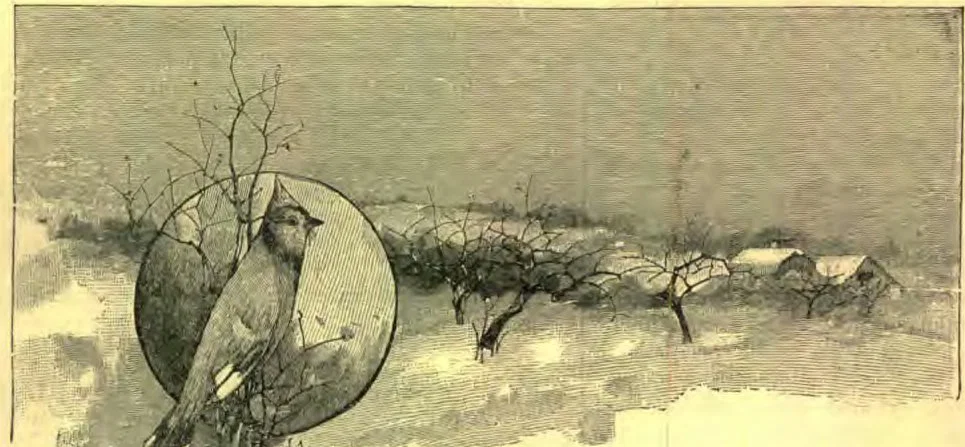
“WHEETEE, wheetee, wheetee!” “Do you hear?— What is it sounding far and near, Out where the chilly north wind blows?” “Wheetee, wheetee!”—“Listen—there it goes!”
“Wheetee, wheetee!” “Ah, I see, I see! Out in the leafless alder tree.” “Wheetee, wheetee!”—“How he chirps away, That saucy beauty, the brave blue jay!”
“Poor little bird, why don’t you go Far from the land of ice and snow; Fly with your dainty wings away Where flowers and sunshine always stay?”
“Where do you look for seed or crumb Now that cruel Jack Frost has come? Where do you hide your pretty head When all the flowers and leaves are dead?”
“Wheetee, wheetee!—why, I cannot tell Who it may be that loves me well; But surely, little one, some one cares How the poor little birdie fares.
“Does some one, somewhere, loving and true Watch with tenderness over you?— When you thank Him, whisper a word For me. He cares for the winter bird.”
—Sydney Dayre.

THE FAIRIES’ GIFT.

Last Christmas Harriet’s grandma came over to spend the day. She brought a red silk bag with a big ball of yarn in it, and a shining set of knitting-needles. They twinkled and glinted at Harriet from the top of the bag, as it hung in the sun on the tall post of grandma’s chair.
“Dear me!” sighed Harriet. “I’m sure grandma means them for me. Hateful things! It makes me tired to look at them!”
“Yes, dear, it is for you,” said grandma, as she saw Harriet looking at the bag. “You know your tenth birthday will come pretty soon.”
“Just the same as General Washington’s, grandma!” cried Harriet eagerly, thinking of a present she would like very much on that day. “But he didn’t have to knit—not as ever I heard of.”
“He did his duty, whatever it was, dear,” said grandma kindly; “and it is yours to learn to be useful, and help mamma knit and sew.”
“Wouldn’t it be wise, grandma, if the fairies could bring our stockings and frocks all sewed and knit?”
Grandma laughed. “No, no, my dear! That would never do. But I believe in fairies, too, and if you take hold and knit this yarn into a pair of stockings for yourself,—there’s just enough,—these fairies I am thinking of will bring you something you want very much.”
“Are you sure, grandma?” queried Harriet.
“Certain and sure!”
“But how can they, grandma? Tell me how!” insisted Harriet.
“You’ll see!” And grandma’s eyes twinkled merrily.
A stocking was “set up,” and the nimble fingers began their long journey,—“click! click!” The needles seemed to chuckle at the little girl’s distress, and Harriet was almost tempted to throw her stocking, ball and all, into the well at the barn. Only the thought of the fairies kept her fingers going.
At the end of a month grandma “toed off” the first stocking. Then the ball began to dwindle very fast, and the two big, anxious wrinkles above Harriet’s nose began to dwindle, too, till finally on her birthday there was but little left of either. She took her bag on her arm, and skipped across the fields to grandma’s house for another “toeing-off.”
Grandma was knitting a double mitten before the fire, and Harriet brought her little chair up to grandma’s knee. Away went their needles,—click, click! clatter! clatter! The flames leaped and danced, the coals snapped, the teakettle sang a tune.
All at once there was a “chink” in Harriet’s lap. With a shout the little girl hopped out of her chair, and went dancing about the kitchen, holding high in her hand a tiny gold locket, and a slender gold chain.
“And to think, grandma, ’t was right in the middle of my ball all the time!” cried Harriet. “But you said the fairies would bring it, grandma!”
“So they did, dear,” laughed grandma, spreading Harriet’s brown fingers on her knee. “See! here they are. And these ten little fairies will work greater wonders, if you will let them, than all the fairies in a whole shopful of story-books.”
“Just my own fingers, after all!” thought Harriet, as she ran over the snow toward home, her red silk bag swinging on her arm and her “fairy” gift about her throat.—Our Little Ones.

GETTING AHEAD.

“Ethel, have you seen my ball?”
“O Ned, I took it to—”
“You took it, did you? What business had you to take it? Where is it?”
“I—don’t know. I took it yesterday because Allie Rande and I wanted to pitch it. I forgot to get it when we were done pitching, and when I looked for it to-day, I couldn’t find it.”
“Just like your carelessness. And now I want to play, and my ball’s gone. I’ll get ahead of you, you’ll see.”
Ethel was sorry for having lost the ball, and was about to say so, but she was as quick of speech and of temper as her brother, and now became angry in her turn.
“O, I suppose you’ll do something as hateful as you can. You’re smart at that. Most boys are.”
“A soft answer turneth away wrath.”
Mamma spoke from the next room as Ned slammed out of the house, and Ethel went to her.
“You ought to say that to Ned, I think, mamma,” said the little girl. “Did you hear how he spoke to me?”
“Yes, and I was sorry.”
Mamma did not say any more, which perhaps made Ethel feel the more sorry for what she herself had said.
“I know Ned will keep his word,” she said. “He’ll be sure to do something spiteful to me before night. Mamma, I think you ought to make him kinder to me.”
“No one but yourself can do much at that sort of making, Ethel.”
“I’d be glad to if I could. I’m sure it’s a real trial to have Ned so cross to me when he’s all the brother I’ve got. Allie Rande’s brother is nice to her all the time.”
“How is Allie Rande to her brother?”
Ethel did not answer, but the question set her to thinking as she walked out upon the piazza. Some of the boys were passing on their way to the ball-ground, and she began to feel more sorry for having lost the ball. Sorry, too, for the angry words she had spoken.
“Allie Rande is always good to her brother, I know. Perhaps that is the reason he is so good to her.”
Crowding upon the little girl’s mind came many remembrances of hasty words and of unloving acts, which had, she could not help feeling, been the reason of much of Ned’s unbrotherly conduct to her.
She was to go over to Allie’s, but as she reached the gate, a new thought struck her.
“I lost the ball, and I ought to find it. I’ve a great mind to go and hunt for it.”
She turned toward the meadow in which she had played with her little friend.
“But I do want to go to Allie’s. Ned doesn’t deserve that I should give it up for him. He probably won’t even say, ‘Thank you.’”
Still the reflection that it was unfair and wrong for her to take her brother’s ball without leave, and then make so little attempt to return it to him, forced her to pause as she turned in the direction of Allie’s home.
“I will find that ball if it takes me all the afternoon.”
With a determined face and very firmly set little feet, she made her way to the meadow. The grass in places was high enough to have well hidden a dozen balls.
“Now, I stood here, and Allie stood there. But I can’t remember which of us threw the last ball when we heard the tea-bell ring, and Allie ran home.”
It took a long time, so long that nothing but her resolve to be better to Ned in future would have kept her to it. She thought the afternoon must be almost gone by the time she joyfully sprang toward the ball as it lay hidden behind a tuft of grass. But the sun was still high, as she looked up at it.
“He looks as if he were smiling and blinking at me, as if he wanted to say, ‘You’ve done pretty well, little girl.’ Well, now I’m going to try the soft answer on Ned. I’m going to put the ball in his room where he’ll see it the first thing when he goes there. And—yes, I’ll put some of my gum-drops with it. Ned likes things to eat. Boys always do.”
In the meantime Ned hung discontentedly about the playground, unable to join in the sport for want of his ball. At length he tired of watching the others.
“I’ll take a scamper over the hill, and see if those nuts are ripe enough to gather,” said he.
A quick turn took him over the brow of the hill, then along the edge of a grove in which the boys had had many a lively nutting frolic. He carefully examined the chestnut and hickory trees.
“No, it’s a little early yet. Phew!—don’t these burrs prick, though! We’ll have to wait a week or two yet, and then the frost’ll set the nuts pattering down. If there isn’t some golden-rod, the first I’ve seen! Wouldn’t Ethel fairly squeal if she could see it?”
He broke off a few of the glowing blossoms, then hesitated.
“But I’m not going to pick flowers for her. I said I’d get ahead of her for losing my ball, and I’m going to. I’ll teach her to let my things alone. But I’ll take some golden-rod to mamma.”
The glory of the autumn sunshine seemed to give additional brightness to the gold which was breaking out into a delicate fringing between the tinted trees and the browning grass. And, as he gazed, its radiance seemed to go straight to the boy’s heart, driving from its deepest corner every angry, revengeful thought. A bright smile spread over his face as he added one stalk after another to his shining burden.
“I said I’d get ahead of her, and I will,” he said, the smile deepening to a laugh. “I’ll play as good a trick on her as ever was heard of.”
As Ethel reached home, she heard Ned’s step in the upper hall, and stole up to see if he had been to his room.
“O dear! he’s been to mine. I know he’s been doing something to scare me. I’m afraid to go to it. Now he’s gone to his room. I’ll just peep—”
Opening her door very carefully, she took a very sharp look around the room.
Nothing dreadful was in sight—nothing to frighten or hurt her. And her eye had not searched half the corners before it fell upon the bunch of golden-rod.
“Oh! Oh! how came it here?”
Ned was again in the hall, and stood looking at her with a smile which seemed to reflect the gold.
“O Ned—I do believe it was you! Was it? O Ned, you’re the dearest brother! But I thought you were going to ‘get ahead’ of me for losing your ball.”
“I thought so, too,” said Ned, showing the ball and the candy gift in his hands. “But I can’t, you see. It’s you that have got ahead of me.”
“You’re both ahead, I think,” said mamma, who had just come. “It’s a good way to get so.”
“Say, Ethel,” said Ned, earnestly, “let’s keep so.”
And we may be sure that Ethel agreed with all her heart; also that other brothers and sisters, if they will try the same way, will agree with mamma and Ned and Ethel that it is a good way.—Sydney Dayre.

Unselfishness and Kindness Win Love

If you wish to be loved, be unselfish, thoughtful, and kind always looking for good in those about you.

The Highest Form of Christian Life

THE highest form of Christian life is self-denial, for the good of others.
Continue reading: FUSSY