Your ShelfYour Projects

Review and Herald, Vol. 75, No. 9.

TRUE CHRISTIANITY
Earlier text: HOW TO SPEAK

The Sanctification of the Spirit Unto Obedience

THE gift of the Holy Ghost, “the sanctification of the Spirit,” is “unto obedience.”
Disobedience to God it is that has brought all the trouble and woe upon the whole world; so that the children of men are at the same time “the children of disobedience.”
But the Lord Jesus gave himself for us, and “suffered for sins, the just for the unjust, that he might bring us to God,” that he might bring us unto the ways of obedience. “We are his workmanship, created in Christ Jesus unto good works, which God hath before ordained that we should walk in them.”
But “obedience is not a mere outward compliance;” it is “the service of love.” The obedience is obedience to God. The love, then, from which springs the service, is only the love of God. “The love of God is shed abroad in our hearts by the Holy Ghost which is given unto us.” “For this is the love of God, that we keep his commandments.”
Therefore it is written, “Ye have purified [sanctified] your souls in obeying the truth, through the Spirit.” Sanctification is “of the Spirit” only. Sanctification is “through the truth” only. The Spirit is only “the Spirit of truth.” The commandments of God are only “the truth.” And true obedience to that truth can be only “through the Spirit.”
All trying to keep the commandments, all trying to obey the truth, all trying to do anything, without the Spirit of God, is altogether vain. “God is a Spirit: and they that worship him must worship him in spirit and in truth.”
“Without me ye can do nothing.” “Receive ye the Holy Ghost.” Then, strengthened with might by his Spirit in the inner man, Christ dwelling in the heart, and filled with all the fulness of God, you and I can do all things through Christ, which strengtheneth us.
This is sanctification of the Spirit. This is obedience. And it is sanctification of the Spirit unto obedience.

U. S

“I PRAY not,” said Christ, when supplicating the Father in behalf of his people, “that thou shouldest take them out of the world, but that thou shouldest keep them from the evil.” Thus it does not seem to be the purpose of God to exempt his people from the conflicts in this world necessary for their discipline, but to preserve them in the struggle, and keep them from the evil. With every temptation a way of escape is provided. The psalmist gives utterance to the same sentiment: “Cast thy burden upon the Lord, and he shall sustain thee.” This is a very plain injunction how to act under certain circumstances, and a precious promise is connected therewith. Mark what the promise is. It is not that he will take the burden from you, so that you will have no burden to bear, but that he will “sustain thee;” and that is more blessed still. Not a release from discipline in the school of Christ, but wisdom and grace to bear it, and make the best use of it. It is as if you were carrying a heavy load, which seemed sufficient to crush you to the earth, and some friend should come to your side, and put his shoulder with yours under the burden, or throw a supporting arm about you while you go forward. Better to walk with the Lord in the dark, than go alone in the light. And this is what it is to cast your burden on the Lord,—it is to let the Lord come into your heart, and walk by your side, and lend you his divine assistance. He will sustain you; for “he careth for you.”

U. S

A PECULIAR PEOPLE.

SPEAKING of those who are to be looking for Christ in the last days, Paul writes to Titus as follows: “Who [Christ] gave himself for us, that he might redeem us from all iniquity, and purify unto himself a peculiar people, zealous of good works.” Titus 2:14. This is an expression of great force, and beauty, and encouragement; but these features of the text are often lost sight of by a misunderstanding of the word “peculiar.” In its common colloquial sense, it is applied to anything that is strange, odd, or unusual; and some seem inclined to give it the same signification here: then when they are criticized for being, in their dress, speech, or actions, odd, uncouth, or fantastic, they reply, “O well, that is all right; for does it not say that the Lord is to purify to himself ‘a peculiar people?’”
But that is not the meaning of the word “peculiar” in this passage. As here applied to a people, it means a people who are peculiarly and specially the Lord’s. It refers to a people whom he will consider a special treasure unto himself. They are those to whom the Lord refers in Mal. 3:17: “And they shall be mine, saith the Lord of hosts, in that day when I make up my jewels; and I will spare them, as a man spareth his own son that serveth him.” Such a people the Lord will gather out to represent himself and his truth in the last days. The passage, therefore, should not be understood as meaning that the Lord will purify to himself a strange, odd, uncouth, and dowdy people, acting in ungentlemanly, uncultivated, and repulsive ways; but rather, a people who will be peculiarly and specially precious in his sight because, in their life and character, they properly represent him before the world. Such a people he is now calling out and purifying to himself. Who will join the ranks?
In Ex. 19:5 we find the word used in the same sense, as follows: “Now therefore, if ye will obey my voice indeed, and keep my covenant, then ye shall be a peculiar treasure unto me above all people;” and the same in Deut. 14:2, where Moses, forty years afterward, rehearsing how the Lord was fulfilling his word unto them, says: “For thou art an holy people unto the Lord thy God, and the Lord hath chosen thee to be a peculiar people unto himself, above all the nations that are upon the earth.” And under the gospel it is proposed that the Lord’s people shall occupy, in a spiritual sense, a corresponding position; for Peter says: “But ye are a chosen generation, a royal priesthood, an holy nation, a peculiar people; that ye should show forth the praises of him who hath called you out of darkness into his marvelous light.” 1 Peter 2:9.
And this meaning of the word “peculiar” is in full accord with its immediate context in Titus 2:14; for there we have the statement that Christ gave himself for us, to redeem us from all iniquity (anomias, “lawlessness”), and to purify, or cleanse, us from everything offensive in his sight. When such a work is wrought for any people, they will, of course, be peculiarly precious to him.
And what will be the badge by which we are to show when we have reached this position? — Not any oddities and eccentricities in dress or action; not anything which would unpleasantly attract the attention of the people, and lead them to regard us with the same curiosity and gaping wonder they would a circus or a menagerie (they will do enough of that in any case); but our badge is to be a zeal for, and perseverance in, good works — “zealous of good works,” says the text. The same apostle (Gal. 6:9) further encourages us in this course when he says: “And let us not be weary in well doing: for in due season we shall reap, if we faint not.” Peter also exhorts us to commit the keeping of our souls to God in well doing, as unto a faithful Creator.
U. S.

FRANCES E. WILLARD.

MRS. S. M. I. HENRY.
I SHALL never forget my first impression of Frances Willard. I was living at Rockford, Ill., and Miss Willard had just come into the temperance work, and been made president of the Chicago union. She wrote asking me to come to Chicago, and assist her in organizing the work. I was to meet her at a certain church, to which I went directly from the train, and began to search for the place where the women were gathered; but I was early, or the others were late, I have forgotten which. I could not find any one, so I walked around, and went up the stairway to the audience room; but no one was there. Finally I heard voices, which I followed, and found two or three women in the basement. It was a December day, and Miss Willard was sitting beside the furnace. She arose and greeted me in her characteristic fashion, which it is impossible to describe; but every one who has ever seen her will remember the wonderful charm with which she invested every act of her life, and can understand the gentle grace of the greeting which she gave me. From that moment I have loved her, and our hearts were knit together in the warmest ties.
There were not many of us in those days of the first reaction from the “crusade” enthusiasm; but we had felt the burdens of others, and that we must carry on the work which had been given to us. The women who had suffered from the curse of intoxicating drink in their homes could not face the battle. Those who had seen their substance waste away, and had become obliged, at the hardest, to pick up their bread for themselves and their little children, had come to recognize the saloon as an engine of destruction pointed directly against them; but, as a rule, they had no courage left with which to wage a war against it. If they had been left to do this work, I think it would never have been done. The deadly power of this great evil would have gone on unchallenged had not God opened the eyes of those who had never been touched personally by the curse, and laid upon them the sorrowful burden of others.
Miss Willard had never been touched by drunkenness, at least she did not know at that time that it was lurking near her; but she had been interested in the progress of the crusade, and when the call of God came to her, she was ready for her work.
A copy of her “Glimpses of Fifty Years” she presented to me on my own fiftieth birthday. The inscription, which is in her own handwriting, is this: “To my beloved friend and comrade in the work of Christ, Mrs. S. M. I. Henry, on her fiftieth birthday, from Frances Willard.”
I think that I can do no better than to help my readers see her as fragments of her own story will reveal her to us.
First of all, I want to say that few books have been criticized more than this one; but the criticisms have been on the very points that make it valuable to us. She wrote it for us, at the request of her own women, who wished the simple facts of her life as a legacy to their daughters and sons. She was not one to thrust such a personal history upon an unwilling public; but she was one to sacrifice all personal feeling to serve her comrades in the cause by any possible means.
In her account of her first going away from home, she says: “I was determined to teach school, because I wanted to be independent. . . . So the arrangement was made, and my father accompanied me to Harlem; for with his ideas of the protection that should be accorded to women, he could not conceive of my going there alone, although I was in my twenty-first year.”
Then she tells of her first meeting with one who became a lifelong friend,—an incident which shows how she was then the same spirit that we have known, true to conviction, but unobtrusively keeping out of the way. It was her first meal in the home where she was to board. The daughter of the house had come into the room at supper-time, and on seeing a demure young stranger there, acted as if she did not like it. Miss Willard, keenly susceptible, felt deeply pained, and went to her room with a sense of loneliness and homesickness. She says: “I did not cry; for I had made up my mind that I would not. It was clearly a case of ‘mind cure;’ for the occasion certainly warranted a demonstration. Pretty soon there was a rap at the door, and Miss Clara came smiling in, grasped the situation at a glance, spoke to me with great gentleness, and said, ‘You are lonesome, aren’t you? It is too bad. I wonder if you would not rather come to my room?’ From that hour to this we have been warm and trusted friends.”
“I was glad to leave my little bare room for hers, so much more tasteful and attractive, but here was a new dilemma. I knew that it was my duty to kneel in prayer before retiring, as had been my custom all my life, excepting a few weeks of my first term in Evanston; but I knew, from various indications, that Clara had not been trained to do this. She was a gay, laughing girl, and I dreaded her criticism; but when the time came, I lifted up my heart to God, and fell upon my knees beside the bed, feeling myself to be a spectacle, and with a sense of sacrifice which, absurd as it was, cost me more than anything I had done for many a year. But in a moment this generous-hearted girl had knelt beside me, with her arm around my neck, and from that hour she became thoughtful concerning spiritual things.”
Thus in her girlhood life true to her convictions, she was made an instrument in God’s hands for winning a soul,—a soul who became a power in Christian circles.
Her brother, Oliver Willard, was editor of the Chicago Daily Post and Mail, and speaking to her one day about the crusade, he remarked: “I shall speak just as well of the women as I dare to.” “A most characteristic editorial remark,” says Miss Willard, “I have since thought, though more frequently acted out than uttered. Meanwhile it occurred to me, strange to say, for the first time, that I ought to work for the good cause just where I was—that everybody ought. Thus I received the arrest of thought concerning which, in a thousand different towns, I have since then tried to speak.”
It was in these words of her brother that Miss Willard recognized at least one syllable of the call of God to her to work for the cause which these same women had espoused, and to share with them in whatever it would bring.
Just a few lines will give an idea of how she came to espouse the cause of unfortunate women, and became the world-wide apostle of “a white life for two.” They are the closing words of her first address upon the subject:—
“When I was first a boarding-school pupil at Evanston, in 1853, a young woman who was not chaste came to the college through some misrepresentation, but was speedily dismissed. Not knowing her degraded status, I was speaking to her when a schoolmate whispered a few words of explanation that crimsoned my face suddenly; and grasping my dress lest its hem should touch the garments of one so morally polluted, I fled from the room. It was, no doubt, a healthful instinct which led me to do this; but I am deeply grateful that the years have so instructed and mellowed my heart that, could the scene recur, I would clasp that poor child’s hand, plead with her tenderly, and try to help her instead of deserting her, as I did in my more self-righteous youth.”
This shows the absolute justice with which Miss Willard treated herself in this which is to be her own memorial for all time, not sparing herself in regard to a circumstance which she always remembered with a feeling of shame.
Miss Willard took upon herself the burden of this social-purity work because there was in it that which promised only criticism and contumely. She would not have it laid upon any other woman, but bared her own breast to the shafts of an indecent world, outraged at any effort to bring purity out from under the shadow of its contempt. One of the most beautiful traits of Miss Willard’s character was her absolute unselfishness and simplicity in her relations to others. She was like a true homemaker, who takes upon her own hands that which she thinks no one else would like to do.
Those who have seen her, know of the wonderful grace with which she presided over a meeting. I do not know of any man or any other woman who has the power over an audience that Frances Willard had. At the great conventions, just the moment she came upon the platform and took her place as presiding officer, however everything might have been “cut and dried,” whatever formality might be in the arrangements, the audience, large or small, became simply a company of “our folks.” People have come thousands of miles to a convention just to watch the inimitable grace and tact with which she would “manage.” Over one thousand were at the last convention in Buffalo, who were not delegates, but were drawn thither largely by the peculiar attraction of Frances Willard’s presence and power.
I think it is perfectly safe to say that Frances Willard was the greatest woman the world has ever produced. This may sound startling, but not one will object that this is not the greatest age of achievement since the world began,—the greatest in wide-spread light, in the application of principles, in the attainment of every high and noble enterprise. That being so, the one whose influence reaches farthest for every good cannot be second to any. There may have been women greater in some one line; but take her in her completeness; her pure, beautiful simplicity; her single-heartedness; her unselfish “preferring” of others; her devotion to what she believed to be true; that broad inclusiveness that could take the women of the world as she found them, as the narrowness of bigotry had left them for her to find and make over,—women of every faith, of no faith, of nearly every nation, tribe, and people on the earth, and unite them into one harmonious union,—all this being so, who shall deny the claim which we make for our departed leader,—that her peer has never been known in former ages, and surely not in this?
What will result from her loss is hidden in the bosom of God. But I believe that the W. C. T. U. is a plant of his own planting; that Frances Willard was his appointed agent in bringing it to its present position; and that he has control of its future.
As for her, she has stepped from the zenith of her fame into the rest that awaits the chosen ones. It is a loss that we feel we cannot afford; but God’s time could not but be the best time for her, and it cannot be an ill time for us. Her life was hid with Christ in God; so it must have been God’s hand that drew her to her rest.
Her work is her best monument; but one thing we of the W. C. T. U. should lay to heart. The Temple was to her a living issue from the first inception of it in the mind of its builder. She had determined that its debt should be paid; she had started out to begin her self-appointed task, and she has left that unfinished task a legacy to every White Ribboner. Let it be promptly paid, and the Temple left to stand as a monumental pile sacred to her memory until our Lord shall come.

IT STILL LIVES.

MANLY pluck is so scarce nowadays, even in the story-books, that when we find an instance of it in real life, we desire to let everybody know it. Also we love to honor the manly man who displays the manly pluck. Therefore we gladly print the following “true story” from the World:—
A blue-coated official waded through a few pools of melted snow in the district of the Bronx, and finally mounting the big pile of well-frozen slush, beheld a gang of “white wings” laboriously working away with pick and shovel and brush. Bossing the job was a young man in the gray uniform of a foreman. The blue-coated officer evidently was looking for this same young man; for his eyes rested upon him, and, hat in hand, he politely inquired: “Is this Mr. Hines, the commissioner’s secretary?”
“No; this is Mr. Hines, the street-sweeper,” answered the young man.
“You’re mistaken,” answered the blue-coated one, politely; “you’ve just been appointed. The commissioner wants to see you.”
Whereupon Joseph Hines left the mud and the slush, and reported at the handsomely furnished rooms of the Street-cleaning Department in the New York Life Insurance Building. He was escorted to a fine roll-top desk, and told that he could sit there as long as he behaved himself.
This was on Monday. Mr. Hines was sitting there yesterday when a World reporter found him.
“I never met Commissioner McCartney in my life,” he said, “until I was called before him, and told that I had been appointed as his private secretary. I had hoped to be made a foreman, but beyond that I did not even dream of anything. I suppose it’s all right,” he said, with a laugh, “and that I won’t wake up, and find myself up in the Bronx. But don’t pinch me too hard, because I may be asleep, after all, and this is a very pleasant dream. Seriously, though, I think I know enough about office-work, and particularly of the work in this department, to fill the position, and I am going to try hard to hold the job.”
Mr. Hines was born in the first ward. After a few months spent in a big steamship office, he entered a wholesale carpet house. He rose from office boy to clerk, and at twenty-seven years of age was buyer, with a large salary. He married a charming New York girl, and went to live in a fine flat on the East Side. Then came reverses. The firm for which Hines worked began to reduce expenses. He was thrown out of employment, and as vacancies in his line are few and far between, he soon found his little savings gone. There was a wife and child to look after now, and Hines, having tried almost every field, made up his mind that he would have to get down to every-day laboring work.
And so he called upon a political friend to get him, if possible, any position in the Street-cleaning Department. “Larry” Delmour, then the leader in his district, went to commissioner Waring, and asked him to find room for the young man. Colonel Waring said that he could give him a job at cleaning the streets, and Delmour went back to the young man very much discouraged.
“That’s all right,” said Hines; “I’ll take the job right away. I’m not going to sit around and see my family starve, when I can earn $1.64 a day with a broom.”
So Hines reported for duty in the district of the Bronx. But he didn’t have to handle a broom. The inspector saw at once that he was a bright, intelligent young man, and made him a clerk in the stables. Soon afterward he was appointed acting foreman of a gang of laborers. But all the time he continued on the pay-rolls as street-sweeper!
Hines’s friends, among them Maurice Featherston, promised to try to get him a position as foreman; but Commissioner McCartney, after reading the recommendations, decided that he was just the sort of man he wanted as his private secretary. He had never seen Hines, but after hearing of his plucky struggle with poverty, he felt safe in making the appointment, so he sent a message to Hines to report for duty.
The salary of the commissioner’s secretary is $1,500 a year. The young man had been compelled to move to a very modest home, but now he will move back to his old district, and live comfortably.
“You see,” he explained, yesterday, “I had to move up to the annexed district because I didn’t have enough money to pay car-fare or buy lunches, but I guess better times are coming now.”
If this bright young man had got so “stuck up” when he was prosperous and had a big salary, that he had thought it beneath him to take honest employment, however plain and humble, when he was in adversity, you can see plainly enough that he would have always stayed in “adversity;” but he would have had nobody but himself to blame for it.
Never be afraid to “step down.” If you “step down” in the right spirit, you will presently find that you have stepped up, in what was seemingly a great stepping down. “Adversity” is not always adversity. Long, long ago one of the most eminent men of his time was by experience constrained to exclaim to his happy family, on a happy occasion, “We should have been ruined, had we not been ruined!”
Manly pluck still lives, thank the Lord! Be a manly man, with manly pluck. May Mr. Hines live long and prosper always, as he has since he first took that broom in his hand at $1.64 a day. And let all the people say Amen.

IN THE SCHOOLS.

CHURCH SCHOOLS.—January 24 I left Battle Creek for Indianapolis to attend the first parents’ and elders’ school, so far as I am aware, that was ever held. I found a good number from outside Indianapolis in attendance. These, with the members of the Indianapolis church and a few persons not of our faith, made a school of about a hundred and fifty. The object of the school was to bring the parents and church-elders together for the consideration of the best methods of work in the home and the church. Regular daily classes were conducted, and the students were invited to ask questions freely, and to make suggestions. All seemed to desire earnestly to know what the Lord had said on these subjects, and a statement from the word of God settled all inquiries; there was no attempt to urge pet plans. The Bible and Testimonies are complete and explicit on every point touching the home and church; and just how much we have lost by not studying these, we do not know; but God says that even now we can redeem the time.
Dr. C. C. Nicola used a method in the health studies which is worthy of notice. The new text-book used by the whole school was the book “Healthful Living.” The lessons were read, paragraph by paragraph, by the members of the class. Questions were asked to direct the mind to the scientific principles on which the statements in the Testimonies rested, thus fastening the truth upon the mind in two ways, making it difficult to forget. Besides, it is thus possible to approach those who do not believe in the Testimonies with scientific reasons for the principles which we gather from them.
Mrs. S. M. I. Henry gave valuable instruction to parents; a number of people outside our membership attended her meetings. One afternoon was given to the members of the W. C. T. U., and Mrs. Henry delivered a lecture. This made a good impression upon all. Elders Morrison, White, and Van Horn gave timely instruction to the elders of the churches. Elder White gave one talk to the elders, which, I hope, will appear in the REVIEW.
A few lessons were given by the writer, presenting God’s plan for educating our children. The last evening of the meeting the church at Indianapolis raised fifty dollars with which to equip a church school; over thirty pupils were pledged for one term, the tuition to be one dollar a month. A school board of five members was elected, and it is expected that the school will be opened March 1.
From Indianapolis I went to Farmersburg, in southwestern Indiana, where one of the first church schools was opened by the Battle Creek College, under the direction of Professor Tenney. Sister Maud Atherton has been in charge. I spent two days visiting the school and brethren. The attendance has been about twenty-five. Sister Atherton “boards around,” thus becoming well acquainted with children and parents; on this account she is able to help them more than she could if she did not come into such close contact with them. The parents and Miss Atherton co-operate harmoniously with one another, which is a most essential thing in character-building, and difficult to accomplish in a secular school. All her pupils have heard their teacher pray in their own homes, which would naturally have a great influence for good over them; for, if there is any one besides the parents who exerts a strong influence over children, it is their teacher. The brethren here are poor, and are obliged to hold their school in the church building. The pulpit is curtained off, shutting it from the view of the children. During the time I was there, the behavior of the pupils was much better than in the average Sabbath-school; for they had been instructed from the first day that they were in God’s house. The pupils all expressed themselves as anxious to prepare for missionary work.
From Farmersburg I went to Salem, which is about twenty-five miles southeast. Sister Mattie Pease is the teacher there; this school is also held in the church. In the lessons I heard recited, seeds of truth were planted in the hearts of the pupils which will surely yield fruit. It would have done good to any lover of the word of God to hear little boys and girls tell about the fall of man, the nature of sin, and the plan of redemption. The recitations were much different from the average Sabbath-school recitation. The children had studied these subjects for days, just as they would have studied a lesson in geography or arithmetic, and they were intensely interested. It was not a lesson tacked on for the occasion. They talked of those things that had been permeating their hearts and minds for weeks; if you had watched them in their work and play, you would have been convinced that as a man “thinketh in his heart, so is he.” Sister Pease also “boards around.” She loves her work, and is of great help to the brethren and sisters.
A good influence has gone from this little school throughout the whole community. The parents of fifteen children have become so deeply interested that they have arranged to place their children in the school next term, which opens in March. With those she now has, Sister Pease will have about twenty children in her school from families not of the Adventist faith. No effort is made to proselyte these children; they are taught in the correct way, and their parents are just as well pleased with the true principles of education as they are with the true principles of health.
There had been considerable sickness in the community, and Sister Pease had used her knowledge as nurse. One old gentleman heard of her work, and thought she was a physician, and so sent word to the “woman doctor,” as he called her, inviting her to his home, and offering her free board if she would come and give him some instruction in health principles. Sister Pease went there once, and had a very profitable visit; she expects to go again.
I next visited the church school at Milton Junction, Wis. The brethren have rented a building, and use part of it for the school. I found twenty-nine pupils, who are deeply interested in their work. Sister Waters conducts her work on practically the same plan as that followed in the schools already mentioned. The people of Milton Junction and Milton, just one mile distant, are considerably stirred up; a number of outside students have been enrolled, and I was told that two families wished to place six children in the school if it did not fail. Many think that our people will soon grow tired of the plan, and send their children back to the public schools. In this I believe they will be disappointed; for our brethren at Milton Junction are all of splendid courage, and intend that their children shall have a Christian education. The tuition was raised to one dollar a month. With their strong school board, they can make this school into a small industrial school, which will employ several teachers. Since I left, a man has agreed to contribute $500 toward the enterprise.
The opening of these church schools is the beginning of a new era among Seventh-day Adventists. The principles of true education are to be introduced in them, and carried out to the whole world. Thousands of our young people will give themselves to the Lord, and will make speedy preparation to go out as missionary teachers. In a very recent Testimony these words occur: “There should be schools wherever there is a church or company of believers; teachers should be employed to educate the children of Sabbath-keeping parents.” It will not be long before ministers will feel that it is a part of their work to establish a school wherever a church is organized. The contest between true education and false will be fierce, but not long. The Lord says: “Now, as never before, we need to understand the true science of education. If we fail to understand this, we shall never have a place in the kingdom of God.”
E. A. SUTHERLAND.

URUGUAY AND ARGENTINA.

I have just finished my visit to Uruguay. Although the brethren have passed through some severe trials during the revolution, they lost no property, and the Lord granted them special care and protection. Over a year had passed since I last visited them, but they were still of good courage. After a few weeks’ labor, twelve precious souls were added to this company by baptism. Their tithe and donation the past quarter amounted to over three hundred dollars in gold. May the Lord bless that little church.
In Argentina the work is still prospering. Brother Vuilleumier reports a number of souls converted in Las Tunas. Brother McCarthy is laboring with excellent success in the province of Cordova. In Buenos Ayres some souls have begun to obey the truth under peculiar trials. Brother and Sister Snyder are working among the Spanish-speaking people in Buenos Ayres with some prospect of success, as some have already embraced the truth. Sister Post has a wide circle of acquaintances among the Scotch people, and is working earnestly for them. The Lord has blessed the labors of Brother Oppegard. The message is onward in this field. Brother and Sister Town are of good courage. There is a feeling of good cheer and courage among all the workers in this field. We praise the Lord for this, and for his presence with us in this southern country. F. H. Westphal.

DISTRICT 2.

January 21–24, in company with Brother Crisler, I was with our people at Barberville, Fla. Brother Huffman remained with the company at Orlando, holding meetings there until the 24th, when he joined us at Barberville. The members of our church at this place live from six to thirty-five miles away, and meet in their church building for general meetings. The Sabbath-school of those residing in the place numbers about twelve. Our people in that part of the State were well represented in our general meeting. It was my privilege to speak to them seven times. Elder Crisler spoke twice, and Elder Huffman once. Our meetings were full of interest to our people, and to those who came in to hear.
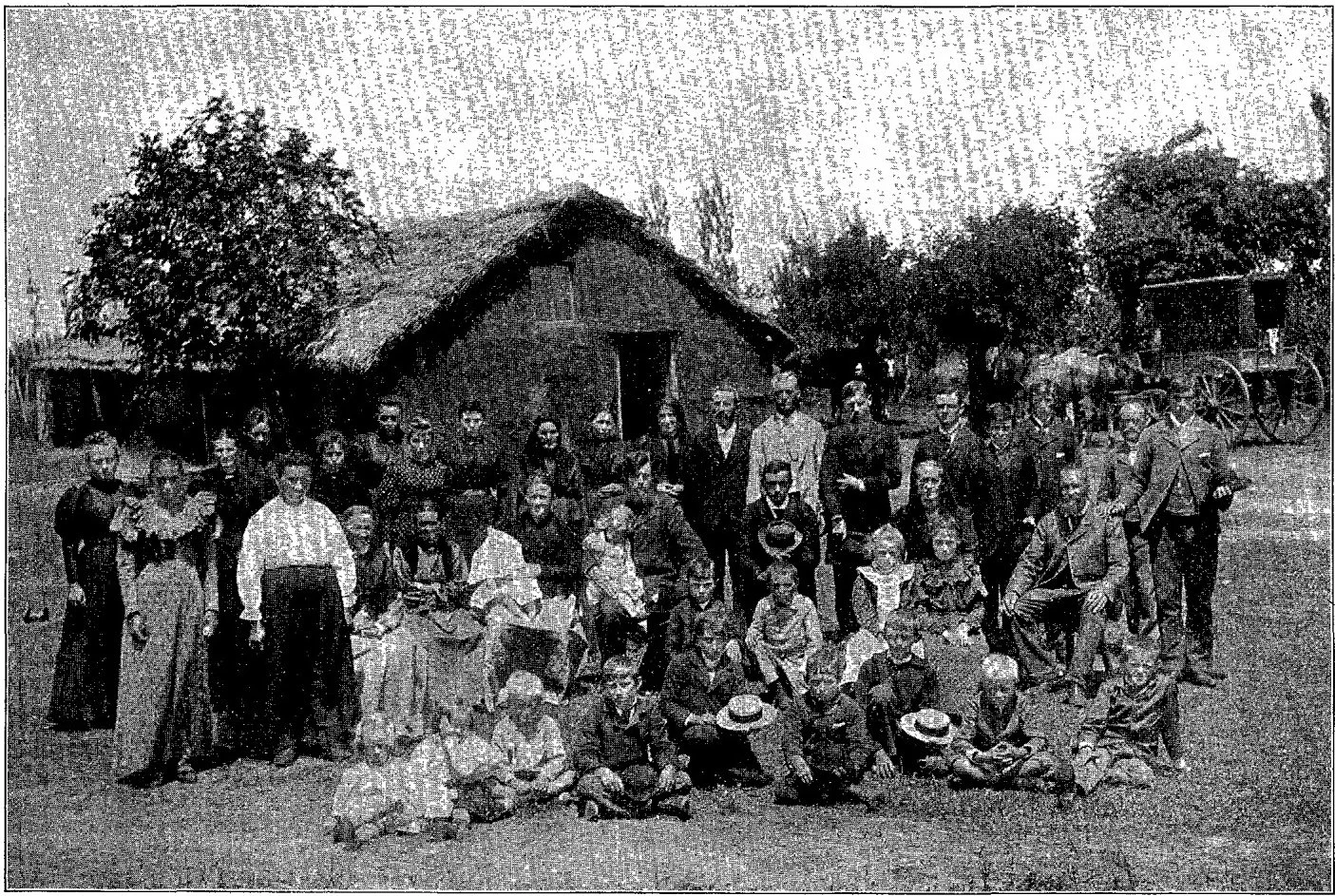
THE CHURCH AND MEETING-HOUSE AT NUEVA HELVETIA, URUGUAY. THE TREE BY THE HOUSE IS A FIG-TREE.
January 25–30 we were with our people in Jacksonville, Fla. The regular attendance at the Sabbath-school of those meeting in the rented church, at the corner of Charles and Roselle streets, is thirty-four. Several of our people came in from a distance. On First-day, January 30, a church of twenty-four adults was organized. Some of its members are those isolated ones who unite from other points in that part of the State. During this general meeting, the Lord came near to bless his people. Thus closed my five weeks of labor in Florida. To me it has been a season of refreshing at every point, and our people seemed greatly encouraged by hearing of the dealings of the Lord with his people.
January 31 I came six hundred and fourteen miles to New Orleans. Here, in company with Brother Allee, superintendent of the district, we held meetings from February 1–6. During this time we each spoke seven times to our people and interested persons who came in. The Lord signally blessed in our meetings. Those laboring in the place seem encouraged with the present situation of the work. Sisters Simmons and Hobbs, from Chattanooga, arrived in time for our meetings. They come as Bible workers to join Brother J. E. Evans and his family and Sister Booth, in laboring for souls in New Orleans. On Sabbath, February 5, five persons were baptized by Brother Allee, in the baptismal font of the First Baptist church, which was kindly granted for the service. We thank the Lord for all tokens of his favor in the work.
J. N. LOUGHBOROUGH.

PENNSYLVANIA

HARRISBURG.—Brother Morris Lukens and I began to labor together at Harrisburg, the capital of Pennsylvania, about three months ago. Besides canvassing a part of the time, and to supply the lack of a rescue mission of our own, we labored in the rescue missions here, in the Dauphin county prison, in the Sunday Breakfast Association, in a church, in a schoolhouse, and with families. During this time we had many interesting and encouraging experiences.
Before we began this work in the highways and hedges, our Sabbath-school had but two classes, and our church met in a private house. We now have four classes in our Sabbath-school, and our church holds its services in a good church building, into which the Lord led us. During this time we found, in and near this city, about fifteen persons who were keeping the Sabbath, and were glad to learn of our church organization here. In our rescue work we met a number of excellent workers; some of these have become interested in our work. One intelligent woman has already accepted the truth.
Several weeks ago Brother Lukens’s little boy was taken sick; and in spite of all that could be done for him, he grew worse, and the physician in charge had very little hope of his recovery. We took the little sufferer to the Great Physician, and according to the promise in James 5:15, his fever left him, his pulse became normal, and he was entirely healed, much to the surprise of the physician and the joy of the parents and church.
We are glad to know that the Lord is the same yesterday, to-day, and forever. He who guided Paul and Silas, and all his faithful servants of old, will never forsake even the weakest one who puts his trust in him.
GEORGE W. SPIES.

NORTH CAROLINA.

Since my last report I have labored at Lego, Archdale, Iron Station, Cowan’s Ford, Norwood, and Wadesboro. At Lego three were added to the church. At Iron Station we had a few good meetings. The attendance was small at first, but increased at each service, and some interest was manifested to hear the truth. I hope the work there can be followed up. I held one meeting near Cowan’s Ford, at the home of Brother Stillwell. The attendance was good, and the interest excellent. The people seemed anxious for further meetings, but I could not remain longer at that time, because of other appointments.
At Wadesboro I baptized one dear brother who is engaged in the canvassing work. I passed the week of prayer with the brethren at Archdale. The attendance was not large, but we had good meetings, and all enjoyed the readings. Some offerings were made for missions.
I have spent considerable time with the friends of our faith near Norwood, and the work is gaining ground at that place. Those who have embraced the truth are growing stronger and gaining victories; others are interested. I am trying to present the whole truth to them as fast as I can. I gave the Week of Prayer Readings to them a little after the regular time; all seemed to enjoy them. One dear soul was baptized at that place, and I hope to see others unite with us before a great while.
I am of good courage in the work of the Lord, and am seeking for a deeper and richer experience from day to day. I know that this is our blessed privilege as we near the close of the message. B. F. PURDHAM.
Continue reading: MINNESOTA