Your ShelfYour Projects

Signs of the Times, Vol. 27, No. 23.

THE TEMPORAL AND THE ETERNAL

Signs of the Times

Jun 5, 1901

Pacific Press Publishing Company · Oakland, California · Jun 5, 1901

THE TEMPORAL AND THE ETERNAL.
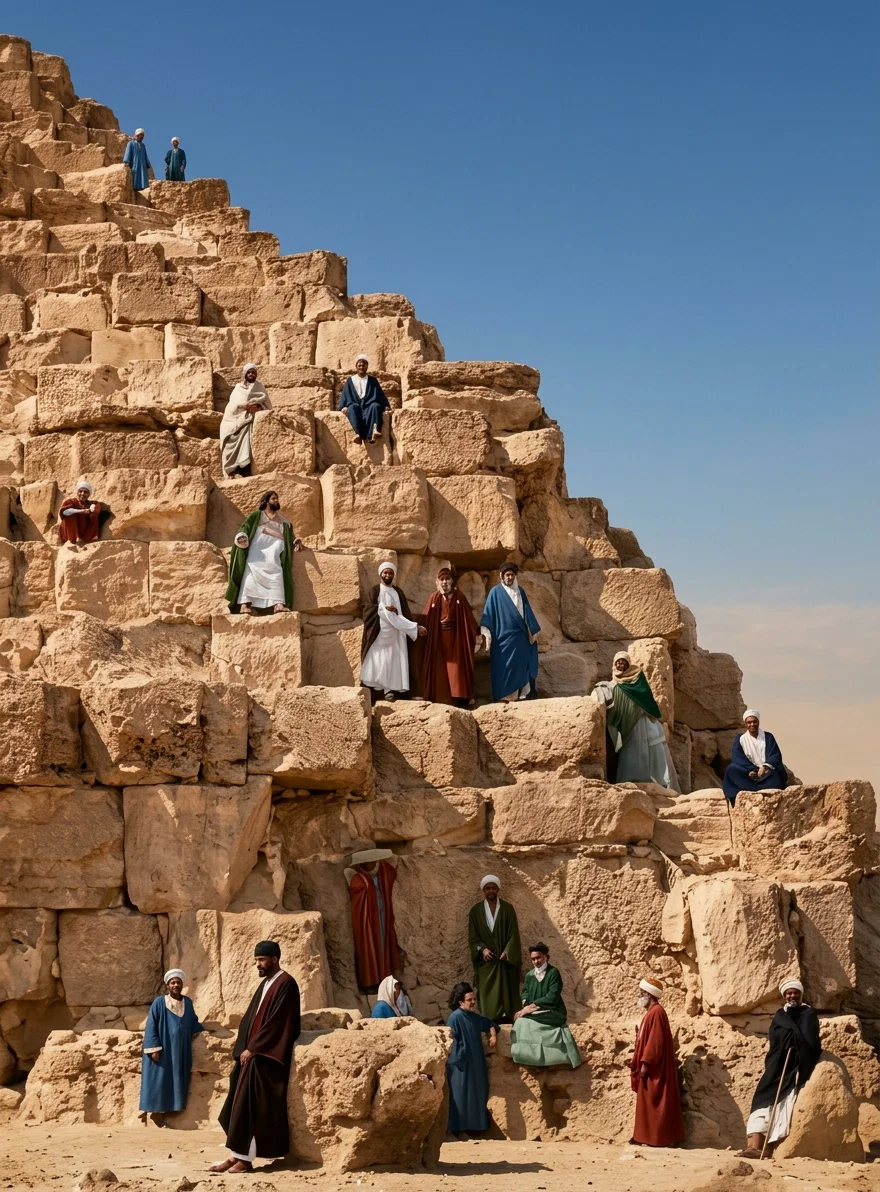
HOW the fingers of Time are crumbling the sere leaves of human glory! How the feet of Time are treading them into dust again! How the intangible elements are toying to-day with the temple and tower, the pyramid and the proud city of yesterday!
A Near View of the Great Pyramid, Once Smooth and Polished, Now Ragged and Crumbling in Decay.
TO-DAY has its lesson for to-morrow, and yesterday its lesson for to-day. The glory of the ancients has crumbled into dust before our eyes. Their lives have gone out like a whisper in the night; but the same stars that shone upon them—the same stars out of which they tried to read their destiny—are shining upon us to-day with the same luster. They builded their polished pyramids that the fame of their name and glory might go down to everlasting generations; but under the noiseless tread of the ages they are ground into powder, that generations to come might see the wasting process of human vanity.
THE great pyramid of Cheops is a standing witness to the frailty and destructibility of all things that human hands have fashioned. Forty centuries ago one hundred thousand skilled workmen were toiling under a torrid sun, year in and year out, to perpetuate the glory of their king and country. Their country now is the “least among the nations.” The once polished stones of their monarch’s monument are disintegrating under the rays of the sun he worshiped, and that kingly pile is now a shattered, corroding heap. The wasting away of the glory of Cheops keeps time to the process of destruction in every other monument to human pride, every work of man. The human aspirant for glory has pressed the record of his speech and his doings into tablets of clay. To-day these books of brick are lisping, stammering, jibbering, in a pitiful attempt to articulate the glories of the human during the heyday of heathenism.
In all this wasting away of the handiwork of man there is the continual retelling of the old story of sin. Sin brought in time, the finite, and the human, a new order of things to the universe of God; and until the history of sin is finished, wasting and desolation are the appointed portion of the works of man.
GOD has permitted men to build, out of the most indestructible material in the earth, massive monuments to self, in order that the slow elements of destruction might teach men their own weakness, their own nothingness; and that then looking up into the imperishable heavens, they might throw themselves upon the mercies of Him who created the stars, who “bringeth out their host by number;” who “calleth them all by names by the greatness of His might;” who holds them by His power so that “not one falleth.” This is the lesson for men to draw from the perishing pyramids. It is the lesson of the triumph of eternity over time; of the infinite over the finite; of a loving Creator over a rebellious creature; of righteousness over sin. The finite has lifted its hand against the infinite, set up the throne of selfishness in the very shadow of Calvary, and flung defiance at that Word which caused the earth to spring out of nothing. A patient Creator allows man’s folly to be manifest to his posterity thru the wasting away of those things which man has made to perpetuate his memory. BUT it is not alone in the pyramids of Egypt that the memorials of human fame are fading away. Every monument to self, to worldly fame, to human glory; every work of selfishness of whatever kind or wherever it is, every work that is not of God, is summoned to its trial in the court of eternity; The test is on, and precedents are barred. “Every man’s work shall be made manifest; for the day shall declare it, because it shall be revealed by fire; and the fire shall try every man’s work of what sort it is.” 1 Cor. 3:13. “His eyes behold, His eyelids try, the children of men.” Ps. 11:4.
WE have looked upon the most glorious and most substantial works of men, and have seen their dust scattered by the desert winds; we have seen the fragmentary records of human achievements gathered together from crumbling mound or broken tower, still trying to tell their shattered story. We have seen sickly childhood, tottering age, and the feeble frame of the wasting invalid, and we have seen the plumed hearse and black-robed mourners leading a perpetual procession to the tomb. We have seen all this, and we have asked: Is there, then, nothing substantial, nothing imperishable, nothing perpetual but death and decay in all the twinkling, star-sprinkled universe of God? Go out in the stillness of the night, when the prattle of humanity has been hushed upon the bosom of the crooning old earth, and look up into God’s great torchlight procession, marching and counter-marching to the orders of heaven; and then fall down upon your knees and ask God about it. Question the Maker. He is not bound by time or distance; His ear is always within hearing of the lips of His feeblest children. Ask Him if there is nothing stable, tangible, perpetual in all His realm.
HE will tell you that “from everlasting to everlasting” He is God. He will tell you that tho “All flesh is grass, and all the goodliness thereof is as the flower of the field” that perisheth, yet the word that has gone out of His lips “shall stand forever.” Isa. 40:6–8. “I am the Lord, I change not.” Mal. 3:6. “The things which are seen are temporal; but the things which are not seen are eternal.” 2 Cor. 4:18. While you are looking upon the dissolution of earthly things, the Lord will tell you that there is “a building of God, an house not made with hands, eternal in the heavens” (2 Cor. 5:1); that the kingdom which He promises to the ransomed of earth is “an everlasting kingdom.” Dan. 7:27. Are you mourning the loss of human love, and wondering if there is any hope to which the soul can anchor? Then know that God has loved you “with an everlasting love,” and seeks to bind you to Himself with His everlasting cable of lovingkindness. Jer. 31:3. Are you discouraged and cast down, forsaken and oppressed? Then know that “underneath are the everlasting arms.” Deut. 33:27. When trouble comes in like a flood till the very earth seems to tremble beneath your feet, then know that “the foundation of God standeth sure, having this seal, The Lord knoweth them that are His.” 2 Tim. 2:19. As He knows the stars and “calleth them all by name,” so He knows you, calleth you by name, knoweth your frame, and remembereth that you are dust. At the same time “the Spirit itself maketh intercession for us with groanings which can not be uttered.” Rom. 8:26.
THEN there is an eternal Rock to which the most storm-tossed can anchor; there is an eternal habitation for the most foot-sore pilgrim; in the midst of change and destruction, there is One who is “the same yesterday, to-day, and forever;” tho the words and works of men are crumbling and fading away, the word and works of God “stand fast forever;” the pyramid may become the plaything of the summer breeze, but “the foundation of God standeth sure;” the record of human selfishness will fade from the memory of the redeemed, but the story of Calvary will be sung by the angels as long as God shall live. “God so loved the world, that He gave His only begotten Son, that whosoever believeth on Him should not perish, but have EVERLASTING LIFE.” C. M. Snow.

TRUE AS IT CAN BE.

Suppose some cold morning you should go into a neighbor's house and find him busy at work on his windows, scratching away, and should ask him what he was doing, and he should reply, “Why, I am trying to remove the frost; but as fast as I get it off one square it comes on another.” Would you not say, “Why, man, let your windows alone and kindle a fire; and the frost will come off”? And have you not seen people try to break off their bad habits one after another without avail? Well, they are like the man who tried to scratch the frost from his windows. Let the fire of love to God, kindled at the altar of prayer, burn brightly in your heart, and the bad habits will soon melt away.—Ram's Horn.

WARNINGS OF THE COMING KING.

In past ages God has never failed to warn His people when any great event or terrible judgment was impending; and they, in turn, are required to convey the warning to the world. Thus when the earth became corrupted with violence and wickedness, and God determined to destroy its inhabitants with a flood, He made known His purpose to Noah; and for one hundred and twenty years “while the ark was a preparing,” that faithful preacher of righteousness failed not to deliver the divine message of a coming destruction. Also when destruction was determined upon Sodom, “the Lord said, Shall I hide from Abraham that thing which I do?” Gen. 18 : 17. And says the prophet, “Surely the Lord God will do nothing, but He revealeth His secret unto His servants the prophets.” Amos 3 : 7.
In accordance with this declaration, the Scriptures contain numerous complete chains of prophecy portraying the history of the world down to the coming of the Lord and the end of the Gospel age, and even to the eternity beyond. It is not the province of these articles to trace these prophecies, except in one or two instances. When the disciples inquired of the Saviour, “What shall be the sign of Thy coming, and of the end of the world?” (Matt. 24 : 3) He proceeded to give them instructions by which they might understand that this event would not transpire in their day, and by which we may “discern the signs of the times.” He first says to the disciples, “Take heed that no man deceive you,” and then predicts false christs, wars, and rumors of wars, but says, “The end is not yet.” Verses 4-6. After describing the uprising of nations with famines, pestilences, and earthquakes, he adds, “All these are the beginning of sorrows.” Verse 8.
The Saviour points out the persecutions which the church must suffer, the rise of false prophets, iniquity, and apostasy in the church; but He assures His disciples that “this Gospel of the kingdom shall be preached in all the world for a witness unto all nations; and then shall the end come.” Verses 9-14. He does not say the world will be converted, as some maintain; He simply says the Gospel will be preached for a witness, and then comes the end. Thus briefly is mapped out the history of the church from Christ’s time till the end of the world.
Again the Lord begins by answering the disciples’ question relating to the destruction of the temple of Jerusalem, and a second time depicts the experience of the Christian church after the escape to the mountains (verses 15, 16), down thru the 1260 years of Papal supremacy, to the shortening of the days “for the elect’s sake.” Verses 21, 22. He shows that after this false prophets will arise, showing great signs and wonders, and if possible deceiving “the very elect,” and also that there will be false teachers saying that Christ has already appeared “in the desert” or “in the secret chambers,” and He adds: “Believe it not. For as the lightning cometh out of the east and shineth even unto the west; so shall also the coming of the Son of man be.” Verses 24-27.
The Saviour next declares that signs in the sun, and in the moon, and in the stars will precede the day of His coming, and He enforced the teachings of this wonderful chapter by the beautiful parable of the fig-tree. “When his branch is yet tender, and putteth forth leaves, ye know that summer is nigh; so likewise ye, when ye shall see all these things, know that it [margin, he] is near, even at the doors. Verily I say unto you, This generation shall not pass, till all these things be fulfilled. Heaven and earth shall pass away, but My words shall not pass away.” Matt. 24 : 32-35.
Will the world, then, know the appointed time of the Lord’s appearing?—No. Says the Saviour: “But as the days of Noe were, so shall also the coming of the Son of man be. For as in the days that were before the flood they were eating and drinking, marrying and giving in marriage, until the day that Noe entered into the ark, and knew not until the flood came, and took them all away; so shall also the coming of the Son of man be.” Verses 37-39. From this and other passages it is evident that altho the designated signs will appear in due time, they will be unheeded by the world in general. The vast majority will still be pursuing their accustomed course, seeking sensual gratification, and laying plans for years of future enjoyment, until at last the great day of God will come upon them “as a snare.” Luke 21 : 35. The apostle says, “When they shall say, Peace and safety, then sudden destruction cometh upon them; . . . and they shall not escape.” 1 Thess. 5 : 3.
Had the antediluvian world heeded the preaching of Noah while the ark was preparing, and “the long-suffering of God waited,” had they repented, forsaken their sins, and accepted the free salvation, they would not have been overtaken by the destroying flood. And so will it be in the great day of final destruction. The day and hour of His coming are hidden in the secret purpose of the Almighty; He has imparted the knowledge of them to no man, and because of this Jesus says, “Watch therefore.” “Be ye also ready; for in such an hour as ye think not the Son of man cometh.” Matt. 24 : 42-44. Those who watch the signs will not be overtaken by surprises, and confusion, and destruction. Paul says: “But ye, brethren, are not in darkness, that that day should overtake you as a thief. Ye are all the children of light, and the children of the day.” “Therefore let us not sleep as do others; but let us watch and be sober.” “For God hath not appointed us to wrath, but to obtain salvation by our Lord Jesus Christ, who died for us, that, whether we wake or sleep, we should live together with Him.” 1 Thess. 5 : 4, 5, 6, 9, 10. And Jesus says, “What I say unto you, I say unto all, Watch.” Mark 13 : 37.
“Heir of the kingdom, O why dost thou slumber? Why art thou sleeping so near thy blest home? Wake thee, arouse thee, and gird on thine armor, Speed; for the moments are hurrying on.
“Keep the eye single, the head upward lifted; Watch for the glory of earth’s coming King; Lo! o’er the mountain-tops light is now breaking; Heirs of the kingdom, rejoice ye and sing.”
AUGUSTA W. HEALD.

THE MORAL LAW.

THINK not that I am come to destroy the law, or the prophets; I am not come to destroy, but to fulfil. For verily, I say unto you, Till heaven and earth pass, one jot or one tittle shall in no wise pass from the law, till all be fulfilled.
A government, of whatever character, requires a governor. This world has a governor,—the God of the universe. His guardiancare is universal, extending to man and beast, reaching even to the little sparrow; for Christ declares, “Are not two sparrows sold for a farthing? and one of them shall not fall on the ground without your Father. But the very hairs of your head are all numbered.”
In God’s moral government, which is a government based upon a distinction between right and wrong, law is essential to secure right action. God’s law is the expression of His character, and in His Word it is pronounced holy, just, and good. David says, “The law of the Lord is perfect, converting the soul; the testimony of the Lord is sure, making wise the simple.”
Lucifer took the position that as a result of the law of God, wrong existed in heaven and on this earth. This brought against God’s government the charge of being arbitrary. But this is a falsehood, framed by the author of all falsehoods. God’s government is a government of free-will, and there is no act of rebellion or obedience which is not an act of free-will.
As Creator of all, God is governor over all, and He is bound to enforce His law throughout the universe. To require less from His creatures than obedience to His law would be to abandon them to ruin. To fail to punish transgression of His law would be to place the universe in confusion. The moral law is God’s barrier between the human agent and sin. Thus infinite wisdom has placed before men the distinction between right and wrong, between sin and holiness.
God is supreme. It is not for finite man to question His right to govern the universe. God asserted His right to rule when He declared, “Thou shalt have no other gods before Me;” “for in six days the Lord made heaven and earth, the sea, and all that in them is.” He is the Creator and the Preserver of the worlds. He upholds the universe by the word of His power. Nature and science bear witness that He has a right to govern His own creation. Angels are subject to His rule; therefore let man bow in adoration before Him.
The Scriptures make it plain that God is Ruler, and that man is under the highest obligation to acknowledge this, and to obey His law with heart and mind, trusting in His power for help and protection. This law which man is called upon to obey as the standard of right for the universe, is the wise and holy counsel of God. It is a moral law, and has its foundation in the difference between right and wrong. Moral law is universal; positive law is not necessarily universal, but may be restricted or extended according to the will of the law-giver. Moral law must be immutable, while positive law may be changed or abolished, as the law-giver may choose.
The Decalog, or moral code of God, consists of ten precepts, engraven on stone by the finger of God. These precepts contain the whole duty of man. The first four define man’s duty to his God; the last six man’s duty to his fellow-man. These two great principles were recognized by the Saviour; for He declared that the whole law hung upon love to God and love to man. Other commands may be found in the Scriptures, but only as an amplification of those contained in the ten precepts of the Decalog.
Christ’s work was to rid the commandments of the traditions and customs placed upon them by the Jewish teachers. The work of covering the law with useless exactions had been planned by the adversary of God, in order that Christ’s pure ministry should not harmonize with the teaching of the scribes and Pharisees. The Jewish leaders had yielded to the temptation to depart from the Lord, and while by their forms and ceremonies making the law a yoke of bondage which the people were not able to bear, they failed to follow its great principles. This led Christ to declare, “Except your righteousness shall exceed the righteousness of the scribes and Pharisees, ye shall in no case enter into the kingdom of heaven.”
At the opening of His ministry, Christ, in His Sermon on the Mount, gave an exposition of the law, which had long been buried under man-made customs and traditions. He brought to light its pure principles, freeing it from the burdensome exactions placed upon it by man. As He showed the far-reaching claims of the law, the Pharisees saw that their pet theories were being swept away by His plain statements. Jealousy took possession of their hearts; for they felt that their teaching and influence were being made of no effect. In their hearts they had so long mingled human tradition with divine commands that when Christ disregarded these traditions, they thought that He was making void the law. But Christ read their thoughts, and suddenly they were startled by the words, “Think not that I am come to destroy the law; or the prophets; I am not come to destroy, but to fulfil. For verily I say unto you, Till heaven and earth pass, one jot or one tittle shall in no wise pass from the law, till all be fulfilled.”
With all the exalted influence and glory he possessed before the fall, Satan could not change the smallest letter of the law; and as an apostate and traitor, he has still been unable to alter it. If he has succeeded in his purpose of gaining the professed Christian world to his side, and if the world and the church have formed a bond of fellowship to make void the law of God, this does not prove that it has been changed. To admit that God made a law so imperfect that it needed to be changed would be to stamp God as changeable and imperfect. God has spoken on this point. Let us heed what He says: “My covenant will I not break, nor alter the thing that is gone out of My lips.”
Christ, in His teaching, fully developed the principles of the law, making it plain that it does not concern the outward actions merely, but has to do with the heart, reaching even to the unspoken thoughts. Christ exalted the law, holding it forth in its original purity as a perfect system of morality. His life was a living illustration of the law of God. He made this law honorable by His perfect conformity to its requirements.
God’s law, enforced in the Old and New Testaments, is an exclusive rule of duty. The objection sometimes brought against the law, that nowhere in the New Testament are all the commandments of the Decalog specified, has no force; for the expressions so often repeated “the law,” “the commandments of God,” mean the whole, not a part.
The Lord has given this rule of righteousness,—the foundation of true religion,—and it must be obeyed. We might better sacrifice all our temporal interests,—houses, lands, riches, liberty, even life itself, than disobey the least of God’s commandments. The Saviour declares, “He that findeth his life shall lose it; and he that loseth his life for My sake shall find it.”
We have many noble examples of loyalty to the law in the history of the prophets and apostles, who endured imprisonment, torture, death itself, rather than break one of God’s commands. Peter and John have left a record as heroic as any in the Gospel dispensation. When called before the high priest, and commanded not to speak at all, nor to preach in the name of Jesus, they answered: “Whether it be right in the sight of God to hearken unto you more than unto God, judge ye. For we can not but speak the things which we have seen and heard. So when they had further threatened them, they let them go, finding nothing how they might punish them, because of the people; for all men glorified God for that which was done.” When they were called a second time before the council, the Jewish leaders asked them, saying, “Did not we straitly command you that ye should not teach in this name? and, behold, ye have filled Jerusalem with your doctrine, and intend to bring this man’s blood upon us. Then Peter and the other apostles answered and said, We ought to obey God rather than men.” In this answer we have evidence that no human authority has a right to place us under obligation to claims which will cause us to disobey our rightful Sovereign, whose subjects we claim to be.
God has special regard for righteousness of character. In His Word we are told that He takes pleasure in them that fear Him, in those that hope in His mercy. He commands the inhabitants of the earth to stand in awe of Him, and yet He invites the most lowly to seek Him, “if haply they might feel after Him, and find Him, tho He be not far from every one of us.”
By willing obedience to God’s commands, we show our love for Him. Thus we gain a fitness to be among that number of whom it will be said, “Blessed are they that do His commandments, that they may have right to the tree of life, and may enter in thru the gates into the city.”
MRS. E. G. WHITE.

Who Shall Change This Body of Our Humiliation

THE END OF SIN’S DOMINION.—NO. 3.

“Who Shall Change This Body of Our Humiliation.”

ONE of the most potent factors thru which humanity is overcome by sin, is the fact of dwelling in sinful flesh, obtained from many generations of sinning ancestry. But he who yields to sin now, is without excuse; for Christ tabernacled in flesh that had become weakened by four thousand years of degeneracy, being subjected to temptations which “were urged upon Him in as much greater degree as His character is superior to ours,” and thus having been sent “in the likeness of sinful flesh,” yet “without sin” (for He yielded not to temptation), He can consistently “condemn sin in the flesh,”—“for we have nothing to bear which He has not endured,”—and He at the same time imparts, to every true believer the power to overcome sin in sinful flesh by the same agency which empowered Him to overcome, namely, the Spirit of God and Christ. He also imparts the power to fulfil the righteousness of that law, of which sin is the transgression. For “Christ has given His Spirit as a divine power to overcome all hereditary and cultivated tendencies to evil, and to impress His own character upon His church.” “Let not sin therefore reign in your mortal body, that ye should obey it in the lusts thereof,” “for sin shall not have dominion over you; for ye are not under the law, but under grace.”
“Every man is tempted when he is drawn away of his own lust and enticed.” Even such heaven-approved characters as the apostle Paul, after having preached the Gospel to the salvation of many, for a period of years, had to fight—but not “uncertainly”—to keep his “body under,” lest that after he had thus preached to others, he himself should be a castaway, by relinquishing his hold upon the Spirit’s power and yielding to the demands of sinful flesh.
But inasmuch as Christ’s body before His ascension, was changed, glorified, immortalized, so these bodies of our humiliation shall be changed, glorified, immortalized, and fashioned like unto His glorious body, at His coming, “according to the power whereby He is able to subdue all things, even unto Himself;” “for we know that when He shall appear, we shall be like Him; for we shall see Him as He is.”
Being thus made equal unto the angels, we shall have no more struggles to keep our bodies under, no sinful flesh to rise up and clamor for the mastery, none of the frailties, afflictions, weaknesses, degenerate tendencies obtained from sinning ancestry, and from cultivation of sinful ways, to bring us again under sin’s dominion. Under present conditions, how naturally and how forcefully does inspiration express our longings for deliverance from sinful flesh, with all of its attendant ills, as it is written: “We that are in this tabernacle do groan, being burdened, . . . that mortality might be swallowed up of life. Now He that hath wrought us for the selfsame thing is God, who also hath given unto us that earnest of the Spirit.” This glorious result being accomplished, then “thru eternal ages, all are secure from apostasy.”
“Hail, brother! hail, thou son of happiness! Thou son beloved of God! welcome to heaven! To bliss that never fades! thy day is past Of trials, and of fear to fall. Well done, Thou good and faithful servant; enter now Into the joy eternal of thy Lord.”
G. W. REASER.

THE TYPICAL PEACE-OFFERING.

The peace-offering of the Hebrew ceremonies differed from all the other sacrifices of that system, in that it permitted the one presenting it to choose whether it should be from the herd or flock, or whether it should be male or female. Lev. 3: 1, 7, 12. But while he might select the kind of creature to be offered, its condition must be just what had been divinely prescribed, namely, “without blemish.” Otherwise the offering was not acceptable to God. Any superfluous appendage, as a wart, or a bit of scurf, or any unseemly mark, would place the intended offering in the rejected list. To have any part lacking, as the tip of an ear or the point of the tail, would destroy the availability of the creature as a peace-offering. Not even a bruise, however slight, or a tiny scratch, could be received of God in this ceremony. Lev. 22: 21-24.
There was a good reason for this. When a man voluntarily selects a gift for another whom he highly esteems, he does not think of choosing something of an ordinary nature, much less something defective or unseemly. He would not risk the mortification of having such a gift peremptorily refused. Were God to receive from those over whom He reigns a defective gift which an earthly prince would despise and refuse, it would not be long before the earthly would be rated above the heavenly, and the influence that should control the minds of men would lose its potency, and so come to be despised. God would have the honor rendered Him which is His due, and He will in no wise give countenance to anything which would detract from that glory. Mal. 1: 6, 7, 13, 14.
There were several motives for rendering peace-offerings. One of these was to manifest thanksgiving for mercies and blessings received; another was to record some vow; and still another was simply to make a voluntary sacrifice. Lev. 7: 15, 16. These were presented, however, at the same place, and in nearly the same manner, as other burnt-offerings. Lev. 3: 2-5. But there were some variations, by which the design of the offering might be seen. For instance, if thanksgiving was the design of the sacrifice, then there accompanied it an offering of unleavened cakes, kneaded in oil, besides plain cakes, with oil applied to the outside. Lev. 7: 11-13.
A peace-offering is still one of God’s requirements. When the carnal heart, which has so long been at war with Heaven’s requirements, desires to conform to the ways of God’s kingdom, the surrender of that heart as a peace-offering to Him becomes an absolute prerequisite to that end. Thus yielding to God and confessing sin brings unqualified forgiveness thru the merits of the Lord Jesus. I John 1: 7, 9. Being thereby justified, or pronounced innocent, thru his faith in Jesus Christ, one already has peace with God, and access to heavenly grace, so that he may rejoice in hope of eternal glory. Rom. 5: 1, 2. When once in such case, we should then “offer the sacrifice of praise to God continually,” thru laudation of His holy name, for mercies constantly received. Ps. 107: 19, 20, 28, 37, 38; Heb. 13: 15.
This peace of God can not be understood, because its greatness passes all human understanding. Phil. 4: 7. One may, however, be filled with it to his utmost capacity (Rom. 15: 13), and so have his heart and mind preserved in purity for the service of the Lord Jesus. This will be a most satisfactory condition, because, being in perfect harmony with every rhythmic motion of heaven’s order, the thrill of heavenly sentiment will fill the very soul with recompensive joy. A peace brought to us thru earthly measures or on human terms, could not possibly do this, because it would be as inconsistent as the basis upon which it rested. No human peace can therefore be adequate to meet the demands of men in their heavenly connection. As fallen man does not, because he can not, understand the perfection of heaven, so the peace which will suffice to harmonize his mind with those infinitely pure and holy things, must be one that rises above his understanding. Such a peace he is incapable of arranging for himself. But in this lack he is not left unsupplied. Jesus says, “My peace I give unto you.” John 14: 27. He does not give it as the world makes a gift, to be withdrawn upon a slight notion, but being a gift of His love it must remain co-existent with that eternal attribute.
So, then, in Him we have peace. In the world we are promised tribulation; but we are exhorted-even under this to be of good cheer, because He who bequeathes to us His peace with God, has been thru all this, and overcome it in our behalf. John 16: 33. Not only will the Lord always give to His followers peace “by all means” (2 Thess. 3: 16), but those who put their trust in Him, He will keep in “perfect peace.” Isa. 26: 3. J. O. CORLISS.

The Law Sends Us to Christ

The law sends us to Christ to be justified, and Christ sends us to the law to be regulated.—John Flavell.
Continue reading: TWO OBJECTS OF SATANIC MALICE