The Youth’s Instructor, Vol. 27, No. 5.

THE BIRD OF TWO SONGS

The Youth’s Instructor

Jan 29, 1879

S. D. A. Publishing Association · Battle Creek, Mich. · Jan 29, 1879

THE BIRD OF TWO SONGS.

ONE cloudy, chilly, unsummer-like afternoon, I was standing in the garden with a stranger. Near us was a large clump of lilac bushes, into which we saw a bird of a dingy, faded, black color fly. Presently she broke out into what, perhaps, she called a song; but it was, in reality, just like the flat squalling of an old cat. “Yaah! yaah!” she continued to cry.
“Pray,” said the stranger, “what bird is that making such a horrible noise?”
“That, sir, is the cat-bird.”
“I should think so, and a burnt cat, too! I thought it was homely enough to the eye, but the color is nothing to this screech.”
“I can’t say much at present to defend the poor bird, for looks and voice are against her. But I am confident you will think better of her ere long.”
The next morning I found my friend standing on the piazza, listening to the notes of a bird in a thick sugar-maple near by. The song was that of a mocking-bird, not so wonderful as the notes of the real mocking-bird, nor even so sweet as those of the thrush, yet they were round and full, and often exquisite. She seemed to repeat the note of every bird with which she was acquainted, robin, sparrow, oriole, and the like, with surprising accuracy. The air was still, and the bird seemed to be swallowed up in song.
“Pray tell me,” said my stranger friend, “what bird is that which sings so delightfully? It is not quite the thrush.”
“That, sir, is our cat-bird.”
“You must be making fun of me. You don’t pretend to say that the homely, squalling bird we heard yesterday, and this singer, are the same!”
“I do truly, and to convince you I will throw a stone into the tree and drive her out, and you shall see that it is the same bird.” With that I threw the stone, and out popped Mrs. Cat-bird, making directly for the lilacs, where she began again to scream, “Yaah! yaah!” The gentleman looked on in amazement. “This bird,” said I, “is very much like some people. In those lilacs she has her nest, and that is her home; but there she never utters a pleasant note. I should think her husband would avoid her, and her little ones tremble at the sound of her voice. But when she gets away from home, up in the lofty tree, you see how agreeable she can be, and how sweetly she sings. I know many people just like her. When away from home they are full of smiles and gentle ways, and they seem to be the most agreeable people in the world. But see them at home! and the cat-bird’s notes are theirs. They contrive to make home just as unpleasant as possible—to themselves, and to everybody that happens to see them at home.”
“Oh, yes,” said the stranger, “I know scores of such people, some fathers and mothers, so easily pleased, smiling and pleasant away from home, but the moment they enter their own doors, every ray of cheerfulness fades out, and they are cold, silent, and repulsive. And some young ladies, I am sorry to say, are so lively, cheerful, obliging, and happy when away from home, that one would think they were uncommonly lovely, while at home they are discontented, disrespectful to parents, coarse, and unlovely. So with children. I know many like our cat-bird with her two songs, lively, cheerful, and well-bred among strangers, but the moment they get home, are rude, disobedient, rough, and ill-tempered. What is the reason why people do so?”—Ladies’ Repository.

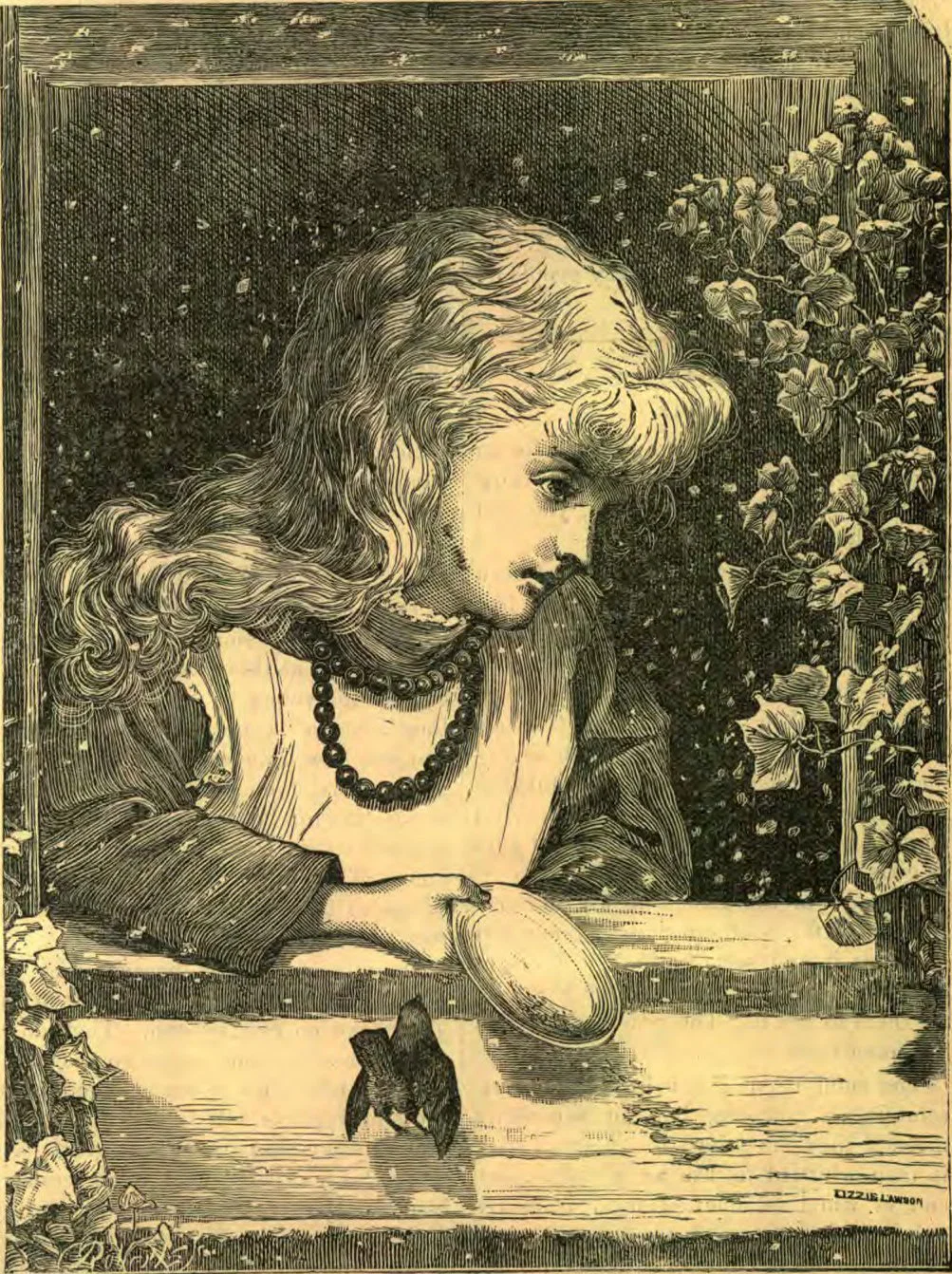
CRUMBS FOR THE BIRDS.

AMIDST the freezing sleet and snow, The timid robin comes; In pity drive him not away, But scatter out your crumbs.
And leave your door upon the latch For whosoever comes; The poorer they, more welcome give, And scatter out your crumbs.
All have to spare, none are too poor, When want with winter comes; The loaf is never all your own, Then scatter out the crumbs.
—Sel.

TOBACCO. FOR GIRLS.

This may seem a strange heading for an article in the INSTRUCTOR, but as I know of some girls who use tobacco, you will excuse the heading.
I have asked boys, when I have seen them using tobacco, how they would like to see their sisters learning to smoke or chew; and the answer always is, “I would not like it at all.” This is the way boys feel about their sisters using tobacco. But have not girls as good reason to say the same of their brothers? If tobacco will defile a girl, will it not a boy? And ought not boys to be just as nice and pure as girls? I think so.
But now of the girls who use tobacco. In some of the Southern States women and girls use it, and seem to think it all right as firmly as men and boys in the North do for them to use it. The practice is called “dipping snuff.”
The snuff is put into a little tin box resembling a blacking box, or something nicer if they can afford it. A small stick is then whittled to use as a dipper, one end of which is chewed until it makes quite a brush; some fasten a small piece of sponge to the stick, with which they dip it, putting it into their mouths, and rubbing it over their gums and teeth. You can imagine how it looks.
The effect is nearly the same as that of chewing or smoking, since the poison is the same. So you see even women and girls, with naturally delicate tastes, can learn to love so defiling and filthy a habit as “dipping snuff.” And they become so attached to it as to be unable to control their appetites, even in the presence of strangers.
Unless such overcome and through grace become pure again, as God designed they should be, I am afraid the Lord Jesus will find no place for them in his kingdom.
GEO. B. STARR.

IMPROVE YOUR TIME.

TIME is truly precious; yet few realize its value and the importance of improving the moments as they pass. It is often difficult for the young to see this as it is. As they advance in age, they can look back and see how time was squandered. They might have done much more to qualify themselves to act their part in life, had they improved their time as they should have done. They might have educated themselves so that they would have been prepared for greater usefulness.
Many fail to do this, because they have not before them the true object of life. They have no definite aim. They do not decide on a high and noble course of life, and lay their plans to reach something noble and valuable. It is of importance to aim at something good and great. And when this is decided upon, perseverance is essential to carry out the object; and system and plan in the use of time, giving a proper portion each day to certain pursuits.
Those who will determine in youth to acquire a good education, and will have a plan and pursue it with perseverance, can accomplish their object. Many are the examples of men rising to distinction as benefactors of mankind, by their own exertions and unconquerable perseverance. Such the world calls self-made men; because they rise to eminence in their professions without the advantages derived from wealth and favorable surroundings. There are some now living who have learned foreign languages, and thus qualified themselves to preach and publish the gospel to men of other tongues, by persevering industry and prayer, without the benefit of schools.
But good schools are a great help, and the young may have the benefit to be derived from them. Are you poor? A fixed and steady purpose will work its way through. Work and study may be used together, as was exemplified by Elihu Burritt, called the learned blacksmith, who acquired more than a dozen languages while at work at his anvil.
Let the youth have courage and decision in planning, and perseverance in execution, and success will crown their efforts. Let them aim at something truly valuable, and turn away from all things which would draw them away from their purpose, and they will accomplish great and noble ends. Do this now, before the time is past and you regret too late the misspent golden days of youth.
R. F. COTTRELL.

ACQUAINT NOW THYSELF WITH GOD.

“Acquaint now thyself with him, and be at peace.” Job. 22:21.
A poor, miserable woman lay upon her dying bed. She began to sense that her life was fast going out, while she was unprepared to meet her Judge. Her cries of distress were heart-rending, as she would exclaim, “I am going to God, and I don’t know him!”
Oh, how terrible is a death-bed scene like this! and yet there are very many such. But many more persons die with their moral faculties so benumbed with sin that only the solemn realities of the Judgment will arouse them. Then what cries of anguish will rend the air, as they call for rocks and mountains to hide them from a holy God.
How can we treat so indifferently our best Friend? and how can we be so unmindful of our own best good; for all our hopes of the future life depend upon our making his acquaintance now? In the great day of God, when the Judgment is set, and the books are opened, how we shall appreciate his friendship. We have but to turn to him with all the heart to be “at peace,” and to secure his everlasting love.
Dear INSTRUCTOR family, “acquaint now thyself with him, and be at peace,” that instead of having to say like this dying woman, “I am going to God, and I don’t know him;” you may be able to say, “Lo! this is our God; we have waited for him, and he will save us. This is the Lord; we have waited for him, we will be glad and rejoice in his salvation.” M. J. C.

MAKE SOMEBODY HAPPY.

“NEVER go to bed without making sure you have done one good action, or made somebody happy,” were the words Charley read as he glanced into a book a few moments before starting for school. “I wonder who does that,” said he, as he closed the book. “I do not, and I don’t believe any one does.”
Charley was a very selfish boy, and liked to have his own way regardless of others’ comfort or enjoyment, and so unthinking had he always been that he did not realize that any one had ever denied himself to gratify his desires. But those words, “somebody happy,” rung in his ears that morning, and seemed to awaken a new train of thought in his mind, and, notwithstanding his former incredulity, he resolved to turn over a new leaf. Many opportunities to test his good resolution occurred that day, and though he failed in some respects, he felt when the day was past that it had been the happiest of his life.
Dear children, it is the privilege of every one of us to seek opportunities to make somebody happy; and if we follow our Saviour’s example, we will do so.
J. A. CORLISS.

LESSONS FOR CHILDREN.

LESSON V.—AI.

Not far from Jericho there was a small city called Ai. It was the same place that is called Hai in Gen. 12 : 8. Joshua sent men from Jericho to Ai, to visit it, and to view the country near it. When these men returned, they told Joshua that the men of Ai were few, and that two or three thousand men would be enough to take the city. So Joshua sent up three thousand men; but the men of Ai came out and chased them, killing quite a number, and driving the others back to Jericho.
Then Joshua fell upon his face before the ark, and cried to the Lord in great distress; but the Lord told him to rise up, and put away the evil from among the people. He told Joshua that the people had stolen, and deceived, and had hid the stolen things among their own stuff; that this was the reason why they could not stand before their enemies; and that those who had done this wicked thing must be destroyed.
The Lord told Joshua to cast lots among the people. When this had been done, the lot fell upon Achan, the son of Carmi. Then Joshua said to Achan, “My son, give, I pray thee, glory to the Lord God of Israel, and make confession unto him; and tell me now what thou hast done; hide it not from me.” Then Achan confessed that when Jericho was destroyed he had taken from the spoils a costly garment, two hundred shekels of silver, and a wedge of gold; and that they were now hid in the earth, in the midst of his tent. So Achan was stoned to death in the valley of Achor, and all that he had was burned.
After this the Lord told Joshua how to take the city of Ai. Thirty thousand men went up by night, and lay in ambush on the west side of the city. In the morning, Joshua went up with an army, and when they came near the city, the men of Ai rushed forth, expecting to drive them back as they had done before. At first, Joshua and his army fled. Then Joshua held forth his spear, and the men who were in ambush behind the city came forth, entered the open gates, and set the city on fire. Then the Israelites turned upon the people of Ai and slew them all.

QUESTIONS.

  1. Where was the city of Ai?
  2. What course did Joshua take to find out how strong the city was and the best way of taking it?
  3. What did the men say when they returned?
  4. How large an army did Joshua send against Ai?
  5. How did they succeed?
  6. What did Joshua do when the men returned?
  7. What did the Lord tell him to do?
  8. What did he say the people had done?
  9. Why could they not stand before their enemies?
  10. What plan did the Lord give Joshua for finding out the guilty ones?
  11. On whom did the lot fall?
  12. What did Joshua say to Achan?
  13. What did Achan confess?
  14. What was done to him?
  15. Did Achan steal from God or from man?
  16. Is it possible to steal from God now?
  17. How do you think it could be done?
  18. Who gave Joshua a plan for taking Ai?
  19. How many men went up by night?
  20. What did these men do when they came near the city?
  21. Who went up in the morning?
  22. What did Joshua and his army do when the men of Ai came out to fight them?
  23. Why did they do this?
  24. When Joshua held out his spear, what did the men do who were lying in ambush?
  25. What became of the people of Ai?

BIBLE LESSONS FOR YOUTH.

LESSON XXXI.—REVIEW.
  1. WHERE did Abraham dwell before coming into the land of Canaan?
  2. What caused him to leave that land?
  3. How old was he when he came into the land of Canaan?
  4. Who came into that land with him?
  5. How old was Abraham when Isaac was born?
  6. How many sons had Isaac?
  7. Who was Jacob’s favorite son?
  8. How many brothers had Joseph?
  9. How did they treat him?
  10. How was he treated by Potiphar?
  11. How did he come to be released from prison?
  12. What interpretation did he give to Pharaoh’s dream?
  13. What honors did Pharaoh confer upon him?
  14. What brought Jacob and his family to Egypt to dwell there?
  15. What change had God made in Jacob’s name?
  16. What were his descendants called?
  17. How did the children of Israel prosper in Egypt?
  18. How were they treated while Joseph lived?
  19. When Egypt had been conquered by a king who knew not Joseph, how were the Israelites treated?
  20. Why did he treat them so cruelly?
  21. Who was raised up of God to deliver his people from this bondage?
  22. Where did Moses dwell for the first forty years of his life?
  23. Where did he spend the next forty years?
  24. How did Moses feel when God called him to go to Egypt to bring out his people?
  25. What mistake had Moses once made in trying to help his brethren?
  26. How did the people receive the message that Moses had for them?
  27. What did Pharaoh say, when Moses delivered his message to him?
  28. How was he made to know the power of the God of Israel?
  29. What was the last plague?
  30. What effect did this produce upon the Egyptians?
  31. How were the Israelites prepared for leaving the land so suddenly?
  32. By whom were they pursued?
  33. Where were they overtaken?
  34. How did the Lord deliver them?
G. H. BELL.

CLASSIFICATION

MOST schools are naturally divided into four divisions,—little ones, or those under ten years of age, which we shall call the 1st, or Infant Division; children, or boys and girls from ten to fifteen, which we shall call the 2d, or Children’s Division; youth, or young people from fifteen to twenty, which we shall call the 3d, or Youth’s Division; and adults, or grown-up people, which we shall call the 4th, or Senior Division.

SABBATH-SCHOOL RECORDS.

WHO SHOULD KEEP THE RECORDS?

The Secretary, under the supervision of the Superintendent, should in most cases keep the records. It is generally best for him to make careful entries in a memorandum book during the school, and then transfer them to the Record book with pen and ink, in a clear hand, at home.

REGISTERS.

When a school is organized, the names of the officers, teachers, and scholars should be entered in separate registers, in which the date of joining, the age (of the children), and the number or letter of the class joined should be carefully recorded. When a teacher or scholar leaves the school, the date of leaving should be marked opposite his name, with a brief statement why he leaves; as, “Removed,” “Sick,” and the like.
The minutes should be brief, and uniform in style, though a repetition of the same words and phrases should be studiously avoided. After giving the membership, the attendance, the number added, the number dropped, the number of visitors, and the amount of the donation, which may be read in the same order each week, the record should contain those items of greatest interest, and such facts as will constitute a brief history of the school. If undecided whether to record an item or not, put it to this test: If this had occurred three months ago would it be of interest to read the record to-day? If so, put it down.

QUARTERLY REPORTS.

At the close of each quarter, the Secretary may read, after giving the report of the previous Sabbath, a record of the entire school for the quarter, not forgetting to mention the present membership of the school, the number added, the number dropped, and the number of visitors during the quarter, with the amount of donations, and other items of interest. W. C. W.

SABBATH-SCHOOL BLANK BOOKS.

The Complete S. S. Record and Register for the use of Superintendents and Secretaries. This book will hold the records of a school for two years. It contains ruled and printed blanks in which to keep, 1st. An officer’s Register; 2d. Teacher’s Register; 3d. Scholar’s Register; 4th. The minutes of a school for one hundred and four Sabbaths; 5th. Weekly record of the total membership and attendance of each class; 6th. Quarterly and yearly record of the average membership and attendance of scholars; and 7th. Cash account.
These books are of three sizes, suited to various schools as shown by the following:—
Record A contains 320 pages (half Russia binding), and is suitable for a school of over two hundred members. Price, post paid, $1.50.
Record B contains 175 pages (half Russia binding), and is suitable for a school of from eighty to two hundred members. Price, $1.20.
Record D contains 110 pages, and is suitable for a school of less than eighty members. Price, 75 cents.
The S. S. Class Record for the use of teachers. This book contains full directions for keeping the record, and a sample page showing the complete record of a class for a quarter. The record is very complete, and yet it is so simple that any one after reading the directions can keep it with ease. Each book will contain the record of a class for two years. Price, post paid, 15 cents.

Trusting Providence Amid Difficulties in Great Enterprises

We shall find difficulties in all-great enterprises; if we are sure we have begun them for God, we may securely cast all events upon his providence, which knows how to dispose of them.

HOW CHARLIE MINDED.

Little Charles was playing soldier With his comrades in the street, When a window was thrown open, And there came a voice so sweet: “Charlie, dear, your father wants you;” Charlie stopped to hear no more: Left his playmates and his weapons, Entered at the cottage door.
Now a merchant who was passing Wanted soon in his employ Such a lad as could be trusted, And he thought of Charlie boy.
And that splendid store was Charlie’s, After years had passed away, Just because he minded quickly, On that pleasant summer day.
Children should respect their parents, And obey them in the Lord: ’Tis the first command with promise, Written in the holy word.
— Watchman and Reflector.

LETTER BUDGET.

How do the children like the weekly Instructor? We think we hear them respond, Good, better, best. One reason why we think so is because they get four budgets of letters where they had one before, and the Letter Budget is the most attractive feature for them. Well, let the little friends send us some good, stirring letters, that we may make the paper more and more attractive.
Dear Editors: I am a little boy almost twelve years old. I have kept the Sabbath ever since I was two years old. I have been taking the Instructor about seven years, and I like it very much. I like it better now because they print it every week. I hope to see the Instructor family when Christ comes. Yours truly, Georgie B. Murphy. Hutchinson, Minn.
Dear Editors: We are two little girls, twin sisters, nearly ten years old. We have taken your paper one year, and like it very much. We have lent some papers to some little girls here, who think it is a nice paper, and we are in hopes they will take it. We are trying to serve the Lord, and to keep the Sabbath with our parents. Stella and Lilla Babcock.
Dear Editors: We are twins, seven years old. We like our little paper very much, and hope it will come every week. We will send the money to pay for it next year ourselves. We love to hear mamma read the stories to children, and the letters from our “Letter Budget.” We love to go to Sabbath-school, and to learn our Sabbath lessons. We want to be good children, so that we may have a part in the beautiful new earth. Pray for us. Yours truly, Hattie and Frankie Carpenter.

OBEYING MOTHER PLEASANTLY.

HARRY had seen some older boys fly their kites from the tops of the houses; and he thought it would be nice fun if he could do so too. So he came to his aunt and said, “Aunt Mary, may I go up to the top of the house and fly my kite?”
His aunt wished to do everything to please him; but she thought it very unsafe ; so she said, “No, Harry, my boy. I think it is a very dangerous sort of play. I’d rather you wouldn’t go.”
“All right. Then I’ll go out on the bridge,” said Harry.
His aunt smiled and said she hoped he would always be as obedient as that.
“Harry, what are you doing?” said his mother one day.
“Spinning my new top, mother.”
“Can’t you take the baby out to ride? Get out the carriage, and I’ll bring him down.”
“All right,” shouted the boy, as he put the top in his pocket and hastened to obey his mother.
“Uncle William, may I go over to your shop this morning?” said Harry one day at breakfast. “I want to see those baskets again that I was looking at yesterday.”
“Oh, yes, Harry,” said his uncle, “I shall be very glad to have you.”
“But I cannot spare you to-day, Harry,” said his mother. “I want you to go with me. You shall go to the shop another day.”
“All right,” said Harry, and he went on with his breakfast.
No matter what Harry was asked to do, or what refusal he met with when asking for anything, his constant answer was, “All right.” He never asked, “Why can’t I?” or, “Why mustn’t I?” Harry had not only learned to obey, but he had learned to obey in good humor.—Carrier Dove.

Letter from Moss Point, Mississippi on Snow

FROM MOSS POINT, MISS.

[A stranger friend addresses the children from the sunny south this week. We all join in a hearty welcome, and cordially invite him to write again.—Eds.]
DEAR INSTRUCTOR FAMILY: Though I am a grown-up boy, I like the INSTRUCTOR very much, and I have been reading it about two years. I always read with great interest the “Letter Budget.”
While I was in Texas, I sent the INSTRUCTOR to four of my friends here, and now I send it (the weekly) to my niece in Louisiana.
The yellow fever has been very bad down here, and money is very scarce; but there are boys and girls here who ought to have the INSTRUCTOR to read. I shall try to get some subscribers if the times are hard.
I want to tell you about the beautiful snow. Yesterday and last night it sleeted and snowed so that to-day the ground is covered about an inch deep with snow, and everything is so beautifully white. This is very uncommon here, among the orange groves and fig-trees. We sometimes have as cold weather, but it very seldom snows.
I have a dear old blind grandmamma; she has been blind eighteen years, and she is eighty-seven years old. She was converted and joined the Methodist church when she was thirteen years old. She is very feeble and childish now; but she loves to pray and talk about Jesus, which she does a great deal. She remembers seeing George Washington, in Savannah, Georgia, when she was six years old. She sat on his knee, and he made her a present of a dress and a bonnet, for she was an entire orphan. He died a few months after this.
Let us, with the new year, start out to live better lives than we have ever done before, and be ready when Jesus comes.
Your friend, PETER H. CLARK.

FLOATING GARDENS.

In the beautiful valley of Cashmere, among the Himalayan Mountains, lies a lovely lake called Dal. Floating about on its surface are numerous small islands, on which grow the fairest cucumbers and most luscious melons known. The way in which these floating gardens are made is very curious. All about the main shores of the lake grow quantities of reeds, sedges, and water lilies. When these grow very thickly together, people cut them from the roots which hold them near the shore. The leaves of the plants are then spread out over the stems, making a sort of trestle-work to support the soil with which it is next to be covered. After this has been done, the seeds are planted and the floating garden is left to care for itself until the fruits are ready for picking.—St. Nicholas.

Live to Be Useful and Give Light

LIVE to be useful; live to give light; live to accomplish the end for which you were made, and quietly and steadily shine on, trying to do your duty.

GOD'S CARE.

A LADY was once riding in her carriage over a mountain road. She saw a beautiful flower springing up by the side of a great rock.
She got down from her carriage, and thought she would take up the little flower and plant it in her green-house. But small and delicate as that flower was, she found it impossible to remove it, because its roots ran under the great rock by whose side it grew.
And as she took her seat in the carriage again, she thought to herself:
“Just so Jesus, the Rock of Ages, shelters those who trust in him.”
And that little rock-protected flower seemed as it grew in its beauty, to be saying to all who went by,—
“Jehovah-Jireh,” the Lord will provide.
—The Myrtle.

You have reached the end of this edition.

The Youth’s Instructor · Jan 29, 1879