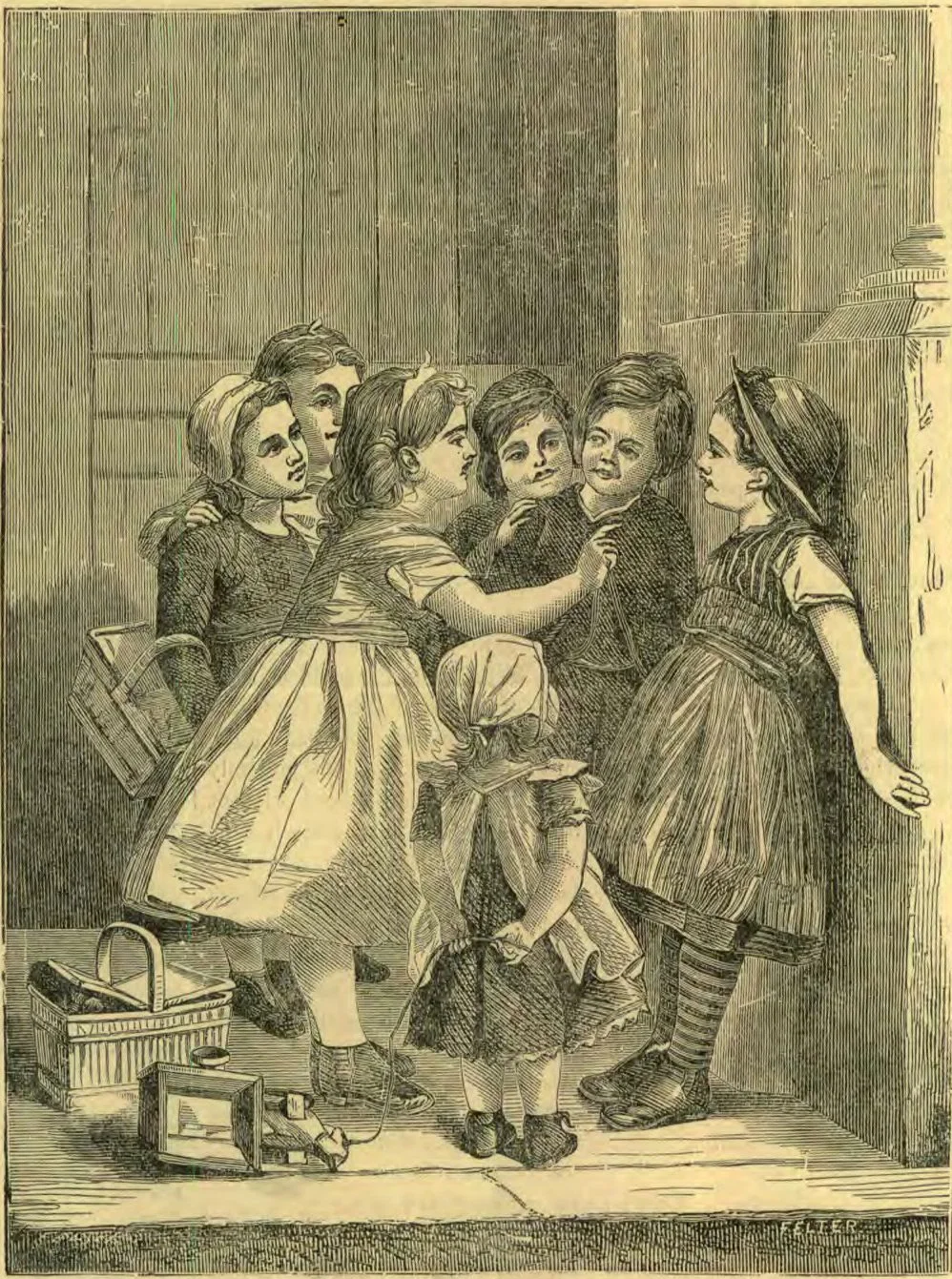
The Youth’s Instructor, Vol. 33, No. 9.

OUR ANTIPODES, THE CHINESE

The Youth’s Instructor

Mar 18, 1885

S. D. A. Publishing Association · Battle Creek, Mich. · Mar 18, 1885

OUR ANTIPODES, THE CHINESE.
By antipodes, you know, we mean those people who live on the other side of the globe, and whose feet are opposite to ours. They are our opposites, not only in their position on the globe, but also in their customs. In reading, it would seem strange to us to begin on the last page of our books and read the lines backward; yet this is the way all Chinese books are written. The spoken language and the written language are entirely different, so that it takes a man nearly a lifetime to become a skillful reader and writer.
When Americans meet on the streets, they clasp each other's hands; when a Chinaman meets a friend, he shakes his own hands. The men wear their hair in long braids down their backs; and if any fop wants his cue to look particularly fine, he braids in false hair or silk thread to make it hang down to his heels. The women comb their hair straight back, and do it up as tight as possible. I suppose the closely cropped hair of the men and the bangs and frizzes of the women of our own country must look as strange to them as their cues do to us.
The small feet of the women form another contrast. After the little children have learned to walk, their feet are bandaged, and not allowed to grow any more, so that most of the ladies among the higher classes have feet only about three inches long. This is a very cruel custom; yet the Chinese ladies do not think it so bad as the habit of compressing all the life-giving organs of the body in tight clothing. Of course, you wouldn't like to own it, but really, girls, don't you, in your inmost heart, think the Chinese have the best of the argument!
They do not have that aversion to coffins that we have. These are usually bought at the undertakers. But often the coffin is made at the house, where the person for whom it is intended can have it fixed to suit himself. When finished, it is stood up in some conspicuous place, where the visitors can examine it, and make all the remarks they choose.
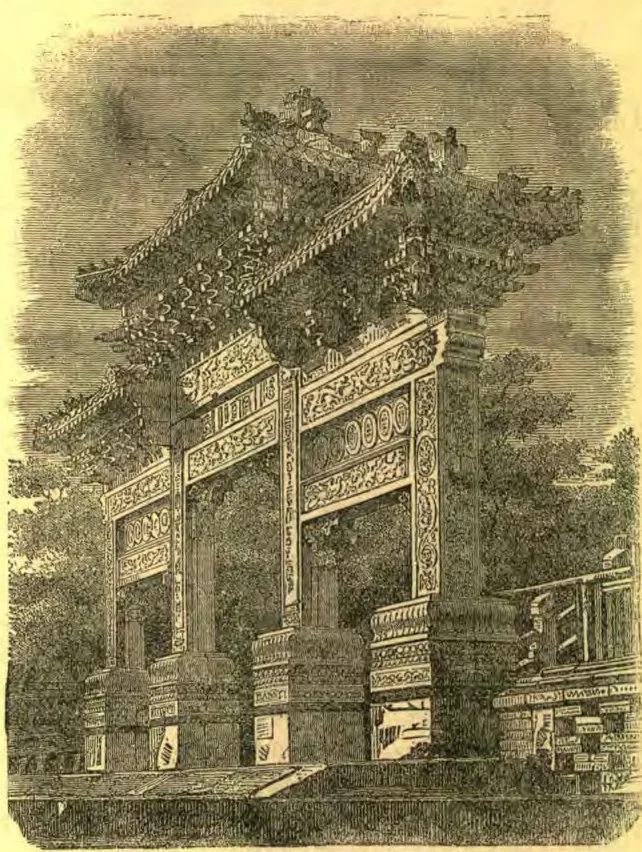
It is thought very praiseworthy for a widow to commit suicide when her husband dies. Oftentimes a splendid monument, in the form of a gateway, is erected to her memory. Such a one is seen in the picture on this page. The emperor sends some money toward it, and the relatives furnish the rest. On it are inscriptions setting forth the virtues of the widow. When the monument is finished, a mandarin goes to worship before it, thus giving the highest earthly sanction to a wicked custom.
But for all their oddities, the Chinese are really very intelligent. They have a reliable history of their country, reaching back for thirty centuries; and they have many valuable and well-written books in their language. The art of printing was understood and practiced by them hundreds of years before Claxton invented his printing press. But their wisdom lacks the “one thing needful”—they have no knowledge of the true God; and without this, all wisdom is foolishness.
W. E. L.

THE KNIGHT AND LUTHER.

DURING one of Luther’s journeys, a noble knight learned that the reformer was to stop at a certain place. He wanted the honor that would come to him could Luther be safely caught up and sent to Rome; so he resolved to hazard the attempt. He ordered his armed retinue to prepare hastily, for there was no time to lose. His confessor also urged him on, assuring him that he would be doing a good work, and save many souls. At early dawn he set out, making his way along the picturesque Berg-Strasse, or mountain road, that skirts the forest of the Odenwald, between Darmstadt and Heidelberg. Arriving at the gate of Miltenburg in the evening, he found the city illuminated, and the town itself full of people, who had come thither to hear and see Luther.
More indignant than ever was the noble knight. Indignation grew to rage, when, arriving at his hotel, his host greeted him, “Well, well, Sir Count, has Luther brought you here too? Pity you are too late! You should have heard him. The people cannot cease praising him.”
The knight was in no mood to hear Luther praised, and sought the privacy of his room. Awakened in the morning by the matin-bell of the chapel, sleep had assuaged his ire, and his thoughts were at home, where he had left an infant daughter at the point of death. As he drew aside his curtain, he saw the flicker of a candle in the window opposite, and waiting a moment, heard a deep, manly voice utter the words, “In the name of the Father, and of the Son, and of the Holy Ghost, Amen.” He heard the voice further continuing in a strong, fervent petition for the whole Christian church, and the victory of the holy gospel over sin and the world.
Being a devout man, his interest was aroused; and donning his armor, he inquired of the landlord who that earnest man was that he heard across the street.
“That earnest man,” responded the landlord, “is the arch heretic Luther himself. Has your grace a message for him?”
“Aye,” said the knight, “but I will deliver it with my own lips;” and with a dubious shake of the head, he crossed the street, entered the house, and in a moment stood before the object of his search.
Luther instinctively arose from his chair, surprised, and not a little disconcerted, by the sudden appearance of a stalwart, armed knight; perhaps he had an unpleasant suspicion of his errand.
“What is the object of this visit?” inquired Luther.
Twice and thrice he repeated his question before receiving a reply.
At length the knight, having recovered somewhat from the spell upon him, said, “Sir, you are far better than I. God forgive me for intending to harm you. I came here to make you a prisoner; you have made a prisoner of me instead. It is impossible for a man who can pray as you pray to be an enemy of the holy Church, a heretic.”
“God be praised!” said Luther, now relieved from his suspicions. “It is His word and Spirit that has subdued you, not mine, though I may be chosen to bring his word to honor in Christendom. Go now your way, therefore, in peace, my lord. He that hath begun a good work in you will perform it to Christ’s coming. If it be God’s will, you shall yet behold miracles; how the Lord will break many swords like yours, and cut the spear in sunder, as he has to-day.”
Convinced and confirmed, the knight lost no time in making his way homeward, attended by his retinue, now still more curious to learn the object of his hasty expedition. Arriving at the bedside of his daughter, he found her out of danger; and falling on his knees, he thanked God for all that had happened. A few years later, when Luther confessed his faith before Charles V., among the assembled nobles who stood at Luther’s side, was this knight, who had once thought to overthrow and destroy him.—Selected.

Sins of Omission and Commission

THERE are sins of omission, as well as sins of commission. It is not enough that we let evil alone; we must also do right.

UNDER THE SNOW.

GRAY and cold is the wintry sky; Wails the wind as it passes by; Where are the daisies fair, and white, That bloomed when the days were long and bright? Under the snow, under the snow, They wait for the soft May winds to blow; The children know! The children know!
Soon the bluebird’s wavering note Over the silent fields will float; Then will the daisy host be seen, Silver stars in a heaven of green; Under the snow, under the snow, They only wait for the frost to go; The children know! The children know!
Sometimes, under the snow of pain, Hearts must lie like the wintry plain; Yet in the springtime, skies will clear; Winter never is all the year. Under the snow, under the snow, Joy, like the daisies, nestles low; The children know! The children know!
—The Well-Spring.

UNDOING

“There, mother! I've finished it now. Can't I put the tiresome thing away, and read my book?” So questioned Annie Leslie, as she tossed from her a plain apron she was making for a poor neighbor's child.
“Let me see what you call finished, Annie,” said Mrs. Leslie.
“Ah!” said Annie, shaking her curly head, “it will not bear close looking at. I do not want you to go over my stitches with your sharp eyes, mother. Do let me put it away, and forget such a thing ever was made!”
Mrs. Leslie only smiled, as she took up the apron, catching sight of many a long stitch, with here and there a stain, telling of careless finger-pricking.
Checking Annie's spring towards the book-shelf for her favorite story, she silently pointed to a seam, cobbled together in Annie's most careless style, and puckered beyond description. Annie hung her head, as her mother bade her sit down, pick out, and re-sew the faulty seam.
“I wish that things never could be undone, mother. I should like never to be able to undo, or to alter anything I had done. It's so tiresome!” exclaimed Annie, with a pout.
“Well, my child,” replied her mother, pleasantly, “your wish can be gratified early. What day of the year is it?”
“The first of March,” she replied.
“Then, Annie, you can look back upon two whole months in this year, every day of which you have said thought, and done countless things you can never undo. You cannot alter a single thing in the past. Does that not satisfy you?”
“No, mother,” said Annie, in a subdued tone, “there are so many bungling stitches in the past months, that I should be thankful to have the chance of undoing them. I've tried to do a little work for Jesus, but I am afraid it will never bear his looking into after all!” And tears fell on the seam she was sewing.
There was sympathy in the motherly face, as Mrs. Leslie answered: “The two months' record and work are done, Annie; and a tender pity for every mistake. We can only put the past into his hands, dear, and ask his help for the future. Will you not trust him to do this, and to help you to live a less careless life, so that there shall be less longing on your part to be able to go over the past?”
“I will try, mother,” said Annie, simply. Might we not each one determine to watch earnestly every word and action, because we can never sit down to undo the past?—Selected.

ON THE PACIFIC OCEAN.

JANUARY twenty, twenty-one, and twenty-two, 1885, were delightful days on the Pacific Coast. At one o’clock, P. M., on the twentieth, we went on board the beautiful steamer, Santa Rosa, lying at Broadway wharf, San Francisco. One hour later, and our floating palace, with her cargo of living freight, loosed her moorings, and moved gracefully out upon the beautiful bay. Soon we went through the famous Golden Gate, passed the Cliff House, and noted Seal Rocks on the left, turned our course southward, and were fairly under way for San Diego, the most southerly port and town on the California coast, distant from San Francisco 480 miles.
During the entire voyage of nearly three days’ continuance, the weather was delightful, the sea remarkably and unusually calm, old ocean maintaining the integrity of the name, “Pacific.”
We soon became acquainted with an English sea-captain, whose sail ship lay at anchor in San Francisco Bay. He was a passenger on the Santa Rosa, on his way to visit a mother and brother living at Los Angeles. We found him a very intelligent and sociable man. He has been studying our publications and reading the Signs for several years.
Our first stop was at Port Hartford. Just above, on the coast, stood a cluster of houses, the homes, as we were informed, of whale fishers. From this point they keep a sharp look out for the spouting of a whale; and when the signal appears, they man their boats, and start in rapid pursuit. This is very hazardous business, of course, grappling with these mighty monsters of the deep; nevertheless, these daring men are quite successful in capturing many a valuable prize.
At Santa Barbara we lay in port more than six hours, giving us ample opportunity to find, and have a very pleasant visit with old friends. We observed, while on shore, that the land and houses seemed to go up and down, and rock to and fro rather uncomfortably. So when the time came, we were glad to get aboard the ship again; for we always preferred the reality to deceitful appearances. We think the beautiful country of Santa Barbara substantial enough; no doubt the Santa Rosa was to blame for appearances.
Our next stop was at San Pedro, the sea port for Los Angeles. Here we parted with much freight, and a number of passengers. We remained anchored in the bay for a full half day. About noon we were on our way again, no more to stop until we reached our destination. We spent most of the time on deck, gazing upon the illimitable sea, and the mountainous California shore, from thirty to fifty miles distant.
Sea gulls, to the number of two or three hundred, accompanied us continually, and furnished the passengers with a subject of no little interest and amusement. The gull appears to be a cross between the pigeon and the duck, very expert either on the water or in the air, and very ravenous,—a kind of feathered scavenger, I should say. They accompanied us day after day, with unwearied wing, solely for the purpose of feeding upon the refuse from the kitchen. Whenever anything eatable was thrown overboard, dozens of them would fall upon it, and a desperate struggle would ensue, each endeavoring to gain all.
On four different occasions we saw the spouting of whales. The whales themselves, being submerged, were too far distant to be visible. Their spouting resembled jets of steam issuing from the surface of the briny deep.
On the afternoon of the last day the passengers on deck had quite a sensation. A large number of porpoises were seen at a distance approaching the ship with almost lightning speed. They are a species of fish, from three to five feet long, with a long snout like a tin horn. So active are they that they can dart entirely out of the water several feet into the air, then plunge again into the deep. On reaching our ship, they soon disappeared.
At about seven o’clock in the evening, without a single symptom of sea-sickness, we arrived in safety at San Diego. Thus ended our first sea voyage, short, pleasant, and impressive, not soon to be forgotten. How mighty are thy works, O God!
H. A. ST. JOHN.

THE GULF-STREAM.

THERE is a river in the ocean. In the severest droughts it never fails, and in the mightiest flood it never overflows. Its banks and its bottom are of cold water, while its current is of warm. The Gulf of Mexico is its fountain, and its mouth is in the Arctic seas. It is the Gulf-stream. There is in the world no other so majestic a flow of water. Its current is swifter than the Mississippi or the Amazon, and its volume more than one thousand nine hundred times greater. Its waters, as far as the Carolina coast, are indigo blue. They are so distinctly marked that the common sea-water can be traced with the eye. Often one-half the vessel may be seen floating in the Gulf-stream water, while the other half is in the common water of the sea, so sharp is the line and want of affinity between those waters, and such, too, the reluctance, so to speak, on the part of that of the Gulf-stream to mingle with the common water of the sea. In addition to these, there is another peculiar fact. The fishermen on the coast of Norway are supplied with wood from the tropics by the Gulf-stream. Think of the Arctic fishermen burning upon their hearths the palms of Hayti, the mahogany of Honduras, and the precious woods of the Amazon and Orinoco.—Hall's Journal.

Forgiveness: The Bridge We All Must Cross

He that cannot forgive others, breaks the bridge over which he must pass himself; for every man has need to be forgiven.

HASTE THEE, SPRING.

OH, HASTE thee, bright and joyous spring, When verdure robes the earth as queen, And happy birds are on the wing.
Too long our snow and ice-bound earth Has lain a cold and dreary dearth. Too long we sigh for spring-time birth!
Oh, haste thee! Bring us life and peace— From icy fetters sweet release; Our hopes, our love, and joys increase.
Mount up, O Sun, and soar on high, Thou mighty Monarch of the sky! Ay, frozen nature now defy.
Melt down, beneath thy piercing rays, The snow-forts of these winter days, And gladsome earth will speak thy praise.
Oh, haste thee, ever welcome spring; We to thy memory tribute bring, And of thy beauties fain would sing.
Oh, haste thee, happy, sunny hours, With dancing rills and lovely bowers; We long to greet and claim them ours.
Then haste thee! Speed the moments on Till winter's icy course is run, And glorious spring-time is begun.
J. M. HOPKINS.

IMPORTANT BIBLE SUBJECTS.

LESSON 36.—INHERITANCE OF THE SAINTS.

(Continued.)

THE FIRST DOMINION FORFEITED.

[NOTE TO THE STUDENT.—Do not consider the lesson learned until you can give at least the substance of every text, with the correct reference for each. The references in black letters indicate those texts that should be committed to memory. A little diligent application each day will enable you to do this.]
  1. WHEN the earth was created, to whom was the dominion over it given? Gen. 1:26-28.
  2. What was its condition at that time? Gen. 1:31.
  3. Did man also share in this perfection? Gen. 1:27; Eccl. 7:29.
  4. What further shows that the dominion which God intrusts to man must be free from sin? Dan. 27; Matt. 6:10.
  5. Then until what time only could Adam hope to retain the dominion given to him?
  6. When the dominion was given to Adam, what prohibition was put upon him? Gen. 2:17.
  7. Did he heed this prohibition? Gen. 3:6.
  8. Since the dominion given to Adam was a perfect one, what necessarily resulted from his fall?
  9. By what agency was Adam’s fall accomplished Gen. 3:12, 13.
  10. Who is the serpent? Rev. 20:2.
  11. If a man is overcome by another, what is the result? 2 Peter 2:19.
  12. By whom was Adam overcome?
  13. Then to whom did he become subject?
  14. What becomes of a man’s possessions, if he himself is overcome by another? Matt. 12:29.
  15. Then when Adam was overcome by Satan, what must have become of the dominion which he held?
  16. What title does Paul apply to the one who blinds men concerning the gospel? 2 Cor. 4:3, 4.
  17. What is the name of the one who performs this work of deception? 2 Thess. 2:9, 10.
  18. Then who is “god of this world”?
  19. What other title does Paul apply to the one who works in the children of disobedience? Eph. 2:2.
  20. Although Satan usurped the dominion from Adam, did he become absolute ruler? Dan. 4:29; Jer. 27:4, 5.

NOTE.

SINCE a sinless dominion was given to Adam, and God intrusts to man no other kind of dominion, it follows that Adam could hope to retain it only as long as he remained sinless. Therefore when he fell, the necessary result was that he lost his dominion. Of course he forfeited all the right that he had to the one who overcame him.

HOW TO SUCCEED.

The Rev. F. E. Clark, in his work entitled, “Our Business Boys,” published by D. Lathrop & Co., says a great many good things to business boys; and they apply just as well to business girls, too. So anxious was Mr. Clark to help boys make something of themselves, that he wrote to one hundred practical business men of Portland, Me., asking what principles boys should possess, and what dangers they should shun, in these times, to be truly successful in business matters.
Of the one hundred men to whom he wrote, eighty-three replied, some of them writing several pages; and Mr. Clark says that after he had drawn off on to a long roll the suggestions of each, he had “good advice by the yard.” You may be sure these thorough-going business men, who had grown up with their trade, and had employed clerks for years, were able to give some very valuable advice.
If our young readers should never become doctors, lawyers, merchants, or anything of the like, we trust they already claim to be business boys and girls; and as such, that they will be glad of the experience of those who have made a success in that which was honorable.
Who are the business boys and girls? Not those who go moping around in a dreamy-like manner, with eyes and ears half closed, and with no ambition to help even themselves. No, indeed! they are just the opposite in character. They are the boys and girls who are all astir, their minds craving knowledge, and their bodies exercise; who are quick to see, and ready to do duty, and to venture to take responsibilities.
To make true success, these youthful minds need the counsel and experience of older and wiser persons; and Mr. Clark quotes certain elements of true business success from his eighty-three letters, which may assist one even in the ordinary duties of life. We haven't space for all; but we quote first what one man gave as the parts which make up true business success. He puts it—
30 per cent. Patient, persistent, dig, dig, dig, at it every minute.
30 per cent. Reputation (founded upon fact) for honest dealing every time.
10 per cent. Luck, and fortunate circumstance, caught on the fly.
20 per cent. Snap!
10 per cent. More persistent dig.
100 per cent. Success.
One writer says that when you are employed by another person, you must make your services indispensable to him. “By hard work, by thorough knowledge of detail, by fidelity in little things, make such a place for yourself that your employer cannot get along without you.”
“If you want to succeed in some one thing, throw your whole soul into it,” says one.
Another says, “‘Go-at-ive-ness’ is the first condition of success, and ‘Stick-to-it-ive-ness,’ the second,” which is similar to the plan of Dr. Judson, the celebrated missionary to India. When asked how he accomplished so much, he said, “I have no plan, except that when I have anything to do, I go and do it.” All who have read the life of Dr. Judson know that he did “go-at-it,” and “stick-to-it,”—that is, to the special work he had to do.
The eighty-three men were especially agreed in two things,—that “hard work is the price of success;” and that “you must be true, if you would succeed.”
One writer says, “The prime requisite of true success in business is honesty.”
“I have always been just as careful to pay a debt of fifty cents as fifty dollars,” says another.
And another, “I care not what respectable business or occupation or trade a young man engages in, if he knows his business, has any brains, and sticks to it, he will succeed provided he is honest; the foundation of the structure is truth. I consider this the most essential of all virtues; for it aids all others.”
“I have never known dishonesty to be successful in the long run,” says another.
One wealthy man says, “All my success in forty-three years has depended upon the principle of honesty.”
Then, dear reader, this is the sum: Knowing your duty, go at it; that is, don't put it off for a more favorable time. Having begun your work, stick to it; work hard at it until it is completed. Always preserve the strictest honesty even in the smallest matters, serving your employer so faithfully that he cannot afford to dispense with your services. Such success will be honored of Heaven.
M. J. C.

THE DECLARATION OF INDEPENDENCE.

Few people know that the original Declaration of Independence is kept in the library of the State Department at Washington. It is in a cherry case under glass. But the doors are thrown open all day long, and strong rays of light are eating up its ink day by day. The Constitution is written on parchment. The text of it is in a hand as fine as copper-plate, and the ink of this part can still be plainly read. The signatures, however, are written in different ink, and they are very fast disappearing under the action of the light. The bold signature of John Hancock is faded almost entirely out. Only J, o, h, and an H, remain. Two lines of names are entirely removed from the paper; not a vestige of ink remains to show that names were ever there. Ben Franklin’s name is gone. Roger Sherman’s name is fast fading. I could not find the name of Thomas Jefferson, and Elbridge Gerry has lost its last syllable. Charles Carroll and John Adams have been scoured off by the light, and only eleven names out of fifty odd can be read without a microscope. Just below the Constitution lies the original of it in Jefferson’s handwriting. It is on foolscap paper, yellow with age, and worn through where the manuscript has been folded. The writing is fine and close, and the whole Constitution occupies but two pages. The ink is good, and it remains as fresh as when it left the quill of Jefferson, over one hundred years ago. It is full of erasures and interlineations, some of which are in Franklin’s handwriting, and the others in the strong script of John Adams.—Selected.

NO CHANCE TO RECTIFY MISTAKES.

WHEN I was a young man, there lived in our neighborhood a farmer who was usually reported to be a very liberal man and uncommonly upright in his dealings. When he had any of the produce of his farm to dispose of, he made it an invariable rule to give good measure—rather more than would be required of him. One of his friends, observing him frequently doing so, questioned him as to why he did it. He told him he gave too much, and said it was to his disadvantage. Said the farmer:—
“God has permitted me but one journey through the world; and when I am gone, I cannot return to rectify mistakes.”
The old farmer’s mistakes were of the sort he did not want to rectify.—Selected.

Keep Your Face Toward the Sun of Righteousness

KEEP your face toward the Sun of Righteousness. Then the shadow of self will fall behind you, and not darken your way. Then you will have a sure guide, whose brightness no false, delusive light can outshine.

STOPPING AND STARTING.

Railroad managers in America are giving fresh attention to the cost of stops and starts in the running of trains. It would seem from some of the more careful estimates, that there is more of waste in this line than in any other in railway service. More power is called for, and more is wasted, in the slowing and stopping and starting of the machinery than in the free play of that machinery at its greatest speed. This is a truth that has long been noted in the use of mental and moral machinery. Every intelligent observer of Sabbath-school methods knows that intermissions in the school sessions, or in the teachers’ meetings, the interruption of the series by recesses and vacations, taxes the machinery and wastes power as no other strain can. And the same truth is marked in the progress of personal character. The man who is “always sinning and always repenting” in his moral course, racks his moral nature to very little purpose. It was said of Isaac, as the child of promise, that, as he grew, he “went going;” and that is the best way for any child of promise who is on the right track—to go going, instead of to go stopping and starting, starting and stopping again.—S. S. Times.

Belonging to Christ Through His Redeeming Blood

We must never forget that we have been purchased by the blood of Christ; therefore we belong to Christ and should work for him.

PLENTY TO DO.

MAY, if I have but a mind, Do good in many ways; Plenty to do the young may find In these our busy days. Sad would it be, though young and small, If I were of no use at all.
One gentle word that I may speak, Or one kind, loving deed, May, though a trifle poor and weak, Prove like a tiny seed. And who can tell what good may spring From such a very little thing.
Then let me try, each day and hour, To act upon this plan,— And what good is in my power, To do it while I can. If to be useful thus I try, I may be better by and by.

HOW ORVIE CONQUERED SELF.

It was grandma's birthday, and all the children and grandchildren were coming to spend it with her.
Aunt Mary, who lived at the old home, had been busy all the week; for she knew there would be six hungry little folks to feed besides Orvie, who had kept nearly as busy as his mother, asking questions. When at last all was ready, she took a tiny basket down from the cupboard, and said: “Here, Orvie, are the last of those maple-sugar cakes that I made you last spring. You've eaten nearly all of them, but there's just enough left to give your cousins each one.”
Orvie's face clouded. He had no little brothers or sisters to share his toys and goodies, and this had made him rather selfish.
“I don't want to, mamma,” said he. “I want them all myself.”
“Very well,” said mamma: “only I'm sorry my little boy has such a selfish disposition. I'm afraid he'll never be happy or make others so unless he tries to overcome it;” and then she put the basket back on the shelf.
Finally the long-expected day came, and with it the uncles and aunts, and the six merry cousins.
Each of the cousins had some gift for grandma,—something which they had bought with their saved-up pennies, and that made it much nicer, you know. Grandma, when she heard of it, kissed all of them over again, and said, three or four times, “Bless the little lambs.”
The cousins got along very nicely together until dinner time, playing “hunt the handkerchief” and “puss wants a corner;” but after dinner, Bessie said, “Orvie, let's see your play-house.”
Now Orvie had a very nice play-house that his papa had made him, and in it there were a great many toys. He was very willing they should see it, for he liked to have them admire it, and hear them say how much they wished they had one too; but he didn't want them to touch any of the pretty toys. Of course, there was no pleasure in just looking at them. They wanted to play with them too; so when Ernie, who had been admiring a big blue agate until Orvie had taken it from him, picked up a whip and cracked the hobby horse around the heels, he received such a sound slap that it made him run from the room with the tears chasing down his cheeks.
The other children looked so alarmed and surprised that Orvie began to feel somewhat ashamed; and when Aunt Annie came in to see what was the matter, he tried to excuse himself by saying: “I told him not to touch them, and he shouldn't, if he didn't want to get hurt.” “I guess you had better all come out, children,” said Aunt Annie, and so they left Orvie all to himself. His conscience pricked him not a little; and by the time he had put his toys again in place, he began to think that he was a very naughty boy. Even when he went out, he was so quiet that mamma, who had heard nothing of the trouble, wondered what was the matter.
After a while, Aunt Annie, who saw that Orvie was sorry for what he had done, but still did not venture to join the rest in their games, asked, “Why don't you play post-office?”
“Oh, yes,” said Bessie, “its lots of fun. We'll write each other letters, and our mothers will write some too. Which will be postmaster, Orvie or Ernie?”
Of course, both wanted to be, but Ernie generously said, “Let's choose Orvie;” and so they did, though this made Orvie feel more ashamed than ever. Then two of the girls were mail-carriers, who carried the mail from the post-office behind the sofa to the houses made of chairs; while baby May, with her cart, gathered the letters from the uncles and aunts, who seemed suddenly to remember that they had a great many to write.
After they had received several letters apiece, a bright thought entered Orvie's head; and though it cost quite a struggle, he slipped quietly out, and when he returned unnoticed, he had something done up in six neat packages, with a name printed in big, round letters on each; and what do you think was in them? Well, it was those maple-sugar cakes; and in the one marked “Ernie” was the blue agate besides.
“Oh, what cunning sugar-hearts!” said Jennie.
“And such pretty blue ribbons!” said Bessie.
“Who sent them? did you, Aunt Mary?” asked the rest.
Aunt Mary shook her head, and so did all the uncles and aunts; but Uncle Dick, who saw how Orvie's eyes danced, said, “You better ask the postmaster, I guess.”
What a rush they made for Orvie then! One of the girls held him by the coat, while Ernie peeped over his shoulder. Bessie laughed so hard that she had to stand up against the wall to keep from falling, indeed they all laughed and talked in one breath. And how glad Orvie felt, and what lots of letters he got! But he thought this one with mamma's name at the bottom was the best:—
“Mamma is so glad that Orvie has conquered self. He has made her very happy by his kindness to his little cousins, and she is sure he is much happier, too.”
S. ISADORE MINER.

Letter Budget.

THERE is space in the Budget for only one letter this time; but you will not mind waiting just one week for other letters when you have such a nice story to read. Delia and her Sister Mary are French girls. How glad we all are that some from almost every nation have the INSTRUCTOR.
DELIA PAQUETTE writes from Menominee Co., Mich. She says: “I and my sister Mary are now taking the INSTRUCTOR, which we find very instructive; and we are always glad when it comes. I am nine years old, and my sister is nearly eight. We are keeping the Sabbath with our parents. We have a Sabbath-school to attend. We are in Book No. 1. We want to live in the fear of God, and try to be faithful. We send love to the INSTRUCTOR family.”

You have reached the end of this edition.

The Youth’s Instructor · Mar 18, 1885