The Youth’s Instructor, Vol. 49, No. 18.

Crater Lake

The Youth’s Instructor

May 2, 1901

Review and Herald Publishing Company · Battle Creek, Mich. · May 2, 1901

Crater Lake

II

Its Discovery and Exploration
At the advent of white men in southern Oregon, Indian legends told of a great sunken lake in the top of a mountain, where evil spirits were wont to hold high carnival. Only the conjurers, or “medicine men,” had ever seen it; for its solitary island, so the legends said, was the abode of a great demon who was ever on the watch to seize and destroy the presuming brave who would dare to peep over the cliffs and look upon the deep blue water over which he ruled.
Who was the first white man to discover Crater Lake is a question over which there has been considerable dispute. Some claim that it was discovered by the soldiers of General Fremont’s exploring party in 1847; but there is no authentic record to substantiate this claim. Several prospectors and hunters claim to have seen the lake about that time, and in the early fifties; but as these claimants were silent until after a description of the lake had been given to the world by others, they are entitled to no credit for what they saw but failed to report.
In the early summer of 1853 a party of six California prospectors, who were in search of the mythological “Lost Cabin Mine,” lost their way in the mountains near the head of Rogue River, and were compelled to climb mountain peaks in search of some landmark by which they could ascertain their whereabouts. One day, after climbing a long gentle slope, they came suddenly upon the cliffs overhanging the lake. They were so struck with wonder and admiration that they forgot for a time their anxiety, and spent half a day tramping along the rim of the lake and deciding upon a name for it. They finally agreed to call it Deep Blue Lake, and when they returned to civilization, they gave this name, with a fairly good description of the lake, to the world. But they were unable to locate it with any degree of accuracy, and as there were no newspapers then published in that vicinity, the story was soon forgotten.
Nine years later another party of prospectors came upon the lake while looking for a camping place. There was then a paper published in Jacksonville, and when this party reached there, they published an account of their discovery with a description and the location of the lake.
In the next few years several different parties, who had never heard of the lake, accidentally discovered it, and gradually it came to be pretty well known in the surrounding country. But in those days the Oregonians spent half their time in hunting gold and the other half in fighting Indians; and it was not until 1869 that a wagon road was opened from the old military road between Jacksonville and Ft. Klamath up the steep mountain side to the rim of the lake.
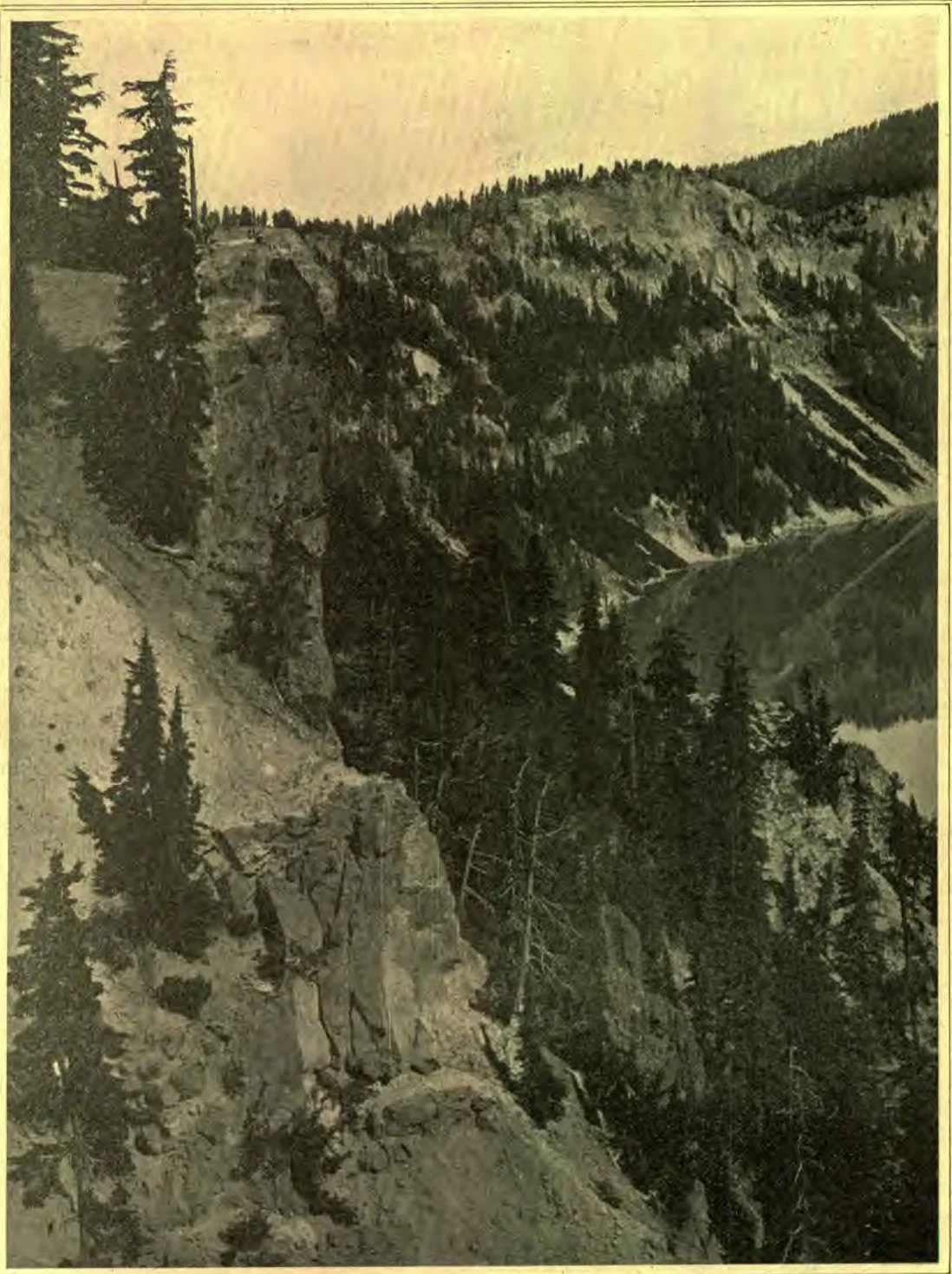
THE CLIFFS OVERHANGING THE LAKE
The party that opened the road took with them a boat in which they succeeded in reaching Wizard Island and several other points that were otherwise inaccessible. This was the first party to call it Crater Lake, and though they had not a shadow of a right to give it a name, it will no doubt be known as Crater Lake as long as the world stands.
In 1883 two men from the United States Geological Survey visited the lake, but did not remain long enough to explore it thoroughly. Two years later a party was specially detailed to this work by the Geological Survey. Nearly a month was spent in surveying and sounding the lake. During that time more than a hundred and fifty soundings were made, some of which showed a depth of over two thousand feet.
J. Edgar Ross.

VILLAGE LIFE IN NEW BRUNSWICK

THE village of Tracadie, in which I live, is situated in the northeastern corner of New Brunswick. It is delightful and cool here in the summer, and many tourists visit this place during the warm months of the year. I have been here only about six months, and so have not spent a winter in this place, but they say the winters are severe, the snow lying several feet deep during many months of the year. The springs are late and cold, but vegetation is rapid during the summer months. The soil is a sandy loam, suited to the raising of potatoes and wheat. The surface is level or gently sloping toward the sea.
The people, who are almost entirely French, seem very peculiar to a person not acquainted with them, but I am gradually becoming acquainted, and find them a simple, good-hearted people, fond of amusements, and with few wants, taking each day's cares and joys as they come, with that contented spirit which is born of a belief that with them “all is well.” Most of them are the descendants of the Acadian French who were compelled to leave their fertile farms in Nova Scotia in 1755 for refusing to take the oath of allegiance to the sovereign of England. Many of these French emigrants settled along the New England coast, but afterward found their way to this province. They are a short, dark-complexioned people, speaking for the most part the French language, although nearly all of them speak English also. Almost the first question asked a stranger is, “Parlez-vous Français?” (Can you talk French?) and if they find that you can not, they do the best they can with what English they have, and some of them speak it well. In this village there are about one thousand seven hundred people.
These people seem to be about fifty years behind the times, in some things, at least. It is a common thing to see women in a potato field during the digging time, working away with heavy new-land hoes, such as our fathers used for planting on the new farms years and years ago, when America was first settled. These women hire out for (vingt-cinq) twenty-five cents a day, and work outdoors like men during the planting and harvesting time. They are industrious indoors also, manufacturing all their own wool. Almost every house contains a little old-fashioned flax-wheel, on which all the yarn is spun; also the hand loom; and although nearly all the women can weave, it is quite common for the neighbors to change work, so that all have a chance to help others at what they regard their heaviest work. I think this custom comes from their love of company and of associating together.
The women knit, sew, and weave carpets during the long winter evenings. The most beautiful home-made carpets are manufactured from a mixture of wool and rags. They cut the rags up in small pieces, pick them all to bits, churn them, mix them with the wool, and then card and spin the mixture. They also full and nap cloth for the men's wear. To full the cloth, they arrange a large table in the center of the room, around which a number of young people sit. Then they take a web of cloth of perhaps thirty yards, and wet it in hot soapsuds, stretch it on the table, and these young folks press, pull, slap, pound, and squeeze it for hours. When through with this process, the cloth is thicker and narrower, that which was but a yard wide at the start being now but three quarters. It is now dried and napped, and is ready to make up.
Winter is the principal fishing season. The men make holes in the ice, through which they place nets, and catch an abundance of smelt, some cod and salmon, and trout. Other kinds of fish are taken, but the smelt seem the most plentiful at this season of the year. Some of these fishermen make considerable money, while others make little, and are very poor.
I must not forget to tell you that the place abounds in swine, which are left to run at large, winter and summer. In summer they plow up the sandy roads at a fearful rate; and in the winter they wander over the snow, and one is apt to meet some of them even in the night.
There is a lazaretto carried on here by the Catholics, the only one in the Dominion of Canada. At present there are about twenty lepers in this institution, who are taken care of by as many nuns. It is a sad sight indeed to go into the hospital, and see these poor souls, with their red, swollen faces, shut away from all the world, trying to make the best of their sad lot, and be company for one another. They can never, never leave the lazaretto; no one would dare give them employment or have them about the premises as it is thought that leprosy is very contagious; yet many people visit this lazaretto. Of course they are told not to touch with the bare hand the lepers or any furniture in the room. The patients like to have ministers and missionaries visit them and read and pray with them. Only four of these lepers are Protestants. I have visited them, and taken them our periodicals. One woman believes Christ’s second coming is near, and she very much appreciates the Review and the Signs. Let us pray that some of these poor inmates may yet accept the truth in all its purity, and be lights for others in this benighted hospital.
Will the INSTRUCTOR family remember this far-away place in their prayers? As there are children here who will gladly accept our little papers, I shall be glad if you will send me some by mail. This is indeed a needy field, and these poor people as well as others must hear the message.
MRS. AMELIA-NASSON PRICE.

WATER CHANGED INTO WINE

INTRODUCTORY

Preceding Events.—This, the first miracle of Christ, was immediately preceded by these events:—
  1. Baptism of Christ. Matt. 3: 13–17.
  2. Temptation in the wilderness. Luke 4: 1–13.
  3. Call of the first three disciples (John, Andrew, and Peter). John 1: 35–42.
  4. Call of Philip and Nathaniel. John 1: 43–51.
NOTE.—This miracle was performed the third day after the calling of Philip and Nathaniel.
Main Reference.—John 2: 1–11.
Other References.—None.
The Bible Story of the Miracle.—“And the third day there was a marriage in Cana of Galilee; and the mother of Jesus was there: and both Jesus was called, and his disciples, to the marriage. And when they wanted wine, the mother of Jesus saith unto him, They have no wine. Jesus saith unto her, Woman, what have I to do with thee? mine hour is not yet come. His mother saith unto the servants, Whatsoever he saith unto you, do it. And there were set there six waterpots of stone, after the manner of the purifying of the Jews, containing two or three firkins apiece. Jesus saith unto them, Fill the waterpots with water. And they filled them up to the brim. And he saith unto them, Draw out now, and bear unto the governor of the feast. And they bare it. When the ruler of the feast had tasted the water that was made wine, and knew not whence it was (but the servants which drew the water knew), the governor of the feast called the bridegroom, and saith unto him, Every man at the beginning doth set forth good wine; and when men have well drunk, then that which is worse; but thou hast kept the good wine until now. This beginning of miracles did Jesus in Cana of Galilee, and manifested forth his glory, and his disciples believed on him.” John 2: 1–11.
Place.—Cana of Galilee, about eight miles north of Nazareth, and eighteen miles from Capernaum. It was called Cana of Galilee to distinguish it from another Cana in Samaria.
Circumstances.—This miracle was performed in the personal presence of Christ, at the marriage feast of relatives of Joseph and Mary. Mary the mother of Jesus was there. Christ and his disciples (five in number) were invited guests. The miracle was made manifest by obedience to Christ’s two commands: viz., (1) “Fill the waterpots;” (2) “Draw out.”
Great Lesson.—One of the great lessons taught by this miracle is that the growth and ripening of every cluster of grapes is in reality a miracle. The ordinary phenomenon by which nature turns water into wine in the clusters of the vine is just as much a miracle, although common and ordinary to us, as was this unusual and extraordinary wonder which the Saviour wrought. Both require the same divine wisdom and infinite power, the only difference being in the length of time consumed in the working of the miracle.

STUDY OF THE MIRACLE

“There Was a Marriage in Cana of Galilee.”—It was the custom of the times to have the marriage festivities continue for several days. The ceremonies accompanying such an occasion were, in many respects, quite different from the marriage ceremony of to-day. The following is taken from Edersheim’s “Life and Times of Jesus,” Vol. 1, page 354, and very concisely describes the ceremonies and festivities of a Jewish marriage:—
“First came the merry sounds of music; then they who distributed among the people wine and oil, and nuts among the children; next the bride, covered with the bridal veil, her long hair flowing, surrounded by her companions, and led by the friends of the bridegroom and the children of the bride-chamber. All around were in festive array; some carried torches, or lamps on poles; those nearest had myrtle-branches and chaplets of flowers. Every one rose to salute the procession or join it, and it was deemed almost a religious duty to break into praise of the beauty, the modesty, or the virtues of the bride. Arrived at her new home, she was led to her husband. Some such formula as ‘Take her according to the law of Moses and of Israel,’ would be spoken, and bride and bridegroom crowned with garlands. Then a formal legal instrument, called the Kethubah, was signed, which set forth that the bridegroom undertook to work for her, to honor, keep, and care for her, as is the manner of the men of Israel; that he promised to give his maiden-wife at least two hundred zuz (or more as might be), and to increase her own dowry (which, in the case of a poor orphan, the authorities supplied) by at least one half, and that he also undertook to lay it out for her to the best advantage, all his own possessions being guaranteed for it. Then after the prescribed washing of hands and benediction, the marriage-supper began, the cup being filled, and the solemn prayer of bridal benediction spoken over it. And so the feast lasted, it might be more than one day, while each sought to contribute, sometimes coarsely, sometimes wisely, to the general enjoyment.”
W. S. SADLER.

SAYING AND DOING

A constant peril in the Christian life, and an incalculable obstacle to the progress of the kingdom, is the disparity in our Christian lives between sentiment and action. We thrill with emotion over a deed of chivalry, and are thoughtless in our family life and unmannerly when we travel. We glory in sunlight honesty, and are tricky in business. We admire the purity of Sir Galahad, and read books that we would not like our friends to see over our shoulders. We are stirred by the records of martyrdom, and grumble over our breakfast. We feel that to praise virtue is to do our duty by it, not realizing that we are constantly under the arraignment of the Lord of reality. “Why call ye me, Lord, Lord, and do not the things which I say?”—Maltbie D. Babcock, D. D.

“LIKE YOUR FATHER”

“How much like your father, you are, William,” said an old man, laying his hand on a young preacher’s shoulder, the other day; “and you grow more like him every day.”
“Heavenly Father,” said the young man, as he went about his duties, “help me so to live that men shall find in me a likeness to thee, even thee, great Father! And O that it may be found of me that I grow more like thee every day!”

THE LORD IS RISEN

The Jewish rulers had carried out their purpose of putting the Son of God to death, but they did not feel the sense of victory that they had thought they would after silencing the voice of the great Teacher. Even in the hour of their apparent triumph they were harassed with doubt as to what would next take place. They dreaded a dead Christ more, a great deal more, than a living Christ. They had a deep conviction that their revenge against Jesus for exposing their hypocrisy would not bring rest to their souls. They had heard the cry, “It is finished,” “Father, into thy hands I commend my spirit.” They had seen the rocks rent, and had felt the mighty earthquake, and they were restless and uneasy. The words spoken by Christ when he was under their cruel power recurred to their minds.
Not on any account would the priests have allowed Christ’s body to hang on the cross during the Sabbath, for already the agitation caused by his death was giving publicity to his life and mission. When the people heard that the mighty Healer was dead, and that the sick and suffering had no one to relieve their distress, they applied to the priests and rulers for sympathy and relief. They were sent away empty; but apparently they were determined to have the living Christ among them again, and soldiers were stationed at the temple gates to keep back the multitude that came with their sick and dying, demanding entrance.
The world without a Christ made an impression that a living Christ could not have made. People came from far and near to see the one of whom the priests and rulers had declared, “The world is gone after him.” The recital of the deeds done by the priests shocked the people. They would not have allowed Christ to be thus treated; for had he not shown compassion to their sick? Never had he turned one away with the harsh denunciations used by the Pharisees.
Christ had said to his disciples, “Behold, we go up to Jerusalem; and the Son of man shall be betrayed unto the chief priests and unto the scribes, and they shall condemn him to death, and shall deliver him to the Gentiles to mock, and to scourge, and to crucify him: and the third day he shall rise again.” Overwhelmed with sorrow, the disciples did not see the hope and comfort in these words. By Judas they were repeated to the priests, and when they heard them, they mocked and ridiculed, speaking of Christ as a deceiver, a name that might appropriately have been applied to themselves. But now, when they heard the clamor for Jesus, the mighty Healer, who had cured the sick and raised the dead, they thought of his words, and remembered that he had said he would rise the third day, and they were horrified at the thought. Would he rise from the dead, and as judge arraign his accusers before his bar?
Death and the grave must hold him whom they had crucified. “Command therefore,” they said to Pilate, “that the sepulcher be made sure unto the third day, lest his disciples come by night, and steal him away, and say unto the people, He is risen from the dead: so the last error shall be worse than the first.” “Ye have a watch,” said Pilate, “go your way, make it as sure as ye can.”
The priests gave directions to have a stone rolled before the opening of the tomb. Across this they placed cords, sealing them with the Roman seal. Soldiers were then stationed around the sepulcher, to prevent it from being tampered with. The priests did all they could to keep Christ’s body where they had laid it. He was sealed as securely in his narrow tomb as if he were to stay there through all time.
So weak men counseled and planned to secure the body so hated by the Jewish dignitaries, and so precious to the disciples. Little did the murderers realize the uselessness of the efforts they were making to keep Christ in the tomb. By their actions Christ was glorified. The very efforts made to prevent Christ’s resurrection are the most convincing proofs of his resurrection. The greater the number of soldiers placed around the tomb, the stronger would be the testimony borne in regard to his resurrection.
There was only one entrance to the tomb, and neither human fraud nor force could tamper with the stone that guarded the entrance. Here Jesus rested during the Sabbath. A strong guard of angels kept watch over the tomb, and had a hand been raised to remove the body, the flashing forth of their glory would have laid him who ventured powerless on the earth. He who died for the sins of the world was to remain in the tomb for the allotted time. He was in that stony prison house as a prisoner of divine justice, and he was responsible to the Judge of the universe. He was bearing the sins of the world, and his Father only could release him.
Christ had declared that he would be raised from the dead on the third day; and at the appointed time a mighty angel descended from heaven, parting the darkness from his track, and resting before the Saviour’s tomb. “His countenance was like lightning, and his raiment white as snow: and for fear of him the keepers did shake, and became as dead men.” Brave soldiers, who had never been afraid of human power, were now as captives taken without sword or spear. The face they looked upon was not the face of mortal warrior; it was the face of a heavenly messenger, sent to relieve the Son of God from the debt for which he had become responsible, and for which he had now made a full atonement. This heavenly visitant was the angel that on the plains of Bethlehem had proclaimed Christ’s birth. The earth trembled at his approach, and as he rolled away the stone from Christ’s grave, heaven seemed to come down to earth. The soldiers saw him removing the stone as he would a pebble, and heard him call, Son of God, thy Father saith, Come forth. They saw Jesus come from the grave as a mighty conqueror, and heard him proclaim, “I am the resurrection, and the life.” The angel guards bowed low in adoration before the Redeemer as he came forth in majesty and glory, and welcomed him with songs of praise.
MRS. E. G. WHITE.

I KNOW WHOM I HAVE BELIEVED

You ask me how I gave my heart to Christ? I do not know. There came a yearning for him in my soul So long ago; I found earth’s flowers would fade and die; I wept for something that would satisfy; And then — and then somehow I seemed to dare To lift my broken heart to him in prayer. I do not know — I can not tell you — how; I only know He is my Saviour now.
You ask me when I gave my heart to Christ? I can not tell. The day, or just the hour, I do not now Remember well. It must have been when I was all alone The light of his forgiving Spirit shone Into my heart, so clouded o’er with sin; I think — I think ’twas when I let him in. I do not know — I can not tell you — when; I only know He is so dear since then.
You ask me where I gave my heart to Christ? I can not say. That sacred place has faded from my sight As yesterday. Perhaps he thought it better I should not Remember where. How I should love that spot! I think I could not tear myself away; For I should want forever there to stay. I do not know — I can not tell you — where; I only know He came and blessed me there.
— Guild Life and Work.

THE LAND OF DAWN BEAUTY

“The Land of Dawn Beauty” is a name sometimes applied to Korea, that little peninsula that lies west of the Japan Sea, about which China and Japan were fighting such a short time ago. The name seems most appropriate just now, for the dawn of a glorious morning has indeed come to Korea. The Bible has reached her shores, and its divine rays are illuminating the minds of her people. It is but sixteen years since the first missions were established there, and now the churches and communities where some knowledge of the Holy Word exists can be counted by the thousands.
The Koreans, from what C. C. Vinton, M. D., says in the Assembly Herald, seem to have practically no religious belief of their own “to be cast out before Christianity can enter.” And besides, unlike the Chinese, they are ready to welcome foreigners and to adopt foreign customs as superior to their own. If to a village comes a Bible, or a New Testament, or a Christian book, or even a leaflet, or some native who has learned a little of the story of Jesus, the liveliest interest is at once awakened, a school of inquiry is started, and soon a little band is found meeting together for worship and study; and when a clearer knowledge is obtained, they send out messengers to carry the glad tidings of a Saviour’s love to other towns. It is marvelous. It is more like apostolic times, Mr. Vinton says, than anything the world has ever seen.
If a little community is not satisfied with what it can learn from the means at hand, it sends messengers to the missionaries, though they must travel on foot a weary journey of many days’ duration. If no one can go back with these messengers, they remain until the truth can be learned. If a man is found who can return and become their teacher, they obligate themselves to support and “to obey all his instructions.” Every Korean convert is expected to be able to tell the truth to others.
They do not wait for outside help or outside means. They build their own churches, support their own pastors,—where they have any,—and send out their own evangelists.
Mr. Vinton, therefore, calls Korea “the strategic mission,” evidently looking upon it as the point which, if taken now, will give us the vantage-ground over the heathen world. God is calling for consecrated men and women to come to Korea. The door is open; shall the opportunity be lost? Shall our gold be withheld? Shall we stand with folded hands, fearing, delaying, until the dawn, rising so auspiciously now, goes out in rayless night?
China can be converted through Korea; Koreans can evangelize the great nations to the north. They can touch and melt the hearts of Japan. Remember Korea.
MRS. S. ROXANA WINCE.

MARVELS OF THE VOICE IN THE LABORATORY

“I AM glad you came to-day,” said the chemist, as I entered the laboratory this morning. “My friend, Mrs. X, is just going to show us some of her experiments, and I would like you to share the privilege of seeing them.”
Mrs. X is a well-known vocalist; but I had not known of her having even an amateur’s interest in chemistry, and I looked with curiosity at the preparations for her experiments.
She produced several small tubes of different shapes, each connected with a simple receiver, whose circular mouth was covered with a thin, tightly-stretched sheet of rubber. On these disks she placed various substances,—lycopodium powder, colored glycerin, and thin paste of different tints. Then, lifting one of the tubes to her lips, she sang a low, soft, sustained note.
I, looking on, saw a wonderful thing. The color paste gathered itself together in the middle of the rubber disk, then began to tremble about the edges, and suddenly shot out delicate petals, and burst into a perfect daisy blossom! As Mrs. X sang on, changing her tones, the daisy vanished, and a marigold and a chrysanthemum appeared in turn.
Upon another disk the color paste was spread in a thinner consistency, and singing into this, Mrs. X made blossom out tiny forget-me-nots, violets, and pansies; while, on still another, at the magic bidding of her voice, grew clustering, feathery ferns; on another, a fairy landscape—lake, tree, and shrubbery—sprang into being; and, on yet another, writhed the coils of a serpent.
I watched, marveling. “The sound waves,” said the chemist, “which usually roll on unseen by us, are checked by the rubber disk, and revealed to us in the soft, easily moved paste on its surface.”
“Singing flowers and ferns, trees and serpents into being!” I exclaimed. But, after all, our voices do create many a bright flower to bloom for our neighbor’s joy and refreshment, and, alas! many a venomous serpent to poison his peace and happiness. These wonderful forms are only a symbol of the real voice-flowers and voice-vipers, which do such beautiful and blessed or such terrible work in men’s lives.
Every one of us is, by his voice, a creator of good or evil. Let us pray God, the great Creator of all good, so to govern our voices, and so to inspire them, that they may bring into being only beautiful forms, which shall be for the gladness of our neighbors and the glory of our God.—Well Spring.

DO NOT MORTGAGE

“Begin right, and begin right away,” would be a good motto for young people who have contracted the unfortunate habit of dawdling. Do not wait until to-morrow. Begin now, before the sun goes down. Work promptly done is an incentive to new endeavor. It increases skill, and gives new courage to press forward. It repays tenfold, even in the satisfaction of the present hour, the peace of mind that comes from the consciousness of completed tasks.
“Procrastination,” says “Poor Richard,” “is the thief of time.” It steals more than time. It purloins our freedom,—makes us slaves and debtors, whose to-morrows are forever mortgaged. Nor does the mischief stop here. No man is sufficient unto himself; at every point his life touches other lives. Humanity is one great family; and no one can delay or postpone his work without infringing on the rights of others.
The story is told of a boy who agreed to mow three acres of grass in as many days. Looking over the field the first morning, he decided that the work could be done in two days, and spent that day playing with other boys. The second morning his desire to begin the task was even weaker than it had been at first. He whispered to accusing conscience that the work could certainly be done in one day, and went off again to play. The third morning, however, the field appeared much larger than it had either of the preceding days, and the boy sat down a while to think before he began his work. Lulled by the hum of insects in the grass, and the cool shade of the tree under which he sat, he went to sleep. When he awoke, it was high noon. As he could not possibly mow three acres of meadow in one afternoon, he betook himself to sport again. Next day it rained heavily, and the next, and the next, until the already over-ripe grass was ruined.
Shifting the burden of the day to the morrow is not only slothful and careless, but betrays a lack of thought and foresight of which no intelligent boy or girl should be guilty. You would not be so foolish as to try to pour a quart of water into a pint measure. Is it less foolish to try to squeeze the labor of two days into one?
An accusing conscience, a palsied will, loss of energy and ambition, a sure weakening of the highest springs of character,—all these are the sure fruits of the policy, or rather impolicy, of procrastination.
“Begin right, and begin right away.”—Success.

THE BLESSING OF LIMITATIONS

The little boy in the orchard said: “I wish I was tall enough to reach that ripe apple.” The apple was fully fifteen feet above his head, and that would have been his height if his wish had been granted. I said to him: “Why, Johnnie, if you were tall enough to pick that apple, you would be too tall to go into your home to-night without getting down on your hands and knees. Your bed would not be half long enough to hold you, and you would have to throw away all your clothes and get new ones that would cost four times as much. That would be paying a pretty big price for an apple, wouldn’t it?”
“Yes,” said Johnnie. “I didn’t think how foolish I was.”
We have plenty to learn, plenty to do, and plenty to enjoy in the sphere in which God has placed us; and if we are faithful in that sphere, it will expand, as our spirits expand, throughout a limitless future.—Herald and Presbyter.

ONLY

Only a smile,—but a peace from above, Sent from the Brother divine, Bathed a sad spirit in visions of love, Aiding the effort of thine.
Only a frown,—but a horrible dream Thundered down chasms of gloom, Mad in a turbid and wild dashing stream, Passing all life and the tomb.
Only a word,—but the angels of rest Bent their glad listening ears; That gentle word of all boons was the best, Blessing the lingering years.
Only a penny,—the face was so wan! Hope seemed a journey away; All in a moment the sadness was gone, Gone like the breaking of day.
Only a switch, and a train is destroyed; Only a signal, and saved. Only a sneer, and a life is decoyed; A smile, and the battle is braved.
Only a lift in the journey of life, Only a word from a friend; Yet was the pang taken out of the strife, Cheering the way to the end.
Only a word of the mansions above, Yet like a waymark it seemed, Guiding the feet to the heaven of love, Joyous with all the redeemed.
B. F. M. SOURS.

HOME AGAIN

ONE day, a long, long time ago,— it must be most a year,— Our daddy kissed us children all, and bade us all “good-by;” He said, “Be good to mother, dears;” and then, upon a ship, He sailed away, quite out of sight, between the sea and sky. Then, O, the letters daddy wrote, so full of curious things: How we were eating breakfast when he was going to bed; How he was having sleigh-rides, or wading through the snow, The while the summer sun, with us, was shining overhead.
And when the winds were blowing loud, and clouds were in the sky, My mother looked across the sea with sober eyes and lips; And when she prayed, she always asked the loving Lord to keep The sailor men who have to go down to the sea in ships. But all the year has passed away, and spring has come again, And mother’s eyes are shining bright, her heart is light and free; And we — we can’t contain ourselves, for overflowing joy, For daddy’s safe at home to-night from over land and sea.
ELIZABETH ROSSER.
Continue reading: LIFE AND ADVENTURES OF JACK BROWN-TIPS