The Youth’s Instructor, Vol. 32, No. 25.

THE TOMB OF ABSALOM

The Youth’s Instructor

Jun 18, 1884

S. D. A. Publishing Association · Battle Creek, Mich. · Jun 18, 1884

THE TOMB OF ABSALOM

Written for the Instructor.

THE TOMB OF ABSALOM.

Among the many objects in and about Jerusalem, which claim the traveler’s attention, not the least interesting are the rock-hewn tombs. These are the most numerous in the valleys on the eastern and southern sides of the city. Doubtless you remember reading, in a former number of the INSTRUCTOR, a description of some of these noted, rock-hewn tombs.
One of the many remarkable ones found in the eastern valley, is the so-called tomb or pillar of Absalom. The lower part of this structure is a huge square, twenty-two feet wide, hewn out of the solid rock, and ornamented with columns and pilasters. Above this are two layers of hewn stones, with a molding around the edge, the whole topped out with a curved dome of masonry, crowned with a cluster of palm leaves. It stands forty feet above the surrounding soil. In the accompanying picture is given a good representation of this tomb.
The interior of the lower part consists of a small room eight feet square, which was broken into several centuries ago, probably for the sake of plunder. In the eastern wall of this room are two small recesses about two feet deep; but the places for burying the dead, if any such ever existed, have been long ago covered by the rubbish that encumbers the place.
We read in 2 Sam. 18:18, that “Absalom in his life-time had taken and reared up for himself a pillar, which is in the king’s dale; for he said, I have no son to keep my name in remembrance. And he called the pillar after his own name; and it is called unto this day, Absalom’s place.” This tomb in the valley of Jehoshaphat, is pointed out by tradition as the identical pillar which Absalom reared. The Jews, to show their abhorrence of the rebellious course of this ungrateful son, cast a stone at it, and spit upon it every time they pass the place, so that the base and a part of the pillar have become buried beneath this pile of rubbish. Eminent authorities tell us, however, that this monument was probably erected at an age later than that of David, urging, in proof of this statement, that the style of architecture is such as to place its building in a somewhat later period.
It undoubtedly stood here when our Lord passed down the valley on his way over to Olivet. But while we may not know with any degree of certainty that this monument stood in the days of king David, it serves to bring vividly to mind the base usurper of the throne of Israel, and his untimely and ignominious death. And we can again hear, echoing down through the ages, David’s heart-broken lament for his beautiful son, “O my son Absalom! would God I had died for thee, O Absalom, my son!”
“Is it so far from thee Thou canst no longer see, In the chamber over the gate, That old man desolate, Weeping and wailing sore For his son, who is no more? O Absalom, my son!
“Is it so long ago That cry of human woe From the walled city came, Calling on his dear name, That it has died away In the distance of to-day? O Absalom, my son!”
W. E. L.

ONE RAINY DAY.

Four more disconsolate-looking boys I think you never saw. They were all in the dining-room; Ned at the window, looking out into the pouring rain, Will on the lounge, Joe on the floor, with his feet on the window sill; as for Ted, he was curled up in papa’s big chair, if anything, the most forlorn looking of the lot.
“I don’t believe it’s rained harder since the flood,” said Ned.
“And to think it should have come to-day!” came from Joe.
“It’s always so when we lot on anything, something up and happens;” and Will turned his face to the wall. There was a suspicious moisture in his eyes, and his lips would tremble; and he was a boy, consequently all such demonstrations must be suppressed and hidden.
For two whole weeks they had looked forward to this day, almost counting the minutes as they passed; for was not this Ned’s birthday, and was not papa going to take them to Shaker Pond fishing? And the very first thing they heard in the morning, you may be sure it was early, was the rain beating against the window. Instantly the spirits of each fell below zero, and remained there. Papa, mamma, and all offered consolation, but they refused to be comforted. There might be other days, but they would not be this day.
Gussie was going through the hall singing merrily. Why shouldn’t she? It was not her birthday, and being a girl, she would shed no tears over the delay of a fishing excursion. For just a moment I am not sure but each of the four wished that they were girls so they could go through the halls singing merrily, too. They could hardly remember how it felt to be bright and happy, it seemed so long since they got up.
A minute later the door opened, and Gussie came in, looking for her hat. She had on her waterproof and rubber boots, and was going over to Addie Grant’s to spend the day. She knew they would have just a splendid time. She could hardly wait to get there; for, really, she had not seen Addie for two whole days, and she had “so much” to tell her.
As she looked around upon the four boys, she stopped and laughed. It seemed so foolish to be so miserable about such a little disappointment, though to be sure she had felt very much the same only a short time before, because—well, because mamma wanted her to stay home and help her, instead of going off with Addie.
“Why, boys, you look as glum as if you had lost all your friends and relations.”
Instantly three pairs of shoulders shrugged ominously. They were not disposed to endure much ridicule. As for Ted, his tears flowed a little faster, if possible.
Gussie found her hat, and went out; but somehow she did not sing again. She went to the door, opened it, opened her umbrella also, stood still a minute, then stepped out, and then back again, closed the door, and went slowly upstairs to her own room. There she sat down in the first chair, and considered.
“Oh, dear me!”
Well, you would hardly believe it, but her face, which only a few minutes before had been brimming over with sunshine, looked almost as forlorn as any of her brothers’. What could have come over her?
“Oh, dear!” she sighed, more dolefully than before. “If I had done as mother tells me to, and hung my hat up where it belongs, I wouldn’t have gone in there, and then I wouldn’t have known or thought.”
It was a trying thought. Gussie twitched off the offending hat, and sent it flying over to the bed.
“I suppose they are dreadfully disappointed,” she said, rather more calmly. She sat still a long time; then she went over to the window, and took up her little “Daily Food.” Mamma had given each of them one, and expected them to learn the verses regularly. That morning Gussie’s had been, “For even Christ pleased not himself.” Of late she had been trying to be like him. Even he pleased not himself; why should she?
Two minutes after, her waterproof hung in the closet, her boots stood side by side in the hall, and Gussie herself stood in the dining-room door with a smiling face, but just the least bit of an ache in her heart, for you know she had meant to have such a “splendid time.”
“I concluded not to go, after all,” she said, in answer to Ned’s dreary look of surprise. “So come on; let’s have some games.”
“Now, generally speaking, the boys considered it the greatest treat to have Gussie play with them; for was she not just the merriest, jolliest play-fellow? and who knew more games than Gussie? But to-day they did not wish to be amused; in fact, they would not be amused if they could help it.
Having put her hand to the plow, Gussie did not propose withdrawing it; but if she had not been very courageous and persevering, she would have left them to their own devices after all. As it was, she smothered all thoughts of desertion, put all her energy into her play, laughed merrily at her own jokes, but not a bit of notice did she take of long faces and funereal manners. Suddenly, somehow, none of them knew how, they all caught themselves looking at one another. Gussie laughed outright, the boys puckered and twisted, and finally exploded into a good, hearty laugh.
Half an hour after, if you had asked them anything about going fishing, they would have looked at you in surprise, for they actually forgot all about it. The ice once broken, what a merry time they had that long, rainy day!
“I are n’t ag’in’ to c-r-y again when I don’t have fings I want,” said sleepy Ted that night, “‘cause may be I’m goin’ to have sumpin’ better.”
Gussie had kissed mamma “good night,” and was just about to shut her own door, when Ned appeared.
“I say, Gus,” he said, twisting about uneasily, “mother told us about your staying at home, and you were just grand; the boys wanted I should tell you so.”
“Oh, that’s all right,” laughed Gussie, with such a happy feeling in her heart.
Suppose after all she had not staid? Still Ned lingered. Evidently there was something else he wished to say. He had turned to go, when all at once he wheeled around, came back, and putting his arms around Gussie’s neck, with a rough caress said:—
“We won’t forget it of you, Gus; and—me and Joe thought may be you’d like to know we meant to try, too.”
He was off before Gussie could say a word.
“Why didn’t you come over yesterday, Gussie?” asked Addie, when they met the next day.
“Oh, the boys were so disappointed because they couldn’t go fishing, I staid home to amuse them.”
“I’d have let them amuse themselves,” said Addie.
But Gussie was very thankful just then that she had not yielded to the temptation to do so.—Kate Sumner.

JUNE

When the sunshine is spilling like rain In the laps of the buttercups, And the breeze in the lane has a glad, new strain, And the bee on the wild rose sups; When daisies white in the door-yard peer, With a dew-drop hung in each pretty ear, Oh, then it is merry June.
When the saucy bobolink’s laugh Is reddening the cheeks of the pinks, And the woodland stream is telling its dream, And all the bright thoughts it thinks; When butterflies flit through the meadow sweet, And the showers and the sunbeams meet, Oh, then it is merry June.
When the pathway that winds to the woods Is hidden in flag-flowers blue, And the airy birch has never a smirch On her silvery gown but dew; When sunset waits for the lady moon, And morning wakes with a blush full soon, Oh, then it is merry June.
When in roses and honeysuckles The breezes perfume their wings, When strawberries hide in the meadows wide, And laurels wake by the springs; When the blue sky laughs the whole day long, And the heart is light as the thrush’s song, Oh, then it is merry June.
—Susan Hartley.

THROUGH NORTHERN ITALY

FOREIGN TRAVEL.—NO. 8.

THROUGH NORTHERN ITALY.

Northern Italy is one of the fairest and best of God's gifts in nature. It is a beautiful and excellent heritage for any people. In climate, fruitfulness, and natural advantages it is almost unsurpassed. It contains the better class of the population of Italy. The contrast between the people here and those in Southern Italy is very great. This portion of the country is very thickly settled, and contains many fine cities. It is visited by large numbers from other countries, who come to enjoy its climate and its many opportunities for improvement in the arts. In sculpture, music, and painting, as well as in other branches of the fine arts, Northern Italy holds a very prominent position among those who worship the artistic; and it is considered almost necessary that those who prepare themselves for life-work in such branches should receive instruction here. Large numbers of persons from Germany, England, and America take up their residence in some of these Italian cities for a time or for life, and devote themselves to these pursuits. The most famous artists of America, among whom is Hiram Powers, the sculptor, have resided long in Italy. Here are afforded rare opportunities for instruction; and it is, in short, the fashionable thing to do. Custom and fashion are great powers in this world. Statues of great men, saints, and angels are wonderfully prevalent in Italy.
After this much by way of introduction, we will resume our railroad route. The contrast is very great on coming down from the mountains of Switzerland, with their rugged, snow-capped grandeur and wildness, to the mild climate of fair Italy. The extreme northern part of Italy is a region of beautiful lakes. Lake Lugano, Lake Como, and Lake Maggiore are the most prominent. The latter is thirty-seven miles long, and one or two miles wide. The country round about is charming. The train passes through many vineyards, chestnut and walnut groves, and orchards of apple, pear, peach, plum, and cherry trees. Many visitors spend a season at these lakes.
Our course is down the valley of the River Tocia, a beautiful stream. The country gradually becomes more level, and we find ourselves in the famous plains of Lombardy, of which Milan is the center. It contains, with its suburbs, upward of 300,000 people, and is one of the largest cities of the peninsula. Its existence can be traced back some six hundred years before Christ. It was one of the largest cities of Italy in the time of the Romans. It has passed through many vicissitudes, having been destroyed several times during the wars which have occurred so often in this country, and then has been again rebuilt. It is a very important manufacturing town. Silk and woolen goods are its principal staples. It stands in the highest rank for its works of art, especially that of sculpture.
The Cathedral of Milan is one of the largest in the world. There are only two in Europe which exceed it,—St. Peter's, in Rome, and the Cathedral of Seville, in Spain. The interior is 477 feet in length, 183 in width, and 155 in height. The dome is 220 feet high, and the tower 360 feet above the pavement. The roof is adorned by 98 gothic towers, and on the outside of the building there are over 2,000 statues in marble. It was begun in 1386, and is not yet completed. There are many other fine buildings in this city, but we had no time to look at them.
Our train passes through the plains of Lombardy and Piedmont to Turin. The first of these is so named from the Germanic tribe which invaded Italy, and appropriated to itself some of the finest portions of the territories of Rome. Lombardy contains nearly 4,000,000 of inhabitants, and covers about 9,000 square miles. It contains three different zones of cultivation: First, the regions of mountain pastures, where flocks and herds are plenty; then the undulating country of vineyards and fruit trees, where the silk culture is carried on; and then the level plains, covered with wheat, corn, and rice. The summers are hot and dry, very little rain falling beyond the lower Alps. The land here is more extensively irrigated than in any other portion of Europe. A failure of crops is therefore very rare. The ditches for letting in the water are visible in all directions. The country is very level. Meadows in some instances yield as many as twelve crops in a year, the winters being so warm as not to stop vegetation. This seems almost incredible, but it has been so stated on good authority.
The silk culture seems to be very extensive, judging from the prevalence of mulberry trees, many hundreds of square miles throughout Northern Italy being covered with them. Everywhere, as far as the eye could see, are rows of these trees, set far enough apart so that the land can be cultivated between them. They do not look very beautiful, as the limbs are cut off two or three feet from the trunk, from which sprouts spring out, thus supplying the young worms with their food. In some sections, a large vine is planted close by the tree, so that it supplies a trellis for the vine, as well as furnishing leaves for the worms. We saw level fields prepared for the cultivation of rice. These have to be wholly flooded with water in the early stages of its cultivation.
There is great sameness in the country between Milan and Turin. It is the most level country I ever saw. Turin is a city of some 250,000 people. It is situated upon the River Po, and traces its existence back beyond the Christian era. Its history has not been as famous as many of the Italian cities. It looks more like a modern city than any other we have seen in Italy, being quite regularly laid out. It has grown rapidly within the last twenty-five years. It was the residence of the kings of Italy from 1859 to 1865, and the capital of Italy. But Rome now has that honor. The north-east portion of Italy has been the center of the great struggle which has been going on for the last fifty years to make Italy a united kingdom. This portion of it is peopled by the best quality of population in the peninsula.
We spent a short time in the mountain country of Piedmont, the home of the Waldenses. Here is very beautiful scenery. In these valleys, during the dark ages of Catholic supremacy, many of the people gave their lives for the sake of their faith. They were hunted to death because they would not renounce their Bible faith. Here are the caves where many of them hid. We should have been glad to visit them, but had not the time.
In going through Northern Italy, we passed the famous battle fields of Magenta and Marengo. At the latter, Napoleon I. gained a great victory over the Austrians; and at the former, Napoleon III. also gained a victory over them.
Our route lay through Genoa. This is situated on the sea, and is the most important commercial city of Italy. It has about 180,000 people. It is strongly fortified, and as we passed along, we could see the bristling forts on almost every high hill. In entering it, we passed through a long tunnel, and another on leaving it. Genoa was one of the most powerful cities of the world in the middle ages, disputing with Venice the supremacy of the seas. Its commerce then was far greater than that of London or Liverpool. But its power has long since passed away. The situation of the city is very fine and commanding, looking down upon the harbor from the heights which surround it. But we can give but little description of it, for our stay was very short. UNCLE IDE.

A TRUE GENTLEMAN.

A FEW years ago, a fashionably-dressed young man took his seat at a table of the Girard House, Philadelphia. There was an air of self-conscious superiority in the youth, which attracted general attention. He read the menu with smothered disgust, gave his orders with a tone of lofty condescension, and when his neighbor civilly handed him the pepper-box, he stared at him for his presumption as though he had tendered him an insult. In short, a person of the blood could not have regarded a mob of surfs with more arrogant hauteur than did this lad the respectable travelers about him.
Presently a tall, powerfully-built old man entered the room, and seated himself at one of the larger tables. He was plainly dressed, his language was markedly simple. He entered into conversation with his neighbor, who happened to be a poor tradesman, and occasionally during his dinner exchanged ideas with a little lady of five summers who sat beside him. The colored servants spoke to him as to an old friend.
“How is your rheumatism, John?” he said to one, and remembered that another had lately lost his son.
“Who is that old-fashioned gentleman?” asked a curious traveler of the steward.
“Oh, that is Judge Jere Black, the greatest jurist in the country!” was the enthusiastic reply.
“And the young aristocrat? He surely is somebody of note.”
“He is a drummer who sells fancy soaps.”
Judge Jeremiah Black, who died last summer, was noted and feared in public life for the massive force of his intellect. “Every blow kills!” said a listener to one of his arguments. On the other side, an old farmer neighbor wrote of him: “We shall never have another man as pure, kindly, and simple among us.”
The boys who read this can find much to study in the massive nature of this old man, with his powerful brain, his simple, direct manner, and his unfaltering childlike faith in God. With his last breath, taking his aged wife by the hand, he said, “Lord, take care of Mary,” and so died. —Youth’s Companion.

NEW-TESTAMENT HISTORY.

LESSON 192.—REVIEW OF ACTS 22, 23, 24, AND 25.

1. How did Paul begin his address? Acts 22:1–3.
2. What are the main points in the story of his conversion?
3. At what point was his discourse interrupted? Verse 21.
4. How did they show their rage? Verses 22, 23.
5. What did the chief captain then do? Verse 24.
6. How did Paul escape scourging? Verses 25–29.
7. Where was Paul brought on the morrow? Verse 30.
8. Describe his manner before the council? Acts 23:1–5.
9. How did he cause a division among the council? Verses 6–8.
10. How was he rescued from their fury? Verse 10.
11. What encouragement did the Lord give him that night? Verse 11.
12. What conspiracy did the Jews form for taking his life? Verses 12–15.
13. How were their base designs brought to naught? Verses 16–22.
14. What measure did the centurion take to insure Paul's safety? Verses 23, 24.
15. What was the substance of his letter to Felix? Verses 25–30.
16. Describe the journey to Cesarea. Verses 31–33.
17. How was Paul received by the governor? Verses 33–35.
18. Whom did the Jews secure to accuse Paul? Acts 24:1.
19. How did this orator begin his address? Verses 2–4.
20. Of what did he accuse Paul? Verses 5, 6.
21. How did he say they were prevented from carrying out their design? Verses 7, 8.
22. State the leading points of Paul's defense. Verses 10–21.
23. How did Felix dispose of the case for the time? Verse 22.
24. What was done with Paul? Verse 23.
25. On what other occasion did Paul speak before Felix? Verse 24.
26. What was the nature of Paul's remarks, and how did they affect Felix? Verse 25.
27. Why did Felix keep Paul two years in custody? Verse 26.
28. Why did he finally leave him bound? Verse 27.
29. What course did the Jews take as soon as Festus came to rule the province? Acts 25:2, 3.
30. What request did they make of Festus?
31. How did Festus reply? Verses 4, 5.
32. On arriving at Cesarea, what command did he issue? Verse 6.
33. What caused Paul to appeal from Festus to Cæsar? Verses 9–12.
34. Who came at this time to congratulate Festus on his appointment to office? Verse 13.
35. What did Festus tell Agrippa about Paul? Verses 15–21.
36. What request did Agrippa make? Verse 22.
37. Why was Festus anxious to have Agrippa examine Paul? Verses 26, 27.

A NEW QUESTION BOOK.

“PROGRESSIVE SERIES.—No. 6. Bible Lessons. From the Sending Out of the Twelve Disciples to the Week of Our Lord’s Passion. By G. H. Bell.” Such, in full, is the title page of the new Question Book just issued by the S. D. A. Publishing Association. The present volume, as the preface states, embraces the greater part of the ministry of the Saviour. To quite an extent, our Lord’s lessons of wisdom and truth are given in his own words. The lessons in this book are not intended for children, but for youth ranging from twelve to eighteen years of age. The book is in the same style as Question Book No. 5, and has thirty-nine advance lessons and thirteen reviews. It contains 174 pages, is bound in flexible cloth, and will be sent, post-paid, for 25 cents. Address,
REVIEW & HERALD, Battle Creek, Mich.

SUMMER

ORCHARDS all in blossom, Fields of growing grain; Clover in the meadows, Violets in the lane; Roses in the gardens, And, where’er you pass, Round, gold dandelions Glowing in the grass.
Song in every tree-top, Joy in every shower; Life in every atom, Bees in every flower. Fair the fields with promise, Blissful all the air; Fragrant all the forests, Sunshine everywhere.
To the blossoming meadow Hie at noon away, Where the spotted lilies Spread their petals gay. In the liquid measures Of the bobolink’s tune, You will find outspoken All the soul of June.
—Luella Clark.

HOW “DEATH’S DOOR” RECEIVED ITS NAME.

DEATH’S DOOR is the name of a narrow channel uniting Green Bay with Lake Michigan, at the head of the long peninsula which forms nearly all of Door County, Wisconsin.
The channel proper is only about three miles wide, and is a very dangerous place to lake steamers, on account of the terrible wind storms which sweep down from the surrounding bluffs without a moment’s warning. It is said that the compass will not act while passing the Door, thus rendering it almost impossible to pass through in a dark night or in a fog.
The name Death’s Door has its origin in an Indian tradition undoubtedly founded on fact. About two hundred years ago, Washington Island, which is about twelve miles from the main land, was the home of the Pottawattamie Indians. Across on the main land were their hunting grounds. Any intrusion on these hunting grounds by neighboring tribes was at once resisted; and in consequence, many bloody battles were fought near the end of the peninsula.
On the occasion to which the tradition refers, the Chippewas had for some time been intruders, and every effort to drive them off had proved futile. Finally the Pottawattamies determined to make a final effort to drive them off. Mustering every able-bodied man in the tribe, who could use the tomahawk, they prepared to embark. Every canoe was needed to carry the warriors over.
One August afternoon, the fleet of birch barks set out on its expedition of death; pushing out at the westerly side of Detroit Island, they attempted to cross to the main land, intending to make an attack on the enemy the following night. When about half way across the Door, a white squall, such as is common in that region, rushed down upon them, upsetting their canoes, and drowning every warrior of the Pottawattamie tribe.
The Indians called the passage the Door of Death; and the French, Port du Mort, which in the English would be Death’s Door.
The Indians supposed the squall to be the breath of an evil spirit which resided in the bluff whence the storm came; and the remaining Pottawattamies soon left the island. The Indians still believe that the evil spirit resides in the vicinity, and an Indian scarcely ever visits any of the islands of the Door.
Many valuable vessels have been destroyed, and many lives lost, while attempting to pass through Death’s Door. The name reminds us of the words of the poet,—
“Death hath so many doors to let out life.”
They seem to be ever open, and we long for the time when death’s doors will be forever closed, and victory over death will be the glad and glorious song. ERNEST E. OLIVE.

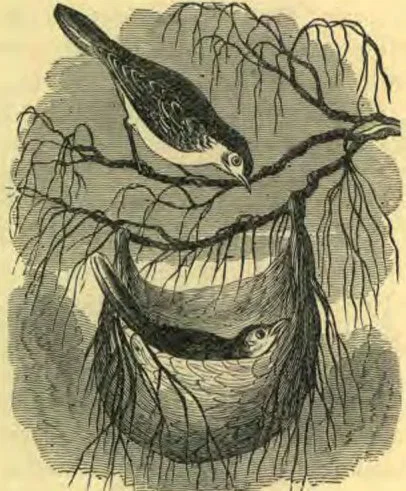
THE HANG-BIRD'S NEST.

CRADLE SONG.

ROCK-A-BY, birdies, upon the elm-tree, Where the long limbs wave gently and free; Tough as a bow-string, and drooping and small, Nothing can break them to give you a fall. Rock-a-by, birdies, along with the breeze, All the leaves over you humming like bees; High away, low away, come again, go! Go again, come again, rock-a-by-low!
Wonder how papa-bird braided that nest, Binding the twigs about close to his breast? Wonder how many there are in your bed, Bonny swing-cradle hung far overhead? Never mind, birdies, how lightly it swings, Mother-bird covers you close with her wings. High away, low away, come again, go! Go again, come again, rock-a-by-low!
Rock-a-by, birdies, there's no one to tire; Mother rides with you; her wings are like fire; All the bright feathers are 'round you so warm; Rain cannot reach you and wind cannot harm. Pretty bird-babies, let baby go swing In your high cradle, while mamma shall sing: High away, low away, come again, go! Go again, come again, rock-a-by-low! —Geo. S. Burleigh.

NELLIE'S COMFORTER.

This “comforter” was a little yellow-haired girl, who carried sunshine wherever she went.
Little Nellie had not seen the beautiful sunshine for six long, dark years. In a terrible accident, she had lost her sight when only six years of age, and because of the kindness and thoughtfulness of Fanny Gray to her, she called her a “comforter.”
Nellie's mother was poor, and every day she had to leave her poor blind girl all alone, while she worked hard to earn the dollar she brought home at night.
Every morning she dressed her neat and clean, and in summer always placed her by the window, which Fanny never failed to pass on her way to school. When she could get started in time, she would stop and read her a short chapter in her little Testament, or a bright story from her Reader. But if the last bell was ringing, she would call through the window,—
“Here, Nellie, is a yellow apple, just the color of my hair, and a flower that is the color of the sky; I hope they will comfort you until I come back.”
And all day she would smooth its little petals, and hold its cool, sweet leaves to her hot lips, and think, “What a comforter she is!”
When the noisy troops of children went rushing by to their homes at night, the footsteps she had learned to know so well always halted, and Fanny, laying her warm, chubby hand on Nelly's slender one, would say, “Did Jesus come to see you to-day? I asked him to.”
With grateful tears, Nellie would reply, “Jesus listened to your prayer, dear Fanny, and has been sitting with me all day.”
No matter how many visitors she had, how hard it rained, or how hot the sun was, she never forgot poor blind Nellie, but remembered her in some way, the whole year through.
Cannot our little readers find some one to comfort with their kind and thoughtful ways? It may be some one in their own home,—a tired mother, a feeble grandmother, or a little brother or sister, who might be made sweeter and better by your loving attention. Try it, dear children, and see if Jesus doesn't give you a blessing “sweeter than honey in the honey-comb.”—S. S. Advocate.

AN EDUCATED ROBIN.

The most remarkable instance that I ever remember to have met with of a young pupil's not only imitating, but far surpassing his tutor, was related to me by an English gentleman who owned a large aviary, numbering no less than three hundred and sixty-six inhabitants, all first-rate songsters; and his fame as an amateur was widespread.
Among the multitude of his visitors was a friend who informed him that a relative of his was possessed of a most wonderful bird that he should much like to have him see and hear. He took the address, and went at an early day to visit the prodigy. On entering the house referred to, and presenting his card, he was at once ushered into a drawing-room. He there saw two cages—nightingale cages—suspended on the wall. One of them, with a nightingale in it, had an open front; the other had a green curtain drawn down over the front, concealing the inmate.
After a little conversation on ornithology, the host asked him if he should like to hear one of his nightingales sing. Of course he was all expectation. Placing him beneath the cage, and drawing up the curtain before alluded to, the bird above, at a whistle from his master, broke out in a succession of strains that he never heard surpassed by any nightingale.
The rapid utterance of the bird, his perfect abandon to the inspiration of his music, and indifference to all around him, caused the gentleman to involuntary exclaim, with Coleridge:—
“That strain again! Full fain it would delay me.”
And so it did the rapt listener. He stood riveted to the spot, knowing how seldom nightingales in a cage so deport themselves.
After listening some time, and expressing his astonishment at the long-repeated efforts of the performer, so unusual, he asked to be allowed a sight of him. Permission was granted; the curtain was raised, and he saw before him—a robin.
This bird had been brought up under the nightingale from its earliest infancy, and not only equaled, but very far surpassed, its master in song. Indeed, he put him down and silenced him altogether.
In this case, the robin retained not one single note of his own, whereby the finest ear could detect him.—G. B. G., in Golden Days.
Continue reading: IF YOU PLEASE