It is often argued that the Sabbath was made because man needed a weekly period of rest. This statement is based on the words of Christ, in answer to the question of the Pharisees when the disciples were plucking corn on a certain Sabbath day, “Behold, why do they on the Sabbath day that which is not lawful?” Christ’s answer was, “The Sabbath was made for man, and not man for the Sabbath.” Did he mean by this that the Sabbath was made for man because he needed physical rest? That was not what the Sabbath was made for. God rested on the seventh day; but was it because he was tired and needed rest? In Isaiah 40:28 we have these words: “Hast thou not known? hast thou not heard, that the everlasting God, the Lord, the Creator of the ends of the earth, fainteth not, neither is weary?” So it was not because he was weary that he rested “from all his works which he had made.”
Then the question comes, Why did God rest on the seventh day? Because “in six days the Lord made heaven and earth, the sea, and all that in them is.” His work was finished, and so he rested because it was finished. One of the definitions of “rest,” given by Webster, is: “A cessation from motion or labor.” So it was with God; he ceased from labor, or rested, on the seventh day.
“And God blessed the seventh day, and sanctified it: because that in it he had rested from all his work which God had created and made.” The Sabbath is holy, because God sanctified it, and to sanctify anything is to set it apart for a holy purpose; so it is in this sense the Sabbath was made for man—for his spiritual and not his physical rest.
In Exodus 31:12-14, we find the Lord commanded the children of Israel on this wise: “And the Lord spake unto Moses, saying, Speak thou also unto the children of Israel, saying, Verily my Sabbaths ye shall keep: for it is a sign between me and you throughout your generations; that ye may know that I am the Lord that doth sanctify you. Ye shall keep my Sabbath, therefore; for it is holy unto you.” Now, if the Lord made the Sabbath for man’s physical rest, why did he not here command them to rest because they physically needed it? Instead, he told them to rest because the day was holy, and because it was a sign between himself and them. A sign of what? A sign that those who keep the Sabbath are the children of God; so to say that the Sabbath was given for physical rest takes all the sanctity from it. It does not tend213to draw men nearer to God, and think of him as the Creator of all things, but men keep the Sabbath for selfish ends—to rest because they are tired. They think of self and not of their Creator. He who keeps the Sabbath as the Lord has bade him keep it, does not think of self; he does not rest because he is tired, but because in the Sabbath of the Lord, the day that God sanctified, there is a blessing for him, and he feels that blessing each Sabbath. It is to him the memorial of God’s wonderful power in creation. The popular teaching by the clergy and others that the Sabbath was made for physical rest is one of the reasons why those professing to serve God do not reverence his Sabbath. People are led astray by those professing to be their teachers by such arguments to prove the sanctity of a day in the place of the one God blessed and called his day.
The following, from the Nashville Christian Advocate, is a fair sample of the arguments used to show that the Sabbath is a necessity from a civil standpoint:—
If the Sabbath was made for man, then he needs it, and cannot get along without it. He needs it just because he is man. His constitution—physical, intellectual and moral—is such that it is impossible for him to dispense with the weekly period of rest without suffering damage in many ways. The law of the Sabbath is, therefore, of perpetual force. Given in the Decalogue, it is thus reaffirmed in the Gospel, and holds good for all time. The Christian accepts it as a divine institution, and keeps it for the fear and love of God.
“The law of the Sabbath is, therefore, of perpetual force,” because it affords physical rest, says the Advocate. This is not biblical. After telling the children of Israel that the Sabbath was a sign between God and his creatures, and that it was holy, the Lord said, “Wherefore [for this reason], the children of Israel shall keep the Sabbath, to observe the Sabbath throughout their generations, for a perpetual covenant.” But the Advocate begs to differ with the Lord. It further says, “Given in the Decalogue, it is thus reaffirmed in the gospel.” But does the Advocate keep the Sabbath given in the Decalogue? It does not. It keeps Sunday which is not the Sabbath at all. The fourth commandment says, “the seventh day is the Sabbath,” but Sunday is acknowledged by all to be the first day of the week. The Advocate not only keeps Sunday itself, but teaches men to violate the command of God and observe it also; and uses such arguments as the foregoing to prove that the State should compel everyone to keep it. After speaking of the Sabbath as it was given to the children of Israel,—the purely religious Sabbath, as it calls it, the Advocate says:—
So much for the purely religious Sabbath. With it the State has and can have nothing to do. But it is, nevertheless, the fact that the State, recognizing the practical importance of the Sabbath as a civilizing force, invest its observance with the sanctions of human law. This is not specifically in the interests of religion; it is simply a matter of public policy, and looks to the temporal welfare of the community. The Sabbath thus guaranteed by the State—and it is so guaranteed in nearly every American Commonwealth—is a political institution, a part of the law of the land, to be upheld and supported by civil authority, as really and truly as the laws protecting life and property. While it is of great value to all citizens, it has a special worth to the laboring classes. Any attempt to break it down or set it aside is really hostile to their interests. The abolition of the civil Sabbath means seven days’ work for six days’ pay. There is no civil side to the Sabbath of the Decalogue; it is a purely religious institution, given for a religious purpose, Sunday is, in a sense, a civil institution, because it was ordained by man; but it is, nevertheless, a church dogma, and therefore the State should have nothing to do with it. The Sabbath of the Bible and Sunday, the Sabbath of man, are two entirely different things. The one—the seventh-day Sabbath—is the Lord’s, given that men might remember him as the Creator; the other—Sunday, or the first day of the week—is Satan’s, given to draw men away from the Sabbath of the Lord, that they may be forever lost as he himself is.
ALFRED MALLETT.
An Old Soldier Dissents.
[In the Memorial services at Berry Centre, N. Y., on May 28, the speaker, who was a minister, exhorted the old soldiers to “war a good warfare” in behalf of “the American Sabbath.” One at least of his hearers, and an old soldier, failed to recognize the fitness of such a discourse on such an occasion, and disagreeing with the theology of the speaker, replied to him as follows in the Elmira Telegram.]
THE so-called “American Sabbath” is wholly unscriptural, and to enforce its observance by law is productive only of evil. Let right, truth, and liberty prevail in all things regardless of “institutions.” That “Jesus Christ is ruler of this world” is not now true. He is the rightful heir of the world, but is now acting as our high priest and intercessor, awaiting the time appointed of the Father, as abundantly shown in prophecy; then he will return to earth, break in pieces like a potter’s vessel all the wicked kingdoms of Satan that now rule in this world, establish his own kingdom and reign here personally forever.
Seeing men differ so widely in their understanding of the Bible, if it should be the basis of all our legislation, who has God appointed to be an infallible expounder thereof, that all may know the truth? Whose exposition is to be accepted by all others, whether they believe it or not? Must those who believe differently be compelled to conform to another’s dictum? What kind of “religious liberty” is that? Law can make hypocrites in the outward observances of forms and ordinances, but law cannot reach the heart to make men better.
The official head of which of the leading denominations of America has Christ appointed to be his vicegerent here, to execute his rulership of this Nation? Is it Bishop Simpson, Dr. Talmage, Leo XIII., Dr. MacArthur, or some other man? Robert Ingersoll is said to be a good, kind, law-abiding citizen, and he fought for the preservation of our Union, with civil and religious liberty; and—as far as law is concerned—should have an equal right to believe or not to believe, and advocate his own views. Law is for the protection of our liberties and our rights of citizenship; not to bind religious dogmas upon us. “The American Sabbath” is well so-called, for it is man-made. There is no record that God ever made an American Sabbath, but he did sanctify and bless a certain day, viz., the seventh day, Saturday. There is not one word in the Bible showing Sunday to be more sacred than any other day; therefore men should cease insulting God by robbing this holy day of its prestige, sanctity and authority to bolster up a man-made “American Sabbath.” Having full liberty to love and observe their Sunday, ought to satisfy them without calling on soldiers to war a good warfare in binding on men a counterfeit Sabbath. Let soldiers, as they love the liberty for which they fought, never by word or deed assist in foisting bigoted-born, religious legislation on men to bind their consciences, but let us “war a good warfare” to sustain the much vaunted assertion that this is truly “the land of the free and the home of the brave.”
R. ANDREWS.
Church and State.
By H. F. Phelps
STRIFE for civil power on the part of the great religious bodies is now not only possible but inevitable in this country. This was so in the fourth century in Rome; and it is now equally true here. The very same steps that were taken at that time, have been taken here to lead up to this strife and contention.
Constantine professedly espoused the Christian religion. This he had a right to do; but he went beyond this. He went beyond his rights as a ruler. He had imbibed the old pagan idea that a ruler was to be considered as the “guardian of the public morals.” And so by virtue of his position as ruler he said the religion of his choice should also be that of his empire. Thus, that which he, Constantine, called the Christian religion, became the imperial religion—the religion of his empire. This made it possible for the great contending religious elements to seek control of the civil power claiming that their religion was the Christian religion. And this resulted in the final supremacy of the greatest religio-political combination the world has ever seen.
The parallel is before us in this country. Justice Brewer believes in what he is pleased to call the Christian religion. This is just as far as he has any right. He may espouse any feature of any religion214he may please, and put any interpretation he may choose upon his creed, if he has one. But he has no right either constitutionally or morally to decide that his religion is the religion of the Nation. When Justice Brewer, representing the people, clothed with judicial power received from the people, goes so far as to accept the old pagan idea that a ruler or judge is “the guardian of public morals,” and decides that “this is a Christian Nation,” thus saying that this religion is the religion of the Nation, to the exclusion of all others; he transcends the powers granted to him by the people, usurps rights and powers retained by the people, and makes an image to that Church and State despotism which has cursed the world for ages. The very first quotation which Justice Brewer gave to prove his position, was from Catholic authorities. Now his decision that “this is a Christian Nation,” and his arguments, give an opportunity for the Catholic Church to come in and claim the country by virtue of the precedence of their church, their religion, over all others. And thus will be inaugurated a strife for power on the part of Protestants on the one hand, and the Catholic Church on the other, such as was never seen since the Dark Ages. Already is seen evidences of the coming struggle. Soon, very soon, “old controversies which have apparently been hushed for a long time will be revived, and new controversies will spring up; new and old will commingle, and this will take place right early.” “The storm is gathering, the clouds are loading, ready to burst upon the world.” And none will be more surprised than Protestants of this Nation when they see how they have paved the way for the subversion of all our country’s rights, to the power of Rome, the foe of all our free institutions.—H. F. Phelps, in Mankato (Minn.) Ledger.
Have They the Right to Do It.
By B.
THE following from the Dispatch, of Birdsboro, Pa., illustrates the crude ideas which many people have of the powers of the Government:—
The AMERICAN SENTINEL is up in arms against the religious sentiment of the day in its effort to close the gates of the World’s Fair on Sunday. It seems to see in this interference of Congress, the certainty of a union of Church and State. As to such a result, we think its fears are groundless. But admitting such to be the ultimate condition of things what is the SENTINEL going to do about it? Our law-makers are going to legislate to suit their preferences and convictions. And as perhaps a large majority of them may be believers in the sanctity of Sunday, is it not natural for them to protect the sanctity of that day? The only hope of the SENTINEL, in our estimation, is in changing the faith of the Christian Church in this respect, and then it is a question if there is much hope there. We fear that Sunday folks are joined with their idol.
It makes not a particle of difference what the religious opinions of our law-makers are, they have no right to be governed by them in their official capacity. Congress is by the Constitution prohibited from making any law “respecting an establishment of religion, or prohibiting the free exercise thereof.” Now if Congress makes no law setting up a single denomination as a State Church, yet by law gives certain sects and modes of worship a preference, requiring everybody, as is done by Sunday laws, to observe the “holy days” of those sects, does it not thereby violate the Constitution and interfere with the free exercise of religion? It may be as the Dispatch says, that our fight is a hopeless one, but should we for that reason abandon it?
B.
Selfishness and the Movement for Sunday Laws
THERE is much truth in the following paragraph from the Nashville Christian Advocate, of June 15:—
Nothing is more protean than the spirit of selfishness; it takes on a thousand forms and guises. Many people are saturated with it who imagine themselves to be perfect models of generosity. It is not identical with the greed for money, or place, or pleasure, though it frequently manifests itself as covetousness, as ambition, and as sensuality. The essence of it consists in the determination to have one's own way, without regard to the wishes and rights of other people.
These words are exactly descriptive of those professing Christians who are clamoring for Sunday laws. The Sunday movement is selfish throughout. The ministers think nothing of other people's rights so long as their pet day is exalted. The Advocate truthfully says the essence of selfishness “consists in the determination to have one's own way, without regard to the wishes and rights of other people.” Why does not the Advocate practice what it preaches? In an editorial in the same issue it attempts to justify the State in passing Sunday laws on civil grounds,—because man requires a weekly rest-day. The right to rest at a certain time belongs alone to the individual. Sunday laws, on whatever plea, interfere with the rights of some, and therefore those who ask for them are selfishness itself. They are Christian only in name.
California's Lack of Sunday Laws Debated
R. H. McDONALD, of San Francisco, publishes this in one of his monthly tracts:—
California alone, of the forty-four States and four Territories of the United States, is the only one without some form of a Sunday, or one day in seven as a legal rest day. Do not your cheeks tingle with shame when you think of this?
To Dr. McDonald’s question, the San Francisco Examiner makes this apt reply:—
My good man, they do not. Following the commandment, “Remember the Sabbath day to keep it holy,” I fail to find the words, “Governments shall have power to enforce this article by appropriate legislation.”
It is strange that all men cannot see the incongruity of Sunday laws.
Trinidad Petitions for a Sunday Law
It has suddenly been discovered that the island of Trinidad is very much in need of a Sunday law, and the Governor has been requested by petition to furnish one. One enthusiastic advocate of the measure, writing to the Trinidad News, says:—
A large majority of the population, Mr. Editor, are in favor of whole day closing on Sunday, and it is to be hoped the authorities will lose no time, as soon as the petitions are presented, in passing and carrying into effect the ordinance to make Sunday what it should be—a day of rest and holiness.
Mark the closing words of the quotation—this gentleman wants Sunday made a day of holiness by ordinance! Another correspondent of the same paper declares:
We believe the whole scope of Christian ethics is to distinguish the Lord’s day from the Jewish Sabbath.
Of course he wants Sunday, but not in the same way some others do. His is however a rather narrow view of Christian ethics.
The News itself favors the proposed ordinance on civil grounds, though admitting that “in some respects of the case it certainly is a religious question.” The News thinks that “the desire of the promoters of the movement is simply to render it easier for those who wish to spend the day in worship to do so.” It is the old plea to have the cross and the self-denial eliminated from the Christian religion by act of Parliament!
Attorney-General Enforces Sunday Law on Fishing and Hunting
As the Mail and Express puts it, the Attorney-General of this State has decided that “the State Fish and Game Law Commission must prevent Sabbath desecration.” The section of the Penal Code to which the Attorney-General refers provides that—
All shooting, hunting, fishing, playing, horse racing, gaming or other public sport, exercises or shows upon the first day of the week, and all noise disturbing the peace of the day, are prohibited.
The Attorney-General says it is the duty of the State Commission and its officers to see that this provision is not violated so far as it relates to hunting and fishing. Whose duty it is to see that nobody takes any public exercise is not stated.
Signs of the Times on Sunday Law Critique
THE Signs of the Times says: “If the Sabbath is to be enforced as a hygienic measure, for the good of the public health, why not regulate by law the hours of sleeping and waking? A certain amount of sleep is requisite to health. If a law of rest for one demands a law of rest for all for one day in the week, why is not that just as true concerning the hours of the day? Sunday or Sabbath laws from every standpoint would be a roaring farce were it not for the possible persecution and necessary wickedness involved in them.”
Union Meeting Protests Sunday Opening of Columbian Exposition
At a union meeting held in the Hebron, Pa., Lutheran Church, on the 18th ult., a paper was adopted, without a dissenting voice, part of which is given here:—
It is with profound sorrow and sense of humiliation that we have heard of the decision of the Appellate Court declaring the gates of the Columbian Exposition open on the Sabbath. We deplore this action and utter our solemn protest against the profanation of the holy day for purposes of gain that is contemplated. We recognize the fact that the struggle on behalf of the Sabbath in this country is not ended, and we pledge ourselves anew to do what lies in our power to maintain and defend the law of the Lord in regard to a day of rest.
Is it ignorance or is it wilfulness on the part of these people? They pledge themselves anew to do what lies in their power to maintain and defend the law of the Lord, and yet they violate his law week after week. They work on the Sabbath enjoined in the Decalogue, and observe another day. These same people, when told that the Sabbath of the fourth commandment is still binding upon Christians, will tell us that the law is abolished. This is inconsistent. Christians can never be the means of converting unbelievers so long as they are not consistent in their teachings.
Extradition Protests and Religious Liberty in America
THERE is quite a general protest in the United States against the clause in the treaty with Russia, which binds the American Government to extradite refugees accused of attempts on the life of the Czar, since the expression of an opinion adverse to the Government is in Russia construed as an attack on the Czar. But those who protest do not seem to realize that such an action on the part of the United States Government is exactly in line with the principles which many of them are advocating. Where the free exercise of religion is prohibited by law, there can be no freedom of any kind; and the United States is getting an unenviable notoriety in the line of interfering with religion. When, as in Tennessee, grand juries interrogate children and women as to what is said in religious meetings, in order that they may bring an indictment against God-fearing men, it is no wonder that sympathy should be manifested with Russian oppression.—Present Truth, London, England.
The Theocrat Rebukes Editors Over World's Fair Sunday Opening
A NATIONAL Reform paper, The Theocrat, published at Johnstown, Pa., is very much disturbed because the World's Fair is open on Sunday; and blaming wicked editors, that is, editors who do not agree with The Theocrat, for the present dilapidated condition of governmental religion, our contemporary loses its temper and says:—
Ungodly editors may rejoice because iniquity triumphs, but they should not forget that when their bodies are rotting in the grave and their souls are writhing in the torments of hell, that the truth of God will go marching on until the devil and all his followers shall be entirely overcome.
Now, this shows bad theology as well as bad temper, and both are very far from becoming in Christians. Peter and John were rebuked by their divine Master for wishing him to call down fire upon his enemies; but The Theocrat would do worse than call fire down upon those who do not agree with it upon the question of Sunday observance; it would consign them to the torments of the “orthodox” hell. The wish is father to the thought, and shows that the average National Reformer is a good man not to trust with power to punish “heretics.”
RELIGIOUS LIBERTY LIBRARY.
The Religious Liberty Library is a monthly publication (with occasional extras) published by the International Religious Liberty Association. The following numbers have been issued:—
No. 1. Due Process of Law and the Divine Right of Dissent. An interesting and instructive work upon the “Process of Law,” “Christianity and the Common Law,” “Individual Right of Religious Belief,” “The Divine Right of Dissent,” etc., in review of Judge Hammond’s decision in the King case. By A. T. Jones. 120 pages. Price 15 cts.
No. 2. Religious Intolerance in the Republic. A lucid and vivid portrayal of recent persecutions in Tennessee, written by the editor of the Arena. 16 pages. Price 2 cts.
No. 3. Church and State. A timely document upon the origin of Church and State union, with the arguments and excuses for Sunday laws exempting church property from taxation, laws against blasphemy, religious tests, etc., all well considered. By James T. Ringgold, of the Baltimore Bar. 60 pages. Price 10 cts.
No. 4. The National Sunday Law. Arguments in behalf of the rights of American citizens, presented by A. T. Jones in opposition to the Blair Sunday Rest Bill. A thorough catechism upon the subject of Church and State. 192 pages. Price 25 cts.
No. 5. Sunday Laws in the United States. Their groundlessness and unconstitutionality exposed. By James T. Ringgold. 24 pages. Price 3 cts.
No. 6. The Captivity of the Republic. A Report of the Hearing on the Sunday Closing of the World’s Fair, before the House Committee on Columbian Exposition, Jan. 10–13, 1893. 128 pages. Price 15 cts.
No. 7. Appeal and Remonstrance. Resolutions adopted by the General Conference of the Seventh-day Adventists, Feb. 24, 1893, with documentary evidence attached. 24 pages. Price 3 cts.
No. 8. Appeal from the U. S. Supreme Court Decision making this a “Christian Nation.” A Protest. A review of the decision of the Supreme Court of the United States declaring that “this is a Christian nation;” a powerful protest against the union of Church and State involved in this decision; also the subsequent act of Congress closing the World’s Fair on Sunday, and how it was secured. The work contains the text in full of this remarkable decision of the U. S. Supreme Court. By A. T. Jones, Editor AMERICAN SENTINEL. 86 pp. Price 15 cts.
No. 9. Shall Religion be Taught in the Public Schools? A lucid exposition of both the unconstitutionality and impracticability of connecting religion with our public school educational system. 12 pages. Price 2 cts.
No. 10. Religious Liberty and the Mormon Question. Is the Prohibition of Polygamy Religious Legislation? This tract is a dispassionate arraignment of polygamy as an invasion of natural rights, and a logical defense of the right of every man to keep any day or no day as a season of rest and worship. 20 pages. Price 2½ cts.
Annual subscription to the Library, $1.00.
Address—PACIFIC PRESS PUB. CO.,
43 Bond St.,
New York City.
EAGLE BRAND THE BEST ROOFING
Is unequaled for House, Barn, Factory, or Out-Buildings, and costs half the price of shingles, tin or iron. It is ready for use, and easily applied by any one. Send stamp for samples, and state size of roof. Address.
EXCELSIOR PAINT AND ROOFING CO.,
DEPT., 9, 155 DUANE STREET, NEW YORK, N. Y.
“EVERYBODY’S LAW BOOK”
Is the title of the new 768 page work prepared by J. Alexander Koones, L. L. B., member of the New York Bar.
It Enables Every Man and Woman to be Their Own Lawyer.
It teaches what are your rights and how to maintain them. When to begin a law suit and when to shun one. It contains the useful information every business man needs in every State in the Union. It contains business forms of every variety useful to the lawyer as well as to all who have legal business to transact. Inclose two dollars for a copy, or inclose two cent postage stamp for a table of contents and terms to agents. Address,
Benj. W. Hitchcock, Publisher,
385 Sixth Avenue, New York.
Abiding Sabbath And Lord's Day.
By Alonzo T. Jones
BY ALONZO T. JONES.
A pointed review of the $500 and $1,000 prize essays in support of the Christian Sabbath, so called. Those desiring some $1,000 reasons for keeping the first day of the week, will find them here. 173 pages, 20 cents. Pacific Press, 43 Bond St., New York City.
THE MEDICAL MISSIONARY.
By John Harvey Kellogg
J. H. KELLOGG, M. D., Editor.
A twenty-four page monthly journal, devoted to the various phases of medical missionary and benevolent work. It contains each month also articles of general interest on mission fields, and items of missionary intelligence. Each number is illustrated.
Published by the S. D. A. Medical Missionary and Benevolent Association.
Price 25 cents per year.
Address Medical Missionary, Battle Creek, Mich.
HEALTH FOODS.
For more than sixteen years the Battle Creek Sanitarium has maintained a Health Food Department, at first for the benefit of its patients and patrons, later, and for more than a dozen years, with increased facilities, to supply the general public. Within the last year More than 150 Tons of the following named foods have been manufactured and sold:—
Oatmeal Biscuit, Rye Wafers,
Medium Oatmeal Crackers,Fruit Crackers, Carbon Crackers,
Plain Oatmeal Crackers,No. 1 Graham Crackers, Avenola,
No. 2 Graham Crackers, Granola,
Plain Graham Crackers (Dyspeptic),
Wheat Granola, White Crackers,
Whole Wheat Wafers,Gluten Biscuit, No. 1, Gluten Wafers,
Gluten Biscuit, No. 2, Infants’ Food.
Granola, The Gem of Health Foods.
Our Granola, which has now been manufactured by us for nearly seventeen years, is unquestionably the finest health food ever devised, and is greatly superior to any of the numerous imitations to which its success has given rise.
_TO THE PUBLIC:_ This certifies that the Battle Creek Sanitarium -Health Foods, manufactured by the Sanitarium under the name of the Sanitarium Food Company, are made under my direction and supervision, and that Granola and the other special foods manufactured by this company, are not made or sold by any other firm or person except their duly authorized agents. J. H. KELLOG, M. D.
Our goods are shipped to every part of the world—to Australia, New Zealand, India, Persia, and other foreign countries, as well as to all parts of the United States; and in every instance they have demonstrated their wonderful keeping properties. The following are a few of the hundreds of testimonials received from persons who have for years made use of our foods.
MICHIGAN.
I have for three years used the “Health Foods” in my family, and can heartily recommend them, both for purity and health-giving properties. C. F. PORTER, D. D. S.
INDIANA.
Your “Health Foods” are the wonder of the nineteenth century. I have used Granola but a short time, but have already experienced relief from indigestion and acid, or flatulent dyspepsia. I also find the Zwiebach nourishing and toothsome. D. M. KAUFFMAN.
I have personally tested your excellent food known as Granola. It is highly pleasing to the taste, easy of digestion, and the most nutritive cereal production with which I am acquainted. DR. R. W. BULA.
NEW YORK.
Your Granola is the best selling invalid food I have ever handled. I have already sold nearly two thousand pounds. A. J. BROUGHTON.
CONNECTICUT.
We have used your “Health Foods” in our family for three years, and can not get along without them. Having been troubled with dyspepsia and chronic inflammation of the stomach, I find that your Granola, Avenola, Wheatena, and Gluten are the only foods that I can eat with safety. WM. M. MERWIN.
OHIO.
Our baby is a testimonial to Sanitarium food. She is ten months old, weighs twenty-eight pounds, and is as ruddy and healthy a specimen as can be seen. She has actually gained flesh while cutting her last two teeth. Her flesh is firm and sound, and she is very strong. FRED. L. ROSENBERG.
MINNESOTA.
We have twins, and the little fellows are thriving nicely. The food agrees with them perfectly, and I have recommended it to many who are bringing up babies “by hand.” D. W. McCOURT.
We are constantly improving our foods, and adding to our list as the result of experimental researches conducted in the Sanitarium Laboratory of Hygiene and our Experimental Kitchen. For the latest descriptive circular and price list, address, SANITARIUM HEALTH FOOD CO., Battle Creek, Mich.
Found at Last!
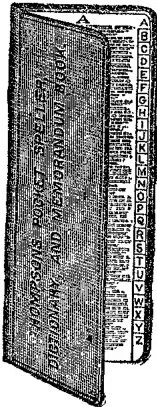
A Pocket Speller, Dictionary, and Memorandum Book Combined.
It gives the right orthography of all words (over 22,800) in common use, and in nearly every instance their definition. It also gives rules for the use of capitals and punctuation marks, abbreviations of names of States and Territories, letters of introduction and recommendation, definitions of commercial terms, forms of notes, due bills, receipts, letters of credit, orders for money, merchandise and goods stored, principal holidays, marriage anniversaries, combination of shades, and carefully selected laws of etiquette in social and business life, also a silicate slate for memoranda.
This Speller gives the most complete list of words in common use; it is a Speller, Dictionary, Handy Companion, and Memorandum Book combined; it is indexed; it prints all words pronounced alike but spelled differently, so they can be distinguished at a glance; it shows where the letter e at the end of a word is to be dropped when adding ed or ing; it gives a complete list of the most practical business forms; it gives the laws of etiquette in social and business life; these rules alone are worth the price of the Speller.
This Speller is bound in leather, is of convenient size to be carried in vest pocket, and its price brings it within the reach of all. American Russia leather, gilt edge, 50 cents. Sent post-paid to any address on receipt of price. Address Pacific Press Publishing Co., 43 Bond St., New York City.