"And so you really are going at last, Miss Susan?"
I had come from quite a distance on the other side of the scattering country parish to see Miss Susan Mildmay, hearing that she was going away as a missionary. I was just in time, for I found the dear little spinster surrounded by bags and boxes waiting for the stage which was to carry her over the first dozen miles of her long journey.
"Yes, indeed," she said, with a smile, "I've always had it on my mind to go, you know. I thought I'd do it when I was a girl—when father and mother were strong, and there seemed plenty of others to take care of them. But it was not laid out for me. All the others married or died, and so here I've been. Father lost his health, and when he was taken there was poor Mark. Now they've all done with me; and it seems exactly as if Providence was opening the way for me, for I've had the chance to let the little house with the furniture just as it stands. So I've been for the last six months winding up and getting ready. And," she straightened herself up with a smile, brushing away the tear which had come with the memory of poor Mark, "there's work in me yet, I'm only forty-three, and strong and hearty."
"I should think, Miss Susan," I said, "that you would need a little rest before going to work again."
"Rest? Bless your heart, dear, it rests me to work. Perhaps it makes you laugh to think of me going for a missionary, and no wonder if it does, I'm sure. When I used to think of it when I was young, I always laid out to do a great deal of studying and fit myself for it. But I haven't had the chance of that, you see. The years have gone and gone, and I haven't had time. You wouldn't think I was the sort to go on a mission, now would you?" she asked, with a laugh.
"I'm not so sure of that," I said.
"Well, I had about made up my mind long ago that the Lord didn't want me for that branch of his work. But," she brightened wonderfully as she went on, "since Mr. Vernon went out last year he's been writing to me pretty regular, and you'd be surprised at some of the things he says. Says they want just such work as I could do as bad as they want preachers. Says they want somebody to teach those poor creatures that it's nice to be clean and to wear decent clothes—"
"He must be a very sensible man," I said.
"Yes—and says," Miss Susan grew more animated and earnest with every word, "that it isn't much good to tell the poor souls about the love of Christ till they learn that love is a good thing. How can they learn to love their Saviour till they learn to love each other?—till they know there's something better than going to war and torturing their prisoners, eh?"
She grasped my hand and looked into my face with beaming eyes.
"Miss Susan," I said, giving her dear hard-working hand a reassuring clasp, "if Mr. Vernon wants someone to go and tell people how to love each other, he can't do better than to send for you."
"Anyone can do that, you know," she went on. "And it's a wonder," her voice softened, "if I can't whisper something about the love of Christ too—eh, dear?"
"Ah! Miss Susan, I shall see you bringing your own stars for the King's crown."
Tears came into her eyes, but she had no time to shed them, for a few kindly neighbors were beginning to gather, to wish her Godspeed on her journey.
II. ALTERED PURPOSES.
"There's the stage coming," cried someone. Miss Susan grasped her bags, others carried the boxes to the gate, and we watched the approach of the lumbering vehicle through a cloud of dust.
The driver drew up, but instead of looking inquiringly for a passenger and concerning himself about Miss Susan's baggage, he busied himself with lifting from the stage two children who came towards her, each carrying a small bundle of clothing. The older one, an unattractive-looking boy, gazed, half-curiously, half-defiantly, around, but the little girl, several years younger, looked from one to another of the strangers about her with a wistful, pitiful little face.
"Here's a letter for Miss Susan Mildmay," said the boy. "Isaac Barry was our father, and he's dead."
"Isaac Barry dead!" exclaimed Miss Susan, coming forward in surprise and dismay.
She opened the letter and read what some of the shrewder of her neighbors had already guessed. Her cousin, Isaac Barry, had sent his orphan children to her to be cared for.
"It takes my breath away," said poor little Miss Susan, sinking down on a garden bench with a look of helpless bewilderment.
"I suppose you might as well go on," said someone to the stage driver. "She can't go to-day anyway."
"Nor any day, I'm afraid," said another, as Miss Susan took the neglected-looking little girl in her arms and cried, thinking of her cousin Isaac.
There was quite a season of subdued excitement among the neighbors, and at length one of Miss Susan's friends came to her.
"Seems to me, Miss Susan, it's a great pity for all your plans to be tipped over this way. Isaac Barry has a brother out West that ought to take these children. It's his duty, not yours."
"May be so," said Miss Susan, "but John Barry isn't that sort of a man. He wouldn't do it unless he had to, and if he had to, he might not always be kind; poor fatherless and motherless children!"
"And you're going to give it all up?"
"Yes, the Lord's laid out other work for me, you see. I guess Mr. Atkins'll give up the lease of the house when he knows how 'tis."
She gave one look at the distant stagecoach, and carrying the poor little waif who had come to her arms, turned her back upon hopes and plans, and went again into the little house.
"Well," said old Farmer Ryder, a staunch friend of Miss Susan's, as I walked with him through a quiet country lane, when the neighbors took leave of her half an hour later, "if I hadn't always believed there was a Heaven for some folks, I'd believe it when I look at Susan Mildmay."
"How is that?" I asked.
"Why, you know some o' these science folks tell us there isn't anything but this life—that such as it is we just live it out, and that's an end o' the whole business. But don't talk to me! Now here's Susan been a convenience for other folks all her life. Nobody's ever thought o' what she'd like, it's always been what did others like her to do for 'em. She's worked and worked year in and year out, first of all for her parents—and there wasn't never anyone harder to do for'n her father when his health give out. She was to marry Seth Marsh—good fellow Seth was—but she couldn't leave the old folks, so after waiting till he got tired, he went off and married someone else. And when her parents died there was her brother Mark—weak-minded, and desperate hard to get along with. And then the Lord took him away, and now't she was just going to have the desire of her heart, that no-account cousin o' hers has up and died, and left these young ones for her to take care of. No, sir," the old farmer gave a vigorous stamp, "don't tell me there ain't a chance somewhere for such as her."
After that day, my way lay for many years far from the country neighborhood.
"How is Miss Susan getting on with her family?" I sometimes asked in writing to friends. And the answer came in varying tones: "Having a tussle to get some kind of decency into the ill-brought-up children." "Having her poor, gentle little life bothered out of her by that scape-grace of a boy."
Long afterwards the word came: "It really seems as though Miss Susan is managing to infuse some of her own grace into the spirit of that boy. For years all the neighbors held up their hands over his pranks, wondering what kind of an end he would come to,13and thinking the very best thing he could do would be to run away and leave her in peace. But a marvelous change has come over him, and he's joined the church, and now Miss Susan's talking of mortgaging her little place to get him educated. A shame, folks say. But he's a bright young chap, after all."
III. FOURTEEN YEARS AFTER.
Fourteen years after the day I had seen Miss Susan turn from her cherished plans to give a home and a mother to two homeless and motherless children, I found myself at church in a town not very far from where she lived.
A young minister in the pulpit so held my attention that I could scarcely follow out my desire to try if I could find a few familiar faces in the congregation. His earnest face and voice gave fullest evidence that his whole heart was set upon his Master's business, and he was listened to with more than usual interest.
Among those who seemed absorbed in his eloquently-given message, was one whose face seemed to bring me a flavor of memories of long ago. I could not get a fair sight of the eyes intently fixed upon the speaker, but surely I could not be mistaken in the mouth, with its lines of patient peace. Thinner of face and grayer of hair than of old, I still held to my opinion, and felt no surprise when the eyes, beaming with a wealth of unspoken content, were turned upon me in the vestibule at the close of the service.
"Miss Susan Mildmay!" I exclaimed.
"Yes, it's me," was the glad response. "And how long it's been—and how good it is to see you! And—this is my boy."
What a fullness of satisfied, gratified love and pride was crowded in her tone as she placed her hand on the arm of the young minister, who had come quietly to her side. I saw him lay his own over it as he bowed to me.
"What!" I said, "not the boy who came to you that day?"
"Yes, that very boy, Isaac Barry," said Miss Susan, in a flutter of delight. "Yes, I remember, you were there that day. Dear me—so long ago! And you haven't heard, have you?" went on the dear little soul, in a half whisper, as the young man's attention was claimed by others, "no, you've only just come, so of course you haven't—that Isaac's going for a missionary—and I'm going too!"
"You, Miss Susan!"
"At last! There's work in me yet, and Isaac says there's plenty of just such work to be done as I can do. And, oh," she rapturously clasped my hand, "don't you remember the time I thought the Lord was ready for me out there, and he wasn't? No, dear, he wanted me here yet. Sometimes (I can confess it now) I used to get almost discouraged with Isaac. And then I used to say to myself—sharp: 'Susan Mildmay, you setting up to want to go to look after lost sheep when the sheep are at your very door—and not half such forlorn, miserable sheep as you thought of tackling out there, either. I'm ashamed of you!' And then I'd take courage and go on. And now look!"
"Miss Susan," I said, "if that boy of yours brings a thousand stars for the Master's crown every one of them will owe their brightness to you."
LEARN TO WAIT.
LEARN to wait—life's hardest lesson,
Conned, perchance, through blinding tears,
While the heart-throbs sadly echo
To the tread of passing years.
Learn to wait—hope's slow fruition;
Faint not, though the way seem long;
There is joy in each condition—
Hearts through suffering may grow strong.
Constant sunshine, howe'er welcome,
Ne'er will ripen fruit or flower;
Giant oaks owe half their greatness
To the scathing tempest's power.
Thus a soul untouched by sorrow
Aims not at a higher state;
Joy seeks not a brighter morrow,
Only sad hearts learn to wait.
Human strength and human greatness
Spring not from life's sunny side;
Heroes must be more than driftwood
Floating on a waveless tide.
—Selected.
SOME ALLIED EVILS.
It is a truth which all observation and experience tend to confirm, that vicious habits and other things of evil, like "birds of a feather," are usually found flocking together. It is to be remembered that nearly all gambling and drinking resorts are furnished with reading matter and pictures as near the line of positive obscenity as the law will allow. A significant case in point is the recent introduction of the Spanish bull-fight in the Belgian watering place at Spa, one of the most notorious gambling resorts in Europe. The proprietors of the gambling dens at Spa, having succeeded by various subterfuges in re-instating the prohibited roulette and trente-et-quarante, find that the gaming table no longer satisfies the cravings of famished pleasure seekers, and so they have decided to introduce bull-fights.
It is in ways like these that the devil and those who are engaged in his service take advantage of the weaknesses of human nature. They know that indulgence in one form of evil is quite sure to be followed by indulgence in another. When they have once broken down the moral restraints around the hearts of the boys and young men so far as to permit the introduction of vile and impure thoughts, they know that the rest is comparatively easy. From such things the transition to vicious habits and open acts of wickedness is direct and rapid. The boy whose mind has been debauched by vile pictures, is quite sure to become a good customer of the cigarette dealer, and after that of the liquor seller, and along with these of the keeper of the gambling house and the brothel. All these evil trades, and particularly the three latter, are closely allied. They are always in fact, and often literally, "next door" to each other. There is a fellow feeling between them which makes them "wondrous kind" in furnishing victims to one another, and in defending one another's interests. They are to a large degree interdependent. They stand and fall together.—New York Observer.
SIMPLE CURE FOR COLD FEET.
THE following remedy for cold feet is recommended for sedentary sufferers, as well as policemen, cab-drivers, and others who are exposed to the cold: "All that is necessary is to stand erect and very gradually to lift one's self up upon the tips of the toes, so as to pull all the tendons of the foot at full strain. This is not to hop or jump up and down, but simply to rise—the slower the better—upon tiptoe, and to remain standing on the point of the toes as long as possible, then gradually coming to the natural position. Repeat this several times, and, by the amount of work the tips of the toes are made to do in sustaining the body's weight, a sufficient and lively circulation is set up. A heavy pair of woolen stockings drawn over thin cotton ones is also to be recommended for keeping the feet warm."—Selected.
NON-ALCOHOLIC MEDICATION.
Susan Dodds, M. D., of St. Louis, Mo., writes thus to the Union Signal concerning her experience in treating disease without the use of alcohol:—
"So far as my own personal experience is concerned, and that of my sister-in-law, with whom I am associated, I would say that during the twenty years that we have been in practice we have treated successfully both acute and chronic diseases without using alcohol in any form.
"When the 'crisis' comes in a fever—and we have had the very worst forms of it to deal with—instead of applying the whip (alcohol) to rouse the jaded and temporarily exhausted energies of the system, we follow the very reverse method. We let the patient rest; this is the supreme moment, when the doctor, if he is wise, will prescribe persistent let aloneativeness. 'Masterly inactivity' is what is needed more than anything else, save good nursing.
"The system needs quiet; it has been undergoing the greatest activity for days, perhaps for weeks, in the powerful effort to expel poisons from the vital domain—for that is just what a fever means; it is an action of the system to throw out impurities.
"The climax, then, having been reached, Nature calls a halt; the object has been accomplished, and there follows a period of repose; the temperature lowers; the pulse weakens; the strength (apparently) is gone. It is just here that the mistake is usually made; the 'let-down' (rest) is mistaken for collapse, when it is really nothing of the sort. It is Nature's breathing spell. She is tired out; sleep is wanted.
"Then it is time to keep hands off, to let Nature have her way; all will turn out well; the patient will pull through. And, greatly to the astonishment of friends (and others), instead of there being a tardy, feeble recovery, there will be a prompt and vigorous reaction; no set-back, 'no relapses,' but a steady progress back to life and health.
"How often have I seen it in typhoid fever, diphtheria, bronchitis, scarlatina, inflammation of the bowels, pneumonia, brain fever, and the rest.
"So rapid, indeed, is the recovery, that lookers-on remark, after it is all over, 'Why, there was not so very much the matter after all.'
"This, the rapid recovery, is as it should be. Convalescence ought to be prompt, and it would be if it were not interfered with. Stimulants (in the opinion of the writer), of whatever kind, have no place in Nature's materia medica, not even in so-called prostration. When Nature pulls in the check rein, then is the time to stop.
"Unfortunately, that has not been the custom; it has been the other way; and many lives have been lost in consequence. At the very moment when exhausted Nature says, 'Rest,' wine or other stimulant is resorted to, and the vital powers, rousing to a final effort, work themselves to death. The embers of life are stirred, until the fire is extinguished forever."
SECULAR.
—Civil war still rages in Hayti.
—Only four per cent. of the corn crop of the United States is exported.
—The excitement over the Panama Canal crisis has greatly abated in France.
—December 18 a severe snow-storm interrupted railroad travel in Nova Scotia.
—The bill for the admission of the Territories is to be called up in the House January 15.
—Another mysterious murder has been committed in the White Chapel District of London.
—The recent severe storm in Canada caused intense suffering in the Province of Quebec.
—A man who had been unmercifully beaten by White Caps, died near Kansas City on the 16th inst.
—Another Japanese steel gunboat will be launched next month. It is expected to steam twenty knots.
—Oliver Ditson, the musician, died at his home in Boston, on the 21st inst., aged seventy-seven years.
—It is stated that gambling is extensively carried on in the Pullman cars on some of the trans-continental lines.
—The French man-of-war Roland arrived at Colon on the night of the 17th inst., to look after French interests there.
—The Sultan of Zanzibar returned recently to his dominions and immediately began practicing horrible cruelties upon persons obnoxious to him. Accused persons were cruelly murdered in the streets by his order, without even the semblance of a trial.
—The friends of the Blair Sunday Bill express themselves as confident of its passage before the 4th of March, 1889.
—It is said to be certain that England will send no one to Washington to succeed Lord Sackville as long as Cleveland is President.
—Quite a severe shock of earthquake was experienced in Washington and Warren Counties, N. Y., on the morning of the 19th inst.
—A chair of temperance will be endowed by the Catholic Total Abstinence Societies in the Catholic University at Washington, D. C.
—The number of co-operative banks of one sort and another in our whole country is nearly 4,000. In 1876 there were scarcely 1,000.
—The schooner, August Flower, from Philadelphia, is believed to have been lost, with her crew of four men, in a recent gale on the Atlantic.
—Monsignor Kirby has telegraphed to Ireland a denial of the story that the Pope refused to bless the reliquaries sent to him by an Irish priest.
—Terrible storms, causing loss of life and property, are reported from the Department of Pyrenees-Orientales, France, under date of December 16.
—The corn crop of the United States for 1888 is estimated at 2,000,000,000 bushels. Corn is grown to some extent in every State and Territory except Alaska.
—The Rome correspondent of the New York Mail and Express makes the prediction that the next Pope will be an American, most probably Cardinal Gibbons.
—Recent news from Samoa, by way of Auckland, reports hard fighting between the forces of Mataafa and Tamases. The latter was defeated. About 100 were killed.
—During a trial in London on the 17th inst., a phonograph was introduced to reproduce a letter and other papers. The instrument was worked successfully.
—The Freeman's Journal (Catholic) says that "it is undoubtedly idle to waste time in attempting to have the present public-school system made acceptable to Catholics."
—An attempt was made on the 20th inst. to destroy the car works at Lichfield, Ill., by a dynamite bomb. Part of the building was wrecked, and two of the employees seriously injured.
—A railroad train was robbed on the 16th inst. near Duck Hill, La. One passenger, who left the train with a Winchester rifle, was fired upon and mortally wounded by the robbers.
—A dynamite magazine, three miles from Bradford, Pa., containing 800 pounds of dynamite, blew up on the 16th inst., doing great damage to surrounding property. No one was injured.
—The fire insurance losses in this country and Canada, during November, amounted to $9,058,700, a reduction of $7,000,000 as compared with last year, and of $1,000,000 as compared with 1886.
—Eleven men, employed in repairing a railroad bridge across the Merrimac, near Hookset, N. H., on the 19th inst., were thrown into the water by the moving of the ice, and three of them were drowned.
—The total loss by fire in the United States and Canada for eleven months of 1888, foots up $113,654,220, a reduction of five millions from last year, but an increase of eight millions over the record of 1886.
—The total production of anthracite of all the companies for the week ended on Saturday last was 780,615 tons, as compared with 770,845 tons for the corresponding week in 1887, an increase of 9,170 tons.
—A few days since Representative Breckinridge, of Kentucky, introduced the joint resolution reported during the last Congress by Representative Tucker from the Committee on Judiciary, proposing an amendment to the Constitution defining polygamy, and making it unlawful within the jurisdiction of the United States, or any State.
—Two Germans were recently discovered photographing French forts, and were unceremoniously hustled out of the country. The apparatus used for taking the pictures resembled a book. The incident is not likely to add anything to the good feeling between the two countries, nor will it contribute to the freedom of tourists who wish to visit French fortresses.
—An important experiment was successfully made on the 21st inst., at the Annapolis (Md.) proving grounds. A steel-pointed iron projectile weighing 250 pounds was fired from one of the new steel breech-loading rifled guns of the new cruiser Chicago, which penetrated a steel target ten inches thick and cut through the solid oak back.
—It is estimated that it will cost $2,000,000 to establish the boundary between Alaska and the British possessions.
—A dispatch from Calcutta, India, under date of December 19, states that the Chittagong Hill tribes have raided the lowlands, killing a number of people. An expedition, consisting of 1,200 men, has started out to punish them.
—For weeks past all sorts of rumors have been current concerning Stanley, the noted African explorer; now, however, it is positively asserted that a letter has been received from him, stating that he has joined Emin Pasha.
—Late advices from South Africa say that the king of Swaziland recently caused the massacre of his premier and six chiefs, and their people, who were supposed to be concerned in a plot to dethrone him in favor of his brother.
—A new dynamite gun is on exhibition in New York. It is claimed that it is capable of throwing shells a distance of five miles. The so-called gun is a rapidly revolving disk, from the periphery of which the projectiles are thrown.
—After the recent election in Servia, the peasants belonging to the radical party celebrated their victory by burning the houses of their opponents. It is said that the sky was lurid for three nights from the reflection of the flames of burning buildings.
—A bill has been introduced in the Senate providing that instead of the amounts now paid, the salaries of the Chief Justice of the Supreme Court of the United States shall be $20,500 a year, and of each Associate Justice $20,000. The present salaries are: Chief Justice, $10,500; Associate Justices, each, $10,000.
—December 20 a combined force of British and Egyptians made an attack upon the rebel position at Suakin. They stormed the redoubts and the trenches, and, after an engagement lasting half an hour, drove the enemy into the bush. The rebels are reported to have lost 1,000 killed. The British loss was four.
—It is said that there is a movement on foot in New York for American capitalists to take up the Panama Canal and finish it. It is not at all likely, however, that anything will come of it. The original stockholders are not yet ready to give the canal up, and it now seems probable that they will furnish means to continue the work.
—Two attempts have been recently made to wreck an express train on the St. Louis and San Francisco Railroad, in Missouri. In the second instance the train, which carried 200 people, was saved by an engine which passed over the road several minutes in advance. The engine was wrecked, and the track torn up for nearly a quarter of a mile. The fireman, though suffering from a broken ankle, crawled back more than a mile and flagged the train.
—Last July the Legislature of New York passed a law restricting the profitable labor of convicts to the manufacture of articles needed by the prisons or charitable institutions. The result has been to make 2,600 idle convicts in the three State prisons, and to greatly increase the sickness and misery of the prisoners. The deficit in the State prison accounts will amount to $400,000 a year, which the tax-payers will have to pay for keeping the convicts in idleness. A great deal of complaint is being made over the results of idleness of convicts.
RELIGIOUS.
—Rev. Isaac Erret, editor of the Christian Standard, Cincinnati, died on the 10th inst.
—The Moravian mission of the Nushagak River, Alaska, is three thousand miles from its base of supplies.
—The Interior says that "twenty-nine different languages are in use by those who preach and teach and read the Bible" to the inhabitants of Pennsylvania.
—Wealthy Jewish citizens of New York have, so says the Times and Observer, organized a social club in which no gambling is allowed. Evidently the members are not patrons of church fairs.
—It is stated that in order to conciliate the Czar the Pope is strongly inclined to grant all the concessions demanded by Russia, including the introduction of the Russian language in Catholic Churches in Little Russia and Lithuania.
—A medical missionary society has been in successful operation in New York for seven years. The society is unsectarian, as is evidenced by the fact that the forty-three students in training during 1887 belonged to nine different denominations.
—It is stated that the Jaffa and Jerusalem railway is fast approaching completion, and within a few months the Holy City will be placed in direct communication with the sea-coast. Jaffa, or Joppa, is the starting-point of the road.
—The Supreme Court of Turin has decided that a Jewess married to a Jew must raise her children in the religion in which she was born, according to the will and testament of her husband, though she may have chosen to embrace the Christian religion.
—The Church Progress (Catholic) says that "the recent Catholic Congress held in Zurich, Switzerland, was a great success. The members decided to convoke a general assembly of Swiss Catholics next year for the purpose of founding an association in defense of the church and of the Holy Father."
—The report that the Pope sent a second receipt to the Irish bishops some two weeks since, has been confirmed. The document, it is understood, reaffirms the position taken by the Vatican some months since, and requires the bishops and clergy to carry out the wishes expressed by the Pope in his former letter.
—A colored clergyman makes the statement that secret societies are among the great evils which afflicted the colored race in the South. Memphis has eighty-two of them, and almost all the adults of both sexes are members of one or more of them. He said that they are formidable rivals to the churches.
Obituary.
By S. Thurston
HAMILTON.—Died in San Diego, Cal., December 17, Mrs. J. A. Hamilton, in the fifty-seventh year of her age. Sister Hamilton has been striving to walk in all the commandments of God for about nine years. Services by the writer. Text, Psalm 17: 15.
S. THURSTON.
THE SABBATH QUESTION
By Editor
IS THE
LEADING SUBJECT OF THE DAY.
THE GREAT DEMAND OF THE HOUR, FROM THE PULPIT AND THE PRESS, IN SOCIAL CIRCLES AND IN LEGISLATIVE HALLS, IS
That the Sabbath be more strictly observed. To assist the intelligent-minded of our land to have correct views of this important question, a book has been prepared which thoroughly discusses the Sabbatic institution in every conceivable phase. Such is the valuable work entitled
"History of the Sabbath and the First Day of the Week."
BY ELD. J. N. ANDREWS.
This great and exhaustive work is the result of ten years' hard labor and historical research. The book contains 548 12mo pages, and is printed in clear type, on good paper, and is well bound. Price, post-paid, $2.00.
Address, PACIFIC PRESS, Oakland, Cal.
Rural Health Retreat,
ST. HELENA, CAL.
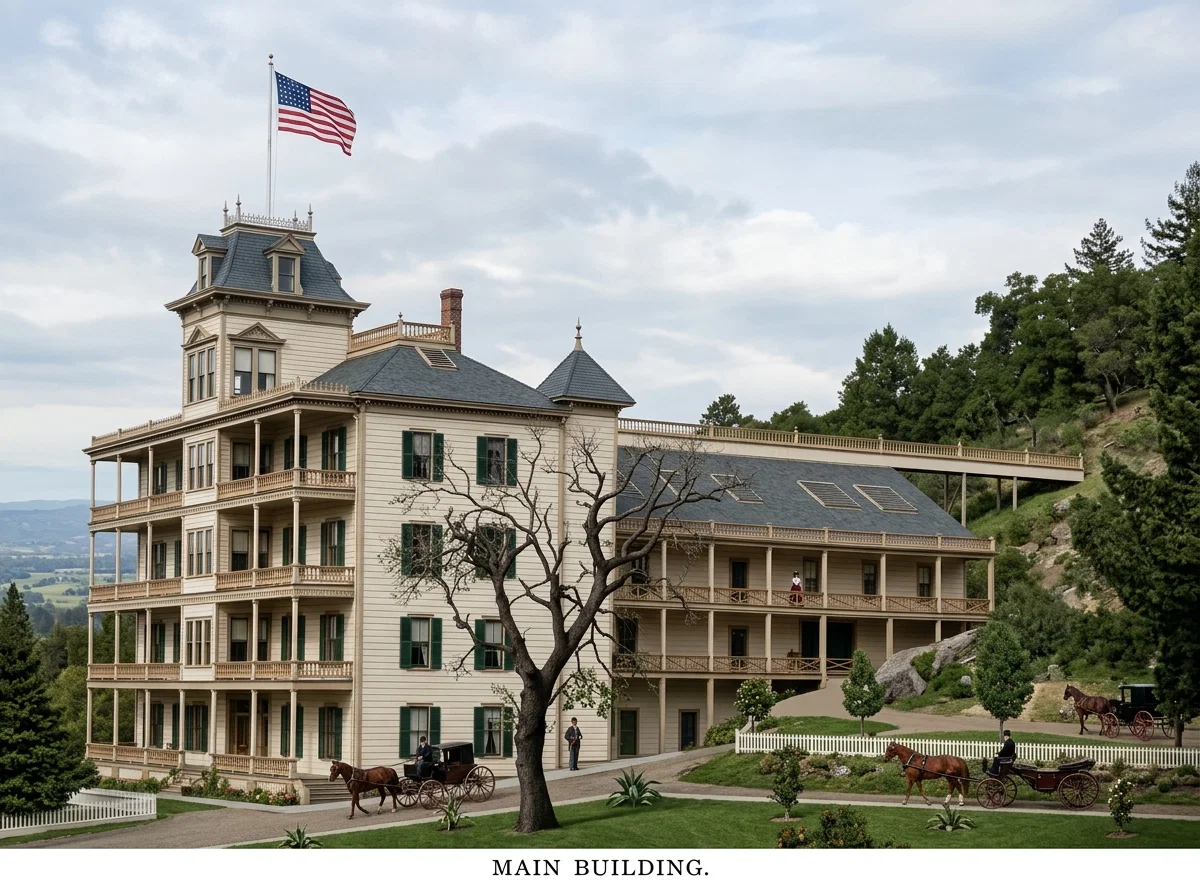
MAIN BUILDING.
The above is the Main Building of the Largest Medical and Surgical Sanitarium on the Pacific Coast.
WHILE California itself has been denominated "The Great Sanitarium of the World," the portion of Napa Valley in which this institution is located has been, by tourists and travelers, called "The Sanitarium of the State, with as fine a climate as is to be found on the face of the globe, an asylum for consumptives and asthmatics."
From the parlors of the above building, situated on the southwestern slope of Howel Mountain, some four hundred feet above the valley, is obtained a view of scenery not rivaled anywhere, even in sunny Italy. Parties who have traveled through Switzerland and all over the world pronounce the view obtained from the upper portion of the Retreat as grand as they ever saw anywhere.
Not only does Crystal Springs Health Retreat afford the advantages of a glorious climate, but it has connected with it
A CORPS OF PHYSICIANS REGULARLY GRADUATED FROM A LIBERAL COURSE IN MEDICINE AND SURGERY
who have had many years' experience in practice. They are not blind devotees to any exclusive "pathy," have no "pet theories" to follow to the exclusion of the advancing knowledge of Hygienics and Therapy. They employ no patent nostrums, nor countenance quackery in any form. They are assisted by male and female attendants who have had a liberal training in the largest Hygienic and Surgical Sanitarium in the world.
Free lectures are given, twice a week, in the parlors of the institution on the subjects of physiology, disease, health, and hygiene. It is the purpose of the managers and physicians that our patients and guests shall not only have an opportunity to recover their health, but that they may learn how to keep well when they leave the hill side.
The remedial measures employed include
Baths by Vapors, Air, Water, Electricity, Heat and Sunlight; Galvanic and Faradic Electricity, Swedish Movements, Massage, Dumbbells, Indian Clubs, Free-hand Exercises, Marching, Mechanical Appliances, and exercises for Development of Lungs, Vital Organs, and Muscular System, restoring and increasing Nervous Energy, equalizing Circulation and Curving Deformities. Treatment of Eye, Ear, Nasal, Throat, and Lung Diseases.
Bad cases of Piles, Prolapsus of Rectum, Fissure, Fistula in Ano, Consumption pronounced incurable in the East, Epilepsy, Asthma, Dyspepsia, Enlargement of Liver and Spleen, Abscess of Liver, Constipation, Diseases of Kidneys, Bladder, and Genito-Urinary Organs, Varicocele, Impotency, Nocturnal Losses, Spermatorrhea, Uterine Displacements of many years' duration, Uterine and Ovarian Tumors, Cancers, Nervous Diseases, and Paralysis have been successfully treated and cured at the Retreat. Especial inducement is offered to all suffering with ailments peculiar to females.
Crystal Springs is two and one-half miles from St. Helena, which is a station on a branch of the Southern Pacific R. R., and may be reached from Vallejo Junction, or from Suisun. A coach will meet passengers at St. Helena Station, who give notice to the Retreat before hand of their expected coming. Passengers with baggage are taken from the station to the Retreat for 50 cents each. There is telephone connection between St. Helena and the Retreat.
The expenses at this institution are very reasonable.
Rooms, with board and treatment, from $12.00 to $20.00 per week, according to room occupied.
Rooms and board, without treatment, from $6.00 to $12.00 per week. Special terms by the month. A few rooms in cottages at reduced rates. Please write and obtain full descriptive circulars, and such information as you desire concerning the place, and come and see for yourself. Address,