The Youth’s Instructor, Vol. 35, No. 33.

THE CHURCH OF THE NATIVITY

The Youth’s Instructor

Aug 17, 1887

S. D. A. Publishing Association · Battle Creek, Mich. · Aug 17, 1887

THE CHURCH OF THE NATIVITY.
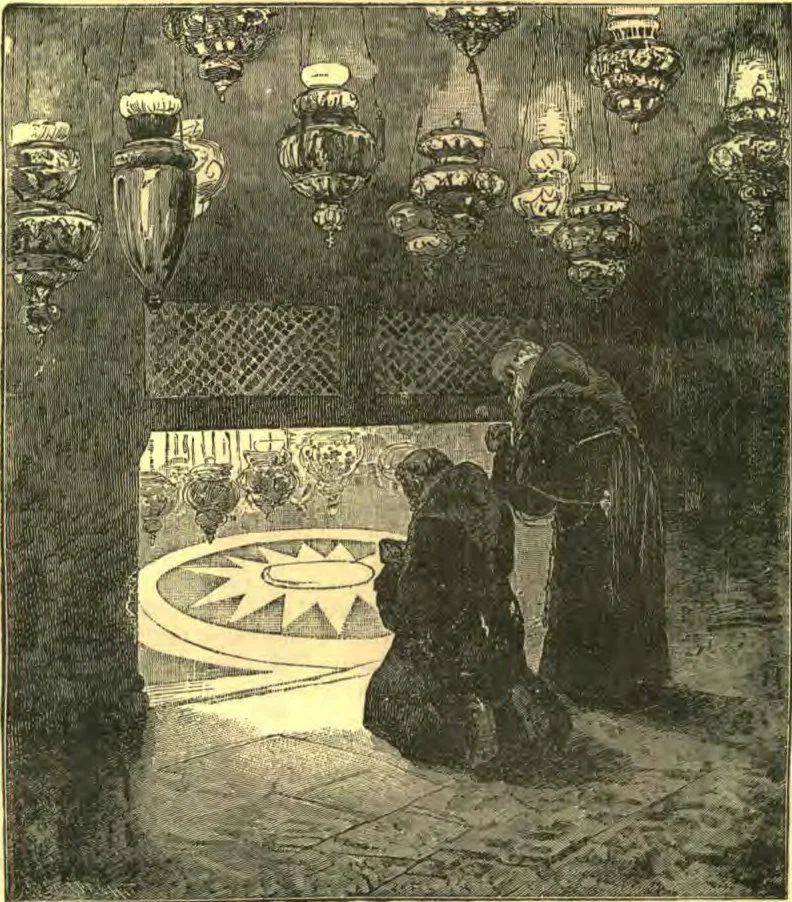
The roads of Palestine, like its springs, do not change their location. Where we tread them now we may be sure the actors in Holy Writ traveled thousands of years ago. Perhaps around no six miles of road do so many memories cluster as in those stretching between Jerusalem and Bethlehem. Over this road Abraham traveled; near the city Jacob buried his best-loved wife; on these plains the shepherd-king led his sheep; here the beautiful Ruth gleaned in the fields of Boaz; and here, outshining all other memories, the Saviour of the world was born.
As we approach the town, the first object that attracts the eye is the massive convent and church of the Nativity, less noticeable for its beauty than its strength. The courteous monks in charge of the convent will give us a hospitable greeting, and make us welcome to all their humble means afford. The old church, which forms the greater part of this pile of masonry, is one of the few places in the Holy Land to whose claims we may give credence. If it does not stand on the exact site of the old manger in which the Saviour was born, we may be sure it is not many yards from it.
Says a traveler: “The magnetic center of Bethlehem, around which cluster the churches and convents, is the grotto or cave which has been recognized since the second century as the scene of the Saviour’s birth. The Empress Helena, mother of Constantine, in the year 327 built over it the basilica which now covers it. Hence this is the oldest Christian church in the world. This venerable building, with its nave and pillared aisles that have echoed Christian worship for over fifteen hundred and fifty years, might well attract pilgrims; but the attraction lies in the grotto beneath its choir. This grotto is reached by either of two curving stone staircases, which enter it on the right and left of its most sacred shrine at its eastern end, and is known as the Chapel of the Nativity.
“It is a low vault in the solid rock, thirty-eight feet long and eleven wide. In a semi-circular recess at its eastern end a silver star is set into a marble slab in the pavement, on which are cut the words, ‘Hic de Virgine Maria Jesus Christus natus est,’—‘Here Jesus Christ was born of the Virgin Mary.’ (See cut on this page.)
“That this is literally true we may not assert, but we may believe that this church stands over the spot where stood the house in the stable of which was born the Saviour of men. Nor is it impossible that this grotto was the cave-stable of that house. A place more tenderly touching the heart of the Christian is not to be found the wide world over. . . .
“On one of our visits to the Grotto of the Nativity we were much interested in a group of pilgrims from Russia. The men were tall and powerful, with shocks of red hair parted in the middle, and clad in long coats belted about their waists. The women were sturdy, homely, and square. All were profoundly serious. And no wonder! Their simple faith had brought them all the long way from their homes in the distant North, sleeping and living on the unsheltered deck by sea and traveling on foot by land, to visit the places where Jesus was born and had died. And now they stood before the holy spot where their Redeemer first appeared to men. A Greek priest held a large volume of the Scriptures, which he rested upon the heads of the three kneeling pilgrims, and read to them the story of the nativity, to which they listened with solemn awe. The reading ended, the book was laid upon the head of each of the pilgrims; each kissed it and the hands of the priest; then, kneeling they pressed their lips to the silver star which marked the holy spot.”
However questionable their adoration of the place may appear in our eyes, it certainly will do neither them nor us any harm to remember that for our sakes the Word was once made flesh and dwelt with men.
W. E. L.

HELPFULNESS

“Bear ye one another’s burdens, and so fulfill the law of Christ.”
An inspired writer gives this command, and the smallest child can keep it; for loving words and a sweet smile or caress will often so lighten a heavy burden of care that the little one is really helping to bear it. But many can do more than this, and it often lightens one’s own burden to bear that of some one who is more heavily laden or burdened in a different way.
A sweet helpfulness of character soon shows itself in many little things, from the child who lays her dimpled hand on a mother’s aching brow with the artless question, “Does my little hand feel good?” to the young girl who, putting aside all thought of self, sits hour after hour in a darkened room watching beside a sick-bed.
It is not only the burdens of those who are near and dear to us that are to be borne, nor of those to whom we are attracted by their natural gifts, but the burdens also of God’s poor and disagreeable children, for whom few care. All bear his image, however begrimed or defaced it may be, and all have a right to our help and sympathy. If a person has a heavy basket to carry, and we take right hold and carry part of it, we feel that we have really helped to bear that burden; and this is the only way in which we can help.
The oldest little daughter of a large family, especially if money does not come in fast enough to supply the wants, will find plenty of opportunities for lifting burdens; and the oldest boy at home can never lack a chance for being helpful.
When mother has been awake at night with a cross baby, and Bridget has the toothache, how much sweeter than an hour’s unnecessary sleep in the morning is the satisfaction of getting breakfast in a state of forwardness before one has even been called to get up. “Such a help!” sighs poor, weary mamma. Tending the cross baby afterwards would not perhaps be sought as an amusement, but it lightens the burden; and if you get so tired of him in a little while, how do you think it is with those who have the charge of him all the time?
A boy’s help is sometimes invaluable when he gives it cheerfully; and he can do many things that would not be easy for a girl to do. A constant practice of helpfulness, of asking one’s self on first rising in the morning, “Now, what can I do to help some one to-day?” will bring a strong feeling of loving sympathy towards all, that will make such a person welcomed everywhere like the sunshine.
Every now and then some brave and noble act by which a life has been saved, or possibly many lives, is done by a very young person; and the boys and girls who hear of it think how splendid it is, and how they wish they could do some such thing and be praised and admired by every one. They can do just such things, if the opportunity comes to them, by beginning now to do acts of helpful kindness to those about them, and steadily persevering in it.
The boy who saved a train from being wrecked, or the girl who snatched a burning child from death at the risk of her own life, did not just begin then to think of others; but like the unseen working of the coral insects beneath the waves, they were quietly rearing a foundation of “little acts of kindness, little deeds of love,” long before the opportunity came that made them famous.—Ella Rodman Church.

A SUMMER LESSON.

The brook that threads the forest glade Whispers, beneath the shade, His dream of love to listening flowers Through the long summer hours, While myriad insects in their festive round Tune all the air to one rich harmony of sound.
The leaves which rustle in the breeze Make music as they please, And the soft zephyrs pass along Echoing the mystic song, Till the whole woodland like a chantry rings With hymns antiphonal, praising the King of kings.
Here let us rest awhile and dream Upon sweet Nature's theme,— The love of God in great and small, And mercy over all, So fair a nursery garden still is ours, Fragrant with memories dropped from Eden's long-lost bowers.
If love can bear so long with sin, The heart of man to win, If heaven its beauty thus can spend, Yet hardly reach its end, How shall we dare to weary or complain, Though all our toil and work should seem to be in vain?
The palest flower that hides unseen Beneath its leafy screen, The smallest bird that sings on high Its gladness to the sky, The faintest whisper of the summer wind Each has its special work in God's eternal mind.
A life of sacrificed desire, A heart consumed with fire, Eyes that can read in every face Some lines of heavenly grace, Lips that dare only speak kind words and true, How shall they ever fail some heavenly work to do?
Rise with the sunshine of the brook Brightening in every look, Fill thy hands full of God's dear flowers, Born of the springtide showers, Learn of sweet Nature how to work his praise, And take this summer world to gladden wintry days. —Sunday Magazine.

“GIVE ME A PENNY, SIR?”

Do you think your lot a hard one, that you are not receiving the proper attention, nor your share of the comforts of this life? Let me tell you a little story.
Recently I was standing by a steamer lying in the docks of Liverpool, England. A little fellow, about twelve years of age, came up to me, and hesitatingly said, “Give me a penny, sir?”
Said I, “What would you do with it?”
“Sir,” said he, “I want something to eat.” My heart was touched by his pitiful words. Seeing that he was from America, I thought I would question him some. I learned that he was born in Ohio. His father was killed in the Zulu war, after which his mother received a pension. But soon his mother died, leaving two children, a boy and a girl. They were provided with good homes. The boy was sent to New Orleans to live with a farmer. He was treated kindly, but, as many others think, he imagined he could do better elsewhere. “If I can only get to the Old World!” he thought. So one morning he made his way to the city (New Orleans), and there “stowed himself away” in a ship.
When he arrived in Liverpool, he found himself in a strange land, with no friends, and but a few pennies in his pocket. These were soon gone, and he tried, but in vain, to get work.
After his pennies were gone, he was compelled to sleep outdoors, under cars, in wagons, or wherever he could find any shelter. In this condition he came to me. His greatest anxiety was to get back to America. Like the prodigal, he knew that at home there was “enough and to spare.” But you see that idea of doing better led him into serious trouble.
After giving him some words of advice, I granted his request, and bade him good-bye. I am sure if this little lad could only have had one glance at the poor children of Liverpool, he never would have made such a mistake.
To give you a faint idea of the way that many of these poor children have to do in order to keep from starvation, I will cite an instance or two that came under my observation. One day while boarding a ship at the wharf, I heard a lamentable cry. Looking around, I soon discovered a poor, wretched little fellow half clad, and besmeared with filth from head to foot, who was hurriedly led toward the ship by a man. With interest I watched them to see what was to be done with the boy. He was brought on board the ship and taken to a bath-room. Are they going to give him a bath, thought I? No, not so fortunate for the poor boy, for that would have done him good. The man rudely asked him what he wanted aboard the ship. Said the little fellow, “Sir, I wanted something to eat.” “You wanted something to eat? I have something good for you—some cane soup,” growled the man. After questioning him for some time in an abusive way, he locked the door.
Soon he returned, bringing with him a large cane. Unlocking the door, he said, “Well, are you ready for the soup?” Is he going to beat him with that cane? thought I. From the pitiful pleading that followed, it was evident that the boy well understood how the cane was to be used. The man stepped inside the door, and locked it behind him. He began at once to beat the little fellow. I could hear now and then from the boy, “O sir, I beg your pardon, I beg your pardon.” Shortly the man came out, and locked the boy in, with the encouraging words, “I will bring you some more soon.” True to his word, he came again to the room, and unmercifully beat him again. I stepped to the door, and through an opening I saw the boy with his clothes half off, begging in a most pitiful manner for the man to have mercy on him. The sight was heart-rending.
When the man, who proved to be the second officer of the ship, came out, I stepped up to him, and asked why he was punishing the lad. “He has been stealing food from the ship,” said he; and I could say no more.
No one need go hungry long in America; but here the people are so tormented by hungry persons begging for food, that thousands are turned away. Some of necessity are driven to steal. Then, again, there are so many drunken parents! Some compel their children to support them.
Late at night these poor children may be seen selling bits of kindling-sticks. To procure food for hungry mouths?—No, but to satisfy the liquor-thirsty mouths of their parents. Frequently they return without having sold anything; and then, instead of being allowed to retire for the night, the angry father or mother sends them out again, warning them not to return till they have sold something.
Now, children, do you think your lot a hard one? If so, compare it with these poor children of England, and ask your kind, heavenly Father to forgive you for allowing such thoughts to enter your minds. Are you not glad that some day, and soon too, the good Lord is coming to this earth, and then all this sorrow and sighing will have an end? But do you imagine that he will have any complaining ones in that new earth?—No; they will all have overcome. Are you not going to be one of them? E. S. ANTHONY.

A VISIT TO THE GULF OF MEXICO.

In company with a few friends, we went to seek a few days' recreation on the Gulf Coast; for the extreme heat of this semi-tropical climate during the months of July and August is almost unendurable. On the sea-beach a delightful breeze blows constantly during the hottest days of the heated term.
We are at Ocean Springs, a quiet little country village in the southeastern part of the State of Mississippi, and situated on the arm of the Gulf of Mexico. Perched on an eminence overlooking the water, we can see, from the door of our tent, yachts, schooners, sloops, barges, and steamers coming and going in every direction. The sea-breeze and the salt baths are very invigorating. The morning hours are the best for bathing, for the tide goes out in the afternoon, leaving the water low.
But even a bath in the sea has its drawbacks. There is in the water a little creature called the "Sea Nettle." It is very much dreaded by bathers. It looks like an old rag floating upon the water, ready to drop to pieces upon the slightest touch. You would hardly believe it a living creature until you had watched it for some time. Wherever it strikes the flesh, it leaves a smarting, fiery sensation, similar to the touch of a nettle, and the sting lasts for hours. Four of our company have had a practical experience with them.
We have seen many curious fishes since coming here. The jelly-fish is a very strange animal, looking like a lump of peach jelly floating through the water. It is considered one of the lowest orders of animal life.
You have used the expression, perhaps, “Flat as a flounder,” yet I doubt if you knew how appropriate the expression is. The flounder has scales on one side only, and looks much like one of our sunfish split in two from head to tail. It swims in a semi-horizontal position, and has both eyes upon one side of its head. It is the flattest fish we ever saw.
The croaker is another species peculiar to salt water. It is a small fish, and as soon as taken from the water, begins to make a croaking noise, from which it takes its name. They are excellent fish for food.
The red fish and the Jack fish both grow very large. We saw the head of a Jack fish that weighed sixty pounds. The French people make a soup of the head by boiling it with potatoes, and seasoning it with black and red pepper, salt, and wine. They consider this one of the most delicious of dishes. It may be a palatable dish to a perverted appetite, but it certainly cannot be a healthful one. The red fish are like those we see in fresh water, with the exception that they are much larger. The one we saw weighed about twenty-five pounds. They come into the bays in schools of from three to five hundred, and are caught in seines. One of the fishermen told us that their seine caught so many on one occasion that they could not draw them in. It reminded us of the time when the fishermen of old, at the command of the Master, cast in their nets on the other side, and caught so many fish that their nets brake.
Almost every morning a schooner or sloop comes sailing in, loaded with oysters, shrimps, and fish. The oysters are deposited in shallow water near the beach, where they propagate. They emit a milky substance, and upon whatever this “spat” is deposited, the oyster grows. Sometimes they grow on sticks, stones, or posts. Often they are found in clusters of from four to six each. The shrimps are canned at a large canning factory situated on the beach a little way from us.
Crab fishing is quite an exciting sport for the boys and girls. Tying a piece of beef to the end of a string, they drop this into the water, whereupon it is immediately seized by a crab, who holds it so tenaciously that he is pulled above the surface of the water. A small hand-net attached to the end of a pole is then slipped under him, and thus secures him. Crabs have a shell somewhat similar to a mud-turtle, and very sharp, long-shaped claws. If they chance to get hold of your hand, they pinch severely, sometimes cutting great gashes. They do not turn around when they want to go backward, for they can crawl as fast one way as another. They do not go straight ahead, but pass either to the right or left.
You may be somewhat at a loss to know what people do with these crabs. You will be surprised when I tell you they cook and eat them. They are pitched alive headlong into a kettle of boiling water, and when they have turned a bright-red color, are ready for the table. They are considered a very delicious dish. When placed upon your plate, they look like a small turtle ready to crawl. No doubt it would take a good deal of urging to induce most of the INSTRUCTOR family to eat one, should they have an opportunity.
On our journey to this place we saw several alligators, leisurely swimming to and fro. They are as savage and hideous looking monsters as their portraits represent them to be. In fly time they lie with their heads upon the shore, mouth wide open, until it is well filled with flies, when they quickly close it, thus securing a portion of their food. If a dog chances to pass near enough to them, they hit him a quick, sharp blow with their tail, thus stunning him, and then they turn and devour him. White people are seldom disturbed by them while bathing, but they will attack a colored person almost as soon as he enters the water. E. HILLIARD.

AUGUST AND ITS WORK.

WHO has made dry all the cool, shady places Where my little brook used to ripple and play? “I coaxed the brook off,” said fiery-breathed August; “In soft little mist-clouds it floated away.
Who has turned yellow and brown my green pastures? Who has been bleaching my green sea of wheat? “I ripened the verdure,” said fierce, scorching August, “And I threw those brilliant-hued flowers at your feet.
“I finished the ripening of all the wild berries, And I put the bloom on the fair, downy peach; For me in the orchard the sweetings grow mellow, And I have some beautiful tintings for each.”
—Sarah E. Howard, in Our Little Ones.

THE SINGLE MUSIC LESSON.

He who can read one book can read many books. He who is master of one tune can soon sing many tunes. But few have the patience to drill upon elements till they learn the secrets of perfection. In “Fetis’s History of Music,” the following story is related:—
“Porpora, one of the most illustrious masters of music in Italy, conceived a friendship for a young pupil, and asked him if he had courage to persevere with constancy in the course he should mark out for him, however wearisome it should seem. When the pupil answered in the affirmative, Porpora wrote upon a single page of ruled paper the diatonic and chromatic scales, ascending and descending, the intervals of the third, fourth, and fifth, etc., in order to teach him to take them with freedom, and to sustain the sounds; together with the trills, groups, appoggiaturas, and passages of vocalization of different kinds. This page occupied both master and scholar during an entire year; and the year following was also devoted to it. When the third year commenced, nothing was said of changing the lesson, and the pupil began to murmur; but the master reminded him of his promise. The fourth year slipped away, the fifth followed, and always the same eternal page. The sixth found them at the same task; but the master added to it some lessons of articulation, pronunciation, and, lastly, of declamation. At the end of this year, the pupil, who supposed himself still in the elements, was much surprised, when one day his master said to him: ‘Go, my son, you have nothing more to learn—you are the first singer of Italy, and of the world!’ He spoke the truth, for this singer was Caffarelli.”—The Christian.

Character Preaches: Fenelon and the Witty Nobleman

A British nobleman, more famed for his wit than for his religion, having once lodged with Archbishop Fenelon, was so impressed with his beautiful Christian character that, on parting with him, he said, “I must stay no longer, or I shall become a Christian in spite of myself.” Character preaches, children.

PRAYER

LESSON 2.—ENCOURAGEMENTS TO PRAYER.

1. How does God encourage Christians to pray?—By promises and by examples in which prayers have been answered.
2. What precious promise is made in Matt. 7:7, 8?
3. In what other place is the same promise recorded? Luke 11:9.
4. Mention some conditions of this promise. Matt. 21:22; Mark 11:24; 1 John 3:22.
5. What promise does the Saviour make to his disciples? John 14:13, 14.
6. What does David say concerning his own experience? Ps. 3:4.
7. How does he express his confidence in the promises of God? Ps. 6:9.
8. What strong assurance does he manifest? Ps. 66:19.
9. What does the Saviour say in addressing his Father? John 11:42.
10. How may it be shown that David was heard in personal matters as well as in the affairs of state? Ps. 34:4; 40:1–3.
11. How do you show that God will hear the prayers of those in the humblest walks of life, as well as the prayers of kings and princes? Ps. 34:6.
12. What other encouragement is given to the humble and the oppressed? Ps. 10:17.
13. What promise is made to the destitute? Ps. 102:17.
14. What strong assurance is given to those who are in trouble? Ps. 50:15.
15. What encouragement is given to those who lack wisdom? James 1:5.
16. To what extent may this promise be fulfilled? Jer. 33:3.
17. To whom is salvation promised? Rom. 10:13.
18. What must be implied in a prayer that secures salvation?—Such depth of sincerity as would lead to repentance, faith, and obedience.
19. What promise is made to those who unite in social prayer? Matt. 18:19.
20. What must be observed in order to secure this promise? 1 John 5:14, 15.
21. When a people shall be generous to the poor, kind to the afflicted, and merciful to the oppressed, what assurance have they from God?—“Then shalt thou call, and the Lord shall answer; thou shalt cry, and he shall say, Here I am.” Isa. 58:9.
22. What will be said to those who shall be refined as silver is refined, and tried as gold is tried? Zech. 13:9.
23. Unto whom must all flesh come? Ps. 65:2.
24. How will they be received? Lam. 3:25.
25. What does the prophet say to those who have repented of their sins, and turned to the Lord?—“He will be very gracious unto thee at the voice of thy cry; when he shall hear it, he shall answer thee.” Isa. 30:19.
26. Give some examples in which prayers have been answered.

NOTE.

Our Father Invites Us to Come.—Why should people be so shy of God? He is doing everything to woo and win them, and to secure their confidence. So much has he done, that he asks (and I cannot answer) what he could have done more. He waits on his throne of grace to be gracious to them, but they come not near to him. He even calls to them to come to him, using, too, the language of most affectionate address: “Son, my son;” but they respond not, “Abba, Father.” It is strange they should treat this Father so. They treat no other father so. What child does not, in the morning, salute his father? And what father does not expect the salutation of each child, as he comes into his presence? Oh, yes, we love our father who is on earth; and we remember with gratitude the favors he does us. And does the Father of our spirits, the Giver of every good gift, deserve no daily notice from us, no affectionate salutation, no grateful recognition of indebtedness to him? I am certain he expects it, for he says, “A son honoreth his father; if then I be a father, where is mine honor?” He claims to be a father; and O how well he has established that claim! Truly he is a father, and “like as a father pitieth his children, so the Lord pitieth” his. And to the compassion of the father, he adds the tender care and untiring mindfulness of the mother. “Can a woman,” he asks, “forget her sucking child?” She may, he says, but he will not forget his people. How strange it is that men will not go to the closet to meet and to pray to such a Father.—Nevins.

FRIENDSHIP AMONG INSECTS.

That friendship exists between insects is well known. Especially is this true among ants, and it is surprising how quickly these little creatures recognize the presence of an intruder. At Colorado Springs, the surrounding country is marked in a very noticeable manner by the ant-hills, some of which are a foot or more in height. I often visited them, and spent considerable time in watching the methods and habits of their inhabitants. If a stick was thrust into a large nest, thousands of ants would rush out to the attack, and their numbers in a single nest may be realized when I say that I have swept them back with a bit of weed so that they formed at the bottom of the pit a solid mass almost as large as my closed hand. Such a ball must represent many thousands, yet all are friends or acquaintances. It is said that Napoleon knew all his soldiers, but here are ants that undoubtedly have less to distinguish them than human beings, that recognize untold thousands constituting their tribe.
That this is so I have often demonstrated by dropping among them an ant to all intents and purposes alike, but from another nest. The recognition of a stranger is immediate, and the intruder is at once attacked and either killed or driven out. In a nest near my house the ants from frequent visitations became extremely savage and would at once attack a newcomer. One day I dropped a huge iron-jawed black ant in among them. In a second it was seized by legs and antennae by as many of the furious host as could crowd about. At first the giant struggled, then finding escape impossible, he began leisurely destroying his tormentors, every movement of the ponderous jaws resulting in the decapitation of a victim, until finally he actually secured his release.
As in nests of Formica pratensis it has been estimated that there are often half a million individuals, it is evident that the memory of the ant is remarkable. Some interesting experiments may be tried to prove that friendship exists between ants, and that old acquaintances are not forgotten. If an ant from a certain nest is taken away and kept for a day or so and then dropped among the rest with a stranger, it is not molested, but the stranger will be found soon after badly used if not dead.
The length of time that ants will remember friends has been determined in an interesting series of experiments by Sir John Lubbock. In August, 1875, he separated a colony of Formica fusca which he had kept for some time. Eight months later he took one of the ants and a stranger and placed them in the old colony. The long-absent ant seemed perfectly at home and was not disturbed, while the other was immediately attacked. Ten months after the original separation he returned another old friend and a stranger. The latter was at once seized by the antennae and dragged from the nest, while the former was not molested, though it was noticed that it did not mingle freely with the family. This experiment was repeated many times, the returned ant being marked with paint so as to be distinguished, and not only was it unmolested, but its old acquaintances insisted upon removing the paint. Sir John concludes his experiments with the following:—
“Friends were in most cases amicably received even after more than a year of separation; but while the strangers were invariably attacked and expelled, the friends were not always recognized, at least at first. It seemed as if some of the ants had forgotten them, or perhaps the young ones did not recognize them. Even, however, when the friends were at first attacked, the aggressors soon seemed to discover their mistake, and friends were never ultimately driven out of the nest. This recognition of old friends after a separation of more than a year seems to me very remarkable.—July Wide Awake.

A DARE.

BOYS, never be dared! If a thing be right, Why, then for its own sake do it; If wrong, to be dared is cowardly quite; Just dare to say No, and stick to it. —Golden Days.

HORSES

Some items of interest concerning the horse were published in a late Harper’s Young People, from which we make the following extract:—
“Familiar as we are with the use of horses, and accustomed to regard them as the property of man, we almost lose sight of the fact that there was once a time when these noble animals were free to roam about as they pleased. There are some wild horses at the present day, it is true, yet it is believed that all of these have descended from tame horses which have at various times escaped from their masters.”
“The history of the horse on our own continent, so far as it is known, is exceedingly interesting. It shows that at the time of the discovery of America there were no horses here, and that they were afterward brought into the country by the Spaniards during the Mexican wars. According to the accounts of the conquest, the natives of Mexico were greatly astonished to behold the invaders upon horseback. Not only was the beautiful animal itself wholly unknown to them, but their surprise was increased by the remarkable sight of a man seated upon its back.”
“Notwithstanding the fact that horses were then unknown in America, still the fossil remains which have been found in the western part of the United States prove that horses existed in the New World in very early times. Therefore, for some good reason which is not understood, they must have died out upon this continent before the arrival of the Europeans upon our shores. These interesting fossils likewise show us that the horses of that far-off time were curious little animals, very different from the graceful, elegant horses of our own time.”
“The earliest of these creatures yet found was a small animal only about the size of a fox, with four well developed toes and rudiments of the fifth toe on the forefoot. Since that time the horse has gradually increased in size, and lost its superfluous toes, and naturalists now have the satisfaction of tracing its descent, by means of these fossils, through the intermediate four-toed and three-toed forms, down to the horse of the present day, with its one perfect toe. These changes must, of course, have occurred by easy stages. The side toes no doubt gradually diminished in size, and at the same time the middle toe grew larger and stronger, supported by the solid hoof, which is simply a very thick nail.”
“Horses, therefore, as we know them, walk on this long middle toe, which is covered with the strong hoof, and forms what is generally spoken of as the foot. What we call the horse’s knee is in reality the heel, and under the skin, just below the heel, may yet be found two slender bones, called the ‘splint bones,’ which are remnants of the lost toes of the ancestors of our modern horse.”
“Horses are remarkably intelligent and docile, showing a strong memory for places. They yield themselves wholly, as we know, to the service of man, often entering with enthusiasm into the work assigned them, and we can scarcely estimate the assistance they have rendered in the spread of civilization throughout the world. Each of the various breeds of horses is suited to some special kind of labor, and we may notice that while one breed excels in speed and another in strength, others are valued chiefly for their powers of endurance.”

HOUSE OF HEN FEATHERS.

At Pekin, China, there is a building called the “Ki-mao-fan, or the House of Hens’ Feathers.” The house is one vast room. Over the floor is a thick coating of feathers. This is the great bedroom of the poor of Pekin,—men, women, and children,—all of whom have the privilege of sleeping on these feathers at a sixpence apiece. When all have entered, and selected their places, there is lowered from the ceiling a felt blanket or coverlid the exact size of the floor. Suffocation is avoided by the sleepers’ poking their heads through holes provided in the covering. Fancy the appearance of such a room with the blanket lowered, and several hundreds of shaven heads lying like large billiard balls upon it. At day-light the tam-tam, or drum, is struck to awake the sleepers, and as a signal to draw their heads out of the holes. A few minutes after, the huge quilt is hoisted again to the ceiling, and the beggars emerge from the sea of feathers, much as ants appear on a pleasant day swarming around their hill. W. S. C.

A NATURAL BRIDGE IN OREGON.

Mrs. Ada B. Millican, of Eugene, in a conversation, furnished the writer with some notes concerning a remarkable natural curiosity. It is situated about 18 miles from Oakland, Douglas County, at the head of a canyon, on a stream putting into Rock Creek, and is about two miles from the base of Tyee Mountain, which is the highest point south of St. Mary's Peak, in Benton County. Incidentally it may be remarked that not less than nine snow-clad summits and the mountains around Crater Lake can be seen from this place of observation. The bridge was discovered by Charles Magee, of California. The arch is almost perfect, and from base to base is 90 feet wide, with remarkably regular, perpendicular walls, the whole looking as if chiseled by the hands of a skilled giant.
The approaches on the top are about 200 feet from one side to the other, while inside, from base to top of the bridge, 90 feet. From top of arch to top of bridge, 30 feet. On the bridge are all kinds of growths—oak, maple, fir, cedar, laurel, balm of Gilead, and a great variety of shrubs, grasses, and flowers. Inside it is clear of all growths, so its proportions can be well observed. There are very large trees around, and the scenery is wild and weird. It is a beautiful place for camping, having pure air and water, fish and game.—Salem (Oregon) Sentry.

Origin of the Horseshoe Superstition

The superstition connected with the horseshoe is supposed to have its rise in the halo which is made to surround the heads of saints in pictures. In early times the halos were often made of shiny metal, in the form which one may see in old engravings. By degrees the colors of the picture faded, leaving the metal, which was shaped almost exactly like a horseshoe.

THE SHEPHERD BOY.

Like some vision olden Of far other time, When the age was golden, In the young world's prime, Is thy soft pipe ringing, O lonely shepherd boy: What song art thou singing, In thy youth and joy?
Or art thou complaining Of thy lowly lot, And thine own disdaining, Dost ask what thou hast not? Or the future dreaming, Weary of the past, For the present scheming, All but what thou hast?
No, thou art delighting In thy summer home Where the flowers inviting Tempt the bee to roam; Where the cowslip, bending With its golden bells, Of each glad hour's ending With a sweet chime tells.
All wild creatures love him When he is alone, Every bird above him Sings its softest tone; Thankful to high Heaven, Humble in the joy, Much to thee is given, Lowly shepherd boy. —Selected.
Continue reading: HULDAH TUTTLE