The Youth’s Instructor, Vol. 34, No. 22.

TRAVELING IN THE DESERT

The Youth’s Instructor

Jun 2, 1886

S. D. A. Publishing Association · Battle Creek, Mich. · Jun 2, 1886

TRAVELING IN THE DESERT.
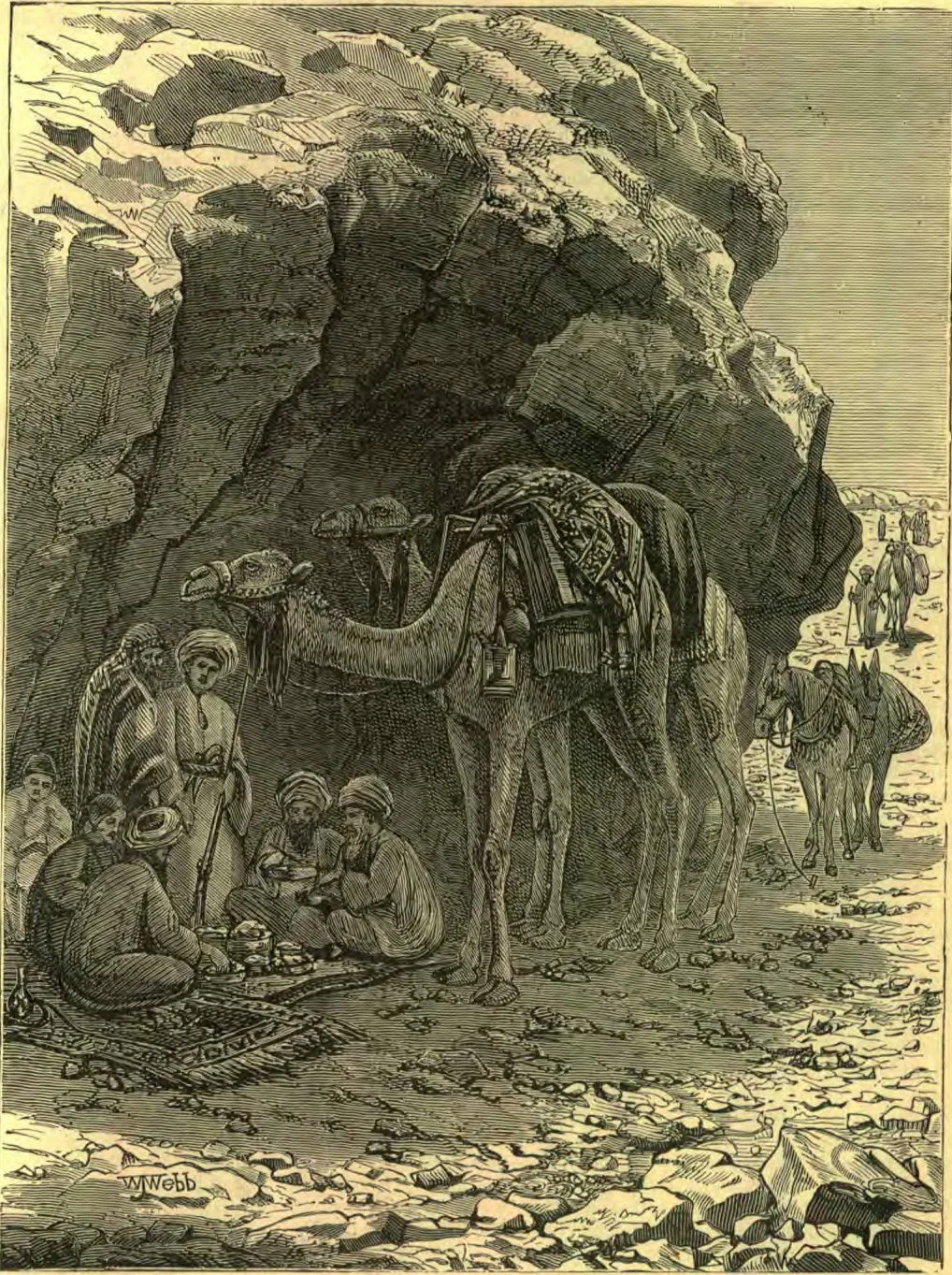
To those used to the easy traveling by railroad and steam-ship, where everything is made as agreeable and convenient as possible, a journey on the back of a camel presents a degree of hardship and novelty to be found perhaps nowhere else. In our picture we see a long caravan making its noon-day halt under the shadow of a great rock, no doubt the only shelter from the burning sun and sand for miles around. Isabella Bird Bishop, in Leisure Hours, gives a vivid and interesting description of a journey from Egypt to Sinai and back, under the escort of several Arabs, of whom Hassan was the chief. Perhaps you will get as good an idea of the ups and downs of desert travel from a few extracts out of this article, as from any thing that might be written.
Of the camel she had to ride, she says: “My beast is a saddle-camel, quite young, and not completely broken; it occasionally shies, and for a few yards afterwards breaks into an agonizing trot. It does not lie quiet while I mount it, but two or three times, just as I have been getting on, it has jumped up with an angry roar, and has taken the combined effort of several Bedaween to make it lie down and keep down. I have now traveled on saddle-horses, pack-horses, mules, asses, cows, elephants, and a camel; and though the fatigue of sitting ten hours daily on a camel’s back is very great, and its slow, swinging gait is wearisome and painful to the muscles, it is not nearly so bad as I expected—not worse, I think, than an elephant, and not so bad as a Japanese pack-horse.”
“I usually walk,” she says, “as far as I can to lessen the tedium of the day. . . . When I can walk no farther, my camel, with much difficulty and many objurgations, is made to lie down. Hassan stands on one side and the sheykh on the other, and with Hassan’s help I attempt to take a flying leap into the middle of the saddle. Sometimes this is successful the first time; and if it is, Hassan puts an arm in front of me, and the sheykh puts an arm behind me, and the dreaded moment arrives, which I am more cowardly about each time. The camel, with a jerk which might dislocate one’s neck, jumps on his knees, nearly throwing me backwards, then another violent jerk brings him to his haunches, and would throw me over his head but for Hassan’s arm; then the forward movement is arrested by another jerk which sets him on his four legs, and leaves me breathless on the lofty elevation of his hump. This process is reversed as one dismounts, and is repeated six times daily!
“But things are not always so comparatively smooth; for just as I am prepared to spring, the brute makes a snarling lunge with his teeth either at me or his driver, or just as I am half way up, jerks himself up on his four legs, and the whole has to be gone over again. Yesterday, I had just touched the saddle, when, by a rapid movement, he threw me off sidewise; and this morning, jerking himself up before I had clutched firm hold of the saddle, he threw me over his shoulder, and bruised me a good deal. After being mounted, the caravan straggles in single file, Hassan bringing up the rear, my camel being led, and for four or five hours we crawl over the burning, glaring sand.
“I now understand what is meant by, ‘As a hireling I earnestly desireth a shadow.’ At 8:30 the shadow of my driver is fully eight feet long, and as the morning wears by, it shortens to something a little over two feet; then I know that noon has come. The camels halt; and if there be a rock which casts a shadow, Hassan lays a blanket in the shade for me, and while the Bedaween smoke and sleep for an hour, I read the Scripture account of the wanderings, and lunch on a cluster of raisins. I am learning a deep sympathy with the Israelites, and their unbelief and murmurings become more intelligible as the days go by.
How terrible must have been the trudge through this ‘waste howling wilderness,’ how bitter the regrets for the green valley of the Nile, how weary the barren sands, how terrible the burning heat! Better than all do I understand the words, ‘the shadow of a great rock in a weary land.’ To-day, on the parched plain no rock was found to give shelter in the heat of noon. There was but a big stone about two feet high, under the lee of which the Arabs scraped a big hole, into which I crawled, and lay down screened by a blanket laid over my double umbrella. The sand was burning even through my clothing.
“After this halt, the baggage-camel and the sheykh start early, so that I may find my tent pitched when I arrive at the camping-ground; and I, with Hassan and my driver, follow. Then come five exhausting hours over the blinding, burning sand, and oh! how eagerly I watch the driver’s lengthening shadow growing, growing, growing, till it slants surely twenty feet across the sand, and then in the distance I see my white tent, and soon the day’s toils are done. The camels are turned loose for a short time to browse upon such scanty herbage as exists—gray and bitter—some species of artemisia, the tamarisk, and the acacia. The Bedaween makes a fire of the dried camel’s dung which they have picked up on the way, to which is added a little charcoal brought from Egypt, at which they boil their coffee and roast their maize; and I take my supper. The camels are then brought in and made to lie round the fire, looking like ‘wrecked ships.’ The Arabs talk and smoke, then putting on their goat’s-hair cloaks, lie down to sleep outside their camels; Hassan retires into his small bell tent, out of which his feet protrude; and by the time that it is quite dark, the camp is quiet, till the grunting and roaring of the camels at daybreak awake me.”

THE FOUR DESIGNERS.

MOTHER earth must have a carpet. Who'll design it? "I," said Spring; "With my rain-dipped, sun-tipped brushes, I'll design the sweetest thing Ever seen." And, true to promise, Worked the artist morn and e'en, And a tapestry of velvet Wrought she of the tenderest green.
"I'll improve on that," said Summer, Clever artist, in his prime. "I would tire of emerald sameness, All I ask is proper time." One by one, and bunch by bunch, then, Showers on showers of flowerets fell, Scattered this way, scattered that way, Summer laughed, "I like it well."
"I," sighed Autumn, old and lonely, "Lose my taste for youthful things," And she paints a dull-brown background; When 't is finished, then she flings Here and there a leaf of yellow, Here and there a leaf of red, Like bright spots that memory echoes From a happy youth, long dead.
Aged, hoary, bent and feeble, Winter came with tottering feet; Peevishly the artist muttered, "I could paint it more complete." But his hand, no longer steady, Lets the laden brushes fall, And with death-chilled, stiffening fingers, Spreads his white shroud over all.
—Jone L. Jones, in Golden Days.

WHAT THE FOREMAN SAID.

At the time I visited the chair-factory in Otsego, where there are about one hundred hands employed, the foreman said to me, as I was about to leave, “I want to tell you some facts which you can use in your talks with children and young men. We have a good chance to study different dispositions, as we deal with all kinds of men here. I will tell you who stand the best show for promotion and highest wages, and who stand the poorest chance to get work with us. I am a temperance man, because my connection for many years with so many working-men has taught me the necessity of it. If we find, when a stranger applies for work, that he drinks so much as to interfere with his work, we do not want him. He is not profitable help. He is liable to do damage, or to be away, or to leave us when we want him the most.”
And so he went on telling the bad effects of drinking, and named several cases, which had come under his personal observation, of bright young men totally ruined by intemperance. He pointed to some in the shop—smart young men—who were on that road. They would probably soon be dropped out of the shop. He gave the history of two of his early companions—bright boys—who were raised in luxury, and had everything they wanted. This led them to indulge in tobacco and drinking. Both came to a sad end. I wish all of our boys could have heard his earnest talk on this subject.
Mr. Baker continued: “The next class who stand a poor chance for promotion with us, are the crabbed and cross boys and men. Supposing we have a vacancy, and ten of our men apply for it. All of them are equally capable of filling the place. If there is one that is cross, peevish, and unpleasant to deal with, one who finds fault with those around him, or is easily offended, he will be the last one to be promoted. Such men make trouble in the shop. We do not want them. The place would be given to another person, though not so good a workman, if he was pleasant and agreeable.”
Think of that, children. Business men do not want such boys and men around them. And remember that cross, quarrelsome, fault-finding boys are sure to make the same kind of men. Such a disposition will hinder you financially. And then I thought if business men do not want such persons around them, how much less will the Lord want them in heaven.
“There is another class,” continued the foreman, “whom we do not want in our shop. We find them unprofitable laborers. We do not employ them if we can avoid it. They seldom get promoted, and they are the first ones we discharge; that is, the liars, those who are untruthful, who do not tell things just as they are. You see, we cannot depend upon them; we do not know whether what they say is true, or not. They make us so much trouble that we have learned that they are poor help.”
Now, boys, put this down also, and remember that if you form the habit of telling falsehoods, of covering up the truth, of not being square and reliable in what you say, it will not only shut you out of heaven, but it will hinder you even in this life.
“And another class,” Mr. Baker said, “is seldom promoted in this shop. It is the unsteady class of boys and men. They go fishing one day, off hunting another, playing ball, or away to a party another time. You do not know when to rely upon them. They may be bright, smart, active, and good workmen, yet they are not profitable hands. If there is a good place in the shop vacant they are not the ones that get it. You see we cannot depend upon them. So we always give the best place to the boys and men who are steady and reliable, those on whom we can always depend. Even if they are much slower, and not quite so good workmen, yet we would rather have them. That is the kind of boys and men that we like.” I thought to myself, what a lesson that ought to be for our youth! I wish all of our readers could have heard the earnest talk of this business man on these important points.
Another thing he said was this: “Those who do the roughest and hardest work, get the poorest pay; those who do the finest and easiest work, get the best.”
“Why is that?” I asked.
“Because,” he replied, “the finest work requires the most skill, and intelligence, and faithfulness.”
Then, children, remember this, and put it down as a principle of your life, that whatever you do, you will do it just the best that it can be done. Such kind of work not only brings the best pay and the most honorable positions, but is always in demand. If you want to succeed in life, be temperate, be truthful, be steady, be pleasant, and do your work well.
D. M. CANRIGHT.

ABOUT BROOM-CORN.

Perhaps but few readers of the INSTRUCTOR know much about broom-corn or ever saw a field of it growing; so this brief sketch may be of interest to many.
We are told that the first broom-corn ever raised in America was grown in the garden of that grand old philosopher, Dr. Benjamin Franklin. He found a few stray seeds in a vessel that had sailed to this country from far-off India; and never having seen any seed like it before, and knowing it to have come from that foreign land, he planted it to see what it was.
While growing, it very much resembles our native Indian corn, or perhaps sorghum or sugar-cane. No doubt as Dr. Franklin watched its growth, he thought he had found only a new variety of corn, and perhaps he watched for the ears that contained the grain. But in this he was disappointed, for no ears appeared; but instead, on the top of a very tall, slender stalk grew a heavy, bushy brush, thickly covered with red seed, the exact likeness of the original. Of course the quantity of this first crop was very small, and another year or two was required to demonstrate the value and nature of the plant. So the first crop of seed was planted again the next season, and produced quite a quantity of seed the following fall. As yet, remember, the idea of using this brush for a broom had not dawned upon the mind; it was only the seed that was supposed to be valuable. It was discovered, however, that it was not relished by cattle and horses as well as oats or corn, and was regarded by the farmer as possessing very little value as a feed.
But though rejected as worthless on this account, it soon proved itself useful in another sphere. In those days the only brooms in use were made from a hickory stick cut green in the woods, shaved down in thin splints, and turned over and tied round with a stout string, the upper portion serving for a handle and the lower heavy part for the broom. This did very well to sweep the rude floors of that early day; but what would become of our fine carpets were we to use such rough sweepers now? It did not take long for some one to discover that by putting several stalks of this long-fibered brush together and tying them on to the end of a stick, it made an excellent substitute for the clumsy, harsh, hickory broom; and in making this discovery the rejected and worthless corn soon became valuable. Now the curiosity or wisdom of that old philosopher became apparent, and he no doubt felt in his heart a satisfaction in knowing so simple a thing as planting a strange seed out of curiosity, laid the foundation for a national enterprise; for to-day there is scarcely a house in America that has not a broom in it.
Broom-corn is now one of the staple productions of this country; and before our Western States were settled, it was raised principally along the Genesee and Mohawk Rivers in the State of New York. It requires a deep, rich, black soil to produce the long, slender fibers, and the annual overflow of these rivers prepared the soil especially for this product. But as our Western States developed, the farmers of Illinois soon found that broom-corn was a paying crop, their soil being just adapted to its culture. Then Missouri, Kansas, and Nebraska followed, and some of the other Western and Southern States. The corn is planted about the same time of year as common corn, and in pretty much the same way, except it stands thicker on the ground. The harvest begins the latter part of August or first of September. The corn is not allowed to stand until the seed ripens, but the top or brush is cut from the stalk while still green, the seed is immediately removed by a cylinder scraper, and the brush spread out thin under sheds to cure. When thoroughly dried, it is pressed into bales of about 300 to 500 lbs., secured with strong wires; and it is then ready for shipment. There are men in a few of our large cities, principally in Chicago, that deal exclusively in broom-corn; and soon after the crop is harvested, it finds its way into their large warehouses, and is then sold out in single bales or in car-load lots, to broom makers all over the United States. In some future issue I will tell you how it is made into a broom.
C. S. VEEDER.

WEEDS AND FLOWERS.

I PLANTED a seed, a proper seed, And waited for summer’s golden hour; It came, and over mountain and mead, Fell sunlight soft and genial shower. Then, lo! with wondrous and loving speed, The earth was grateful, and sent a flower.
I planted again, a vagrant thing, Without a name or pedigree, And one bright morning, in the spring, There came a plant none cared to see; ’Twas only a weed, and could not bring Such joy as the flower had brought to me.
Then I read this lesson to my heart: Men ever will reap just what they sow; Time bringeth up with its mother-art, Only the kind we set to grow; It may be right, with its better part— It may be wrong, but the end will show.
Nature will nurse what we plant, with care, And so will time what we do or say; Or good, or ill, it is sure to bear, And we to know it some future day. O heart of mine, shall your fruit be rare, Or only weeds to be cast away? — Wm. Lyle, in Vick’s Magazine.

A GOOD MEMORY.

Through exercise of the senses which God has given, impressions are made upon the brain, thus developing and strengthening the mind. These impressions are favorable or unfavorable, valuable or worthless, correspondingly as were the objects or circumstances good or bad, which gave their existence. These imprints upon the mind, though hidden for a time, are sure to be revealed in the development of the intellectual and moral character, which they largely mold and control.
These things being true, how highly important that we give heed to the words of inspiration: “Keep thy heart with all diligence; for out of it are the issues of life.” Prov. 4:23. Impressions or images formed upon the mind, should be of a character to render it elevated, holy, and pure, that the issues thereof may be good, and only good, in the eyes of Him who knows the hearts of all men.
Especially should children and youth guard well their mental impressions, as these may be carried to life's latest hours. Often with the very aged the power to retain what they may hear or read, has gone. Like footprints upon the sandy beach, which are obliterated by the next rolling wave, so impressions made upon the brain of those far advanced in life, are quickly effaced; while those impressions made, those lessons learned, and the associations cherished in the distant hours of childhood, not unfrequently are retained, with remarkable distinctness, to the close of life.
That faculty of the mind by which past events or ideas are retained, we call memory. Recollection implies an effort to recall ideas which have passed from the mind. One writer says, “So necessary and so excellent a faculty is the memory, that all other abilities of the mind borrow from it their beauty and perfection. To what purpose are all our labors in knowledge and wisdom, if we want memory to preserve and use what we have acquired? What signify all other intellectual and spiritual improvements, if they are lost as soon as they are obtained? It is memory alone that enriches the mind, by preserving what our labor and industry daily collect. In a word, there can be neither knowledge nor arts nor sciences, without memory; nor can there be any improvement of mankind in virtue or morals, or the practice of religion, without the assistance and influence of this power. Without memory the soul of man would be but a poor, destitute, naked being, with an everlasting blank spread over it, except the fleeting ideas of the present moment.”
Memory may be strengthened or weakened, encouraged or abused; it may be rendered good or bad. We have more influence and control over this faculty than is always appreciated.
Next week we hope to give a few rules, which, if observed, will help our young readers in the formation and preservation of a good memory, and we will also mention some remarkable memories.
A. S. HUTCHINS.

“I CAN AND I WILL.”

How many boys there are who can, but never do, because they have no will-power, or if they have, do not use it? Before undertaking to perform any task, you must carefully consider whether you can do it; and once convinced that you are able to accomplish it, then say, “I will do it,” with a determination that you will never give up till it is done. I knew a boy who was studying, and I gave him three examples for his next lesson. The following day he came into my room to demonstrate his problems. Two of them he understood, but the third—a very hard one—he had not performed. I said to him:—
“Shall I help you?”
“No, sir! I can and will do it, if you will give me time.”
I said: “I will give you all the time you wish.”
The next day he came into my room to recite another lesson of the same study.
“Well, Simon, have you worked that example?”
“No, sir,” he answered; “but I can and will do it, if you give me a little more time.”
“Certainly; you shall have all the time you desire.”
I always like those boys who are determined to do their own work, for they make our best scholars and men too. The third morning you should have seen Simon enter my room. I knew he had it, for his whole face told the story of his success. My young friends, let your motto ever be, “If I can, I will.”

Faithful in That Which Is Least

LAY it down as a foundation-rule that you will be “faithful in that which is least.” Pick up the loose nails, the bits of twine, the clean wrapping-paper, and put them in their places. Be ready to throw in an odd hour or half hour’s time when it will be an accommodation, and do not seem to make a merit of it. Do it heartily. Though not a word be said, be sure your employer will make a note of it. Make yourself indispensable to him, and he will lose many of the opposite kind before he will part with you. Those young men who watch the time to see the very second their working-hour is out; who leave, no matter what state the work may be in, at precisely the instant; who calculate the exact amount they can slight their work and yet not get reproved; who are lavish of their employer’s goods,—will always be the first to receive notice that times are dull, and that their services are no longer required.

The Mischief of a Bad Example

THE innocence of the intention abates nothing of the mischief of the example.—Robert Hall.

THE REWARD.

“He that watereth shall be watered also himself.” In no case is this more true than in regard to the Sabbath-school teacher. From sincere effort to instruct others in the truths of the kingdom, there shoot forth a thousand reflex influences that enlarge and enrich the worker. The increased knowledge of the Bible from its systematic study, and the attempt to apply its truths to the lives and consciences of others, brings an almost boundless wealth. Diligent service along this line develops spiritual power and blessedness, as perhaps nothing else can do. The Book of God is, to thousands of feeble believers, almost a sealed volume because read but little, and studied not at all. There are some glittering gems upon the surface, as gold and silver are sometimes found above the ground; but he who would be rich must dig below. The teacher’s work is in a mine of preciousness. Strike hard, and the ring of precious metals shall be heard. But again, the teacher’s fulness is fuller still when to this personal profit is added the joy of rescue. The life-boat is manned with brave seamen, and off for the wreck. Listen to the shout from the shore: “A thousand dollars for every man, woman, or child brought safely to land!” By and by the brave fellows return with one living man plucked out of the sea.
A life saved is more than money. The dollars they may justly have, but the saving of life is a reward of grander proportions. The consecration of one young life after another to Christ under the influence of faithful teaching—oh! the joy is deeper than plummet ever sounded. Still further, and better than all else, is the glorifying of the Master. “Inasmuch as ye have done it unto one of the least of these, ye have done it unto me.” To lay our crowns of joy and triumph at Jesus’ feet; to give supreme glory unto God and magnify his name, is the soul’s highest heaven.
“Well done, good and faithful servant,” will bring a thrill and rapture of blessedness, because he whom we serve is pleased. The favors of God are all of grace. We cannot deserve them, yet our divine employer speaks of them as rewards; and so in one sense they are our wages! Blessed Master, blessed work, blessed wages! Surely we may not avoid, but the rather beg for such service. In the great workshop of God there need be no strikes.—Baptist Teacher.

BIRD-WAYS

OLIVE THORNE MILLER, in the Atlantic Monthly, writes some very curious and interesting things about the ways of her pet birds. She says:—
“Birds not only cough and sneeze, but they dream and snore, making most distressing sounds, as if strangling. They hiccough—a very droll affair it is too—and they faint away. The goldfinch, being frightened one night, in his struggles was caught between the wires, and gave a cry like the squeak of a mouse in distress. On my hastening to his release, he slipped out into the room and flew wildly about until he hit something and fell to the floor. He was picked up, and his fright culminated in a dead faint. The little head dropped, the body was limp, apparently perfectly lifeless, and he was laid in his cage, ready to be buried in the morning. He was placed carefully on the breast, however, and in a few minutes he hopped upon his perch, shook out his ruffled feathers, and composed himself to sleep.
“One feat sometimes ascribed to man is in the case of birds a literal fact—they can sleep with one eye open. This curious habit I have watched closely, and I find it common in nearly all the varieties I have been able to observe. One eye will close sleepily, shut tight, and appear to enjoy a good nap, while the other is wide-awake as ever. It is not always the eye toward the light that sleeps, nor is it invariably the one from the light. The presence or absence of people makes no difference. I have even had a bird stand on my arm or knee, draw up one leg and seem to sleep soundly with one eye, while the other was wide open. In several years’ close attention I have been unable to find any cause, either in the position or the surroundings, for this strange habit.
“No ‘settled old woman’ is more wedded to her accustomed ‘ways’ than are birds in general to theirs. Their hours for eating, napping, and singing are as regular as ours. So, likewise, are their habits in regard to alighting places, even to the very twig they select. After a week’s acquaintance with the habits of a bird I can always tell when something disturbing has occurred, by the place in which he is found. One bird will make the desk his favorite haunt, and freely visit tables, the rounds of chairs, and the floor, while another confines himself to the backs of chairs, the tops of cages, and picture-frames. One hermit-thrush frequented the bureau, the looking-glass frame, and the top of a card-board map which had warped around until the upper edge was almost circular. On this edge he would perch for hours and twitter and call, but no other bird ever approached it. Still another would always select the door-casing and window cornices.
“Every bird has his chosen place for the night, usually the highest perch on the darkest side of the cage. They soon become accustomed to the situation of the dishes in their cages, and plainly resent any change. On my placing a drinking cup in a new part of the cardinal’s residence, he came down at once, scolding violently, pretended to drink, then looked over to the corner where the water used to be, and renewed his protestations. Then he returned to the upper perch, flirting his tail and expressing his mind with great vigor. A few minutes passed and he repeated the performance, keeping it up with great excitement, until, to pacify him, I replaced the cup. He at once retired to his usual seat, smoothed his roughened plumage, and in a few moments began to sing. A dress of new color on their mistress makes great commotion among these close observers, and the moving about of furniture puts the tamest one in a panic.”

IMPORTANT BIBLE SUBJECTS.

LESSON 9.—CHRIST THE END OF THE LAW.

[NOTE TO THE STUDENT.—Do not consider the lesson learned until you can give at least the substance of every text, with the correct reference for each. The references in black letters indicate those texts that should be committed to memory. A little diligent application each day will enable you to learn them, although this need not be considered a test of scholarship.]
1. What does Paul say that Christ is to every one that believeth? Rom. 10: 4.
2. Does this mean that Christ came to abolish the law? Matt. 5: 17; Isa. 42: 21.
3. In what sense besides “termination” is the word “end” frequently used?—Design, object, or purpose. See Webster’s Unabridged Dictionary, definition 4.
4. Quote a text from the Bible where it evidently has this meaning. James 5: 11; or any one of the following: Rom. 14: 9; John 18: 37; Amos 5: 18; Luke 18: 1; Heb. 13: 7; 1 Peter 1: 9.
5. What does Paul elsewhere say is the end of the law? 1 Tim. 1: 5.
6. What is the meaning of “charity”?—Love. See rendering of this text, also of 1 Cor. 13, in Revised Version.
7. And what is love? 1 John 5: 3; Rom. 13: 10.
8. Then to what is Paul’s statement in 1 Tim. 1: 5 equivalent?—“Now the design of the commandment (or law) is that it should be kept.”
9. If a man kept the law, how would he stand before God? Rom. 2: 13.
10. Then what may be said to be one end or design of the law?—To justify men before God. This may truly be said to be its object, for it will justify only the obedient, and it is the design that the law should be obeyed.
11. What would be necessary in order that a man could be called a “doer of the law”?—It would be necessary that he should have kept the law in every particular during every moment of his life.
12. Has any body ever kept the law thus perfectly? Rom. 3: 10–12.
13. Then must not the law fail of its object in securing the justification of men? Rom. 3: 20.
14. How, then, is it possible for a man to secure justification? Rom. 3: 24, 25.
15. Then in what sense may Christ be called the end of the law?—He secures the justification of men, a thing which the law can no longer do.
16. What have we learned was a primary design of the law? See answer to question 8.
17. Is it possible for any man to meet this requirement? Gal. 5: 17.
18. How is it possible for any one to do what is required? John 15: 5.
19. For what express purpose did Christ suffer for man? Rom. 8: 3, 4.
20. Then how again is Christ the end of the law?—He enables those who are “in him” to keep the law, thus fulfilling its design.
(To be continued.)

HUMBLE STATION.

DEEM not thy toil obscure, It shall have luster, being rarely done; Not ours to choose, but ours to use aright The gifts of God, or ten, or only one. —O. N. Potter.

THE NEWSPAPER PLANT.

JACK-IN-THE-PULPIT, in a late St. Nicholas, thus describes this curious tree or plant. He says:—
“It seems that in certain far-away countries called New Mexico and Arizona, there are great tracts of desolate desert lands, where the very hills seem destitute of life and beauty, and where the earth is shriveled from centuries of terrible heat. And in these desert tracts grows a curious, misshapen, grotesque and twisted plant that seems more like a goblin tree than a real one.
“Of all the trees in the world, you would imagine this to be the most outcast and worthless—so meager a living does it obtain from the waste of sand and gravel in which it grows. And yet this goblin tree is now being sought after and utilized in one of the world’s great industries—an industry that affects the daily needs of civilization, and is of special importance to every girl and boy.
“Those wise folk, the botanists, call our goblin tree by its odd Indian name of the “Yucca” palm. This plant was for a long time considered valueless. But not long ago it was discovered that the fiber of the Yucca could be made into an excellent paper. And now one of the great English dailies, the London Telegraph, is printed upon paper made from this goblin tree. Indeed, the Telegraph has purchased a large plantation in Arizona, merely for the purpose of cultivating this tree, and manufacturing paper from it. So you see, the Yucca is now a newspaper plant.”

THE PICTURED ROCKS OF VIRGINIA.

The pictured rocks on the Evansville pike, have been a source of wonder and speculation for more than a century, and have attracted much attention among the learned men of this country and Europe. The cliff upon which these drawings exist is of considerable size, and within a short distance of the highway above mentioned. The rock is a white sandstone which wears little from exposure to the weather, and upon its smooth surface are delineated the outlines of at least fifty species of animals, birds, reptiles, and fish, embracing in the number panthers, deer, buffalo, otters, beavers, wildcats, foxes, wolves, raccoons, opossums, bears, elk, crows, eagles, turkeys, eels, various sorts of fish, large and small snakes, etc. In the midst of this silent menagerie of the specimens of the animal kingdom is the full length outline of a female form, beautiful and perfect in every respect. Interspread among the drawings of animals, etc., are imitations of the footprints of each sort, the whole space occupied being one hundred and fifty feet long by fifty wide. To what race the artist belonged, or what his purpose was in making these rude portraits must ever remain a mystery; but the work was evidently done ages ago.

FLOWERLAND,

IN a late Chicago Times is an article entitled “Curiosities of Science and Literature,” by Felix L. Oswald, in which the writer describes a sort of paradisaical flowerland. He says:—
“The terrestrial flowerland par excellence is the Caspian slope of the Caucasus range, near the pass of Derbent, the ancient Pylæ Caucasiæ. The mountains, to a height of five thousand feet, are all summer aflame with flowers, both in the forests and open glades. All sorts of blooming creepers stretch their festoons from tree to tree; flowery mountain meadows attract swarms of butterflies; hollyhocks and tiger-lilies are found near the upper limits of arboreal vegetation. A correspondent of the Ausland, who visited that Caspian Florida in the company of a party of Russian railway surveyors, comes to the conclusion that the highlands of the East were, after all, nature’s favorite garden spots, and that the master races of mankind who abandoned that paradise have, in many respects, gone farther to fare worse.”

A CURIOUS FASHION.

ONE of the principal jewellers in New York received lately a number of petrified eyes, extracted from the bodies of mummies in Peru. Thousands of these mummies are found in a rainless region, where they have been long exposed in large nitre beds.
The eyes were commonly supposed to be those of cuttlefish, but Professor Raimondi, an eminent ethnologist, declares that they are human. They reflect a beautiful amber luster when polished, similar to that of the Mexican fire opal.
A fashionable woman in New York sent twenty of them to a jeweller to be set in a necklace, but three lapidaries, on attempting to cut and polish them, were in turn seized with violent sickness, and refused to work on them. Scientific men are eagerly searching for the cause of this singular poison; and their owner has been forced to find some other ornament for her neck than the shining eyes of dead men.—Youth’s Companion.

THE EARLY DAYS OF THE MAGIC LANTERN.

THE very name of the lantern, which gives us so many happy hours, proves to us that there was a time when people did not understand it, and were more scared than amused by its exhibitions.
It was indeed first invented in the dark ages of the world, when every thing which was new and wonderful struck terror to the hearts of most people. Magic in those days was a profession; and by pretending to see into the future, or work some magic spell in the present, men who were a little more clever than their neighbors gained a dishonest living, and ruled their dupes by fear. Thank God, those times have long since passed away; and with the spread of the gospel, all such silly fears have passed away.
No one knows for certain who invented the magic lantern. Like many another clever invention, it has been assigned to different people, from Roger Bacon in the thirteenth century, to Etienne Gaspard Robat in 1787. Perhaps we shall not be far out if we suppose that all the many men who are said to have invented it really helped to bring it to the state of perfection in which we now see it. One thing is certain, that if the original inventor of the magic lantern could be present now at one of our scientific lectures, where gorgeous dissolving views, lighted by electricity, strike joy and wonder to the hearts of the beholders, he certainly would hardly recognize the child of his brain.
The first description we have of the magic lantern was written by Athanasius Kircher, who died in 1680, in a book called “The Great Art of Light and Shade;” but a man named Porta in Naples alluded to it nearly a hundred years earlier. At that time it was mostly used, as we have hinted, to work upon people’s fears, by pretending to supernatural powers.
Real figures were used, such as shrubs, trees, and people. The room in which the expectant audience sat was darkened, and the picture was let in through a hole in the shutter. Then, as now, lenses were used to make the figures fall in their proper position on the wall.
The first lantern was a square box lighted by a lamp, which hung from the top by a chain. As the wick was not covered, there were clouds of smoke, which must have considerably spoiled the show. By this time the living figures were done away with, and three or four badly-painted figures of skeletons and such horrors took their place. Even in 1787, we find Robat giving a horrible representation of witches at Liege, and we cannot help wondering that rich and poor should have flocked to see the latest marvel.
The next improvement was a brass reflector; but even then its imperfections were so great that the magic lantern was but little used till 1789, when Aime Argand invented a lamp which gave more light and no smoke. From that time, one improvement followed another; till now, instead of being a toy or a terror, it is a popular source of amusement and instruction.—S. S. Advocate.
Continue reading: MYSTERIES OF A LUMP OF COAL