The Youth’s Instructor, Vol. 48, No. 25.

THE HAWAIIANS

The Youth’s Instructor

Jun 21, 1900

Review and Herald Publishing Company · Battle Creek, Mich. · Jun 21, 1900

THE HAWAIIANS

Manners and Customs

The most beautiful, perhaps, of the many interesting Hawaiian customs is that of presenting leis (pronounced lās) to departing friends. These leis are long strands or wreaths of small flowers. They are made in an artistic and curious manner by native women, and are very beautiful.
In order to see the lei-women at their best, we must visit them when their trade is briskest, and when they are unconscious of observation. This will be when a large steamer is preparing to sail; so we will visit the wharf on “steamer-day.”
All along the road near the entrance the women are sitting upon mats, or pieces of mats; while near them are their baskets, in which are leis and other flowers. The former are also carried suspended from the left arm, in readiness for possible customers.
Soon a young man comes hurrying down the street. Instantly the mats are deserted, and he is surrounded by a smiling, chattering crowd, each eagerly forcing upon his attention her leis.
Hastily interrogating, “Three for fifty cents?” and receiving an affirmative reply, he selects one made of the beautiful green leaves of the maile, one of red carnations, and one of white, tosses the coin to the lucky vender, and escapes inside the gate.
Almost every gentleman, unless he is very dignified and unapproachable, has to encounter the importunities of the lei-women on these occasions. The latter, however, are almost invariably pleasant and good-natured, and soon exchange their flowers for the more substantial silver.
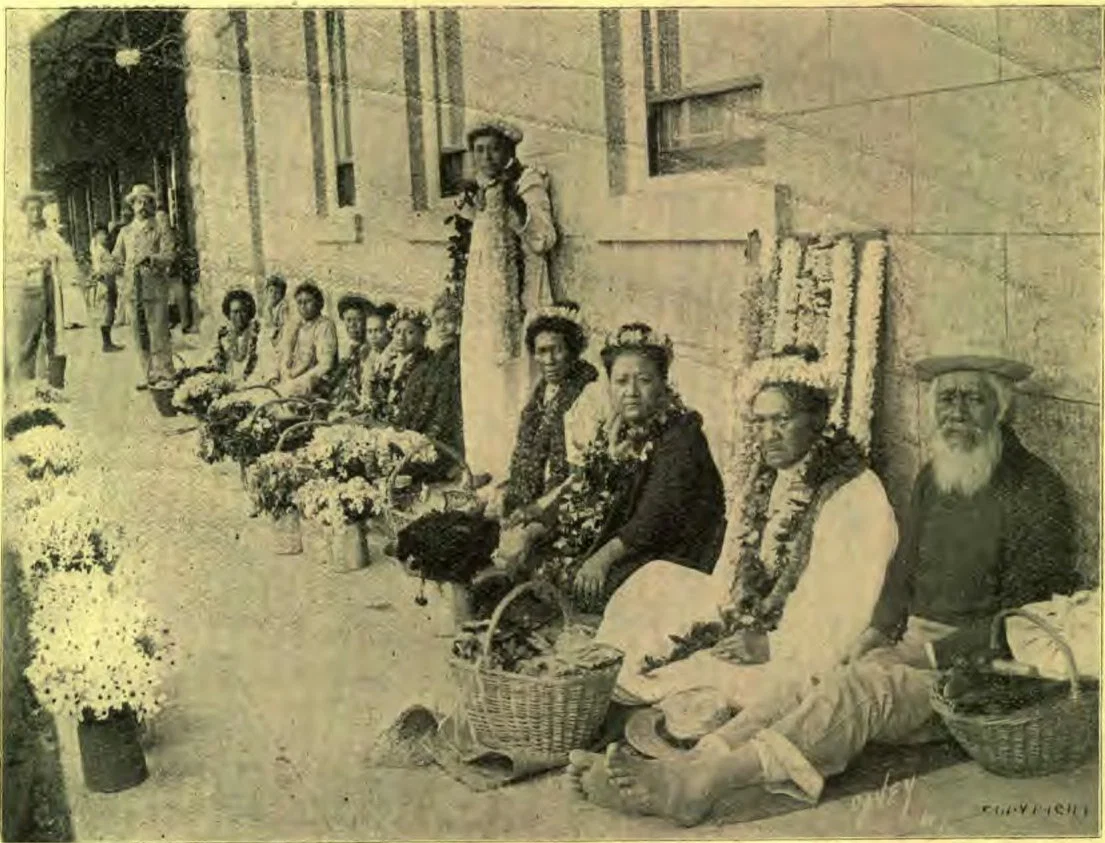
As the time draws near for the boat to leave, the trade in flowers almost ceases; and the lei-women gather up their mats, and prepare for the trip down town. There they will sit all day on the sidewalk, a long row of them, leaning up against buildings, chattering, making leis, and enjoying themselves generally. It is nothing unusual to see them stretched out upon the sidewalk fast asleep.
About nine o’clock in the evening they will take a hack or bus, and ride up the valley and out into the country, where most of their little homes are situated. One not acquainted with the Hawaiian indolence and dislike for anything requiring exertion, might wonder that they do not walk, as an American or Englishwoman would do under the same circumstances: but no; a Hawaiian seldom walks when it is possible to ride. A gentleman, in speaking to us of this characteristic of the native Hawaiian, before we came here, said, “If a Kanaka goes down town with fifty-five cents in his pocket, he will spend twenty five for a hack to ride down, the same to ride back, and five cents for the article he wishes to buy.” While this statement may be somewhat exaggerated, it is more likely to be literally true. We ourselves have witnessed similar instances.
But to return to the wharf. Within the gate all is bustle and confusion. Wagons are here, there, and everywhere. With difficulty we thread our way through them, and stand beside the great ocean steamer. Behind us the government band discourses sweet music; while from above floats down a mingling of fragrant odors, which remind us that some of the sweet things of Eden still remain in the world. Friends on the wharf are saying their last good-bys to friends leaning from the boat above, many of whom are almost hidden by leis,—green, yellow, red, orange, pink, and white, besides many others made of an endless variety of mixed flowers.
Soon the cables are taken in, and the boat swings slowly around. Some of those on board take the leis from their necks and hats, and throw them back as mementos to their friends on shore; others retain them as souvenirs of the fair land from which they are about to sail, and as tokens of love from the friends from whom they are parting. Now the boat is out in the stream; and we turn away, thinking of the time when there will be no more good-bys, no more partings, and wondering how many of those present will pluck never-fading flowers, and share in the joys of those who will dwell forever in the glorious earth made new.
LENA E. HOWE.
THERE THEY SIT ALL DAY ON THE SIDEWALK

THE SEAL AND SEAL-HUNTING

THE seal is a carnivorous quadruped, an amphibious mammal, inhabiting seas of the higher latitude. Its food consists of fish and water-fowl; it lives chiefly in the water, but spends part of its time on shore, reposing in the sunshine, on rocks, sand-banks, and ice-fields. The seal breathes but once in two minutes, even when in full activity on shore; and it has been known to suspend respiration under water for thirty minutes, and some say still longer.
These animals are fond of music, and it is asserted that they will follow a boat a long time if there is music on board.
Seals are of gregarious habits, and are found in their breeding-haunts in almost fabulous numbers. They bring forth their young on shore or on the ice once each year, and only one at a birth.
Before the young are old enough to leave the ice, is the opportune time for the hunter: the young seals are then very fat, and are easily killed by a light blow on the head. They are said to gain six pounds a day, and often have five inches of solid fat beneath the skin. When approached, the males stay to protect the young, and are shot, but the females flee to the water. The young are soon urged into the water by the old seals; and after the young learn to swim, they can not be caught in sufficient quantities to make the business of seal-hunting profitable, and the sealing-ship returns to port.
There are several kinds of seals, but those found in the Gulf of St. Lawrence are the harp-seal and the crested-seal. The adult male “harps” have a light-colored body, with a harp-shaped mark of black on each side, whence their name. The face and the throat are also black. They weigh from four to eight hundred pounds. The young are pure white.
The crested-, or hood-, seal is a maculated gray, and receives its name from a hood, or crest, on the upper part of the head of the adult male. This hood is joined to the septum of the nose, and is capable of being distended and elevated or depressed at will. This seal is the fiercest and most dangerous of all the seals.
The venturesome Eskimo takes great delight in hunting the seal in his fragile canoe, fitted with harpoon and reel. The flesh and fat are used by him for food, and the skins for blankets and wigwams.
These are not the highly-prized fur-seals, but are called “hair-seals,” and are hunted chiefly for their fat and skins. No process has yet been discovered that will successfully prevent the fur from shedding in the skins of the hair-seal.
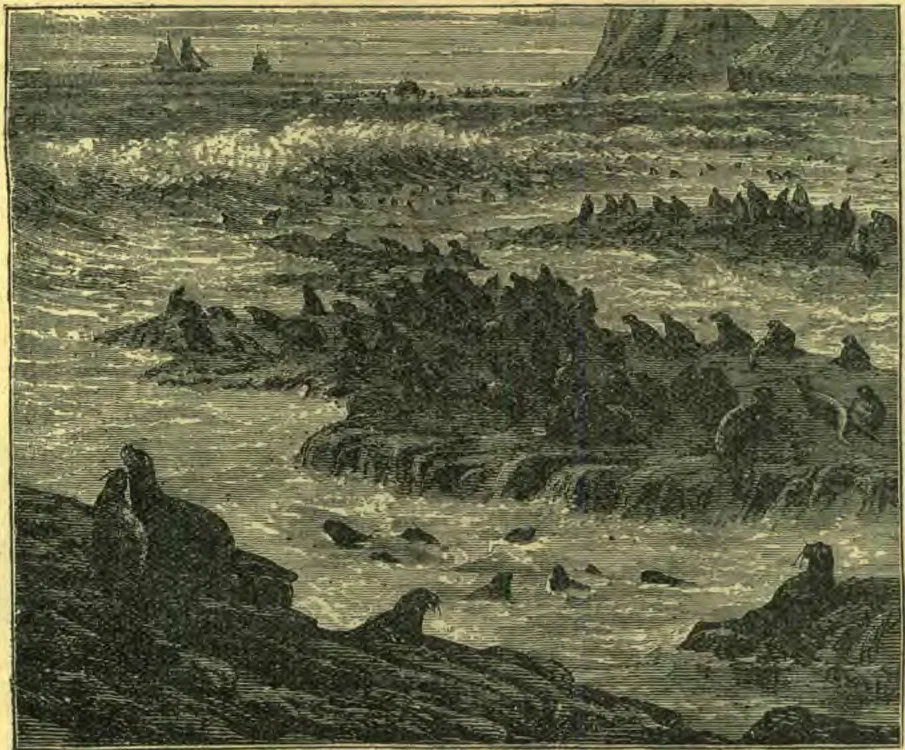
SEALS AT HOME.
SEALS AT HOME.
The fat is converted into oil for lamps, and sells for from fifty to sixty cents a gallon. It is used in engine-rooms, on board ships, and in other places where a non-explosive oil is required. The skins are made into a light-weight leather, and used for book-binding, etc. Boots are sometimes made from the leather, which is quite impervious to water.
A typical sealing-ship is the “Harlaw,” which is fitted with all the necessary equipments for a trip among the ice-fields off the north coast of the Magdalen Islands, in the Gulf of St. Lawrence. The boat is made of iron, and is of about five-hundred-tons’ burden; the bottom is covered with deal, to protect it in the ice; the stem is overlaced with heavy plates for cutting a way through the ice. Between decks and below, great beams have been fastened around the steamer, with many stanch cross-beams, to prevent the ship from being crushed.
The captain of the steamer, D. E. Scott, has on board one hundred and forty men, provided with rifles; spears; gaffs [large iron hooks]; bats; harpoons; long poles; powder; dynamite; etc.
The dynamite is for breaking the ice when the ship is fast, and the long poles are for levers to pry the blocks of ice away. When a sufficient space has been cleared, the steamer backs to one end of the opening, and charges at full speed into the ice at the other end. This process is continued until the steamer plows her way through into open water again.
Ships are sometimes hemmed in by ice, and crushed. Last year the “Mastif” was crushed in this way. The crew were picked up, after thirty-six hours on an ice-floe without food or shelter, by a steamer from Halifax.
The harpoons are used to draw in the old seals from the water after they have been shot. Seals are usually taken on the ice, however; the old ones by being shot, and the young by a blow on the head with a gaff or a bat, with which every man is provided.
When being killed, the plaintive cries of the young seals pleading for life, with their large, round, expressive eyes, full of gentle brightness, streaming with tears, and so touching, have often moved the heart of the hunter to pity for the innocent creatures, and caused him to seek other employment ever after.
The “old hoods” (crested males) are very fierce; they will climb or run over the ice as fast as a man; one will keep two or three inexperienced men at bay, if they are armed only with gaffs. When attacked, these seals distend the crest, which protects the head from the hunter’s blow.
The seals are “sculped,” with fat and skin in one piece, and laid in a pile, called a “pan.” A flag, on which is inscribed the initials of the captain of the ship, is then hoisted over the pan, to distinguish it from pans belonging to other ships.
These pans are often as far as five or ten miles from the ship. They are left until the ship can make its way to them, or nearly so, when the “sculps” are taken on board, and stowed away below. These pans are sometimes stolen by other hunters.
A “barrel-man” goes aloft in the barrel-shaped lookout on the foremast, and with a strong field-glass watches the movements of the men and pans, and pilots the steamer through the best routes from pan to pan. The hunting is carried on till the ship is laden, or the best of the season is over, when the ship returns.
The “Harlaw” has just returned from her latest trip, being the first sealing-ship home. She brought with her fourteen thousand seals, weighing nearly three hundred tons, which sold for $18,385.39.
The men are furnished board, and receive one third of the “catch.” The captain and officers receive a percentage, which varies according to their rank.
By law, each steamship is allowed to make but one voyage annually—between March 12 and April 20.
Seal-hunting is very exciting, and is attended with many dangers. Blinding snow-storms overtake the hunters, and they often lose their way to the ship, and are drowned, or perish with cold. Sometimes they are carried away on ice-floes. Forty-eight men were thus carried to a watery grave last spring.
G. E. LANGDON.
Halifax, Nova Scotia.

THE FIRST ENGLISH PRINTER

It is hard to picture to ourselves a time in which printing and printers were unknown. Yet it is little more than four hundred years since the first book was printed. It was just before the discovery of America that old Laurence Coster, with his blocks of carved wood, and John Guttenberg, with his metal types, invented the art of printing. The first English printer was then a young man, with no thought of the great work he was to do.
His name—and it is one worth remembering—was William Caxton. He was born in London, and in his teens was apprenticed to a merchant. An apprenticeship in England lasts seven years, and young Caxton was twenty-one years old before he had earned a shilling for himself. But he was so faithful and efficient in his service that he won the esteem of his master, who at his death left him a legacy.
Caxton subsequently went to Flanders, and for a number of years was employed as a copyist by the duchess of Burgundy, the sister of King Edward the Fourth of England. But copying was tedious work; and when the new art was made known, Caxton was one of the first to make use of it.
He was still employed by the Duchess Margaret when he issued his first printed work, “The Tales of Troy,” which he had translated from French into English. Several other works were published under her patronage.
He was no longer a young man when he set foot in England once more, but he had the enthusiasm of youth. He found a patron in Sir Anthony Woodville, a brother of the queen of England, and set up a printing office in Westminster Palace. In 1474 he published “The Game and Play of Chess”—the first book ever printed in England. All his books were printed in black Gothic type, or “black-letter,” as were all other English books until the beginning of the seventeenth century, when the Roman characters superseded them.
Before he died,—and he lived to be almost eighty years old,—Caxton printed many other books. No man ever labored more worthily in a noble cause. He lived not for himself but for mankind, and no one better deserves the blessings of posterity than grand old William Caxton, the first English printer.—Fred Myron Colby.

DOORS WIDE OPEN

Youthful, buoyant sons and daughters, Sailing out on unknown waters, Scan hard the skies, look seas well o’er, And may you “port” hope’s open door.
Foolish, drunken sons and daughters, Drifting down dark, sullen waters, For you mankind dips bending oar, To save you from crime’s open door.
Roving, wayward sons and daughters, Riding pleasure’s dancing waters, For you hearts beat; on wings they soar, To open wide home’s open door.
Thoughtful, earnest sons and daughters, Wafted on life’s surging waters, Sail as you may, new seas explore, And reach at last heaven’s open door!
ALMON A. PLATTS.

FLEABANE

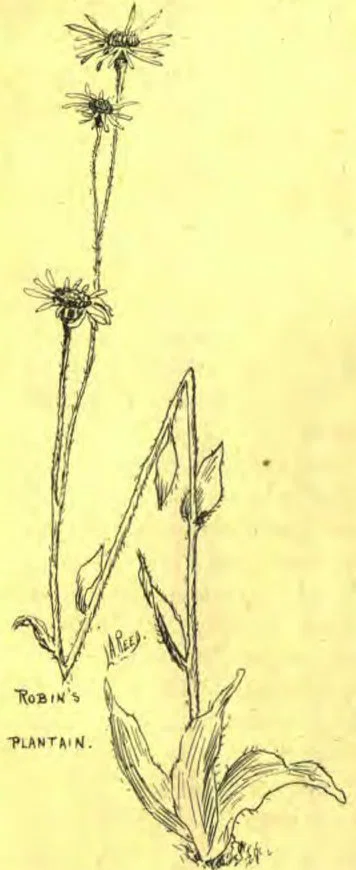
THE Robin's Plantain and the Fleabane are two aster-like flowers that bloom about the first of June.
Robin's Plantain has a yellow center and blue-purple rays. It grows about a foot high. It is a near relative of the asters; but the asters all bloom late in the summer, or in the fall. Robin's Plantain has a fine, hairy look, and the leaves are small and far between; the stem is thick and juicy. The lower leaves usually lie flat on the ground.
The common Fleabane may be distinguished by its numerous thin rays. Robin's Plantain has ray flowers that are comparatively broad; but the ray flowers of the common Fleabane seem almost as narrow as they are thick.
L. A. REED.

THE PRICE OF OUR REDEMPTION

IV

CHRIST was not compelled to endure the cruel treatment inflicted upon him. He was not compelled to undertake the work of redemption,—to step down from his heavenly throne, and come to this earth to receive hatred, abuse, rejection, and a crown of thorns. The humiliation that he endured, he endured voluntarily, to save a world from eternal ruin. He might have continued to abide in the heavenly courts, clothed in garments of purest white, sitting as a prince at God’s right hand. Voluntarily he offered himself, a willing sacrifice.
Not one of the angels could have become surety for the human race: their life is God’s; they could not surrender it. The angels all wear the yoke of obedience. They are the appointed messengers of Him who is the commander of all heaven. But Christ is equal with God, infinite and omnipotent. He could pay the ransom for man’s freedom. He is the eternal, self-existing Son, on whom no yoke had come; and when God asked, “Whom shall I send?” he could reply, “Here am I; send me.” He could pledge himself to become man’s surety; for he could say that which the highest angel could not say,—I have power over my own life, “power to lay it down, and . . . power to take it again.”
When Christ uttered the cry, “It is finished,” he knew that the battle was won. As a moral conqueror, he planted his banner on the eternal heights. Was there not joy among the angels? Not a son nor a daughter of Adam but could now lay hold on the merits of the spotless Son of God, and say: “Christ has died for me. He is my Saviour. The blood that speaketh better things than that of Abel has been shed. The way into the holiest of all has been made manifest.”
God bowed his head satisfied. Now justice and mercy could blend. Now he could be just, and yet the Justifier of all who should believe on Christ. He looked upon the victim expiring on the cross, and said, “It is finished. The human race shall have another trial.” The redemption price was paid, and Satan fell like lightning from heaven.
The darkness rolled away from the Saviour and from the cross. Christ bowed his head and died. The compact between Father and Son was fully consummated. Christ had fulfilled his pledge. In death he was more than conqueror. His right hand and his glorious, holy arm had gotten him the victory.
When the loud cry, “It is finished,” came from the lips of Christ, the priests were officiating in the temple. The lamb prefiguring Christ has been brought in to be slain. Clothed in his significant and beautiful dress, the priest stands with lifted knife, as did Abraham when about to slay his son. With intense interest the people look on. But the earth trembles and quakes; for the Lord himself draws near. With a rending noise the veil of the temple is torn from top to bottom by an unseen hand, throwing open to the gaze of the multitude a place once filled with the presence of God. In this place the Shekinah once dwelt. Here God had once manifested his glory above the mercy-seat. No one but the high priest ever lifted the veil separating this apartment from the rest of the tabernacle; and he entered in but once a year, to make atonement for the sins of the people. But lo! the veil is rent in twain. No longer is there any secrecy there.
All is terror and confusion. The priest is about to plunge his knife into the heart of the victim; but the knife drops from his hand, and the lamb, no longer fettered, escapes.
By the rending of the veil of the temple, God said, I can no longer reveal my presence in the most holy place. A new and living Way, before which there hangs no veil, is offered to all. No longer need sinful, sorrowing humanity await the coming of the high priest.
Type had met antitype in the death of God’s Son. The Lamb of God had been offered as a sacrifice. It was as if a voice had said to the worshipers, “There is now an end to all sacrifices and offerings.”
The crucifixion took place at the time of the Passover, and thousands beheld Christ’s humiliation. Some look upon this publicity only as shame and defeat. But this God had appointed. The Saviour’s work must be deep and thorough. Without shedding of blood there is no remission for sins. Christ must suffer the agony of a public death on the cross, that witness of it might be borne without the shadow of a doubt. It was God’s purpose that publicity should be given to the whole transaction, point after point, scene after scene, one phase of the humiliation reaching into another. MRS. E. G. WHITE.

IF YOU WISH TO BE LOVED

Don’t find fault.
Don’t repeat gossip, even if it does interest a crowd.
Don’t be rude to your inferiors in social position.
Don’t underrate anything because you don’t possess it.
Don’t go untidy, on the plea that everybody knows you.
Don’t contradict people, even if you are sure you are right.
Don’t conclude that you have never had any opportunities in life.
Don’t be inquisitive about the affairs of even your most intimate friend.
Don’t believe that everybody else in the world is happier than you.
Don’t try to be anything else but a gentlewoman; and that means a woman who has consideration for the whole world, and whose life is governed by the golden rule.—Selected.

A VOICE FROM THE CITY

In walls of brick and stone the city lies, A great example of man's handiwork, Girded around with God's green fields, and woods Smothered in shade, where purple shadows lurk.
Brick pavements, blistering in the summer sun, Burn for the breeze that o'er the meadow blows; The high walls languish for the song of birds, And hunger for the violet and the rose.
With pallid face and clinging, golden curls, A little child lies at the window wide, Dying for air made sweet by scent and song, And cooled by wanderings o'er the countryside.
Oh, for a breath, untainted, from the woods, At evening in the stifling city street! Oh, for the feathered choir at break of day, Or cooling shade that makes the noonday sweet!
But country ends where city walls begin; Or otherwise no towns nor fields have we. 'Tis ever so; God's works and man's adjoin, But can not blend, in their imparity.
Minnie Rosilla Stevens.

THREE THINGS

There are three lessons I would write,— Three words as with a burning pen,— In tracings of eternal light Upon the hearts of men.
Have hope! Though clouds environ now, And gladness hides her face in scorn, Put thou the shadow from thy brow: No night but hath its morn.
Have faith! Where'er thy bark is driven, The calm's still sea, the tempest's mirth, Know that God rules the hosts of heaven, The inhabitants of earth.
Have love!—not love alone for one; But men, as men, thy brothers call, And scatter, like the circling sun, Thy charities on all.
Thus grave these lessons on thy soul,— Hope, faith, and love,—and thou shalt find Strength when life's surges rudest roll, Light when thou else wert blind.
— From the German of Schiller.

A BOOK OF PHOTOGRAPHS

While you have but a few photographs, they may be kept separately, either mounted or unmounted, and it will not be difficult to examine the entire lot, or find any desired one. But as prints accumulate, some better method must be used, especially if you wish to keep your collection unbroken. Albums with cardboard leaves are sometimes used; but when prints are mounted in them, the leaves will warp, and give the albums an ungainly appearance; besides, such albums are heavy and bulky.
A much better plan,—in fact, the best plan,—is to print on large sheets of paper, leaving a white border all around, and binding these sheets in book form. Any paper that will not curl may be used. Bromide paper is excellent, but it is better to use some brand that is coated on heavy paper. Equally desirable and much cheaper is the plain silvered paper described last week. The blue-print process, also, is admirably adapted to the making of prints for this purpose.
The size of the sheet on which the pictures are printed should be not less than one inch each way larger than the negatives to be printed from, with an extra half-inch at the end where the prints are to be bound together.
For a five-by-seven-inch negative, if a sheet six by eight and one-half inches is used, it will give a border at least five eighths of an inch wide all around the picture, the extra half-inch at the end being used in binding the book. For this size you will need a printing-frame not smaller than six-and-one-half by eight-and-one-half inches in size; and it will of course need to be fitted with a plain glass.
Take a thin piece of cardboard the size of your printing-frame, and cut an opening in it large enough to receive your negative loosely. Mount strips of black paper so that they will project one eighth of an inch over the opening in this cardboard. These strips will effectually black out any light that might otherwise come through between the edge of the negative and the cardboard.
If your negatives are matted with black paper, as advised in a previous article, the cardboard mat should be placed in the frame with the projecting strips of black paper next to the plain glass. The negative is placed in the opening in the cardboard; and when printed, the picture will be the size of the opening left by the negative mat. If your negatives are plain, the cardboard should be reversed, and the negative placed underneath, so that the strips of black paper will come between the film and the printing-paper. This plan will make the prints all the same size—four-and-three-fourths by six-and-three-fourths inches.
Be sure that you place the negative so that the extra half-inch of border will come at the left of the print, unless you use plain silvered or blue-print paper, and intend to print on both sides. Then one print should have it at the left, and the other at the right. I can not advise you to print on both sides of the paper; but if you do, the picture on one side must be finished before the other side is sensitized.
If your negatives are smaller than four by five inches, it is advisable to have two or more pictures on each page of the book. This may be accomplished by cutting the desired number of openings in the cardboard, and printing all the negatives of equal density should be used for each page. When this can not be done, the thin negatives, when printed, may be covered with a piece of cardboard or black paper to shut out the light until the more dense ones are finished.
Do not crowd the prints too close together. Even when they are small, the page will look much neater if there is an inch of white paper between each picture, than if there is only half that much.
It is an excellent plan to write, with pen and ink, a few words of descriptive matter under each picture.
When the leaves are finished, they may be sent to a book-bindery, and neatly and cheaply bound in flexible covers. Or three or four holes may be punched in the wide margin of each leaf, and they may be strung together with a ribbon or shoestring. The covers of the book may be made of thin cardboard, over which has been glued some dark cotton cloth. The front cover must be hinged, so as to turn back from the pictures, but this will not be a difficult task. The thick, tough paper called by bookbinders “leatheret” is also excellent for covers. As it is flexible, it need not be hinged.
In making up these books, one may have one for each season’s work, or for each different class of subjects, and thus for purposes of reference greatly enhance their value.
J. EDGAR ROSS.

SPARE MOMENTS

How much may be accomplished by improving the spare moments wisely is shown by the example of Mr. R. G. Hazen, of Rhode Island. In Self Culture I find the following said of this man: “No one was more actively engaged in the engrossing activities of life than was Mr. Hazen. At one time he was running several woolen-mills and two lead-mines in the West; he was director of several Western railroads, and was conducting several great lawsuits, writing most of the arguments himself: but during all this time he was writing books that were attracting the attention of the great thinkers not only of this country, but of Great Britain. These books were thought out and written in spare moments of the day. The ten minutes that other men neglect, Mr. Hazen seized as an opportunity to read a page, and furnish his mind with a high thought to brood over through the day. The story of his life is helpful and encouraging to every struggling young man. He had not even the advantages of a common-school education. He attended school for a few years in boyhood; but as soon as strength came, he began work.”
More might be quoted from his life, but enough has been given to show what can be accomplished if a young man is in earnest to gain useful knowledge. It is sad to witness the waste of precious moments indulged in by many, who look upon this time as wholly their own, to be spent in any way they choose. Many young persons spend hours reading dime novels and story papers. Time thus spent is worse than wasted. By such reading their minds are fed with false ideas of life, and they are thus unfitted for its duties.
Dear youth, be careful how you spend your spare moments. Time is too valuable to squander. Grand opportunities are waiting for all who are ready for them. Look well to your spare moments, improve them faithfully, and they will yield you a rich harvest.
MRS. M. C. DU BOIS.

Cheerfulness Is the Heart's Sunshine

CHEERFULNESS is the heart's sunshine.

JUNE STUDY OF THE FIELD

PART V: REVIEW

(June 24-30)
NOTE.—The study this week is a review of the lessons for the last quarter. As the different fields have already been written up quite fully, instead of preparing additional notes we submit a few suggestive questions on those that have appeared in the INSTRUCTOR during the last three months. As almost all use their INSTRUCTORS for missionary work, very few will have access to them in answering the questions. This was expected. Let the questions be answered from memory. Perhaps the most that we shall gain from this exercise will be a conception of how thoroughly we have been studying these fields. But if we profit by this, the exercise may be of real value. The questions have been so arranged that each can be answered with a single sentence. Several might study them together with profit.
  1. What premium is placed upon education in China?
  2. Name two phases of missionary work that seem especially adaptable to this field.
  3. What recent development in Mexico may be preparing that people for the reception of the third angel’s message in the printed page?
  4. Mention some of the results of one woman’s effort in that dark land.
  5. What advantages does Egypt present in preaching the truth to many nations?
  6. When was the message first introduced in the Hawaiian Islands?
  7. What transformation has the gospel wrought in Fiji?
  8. What means has thus far been provided in giving that people present truth in their native tongue?
  9. With what result has the third angel’s message been preached in Jamaica?
  10. How many have thus far accepted the truth in Chile?
  11. What led to the conversion of Signor Cappellini, the founder of the Military Evangelical Church of Italy?
  12. Why is Russia an important mission field?
  13. Mention some opportunities for self-supporting missionary work in Honduras.
  14. How extensively has the message been preached in Uruguay?
  15. Give one text of scripture that should lead us carefully to study the field.

CHARITY

If I were a breeze of nature’s making, Freighted with coolness and scent and dew. I never would set the tall trees shaking, Or blow through the meadows the summer through;
But I’d leave the green, and, for very pity, Would lift my burden of dainty scents, And straightway fly to the crowded city, Among the heat of the tenements.
And I’d find some poor little pale little child there, Who never had known the sea or skies, And I’d kiss her lips till I left a smile there, And another look in her tired eyes.
I’d bring her the breath of the great waves breaking, And odor of pines from the open plain, Till she would forget that her brow was aching, And lift up her poor little head again.
Now don’t you think this the nicest way, dear, For a breeze to act, beyond word or doubt? Because—there’s a moral tucked away here, If only your eyes could find it out.
—Theodosia Pickering Garrison.

THE SCARECROW

In the summer sunshine, Dora, Ned, and Fan Trotted down the cornfield, to see the Scarecrow Man. “What a queer old fellow! See his clothes so old! He would shake and shiver if the day were cold. “Good-morning, Mr. Scarecrow!” (so said little Fan) “I’m glad I don’t look like you, poor old Scarecrow Man.”
“I’m ’most ashamed to see him,” said her brother Ned; “’T was I who tore to pieces that old hat on his head. I’m going to keep Ned Benson as tidy as I can, ’Cause I wouldn’t like to look like a Scarecrow Man.”
Said Dora: “Crows are naughty; no corn we’d have to day If Mr. Scarecrow didn’t drive all the crows away. He stays where papa puts him, and does the best he can. I think I’ll try to be like him,—good old Scarecrow Man.”
That’s what they said about him; then up the field they ran, And left him in his tatters,—poor old Scarecrow Man.
ELIZABETH ROSSER.
Continue reading: WHAT JOHNNY SAW