The Youth’s Instructor, Vol. 48, No. 20.

BEAUTIES OF SOUTHERN CALIFORNIA—V

The Youth’s Instructor

May 17, 1900

Review and Herald Publishing Company · Battle Creek, Mich. · May 17, 1900

BEAUTIES OF SOUTHERN CALIFORNIA—V
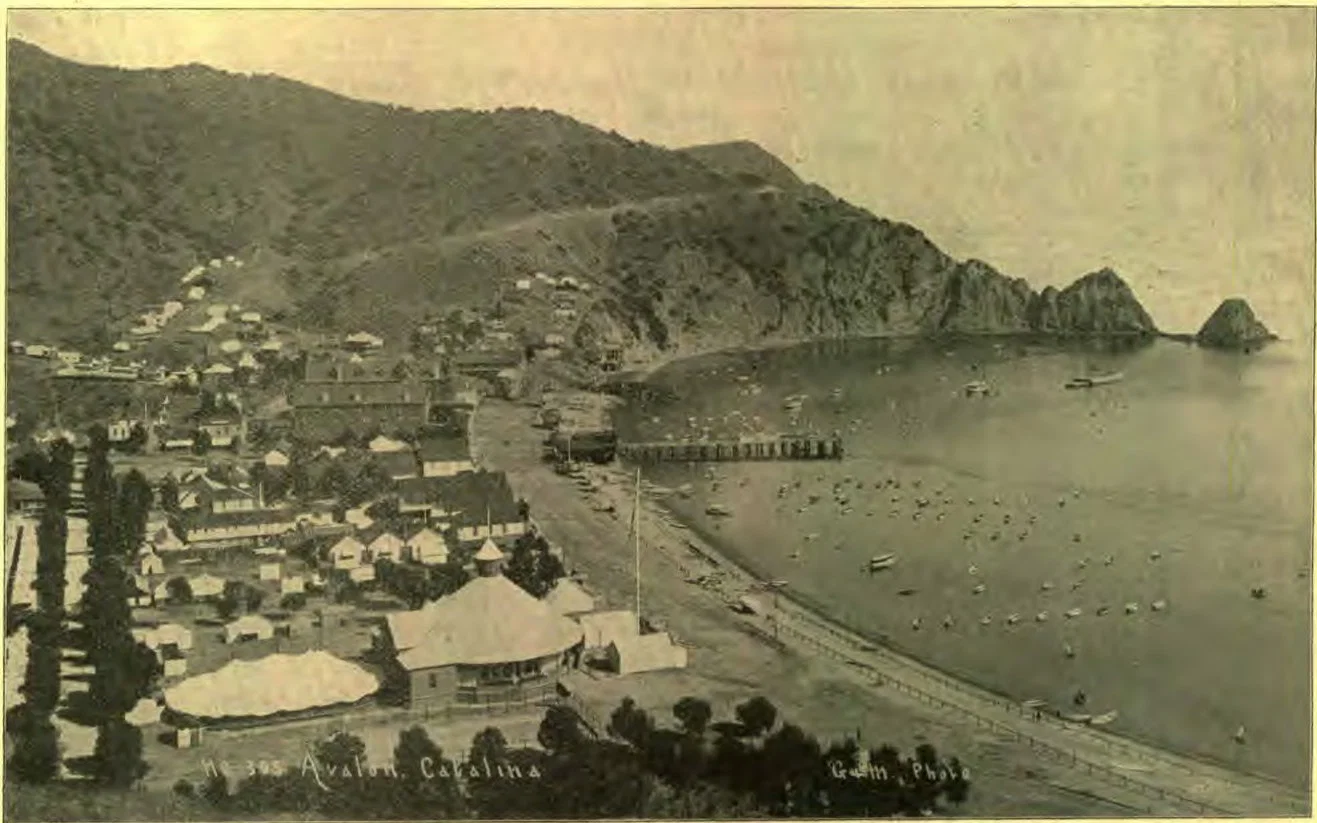
As one looks oceanward from San Pedro harbor, he can see dimly through the hazy mist, at a distance of twenty-three miles, a small black speck upon the face of the waters. This is the island of Santa Catalina.
Twice a day during the busy season the little steamers plow their way through the sea to this summer isle, affording trips that are a delight to the mariner, though less pleasant to those who spend the time paying tribute to Neptune, while the little boat joins in a playful romp with the mighty sea. After being restored to their normal equilibrium, the passengers generally begin to look about to see the spout of the California whale, and watch with interest the schools of flying fish, now flitting about over the water, now darting beneath the curling waves.
As it draws near the island, the boat skims over the ocean, that lies in glassy stillness along its northeast shore, and glides into Avalon, the little half-moon bay sleeping so silently below the bold headlands that children, unattended, paddle carelessly about.
This is the ideal rowing- and bathing-place; for the water is not disturbed by the surf that beats vehemently upon the rocky cliffs of the southwest shore. The wind seldom reaches this sandy beach, and so calm and clear is the water that a look through the glass-bottomed boat reveals wondrous mysteries on the floor of the sea. So perfect is the life there revealed, so clearly do the trees loom up from their watery groves, that the observer is led away into a wonder-world far beyond his most fantastic dreams.
The boat first floats over great kelp beds; then over beautiful gardens of variegated seaweed, where, in and out through the tender sprays, dart the tiny creatures of the deep; then over rocks alive with the strange forms of the submarine world. Order seems to govern all, and the solemn stillness adds impressiveness to the scene beneath.
Here are wonderful fishing grounds, where may be caught anything from a herring to a giant sea bass weighing five hundred pounds. It is amusing to watch the fisher being towed by one of these great monsters. In fact, sometimes it is rather difficult to decide at which end of the line the fisher is. The pride of conquest is the only reward for taking the life of these creatures; for after being wrenched from its happy quarters, the bass is not considered edible.
While most visitors come here because of the enjoyment they find upon the water, the interior of the island is not without attractions. Hovering about the sheltered cove of the bay is the little town of Avalon, the only inhabited portion of the island. In the height of the season, between five and six thousand persons live about Avalon Bay. Many of them inhabit the tent village among the beautiful shade-trees along the macadamized streets; others prefer the more central part of the town, at Hotel Metropole, or the surrounding boarding-halls.
The twenty miles of mountains, with their deep gorges and winding trails, the high cliffs and precipitous rocks, the green valleys and heavy forests, the gushing waterfalls and dancing rills,—all add grandeur to the scenic stage-road that stretches across the brow of the island. Slowly and steadily the ascent is made. When the summit is reached, a halt is called, and the passengers view the broad expanse of the sea, beyond which tower the mountains.
From here the trip is continued to the opposite side of the island in the more inaccessible regions, thickly inhabited with mountain game. The return is quickly made. The passengers are weary with their day's outing, and they leave all to the driver, who gathers the reins, and skillfully guides his six horses past precipices, around curves, through cañons, and down to the valley below.
Santa Catalina Island is twenty miles long and eight miles wide; it is the property of the Banning Company, and is under their careful management.
MRS. KATHLEEN WAGNER-GILMORE.

SOME ISLANDERS AND THEIR LANGUAGE

On a map the islands of the Pacific look like little dots scattered here and there over the ocean; and so they are. But though they are small in comparison with the continents, there are thousands of them, and they are inhabited by millions of persons for whom Jesus died, and whom he loves as dearly as he loves their more favored brethren. The word of God says that the isles “wait for God’s law;” therefore the third angel’s message must be carried to every island, and the truth be preached everywhere as a witness to the people. We have the satisfaction of knowing that our labor among the islands will not be in vain; for we are told that when the redeemed stand before the throne of God, there will be among them some from every nation, kindred, tongue, and people.
Most of the natives of Polynesia belong to the brown race; but some, like the Fijians, resemble the negro, and are evidently of African descent. A large number of the population of the Society group are a mixture of the brown and white races. These are called half-castes, and are quite proud of their white blood. The Tahitian natives have dark eyes and black hair. They are not characterized by either curly hair or straight, as are the negroes and Indians, though perhaps curling hair is the more common. Like the people of the United States, they vary considerably in height. They are usually corpulent, and do not wish to be otherwise. Instead, they consider it very desirable to be fleshy. It is supposed that the original settlers of these islands came from New Zealand.
There is a similarity in the language all through the islands, from New Zealand to Hawaii, yet it varies somewhat in each group. In adjacent groups there is but a slight difference. For instance, that of the Austral Islands is the same as the Tahitian, except that f and h are omitted. Then, too, the Austral islanders use A (ă) for “yes,” while the Tahitian word for “yes” is E (ă).
As Tahiti is the most important commercial center in this part of the South Seas, there is much traffic between it and all the surrounding islands; and this language is understood and used more or less in the Tuamotu, Marquesas, Gambier, Austral, and Cook islands, besides being the native language of the whole Society group.
It is a simple language, or dialect, having but thirteen letters in its alphabet, and a small vocabulary. The difficulty in learning it is in the scarcity of language books and dictionaries, and the lack of set rules for its construction. The natives themselves know nothing about grammar or the rules for their own language. They simply learn it from hearing it spoken. Sometimes two persons who think themselves well versed in the language will disagree over a short, unimportant word, one feeling sure that it should be a, while the other is just as certain that it should be na. As there is no dictionary nor grammar to settle the dispute, it is sometimes hard to know which is right. Probably both are right, as a thought can usually be correctly expressed in more than one way.
As each letter has but one sound, the vowels having the long sound, the language is easy to learn to read or write. The majority of the people are able to read; but they are not naturally studious, and there are but few good readers among them. Most of them make no distinction between words; but when writing, join two or more words together as one word, or else divide a word, making several words from one. This is because they do so little studying or writing, and know the language only by sound.
On account of lack of words, one word or expression sometimes has a multiplicity of meanings. Haapao maitai means “to be careful; to behave well; to do right; do a thing well; to care for; to be watchful;” and many other things. For many English words we have no word in the Tahitian. We have nothing to distinguish the difference between “love,” “mercy,” “pity,” “to salute,” and “a gift,” except the connection in which aroha, the one word for them all, is used.
The words that are lacking are mostly such as are used to express spiritual truths. Those which apply to the feelings or sensations of the body are more plentiful. Instead of the word “sweet,” the Tahitian says that sugar is monamona; a flower is noanoa; and music is navenave. The pronoun differs in the Tahitian in having a dual number, besides the singular and plural. When “you” applies to one person, it is oe; for two persons it is orua; and for three or more, it is outou. There are four different words for “we.” When the pronoun represents two persons, the person speaking and the one spoken to, it is taua. When it stands for the one speaking and another in the third person, it is maua. In the plural number, tatou means the person speaking and the ones addressed; while matou means the person speaking, and two or more others in the third person. These same words are used for “us,” except that they are then preceded by ia.
The Bible has been printed for many years in the Tahitian language, and the Tahitian Bible is used in the Austral, Gambier, Tuamotu, and other adjacent islands, where the natives have none in their own tongue. There is but little literature in this language. A Bible dictionary, Pilgrim’s Progress, a book on the sanctuary, and a number of pamphlets have been printed by other denominations. We have “Steps to Christ,” several pamphlets of Bible readings, two on the Sabbath question, and one on temperance.
In the kingdom of God, when all shall speak the language of Canaan, God’s people will be able to converse freely together of Jesus and his love and redemption, and there will be no trouble in understanding. B. J. CADY.

“THE VIOLENT TAKE IT BY FORCE”

I
“From the days of John the Baptist until now the kingdom of heaven suffereth violence, and the violent take it by force.”
The preaching of John the Baptist created intense excitement. At the beginning of his ministry, religious interest was very low. Superstition, tradition, and fables had confused the minds of the people, and the right way was not understood. Zealous in securing worldly treasure and honor, men had forgotten God. John went forth to herald the Lord’s anointed, and call men to repentance, saying: “Repent ye: for the kingdom of heaven is at hand. For this is he that was spoken of by the prophet Esaias, saying, The voice of one crying in the wilderness, Prepare ye the way of the Lord; make his paths straight.” “Every valley shall be filled, and every mountain and hill shall be brought low; and the crooked shall be made straight, and the rough ways shall be made smooth; and all flesh shall see the salvation of God. . . . Now also the ax is laid unto the root of the trees: every tree therefore which bringeth not forth good fruit is hewn down, and cast into the fire.”
The teaching of John aroused in the hearts of many a great desire to have a part in the blessings that Christ was to bring, and they received the truth. These saw the need of reform. They must not only seek to enter in at the strait gate; they must strive and agonize in order to have the blessings of the gospel. Nothing save a vehement desire, a determined will, a fixedness of purpose, could resist the moral darkness that covered the earth as the pall of death. In order to obtain the blessings that it was their privilege to have, they must work earnestly, they must deny self.
The work of John the Baptist represents the work for these times. His work, and the work of those who go forth in the spirit and power of Elijah to arouse the people from their apathy, are the same in many respects. Christ is to come the second time to judge the world in righteousness. The messengers of God who bear the last message of warning to be given to the world are to prepare the way for Christ’s second advent as John prepared the way for his first advent. If the kingdom of heaven suffered violence in the days of John, it suffers violence now; to-day the blessings of the gospel must be secured in the same way. If form and ceremony were of no avail then, a form of godliness without the power can be of no avail now.
Two powers are at work. On the one side Satan is working with all his forces to counterwork the influence of the work of God; on the other hand God is working through his servants to call men to repentance. Which will prevail? Satan, knowing that his time is short, has come down with great power, and is working with all deceivableness of unrighteousness in them that perish. Every agent that he can employ he is using to prevent souls from coming to the light. The victories we gain over self and sin are gained at the expense of the enemy, and he will not let us enjoy the blessings of God without making determined efforts to resist us. MRS. E. G. WHITE.

DAWN

The glassy water, cool and clear Reflects one solitary cloud; And morning song-birds, far and near, Repeat their matins shrill and loud: “The night is done, and day is here.”
—N. E. Magazine.

THE FIRST SIDEWALK IN NEW YORK

Now that New York is paved from end to end with stone, it may be interesting to know that in the early part of the last century there was not a sidewalk in the whole thrifty town. The first attempt at one was the work of a woman—Mrs. Samuel Provoost, familiarly known to all New Yorkers by her maiden name of Polly Spratt, who was a celebrated belle in her youth, and an exceedingly wise business woman all her life long.
Polly Spratt’s husband died young, leaving behind him a fortune and a large importing business. His widow undertook the management of both. She built a row of offices in front of her handsome house, and a large store on one side. It was a little out of the line of traffic, and the shrewd owner determined to attract special attention to it. She therefore sent for a number of large, flat flagstones, and laid a fine sidewalk, not only in front of her property, but up to the street on either side. As New Yorkers had then no other place to walk than on the round, slippery cobblestones of the street, which sloped to a gutter in the middle, so that it was exceedingly difficult, in winter, to keep dry-shod, Polly Spratt’s pavement was the talk of the town, and attracted so many visitors that her store was always thronged. Others followed her example, and soon the city authorities went to work to give sidewalks to all the principal avenues.
It is said that ladies came from Philadelphia to shop at this wonderful New York store; and that Mrs. Provoost made such a fortune that she kept a two-horse coach,—a thing which no one but the governor had ever been known to do. She afterward married James Alexander, and is well known in all the chronicles of New York as one of the leaders and ornaments of colonial society; and her son, Major William Alexander, became an intimate friend of George Washington.—Selected.

THE MORNING'S GOAL

I gaze upon, at morning light, A lofty mountain far away; I tread beneath my feet at night The crowning heights of early day.
But on the morrow, e'er I rise To view some grander height, afar, Which gleams so brightly in the skies Methinks perhaps it is a star.
Thus, 'mid joy, or yet 'mid sorrow, Ever upward let our way View the heights of each to-morrow From the goals of yesterday.
WALTER CUMMINGS BUTTERWORTH.

Solar Eclipses

Astronomical Study—No. VI

Solar Eclipses
The eclipse of May 28 will afford an opportunity for interesting observation by our INSTRUCTOR family; and it will be in place for all to understand the cause of the phenomenon. Generally speaking, eclipses are of two kinds,—those of the sun and those of the moon. The one to occur Monday morning, May 28, will be either total or partial to our readers, depending, of course, on the latitude in which they live. To those living in the extreme south and southeastern part of the United States, the eclipse will be total; while to those living farther north it will be partial. The farther north the observer, the less of the sun’s face will be covered by the disk of the moon. To those living in Battle Creek, Mich., or on the latitude of about 42°, 42′, north, the sun will show about one fourth its upper surface.
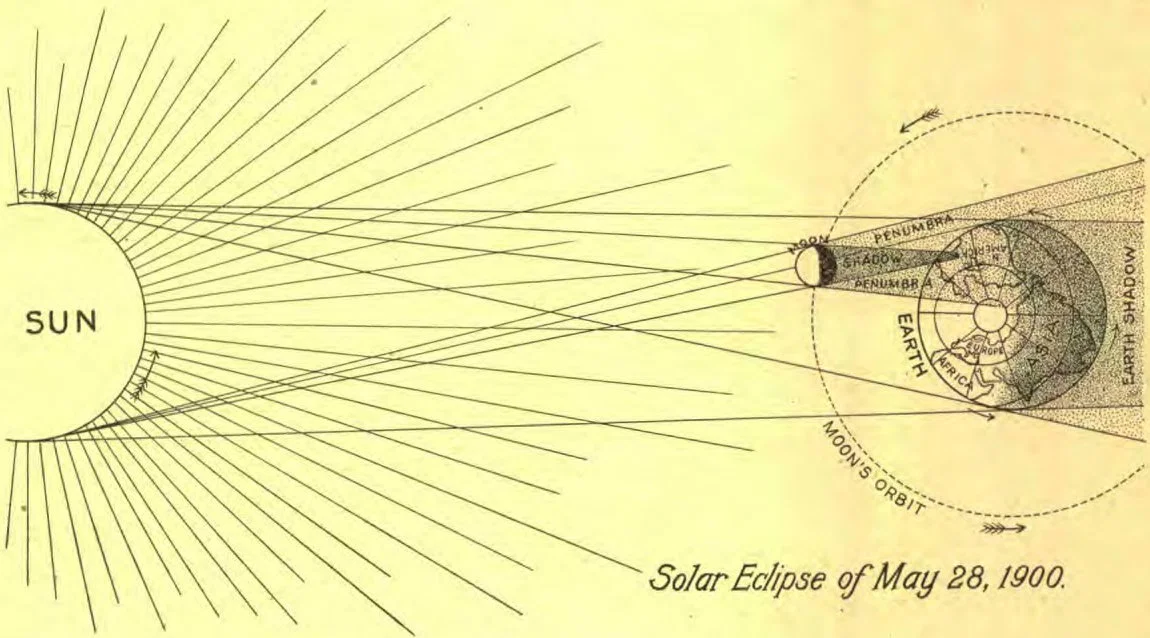
Solar Eclipse of May 28, 1900.
All this will be explained and illustrated in next week’s INSTRUCTOR.
So far as our study is concerned, eclipses of the sun are of three kinds,—total, partial, and annular,—the last-named being the most beautiful of the three. Not that this kind occurs once each year, as might at first be inferred; but that when it does occur, it is round, or ring-shaped. To explain: it will be seen, by noticing the large illustration, that an eclipse of the sun is caused by the moon’s passing directly between the earth and the sun. Now if the moon were always the same distance from the earth, and always passed exactly between the sun and the particular spot on the earth where we happen to live, the eclipse would be always the same; but this is not the case. The moon sometimes swings closer to the earth than at other times, when we say it is in “perigee.” Should it pass between us and the sun at such a time, its disk would completely cover the sun’s disk, and the eclipse would be total to us, and partial to those living some distance either north or south of us. At other times the moon swings farther away from the earth, and we say it is in “apogee.” Now notice the diagram, and see what the effect would be on the shadow of the moon to place the moon farther away from the earth and nearer the sun. By drawing a line from the top of the sun past the top of the moon, and on toward the earth, also one from the bottom of the sun past the bottom of the moon, and on toward the earth, you see that these lines would meet before reaching the surface of the earth, and in that case the whole of the sun’s disk would not be covered. The moon would simply cover a portion of the sun, but not the whole; and to a person living at such a point on the earth that a line drawn directly from him to the center of the moon would reach to the center of the sun, the eclipse, when central, would show the center of the sun darkened, leaving a ring of light all around the outer limb, or edge of the disk, of the sun. This would be an annular eclipse,—an interesting sight indeed.
The diagram explains itself. In order to show the eclipse as coming to our part of the globe at seven o’clock in the morning, we have been obliged to draw this diagram showing the view from above; that is, we are looking down upon the north pole of the earth, the moon, and the sun. Please stand facing the south, with the picture directly in front of you, and you will see it as it would appear to one looking down from above. The sun will be in the east, with its south pole inclined toward the earth, which is the case at this season of the year. The earth’s north pole will be seen to incline toward the sun. The arrows show the direction of the earth’s revolution; this occurs once in twenty-four hours, and in that time brings all sides of the earth into the direct light of the sun, which also passes on around through the earth’s own shadow, thus giving the phases of night and day. It will be noticed that there is a portion of the earth’s surface near the north pole that does not, in the revolution of the earth, pass at all into the shadow of the earth; this explains the reason of the six-months’ day and six-months’ night at the poles. The north polar region is now having its long day, while the south pole is having its long, cold night.
The dotted line passing through the moon shows its path around the earth; and the arrows show the direction in which the moon is traveling. In the diagram the path lies directly through the shadow of the earth; and this much of the illustration is, of necessity, incorrect; for if the moon really did pass through the shadow of the earth, we should have an eclipse of the moon in about fourteen days following the eclipse of the sun, and this is not the case this time. The reason we do not have an eclipse of both the sun and the moon each month is that the moon, in its circuit about the earth, swings north and south, back and forth across our equator, and in so doing throws its shadow many thousands of miles away from our earth. It also passes many miles above and below the shadow of our own world. When it does get into direct line with the earth and sun, we have an eclipse such as will occur the morning of May 28.
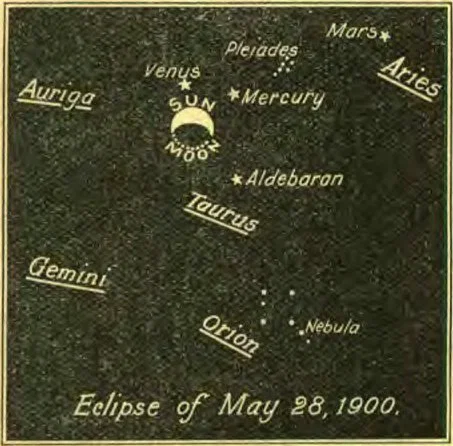
Eclipse of May 28, 1900.
It is impossible to give, in a diagram like the one herewith shown, the relative size and distances of the sun, moon, and earth, and give also what we have given,—their relative positions. In order to grasp the relative size of each, please think of the earth and moon exactly as given, but imagine the sun as a globe standing a trifle less than ten feet high, or a little less than ten feet in diameter; and so far as relative distance is concerned, think of the earth and moon exactly as we see them in the illustration, and imagine the sun nearly ten feet high, standing twenty-two feet away from the picture of the earth.
The smaller illustration shows the heavens as they would appear to us at the time of the eclipse, could the light be so shut off as to let the other planets and constellations appear. Venus and Mercury, you remember, are always to be thought of as being somewhere near the sun; and in this picture we see them exactly where they would appear. In the upper right-hand corner of the picture Mars is shown,—not because he is near the sun, but because he is on the opposite side, and we thought it best to show his picture, too.
Next week we will tell you more about this eclipse, and show how you may expect the sun to appear. For reasons about which we will tell you at that time, thousands of dollars are now being spent to make this coming eclipse an opportunity for special study.
DR. O. C. GODSMARK.

I NEVER KNEW

I NEVER knew how very far from home My wandering feet had strayed, Until I saw The wounds my Shepherd bore— Wounds which his thorny search for me had made.
I never knew within that sheltered home How good it was to be, Till, tired out With wandering and doubt, Back to his fold my Shepherd carried me. — Sunday School Times

CARE OF NEGATIVES

If a negative is worth keeping, it is worth taking care of; and if it is not worth keeping, it had better be thrown into the ash-barrel as soon as you find out what caused the failure.
All negatives should be numbered; and the number, name of subject, time exposed, and stop used, with such other particulars as to light, etc., as may be useful for reference in the future, should be recorded in a book kept for the purpose. All this may seem unnecessary while you have but a few negatives; but when you get two or three hundred (as you soon will if you continue to take pictures), you will find it a great help. It will not only assist in keeping your negatives in order, and in finding any particular one you desire, but will also give you a reference book by which you can readily see the effect of different times, lights, and stops on a great variety of subjects.
If you do not object to seeing a number on your print, it may be written in one corner of the negative with a pen and common writing-ink. The number should be written backward, in order that it may print right in the picture. A little practice will enable you to do this without difficulty. If you do not like to see a number on your print, it may be written with a lead-pencil; and then, unless it is written in some dark shadow, it will not be seen on the picture at all. It is more difficult to see a number that is written with a pencil than one written with ink; but this will be no great drawback, especially if you keep each negative in a numbered envelope.
Negative envelopes are cheap and convenient, but they are by no means essential to the proper care of negatives. An excellent plan is to store them, film down, in empty plate-boxes. The numbers contained in each box may be written on the outside. By following this plan, any desired negative can be found without difficulty. Be careful to pack the plates with the film side down; otherwise you will be likely to scratch the film with the plate lying on top of it when you attempt to remove it.
In storing my negatives, I have for some time followed a plan that requires some extra work to begin with, but has proved in the end to be a saver of both negatives and labor.
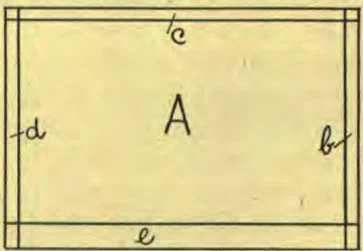
Around the edges of the best negatives, there are always frills, scratches, and blotches that necessitate trimming off at least an eighth of an inch from each edge of the prints. Often much more should be trimmed off, but there is always that much. My plan is to paste strips of black paper, just as wide as the strip that you would trim from the print, on the film side, along each edge of the negative. Let Figure 1 represent a five-by-seven-inch negative. A is the part that would be retained in the finished print; b, c, d, and e are the strips that would be trimmed from the print when it has been printed the full size of the negative: b and c are each one fourth of an inch wide; d is three eighths, and e one half.
Cut strips of black paper of these widths, and long enough to reach across the plate, and cover one side with common starch paste, such as you use in mounting your pictures. Be careful not to use too much paste, or when it is rubbed down on the negative, some may be pressed out at the edges, to make a stain on the film. When each of these strips is in position, b, c, d, and e will be covered with black paper, so that only A can be printed. If a print is made on paper of full size, the remainder will be white, and may be trimmed off entirely, or simply trimmed to an equal width all around, and retained as a border. With most pictures, especially if dark mounts are used, this white border is a wonderful improvement. At the corners of the negative the strips will overlap, and there they will be double thickness. This will in no way interfere with the printing, and will be an additional protection to the negative. Even if a grain of sand does get upon the plate lying under it, there will be little danger of its scratching the film of a negative protected in this way.
Of course if you intend to intensify, reduce, or otherwise “tinker” the negative, that must be attended to before you put on the mat.
Negatives prepared in this manner may be packed, film down, in plate-boxes, and handled with only ordinary care, without danger of being scratched or broken.
J. EDGAR ROSS.

THE BLOOD AND THE CIRCULATORY SYSTEM

God’s word tells us that “the life [or “soul,” Hebrew] is in the blood,”—“the blood is the life.” By comparing Gen. 2:7, which reads, “And the Lord God . . . breathed into his nostrils the breath of life; and man became a living soul,” we see that the air we breathe, the “breath of life,” has something to do with the blood, and that a chemical change occurs as the vital essence in the air comes in contact with the blood. And as the “life,” or “soul,” is in the blood, thus making the blood the life of the being, is it not a marvelous thing to study? Of course we can never understand nor explain the mystery of life from God, in its fullness; but some facts have been revealed to us, and these we will study. The Bible has told us the facts stated; now let us see what medical science has revealed. Possibly each will throw light upon the other.
The circulation of the blood was discovered in 1616 by Harvey. Long before this, many great men, such as Aristotle, Hippocrates, and Galen, were seeking to find out the truth of the matter. In 1553 a man named Michael Servetus discovered the “pulmonary circulation,” or the passage of the blood through the lungs. His discovery was connected with theological ideas that so incensed John Calvin that Servetus was burned alive at Geneva, and his book with him. Only one or two copies are now in existence, one being in the Institute of France. The discovery of the valves in the veins is attributed to Fabricius. Harvey’s complete work marked “an epoch in the study of physiology; and then the scientific world began to emancipate themselves from the ideas of the ancients, and to study nature for themselves.”
Before we study the process of circulation, we must know what the blood is. We have all seen the bright-red fluid as we have pricked our fingers, or cut ourselves. The blood is defined as “a red, opaque, viscid fluid, heavier than water.” This fluid is called “plasma.” An analysis of the adjectives “red,” “opaque,” and “viscid” will be helpful. We speak of the color of the blood as red. This is true of the human family and the animal creation, but the blood of mollusks and other low-grade animals is white, tinged with blue. Such creatures are called “white-blooded.” “Opaque” means obscure, not admitting rays of light; and “viscid” means sticky, of a glutinous consistency. The plasma would be colorless but for the myriads of little red corpuscles that float in it. They constitute about one half the bulk of the blood, there being over a million in a single drop.
The amount of blood in the body constitutes about one thirteenth its entire weight. What would the blood weigh if a person weighed one hundred and thirty pounds? There are two kinds of corpuscles, or cells,—red and white. There are three white corpuscles to a thousand red ones. The white cells are formed by the spleen, lymph glands, and bone marrow, and are useful in repairing injuries to the tissues, as they are found in great numbers wherever inflammation exists. Recently it is known that these white corpuscles are useful in destroying germs and foreign substances that get into the blood. As we breathe, eat, and drink quantities of germs, we should not live long were it not for these wonderful little creatures. The plasma, too, has power to destroy disease germs. Can we not see the necessity of keeping these corpuscles healthy, so they can do their work? The power to work effectually is lost when we eat gross food, and take into the system such poisons as tea, coffee, drugs, alcohol, and tobacco.
Before leaving the white corpuscles, we must know that they are spherical in shape, and measure about one two-thousand-five-hundredth of an inch in diameter. The red corpuscles are much smaller, and are like a flattened disk one three-thousand-five-hundredth of an inch in diameter. They are formed by the red marrow of the bones, and their work is a wonderful one. They absorb and carry oxygen and carbonic-acid gas, in quantities much greater than themselves. When the air rushes into the lungs, with this life of God in it, this “oxygen” as science calls it, the little red corpuscles load up with it, and start out on a tour of distribution. They leave “life” for every tissue and every organ of the body, depositing it at the different places they pass, as they hurry on. The circulation hurries the blood on from head to foot, and these little corpuscles carry their burden of oxygen to renew the worn-out organs. Then, too, they load up on the return trip with poison,—carbonic-acid gas,—and throw it off as they reach the lungs, and the breath goes out in expiration. Inspiration takes in “life” for the corpuscles to carry to the body; expiration throws off “death” that they gather up on their travels. They also carry nutrition from food to the various parts of the body, and material to repair losses. Is not this a wonderful study? When the corpuscles are loaded with “oxygen,” the blood is a bright-red; when loaded with poison, the blood is darker in color—rather blue-black. The former is arterial blood; the latter, venous blood. MRS. M. D. McKEE.

Oldest Printed Book: The Missale Speciale

The oldest printed book is said to be a Missale speciale, or mass book, in a collection in Munich. Competent judges declare it to be at least seven years older than the “forty-two line Bible” of Gutenberg, issued in 1450.

THE FOUR BIG BROOMS

“O MOTHER, why does the big wind blow, And rattle the window-pane? If I close my eyes to sleep just so, It wakes me up again; If I hide my head beneath the spread, You speak so soft and low That I can not hear what you have said, Oh, why does the big wind blow?”
“Let us play, my darling, a merry play. The winds are four big brooms That sweep the world on a windy day, As Mary sweeps our rooms. The south wind is the parlor brush, That sweeps in a quiet way; But the north wind comes with roar and rush On the wide world's sweeping-day.
“Like Mary sweeping the halls and stairs Is the work of the good west broom, And the sweetest odors, the softest airs, Float over the world's wide room. But to-night the broom from the east is here, And with it comes the rain, Like John when he brushes the porch, my dear, And hoses the window-pane.”
The little boy laughed, and cuddled close In his warm and downy bed.
“I hear the broom, and I hear the hose, And I like them both,” he said.
And so, though the rain may pelt away, And the big wind loudly roar, He remembers the wide world's sweeping-day, And thinks of the big brooms four. — Companion.
Continue reading: THE STORY OF A FIG